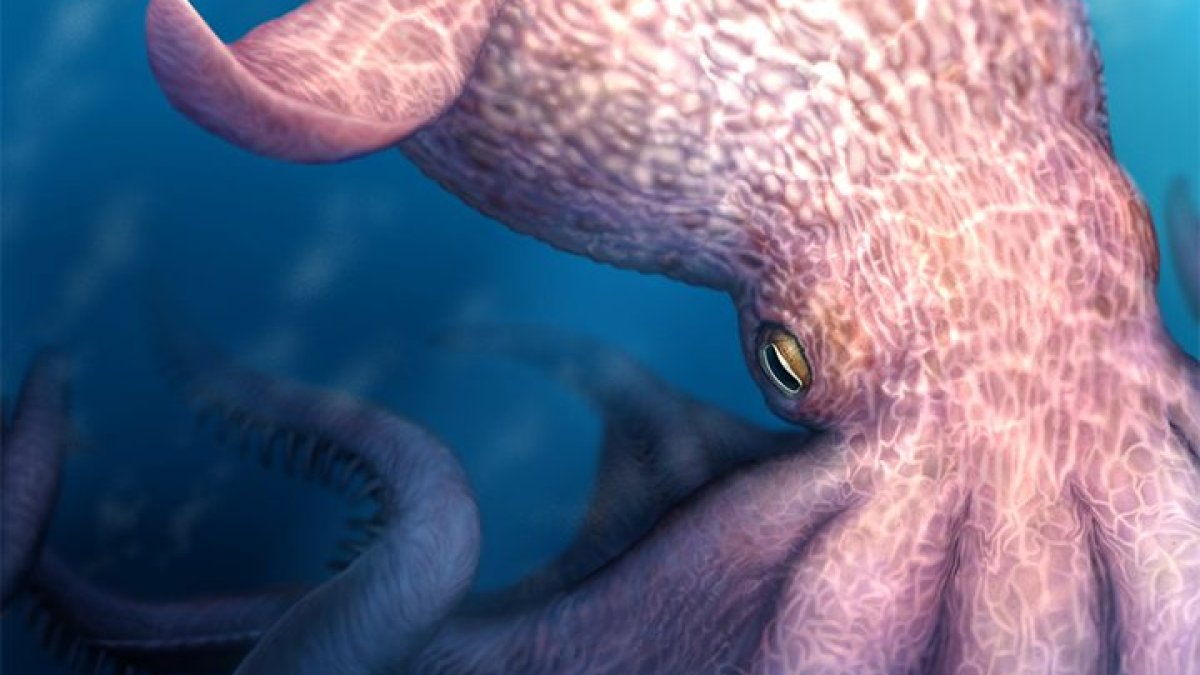
A massive kraken-like octopus may have prowled the seas during the age of dinosaurs
The top predator prowling the seas during the age of the dinosaurs 100 million years ago may have been the octopus.
New analyses of fossilized jaws reveal that massive, kraken-like octopuses once hunted alongside other marine predators. They boasted eight arms and long bodies that extended more than 60 feet (18 meters), rivaling other carnivorous marine reptiles.
"These krakens must have been a fearsome sight to behold," University of Alabama paleontologist Adiel Klompmaker said in an email. He had no role in the new research.
Dinosaur fans know that late Cretaceous-era waters were ruled by sharp-toothed sharks and sea reptiles known as mosasaurs and plesiosaurs.
Why do octopuses get left out of the mix? Scientists have studied giant octopus relatives that roamed when dinosaurs were around, and researched some small octopuses that drilled into clams. But since their soft bodies don't preserve well, it's hard to figure out exactly how big the creatures got.
There's also a perception that squishy invertebrates -- creatures without backbones -- weren't formidable enough to join the ranks of top predators. But octopus' beaks made of stiffened chitin are tough enough to crush shelled and bony critters.
In the new study, researchers studied the jaws of 15 ancient octopus fossils that were previously found in Japan and Canada's Vancouver Island. They also identified 12 more jaws from Japan using a technique they created called digital fossil mining, which closely scans rocks in cross-sections to reveal fossils hiding inside.
They compared the jaws to that of modern-day octopuses to estimate how large the creatures may have been, and determined that the ancient octopuses ranged from 23 to 62 feet (7 to 19 meters) in length. The largest jaw was substantially bigger than that of any modern octopus, said co-author and paleontologist Yasuhiro Iba with Hokkaido University in an email.
They also found that the largest creatures' jaws had significant wear and tear including scratches, chips and rounded edges, suggesting that "the animals repeatedly crushed hard prey such as shells and bones," said Iba.
The findings were published Thursday in the journal Science.
Without access to the octopuses' stomach contents, it's hard to know for sure what they were eating or whether they truly competed with other top predators for their meals. They could have snacked on fish or snails, snatching prey with flexible arms and breaking it apart with their beaks.
Looking for octopus fossils in other places might help scientists get a clearer idea of how they factor into ancient food webs, said paleontologist Neil Landman with the American Museum of Natural History in New York.
"It's a big old planet," said Landman, who wasn't involved with the new research. "So we have lots to look at to piece together the marine ecosystem through time."