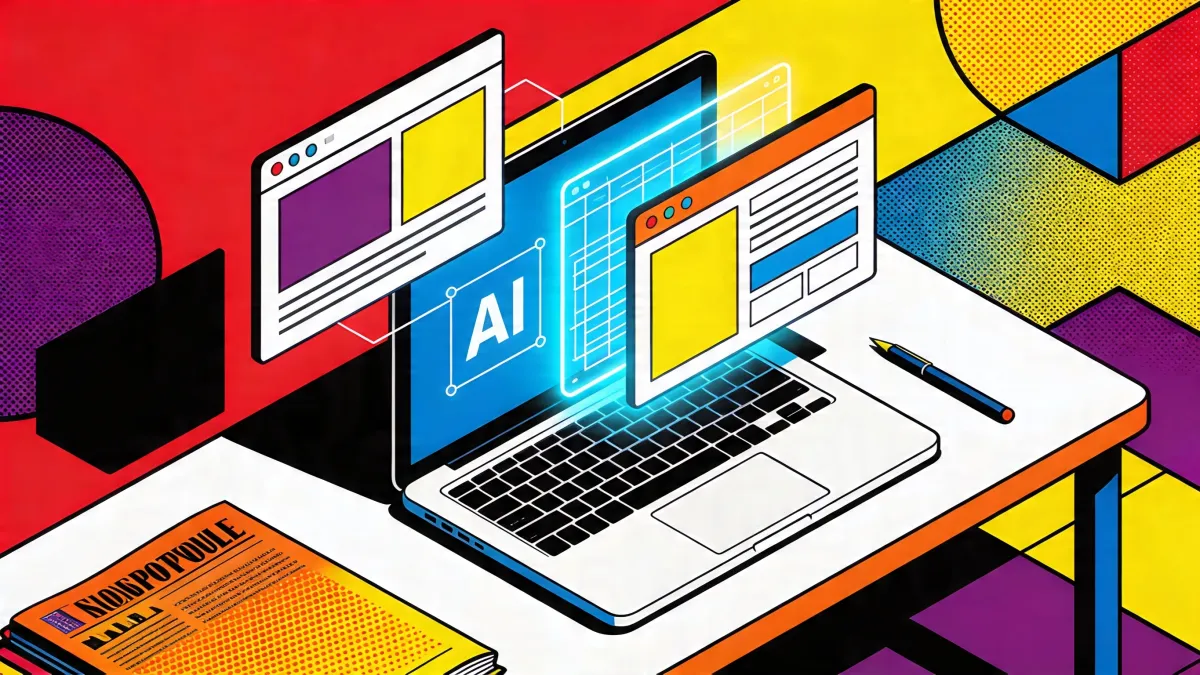
Anthropic Launches Claude Design on Opus 4.7
Anthropic on Friday launched Claude Design, a research preview that lets paying subscribers build prototypes, slide decks, and marketing assets from natural-language prompts. The product reads a team's codebase and design files, then applies the company's colors, typography, and components to every project automatically, according to the launch post. Powered by Claude Opus 4.7, the tool is available to Pro, Max, Team, and Enterprise subscribers and puts Anthropic in direct competition with Figma, Adobe, Canva, and Wix.
Not a Midjourney-style image generator. No cat eating lasagna in space. Claude Design is a workplace tool: pitch decks, landing pages, product wireframes, campaign visuals, and the interface prototypes that used to need a designer and a developer in the same room.
The workflow is conversational. Describe what you want, Claude builds a first version, and you refine through inline comments, direct edits, or custom sliders the model generates for spacing, color, and layout. Anthropic calls the underlying Opus 4.7 its most capable vision model to date. Designers can ration exploration less. Founders and product managers without a design background get a way to turn an idea into something shareable before the meeting ends.
The feature that makes this more than a prompt-to-deck toy is the onboarding step. During setup, Claude ingests a company's codebase and design files and builds a design system that governs every subsequent project. Teams can maintain more than one. Import paths run wide too. You can start from text prompts, DOCX, PPTX, XLSX uploads, or use a web capture tool to grab elements straight off a live site.
Export paths are equally broad. Designs leave as PDFs, PPTX files, standalone HTML, or a folder for internal sharing. Finished work can also be packaged into a handoff bundle for Claude Code. Anthropic told TechCrunch the Canva export is a partnership, not a feint. The two companies have worked together for a year, and Canva chief executive Melanie Perkins said files arrive "fully editable and collaborative."
Datadog product manager Aneesh Kethini told AdWeek his team has "gone from a rough idea to a working prototype before anyone leaves the room." Brilliant, the online learning platform, is in the beta too.
The tool's existence moved markets before it shipped. After The Information first reported the plans earlier this week, shares of Adobe, Wix, and Figma each dropped more than two percent, according to The Decoder. The S&P 500 Software and Services Index is down nearly 26 percent this year as investors price in what AI tools might do to incumbent productivity software.
Anthropic's growth numbers explain the anxiety. Revenue has ripped. The company puts its annualized figure at roughly $30 billion, up from $9 billion at the close of 2025. Over a thousand enterprise customers now cut annual checks of $1 million or more to Anthropic, and that tally doubled in under two months. Venture capitalists are reportedly offering a valuation of up to $800 billion, more than double the $380 billion Anthropic fetched in February. On the secondary-market platform Caplight, shares already trade at $688 billion. OpenAI, for reference, last marked at $852 billion.
The compute bill is steep. Anthropic recently replaced its Enterprise flat rate, which topped out at $200 per user per month, with a $20 base fee plus usage charges. A shift that could double or triple costs for heavy users.
Opus 4.7 is not Anthropic's best model. That title belongs to Claude Mythos Preview, the cybersecurity-specialized system the company unveiled on April 7 and restricted to select partners through Project Glasswing. On Humanity's Last Exam without tools, Mashable reports Mythos scored 56.8 percent against Opus 4.7's 46.9 percent. Opus 4.6, the February flagship, managed 40 percent.
CEO Dario Amodei is meeting with the White House about Mythos this Friday, as the Trump administration, tech executives, and bank chiefs weigh what a model that can simulate a full corporate network attack should be allowed to do in public.
Anthropic shipped Opus 4.7 with what the company calls "safeguards that automatically detect and block requests that indicate prohibited or high-risk cybersecurity uses." Claude Design inherits those guardrails by running on the same model.
The design tool is off by default for Enterprise accounts. Admins have to switch it on. For everyone else, access arrives in waves through the day. Figma, Wix, and Adobe spent years teaching customers to think in layers and artboards. Anthropic just handed those customers a sentence.