Anthropic policy chief Jack Clark says, "AI will help make a Nobel prize-winning discovery within a year.
AI is rapidly evolving beyond a search engine, with predictions of Nobel Prize-winning scientific discoveries and AI-staffed companies within the next 18 months. While AI offers immense potential, concerns are rising about its impact on human critical thinking, with a call to use AI as a partner rather than a replacement for thought.
If you've been using AI as a fancy search engine, it's time to think bigger. Way bigger.
Jack Clark, a co-founder of Anthropic and the creator of the AI assistant Claude, recently told students at Oxford University that in the next 12 months, an AI system will work with humans to produce a scientific discovery that could win a Nobel Prize. That's just the tip of the iceberg of his predictions.
Clark spoke of a "vertiginous sense of progress" in the field, almost dizzy at how fast things are moving. This is the kind of bold claim that deserves both attention and scrutiny from a generation that has seen endless delays to self-driving cars and AI chatbots fumbling basic questions.
This is already beginning to happen
The thing is, Clark's Nobel prediction isn't coming out of nowhere. It has almost already happened.
2024 saw AI receive its biggest accolade yet, with two Nobel Prizes awarded to researchers whose work stemmed from artificial intelligence. John Hopfield and Geoffrey Hinton won the Nobel Prize in Physics for their pioneering work in machine learning. In another development, David Baker, Demis Hassabis, and John Jumper were awarded the Nobel Prize in Chemistry for using AI to crack the protein-folding problem, a challenge that had stumped scientists for more than 50 years.
What Clark is saying is that the next breakthrough is already in the pipeline, and this time, AI won't just help with research. It might push it.
A timeline that sounds wild, until it doesn't
Clark did not stop at the Nobel Prizes. He laid out a bigger roadmap for where he sees AI going.
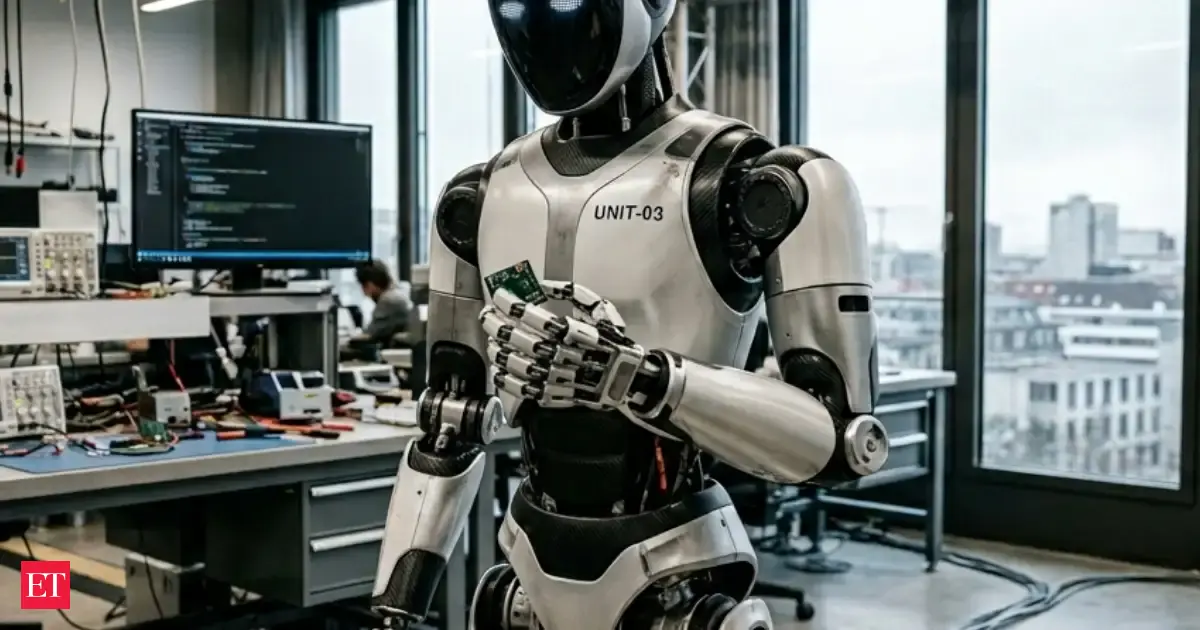
Within 18 months, he believes we'll be seeing companies staffed entirely by AI agents making millions in revenue. In two years, we'll have bipedal robots with AI brains working alongside tradespeople on job sites. And by 2028, AI systems could be designing their own successors, effectively creating the next generation of themselves.
He also warned that one day AI could become "more capable than all of us collectively," comparing the failure to prepare the public to the failure to prepare for pandemics such as COVID-19 adequately.
Image Credits: Wikimedia Commons| Anthropic co-founder Jack Clark has warned that worst-case AI scenarios, including existential risks, have not been ruled out.
The part of this story no one wants to talk about
Clark didn't just deliver a talk full of hype. He was also blunt about the dangers, saying that worst-case scenarios, including ones where AI poses an existential threat, had not been ruled out. He said that there are still plausible scenarios where the technology has "a non-zero chance of killing everyone on the planet," adding it was important to make clear that the risk had not gone away.
He also said he wished humanity would slow down development to prepare better for what's coming. But he doesn't think that will happen, given the fierce competition between companies and countries racing to build more powerful AI.
That tension, between knowing things are moving too fast and feeling unable to stop, is something a lot of young Americans feel, even if they can't quite name it.
Outsourcing your thinking has a real price
Labs are seeing scientific breakthroughs unlocked by AI, but there is a quieter conversation about what AI is doing to the rest of us.
Michael Gerlich's peer-reviewed study in Societies surveyed 666 participants across different ages and education levels and found a significant association between greater AI tool use and lower critical thinking abilities, with younger participants relying more on AI and scoring lower on critical thinking assessments than older participants.
That's a surprising finding for a generation of millennials and young adults who have grown up, quite literally, with a smart device in hand. The more we have AI do our thinking for us, the less we may do it ourselves.
In simple terms, Oxford's Institute for Ethics in AI Prof Edward Harcourt warns that AI systems that do more and more for us run the risk of creating "cognitive atrophy," a gradual weakening of our judgment and decision-making. He advocates what some call "Socratic AI," tools that make people think, not think for them.
What this means for you
AI isn't coming. It's already here. And if Clark is right, the next 12 to 24 months will see changes that make the last two years look slow.
Young Americans' dilemma isn't whether to engage with AI; that ship has already sailed. The question is what to do about it. Another way is to make it a shortcut for every decision you make. Another is to use it as a partner while sharpening your own judgment.
The scientists who just won Nobel Prizes didn't let AI take over their thinking. They aimed it at the hardest problems in the world and hung on. That's a model worth keeping.