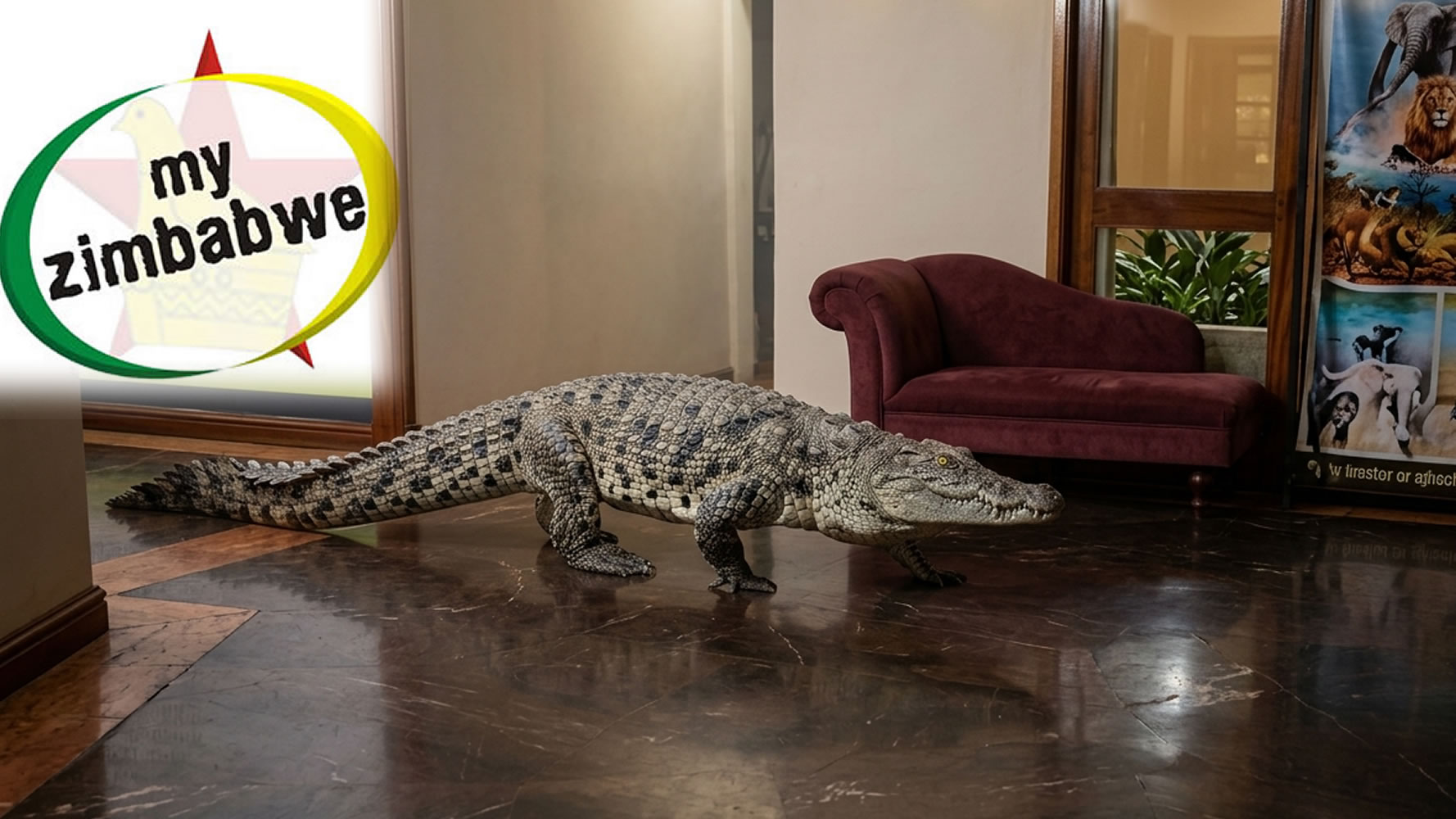
Chaos as 3.6 Metre Hungry Crocodile 'Walks' into a Vic Falls Hotel Like a Paying Guest, Climbs Reception & Heads to Kitchen (VIDEO)
Victoria Falls - The tranquil dawn at Victoria Falls' A'Zambezi River Lodge was shattered on Friday, 17 April 2026, by an extraordinary and terrifying intrusion. A colossal 3.6-metre Nile crocodile, a creature typically confined to the Zambezi River's depths, brazenly ambled into the hotel premises, reportedly scaled the reception desk, and made its way towards the kitchen. While the incident, captured in viral footage, caused panic among guests and staff, it serves as a stark and unsettling reminder of a much deeper, more pervasive crisis unfolding across Zimbabwe: the escalating conflict between humans and wildlife.
This dramatic encounter at a luxury lodge, famed for its proximity to nature, is far from an isolated spectacle. It underscores a critical trend that wildlife experts are increasingly highlighting: the erosion of natural habitats and the alarming breakdown of the vital buffer zones that once separated human settlements from the wild. These
The Uninvited Guest: A Close Call at A'Zambezi River Lodge
The early morning hours of Friday, 17 April 2026, brought an unexpected visitor to the A'Zambezi River Lodge. Staff at the Victoria Falls establishment were jolted by the sight of a 3.6-metre Nile crocodile calmly navigating the hotel's grounds. The reptile, believed to have originated from the nearby Zambezi River, was first spotted by vigilant hotel employees. Their swift actions prevented the situation from escalating, as they immediately raised the alarm, initiating a coordinated response to safeguard both people and the animal.
Zimbabwe Parks and Wildlife Management Authority (ZimParks) personnel arrived promptly on the scene. ZimParks spokesperson, Mr Luckmore Safuli, confirmed the incident and provided details on the authority's decisive actions. "The animal, identified as a Nile crocodile (Crocodylus niloticus) originating from the Zambezi River system, was safely immobilised and translocated by trained authority personnel," Mr Safuli stated. He further reassured the public that, despite the alarming nature of the event, "No human injuries or property damage were recorded." The crocodile was subsequently released back into its natural habitat in the river.
Mr Safuli also offered a perspective on the crocodile's unusual presence, noting that such occurrences, while startling, are not entirely unprecedented in this environment. "The authority notes that the incident occurred within the species' natural range and habitat. The lodge is situated in a riverine environment along the Zambezi River, which supports established crocodile populations. Terrestrial movement by crocodiles is normal behaviour and is commonly associated with basking, nesting, dispersal, or territorial activity."
Mrs Pride Khumbula, RTG Corporate Affairs and Quality Manager, corroborated the incident, explaining that the reptile had ventured into one of the lodge's water features, which are designed to harmonise with the surrounding natural landscape. "A'Zambezi River Lodge can confirm that a crocodile was sighted on the property on Friday 17 April 2026. The situation was promptly managed in close coordination with ZimParks, who responded swiftly, safely apprehended the animal from the hotel's water feature where it had made its way into, and relocated it back into its natural habitat."
Mrs Khumbula emphasised the lodge's unique position within the Zambezi National Park, highlighting its commitment to coexisting with wildlife. "The hotel is uniquely located within the Zambezi National Park, where we proudly coexist with wildlife as part of a protected natural ecosystem. We are fully cognisant of our position within a designated wildlife corridor and actively support biodiversity by allowing animals to move freely within their natural habitat." She added that such wildlife sightings are a regular feature of the lodge experience, with hippos, elephants, warthogs, and monkeys frequently observed on the grounds and along the riverbanks. "This is part of what makes A'Zambezi River Lodge a distinctive and sought-after destination. During this recent incident, some of our international guests expressed excitement at witnessing such a rare occurrence," Mrs Khumbula remarked. She concluded by reiterating the paramount importance of guest and staff safety, assuring that the experienced team is well-trained to handle such situations.
The Broader Canvas: Human-Wildlife Conflict in Zimbabwe
The incident at A'Zambezi River Lodge, while resolved without harm, casts a spotlight on the escalating human-wildlife conflict (HWC) that has become a critical concern across Zimbabwe. The statistics paint a grim picture of a growing crisis, driven by a complex interplay of environmental and anthropogenic factors. In 2025 alone, Zimbabwe recorded a staggering 62 human fatalities and 81 injuries directly attributable to encounters with wildlife. This represents a significant increase from the 49 deaths and 90 injuries reported in 2024. Beyond human casualties, the economic toll on communities is substantial, with livestock losses more than doubling from 362 in 2024 to 801 in 2025.
ZimParks acting spokesperson Tamirirashe Mudzingwa revealed that conflict incidents surged by 26 per cent, escalating from 1,654 cases in 2024 to 2,090 in 2025. He attributed this alarming trend primarily to climate change and the intensifying competition for dwindling natural resources. "Climate change and increasing competition for scarce water and grazing resources are bringing people and wildlife into closer and more frequent contact," Mudzingwa explained, noting that this pattern is mirrored across the wider region and globally. Shifting weather patterns are profoundly disrupting ecosystems, forcing wildlife to venture closer to human settlements in search of sustenance.
The districts most severely affected by HWC include Kariba, Mbire, Chiredzi, Binga, Hwange, Hurungwe, and Nyaminyami. In these areas, hyenas, crocodiles, and elephants are the primary species involved in reported incidents. A study highlighted that over 80 per cent of recorded human deaths in HWC incidents involved only two species: elephants and crocodiles, with crocodiles alone being responsible for a significant portion.
The Encroachment: Tourism, Conservation, and the Vanishing Buffer Zones
The narrative of the A'Zambezi River Lodge crocodile is inextricably linked to the broader issue of habitat loss and the breakdown of natural buffer zones. Victoria Falls, a global tourism magnet, has witnessed a proliferation of luxury lodges and human infrastructure. While these establishments market an immersive "wild" experience, they often inadvertently contribute to the very conflict they claim to celebrate. The expansion of human footprint into traditional wildlife corridors and habitats leaves animals with fewer options, compelling them to seek resources in areas previously undisturbed.
Conservation efforts are thus caught in a delicate balance. Hotels, while promoting the allure of the wild, are frequently ill-equipped to manage the inherent risks of coexisting with dangerous predators. The question arises: how can the tourism industry genuinely offer an authentic wildlife experience without exacerbating the conflict? The answer lies in a more profound understanding and respect for ecological boundaries, coupled with robust mitigation strategies.
Legislative Responses and Community-Based Solutions
Recognising the gravity of the HWC crisis, the Zimbabwean government and conservation partners are actively pursuing various interventions. ZimParks, for instance, responded to over 99 per cent of reported cases in 2025, neutralising 556 problem animals to mitigate immediate threats to communities. Beyond reactive measures, legislative reforms are underway to provide support to affected families. The Parks and Wildlife Amendment Act No. 4 of 2025, for example, makes provisions for a human-wildlife conflict relief fund, though its implementation mechanisms are still under development.
Community-based conservation initiatives are emerging as a crucial component of the solution. These programmes, particularly effective in high-pressure areas, aim to strengthen local participation in wildlife monitoring and response. By creating tangible economic value from conservation, such as through sustainable tourism or resource management, these initiatives foster a sense of ownership and shared responsibility among communities. Ongoing interventions include extensive awareness campaigns, livelihood support projects, and the deployment of community guardians who alert authorities when animals stray into villages. Furthermore, ZimParks and its partners are assisting communities in constructing predator-proof kraals and bomas, and in employing innovative deterrents like chilli bombs to protect crops.
Recent Incidents: A Chronicle of Conflict
The A'Zambezi River Lodge incident is but one chapter in a continuing saga of human-wildlife encounters across Zimbabwe. The year 2025, in particular, saw numerous instances of conflict:
-
Elephant Attacks: In the Southern Province, over 10 lives were lost in 2025 due to elephant attacks, often as these majestic creatures crossed into human-dominated areas, driven by habitat fragmentation and the search for water and food.
-
Crocodile Encounters: Beyond the A'Zambezi incident, crocodiles remain a significant threat. A recent, harrowing event involved a British student, Amelie O.B. (18), who was mauled by a crocodile near Victoria Falls, highlighting the constant danger posed by these apex predators in riverine environments.
-
Culling Programmes: In a controversial but deemed necessary measure to manage overpopulation and mitigate conflict, Zimbabwe authorised the culling of 50 elephants in the Savé Valley in 2025. Such programmes underscore the difficult decisions faced by wildlife authorities in balancing conservation with human safety and agricultural protection.
The Tough Questions: Is Victoria Falls Too Crowded?
The incident at A'Zambezi River Lodge, while seemingly an isolated event, forces us to confront uncomfortable truths about our relationship with the natural world. The question posed at the outset - is Victoria Falls becoming too crowded for both people and the animals that make it famous? - resonates with increasing urgency. The scientific reality of human-wildlife conflict is complex, rooted in ecological pressures, climate change, and human development.
While the tourism industry thrives on the allure of the wild, it must also bear the responsibility of sustainable coexistence. This entails not just swift responses to incidents, but proactive measures: rigorous environmental impact assessments for new developments, the establishment and maintenance of genuine wildlife corridors, and continued investment in community-based conservation. The immobilisation of the A'Zambezi crocodile, rather than its destruction, offers a glimmer of hope - a testament to a growing understanding that these creatures are not just "monsters" but integral components of a delicate ecosystem, deserving of protection. However, without fundamental shifts in how we manage our shared spaces, such dramatic encounters will likely become more frequent, challenging the very essence of what makes Victoria Falls a wonder of the world.
Conclusion
The crocodile's unexpected visit to the A'Zambezi River Lodge serves as a potent symbol of the intensifying human-wildlife conflict in Zimbabwe. It is a narrative that extends far beyond a single incident, encompassing the profound impacts of climate change, habitat loss, and the ever-expanding human footprint. As Victoria Falls continues to draw visitors with its unparalleled natural beauty, the imperative to foster genuine coexistence between humans and wildlife becomes ever more critical. The future of this iconic destination, and indeed much of Zimbabwe's natural heritage, hinges on our collective ability to address these challenges with foresight, empathy, and sustainable solutions.