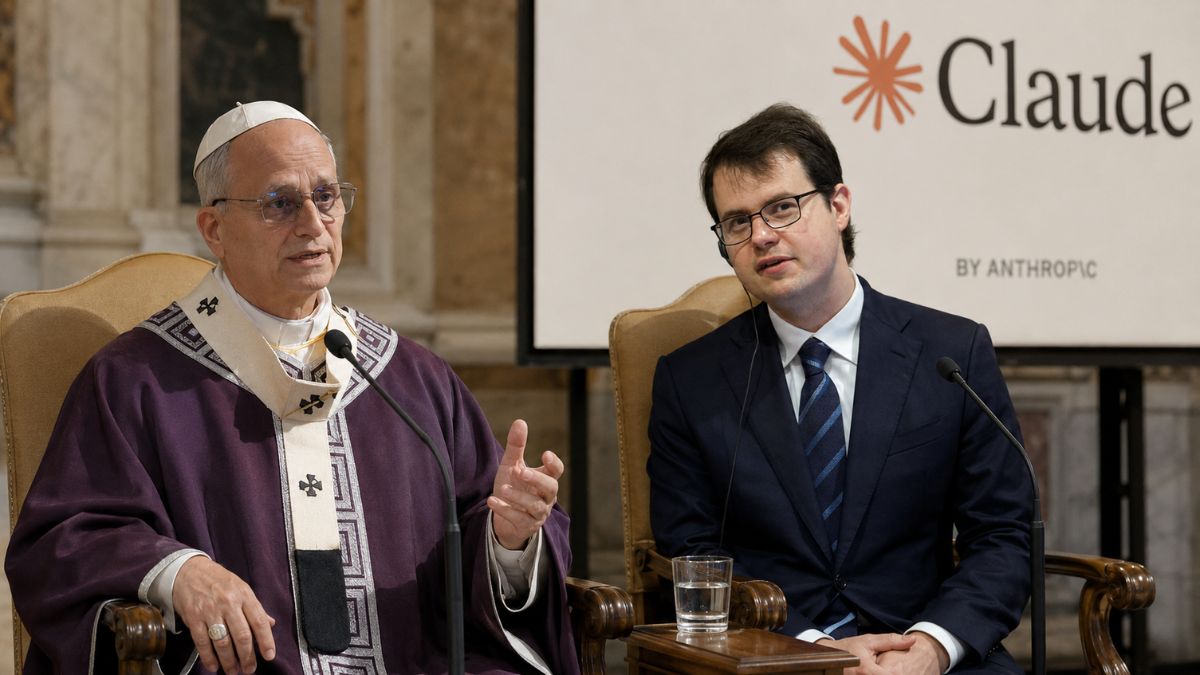
Church, Anthropic to 'find the way for humanity' in AI age: What the partnership may include
The statement is being seen as an attempt by the Vatican to move beyond broad warnings on AI and enter a more structured dialogue with the companies building frontier models. The scope of the collaboration, however, is not a commercial tie-up or a product partnership. Instead, the engagement is expected to be built around ethics, safety, labour disruption, education, model accountability and the wider social consequences of AI.
The Vatican has also formed a commission of senior Catholic officials to discuss AI-related challenges, according to the NYT report uploaded with the brief. That suggests the Church's approach is moving from broad warning to institutional engagement -- with clergy, theologians, ethicists, educators and technology experts all expected to play a role.
For Big Tech, the message is direct: AI may be a technological product, but its consequences are social, moral and political.
Pope Leo's paper says new collaborative efforts are needed among political leaders, labour organisations, businesses and the scientific community to quickly build shared regulations and protections at the international level.
This is where Anthropic's presence becomes significant. Olah is known for work on mechanistic interpretability -- the study of how AI systems arrive at outputs and why they behave the way they do.
National Catholic Reporter noted that inviting Olah may reflect Vatican interest in this specific area: making powerful AI systems more understandable, auditable and accountable.
Reuters reported that he identified three urgent issues: widespread job losses, the need to ensure AI benefits are shared globally, and the unresolved question of how to interpret increasingly complex and opaque AI systems.
The Vatican's own framing also points to a broader public agenda. A Vatican News report on an AI conference linked to Pope Leo's message identified three pillars for AI governance: responsibility, cooperation and education. It said AI must remain an instrument that supports human function and does not deteriorate it.
'Moral imperative of historic proportions' Anthropic co-founder on effects of AI
Speaking at the presentation, Olah said AI development cannot be left only to technology companies and called for oversight from religious leaders, governments and civil society.
According to Reuters, he warned there was "a real possibility" that AI could displace human labour "at very large scale", adding that supporting those affected would become a "moral imperative of historic proportions."
This indicates that the Church-Anthropic dialogue is likely to focus first on the human cost of AI. That includes job losses, reskilling, worker protections and the risk that AI may reduce the value of human labour in sectors where routine work can be automated.
Speaking about mass layoffs that can be triggered by AI across industries, the Pope argued that work is not just a source of income, but part of human development and personal fulfilment. He warns that AI could take over routine work in ways that devalue people who do not have access to the skills or training needed for the jobs left behind.
Possible areas of collaboration as per Pope Leo's Magnifica Humanitas
The string of announcements from Pope Leo come in the backdrop of the publication of his most recent encyclical titled Magnifica Humanitas (Magnificent Humanity) that addresses the concerns about AI's implication for humanity as a whole.
At the heart of Leo's argument is the idea that AI must serve the human person, not replace or rank human worth. He writes that technology is not, "in itself," a force against humanity, but warns that "the pursuit of greater profits cannot justify choices that systematically sacrifice jobs."
The Pope argues that work is not just a source of income, but part of human development and personal fulfilment. He warns that AI could take over routine work in ways that devalue people who do not have access to the skills or training needed for the jobs left behind.
His strongest warning is about a future where progress becomes materially impressive but socially hollow. A society that guarantees employment to only a small fraction of people, he says, risks "human and cultural impoverishment."
In his recently published letter, the pope has also called for government regulation of private AI companies, protection and retraining for workers that are likely to be replaced by AI along with safeguards for children.
The encyclical says parents need support from schools and governments to help children resist excessive AI use, cyberbullying, isolation and pressure to share intimate images or sensitive information.
The collaboration also has an education angle. Vatican News said education for students in the age of AI must go beyond coding or technical skills and should focus on critical thinking, empathy and the ability to distinguish truth from fabrication.
Military use of AI is another likely area of cooperation between both sides. Anthropic has previously been in the spotlight for refusing to loosen safeguards around the use of its models for lethal autonomous warfare or mass surveillance, according to the National Catholic Reporter.
The Vatican, meanwhile, has repeatedly warned against weapons systems where human responsibility is weakened or removed.
For the Vatican, Anthropic's presence gives the Church a direct line into the technical debates around frontier AI. For Anthropic, the engagement gives its safety-focused work a wider moral and social frame, beyond the usual Big Tech and policy circles.
The larger message is clear: the Vatican wants AI companies to be answerable not only to investors, users and governments, but also to a wider moral conversation about what technology is doing to work, childhood, truth, inequality and war.