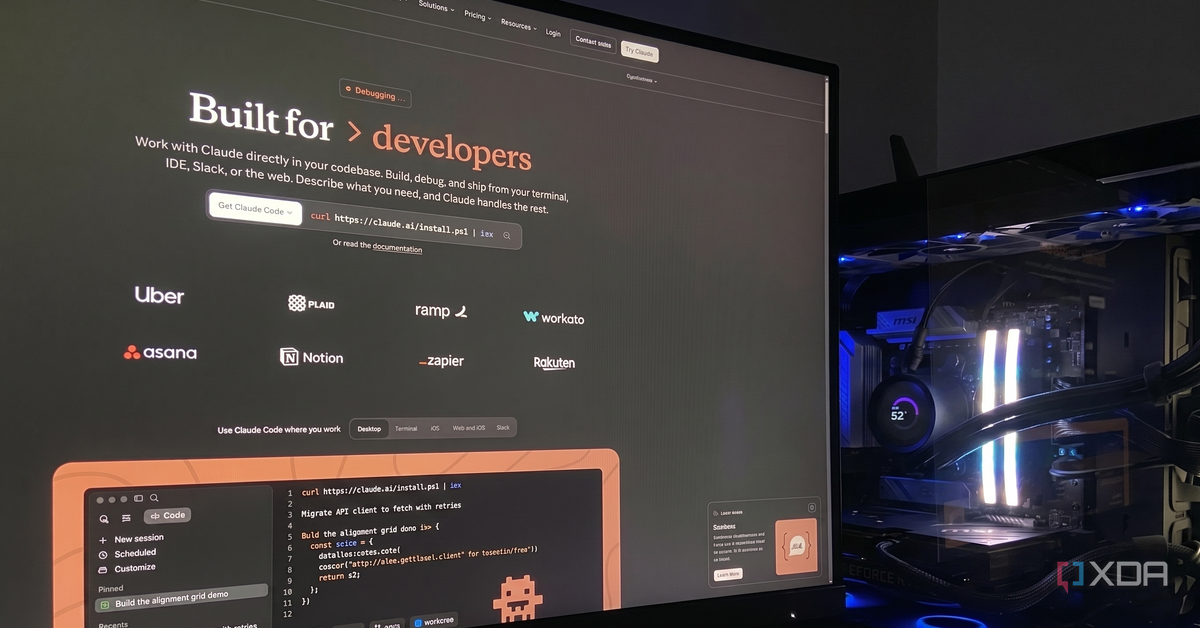
Claude is better than Gemini for Python, but it's unusable until Anthropic fixes this one problem
Abhinav pivoted from a career in banking to pursue his first love in writing. Even while working full-time, he continued contributing as an editor-at-large, a role he has held for more than 7 years. A lifelong tech enthusiast who has built three gaming and productivity powerhouse PCs since 2018, his passion for technology keeps him closely following the semiconductor industry, from NVIDIA and AMD to ARM. His MSc dissertation explored how artificial intelligence will reshape the future of work, reflecting his curiosity about the wider social impact of emerging technologies.
The fact that Claude Sonnet 4.6 eclipses every other frontier model on the market in programming workflows is pretty well-established. If there was any lingering skepticism, the extensive benchmarks I have run recently prove its coding dominance rather decisively. When you need rapid prototyping and complex code generation, Sonnet 4.6 effortlessly outperforms competitors by a long shot.
I have come to realize, however, that generative capability is only one piece of the puzzle. Sustained productivity relies a lot more on platform usability, which is a factor that can ultimately matter much more than the underlying intelligence of the model itself. Lately, Claude has developed a severe workflow disrupting bottleneck for those on its free tiers, and this has got me to pivot towards Gemini, even if it ends up taking a lot more fine-tuning.
Claude's session limits have become very punishing lately
For programming and debugging, that's a nasty problem to have
Over the last few months, I've leaned heavily on Sonnet 4.6 for a wide variety of "vibe-coding" projects. Because I'm still relatively new to Python, almost all of my practical learning comes directly from interacting with the platform. Whether I'm prototyping personal workflow automations or experimenting with a 2D platformer with Pygame, it benefits to see the code in action and ask the model to justify its specific design and execution decisions.
This iterative learning process, however, requires continuous, uninterrupted dialogue, which is exactly where the current system is breaking down. The friction started right after Anthropic introduced peak-hour throttling of its services on the platform. This meant that the available tokens were consumed much more quickly whenever the demand for the service was higher. Abruptly hitting a strict rate limit in the middle of development inevitably puts a halt to the workflow. When the prompt box locks me out, the only options are to either migrate my context history to another LLM to pick up the pieces, or untangle the remaining logic myself. Neither route is without its own inconvenience.
I built 3 Python apps with Claude Code that actually saved me time
Reclaiming my time, one prompt at a time
Posts 1
By Abhinav Raj
I'd rather stick with Gemini, for now
Even if that means missing all the great Claude Code features
I've had my fair share of experience in Python coding across every major LLM platform, and the competition for me had narrowed down to Anthropic and Google. When it comes to coding capabilities, there's no doubt that Claude Code outperforms Gemini thanks to its superior code generation, strict prompt adherence and error avoidance. Besides this, it just handles complex logic better, and requires far less hand-holding than any other LLM. Although I'd argue that this is almost a requisite when you're dealing with such stringent usage limits for the platform to be at all usable.
The economics of Sonnet 4.6 and Opus 4.6, however, deserve serious consideration, especially for paying users. Claude restrics standard paid users to a 200K-token context window. Conversely, the similarly-priced Gemini 3.1 Pro comes with a massive 1M-token window, making it a better deal in price-to-performance. At the time of writing, Google's flagship model is about 2.5x cheaper on input and half the output cost of Claude Opus 4.6.
Since my daily vibe-coding sessions usually involve brainstorming and tend to get messy, Gemini's massive context runways and forgiving limits are far more practical for getting things done. I find that it is much easier to deal with frequent fine-tuning and a couple of missing features than to hit a multiple-hour lockout in the middle of the session, and I imagine it would be doubly frustrating for paying users whose productive hours fall between the "peak demand" period. The abrupt breaks completely shatter the flow of ideas and make it easy to lose the vision of the project.
Anthropic is putting out some great features, but they're out of reach
What's a feature good for when you can't use it at all?
Anthropic has been the industry-leader in putting out some incredible features with a wide variety of applications, but for many, they remain frustratingly inaccessible. I was certainly not alone in experiencing this squeeze. Since the last and penultimate week of March 2026, tech forums and subreddits have been abuzz with users complaining about unusually excessive usage caps. What concerns me is the fact that it has now begun to undermine the platform's day-to-day utility.
Subscribe to the newsletter for LLM platform insights
Need clearer guidance on LLM tradeoffs? Subscribing to the newsletter gives focused coverage of model tokenomics, platform usability, and coding workflow tradeoffs -- practical analysis to help you compare platforms.
Get Updates
By subscribing, you agree to receive newsletter and marketing emails, and accept our Terms of Use and Privacy Policy. You can unsubscribe anytime.
The "bottleneck" in question isn't strictly limited to heavy-duty programming tasks in Claude Code either. I recently tested Claude's new interactive visuals, and while the feature itself was nothing short of a game-changer in information visualization, the excitement completely evaporated when I discovered that generating just two of these "visuals" completely exhausted 100% of my usage limits on the free tier. It's regrettable when a well-rounded feature such as this is reduced to a tech demo.
The growing gap between what Anthropic promises and what users can reliably access is coming in the way of the usability of the platform, and this has got many users looking at the closest competitors.
The tokenomics of LLMs is a worthy consideration when choosing platforms
There's absolutely no denying that Anthropic's direction is genuinely impressive, and that's why Claude is the most capable model for coding workflows. The primary issue I take is with accessibility, because without it, capability itself is a hollow selling point. The growing gap between what Anthropic promises and what users can reliably access is coming in the way of the usability of the platform, and this has got many users, not unlike myself, looking at the closest competitors.
Google Gemini
Gemini is Google's multimodal artificial intelligence model capable of generating text, code, images, and videos.
See at Google Gemini
Expand Collapse