Crusoe, Microsoft Expand Abilene AI Campus, Add 900 MW
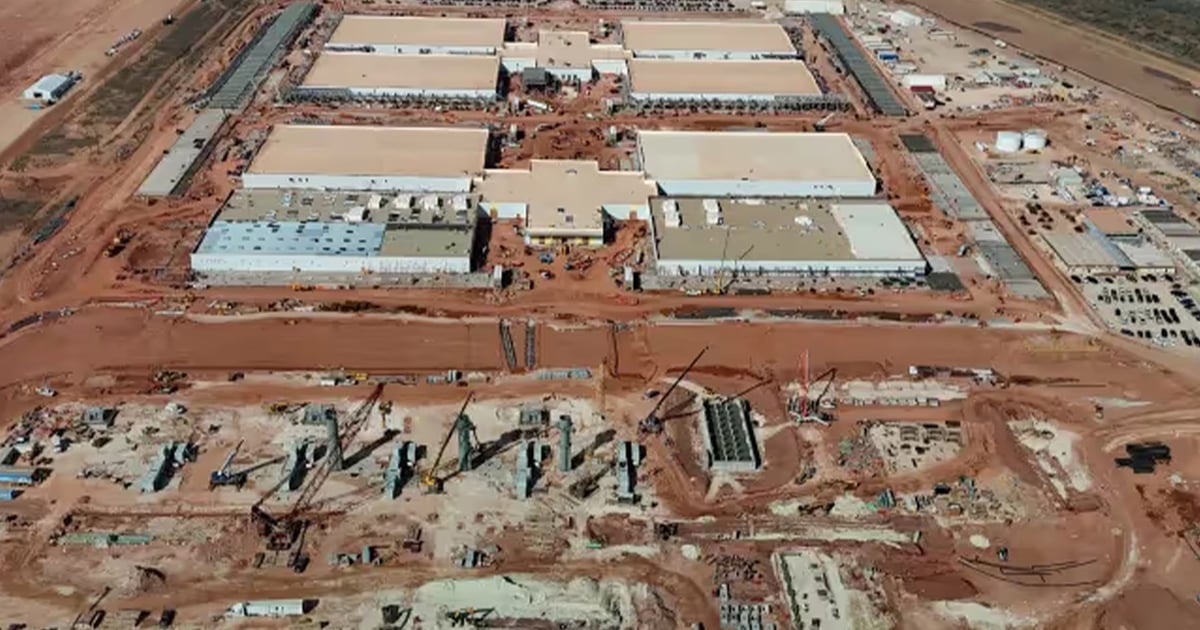
An aerial shot of Crusoe's Abilene AI data center campus.Image: Crusoe
Crusoe is expanding its presence in West Texas, announcing plans for a 900 MW AI data center facility in Abilene designed to support large-scale Microsoft workloads.
The expansion - adjacent to Crusoe's existing Abilene development - will bring total planned capacity to roughly 2.1 GW, positioning the site among the largest AI-focused data center hubs in the US.
It's the latest phase in one of the country's fastest-moving (and most closely watched) digital infrastructure builds. The scale of the project reflects how quickly expectations are shifting.
"It's significant, but it's starting to feel less surprising than it would have even 18 months ago," Andy Cvengros, managing director at JLL, told Data Center Knowledge. "The hyperscalers and AI players have completely reset expectations around campus scale."
"A few years ago, a 100 MW deal was a headline," he added. "Now we're seeing single-site programs that dwarf that."
Related:Texas Gets Tough on Data Center Power - Who's Next?
Crusoe began construction on its Abilene facility in mid-2024 at the Lancium Clean Campus, initially tied to the Stargate initiative with Oracle and OpenAI. However, recent reports suggest the companies have scaled back their expansion plans.
The first phase - two buildings totaling about 200 MW - moved from groundbreaking to operations in roughly a year, an exceptionally fast hyperscale timeline. By early 2025, Crusoe secured billions in financing to scale the site into a 1.2 GW campus spanning eight buildings, with construction on the next phase soon underway.
At the same time, tenant requirements have evolved. What began as a tightly aligned Oracle and OpenAI deployment has evolved amid changing capacity needs and financing conditions, with Microsoft stepping in to secure large blocks of capacity.
The shift reflects a broader trend - large AI campuses are increasingly designed as flexible, multi-tenant "AI factories," rather than single-tenant deployments.
Crusoe says the new campus reflects a fundamental shift in hyperscale design, one where power availability, not just compute, drives site selection. The project includes a 900 MW behind-the-meter power plant paired with battery storage, designed to enhance reliability and mitigate grid constraints.
That approach aligns with what site selectors are seeing across the market.
"It's the starting point of almost every conversation we have with clients right now," Cvengros said. "Land is available. Construction materials are available. Labor is manageable. Power is the constraint."
Related:Could Texas Overtake Northern Virginia as the Data Center Capital?
The Abilene site reflects that dynamic, building on access to abundant, low-cost energy, including wind, sufficient to meet AI's growing energy needs.
"Crusoe is building a new AI factory campus in Abilene, purpose-built for next-generation AI," said CEO Chase Lochmiller. "By integrating 900 MW of on-site generation, we're laying the industrial foundation for American AI - at unprecedented speed."
The inclusion of large-scale, behind-the-meter generation marks a shift in how hyperscale infrastructure is being deployed.
"When you're talking about gigawatt-level demand, the grid simply can't absorb that cleanly in most markets," Cvengros said. "Behind-the-meter generation lets developers move faster and gives operators more control over their power profile."
The approach - once considered niche - is increasingly being adopted to work around interconnection delays and grid constraints.
For Microsoft, the deal expands a growing portfolio of large-scale infrastructure partnerships aimed at securing AI capacity.
"As customer demand for AI grows, Microsoft is focused on ensuring access to reliable, responsible infrastructure at scale," said Noelle Walsh, president of cloud operations and innovation, in a statement. "Crusoe's Abilene facility reflects the type of infrastructure needed for next-generation AI."
Related:Trump Admin's Ratepayer Protection Pledge: What It Means for Hyperscalers
The move highlights a broader shift in which hyperscalers are increasingly turning to external developers with integrated power strategies to secure capacity quickly, particularly as core markets face power and permitting constraints.
Local officials highlight the project as evidence of West Texas' emergence as an AI infrastructure hub.
"West Texas has become the Silicon Prairie for AI," said Rep. Jodey Arrington (R-TX), in a statement. "This expansion underscores the region's role in ensuring America - not China - leads the next frontier of information technology."
Crusoe's Abilene expansion highlights a broader shift toward power-driven site selection and gigawatt-scale campuses.
As noted at a recent industry forum, "Texas is 15% of all the data center connectivity in megawatts in the US," underscoring the state's growing role in hyperscale development.
Behind-the-meter generation is emerging as a central strategy, with estimates suggesting "50% to 65% of large-scale data centers will be running behind the meter" in the coming years.
Together, these trends point to a new model - one defined by energy access, speed, and flexibility over proximity to conventional network hubs.