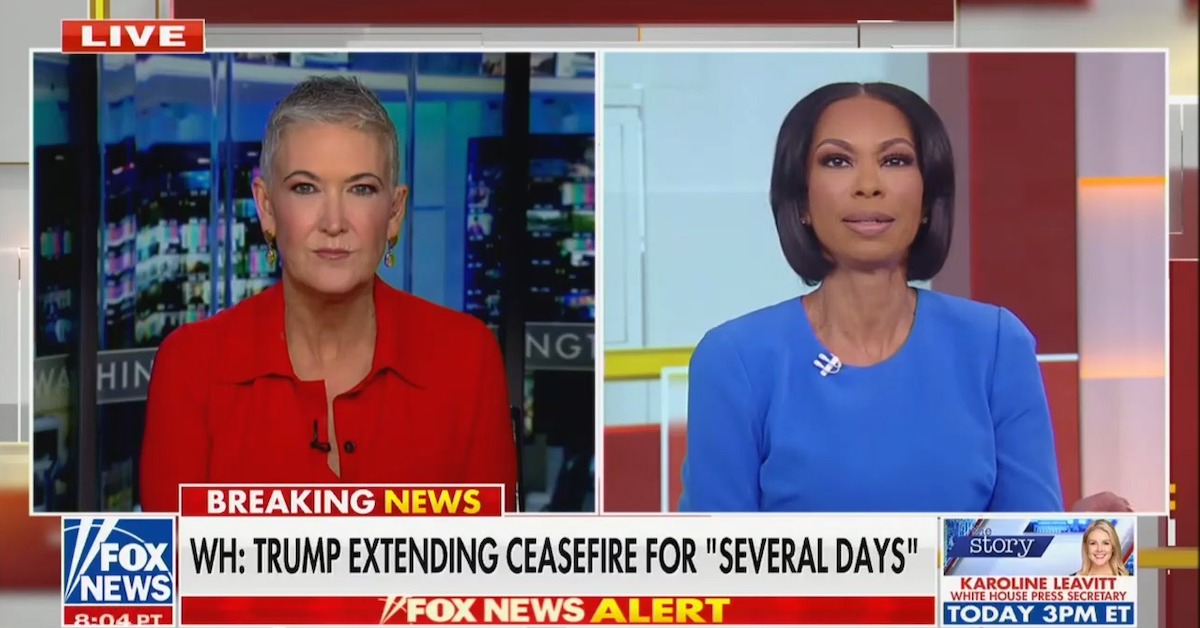
Fox's Jen Griffin Reports Iran 'Never Agreed' to Trump's Ceasefire Extension as Strait of Hormuz Chaos Rages On
Fox News chief national security correspondent Jennifer Griffin reported on Wednesday that Iran "never agreed" to President Donald Trump's extension of a ceasefire as chaos in the Strait of Hormuz rages on.
Griffin joined Harris Faulkner on The Faulkner Focus on Wednesday, one day after Trump announced an extension to a ceasefire agreement with Iran while he continues to try and hammer out a deal. Griffin reported, however, that Iran "never agreed" to the extension and the country's shaky leadership structure makes negotiations and clear guidelines more difficult.
"Based on the fact that the Government of Iran is seriously fractured, not unexpectedly so and, upon the request of Field Marshal Asim Munir, and [Pakistan] Prime Minister Shehbaz Sharif, of Pakistan, we have been asked to hold our Attack on the Country of Iran until such time as their leaders and representatives can come up with a unified proposal," Trump wrote in a Truth Social post.
Griffin reported on the ceasefire and various reports of Iran striking and seizing ships in the Strait of Hormuz, where roughly 20% of the world's oil supply moves through. Iran announced its own blockade in the Strait after Trump's original ceasefire agreement.
Griffin reported:
Iran never agreed to an extension of the ceasefire and the IRGC Navy continues to attack commercial shipping in the Strait of Hormuz. Since President Trump announced the extended ceasefire three commercial ships have come under attack from Iran. Early this morning an Iranian Revolutionary Guard Corps gun boat fired at the Liberian Greek-owned ship 15 miles northeast of Oman. Iran's Navy fired on the vessel with no warning, according to the British Royal Navy, causing heavy damage to the bridge. All crew were reported safe. Three hours later the U.K. Maritime Trade Operations Centre reported evidence of a second incident, this time eight nautical miles west of Iran.
She also reported the U.S. blockade has turned back more than two dozen vessels, but dozens of Iranian ships are still making it through the Strait of Hormuz. Griffin noted that the U.S. military supply has also taken significant hits during the war, with a reported 45% depletion in precision strikes missiles and a roughly 50% depletion in anti-ballistic missiles interceptors.
Faulkner asked for clarification on the ceasefire extension, arguing Iran's stance is causing confusion.
"Just a pause there, because you reported and reminded everybody that Iran never actually agreed to the ceasefire. So that's interesting, because they accused the United States blockade in the Strait of Hormuz of being a violation of the cease fire. So I mean, so they never agreed to it, but they expect it to be honored," she said.
"Well, the real question, Harris, is who is negotiating on behalf of Iran? Who is in charge there?" Griffin responded. "And we really still are not clear at this point. The IRGC and the IRGC Navy does one thing, and their speaker of Parliament says another thing to Pakistan. So it's very difficult to know what is actually happening and what is happening with the leadership of Iran right now."
Watch above via Fox News.