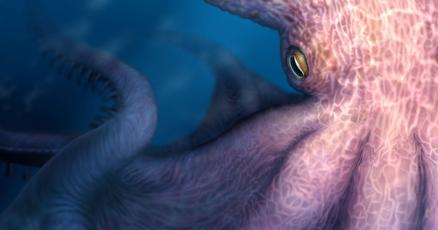
'Kraken-like' giant octopuses ruled oceans 100 million years ago
By Stephen Beech
Giant "kraken-like" octopuses were terrifying apex predators of the oceans 100 million years ago, according to new research.
The "enormous" creatures were active carnivores who routinely crushed hard shells and bones with their powerful bites, say scientists.
They also used their long, flexible arms to seize large prey while dismantling it with their strong beaks.
Scientists previously believed that giant marine reptiles and sharks were the top predators of the sea during the Cretaceous period.
Now a new study, published in the journal Science, suggests colossal "kraken-like" octopuses once hunted in the Late Cretaceous seas.
Japanese scientists say they grew as large as 19 meters (62 feet) in length and competed with -- and perhaps even preying on -- large ocean apex predators like mosasaurs.
The Kraken was a legendary, colossal sea monster originating from Scandinavian folklore, often depicted as a giant squid or octopus capable of sinking ships and dragging seamen to their deaths.
Shin Ikegami said: "For hundreds of millions of years, marine ecosystems were thought to be dominated by large vertebrate apex predators. Invertebrates served as smaller prey.
"However, unlike shelled invertebrates, octopuses followed a unique evolutionary trajectory.
"Instead of protective shells, these creatures evolved soft-bodies, which gave them unprecedented mobility, vision, and intelligence.
"Some of these species grew to enormous sizes, too, and have functioned as top-tier predators, yet their precise ecological role has remained uncertain due to limited fossil evidence."
Ikegami, a paleobiologist at Hokkaido University, in Sapporo, Japan and his colleagues evaluated the patterns of wear on fossilized jaws of ancient octopus relatives.
He said: "Wear on the jaw -- produced when biting into hard, skeletal prey -- leaves characteristic damage similar to the damage seen in modern shell-crushing cephalopods.
"Measurements of an octopus jaw can also be used to estimate their overall body size."
Ikegami and his team re-examined 15 large fossil jaws from ancient octopus relatives and identified clear signs of wear on particularly well-preserved specimens.
Using advanced digital fossil-mining techniques, they uncovered 12 additional jaws of finned octopuses from Late Cretaceous sediments, dating back to 72 million to around 100 million years ago.
In analyzing them, the team identified two main species -- Nanaimoteuthis jeletzkyi and N. haggarti.
Ikegami said: "These finned octopuses, N. haggarti in particular, grew to exceptional sizes, ranging from around seven to 19 meters, rivalling the size of contemporaneous giant marine reptiles and potentially representing the largest invertebrates currently described.
"Moreover, in the largest individuals, the jaws showed extensive wear, with once-sharp features in small juveniles becoming blunted and rounded over time.
"The wear patterns suggest that these creatures were active carnivores that routinely crushed hard shells and bones with powerful bites, and used their long, flexible arms to seize sizable prey while dismantling it with their strong beaks, a behaviour that has been linked to advanced intelligence."
He added: "The findings indicate that N. jeletzkyi and N. haggarti were not merely prey but highly active participants in shaping marine ecosystems while occupying roles previously attributed only to large vertebrates."