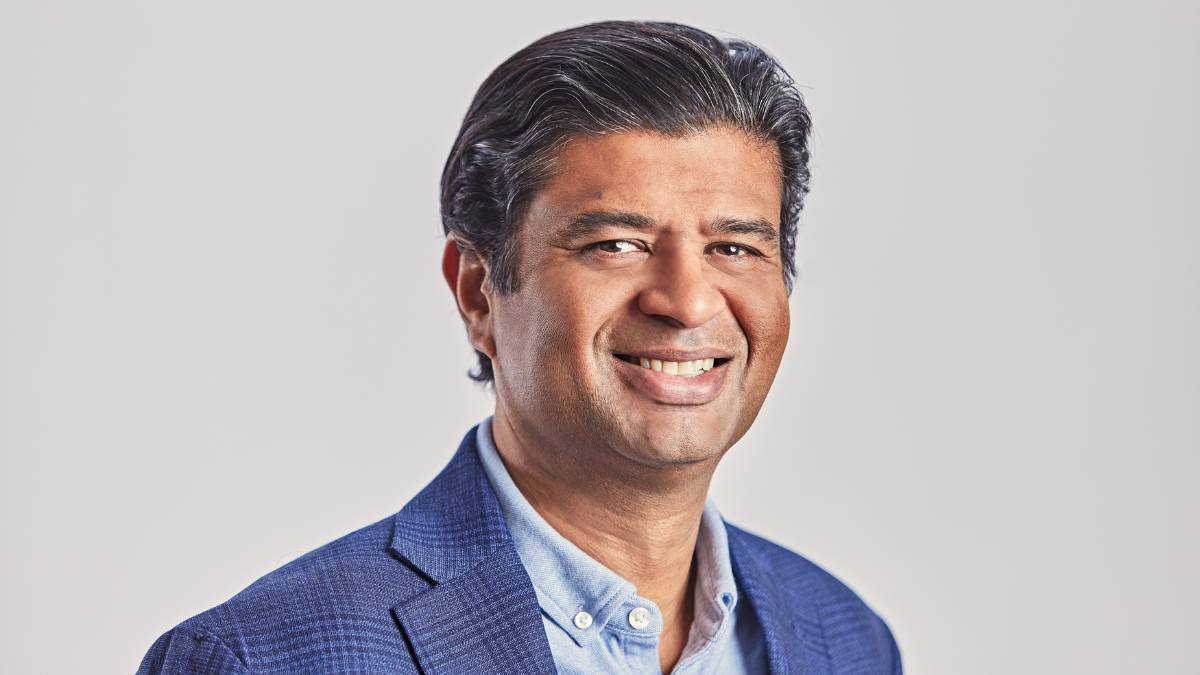
'Multiple measurement currencies create chaos, need single source of truth': Karthik Rao, CEO of Nielsen
At a time when the domestic media landscape is fragmenting across TV, mobile and digital platforms and being reshaped by AI -- audience measurement is under scrutiny. The complexities of the market here, says Karthik Rao, chief executive officer, Nielsen, a global leader in measuring viewership, presents an opportunity for the company to fine-tune its products and services. In an interview with Viveat Susan Pinto, Rao outlines his priorities for India. Excerpts:
Why is India so critical to Nielsen right now?
India is unlike any other market. Print remains resilient, linear TV hasn't declined as sharply as in other regions, and yet streaming and mobile viewership are growing rapidly. Add AI into the mix, and you have a highly complex media ecosystem. For us, that complexity is an advantage. If we can build solutions here, we can scale them globally. That's why we see India not just as a market, but as an innovation hub for the world.
What does that translate to in terms of investment?
We've grown to nearly 6,000 employees in just three years, and we're still growing. But the more significant shift is structural -- India is now a decision-making hub. Global leaders across technology, finance, and marketing are based here, shaping decisions for the entire company. This is no longer the traditional offshore model; India is central to how we operate globally.
There's a growing push for multiple measurement currencies in India. What is your view on this?
Multiple currencies create chaos and confusion. If the same show has four different numbers, which one is the truth? You need a single source of truth because trust comes from a single, transparent standard. You can layer other metrics on top of that. But the base has to be one common truth. Otherwise, you fragment the market and devalue content.
How is AI changing your business?
AI will fundamentally reshape both consumption and measurement. On the consumer side, discovery will become seamless -- you won't need to jump across apps. On our side, we're building AI-first systems, enhancing metadata to go deeper into content, and even exploring synthetic panelists to scale insights. We're also starting to measure how people use AI itself. That's becoming a new layer of media consumption.
What are the key innovations coming out of India?
Cross-media measurement is a major focus. Take our work on the Indian Premier League -- we're integrating streaming, mobile, and linear TV data to deliver a unified view of audiences across platforms. This is being done in partnership with the Broadcast Audience Research Council of India. It's a challenge the industry has been trying to solve for years. While we began with sports, the model can extend across all forms of content.
Tell us about your new 'Streaming Plus' audience measurement panel. With the rise of big data, is panel-based measurement still relevant?
'Streaming Plus' is our next-generation system, launched first in India. It tracks viewing across mobile and connected TV, captures app-switching behaviour, and measures both ads and content -- while also beginning to map actions such as shopping. Over time, we plan to scale this to more than 100,000 panelists. The idea is simple: combine human-observed data with big data to get both accuracy and scale.
To your question on relevance of panel-based measurement, I think it is more than ever relevant today. While big data tells you about volume of viewership, panels tell you who is viewing. And media is fundamentally about people. The future is not one or the other -- it's panel plus big data. That's our global approach.
Short-form content like micro-dramas is exploding in India. How do you measure that?
That's precisely what systems like 'Streaming Plus' are designed for. Consumption is rapidly shifting toward these formats, particularly on mobile. The key is to capture not just what people watch, but why they move across apps and formats. That's where the next level of insight comes from.
Indian advertisers are still heavily focused on reach. Is that a limitation?
Reach is foundational in a market of this size. If you can't reach people, you can't sell anything. But over time, we'll see a shift towards fandom and community. Look at the Indian Premier League -- it's not just about viewership anymore. It's about year-round engagement and monetisation.