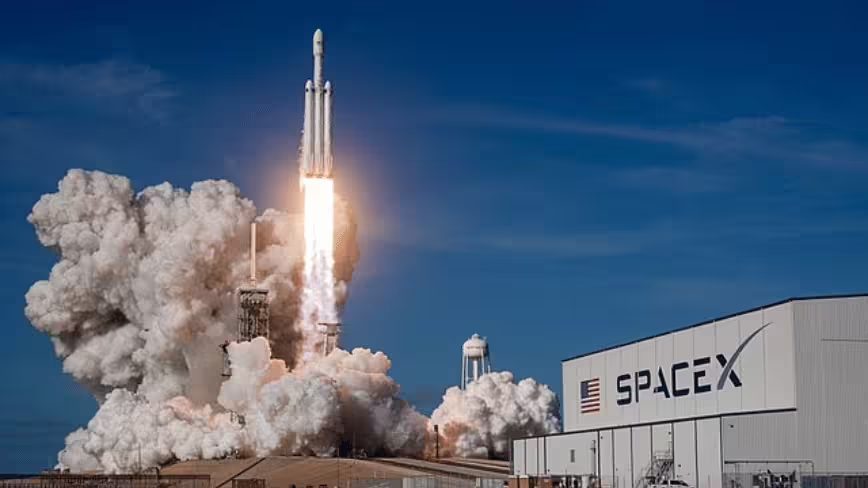
SpaceX has spent more than $15 billion on Starship
SpaceX has spent more than $15 billion developing its Starship megarocket and is pushing for a launch cadence that would make space access resemble an airline schedule rather than a government programme, Reuters reported on Friday, drawing on the company's confidential pre-IPO prospectus.
The figure quantifies, for the first time, the cumulative cost of the development programme that underpins the more speculative two-thirds of SpaceX's targeted $1.75 trillion IPO valuation.
The prospectus, which Reuters has been reporting on for the past week ahead of the public S-1 filing, shows SpaceX's capital expenditure surged nearly fivefold from $5.6 billion in 2024 to $20.7 billion in 2025.
Of that 2025 capex, $12.7 billion was directed at AI initiatives, exceeding spending on the company's core space and satellite operations. The result was a swing from $791 million in net profit in 2024 to a $4.94 billion net loss in 2025, a swing driven less by Starship itself, which has been a steady multi-billion-dollar drag for years, than by the absorption of xAI in February 2026 and the build-out of Starlink-adjacent AI infrastructure that the merged entity now sits on.
Starlink remains the financial engine: $11.4 billion in 2025 revenue and $4.4 billion in operating profit. Total SpaceX revenue for 2025 has been reported at approximately $15-$16 billion.
Starlink had 9 million subscribers at year-end 2025, with Quilty Space projecting growth to 16.8 million by the end of 2026, and total SpaceX 2026 revenue tracking towards roughly $20 billion with $14 billion in EBITDA.
'Airline-like rocketry' captures Musk's longstanding ambition for Starship: launches that happen on a daily or hourly schedule, with rapid turnaround between flights, vehicle reuse measured in dozens or hundreds of cycles, and per-kilogram launch costs that fall by orders of magnitude rather than percentages.
Today, sending one kilogram to orbit on a Falcon 9 costs commercial customers between $2,700 and $3,000, already the lowest price on the market by a wide margin. Starship's stated target is $10-$100 per kilogram, a 30- to 300-fold reduction.
The arithmetic of that target depends on a single assumption: that a Starship vehicle costing approximately $90 million to build can fly 100 times, spreading construction cost across all 100 missions.
Whether that flight rate is achievable is the question Flight 12, the first launch of Starship Version 3, is meant to begin answering. SpaceX completed the first full static fire of Booster 19 with all 33 Raptor 3 engines firing simultaneously on April 14, generating approximately 9,240 tonnes of thrust, more than any launch vehicle in history.
The inaugural V3 flight is targeting early to mid-May 2026, just before the IPO roadshow begins in the week of June 8. The Federal Aviation Administration has authorised SpaceX to increase its launch cadence at Starbase from 5 to up to 25 launches per year as of May 2025, and a separate February 2026 authorisation cleared up to 44 Starship-Super Heavy launches per year at Pad LC-39A in Florida.
The track record on cadence promises is mixed. SpaceX flew 5 Starship test flights in 2025 against a stated target of 25, a fivefold miss that mirrors the proportional slip Falcon Heavy showed in 2013.
Operational programmes have tracked closer: 170 Falcon launches in 2025 against the company's public targets, Starlink subscriber growth within roughly 10% of plan since 2022, and Falcon 9 reaching 32 flights on a single booster.
The pattern of New Market Pitch's milestone tracking is consistent: SpaceX hardware engineering goals are typically delivered, but two to five years late, while operational programmes once a vehicle reaches serial production track within roughly 10% of target. Starship is currently in the first category.
The Starship spending disclosure lands in the middle of a Reuters series on the SpaceX prospectus that is, in effect, the public version of an investor roadshow document SpaceX has not yet formally distributed.
The now-public S-1 confirms that Musk holds approximately 42% of SpaceX equity but controls roughly 79% of votes through a dual-class share structure. The IPO targets a $1.75 trillion valuation and a raise of up to $75 billion, more than 2.5 times Saudi Aramco's $29.4 billion 2019 record.
Twenty-one banks are managing the offering, internally code-named Project Apex, with a Nasdaq listing targeted for June and an unusual 30% retail allocation against the typical 5-10%.
The Starship $15 billion figure is the number that anchors the speculative half of the valuation thesis. PitchBook's analysis values SpaceX at 95 times 2025 revenue, with a fair-value range of $1.1-$1.7 trillion.
Morningstar called the $1.5 trillion target 'expensive and risky, but not irrational.' Roughly one third of the $1.75 trillion target is defensible on proven Starlink and launch cash flow; the remaining two thirds rests on Starship V3 reaching orbit reliably, orbital propellant transfer working at scale, Direct-to-Cell scaling beyond initial deployment, the Artemis III lunar lander mission, the orbital AI data centre buildout, and Mars.
Blue Owl's 10x return on its SpaceX position, disclosed this week alongside Meta bond financing and Anthropic's near-$900 billion fundraise, reflects the degree to which 2026 financial markets are now organised around a single underlying bet: that the current generation of AI infrastructure companies will be worth multiples of today's already extraordinary valuations.
The prospectus is unusually direct about the dependency. "Any failure or delay in the development of Starship at scale would delay or limit our ability to execute our growth strategy," the S-1 says.
The vehicle is the prerequisite for Starlink Version 3 satellites (which are too large for Falcon 9), for orbital AI data centres (which require throwing GPU clusters into orbit at a cost-per-kilogram unreachable on Falcon 9), for NASA's Artemis III lunar landing (which uses a Starship variant as the Human Landing System), and for any future Mars mission.
The single-vehicle dependency is what makes the $15 billion figure structurally important rather than just operationally relevant. The capital is not optional spend; it is a precondition for the rest of the business plan.
Musk's historical track record on Starship timelines is the cleanest predictor of where the spending lands relative to the IPO. Engineering milestones tend to ship eventually: Falcon Heavy was 5 years late, Crew Dragon 3 years, Starship's first orbital attempt 21 months, the Super Heavy booster catch 6 to 12 months. The Starship 25-flight target for 2025 missed by 5x.
The Mars dates have a 0% on-time record across four iterations (2018, 2021, 2024, 2026). For investors pricing the IPO at 95x revenue, the relevant question is not whether Starship eventually works -- the engineering track record suggests it does -- but whether it works on a timeline consistent with the cash flows the valuation implies. As the conflicts of interest piece we wrote last month documented, the entanglement between SpaceX's defence contracts, NASA dependencies, and Musk's political position adds a second layer of execution risk that is not captured in the engineering timeline alone.
Flight 12 is more than an engineering milestone. A successful V3 orbital test before the June IPO would validate the next-generation launch architecture, demonstrate progress toward the Artemis lunar lander timeline, and reinforce the long-term thesis that Starship will reduce launch costs by an order of magnitude.
A failure or significant delay would give skeptics ammunition during pricing negotiations and could meaningfully compress the valuation range PitchBook and Morningstar have already qualified as expensive and risky. The investor roadshow begins, on current scheduling, the week of June 8, with a major investor event on June 11 and a Nasdaq listing target of late June.
If Flight 12 succeeds and the launch cadence Reuters describes as 'airline-like' begins to materialise even at a fraction of the long-term ambition, the $15 billion in cumulative Starship spending becomes the most successful private R&D investment in the history of aerospace.