SpaceX IPO Spurs Surge in Korean, US Space ETF Investments
Tema Space Innovators and TIGER ETFs attract record inflows as investors pivot from semiconductors to space ahead of SpaceX's Nasdaq debut
Investor funds are rapidly shifting toward the space sector ahead of the anticipated initial public offering (IPO) of SpaceX, the aerospace company led by Tesla CEO Elon Musk. Capital that had been flowing into semiconductors is now transitioning to the space industry.
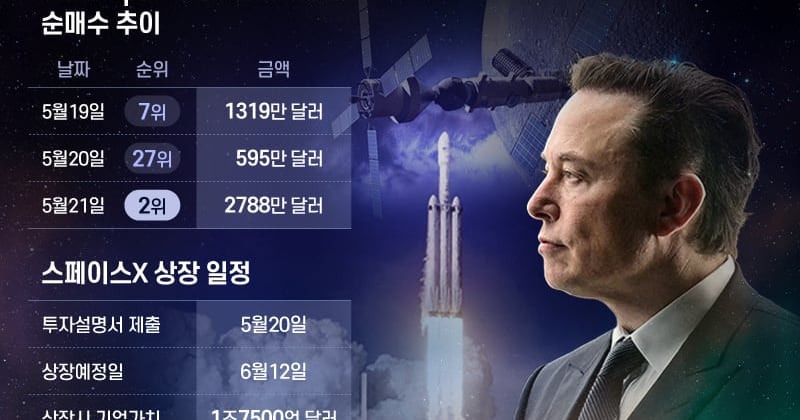
According to Securities Information Broadway (SEIBro) on the 26th, the second-most net-purchased ETF by Seohak ants, Korean retail investors buying foreign stocks, on the 21st was the 'Tema Space Innovators ETF,' attracting US$27.88 million (approximately 41.9 billion Korean won) in investments. The ETF's net purchase ranking rose sharply from 7th on the 19th (US$13.19 million) and 27th on the 20th (US$5.95 million) as funds poured in over a short period.
The surge in investments into this ETF is attributed to expectations surrounding SpaceX's IPO. The ETF invests in space-related companies, including a special purpose vehicle (SPV) holding SpaceX preferred shares (PFD, 10.7%), Rocket Lab (8.11%), Planet Labs (6.63%), and Filtronic (5.39%). Since SpaceX is a private company and direct investment is impossible, indirect demand is concentrated through the SPV, which holds unlisted shares.
As anticipation for SpaceX's listing grows, domestic space-themed ETFs are also seeing inflows. According to KOSCOM ETF Check, the top-funded ETF on the 21st was 'TIGER U.S. Space Tech,' which saw 60.6 billion won in net inflows. The TIGER U.S. Space Tech ETF surpassed 1.3169 trillion won in assets under management on the 21st, just 24 trading days after its listing, setting a record as the fastest passive ETF in South Korea to exceed 1 trillion won.
The 'TIGER U.S. Space Tech ETF' comprises space companies such as Rocket Lab (24.97%), Intuitive Machines (18.51%), Redwire (17.73%), and AST SpaceMobile (11.03%). Although it does not invest in SpaceX, expectations that the space industry will attract capital following SpaceX's listing have driven investor sentiment.
Analysts note that investment funds previously concentrated in the semiconductor sector are now moving to the space industry. Indeed, the top ETFs by net inflows last week (15-21st) were mostly semiconductor-focused products. At the time, SOL AI Semiconductor TOP2 Plus (63.35 billion won), TIGER Semiconductor TOP10 (62.10 billion won), and KODEX AI Semiconductor TOP2 Plus (43.85 billion won) dominated the rankings.
SpaceX is reportedly set to proceed with its IPO as early as June 12. The company submitted an investment prospectus to the U.S. Securities and Exchange Commission (SEC) on the 20th (local time) and applied to list Class A common shares on the Nasdaq and Nasdaq Texas markets.
According to foreign media, SpaceX's valuation is estimated at approximately US$1.75 trillion (about 2,635 trillion won) upon listing. This is comparable to the combined market capitalization of Samsung Electronics (about 1,750 trillion won) and SK Hynix (about 1,380 trillion won).
SpaceX plans to allocate funds raised through the IPO to expand its artificial intelligence (AI) infrastructure. While its satellite internet service Starlink currently accounts for about 60% of total revenue, the company aims to transition toward an AI infrastructure-focused revenue structure.
Kim Il-hyeok, a researcher at KB Securities, stated, "As the cost of Starship launches decreases and safety improves, expectations for building space data centers will grow. Although the S-1 filing notes a high risk of failure for space data centers, these ambitious goals themselves could support SpaceX's valuation."
However, experts caution investors to be mindful of structural risks when investing in SpaceX-related ETFs. Ko Kyung-bum, a researcher at Yuanta Securities Korea, advised, "Since SpaceX remains unlisted, direct investment is difficult, necessitating indirect investment through ETFs holding its shares. However, when investing via SPVs, it is challenging to assess actual investor gains or losses, so structural risks must be carefully considered."