SpaceX launches space station resupply mission; booster recovery brought sonic booms
By clicking submit, I authorize Arcamax and its affiliates to: (1) use, sell, and share my information for marketing purposes, including cross-context behavioral advertising, as described in our Privacy Policy , (2) add to information that I provide with other information like interests inferred from web page views, or data lawfully obtained from data brokers, such as past purchase or location data, or publicly available data, (3) contact me or enable others to contact me by email or other means with offers for different types of goods and services, and (4) retain my information while I am engaging with marketing messages that I receive and for a reasonable amount of time thereafter. I understand I can opt out at any time through an email that I receive, or by clicking here
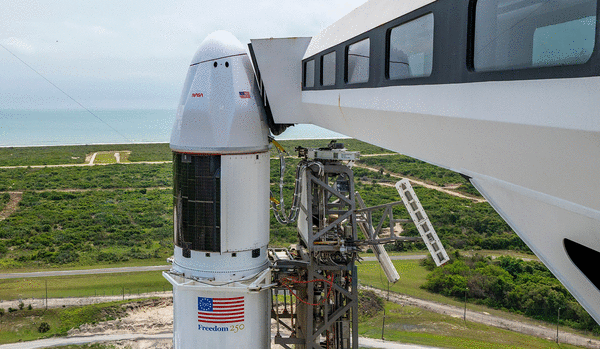
Weather cleared Friday for SpaceX's third try to get a resupply mission to the International Space Station off the ground, launching on time and making a successful booster recovery back on land that brought sonic booms to parts of Central Florida.
Poor weather conditions knocked out both Tuesday and Wednesday attempts, but a Falcon 9 was able to blast off on its third attempt lifting off at 6:05 p.m. EDT from Cape Canaveral Space Force Station's Space Launch Complex 40. Atop the rocket was a cargo Dragon spacecraft filled with 6,500 pounds of supplies as part of the CRS-34 mission.
The first-stage booster made its sixth trip to space with a recovery touchdown at Landing Zone 40 adjacent to the launch pad.
SpaceX had warned ahead of launch the booster's return could have brought the signature booms that accompany breaking the sound barrier about eight minutes after liftoff.
"There is the possibility that residents of Brevard, Orange, Osceola, Indian River, Seminole, Volusia, Polk, St. Lucie, and Okeechobee counties may hear one or more sonic booms during the landing, but what residents experience will depend on weather and other conditions," the company announced in an advisory.
This was the sixth trip to space for the Dragon cargo spacecraft as well. It has about a 37-hour trip to the space station and is expected to dock around 7 a.m. Sunday. The Dragon will remain docked for about a month before making a return to Earth targeting splashdown in the Pacific.
Science highlights among the cargo are experiments named ODYSSEY (Outcomes of microbial Dynamics during Spaceflight and in SimulatEd microgravity), STORIE (Storm Time O+ Ring current Imaging Evolution) and SPARK (Spleen Activity in Space Anemia and Red Cells Kinetics).
ODYSSEY will compare bacterial behavior to see how well Earth-based microgravity simulators mimic space conditions. STORIE will investigate charged particles in Earth orbit as they react to space weather events like solar flare eruptions. SPARK will focus on human samples of both red blood cells and spleens comparing them pre-flight to on-orbit to post-flight as part of NASA's efforts to prepare for future, long-duration astronaut missions.
Other experiments headed up to the station for NASA include one called "Laplace," which will study the movement and collision of dust particles in microgravity to understand particle motion in space, and one called "Green Bone," which will observe how bone cells grow and develop in space on a bone scaffold made from wood.
Some equipment heading up include a replacement power cable for the European Enhanced Exploration Exercise Device, a catalytic reactor, which is a component for the Water Recovery and Management System, and the Universal Pretreat Concentrate Tank, which provides an alternate pretreat concentrate to the Universal Waste Management System and Waste Hygiene Compartment.
Other things flying up include flexible repair patches for sealing the space station's hull, a replacement ultrasonic inspection tool, spare units for the station's vibration monitoring system and parts to improve water processing and oxygen generation.
The launch was the first since May 1 and the 33rd from the Space Coast in 2026. SpaceX has flown all but five of those with NASA's Space Launch System on the Artemis II mission, a Blue Origin New Glenn mission and three flights from United Launch Alliance making up the rest.