The High Cost of Intelligence: OpenAI, Anthropic Face Unprecedented Financial Hurdles on Paths to IPOs - Techstrong.ai
As the high-profile twin titans of artificial intelligence (AI), OpenAI and Anthropic, race toward potential record-breaking initial public offerings (IPOs), a closer look at their confidential financial disclosures reveals a daunting reality: the price of building superintelligence may be the largest corporate loss-making endeavor in history.
Internal documents shared with investors, and reported on by the Wall Street Journal, ahead of recent funding rounds highlight a steep-stakes gamble where technological breakthroughs are currently outpaced by astronomical infrastructure costs.
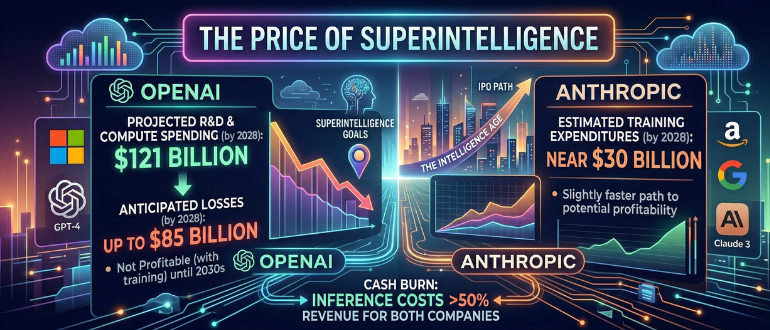
OpenAI, the creator of ChatGPT, projects it will spend a staggering $121 billion on computing power for research by 2028. Even with revenues expected to double annually, the company anticipates losses that year could reach $85 billion, a figure that would surpass the losses of any public company in history.
The primary engine of this cash burn is the escalating cost of training and inference, the processing of user queries. Currently, inference costs consume more than half of the revenue for both companies.
While OpenAI and Anthropic both report two versions of profitability -- one that excludes research compute and one that includes it -- the full picture is sobering.
Excluding research costs, OpenAI is on track for a small pretax operating profit this year. However, when training expenses are factored back in, the Microsoft Corp.-backed company does not expect to break even until the 2030s.
Funded by Amazon.com Inc. and Google, Anthropic forecasts a slightly faster path to profitability, though it still faces training expenditures near $30 billion by 2028.
An OpenAI spokesperson defended the strategy, saying the company is prioritizing growth over immediate profits. The firm continues to support millions of free users, viewing the broad adoption of its technology as a long-term investment that could eventually be monetized through advertising or premium subscriptions.
The sheer scale of capital required to sustain these operations is forcing a shift in the financial sector. Bankers are reportedly lobbying index providers to soften entry rules to accommodate the massive fundraising needs of these AI giants. The Nasdaq recently signaled it would allow newly listed companies to join its index faster, providing them access to broader capital pools.
The IPO timelines remain a point of intense speculation. Anthropic is reportedly weighing a public debut as early as October. Meanwhile, OpenAI is facing internal debates regarding its timing, with leadership split on when to pull the trigger on a listing that will likely redefine tech valuations.
As the financial pressure mounts, OpenAI is also pivoting toward a broader political and economic role. In a recently released 13-page policy document titled "Industrial Policy for the Intelligence Age," the company called for sweeping national reforms to prepare for the arrival of superintelligence.
Proposals include a national public wealth fund seeded by AI company profits, taxes on automated labor to offset job displacement, and pilots of a 32-hour work week to address shifting labor dynamics.
OpenAI CEO Sam Altman has likened the coming AI transition to the New Deal era, warning that while the economic potential is vast, the immediate risks -- particularly regarding cyber warfare and biological weapons -- require urgent legislative attention.
For investors, the proposition is clear: OpenAI and Anthropic offer the chance to own the foundation of the next industrial revolution. However, with breakeven points a decade away and costs measured in the hundreds of billions, the road to the Intelligence Age remains paved with unprecedented financial risk.