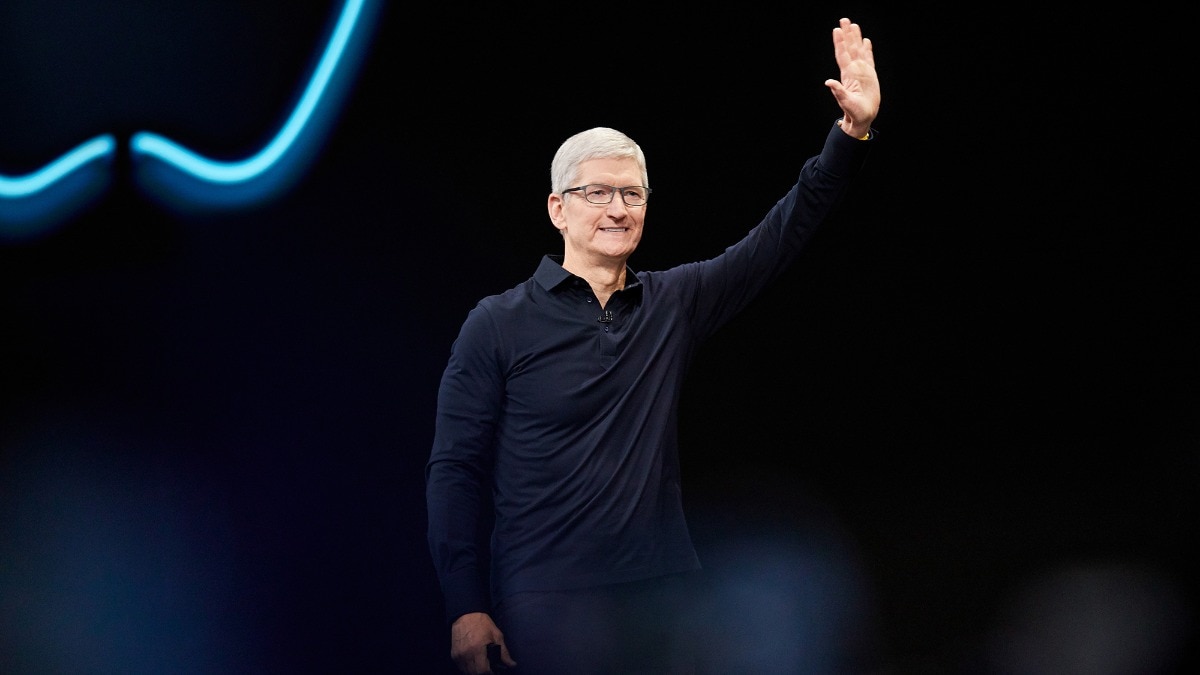
Tim Cook's legacy as Apple CEO is stability in middle of chaos, that stability is now worth $4 trillion
How do you measure success? If you were to ask this question to outgoing Apple CEO Tim Cook, he might answer with just one word -- quietly. That is because Cook has made "quietly" a defining feature of Apple in the last 15 years. The company has grown quietly quarter after quarter since Cook took the reins in 2011. It has turned into a behemoth, this giant that crushes its revenue targets again and again. And unlike most other tech giants, which make noise on a daily basis in this way or that, Apple keeps doing it quietly. That is the legacy of Tim Cook.
In 2011, when I was at the Times Of India, I wrote about Cook taking the baton from Steve Jobs, who was stepping away from an active role because of his cancer. Many people said many things about the transition. Being a tech journalist I too chimed in. In one of the pieces arguing how Apple would miss Jobs, I wrote that under Tim Cook "it can be more difficult for Apple to come up with unique, groundbreaking products and services."
Fifteen years later as I look back, I believe I got it mostly right. Tim Cook, who will hand over the CEO chair to John Ternus on September 1, has been different, very very different compared to Jobs. Under him Apple has also been, like I had predicted, unable to come with unique and groundbreaking products. Except M series chipsets, which essentially build on A series in the iPhone that Jobs started. Other than that AirPods and the Apple Watch have been great successes, but they were most definitely imagined and conceived during the Jobs era.
Numbers do tell a story
But looking back I also believe that I missed, or couldn't have predicted, the way Tim Cook has quietly gone about solidifying Apple into this company that can execute year after year with the precision of a Swiss watch. Apple might not have been able to recreate another iPhone or iPod under Cook, but in the last 15 years it has been due to Tim Cook that the company has become a household name with its products reaching millions of people.
The iPhone might have debuted nearly 30 years ago, but even now it sets the hearts racing every September when the new variants drop. The modern Mac might be a legacy gadget created nearly 40 years ago, but in 2026 it is still surging and defining the personal computer space, something that MacBook Neo showed just a few weeks ago. This is the legacy of Tim Cook.
Of course, if you ask a McKinsey analyst to define success, she would most likely talk about numbers. And Tim Cook has numbers on his side. When he stepped into the big shoes, Apple had a revenue of around $108 billion. In 2026, its annual revenue is over $416 billion. To put in context, this is bigger than the entire GDP of Pakistan. Or almost 70 per cent of India's total forex reserves. In 2011, Apple was making an annual profit of nearly $25 billion. In 2026, the figure is around $110 billion, making it one of the most profitable companies in corporate history. In 2011, Apple had a market capitalisation of around $350 billion. In 2026, it is a $4 trillion company!
Doing boring but reassuring things
But as a tech journalist -- and not as a financial journalist -- I find numbers boring. I believe the true legacy of Tim Cook has been the way he has kept Apple focussed, while internally giving it a culture that makes the company seem like an oasis of stability in the middle of Sam Altman-style chaos. In the last 15 years, the world has undergone some big changes. It is the middle of an era where everything is sifting under our feet. There are big political changes, geo-political changes, big social changes, changes in the way economies work. There are changes also in the supply chain, in the technology within our devices. The arrival of AI is shifting and shaking everything in the world of tech.
In the middle of these big changes, Tim Cook has kept Apple steady. There has been no pivot to the metaverse, similar to what Mark Zuckerberg did. No leadership fights similar to OpenAI dramas. Not even big ticket layoffs. There has been no big AI shift, similar to what Microsoft has done. Unlike Windows, which has become a hotchpotch of new AI and old legacy features, the main appeal of the MacBook has been its old-fashioned software, which is quiet in the way it works and solid.
Apple has been remarkably averse to changes. Its devices keep their design and looks for years, before there is some tweak. The Apple TV, that tiny gadget that you can connect to your television, looks the same as it did in 2010. The Apple software, although now more feature rich, keeps the basics similar to how they were 10 years ago. Whenever there have been changes, in most instances, these changes have been "quiet" changes. A nip and tuck here and there, a new feature added or removed as unobtrusively as possible.
Instead, under Tim Cook Apple has mostly focussed its energies on perfecting what it already has, in a way that adds to the stability. The company has spent much time and many resources in making its devices as robust as possible so that consumers can use them for years in the best possible manner.
At the same time, it has spent energy on keeping prices steady. One of the most remarkable things I have seen done by any tech company is the price of the vanilla iPhone in India. From 2020, when the company launched iPhone 12 to 2024 when it launched the iPhone 16, it kept the price same at Rs 79,900 even though the forex rate climbed, the supply chain shifted, components became more expensive and overall there was inflation all around. Only last year the company moved to a new higher price -- by Rs 3000 -- but then also doubled the storage, effectively making the new phone Rs 7,000 cheaper than the similar iPhone 16!
No wonder Apple has nearly 10 per cent market share in the Indian phone market despite not having budget phones in its portfolio. This too is the legacy of Tim Cook.
Finally, there is the quiet legacy of how Cook has made Apple a company that focuses on its work, instead of noise. Unlike Elon Musk companies, Cook and Apple do not pick political fights, neither with the US nor with China. They keep it steady, and at least outwardly, principled. Apple doesn't swing wildly on matters like immigrant workers, environment, or user privacy depending on which way winds are blowing. Apple doesn't chase the latest hot trend, just because the rest of the world is going crazy about it. In that sense, unlike many tech companies that nowadays work in prophetic mode with a mission to save humanity, Apple and Cook focus on selling their iPhones and Mac. We, the consumers, find it reassuring.
Siri is not a failure, Vision Pro is
None of this is to say that Cook and Apple have not faced failures. They have. Although, I don't think a dumb Siri is a failure. Or missing on AI is a failure. For a company like Apple, fixing Siri or getting on board with AI is going to be easy once it decides to go all-in on it. AI and Siri are failures only because, I believe, Apple is not yet entirely convinced that it warrants the attention others are willing to give. Apple is a hardware company that makes the best products in the categories where it plays. It doesn't want to spend $100 billion dollars on a smarter chatbot.
Instead, the one failure that I see is the Vision Pro. Apple probably saw what Mark Zuckerberg was doing with the metaverse and got carried away due to the conviction with which Zuckerberg was burning money. So, it too went big on virtual reality. But neither for Zuckerberg nor for Apple, the move has turned out to be a success.
Then there are a few missed opportunities. I believe, and I am fully aware of the fact that I am sitting lazily in the armchair of a journalist, Apple could have made two devices: a television and a gaming console. It has the ecosystem, it has the hardware knowhow, and it has a brand. It could have made a gaming console similar to Xbox or PlayStation. And two, a television would have tied up extremely well with everything that the company currently does. It could have been a perfect Apple ecosystem device.
But in the big picture these are mere smudges, not even blemishes. The last 15 years, on the whole, have been glorious for Apple. That is the legacy of Tim Cook. Steve Jobs gave the company its creative spark, a kernel of genius and a bevy of spectacular products. Tim Cook has shaped Apple into a brand that executes this vision to delight and serve millions and millions of users -- steadily, assuringly, without changing. In a world full of chaos and changes, that counts for something.