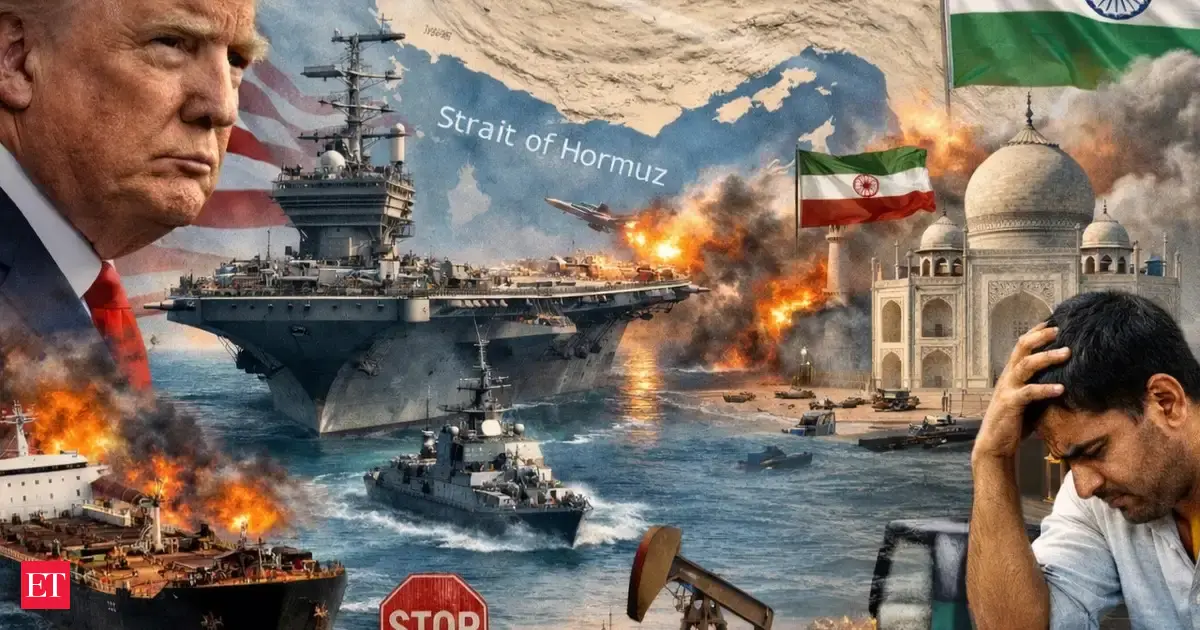
Trump's Hormuz blockade: What's at stake amid global chaos and ripple risks for India
A US-led naval blockade on Iran has sharply escalated tensions around the Strait of Hormuz, threatening global oil flows, trade routes and geopolitical stability. Oil prices have surged past $100 as shipping risks, insurance costs and supply disruptions ripple across markets. While enforcement remains complex and legally contested, the bigger risk lies in escalation and second-order effects -- especially for importers like India, which could face higher crude prices and tighter supply as global demand reshuffles.
A US-led naval blockade targeting Iranian ports and traffic linked to the Strait of Hormuz marks a sharp escalation in the conflict with Tehran, with consequences that stretch far beyond the Gulf -- threatening energy markets, supply chains, international law norms and fragile geopolitics.
At its core, the move by US President Donald Trump is an attempt to choke off Iran's oil lifeline and force it to reopen the strait, a corridor that typically carries nearly a fifth of the world's traded crude oil. But analysts warn the strategy is a high-stakes gamble: difficult to enforce, legally contested and potentially inflationary for the global economy.
The most immediate risk is to oil. With tanker traffic already disrupted by Iran's earlier restrictions, a US blockade compounds the squeeze. Crude has already surged past $100 a barrel from about $70 before the conflict, and analysts warn prices could spike further if flows remain constrained.
A prolonged disruption risks trapping large volumes of Gulf oil, tightening supply just as demand remains steady. For consumers, that translates into higher fuel and transport costs globally, with Asia particularly exposed due to its dependence on Middle Eastern crude.
The disruption is not limited to oil. Roughly 30% of global fertiliser shipments and significant volumes of food and chemicals transit the strait, raising the prospect of broader commodity inflation and supply shortages.
Shipping through the Strait of Hormuz has already slowed sharply, and a militarised blockade adds new layers of risk -- higher freight rates, insurance premiums and logistical uncertainty. Even without full enforcement, the perception of danger is enough to deter vessels.
Supply chain experts warn of cascading effects: higher costs for basic materials, disrupted agricultural inputs and pressure on global harvests.
The result is a ripple effect that "bleeds out throughout the whole world," as Patrick Penfield, professor of supply chain practice at Syracuse University was quoted by AP as saying.
Enforcing the blockade presents operational challenges. The narrow but heavily trafficked strait would require sustained deployment of US naval assets to monitor and potentially seize vessels.
At the same time, Iran retains asymmetric capabilities -- from naval mines to fast-attack boats and missiles -- that could target shipping and escalate the conflict. Tehran has already warned it could strike ports across the Gulf if its own exports are choked off.
That raises the risk of a broader regional confrontation.
The blockade also raises complex questions under international law. Naval blockades must be applied impartially and allow humanitarian supplies; failure to do so could render the action unlawful.
Diplomatically, the move risks straining ties with allies and trading partners whose vessels may be caught in enforcement actions. Countries across Asia, Europe and beyond could face difficult choices between complying with US directives and securing critical energy supplies.
More broadly, the episode underscores growing pressure on the principle of freedom of navigation, a cornerstone of global trade.
For India, the risks are less about direct Iranian supply and more about global market shifts.
Sumit Ritolia, Manager Modelling and Refining at Kpler, told Times of India that it is "still early to draw definitive conclusions" on the impact, noting that India's direct exposure to Iranian crude remains limited. However, he flagged second-order effects as the real concern.
"The situation is a bit more nuanced than a straightforward 'blockade impact,' but the real risk lies in the second-order effects, particularly via China," he said.
If China, currently lifting the bulk of Iranian crude, faces disruptions, it will turn to alternative suppliers, intensifying competition for barrels that India also depends on. That could push benchmark prices higher, tighten availability of medium-sour crude and raise freight and insurance costs.
In the coming weeks, Ritolia expects upward pressure on prices driven by China's rebalancing, tighter availability of discounted barrels and a higher import bill for India even if volumes remain stable.
Sourav Mitra, Partner - Oil & Gas at Grant Thornton Bharat, told Times of India the impact goes beyond hydrocarbons. "Even though the Americans have said the blockade only applies to Iranian Ports, crude oil prices have again breached $100/Bbl as insurers, shippers and traders' price in higher geopolitical risk," he said.
Historically, blockades have been tools of economic pressure rather than decisive solutions. While they can strain an adversary's economy, they rarely achieve quick outcomes -- and often provoke countermeasures.
In this case, the stakes are unusually high. A successful blockade could squeeze Iran's revenues and force negotiations. But failure -- or escalation -- could deepen a global energy crisis, disrupt trade flows and test the limits of military and legal norms.
For now, markets and governments alike are bracing for a prolonged period of volatility, where the cost of disruption may be felt far beyond the Gulf.
(You can now subscribe to our Economic Times WhatsApp channel)