Unconventional orbital currents and torques due to ferro-rotational orbital textures - npj Spintronics
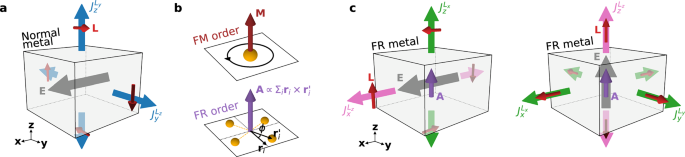
In this work, we demonstrate the electrical generation of unconventional orbital currents in FR systems that preserve both and symmetries. Symmetry arguments reveal that these -even rotation-induced orbital currents -- analogous to -odd magnetization-induced spin currents in FM systems -- manifest as (i) longitudinal orbital currents polarized along the FR axis and (ii) unconventional orbital Hall currents with polarization collinear with either the charge or orbital current [e.g., see (Fig. 1c). Tight-binding calculations show that these effects are driven by an electric hexadecapole (16-pole) moment arising from the FR order, through an intrinsic and nonrelativistic mechanism. To corroborate these findings, we perform first-principles calculations for the FR material TiAu4. Finally, we explore the experimental implications of rotation-induced orbital currents by studying an FR/FM bilayer within a tight-binding framework, demonstrating current-induced orbital accumulation in the FR layer as well as orbital torque in the FM layer. We further suggest that this unconventional orbital torque can enable deterministic, field-free switching of the FM order, pointing to a promising route for orbitronics research based on novel ferroic orders and higher-order electric multipoles.
In the linear-response regime, the orbital current J (or spin current J) generated by an electric field E is expressed as , where X = L or S. Here, α and γ denote the orbital (spin) current flow and polarization directions, respectively. The rank-3 orbital (spin) conductivity tensor σ (σ) can generally be decomposed into -even and -odd contributions, with their nonzero components dictated by the system's symmetry. For example, in a nonmagnetic cubic system with point group O, only the -even conventional Hall components of , where α, β, and γ are mutually orthogonal, are symmetrically allowed.
Symmetry breaking due to ferroic orders can induce additional nonzero components of σ. Here, we focus on ferroic orders that preserve symmetry, classified into two types: -odd FM order and -even FR order. In a cubic system, the FR and FM orders aligned along the z direction reduce the symmetry, leading to the point group 4/m and the magnetic point group , respectively. For both cases, the nonzero components of the total σ are given by refs. (see Supplementary Note 1 and Supplementary Table 1 for all nonmagnetic crystallographic point groups):
In addition to the -even conventional Hall components (, , and ), the components induced by ferroic orders can be categorized into two groups: (i) diagonal components ( and ), describing longitudinal currents polarized along the order parameter (pink arrows in Fig. 1c), and (ii) off-diagonal components ( and ), representing unconventional Hall currents, where the polarization is collinear with either E or J (green arrows in Fig. 1c). It is worth noting that, in the presence of the first-type longitudinal components , the second-type Hall components take the form . This implies a conversion of a primary current into a secondary current (or of into ) for α ≠ β, corresponding to spin swapping or orbital swapping.
These ferroic-order-induced currents inherit the -parity of the associated order parameters. In -odd FM metals, -odd longitudinal spin currents are electrically generated due to the nonrelativistic spin-polarized band structure. Additionally, -odd unconventional spin Hall currents -- also known as the magnetic spin Hall effect or spin swapping -- arise from SOC. These magnetization-induced spin currents in FM metals can accompany the relativistic -odd orbital currents via SOC, e.g., the magnetic OHE. In contrast, in -even FR systems, the rotation-induced orbital currents can be generated, including the longitudinal orbital currents and unconventional orbital Hall (or orbital swapping) currents. Importantly and distinctively, they require neither broken nor SOC, as will be demonstrated.
Rotation-induced longitudinal orbital current
To see how the orbital current can be generated in FR systems, we introduce a minimal tight-binding model with a relevant order parameter. The OAM dynamics can be driven by multipole degrees of freedom. Although the FR order is often described by an axial vector, such as the electric toroidal moment, we focus here on another emergent multipole in FR systems: the electric hexadecapole moment (rank-4), H ∝ xy(x - y) (Fig. 2a), which is even under and . The quantum mechanical operator for this can be constructed by replacing r = (x, y, z) with the OAM operators . Accordingly, we define an atomic-site electric hexadecapole moment operator as
where and ℏ is the reduced Planck constant. Note that can emerge under the point group 4/m exhibiting the FR order along the z direction. In the atomic d-orbital basis {}, Eq. (2) simplifies to , which implies that hybridizes orbital wave functions, effectively rotating them around the z-axis, as illustrated in Fig. 2b.
Let us introduce a two-dimensional square lattice tight-binding model incorporating . We adopt a minimal two-orbital basis {} for describing . Considering only nearest-neighbor hopping, the Hamiltonian is given by
where k is the crystal momentum, a is the lattice constant, is the identity matrix, are the pseudospin Pauli matrices, and is determined by the Slater-Koster hopping parameters in units of eV. The term in Eq. (3) accounts for the crystal field that splits d and levels. The effect of the FR order along the z direction is incorporated through , which is equivalent to in the two-orbital basis, with its magnitude set by Δ = 0.1 eV. Figure 2c shows that a gap between d and bands is opened due to the electric hexadecapole moment. Near the gap, the eigenstates , with energies ϵ ≈ ± Δ, yield the expectation values . We note that corresponds to the submatrix of that is defined in the full d-orbital basis, so effectively captures the out-of-plane OAM.
Here, we derive an intuitive picture of how an electric field E drives the dynamics of for a single Bloch state near the gap. Under , an electron with charge -e after time δt acquires momentum δk = - eEδt/ℏ, leading to the perturbation . The dynamics of follow the Bloch equation , where B(k) is the effective magnetic field satisfying , with arising from the electric-field-induced crystal field variation. In the vicinity of the band gap, with an initial condition , the solutions for small deviations from equilibrium are given by , , and
This result shows that the electric hexadecapole moment undergoes precession due to the intrinsic crystal field that acts as a current-induced effective field, generating the nonequilibrium OAM . This behavior resembles spin dynamics in FM systems under an intrinsic spin-orbit field, although the effect here is nonrelativistic. Note that in Eq. (4) diverges as Δ → 0, but the net value vanishes as the gap closes.
Although the net OAM (or ) vanishes upon k-integration, the net orbital current remains finite, leading to a nonzero . The conventional orbital current operator is defined as , where is the velocity operator. Substituting and , the longitudinal orbital current to first order in E is given by
Integration of Eq. (5) over k-space yields a finite value, confirming the emergence of a rotation-induced orbital current driven by an intrinsic, nonrelativistic mechanism associated with a higher-order electric multipole.
Unconventional orbital Hall current
Additional orbital currents can emerge in multi-orbital systems exhibiting richer orbital texture. To explore this, we construct a three-dimensional tight-binding model for an FR system with the point group 4/m (Fig. 3a; see Methods and Supplementary Note 2), which constrains σ as given in Eq. (1). The tetragonal unit cell consists of A atoms with five d orbitals, and B atoms with an s orbital. The FR order along the z-axis arises from a rotational displacement of the four B atoms by an angle ϕ. The hopping pairs included in the model are shown in Fig. 3a. The next-nearest-neighbor hopping between d orbitals gives rise to the momentum-dependent d-orbital texture responsible for the conventional OHE. Its amplitude is assumed proportional to that of the nearest-neighbor hopping, with the proportionality factor η initially set to 0.5. The hopping between s and d orbitals, which depends on ϕ, characterizes the FR order.
Figure 3b shows the band structure of this model with ϕ = 20°, which exhibits a nonzero expectation value of [defined in Eq. (2)] in equilibrium. Unlike earlier works, where was manually introduced into the Hamiltonian, in this model, it naturally emerges from structural rotation. It is noteworthy that downfolding our Hamiltonian into the two-dimensional d-orbital subspace yields a term proportional to for small ϕ (see Supplementary Note 3), revealing a direct connection between the electric hexadecapole moment and the FR order.
We now proceed to compute the -even part of the orbital conductivity tensor σ using the Kubo formula (see Methods). Figure 3c presents numerical results for the nonzero orbital conductivity components for different values of ϕ, with . The longitudinal () and unconventional orbital Hall () components (e.g., see Fig. 1c), represented by pink circles and green triangles, respectively, vanish at ϕ = 0 and reverse sign under FR-order-reversal (ϕ → - ϕ). In contrast, the conventional orbital Hall components, indicated by blue × and orange + symbols, remain finite at ϕ = 0 and are invariant under FR-order-reversal. These results clearly demonstrate that rotation-induced OHE and conventional OHE have distinct physical origins, while both are -even and nonrelativistic.
To further investigate the mechanism behind rotation-induced orbital currents, we compute for different values of η, which controls the next-nearest-neighbor hopping amplitudes, while fixing ϕ = 20° (Fig. 3d). We find that only the longitudinal component remains finite for η = 0, indicating that it arises solely from the FR order, specifically the electric hexadecapole moment, as demonstrated by our two-orbital model. On the other hand, both conventional and unconventional Hall components emerge as η increases, suggesting that the rotation-induced OHE requires not only the FR order but also the orbital texture responsible for the conventional OHE. This phenomenon can be understood in terms of nonrelativistic orbital swapping -- an orbital analog of spin swapping. It has been shown that in FM metals, a spin-polarized current is converted into a swapped spin current through the interplay of the orbital texture and SOC. Similarly, our results show that the longitudinal orbital current , induced by the FR order, is converted into the unconventional orbital Hall current (or into when ) via the orbital texture. Notably, this conversion does not require SOC, in contrast to spin swapping.
First-principles calculation for TiAu
Next, we investigate the FR material candidate, tetragonal TiAu (space group I4/m) using first-principles calculations (see Methods). The crystal structure exhibits the FR order along the z-axis (Fig. 4a), leading to a nonzero electric hexadecapole moment (Fig. 4b). The orbital conductivity tensor σ takes the same form as Eq. (1), with seven independent nonzero components of , including those for α = x () and α = z (). The rotation-induced orbital currents associated with these components are illustrated in the left and right panels in Fig. 1c, respectively. The components for are related to those for by four-fold rotational symmetry about the z-axis. By evaluating the Kubo formula, the nonzero components are obtained as functions of the chemical potential. For (Fig. 4c), the conventional Hall components exceed 1000(ℏ/e)(Ω cm) at the Fermi level. Additionally, we identify rotation-induced components, including the longitudinal orbital conductivity and the unconventional orbital Hall conductivity . For (Fig. 4d), the rotation-induced components are smaller, with and . The magnitude of the unconventional terms depends on the FR orbital texture (e.g., see Fig. 3), motivating further materials exploration.
While the orbital conductivity is fully nonrelativistic, the corresponding nonzero components of the spin conductivity tensor can manifest, too, due to SOC. When SOC is present, not only the electric multipole moments but also the atomic-site electric toroidal moments, defined in the spinful basis, can emerge from the FR order, contributing to the -even spin current generation. A key distinction, however, is that the spin conductivity vanishes in the absence of SOC, whereas the orbital conductivity remains largely unaffected by SOC due to its nonrelativistic origin (see Supplementary Note 4). Furthermore, the -even orbital conductivity arises purely from the interband contribution, which is robust against scattering time (see Supplementary Note 4), while possible extrinsic contributions are not considered. By contrast, the -odd conductivity in FM systems is dominated by the intraband contribution that scales with the scattering time, but it is prohibited here by invariance.
Unconventional orbital torque and field-free switching
So far, we have discussed rotation-induced orbital currents based on the conventional definition of the orbital current operator, which is not directly measurable. In this section, we show that FR order gives rise not only to orbital currents but also to effects that can be probed experimentally, such as OAM accumulation and orbital torque. To illustrate this, we examine an FR/FM bilayer using a tight-binding model (Fig. 5a; see Methods). In our model, under , the FR layer with generates conventional () and unconventional () orbital Hall currents without spin currents, while the FM layer does not produce orbital or spin Hall currents on its own. This design ensures that the current-induced torque on magnetization M in the FM layer originates solely from the OAM injection by the FR layer.
Within linear-response theory, we compute the current-induced non-equilibrium OAM (δL) and spin (δS) in the FR/FM system with , where is the unit vector of M (Methods). Figure 5b shows the layer-resolved δL per applied electric field. Large OAM components along x and y appear near the top and bottom surfaces of the FR layer, demonstrating orbital accumulation from the unconventional (δL) and conventional (δL) orbital Hall currents. The induced OAM is transferred across the FR/FM interface and subsequently interacts with M. This generates δS, which acts as an effective field for the torque . In particular, the spin-orbit precession with δL results in , leading to the damping-like orbital torque . Due to the presence of δL and δL, we obtain , where and are the effective fields for the conventional and unconventional orbital torques, respectively. The effective fields per charge current density J are estimated in our model (see Methods) as and , which fall within the range of reported values for spin-orbit torque devices using heavy metals.
To gain further insight into how these orbital torques contribute to magnetization switching, we simulate magnetization dynamics within a macrospin model. The dynamics of is described by the Landau-Lifshitz-Gilbert equation
where γ is the gyromagnetic ratio, B is the magnetic anisotropy field, and α is the Gilbert damping parameter. We consider a type-x geometry, in which an easy axis is collinear with the charge current, i.e., . Parameters are set to α = 0.05 and B = 30 mT. The same and obtained above are used here, together with current pulses of J = ± 10 A/m. Figure 5d shows the trajectory of over time t upon a current pulse, illustrated in Fig. 5e. Initially, points along (t = t). The current pulse exerts the damping-like orbital torques on the magnetization. Because of the presence of , is not perfectly aligned with but instead slightly tilted toward (t = t), as shown in Fig. 5f. Hence, after the pulse is turned off, relaxes deterministically to (t = t) without the aid of an external magnetic field. Figure 5e, f illustrates the repetitive switching between under opposite current pulses. These results demonstrate that unconventional orbital torques from FR materials offer a viable route to field-free magnetization switching.