Unconventional "Superionic" State Of Matter Could Exist Deep Within Uranus And Neptune
The rest of this article is behind a paywall. Please sign in or subscribe to access the full content.
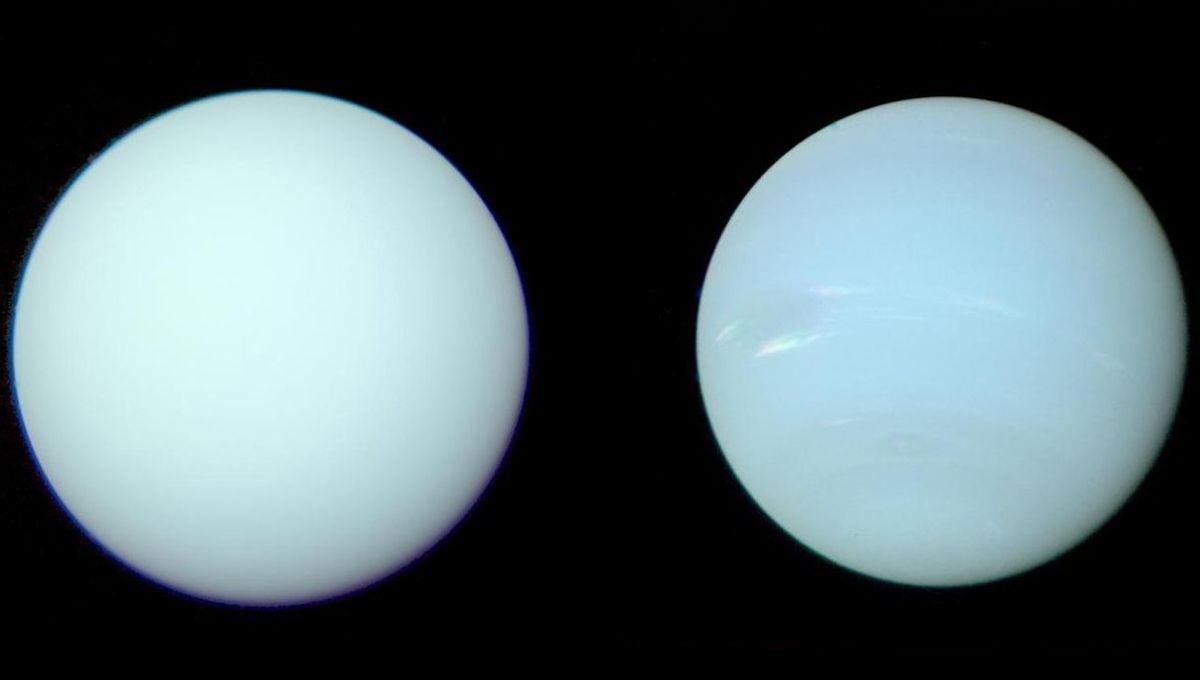
Based on measurements from Earth and up close from the Voyager 2 spacecraft, planetary scientists believe that under atmospheric layers rich in hydrogen and helium, Uranus and Neptune might sport layers of "hot ices" resting above a rocky core. These ices are mainly water ice, methane, and ammonia, though due to the high temperatures and pressures, some weird phase of matter might emerge.
The authors of this new research produced quantum physics simulations of what would happen to carbon hydride - a simple carbon-hydrogen molecule - under extreme conditions: pressures from nearly 5 million to nearly 30 million times atmospheric pressure, and temperatures normally found on the surface of the Sun.
They found that a superionic material emerges with truly unconventional properties. A superionic substance is a solid-liquid hybrid where one type of atom is in a crystalline lattice, while the other type of atom moves. In this case, the carbon is organized in hexagonal structures, and the hydrogen moves about, but only along a spiral pathway, making this a quasi-one-dimensional superionic state.
"This newly predicted carbon-hydrogen phase is particularly striking because the atomic motion is not fully three-dimensional," study author Ronald Cohen, from Carnegie Science, said in a statement. "Instead, hydrogen moves preferentially along well-defined helical pathways embedded within an ordered carbon structure."
The existence of such a theorized state of matter might have big implications for the planets. It could affect internal electrical conductivity and magnetism. The magnetic field of Uranus, for example, is a complicated mess. Uranus spins, roughly, on its side, pointing one pole and then the other at the Sun. Its magnetic field is misaligned by 59 degrees, and it doesn't even go through the planet's center. Could the superionic carbon-hydrogen phase help explain that?
Understanding the origin of the ice giants' magnetisms might have to pass through some exotic and unconventional substances deep within them. This has also got implications for the many exoplanets out there. Whether similar or not in appearance to our own ice giants, they could have some unexpected state of matter lying within.
"Carbon and hydrogen are among the most abundant elements in planetary materials, yet their combined behavior at giant-planet conditions remains far from fully understood," study author Cong Liu, also from Carnegie Science, concluded.