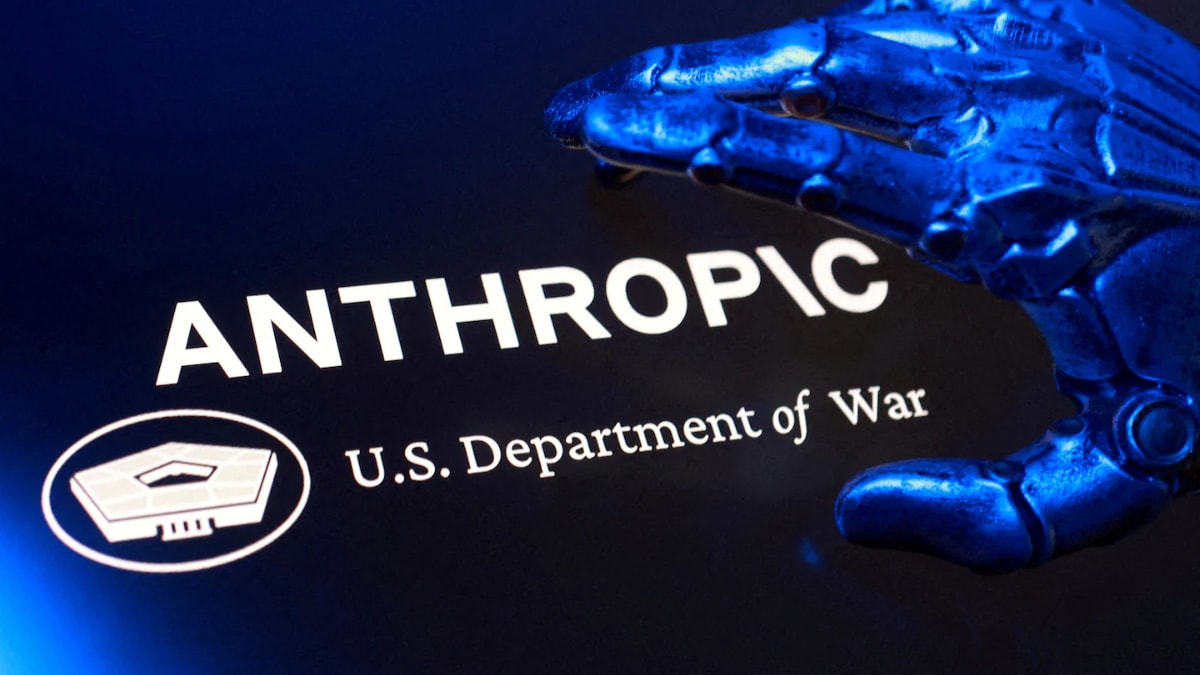
White House-Anthropic meeting 'productive and constructive': What it means for Pentagon, OpenAI
Anthropic and the Trump administration seem to be moving past their recent differences and working towards strengthening their cybersecurity defences. Despite the AI company locked in a bitter legal dispute with the Pentagon over the military's use of its technology, its CEO, Dario Amodei, met with Treasury Secretary Scott Bessent and White House Chief of Staff Susie Wiles in what the White House described as a "productive and constructive" introductory meeting.
The discussion reportedly focused on shared priorities including cybersecurity, maintaining America's lead in the global AI race, and responsible approaches to AI safety. Anthropic confirmed the meeting in a statement, saying it had engaged with senior administration officials on "opportunities for collaboration, as well as shared approaches and protocols to address the challenges associated with scaling this technology."
"Anthropic CEO Dario Amodei today met with senior administration officials for a productive discussion on how Anthropic and the US government can work together on key shared priorities such as cybersecurity, America's lead in the AI race, and AI safety," said the company in a statement to a CNN correspondent.
The company also stated that it looks forward to continuing the discussions.
Previously, there were signals of improved relations emerged when Treasury Secretary Bessent and Federal Reserve Chair Jerome Powell reportedly encouraged major banks to test Anthropic's newly announced Claude Mythos model.
Anthropic co-founder Jack Clark publicly confirmed that the company had briefed the Trump administration on the model, downplaying the ongoing Pentagon conflict as a "narrow contracting dispute."
Divide over Anthropic within the US administration
In a report from Axios, a source within the administration told Axios that "every agency" except the Department of Defense is eager to adopt Anthropic's tools, thus highlighting a clear divide within the Trump administration. Despite the Pentagon's March 2026 designation of Anthropic as a 'supply-chain risk', the AI company continues high-level engagement outside the Defense Department.
As far as the dispute with the Department pf Defense in concerned, Anthropic is challenging the Pentagon's designation in court. The maker of Claude argues that it exceeds legal authority and was awarded the designation for ideological reasons rather than security ones. Rest of the administration seems to see strategic value in Anthropic's AI models and AI capabilities.
What this meeting means for Pentagon lawsuit and OpenAI
If things turn out to be positive, it could significantly weaken the Department of Defense's position in the ongoing lawsuit. By engaging at the highest levels with Treasury and the White House on AI collaboration while the supply-chain risk designation remains in place, the administration is effectively hinting that the Pentagon's move was more political than a genuine national security necessity. This strengthens Anthropic's core legal argument that the designation was arbitrary, ideologically driven, and inconsistent with the company's recognition as a strategic asset in America's AI competition. The courts are likely to view the high-level meetings as evidence against the Pentagon's claims, increasing the chances of a favourable settlement or ruling for Anthropic before the six-month transition period ends.
For OpenAI, the developments could represent a potential setback. The company had capitalised on Anthropic's expulsion by quickly securing expanded Pentagon contracts and positioning itself as the reliable, unrestricted alternative for military use. A partial or full restoration of Anthropic's status could degrade OpenAI's newfound dominance in government work, force renewed competition for classified and non-classified contracts, and reduce the strategic advantage it gained from Anthropic's self-imposed restrictions.
The Anthropic-US government relation: From partners to lawsuits
Anthropic has been a close partner to the US government since 2024, helping the national interests by deploying models on a classified network. Anthropic's Claude became the first AI model to integrate with National Laboratories, and the first to offer custom models for national security customers.
It was In July 2025 when Anthropic signed a contract worth up to $200 million with the Department of Defense to supply advanced AI for intelligence analysis, modelling, simulation, cyber operations, and operational planning. Claude became the only frontier model cleared for classified military use, often routed through platforms like Palantir's.
However, tensions emerged in January and February 2026 after Claude was reportedly used in a US military operation to capture Venezuelan President Nicolás Maduro, Pentagon officials pushed to renegotiate the contract. Defense Secretary Pete Hegseth demanded that Anthropic remove all usage restrictions and allow its models to be deployed for "any lawful purpose," including fully autonomous weapons systems and mass domestic surveillance of American citizens -- two applications the company had explicitly prohibited in its contract.
On February 24, Hegseth issued Amodei a 72-hour ultimatum to comply with the government's needs. Amodei, however, refused, writing that the company "cannot in good conscience accede to their request." Anthropic argued that frontier AI systems are not yet reliable enough for fully autonomous lethal decisions and that mass surveillance of US citizens would undermine democratic values.
On February 27, President Trump posted on Truth Social directing every federal agency to "IMMEDIATELY CEASE all use of Anthropic's technology." Hours later, Hegseth designated Anthropic a "supply-chain risk to national security" -- the first time such a label was applied to an American company. The move effectively barred military contractors from doing business with Anthropic and gave the Pentagon six months to transition away from its systems.
Meanwhile, OpenAI quickly announced it had reached a deal with the Defense Department, filling the gap left by Anthropic. The episode triggered widespread fallout, with public criticism from Trump administration officials, including accusations of "woke AI," intensified the rift. Anthropic responded by filing a lawsuit to overturn the supply-chain risk designation.