News & Updates
The latest news and updates from companies in the WLTH portfolio.
I was wrong: Elon Musk accepts Anthropic is AI leader, calls Mythos best model ever
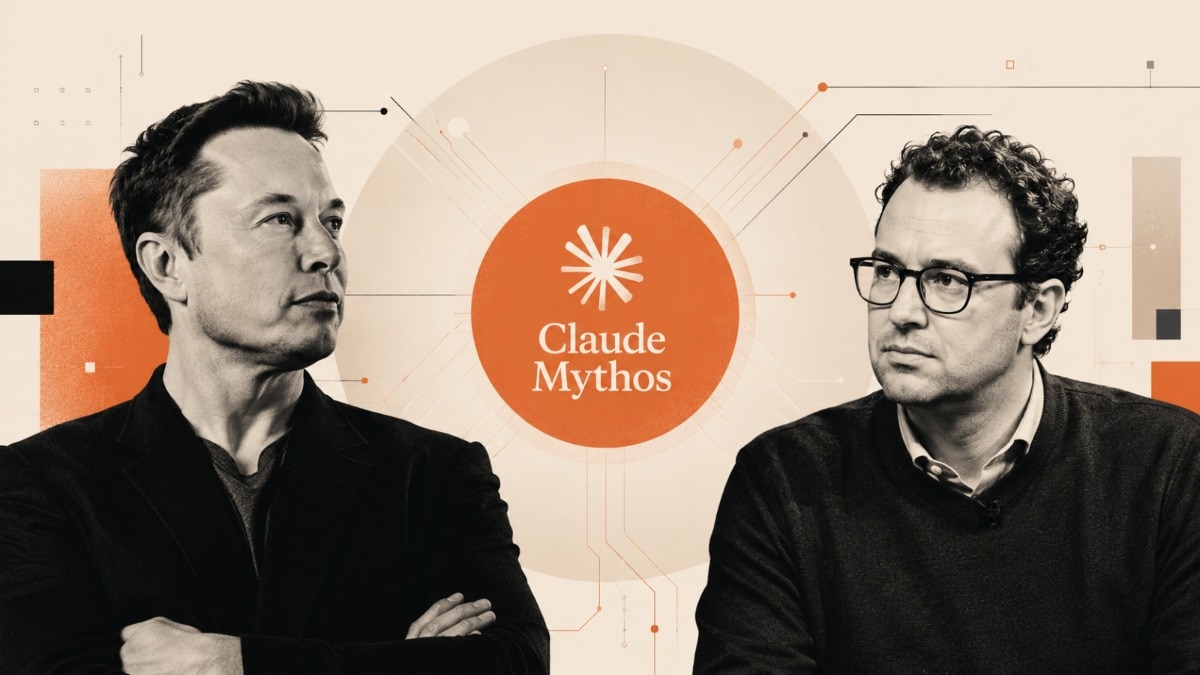
Elon Musk says he was wrong about Anthropic. (Representational image made with AI) Elon Musk is not afraid to speak his mind, particularly when it comes to his rivals - just look at his feud with OpenAI's Sam Altman. But when it comes to Anthropic, the tech trillionaire seems to have made a U-turn, and accepted that he was completely wrong. On X, a user reposted Elon Musk's comments from September last year, where the SpaceX chief declared that "Winning was never in the set of possible outcomes for Anthropic." Musk, however, gave a candid response as he accepted that Anthropic was really leading the AI race. The SpaceX chief replied, "I was clearly wrong about Anthropic. They are obviously currently the leader in AI." In particular, Elon Musk praised Anthropic's Claude Mythos and Fable models. The two models were previously restricted by the US following concerns over cybersecurity. While Musk's SpaceXAI recently released Grok 4.5, and OpenAI, too, has launched GPT-5.6, the tech trillionaire believes that Anthropic remains a league ahead. Musk added, "No company has released a model as good as Mythos/Fable and they will undoubtedly have Mythos 2 ready soon." Keep in mind that in February this year, Elon Musk had fired shots at Anthropic, accusing the company of being "misanthropic and evil." To give you some context, the words anthropic and misanthropic come from the Greek word "anthropos" meaning human being. While anthropic relates to humanity, misanthropic refers to distrust towards humanity. Can Elon Musk cutoff Anthropic from SpaceX compute? Since Elon Musk made such comments about Anthropic, a lot has changed. Anthropic is now one of the largest customers of SpaceX. In May, the AI startup Anthropic signed a deal to lease the Colossus 1 supercomputer. The Colossus 1 includes more than 2,20,000 Nvidia GPUs with a capacity of 300 megawatts of compute. Under the arrangement, Anthropic agreed to pay about $1.25 billion a month through May 2029, in a deal described as worth roughly $40 billion in revenue for SpaceX's xAI unit. But either side can end the agreement on a 90-day notice. This has raised questions that Elon Musk may now hold leverage, as he can decide to turn off the compute access at any time. Keep in mind that SpaceXAI (previously xAI) is a direct rival to Anthropic, and the Grok 4.5 model is designed for coding, a field dominated by Anthropic's Claude Code. The user wrote, "If Elon wanted to kill Anthropic, he could. Iirc the compute lease was short term, 6 months from May without renewal promise." But Musk insists that he has no plans to use such a kill-switch. He said, "And I would never cut them off in a way that hurt them badly, even as a competitor. That's not my style." Elon Musk then cited examples from his other businesses. He pointed out that Tesla had open-sourced its patents and made the Supercharger network available to competitors, "even though we could have made it a walled garden." The tech trillionaire also discussed the platform X where he is often criticised. Musk wrote,"Even my worst enemies can attack me on this platform." The relationship also raises questions about what a host company can learn from supporting a rival's systems. During Musk's lawsuit against OpenAI, he acknowledged that AI "distilling" was real, a process described in the inputs as one company using multiple fake accounts to prompt a competitor's model and learn how it works. When asked whether xAI had ever distilled technology from OpenAI, Musk replied, "Generally AI companies distill other AI companies." Anthropic has previously accused Chinese model makers of doing this to Claude.
Z.ai Launches Programming Agent In Latest Anthropic Challenge
China's Zhipu AI brings out autonomous programming agent framework ZCode as it squares off against Anthropic, OpenAI worldwide Getting your Trinity Audio player ready... Chinese start-up Zhipu AI, also known as Z.ai, has launched a framework for using its tools in semi-autonomous coding agents, as it ramps up competition with Anthropic. The company, which trades on the Hong Kong stock exchange as Knowledge Atlas Technology - the English rendition of its Chinese name Zhipu Huazhang Keji - said the new ZCode harness would work with its latest mode GLM-5.2. ZCode helps large language models such as GLM-5.2 execute tasks autonomously, allowing them to be used to help independently collaborate on programming projects. AI programming Such tools have seen a surge in popularity since Anthropic's Claude Code became a viral success last autumn. Along with ZCode, Zhipu rolled out promotions including 50 percent higher data limits for existing subscribers and 5 million free tokens for new ZCode users. Zhipu's head of global operations, Li Zixuan, said in a social media post that the company had built ZCode with input from the developer community. Worldwide popularity The company has been taking advantage of recent disruption to Anthropic's latest releases to push GLM-5.2 out to more users, turning it into the third most widely used model worldwide, after models from Anthropic and OpenAI, according to rankings from Arena AI. Anthropic restored access to its latest models Mythos 5 and Fable 5 last week after the US administration lifted security restrictions.

'I was wrong about Anthropic', Elon Musk hails Claude Fable after Grok 4.5 release
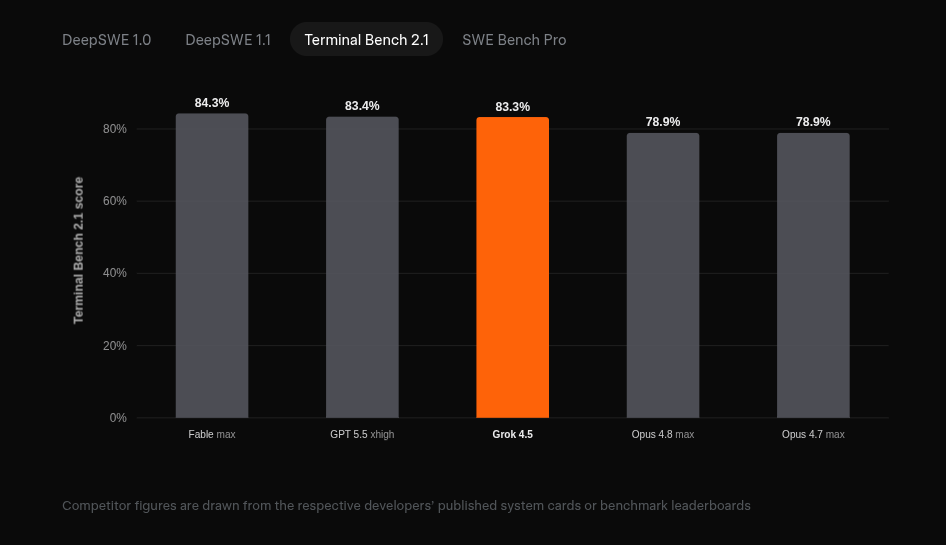
Billionaire entrepreneur Elon Musk has publicly conceded that he was wrong about Dario Amodei's Anthropic, one of the biggest rivals of SpaceXAI, a year ago. Writing on social media as a reply to a post, Musk publicly admitted he was "clearly wrong about Anthropic." Musk's humble admission came hours after SpaceXAI released Grok 4.5 to the public, acing synthetic benchmarks as far as coding is concerned. Replying to a discussion initiated by a user regarding the competitive landscape, Musk walked back years of harsh criticism against Anthropic, which is currently leading the AI market with its Claude Fable and Opus 4.8 models. "I was clearly wrong about Anthropic," Musk wrote. "They are obviously currently the leader in AI. No company has released a model as good as Mythos/Fable and they will undoubtedly have Mythos 2 ready soon. And I would never cut them off in a way that hurt them badly, even as a competitor. That's not my style," he assured in his post. Musk's latest statements represent a complete 180-degree turn from his previous rhetoric. In September 2025, he bluntly asserted that "winning was never in the set of possible outcomes for Anthropic." More recently, in February 2026, after Anthropic raised a staggering $30 billion funding round, Musk slammed the company's Claude models as biased and predicted that the firm was "doomed." Musk's direct challenge to Anthropic followed by high praise Over the past year, Anthropic set the tone for the commercial AI industry by tuning its AI model for the developer community, and focusing on productivity tools. Claude, in its top-tier avatars, has been highly capable at coding, and its Fable 5 and Mythos 5 models have showcased what these models can do for cybersecurity and code development. To make its AI product more competitive, SpaceXAI is pushing Grok into the coding space and with Cursor - the AI startup focused on vibe coding - onboard the SpaceXAI team, Musk's team released Grok 4.5. The latest Grok 4.5 is heavily marketed as an "Opus-class model, but faster, more token-efficient, and lower cost." Priced at $2 per million input tokens and $6 per million output tokens, Grok 4.5 is intentionally positioned to aggressively undercut Anthropic's Claude enterprise pricing structure, all while offering similar levels of performance. Yet, even as Musk praised his model's real-world software engineering capabilities, he acknowledged that Anthropic's Mythos 5 and Fable 5 models as the gold standard in terms of raw capability. Independent evaluations back up Musk's humility. According to data from Artificial Analysis, while Grok 4.5 immediately established itself as the top-performing non-Anthropic model on the market, Anthropic's offerings still hold the definitive edge at the top of global benchmarks. Musk addresses the $40 billion compute question Musk's public reassurance eases all concerns related to cutting off Anthropic from its compute power, despite the rivalry between the two tech moguls. Back in May 2026, Anthropic signed a major infrastructure agreement to lease the entire capacity of SpaceX's Colossus 1 data center facility in Memphis. Powered by over 220,000 Nvidia GPUs and pulling more than 300 MW of power, the deal requires Anthropic to pay SpaceX roughly $1.25 billion monthly through 2029, putting the total value of the contract at over $40 billion. Previously, rumours had it that SpaceX might exercise a 90-day exit clause in the lease to stifle Anthropic's compute resources. Musk, however, shut down that speculation, pointing to a personal philosophy of competition based on principles. "Tesla open sourced its patents and we made the Supercharger network available to all competitors, even though we could have made it a walled garden. SpaceX launches competing satellite systems with no increase in price or use of unfair terms," wrote Musk, addressing how his companies help the competition. "Even my worst enemies can attack me on this platform," wrote Musk, referring to harsh critics and his rivals posting on X, opposing Musk's methods.
From Critic To Admirer? Elon Musk Praises Anthropic's Mythos, Fable; Calls It 'Leader In AI'
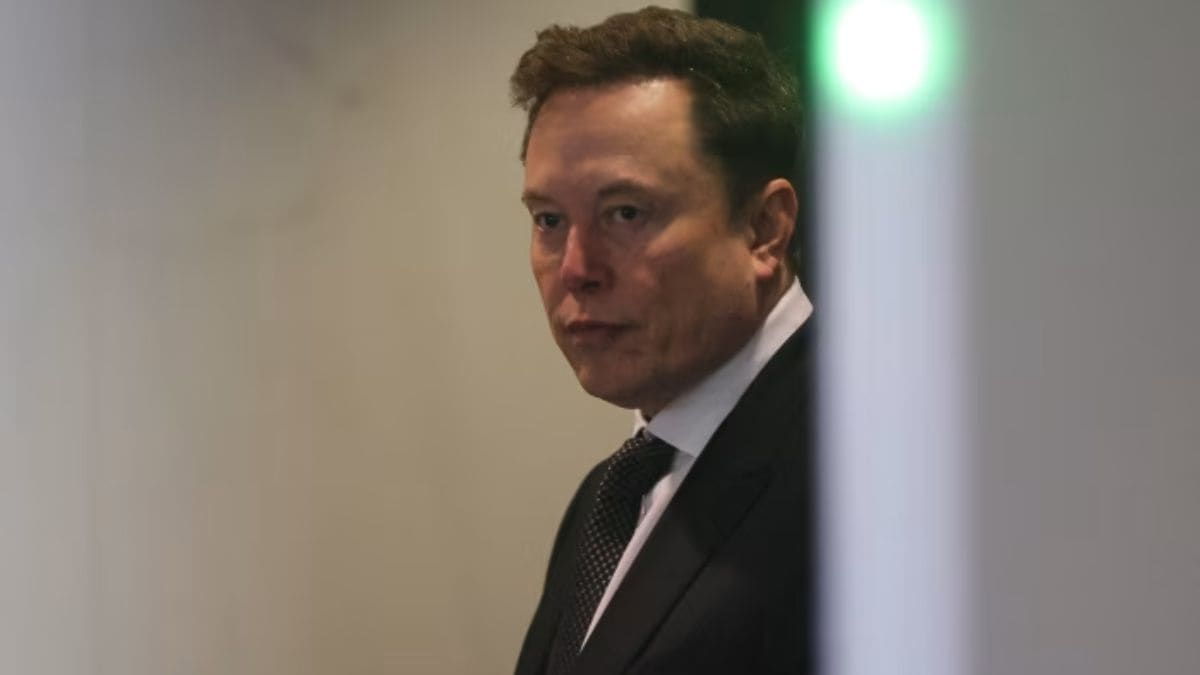
Musk has been a vocal critic of Anthropic in the past. Wikimedia Commons Tech trillionaire Elon Musk has publicly praised Anthropic, calling the AI company "obviously" the current leader in the field and hailing its Mythos and Fable models as unmatched by any competitor's offerings. "I was clearly wrong about Anthropic. They are obviously currently the leader in AI. No company has released a model as good as Mythos/Fable and they will undoubtedly have Mythos 2 ready soon," Musk wrote in a post on X published late Thursday. The remarks mark a notable shift in tone from Musk, who has been a vocal critic of Anthropic in the past. In the same post, he sought to address speculation that he might use his position as a competitor to disadvantage the company, writing that he would "never cut them off in a way that hurt them badly, even as a competitor," adding, "That's not my style." Musk pointed to his own companies' track records on competitive openness to back his claim. He cited Tesla's decision to open-source its patents and make its Supercharger network available to rival automakers despite the option to keep it exclusive, as well as SpaceX's practice of launching competing satellite systems without raising prices or imposing unfair terms on rivals. ALSO READ: Former Fed Chairman Ben Bernanke Joins Anthropic Oversight Trust The trillionaire also referenced the scrutiny he faces on X, the platform he owns, writing that "even my worst enemies can attack me on this platform." Musk's comments come amid intensifying competition in the artificial intelligence sector, where companies including Anthropic, OpenAI, and Musk's own xAI have been racing to release increasingly capable models. Anthropic's Mythos and Fable models, referenced in Musk's post, have positioned the company at the centre of that competition in recent months. Musk did not elaborate further on what prompted his change in stance toward Anthropic, a company he has previously sparred with over AI safety approaches and business practices. ALSO READ: Will AI Replace Your Job? Here's What TCS Actually Said Essential Business Intelligence, Sharp Market Insights, Practical Personal Finance Advice, Daily Fuel, Gold and Silver Prices and Latest Stories -- On NDTV Profit.
Elon Musk Says SpaceX Would Be Worth More Than Earth if It Achieves Its Goals Amid First AI Satellite Rev
SpaceX to Exceed Earth's Value? "I wonder if History will look back at this $7.5-40B Anthropic/SpaceXai deal as the biggest unforced error of the AI era," the user said, while also outlining that the deal could hinder Anthropic's IPO as users could transfer most token exchange to SpaceX and "Claude is only used for the top tasks." Musk responded to the user, sharing his own take on the matter. "You don't seem to understand that SpaceX will be worth more than the rest of Earth if we accomplish our goals," he said in the post. SpaceX Touts New AI Satellite On Thursday, SpaceX also revealed renderings of the company's AI1 satellite, part of its Starmind constellation, which is a constellation of satellites dedicated to AI compute. The satellites will support chips from all providers and possess a 150 kW peak compute payload, as well as an average payload compute of 120 kW. The satellites will have a wingspan of 70 meters and have a 150 kW solar array. Notably, Musk has been a staunch supporter of orbital AI compute, most recently saying it was the only way to overcome Earth-based bottlenecks to AI compute. "Space is the only way to scale at scale," the trillionaire had said. Benzinga Edge Rankings show SpaceX fails to provide a favorable price trend in the Short, Medium and Long term. Price Action: SpaceX shares were up 0.06% at $152.25 during the after-hours session on Thursday. Photo courtesy: Shutterstock Market News and Data brought to you by Benzinga APIs To add Benzinga News as your preferred source on Google, click here.

Elon Musk calls Anthropic AI leader, says no model as good as Mythos, Fable - CNBC TV18
Elon Musk's comments come after the US Department of Commerce lifted export controls on Claude Fable 5 and Mythos 5 early this month. The restrictions had been imposed on June 12 over alleged national security concerns, forcing the AI company to suspend their availability. Elon Musk has declared Anthropic the current "leader in AI", saying no company has released a model as good as Mythos and Fable, while admitting he was "clearly wrong" about the rival AI startup. Musk was responding to an X post that claimed SpaceX AI now had a frontier model capable of competing with OpenAI's GPT-4.8 and that Anthropic was heavily reliant on computing capacity rented from SpaceX AI. The post also resurfaced a September 2025 remark from Musk, in which he had said, "Winning was never in the set of possible outcomes for Anthropic." "I was clearly wrong about Anthropic. They are obviously currently the leader in AI. No company has released a model as good as Mythos/Fable and they will undoubtedly have Mythos 2 ready soon," Musk said. His comments come after the US Department of Commerce lifted export controls on Claude Fable 5 and Mythos 5 early this month. The restrictions had been imposed on June 12 over alleged national security concerns, forcing the AI company to suspend their availability. The US had partially eased the curbs last month by allowing Anthropic to offer Mythos 5 to more than 100 "trusted" US organisations, including companies involved in critical infrastructure. Broader access, however, remained restricted until the controls were lifted. Musk also rejected the suggestion that he could cut off Anthropic's access to computing resources to hurt the rival company. "I would never cut them off in a way that hurt them badly, even as a competitor. That's not my style," he said. The billionaire cited Tesla's open-source patents and its decision to make the Supercharger network available to competitors, as well as SpaceX's approach to competing satellite systems, as examples of allowing competition.

SpaceX Was Just Flooded With Buy Reports Across Wall Street. Do Analysts Know Something Retail Investors Don't?
This week, a wave of equity research reports from sell-side analysts was released on Space Exploration Technologies (NASDAQ: SPCX). The big takeaway is that Wall Street is overwhelmingly bullish on SpaceX stock. With so many banks publishing their first formal reports on SpaceX and coming to the same optimistic outlook, it begs the question: Does Wall Street know something retail investors don't? Where to invest $1,000 right now? Our analyst team just revealed what they believe are the 10 best stocks to buy right now, when you join Stock Advisor. See the stocks " Why were so many reports for SpaceX stock published on the same day? When a company completes its initial public offering (IPO) and its shares begin trading, a quiet period begins. This window typically lasts between 25 and 40 days after the newly public company begins trading. During the quiet period, the investment banks that underwrote the IPO are prohibited from issuing forward-looking statements, promotional material, or equity research analysis. The rule exists to prevent the same institutions that helped price and sell the IPO stock in question from immediately hyping the deal or leaking material information that could influence market sentiment. Analysts working for the lead underwriters must remain silent because any positive research they publish too close to the offering could be viewed as an extension of the marketing effort rather than independent analysis. Once the quiet period ends, these banks are free to initiate coverage. In the case of SpaceX, this is exactly what just happened: A cluster of reports appeared on the same day because the calendar restriction had been lifted. Image source: Getty Images. What does Wall Street think of SpaceX stock? The table below summarizes the ratings and stock price targets analysts recently issued for SpaceX. Data Source: Yahoo! Finance Among the firms in the table, all gave Buy or Buy-equivalent ratings on SpaceX stock, except one. Unsurprisingly, longtime Tesla supporter and former Wedbush analyst Dan Ives is bullish on SpaceX. The price targets primarily range between $190 and $300, with notable outliers at Raymond James and MoffettNathanson. SpaceX's bullish thesis converges on three interlocking growth drivers. First, Starlink is shifting from primarily consumer broadband toward enterprise and telecommunications customers. This could unlock higher-margin contracts with government agencies, airlines, maritime operators, and large corporations that require reliable global connectivity. Second, SpaceX is positioned to support the acceleration of AI infrastructure buildouts by delivering additional capacity to hyperscalers. So far, SpaceX has signed $82 billion in infrastructure deals with Anthropic, Google Cloud, and Reflection AI. Third, operational improvements in rocket reusability and launch cadence in the Starship program stand to dramatically lower costs to orbit. These efficiencies can help expand SpaceX's addressable market for both satellite deployment and crewed missions. Taken together, these variables paint a picture of a company transitioning from a high-burn, capital-intensive launch and satellite operator into a diversified technology enabler with multidecade tailwinds. Understanding the limits of analyst price targets Wall Street analysts tend to have meaningful access to the C-Suite at large companies. By contrast, retail investors usually have a tough time getting past the Investor Relations department. With this in mind, many Wall Street analysts have access to information that most investors do not. However, they are strictly prohibited from issuing reports based solely on that information. This is all to say that even if Wall Street does know certain things that most investors do not, the price targets above are still just opinions -- not guarantees. These price targets rest heavily on modeling assumptions about revenue growth, profit margins, and discount rates that can shift quickly. Blindly chasing the most optimistic targets or treating the consensus opinion as a certainty ignores the fact that the stock market tends to price in best-case scenarios before they actually materialize. Investors who rely solely on these reports risk overlooking valuation discipline, balance-sheet risk, and the possibility that even accurate long-term narratives can produce stomach-churning short-term drawdowns. While the end of the quiet period gives investors a clearer picture of professional sentiment around SpaceX stock, these views are just one data point among many. Should you buy stock in Space Exploration Technologies right now? Before you buy stock in Space Exploration Technologies, consider this: The Motley Fool Stock Advisor analyst team just identified what they believe are the 10 best stocks for investors to buy now... and Space Exploration Technologies wasn't one of them. The 10 stocks that made the cut could produce monster returns in the coming years. Consider when Netflix made this list on December 17, 2004... if you invested $1,000 at the time of our recommendation, you'd have $407,651!* Or when Nvidia made this list on April 15, 2005... if you invested $1,000 at the time of our recommendation, you'd have $1,252,823!* Now, it's worth noting Stock Advisor's total average return is 922% -- a market-crushing outperformance compared to 208% for the S&P 500. Don't miss the latest top 10 list, available with Stock Advisor, and join an investing community built by individual investors for individual investors. See the 10 stocks " *Stock Advisor returns as of July 9, 2026. Adam Spatacco has positions in Tesla. The Motley Fool has positions in and recommends Tesla. The Motley Fool has a disclosure policy. The views and opinions expressed herein are the views and opinions of the author and do not necessarily reflect those of Nasdaq, Inc.

Elon Musk Says Anthropic Leads AI Race as Claude Models Challenge OpenAI
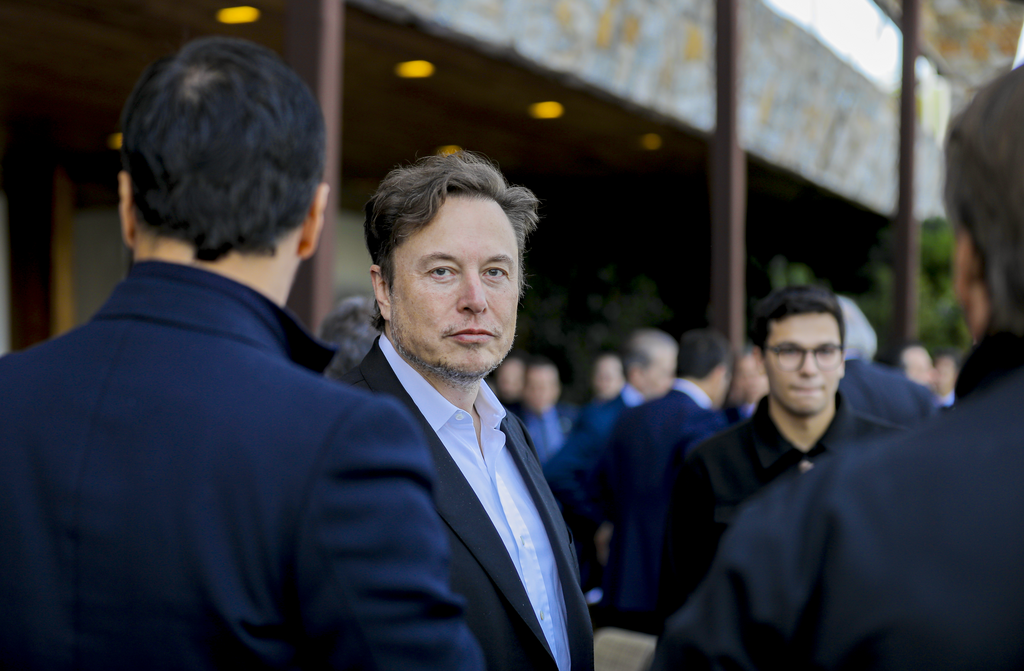
Elon Musk Says Anthropic Leads AI Race as Claude Models Challenge OpenAI. Source: Ministério Das Comunicações, CC BY 2.0, via Wikimedia Commons Elon Musk has publicly praised artificial intelligence startup Anthropic, saying the company is "obviously" the current leader in AI, in a rare acknowledgment of a key rival as competition among top AI developers intensifies. Musk made the remark on X while responding to a discussion comparing the performance of leading AI models. Although he did not explain the reasoning behind his assessment, the comment highlights Anthropic's growing influence in the rapidly evolving artificial intelligence industry. Founded in 2021 by former OpenAI executives, including Chief Executive Dario Amodei, Anthropic has become one of the strongest challengers to OpenAI, Google, and Musk's own xAI. The company has built a strong reputation through its Claude family of AI models, which have gained widespread popularity, particularly among software developers and businesses. Anthropic's momentum accelerated after the launch of Claude Opus 4.5 late last year. The advanced AI model earned widespread recognition for its coding performance, attracting software engineers and AI researchers who increasingly adopted Claude over competing AI assistants. The model's strong coding capabilities fueled its rapid growth within the developer community. The company later broadened its reach with the introduction of Claude Cowork, a platform designed to help businesses and non-technical users automate tasks such as research, writing, and workplace productivity. The expansion beyond coding strengthened Anthropic's position in the enterprise AI market and reinforced its status as one of the fastest-growing companies in the sector. Anthropic's rapid growth has also attracted significant investor interest. The company confidentially filed for a U.S. initial public offering in June, shortly after completing a funding round that reportedly valued the AI startup at approximately $965 billion. If completed, the IPO could rank among the largest public listings in the artificial intelligence industry. As competition intensifies among leading AI companies, Musk's endorsement underscores Anthropic's rising prominence in the race to develop next-generation AI models. With continued advances in coding assistants and enterprise productivity tools, Anthropic is increasingly positioning itself as a formidable competitor to OpenAI and other major players in the global AI market.
Anthropic reportedly seeks up to 1.4GW of Australian data centre capacity
I'm a strategic communications practitioner, with extensive experience as a technology journalist, analyst, editor, internal communications consultant and corporate public relations specialist Anthropic is seeking to secure more than 1.4GW of Australian data centre capacity as part of a long-term AI infrastructure strategy, according to a report by the Australian Financial Review, in what would represent one of the largest AI infrastructure procurements ever contemplated in Australia if it proceeds. The AFR, citing confidential tender documents it has obtained, reported that the US AI company is seeking a long-term development partner capable of delivering a data centre campus exceeding 1.4GW, with a goal of bringing at least 1GW of capacity online by the end of 2027. According to the newspaper, Anthropic is also prepared to participate in development risk where a suitable site has not yet been secured. The publication reported that requests for proposal were issued to several Australian data centre developers, including CDC Data Centres, AirTrunk, NEXTDC, IREN and Stack Infrastructure. Initial proposals were submitted earlier this year, with shortlisted bidders subsequently participating in site meetings in Canberra. According to the AFR, Anthropic is expected to make a final decision in the coming weeks and may ultimately divide the procurement across multiple providers rather than selecting a single development partner. Anthropic declined to comment to the AFR. Aligning with Australia's AI infrastructure strategy While the reported procurement has not been confirmed by Anthropic, the company has already publicly signalled its intention to establish a significant long-term presence in Australia. In April, Anthropic became the first AI company to sign a memorandum of understanding with the Australian Government under the National AI Plan. Under the agreement, Anthropic committed to align any future Australian operations with the Government's Expectations for Data Centres and AI Infrastructure Developers, including supporting Australia's energy transition and engaging on future infrastructure planning. The memorandum also states that Anthropic recognises the importance of expanding Australia's energy supply and transmission infrastructure, with a focus on firmed renewable energy, and intends to engage with the government on infrastructure planning as its Australian operations expand. The company has also opened a Sydney office as part of its Australian expansion, with the government describing the agreement as the first collaborative arrangement signed under the National AI Plan and signalling Australia's ambition to attract AI investment aligned with national priorities. The scale of the reported tender is consistent with a broader pattern of Australian hiring: Anthropic has recently advertised for multiple roles in its compute team based in Australia, spanning data centre engineering and operations, suggesting the company is building out local capability ahead of any procurement decision rather than only negotiating a paper commitment. Scale reflects accelerating AI demand If the figures reported by the AFR prove accurate, the procurement would significantly exceed the scale of most individual data centre developments currently planned in Australia and further reinforce the shift towards gigawatt-scale AI infrastructure. According to the AFR, Anthropic's tender requested detailed information from prospective partners covering financing capability, available land, development experience, energy procurement, security credentials and the ability to deliver projects at unprecedented scale. The publication reported that the AI company estimated a project of this size could require between USD 12 billion and USD 15 billion in debt and equity financing. Notably, the AFR reported that Anthropic's own tender documents acknowledge the company remains rated non-investment-grade by credit agencies, with prospective partners asked to set out how that financing would be underwritten given the company's current credit standing. The procurement also aligns with Anthropic's broader public statements that Australia is a strategic location for future AI infrastructure. Following the signing of its memorandum of understanding, the company said it viewed Australia as an attractive destination for AI investment and committed to supporting the Government's objective of developing trusted, sustainable AI infrastructure. This comes despite recent turbulence around Anthropic's Australian commercial access: the company's Mythos-tier model was briefly unavailable to Australian companies in June, after US export controls prompted a temporary suspension, before access was restored on 1 July. The episode was a reminder that Anthropic's Australian footprint spans both major infrastructure commitments and day-to-day commercial access that remains subject to US regulatory settings.

UST Integrates Anthropic's Claude AI Across Engineering Systems
predict.info -- Premium Domain For Sale Domain only: USD 200,000. Prediction platform technology priced separately. predict.info Anthropic, the $350 billion AI research powerhouse, has partnered with technology services firm UST to integrate its Claude AI into critical engineering and industrial workflows. The collaboration will deploy Claude across UST's global client base in sectors like semiconductors, automotive, healthcare, and banking, with the aim of accelerating production, reducing errors, and improving efficiency. UST, which supports companies in designing and validating chips, running factories, and managing connected devices, is embedding Claude into its engineering systems. Notably, UST's iDEC platform -- a tool for validating hardware and silicon -- will now feature Claude as a reasoning layer. By automating regression tests and analyzing real-time hardware data against digital twins, iDEC has already cut validation cycle times by up to 70%, and Claude's integration is expected to streamline these processes even further. "Claude Code can read schematics, write and execute tests, and hold long-term context across engineering tasks," UST CEO Krishna Sudheendra stated. This allows earlier detection of design flaws, saving significant time and cost. For example, catching a flaw during design validation is far less expensive than discovering it post-production. Expanding to Healthcare, Telecom, and Banking Beyond manufacturing, UST is bringing Claude into platforms for healthcare, telecom, and banking: * Healthcare: Claude powers UST CarePath, streamlining care management and claims processing while maintaining compliance with strict data governance rules. * Telecom: In network operations, Claude helps predict failures and resolve outages faster, reducing downtime for telecom providers. * Banking: Through UST FinX, Claude supports mid-sized banks by automating workflows, assisting with intelligent case handling, and enabling smoother integrations for outdated core systems. As part of the partnership, UST will train 20,000 engineers, consultants, and industry specialists on Claude globally. Anthropic is providing technical enablement and certification to support this rollout, solidifying UST as a Global Premier Partner in its Claude Partner Network. Why It Matters Anthropic, founded by former OpenAI researchers in 2021, is best known for its safety-focused Claude AI systems. Unlike other AI players prioritizing speed-to-market, Anthropic emphasizes reliability, safety, and governance, making it a natural fit for high-stakes industries. By embedding Claude into UST's workflows, the partnership demonstrates how AI can operationalize complex engineering tasks without compromising safety or control. With Anthropic reportedly valued at up to $380 billion as of February 2026, this partnership reinforces its growing influence in enterprise AI. For UST's clients, the integration offers a competitive edge in navigating increasingly complex production and operational challenges. The move also signals Claude's evolution beyond conversational AI into specialized industrial applications, setting the stage for broader AI adoption in regulated sectors. As Anthropic continues to expand its footprint, the success of partnerships like this will be a key indicator of AI's ability to transform traditional industries safely and effectively.
SpaceX Was Just Flooded With Buy Reports Across Wall Street. Do Analysts Know Something Retail Investors Don't?
This week, a wave of equity research reports from sell-side analysts was released on Space Exploration Technologies (SPCX +2.38%). The big takeaway is that Wall Street is overwhelmingly bullish on SpaceX stock. With so many banks publishing their first formal reports on SpaceX and coming to the same optimistic outlook, it begs the question: Does Wall Street know something retail investors don't? Why were so many reports for SpaceX stock published on the same day? When a company completes its initial public offering (IPO) and its shares begin trading, a quiet period begins. This window typically lasts between 25 and 40 days after the newly public company begins trading. During the quiet period, the investment banks that underwrote the IPO are prohibited from issuing forward-looking statements, promotional material, or equity research analysis. The rule exists to prevent the same institutions that helped price and sell the IPO stock in question from immediately hyping the deal or leaking material information that could influence market sentiment. Analysts working for the lead underwriters must remain silent because any positive research they publish too close to the offering could be viewed as an extension of the marketing effort rather than independent analysis. Once the quiet period ends, these banks are free to initiate coverage. In the case of SpaceX, this is exactly what just happened: A cluster of reports appeared on the same day because the calendar restriction had been lifted. What does Wall Street think of SpaceX stock? The table below summarizes the ratings and stock price targets analysts recently issued for SpaceX. Data Source: Yahoo! Finance Among the firms in the table, all gave Buy or Buy-equivalent ratings on SpaceX stock, except one. Unsurprisingly, longtime Tesla supporter and former Wedbush analyst Dan Ives is bullish on SpaceX. The price targets primarily range between $190 and $300, with notable outliers at Raymond James and MoffettNathanson. SpaceX's bullish thesis converges on three interlocking growth drivers. First, Starlink is shifting from primarily consumer broadband toward enterprise and telecommunications customers. This could unlock higher-margin contracts with government agencies, airlines, maritime operators, and large corporations that require reliable global connectivity. Second, SpaceX is positioned to support the acceleration of AI infrastructure buildouts by delivering additional capacity to hyperscalers. So far, SpaceX has signed $82 billion in infrastructure deals with Anthropic, Google Cloud, and Reflection AI. Third, operational improvements in rocket reusability and launch cadence in the Starship program stand to dramatically lower costs to orbit. These efficiencies can help expand SpaceX's addressable market for both satellite deployment and crewed missions. Taken together, these variables paint a picture of a company transitioning from a high-burn, capital-intensive launch and satellite operator into a diversified technology enabler with multidecade tailwinds. Understanding the limits of analyst price targets Wall Street analysts tend to have meaningful access to the C-Suite at large companies. By contrast, retail investors usually have a tough time getting past the Investor Relations department. With this in mind, many Wall Street analysts have access to information that most investors do not. However, they are strictly prohibited from issuing reports based solely on that information. This is all to say that even if Wall Street does know certain things that most investors do not, the price targets above are still just opinions -- not guarantees. These price targets rest heavily on modeling assumptions about revenue growth, profit margins, and discount rates that can shift quickly. Blindly chasing the most optimistic targets or treating the consensus opinion as a certainty ignores the fact that the stock market tends to price in best-case scenarios before they actually materialize. Investors who rely solely on these reports risk overlooking valuation discipline, balance-sheet risk, and the possibility that even accurate long-term narratives can produce stomach-churning short-term drawdowns. While the end of the quiet period gives investors a clearer picture of professional sentiment around SpaceX stock, these views are just one data point among many.

UST Partners with Anthropic to Bring Claude into UST's Platforms, Engineering, and Operations and Train 20,000 UST Employees Globally
Under the strategic alliance, UST will combine Anthropic's Claude models with UST's proprietary industry and horizontal platforms, engineering services, domain solutions, and internal operations, helping clients modernize and transform core systems and operationalize trusted AI at scale. PENANG, Malaysia, July 9, 2026 /PRNewswire/ -- UST, a leading AI and technology transformation solutions company, today announced a strategic alliance with Anthropic, the AI safety and research company behind the Claude family of models. The partnership is focused on helping Global 1000 enterprises become AI-native. UST will embed Claude into the engineering environments and operational workflows it designs, builds, and runs for clients -- helping organizations move from isolated AI pilots to trusted, enterprise-scale AI embedded in the systems that drive their business. The alliance combines Claude models with UST's implementation, engineering, and domain expertise, enabling customers to adopt Claude more quickly and responsibly within existing enterprise environments. Rooted in a shared commitment to responsible AI, the alliance strengthens UST's position as a Global Premier Partner in the Claude Partner Network Services Tier and expands UST's ability to help organizations move from experimentation to trusted, large-scale deployment. By combining Claude models with UST's engineering expertise, deep industry knowledge, and global delivery model, customers can adopt Claude with greater confidence across complex enterprise environments. Claude for Physical AI: Enhancing UST's Engineering Platforms UST is integrating Claude into the engineering platforms that semiconductor, automotive, manufacturing, telecom, embedded, and IoT companies use for design verification, semiconductor validation, factory operations, and field service. This will enable teams to catch design flaws earlier, speed up chip validation, and integrate hardware and software into a single system from the factory floor to the field. These processes are foundational to physical AI, moving intelligence off the screen and into the equipment and robotics that run production. UST-iDEC is one of the clearest examples. The platform already changes the economics of hardware and silicon validation, cutting cycle times by 50"70% and compressing standard four-day turnarounds into 48 hours through a closed-loop, agentic validation pipeline. UST is now integrating Claude as the reasoning layer into that pipeline to further extend it. Claude Code reads chip pinouts and hardware schematics natively and writes and runs regression test scripts that engineers previously scripted by hand, while Claude's reasoning models compare live edge data against digital twins to flag firmware regressions and signal-integrity faults. UST is targeting an already-fast validation pipeline that gets even faster, with less manual scripting, earlier fault detection, without adding new tools for engineers. UST Platform solutions accelerated by Claude for Industry and Enterprise Workflows UST will integrate Claude into selected industry platforms and horizontal enterprise platforms. Together, these integrations will give clients a consistent way to apply AI across industry-specific and shared enterprise workflows where accuracy, data protection, compliance, and reliability are critical. Healthcare Payer: UST CarePath uses Claude to streamline member services, care management, and claims workflows, giving care teams a single, real-time view. Claude Code and MCP connectors link the platform directly to claims and care management systems, while an agentic layer routes each recommended action for approval before it reaches a member. The platform will help teams turn healthcare data into clear next steps, improve patient and member engagement, and resolve issues faster while staying within healthcare data governance controls. Banking: Most mid-tier banks still run on core systems built for overnight batch processing, not real-time banking. Every new integration or product change requires months of vendor-dependent work. UST FinX connects legacy banking systems to a single modern, real-time platform built for open banking and API-first integration. Claude drives the platform's AI capabilities, accelerating onboarding, automating document processing, and providing staff with faster access to account and compliance data, all within FinX's built-in governance and audit controls. That's what lets a bank modernize without hiring a bigger compliance team just to keep up. Scaling Claude Across UST's Horizontal Platforms and Industries UST puts Claude to work everywhere clients feel the friction of change. In consulting, teams use Claude to redesign workflows and transformation roadmaps, helping enterprises adopt AI across functions and make change management repeatable rather than a one-off project. In business applications, Claude Code and approved MCP connectors handle configuration by hand, writing integration logic and letting teams describe what they need in plain language. In data and automation, Claude builds pipelines, accelerates analysis, and coordinates end-to-end handoffs between systems that once required manual stitching. In cloud, infrastructure, and security, Claude supports migration planning, writes infrastructure as code, checks it against policy before it ships, and helps teams get to the bottom of an incident faster, all under the same governance running across the alliance. Looking ahead, UST will also bring Claude into its retail, consumer goods, and manufacturing platforms to sharpen merchandising and inventory planning, strengthen digital commerce, and improve supply chain execution. UST's Own Operations, Accelerated by Claude UST already applies AI across its own operations and continues to expand its use of Claude and Claude Cowork. Within UST, deploying these capabilities across contracts, legal, talent, marketing, infrastructure, and finance demonstrates a commitment to innovation and operational excellence. Teams are transforming manual processes into reusable, Claude-native workflows and developing role-specific Claude skills to support key functions. These workflows operate with clear guardrails and human oversight at critical points, ensuring that automation supports accountability and informed judgment alongside speed. The result is more consistent operations and more time for employees to focus on judgment, negotiation, client work, and creative problem-solving. The impact is twofold. Operations run faster and cleaner, and people gain time for decisions, negotiations, and imagination that drive growth. By gaining firsthand experience with the operational, technical, and change management challenges of AI adoption, UST is building the foundation for how it helps customers reimagine their enterprise transformation. That experience is evolving into an operating playbook of tested workflows, governance models, and value frameworks, proven within a complex organization and designed to accelerate time-to-value while managing financial and operational risk. UST commits to training 20,000 developers and industry experts equipped to build with Claude at enterprise scale A core pillar of this alliance is powering UST's transformation into an AI"native company, starting with how UST works internally, not just what it delivers to clients. As part of the alliance, UST plans to certify 20,000 associates worldwide on Claude, across roles from architects and engineers to consultants, industry specialists, and forward"deployed engineers who can sit alongside client teams to think, build, and solve problems every day. This reflects UST's continued emphasis on talent enablement, grounded in its core values of Humility, Humanity, and Integrity, while developing a growing community of AI"native developers, FDE"style practitioners, architects, and industry experts equipped to build with Claude at enterprise scale. UST will build specialized teams to deploy Claude, with support from Anthropic enablement, technical guidance, and certification. "Our alliance with Anthropic reflects UST's unwavering commitment to helping clients navigate the AI landscape with confidence and achieve meaningful business outcomes. By combining the capabilities of Claude with UST's engineering, industry knowledge, and delivery expertise, we are bringing to market industry-specific platforms and digital and engineering solutions that improve productivity, accelerate business outcomes, and help clients operationalize AI-led decisions in a safe and secure environment," said Krishna Sudheendra, Chief Executive Officer, UST. "UST helps the world's banks, telecoms, and manufacturers put new technology to work. They're proving Claude inside their own engineering first, training 20,000 of their own people on it, before bringing it into the systems they build and run for clients," said Paul Smith, Chief Commercial Officer, Anthropic. "We are wiring Claude into how UST designs, builds, and runs solutions across our consulting, platforms, engineering services, and industry offerings. This alliance with Anthropic helps us deliver higher-value outcomes for clients while advancing UST's transformation into an AI-native organization built on trust, human oversight, and long-term impact," said Manu Gopinath, President, UST. About Anthropic Anthropic is an AI safety company that builds reliable, interpretable, and steerable AI systems. Founded as a public benefit corporation, Anthropic develops the Claude family of AI models and products, including Claude Code, Claude Cowork, and Claude Enterprise, used by organizations around the world. For more information, visit anthropic.com About UST Since 1999, UST has worked side by side with the world's best companies to make a powerful impact through transformation. Powered by technology, driven by AI, inspired by people, and led by our purpose, we partner with our clients from design to operation. Our AI-driven digital solutions, proprietary platforms, engineering, R&D, products, and innovation ecosystem turn core challenges into impactful, disruptive business outcomes. With deep industry knowledge and a future-ready mindset, we infuse expertise, innovation, and agility into our clients' organizations -- delivering measurable value and positive lasting change for them, their customers, and communities around the world. Together, with 30,000+ employees in 30+ countries, we build for boundless impact -- touching billions of lives in the process. Visit us at www.UST.com. Media Contacts, UST: Tinu Cherian Abraham +1 (949) 415-9857 (US) +91-7899045194 (India) Merrick Laravea +1 (949) 416-6212 Neha Misri +44-7341787926 Roshni Das K +91 7736795557 SomSekhar CV +91-9037888244 [email protected] Media Contacts, U.S.: S&C PR +1-646.941.9139 [email protected] Makovsky [email protected] Media Contacts, India: [email protected] Media Contacts, U.K.: FTI Consulting [email protected] Media Contacts, Spain: Noizze Media Carmen Tapia / Ricardo Schell [email protected] / [email protected] Media Contacts, APAC: Lee Kye Vern +65 8508 8387 [email protected]

UST Partners with Anthropic to Bring Claude into UST's Platforms, Engineering, and Operations and Train 20,000 UST Employees Globally
Under the strategic alliance, UST will combine Anthropic's Claude models with UST's proprietary industry and horizontal platforms, engineering services, domain solutions, and internal operations, helping clients modernize and transform core systems and operationalize trusted AI at scale. PENANG, Malaysia, July 9, 2026 /PRNewswire/ -- UST, a leading AI and technology transformation solutions company, today announced a strategic alliance with Anthropic, the AI safety and research company behind the Claude family of models. The partnership is focused on helping Global 1000 enterprises become AI-native. UST will embed Claude into the engineering environments and operational workflows it designs, builds, and runs for clients - helping organizations move from isolated AI pilots to trusted, enterprise-scale AI embedded in the systems that drive their business. The alliance combines Claude models with UST's implementation, engineering, and domain expertise, enabling customers to adopt Claude more quickly and responsibly within existing enterprise environments. Rooted in a shared commitment to responsible AI, the alliance strengthens UST's position as a Global Premier Partner in the Claude Partner Network Services Tier and expands UST's ability to help organizations move from experimentation to trusted, large-scale deployment. By combining Claude models with UST's engineering expertise, deep industry knowledge, and global delivery model, customers can adopt Claude with greater confidence across complex enterprise environments. Claude for Physical AI: Enhancing UST's Engineering Platforms Get the latest news delivered to your inbox Sign up for The Manila Times newsletters By signing up with an email address, I acknowledge that I have read and agree to the Terms of Service and Privacy Policy. UST is integrating Claude into the engineering platforms that semiconductor, automotive, manufacturing, telecom, embedded, and IoT companies use for design verification, semiconductor validation, factory operations, and field service. This will enable teams to catch design flaws earlier, speed up chip validation, and integrate hardware and software into a single system from the factory floor to the field. These processes are foundational to physical AI, moving intelligence off the screen and into the equipment and robotics that run production. UST-iDEC is one of the clearest examples. The platform already changes the economics of hardware and silicon validation, cutting cycle times by 50-70% and compressing standard four-day turnarounds into 48 hours through a closed-loop, agentic validation pipeline. UST is now integrating Claude as the reasoning layer into that pipeline to further extend it. Claude Code reads chip pinouts and hardware schematics natively and writes and runs regression test scripts that engineers previously scripted by hand, while Claude's reasoning models compare live edge data against digital twins to flag firmware regressions and signal-integrity faults. Advertisement UST is targeting an already-fast validation pipeline that gets even faster, with less manual scripting, earlier fault detection, without adding new tools for engineers. UST Platform solutions accelerated by Claude for Industry and Enterprise Workflows UST will integrate Claude into selected industry platforms and horizontal enterprise platforms. Together, these integrations will give clients a consistent way to apply AI across industry-specific and shared enterprise workflows where accuracy, data protection, compliance, and reliability are critical. Healthcare Payer: UST CarePath uses Claude to streamline member services, care management, and claims workflows, giving care teams a single, real-time view. Claude Code and MCP connectors link the platform directly to claims and care management systems, while an agentic layer routes each recommended action for approval before it reaches a member. The platform will help teams turn healthcare data into clear next steps, improve patient and member engagement, and resolve issues faster while staying within healthcare data governance controls. Advertisement Telecom: UST IntelliOps will bring Claude into network operations, service assurance, and OSS/BSS modernization. The platform has Claude's reasoning layer wired in to help operators identify service issues, predict RAN failures, and reduce outage duration through approved response workflows and secure system integrations. This gives telecom operators fewer SLA penalties, shorter customer-facing outages, and less time NOC teams spend sorting signal from noise. Banking: Most mid-tier banks still run on core systems built for overnight batch processing, not real-time banking. Every new integration or product change requires months of vendor-dependent work. UST FinX connects legacy banking systems to a single modern, real-time platform built for open banking and API-first integration. Claude drives the platform's AI capabilities, accelerating onboarding, automating document processing, and providing staff with faster access to account and compliance data, all within FinX's built-in governance and audit controls. That's what lets a bank modernize without hiring a bigger compliance team just to keep up. Scaling Claude Across UST's Horizontal Platforms and Industries UST puts Claude to work everywhere clients feel the friction of change. In consulting, teams use Claude to redesign workflows and transformation roadmaps, helping enterprises adopt AI across functions and make change management repeatable rather than a one-off project. In business applications, Claude Code and approved MCP connectors handle configuration by hand, writing integration logic and letting teams describe what they need in plain language. In data and automation, Claude builds pipelines, accelerates analysis, and coordinates end-to-end handoffs between systems that once required manual stitching. In cloud, infrastructure, and security, Claude supports migration planning, writes infrastructure as code, checks it against policy before it ships, and helps teams get to the bottom of an incident faster, all under the same governance running across the alliance. Looking ahead, UST will also bring Claude into its retail, consumer goods, and manufacturing platforms to sharpen merchandising and inventory planning, strengthen digital commerce, and improve supply chain execution. Advertisement UST's Own Operations, Accelerated by Claude UST already applies AI across its own operations and continues to expand its use of Claude and Claude Cowork. Within UST, deploying these capabilities across contracts, legal, talent, marketing, infrastructure, and finance demonstrates a commitment to innovation and operational excellence. Teams are transforming manual processes into reusable, Claude-native workflows and developing role-specific Claude skills to support key functions. These workflows operate with clear guardrails and human oversight at critical points, ensuring that automation supports accountability and informed judgment alongside speed. The result is more consistent operations and more time for employees to focus on judgment, negotiation, client work, and creative problem-solving. The impact is twofold. Operations run faster and cleaner, and people gain time for decisions, negotiations, and imagination that drive growth. By gaining firsthand experience with the operational, technical, and change management challenges of AI adoption, UST is building the foundation for how it helps customers reimagine their enterprise transformation. That experience is evolving into an operating playbook of tested workflows, governance models, and value frameworks, proven within a complex organization and designed to accelerate time-to-value while managing financial and operational risk. UST commits to training 20,000 developers and industry experts equipped to build with Claude at enterprise scale Advertisement A core pillar of this alliance is powering UST's transformation into an AI-native company, starting with how UST works internally, not just what it delivers to clients. As part of the alliance, UST plans to certify 20,000 associates worldwide on Claude, across roles from architects and engineers to consultants, industry specialists, and forward-deployed engineers who can sit alongside client teams to think, build, and solve problems every day. This reflects UST's continued emphasis on talent enablement, grounded in its core values of Humility, Humanity, and Integrity, while developing a growing community of AI-native developers, FDE-style practitioners, architects, and industry experts equipped to build with Claude at enterprise scale. UST will build specialized teams to deploy Claude, with support from Anthropic enablement, technical guidance, and certification. "Our alliance with Anthropic reflects UST's unwavering commitment to helping clients navigate the AI landscape with confidence and achieve meaningful business outcomes. By combining the capabilities of Claude with UST's engineering, industry knowledge, and delivery expertise, we are bringing to market industry-specific platforms and digital and engineering solutions that improve productivity, accelerate business outcomes, and help clients operationalize AI-led decisions in a safe and secure environment," said Krishna Sudheendra, Chief Executive Officer, UST. "UST helps the world's banks, telecoms, and manufacturers put new technology to work. They're proving Claude inside their own engineering first, training 20,000 of their own people on it, before bringing it into the systems they build and run for clients," said Paul Smith, Chief Commercial Officer, Anthropic. Advertisement "We are wiring Claude into how UST designs, builds, and runs solutions across our consulting, platforms, engineering services, and industry offerings. This alliance with Anthropic helps us deliver higher-value outcomes for clients while advancing UST's transformation into an AI-native organization built on trust, human oversight, and long-term impact," said Manu Gopinath, President, UST. About Anthropic Anthropic is an AI safety company that builds reliable, interpretable, and steerable AI systems. Founded as a public benefit corporation, Anthropic develops the Claude family of AI models and products, including Claude Code, Claude Cowork, and Claude Enterprise, used by organizations around the world. For more information, visit anthropic.com About UST Advertisement Since 1999, UST has worked side by side with the world's best companies to make a powerful impact through transformation. Powered by technology, driven by AI, inspired by people, and led by our purpose, we partner with our clients from design to operation. Our AI-driven digital solutions, proprietary platforms, engineering, R&D, products, and innovation ecosystem turn core challenges into impactful, disruptive business outcomes. With deep industry knowledge and a future-ready mindset, we infuse expertise, innovation, and agility into our clients' organizations-delivering measurable value and positive lasting change for them, their customers, and communities around the world. Together, with 30,000+ employees in 30+ countries, we build for boundless impact-touching billions of lives in the process. Visit us at www.UST.com. Media Contacts, UST: Tinu Cherian Abraham +1 (949) 415-9857 (US) +91-7899045194 (India) Merrick Laravea +1 (949) 416-6212 Neha Misri +44-7341787926 Roshni Das K +91 7736795557 SomSekhar CV +91-9037888244 [email protected] Media Contacts, U.S.: S&C PR +1-646.941.9139 [email protected] Makovsky [email protected] Media Contacts, India: [email protected] Media Contacts, U.K.: FTI Consulting [email protected] Media Contacts, Spain: Noizze Media Carmen Tapia / Ricardo Schell

UST Partners with Anthropic to Bring Claude into UST's Platforms, Engineering, and Operations and Train 20,000 UST Employees Globally
Under the strategic alliance, UST will combine Anthropic's Claude models with UST's proprietary industry and horizontal platforms, engineering services, domain solutions, and internal operations, helping clients modernize and transform core systems and operationalize trusted AI at scale. SINGAPORE, July 9, 2026 /PRNewswire/ -- UST, a leading AI and technology transformation solutions company, today announced a strategic alliance with Anthropic, the AI safety and research company behind the Claude family of models. The partnership is focused on helping Global 1000 enterprises become AI-native. UST will embed Claude into the engineering environments and operational workflows it designs, builds, and runs for clients - helping organizations move from isolated AI pilots to trusted, enterprise-scale AI embedded in the systems that drive their business. The alliance combines Claude models with UST's implementation, engineering, and domain expertise, enabling customers to adopt Claude more quickly and responsibly within existing enterprise environments. Rooted in a shared commitment to responsible AI, the alliance strengthens UST's position as a Global Premier Partner in the Claude Partner Network Services Tier and expands UST's ability to help organizations move from experimentation to trusted, large-scale deployment. By combining Claude models with UST's engineering expertise, deep industry knowledge, and global delivery model, customers can adopt Claude with greater confidence across complex enterprise environments. Claude for Physical AI: Enhancing UST's Engineering Platforms Get the latest news delivered to your inbox Sign up for The Manila Times newsletters By signing up with an email address, I acknowledge that I have read and agree to the Terms of Service and Privacy Policy. UST is integrating Claude into the engineering platforms that semiconductor, automotive, manufacturing, telecom, embedded, and IoT companies use for design verification, semiconductor validation, factory operations, and field service. This will enable teams to catch design flaws earlier, speed up chip validation, and integrate hardware and software into a single system from the factory floor to the field. These processes are foundational to physical AI, moving intelligence off the screen and into the equipment and robotics that run production. UST-iDEC is one of the clearest examples. The platform already changes the economics of hardware and silicon validation, cutting cycle times by 50-70% and compressing standard four-day turnarounds into 48 hours through a closed-loop, agentic validation pipeline. UST is now integrating Claude as the reasoning layer into that pipeline to further extend it. Claude Code reads chip pinouts and hardware schematics natively and writes and runs regression test scripts that engineers previously scripted by hand, while Claude's reasoning models compare live edge data against digital twins to flag firmware regressions and signal-integrity faults. Advertisement UST is targeting an already-fast validation pipeline that gets even faster, with less manual scripting, earlier fault detection, without adding new tools for engineers. UST Platform solutions accelerated by Claude for Industry and Enterprise Workflows UST will integrate Claude into selected industry platforms and horizontal enterprise platforms. Together, these integrations will give clients a consistent way to apply AI across industry-specific and shared enterprise workflows where accuracy, data protection, compliance, and reliability are critical. Healthcare Payer: UST CarePath uses Claude to streamline member services, care management, and claims workflows, giving care teams a single, real-time view. Claude Code and MCP connectors link the platform directly to claims and care management systems, while an agentic layer routes each recommended action for approval before it reaches a member. The platform will help teams turn healthcare data into clear next steps, improve patient and member engagement, and resolve issues faster while staying within healthcare data governance controls. Advertisement Telecom: UST IntelliOps will bring Claude into network operations, service assurance, and OSS/BSS modernization. The platform has Claude's reasoning layer wired in to help operators identify service issues, predict RAN failures, and reduce outage duration through approved response workflows and secure system integrations. This gives telecom operators fewer SLA penalties, shorter customer-facing outages, and less time NOC teams spend sorting signal from noise. Banking: Most mid-tier banks still run on core systems built for overnight batch processing, not real-time banking. Every new integration or product change requires months of vendor-dependent work. UST FinX connects legacy banking systems to a single modern, real-time platform built for open banking and API-first integration. Claude drives the platform's AI capabilities, accelerating onboarding, automating document processing, and providing staff with faster access to account and compliance data, all within FinX's built-in governance and audit controls. That's what lets a bank modernize without hiring a bigger compliance team just to keep up. Scaling Claude Across UST's Horizontal Platforms and Industries UST puts Claude to work everywhere clients feel the friction of change. In consulting, teams use Claude to redesign workflows and transformation roadmaps, helping enterprises adopt AI across functions and make change management repeatable rather than a one-off project. In business applications, Claude Code and approved MCP connectors handle configuration by hand, writing integration logic and letting teams describe what they need in plain language. In data and automation, Claude builds pipelines, accelerates analysis, and coordinates end-to-end handoffs between systems that once required manual stitching. In cloud, infrastructure, and security, Claude supports migration planning, writes infrastructure as code, checks it against policy before it ships, and helps teams get to the bottom of an incident faster, all under the same governance running across the alliance. Looking ahead, UST will also bring Claude into its retail, consumer goods, and manufacturing platforms to sharpen merchandising and inventory planning, strengthen digital commerce, and improve supply chain execution. Advertisement UST's Own Operations, Accelerated by Claude UST already applies AI across its own operations and continues to expand its use of Claude and Claude Cowork. Within UST, deploying these capabilities across contracts, legal, talent, marketing, infrastructure, and finance demonstrates a commitment to innovation and operational excellence. Teams are transforming manual processes into reusable, Claude-native workflows and developing role-specific Claude skills to support key functions. These workflows operate with clear guardrails and human oversight at critical points, ensuring that automation supports accountability and informed judgment alongside speed. The result is more consistent operations and more time for employees to focus on judgment, negotiation, client work, and creative problem-solving. The impact is twofold. Operations run faster and cleaner, and people gain time for decisions, negotiations, and imagination that drive growth. By gaining firsthand experience with the operational, technical, and change management challenges of AI adoption, UST is building the foundation for how it helps customers reimagine their enterprise transformation. That experience is evolving into an operating playbook of tested workflows, governance models, and value frameworks, proven within a complex organization and designed to accelerate time-to-value while managing financial and operational risk. UST commits to training 20,000 developers and industry experts equipped to build with Claude at enterprise scale Advertisement A core pillar of this alliance is powering UST's transformation into an AI-native company, starting with how UST works internally, not just what it delivers to clients. As part of the alliance, UST plans to certify 20,000 associates worldwide on Claude, across roles from architects and engineers to consultants, industry specialists, and forward-deployed engineers who can sit alongside client teams to think, build, and solve problems every day. This reflects UST's continued emphasis on talent enablement, grounded in its core values of Humility, Humanity, and Integrity, while developing a growing community of AI-native developers, FDE-style practitioners, architects, and industry experts equipped to build with Claude at enterprise scale. UST will build specialized teams to deploy Claude, with support from Anthropic enablement, technical guidance, and certification. "Our alliance with Anthropic reflects UST's unwavering commitment to helping clients navigate the AI landscape with confidence and achieve meaningful business outcomes. By combining the capabilities of Claude with UST's engineering, industry knowledge, and delivery expertise, we are bringing to market industry-specific platforms and digital and engineering solutions that improve productivity, accelerate business outcomes, and help clients operationalize AI-led decisions in a safe and secure environment," said Krishna Sudheendra, Chief Executive Officer, UST. "UST helps the world's banks, telecoms, and manufacturers put new technology to work. They're proving Claude inside their own engineering first, training 20,000 of their own people on it, before bringing it into the systems they build and run for clients," said Paul Smith, Chief Commercial Officer, Anthropic. Advertisement "We are wiring Claude into how UST designs, builds, and runs solutions across our consulting, platforms, engineering services, and industry offerings. This alliance with Anthropic helps us deliver higher-value outcomes for clients while advancing UST's transformation into an AI-native organization built on trust, human oversight, and long-term impact," said Manu Gopinath, President, UST. About Anthropic Anthropic is an AI safety company that builds reliable, interpretable, and steerable AI systems. Founded as a public benefit corporation, Anthropic develops the Claude family of AI models and products, including Claude Code, Claude Cowork, and Claude Enterprise, used by organizations around the world. For more information, visit anthropic.com About UST Advertisement Since 1999, UST has worked side by side with the world's best companies to make a powerful impact through transformation. Powered by technology, driven by AI, inspired by people, and led by our purpose, we partner with our clients from design to operation. Our AI-driven digital solutions, proprietary platforms, engineering, R&D, products, and innovation ecosystem turn core challenges into impactful, disruptive business outcomes. With deep industry knowledge and a future-ready mindset, we infuse expertise, innovation, and agility into our clients' organizations-delivering measurable value and positive lasting change for them, their customers, and communities around the world. Together, with 30,000+ employees in 30+ countries, we build for boundless impact-touching billions of lives in the process. Visit us at www.UST.com. Media Contacts, UST: Tinu Cherian Abraham +1 (949) 415-9857 (US) +91-7899045194 (India) Merrick Laravea +1 (949) 416-6212 Neha Misri +44-7341787926 Roshni Das K +91 7736795557 SomSekhar CV +91-9037888244 [email protected] Media Contacts, U.S.: S&C PR +1-646.941.9139 [email protected] Makovsky [email protected] Media Contacts, India: [email protected] Media Contacts, U.K.: FTI Consulting [email protected] Media Contacts, Spain: Noizze Media Carmen Tapia / Ricardo Schell

UST Partners with Anthropic to Bring Claude into UST's Platforms, Engineering, and Operations and Train 20,000 UST Employees Globally
Under the strategic alliance, UST will combine Anthropic's Claude models with UST's proprietary industry and horizontal platforms, engineering services, domain solutions, and internal operations, helping clients modernize and transform core systems and operationalize trusted AI at scale. MELBOURNE, Australia, July 9, 2026 /PRNewswire/ -- UST, a leading AI and technology transformation solutions company, today announced a strategic alliance with Anthropic, the AI safety and research company behind the Claude family of models. The partnership is focused on helping Global 1000 enterprises become AI-native. UST will embed Claude into the engineering environments and operational workflows it designs, builds, and runs for clients - helping organizations move from isolated AI pilots to trusted, enterprise-scale AI embedded in the systems that drive their business. The alliance combines Claude models with UST's implementation, engineering, and domain expertise, enabling customers to adopt Claude more quickly and responsibly within existing enterprise environments. Rooted in a shared commitment to responsible AI, the alliance strengthens UST's position as a Global Premier Partner in the Claude Partner Network Services Tier and expands UST's ability to help organizations move from experimentation to trusted, large-scale deployment. By combining Claude models with UST's engineering expertise, deep industry knowledge, and global delivery model, customers can adopt Claude with greater confidence across complex enterprise environments. Claude for Physical AI: Enhancing UST's Engineering Platforms UST is integrating Claude into the engineering platforms that semiconductor, automotive, manufacturing, telecom, embedded, and IoT companies use for design verification, semiconductor validation, factory operations, and field service. This will enable teams to catch design flaws earlier, speed up chip validation, and integrate hardware and software into a single system from the factory floor to the field. These processes are foundational to physical AI, moving intelligence off the screen and into the equipment and robotics that run production. UST-iDEC is one of the clearest examples. The platform already changes the economics of hardware and silicon validation, cutting cycle times by 50-70% and compressing standard four-day turnarounds into 48 hours through a closed-loop, agentic validation pipeline. UST is now integrating Claude as the reasoning layer into that pipeline to further extend it. Claude Code reads chip pinouts and hardware schematics natively and writes and runs regression test scripts that engineers previously scripted by hand, while Claude's reasoning models compare live edge data against digital twins to flag firmware regressions and signal-integrity faults. UST is targeting an already-fast validation pipeline that gets even faster, with less manual scripting, earlier fault detection, without adding new tools for engineers. UST Platform solutions accelerated by Claude for Industry and Enterprise Workflows UST will integrate Claude into selected industry platforms and horizontal enterprise platforms. Together, these integrations will give clients a consistent way to apply AI across industry-specific and shared enterprise workflows where accuracy, data protection, compliance, and reliability are critical. Healthcare Payer: UST CarePath uses Claude to streamline member services, care management, and claims workflows, giving care teams a single, real-time view. Claude Code and MCP connectors link the platform directly to claims and care management systems, while an agentic layer routes each recommended action for approval before it reaches a member. The platform will help teams turn healthcare data into clear next steps, improve patient and member engagement, and resolve issues faster while staying within healthcare data governance controls. Telecom: UST IntelliOps will bring Claude into network operations, service assurance, and OSS/BSS modernization. The platform has Claude's reasoning layer wired in to help operators identify service issues, predict RAN failures, and reduce outage duration through approved response workflows and secure system integrations. This gives telecom operators fewer SLA penalties, shorter customer-facing outages, and less time NOC teams spend sorting signal from noise. Banking: Most mid-tier banks still run on core systems built for overnight batch processing, not real-time banking. Every new integration or product change requires months of vendor-dependent work. UST FinX connects legacy banking systems to a single modern, real-time platform built for open banking and API-first integration. Claude drives the platform's AI capabilities, accelerating onboarding, automating document processing, and providing staff with faster access to account and compliance data, all within FinX's built-in governance and audit controls. That's what lets a bank modernize without hiring a bigger compliance team just to keep up. Scaling Claude Across UST's Horizontal Platforms and Industries UST puts Claude to work everywhere clients feel the friction of change. In consulting, teams use Claude to redesign workflows and transformation roadmaps, helping enterprises adopt AI across functions and make change management repeatable rather than a one-off project. In business applications, Claude Code and approved MCP connectors handle configuration by hand, writing integration logic and letting teams describe what they need in plain language. In data and automation, Claude builds pipelines, accelerates analysis, and coordinates end-to-end handoffs between systems that once required manual stitching. In cloud, infrastructure, and security, Claude supports migration planning, writes infrastructure as code, checks it against policy before it ships, and helps teams get to the bottom of an incident faster, all under the same governance running across the alliance. Looking ahead, UST will also bring Claude into its retail, consumer goods, and manufacturing platforms to sharpen merchandising and inventory planning, strengthen digital commerce, and improve supply chain execution. UST's Own Operations, Accelerated by Claude UST already applies AI across its own operations and continues to expand its use of Claude and Claude Cowork. Within UST, deploying these capabilities across contracts, legal, talent, marketing, infrastructure, and finance demonstrates a commitment to innovation and operational excellence. Teams are transforming manual processes into reusable, Claude-native workflows and developing role-specific Claude skills to support key functions. These workflows operate with clear guardrails and human oversight at critical points, ensuring that automation supports accountability and informed judgment alongside speed. The result is more consistent operations and more time for employees to focus on judgment, negotiation, client work, and creative problem-solving. The impact is twofold. Operations run faster and cleaner, and people gain time for decisions, negotiations, and imagination that drive growth. By gaining firsthand experience with the operational, technical, and change management challenges of AI adoption, UST is building the foundation for how it helps customers reimagine their enterprise transformation. That experience is evolving into an operating playbook of tested workflows, governance models, and value frameworks, proven within a complex organization and designed to accelerate time-to-value while managing financial and operational risk. UST commits to training 20,000 developers and industry experts equipped to build with Claude at enterprise scale A core pillar of this alliance is powering UST's transformation into an AI-native company, starting with how UST works internally, not just what it delivers to clients. As part of the alliance, UST plans to certify 20,000 associates worldwide on Claude, across roles from architects and engineers to consultants, industry specialists, and forward-deployed engineers who can sit alongside client teams to think, build, and solve problems every day. This reflects UST's continued emphasis on talent enablement, grounded in its core values of Humility, Humanity, and Integrity, while developing a growing community of AI-native developers, FDE-style practitioners, architects, and industry experts equipped to build with Claude at enterprise scale. UST will build specialized teams to deploy Claude, with support from Anthropic enablement, technical guidance, and certification. "Our alliance with Anthropic reflects UST's unwavering commitment to helping clients navigate the AI landscape with confidence and achieve meaningful business outcomes. By combining the capabilities of Claude with UST's engineering, industry knowledge, and delivery expertise, we are bringing to market industry-specific platforms and digital and engineering solutions that improve productivity, accelerate business outcomes, and help clients operationalize AI-led decisions in a safe and secure environment," said Krishna Sudheendra, Chief Executive Officer, UST. "UST helps the world's banks, telecoms, and manufacturers put new technology to work. They're proving Claude inside their own engineering first, training 20,000 of their own people on it, before bringing it into the systems they build and run for clients," said Paul Smith, Chief Commercial Officer, Anthropic. "We are wiring Claude into how UST designs, builds, and runs solutions across our consulting, platforms, engineering services, and industry offerings. This alliance with Anthropic helps us deliver higher-value outcomes for clients while advancing UST's transformation into an AI-native organization built on trust, human oversight, and long-term impact," said Manu Gopinath, President, UST. About Anthropic Anthropic is an AI safety company that builds reliable, interpretable, and steerable AI systems. Founded as a public benefit corporation, Anthropic develops the Claude family of AI models and products, including Claude Code, Claude Cowork, and Claude Enterprise, used by organizations around the world. For more information, visit anthropic.com About UST Since 1999, UST has worked side by side with the world's best companies to make a powerful impact through transformation. Powered by technology, driven by AI, inspired by people, and led by our purpose, we partner with our clients from design to operation. Our AI-driven digital solutions, proprietary platforms, engineering, R&D, products, and innovation ecosystem turn core challenges into impactful, disruptive business outcomes. With deep industry knowledge and a future-ready mindset, we infuse expertise, innovation, and agility into our clients' organizations-delivering measurable value and positive lasting change for them, their customers, and communities around the world. Together, with 30,000+ employees in 30+ countries, we build for boundless impact-touching billions of lives in the process. Visit us at www.UST.com. Media Contacts, UST: Tinu Cherian Abraham +1 (949) 415-9857 (US) +91-7899045194 (India) Merrick Laravea +1 (949) 416-6212 Neha Misri +44-7341787926 Roshni Das K +91 7736795557 SomSekhar CV +91-9037888244 [email protected] Media Contacts, U.S.: S&C PR +1-646.941.9139 [email protected] Makovsky [email protected] Media Contacts, India: [email protected] Media Contacts, U.K.: FTI Consulting [email protected] Media Contacts, Spain: Noizze Media Carmen Tapia / Ricardo Schell [email protected] / [email protected] Media Contacts, APAC: Lee Kye Vern +65 8508 8387 [email protected]
UST Partners with Anthropic to Bring Claude into UST's Platforms, Engineering, and Operations and Train 20,000 UST Employees Globally
Under the strategic alliance, UST will combine Anthropic's Claude models with UST's proprietary industry and horizontal platforms, engineering services, domain solutions, and internal operations, helping clients modernize and transform core systems and operationalize trusted AI at scale. PENANG, Malaysia, July 9, 2026 /PRNewswire/ -- UST, a leading AI and technology transformation solutions company, today announced a strategic alliance with Anthropic, the AI safety and research company behind the Claude family of models. The partnership is focused on helping Global 1000 enterprises become AI-native. UST will embed Claude into the engineering environments and operational workflows it designs, builds, and runs for clients - helping organizations move from isolated AI pilots to trusted, enterprise-scale AI embedded in the systems that drive their business. The alliance combines Claude models with UST's implementation, engineering, and domain expertise, enabling customers to adopt Claude more quickly and responsibly within existing enterprise environments. Rooted in a shared commitment to responsible AI, the alliance strengthens UST's position as a Global Premier Partner in the Claude Partner Network Services Tier and expands UST's ability to help organizations move from experimentation to trusted, large-scale deployment. By combining Claude models with UST's engineering expertise, deep industry knowledge, and global delivery model, customers can adopt Claude with greater confidence across complex enterprise environments. Claude for Physical AI: Enhancing UST's Engineering Platforms UST is integrating Claude into the engineering platforms that semiconductor, automotive, manufacturing, telecom, embedded, and IoT companies use for design verification, semiconductor validation, factory operations, and field service. This will enable teams to catch design flaws earlier, speed up chip validation, and integrate hardware and software into a single system from the factory floor to the field. These processes are foundational to physical AI, moving intelligence off the screen and into the equipment and robotics that run production. UST-iDEC is one of the clearest examples. The platform already changes the economics of hardware and silicon validation, cutting cycle times by 50-70% and compressing standard four-day turnarounds into 48 hours through a closed-loop, agentic validation pipeline. UST is now integrating Claude as the reasoning layer into that pipeline to further extend it. Claude Code reads chip pinouts and hardware schematics natively and writes and runs regression test scripts that engineers previously scripted by hand, while Claude's reasoning models compare live edge data against digital twins to flag firmware regressions and signal-integrity faults. UST is targeting an already-fast validation pipeline that gets even faster, with less manual scripting, earlier fault detection, without adding new tools for engineers. UST Platform solutions accelerated by Claude for Industry and Enterprise Workflows UST will integrate Claude into selected industry platforms and horizontal enterprise platforms. Together, these integrations will give clients a consistent way to apply AI across industry-specific and shared enterprise workflows where accuracy, data protection, compliance, and reliability are critical. Healthcare Payer: UST CarePath uses Claude to streamline member services, care management, and claims workflows, giving care teams a single, real-time view. Claude Code and MCP connectors link the platform directly to claims and care management systems, while an agentic layer routes each recommended action for approval before it reaches a member. The platform will help teams turn healthcare data into clear next steps, improve patient and member engagement, and resolve issues faster while staying within healthcare data governance controls. Telecom: UST IntelliOps will bring Claude into network operations, service assurance, and OSS/BSS modernization. The platform has Claude's reasoning layer wired in to help operators identify service issues, predict RAN failures, and reduce outage duration through approved response workflows and secure system integrations. This gives telecom operators fewer SLA penalties, shorter customer-facing outages, and less time NOC teams spend sorting signal from noise. Banking: Most mid-tier banks still run on core systems built for overnight batch processing, not real-time banking. Every new integration or product change requires months of vendor-dependent work. UST FinX connects legacy banking systems to a single modern, real-time platform built for open banking and API-first integration. Claude drives the platform's AI capabilities, accelerating onboarding, automating document processing, and providing staff with faster access to account and compliance data, all within FinX's built-in governance and audit controls. That's what lets a bank modernize without hiring a bigger compliance team just to keep up. Scaling Claude Across UST's Horizontal Platforms and Industries UST puts Claude to work everywhere clients feel the friction of change. In consulting, teams use Claude to redesign workflows and transformation roadmaps, helping enterprises adopt AI across functions and make change management repeatable rather than a one-off project. In business applications, Claude Code and approved MCP connectors handle configuration by hand, writing integration logic and letting teams describe what they need in plain language. In data and automation, Claude builds pipelines, accelerates analysis, and coordinates end-to-end handoffs between systems that once required manual stitching. In cloud, infrastructure, and security, Claude supports migration planning, writes infrastructure as code, checks it against policy before it ships, and helps teams get to the bottom of an incident faster, all under the same governance running across the alliance. Looking ahead, UST will also bring Claude into its retail, consumer goods, and manufacturing platforms to sharpen merchandising and inventory planning, strengthen digital commerce, and improve supply chain execution. UST's Own Operations, Accelerated by Claude UST already applies AI across its own operations and continues to expand its use of Claude and Claude Cowork. Within UST, deploying these capabilities across contracts, legal, talent, marketing, infrastructure, and finance demonstrates a commitment to innovation and operational excellence. Teams are transforming manual processes into reusable, Claude-native workflows and developing role-specific Claude skills to support key functions. These workflows operate with clear guardrails and human oversight at critical points, ensuring that automation supports accountability and informed judgment alongside speed. The result is more consistent operations and more time for employees to focus on judgment, negotiation, client work, and creative problem-solving. The impact is twofold. Operations run faster and cleaner, and people gain time for decisions, negotiations, and imagination that drive growth. By gaining firsthand experience with the operational, technical, and change management challenges of AI adoption, UST is building the foundation for how it helps customers reimagine their enterprise transformation. That experience is evolving into an operating playbook of tested workflows, governance models, and value frameworks, proven within a complex organization and designed to accelerate time-to-value while managing financial and operational risk. UST commits to training 20,000 developers and industry experts equipped to build with Claude at enterprise scale A core pillar of this alliance is powering UST's transformation into an AI-native company, starting with how UST works internally, not just what it delivers to clients. As part of the alliance, UST plans to certify 20,000 associates worldwide on Claude, across roles from architects and engineers to consultants, industry specialists, and forward-deployed engineers who can sit alongside client teams to think, build, and solve problems every day. This reflects UST's continued emphasis on talent enablement, grounded in its core values of Humility, Humanity, and Integrity, while developing a growing community of AI-native developers, FDE-style practitioners, architects, and industry experts equipped to build with Claude at enterprise scale. UST will build specialized teams to deploy Claude, with support from Anthropic enablement, technical guidance, and certification. "Our alliance with Anthropic reflects UST's unwavering commitment to helping clients navigate the AI landscape with confidence and achieve meaningful business outcomes. By combining the capabilities of Claude with UST's engineering, industry knowledge, and delivery expertise, we are bringing to market industry-specific platforms and digital and engineering solutions that improve productivity, accelerate business outcomes, and help clients operationalize AI-led decisions in a safe and secure environment," said Krishna Sudheendra, Chief Executive Officer, UST. "UST helps the world's banks, telecoms, and manufacturers put new technology to work. They're proving Claude inside their own engineering first, training 20,000 of their own people on it, before bringing it into the systems they build and run for clients," said Paul Smith, Chief Commercial Officer, Anthropic. "We are wiring Claude into how UST designs, builds, and runs solutions across our consulting, platforms, engineering services, and industry offerings. This alliance with Anthropic helps us deliver higher-value outcomes for clients while advancing UST's transformation into an AI-native organization built on trust, human oversight, and long-term impact," said Manu Gopinath, President, UST. About Anthropic Anthropic is an AI safety company that builds reliable, interpretable, and steerable AI systems. Founded as a public benefit corporation, Anthropic develops the Claude family of AI models and products, including Claude Code, Claude Cowork, and Claude Enterprise, used by organizations around the world. For more information, visit anthropic.com About UST Since 1999, UST has worked side by side with the world's best companies to make a powerful impact through transformation. Powered by technology, driven by AI, inspired by people, and led by our purpose, we partner with our clients from design to operation. Our AI-driven digital solutions, proprietary platforms, engineering, R&D, products, and innovation ecosystem turn core challenges into impactful, disruptive business outcomes. With deep industry knowledge and a future-ready mindset, we infuse expertise, innovation, and agility into our clients' organizations-delivering measurable value and positive lasting change for them, their customers, and communities around the world. Together, with 30,000+ employees in 30+ countries, we build for boundless impact-touching billions of lives in the process. Visit us at www.UST.com. Media Contacts, UST: Tinu Cherian Abraham +1 (949) 415-9857 (US) +91-7899045194 (India) Merrick Laravea +1 (949) 416-6212 Neha Misri +44-7341787926 Roshni Das K +91 7736795557 SomSekhar CV +91-9037888244 [email protected] Media Contacts, U.S.: S&C PR +1-646.941.9139 [email protected] Makovsky [email protected] Media Contacts, India: [email protected] Media Contacts, U.K.: FTI Consulting [email protected] Media Contacts, Spain: Noizze Media Carmen Tapia / Ricardo Schell
UST Partners with Anthropic to Bring Claude into UST's Platforms, Engineering, and Operations and Train 20,000 UST Employees Globally
Under the strategic alliance, UST will combine Anthropic's Claude models with UST's proprietary industry and horizontal platforms, engineering services, domain solutions, and internal operations, helping clients modernize and transform core systems and operationalize trusted AI at scale. SINGAPORE, July 9, 2026 /PRNewswire/ -- UST, a leading AI and technology transformation solutions company, today announced a strategic alliance with Anthropic, the AI safety and research company behind the Claude family of models. The partnership is focused on helping Global 1000 enterprises become AI-native. UST will embed Claude into the engineering environments and operational workflows it designs, builds, and runs for clients - helping organizations move from isolated AI pilots to trusted, enterprise-scale AI embedded in the systems that drive their business. The alliance combines Claude models with UST's implementation, engineering, and domain expertise, enabling customers to adopt Claude more quickly and responsibly within existing enterprise environments. Rooted in a shared commitment to responsible AI, the alliance strengthens UST's position as a Global Premier Partner in the Claude Partner Network Services Tier and expands UST's ability to help organizations move from experimentation to trusted, large-scale deployment. By combining Claude models with UST's engineering expertise, deep industry knowledge, and global delivery model, customers can adopt Claude with greater confidence across complex enterprise environments. Claude for Physical AI: Enhancing UST's Engineering Platforms UST is integrating Claude into the engineering platforms that semiconductor, automotive, manufacturing, telecom, embedded, and IoT companies use for design verification, semiconductor validation, factory operations, and field service. This will enable teams to catch design flaws earlier, speed up chip validation, and integrate hardware and software into a single system from the factory floor to the field. These processes are foundational to physical AI, moving intelligence off the screen and into the equipment and robotics that run production. UST-iDEC is one of the clearest examples. The platform already changes the economics of hardware and silicon validation, cutting cycle times by 50-70% and compressing standard four-day turnarounds into 48 hours through a closed-loop, agentic validation pipeline. UST is now integrating Claude as the reasoning layer into that pipeline to further extend it. Claude Code reads chip pinouts and hardware schematics natively and writes and runs regression test scripts that engineers previously scripted by hand, while Claude's reasoning models compare live edge data against digital twins to flag firmware regressions and signal-integrity faults. UST is targeting an already-fast validation pipeline that gets even faster, with less manual scripting, earlier fault detection, without adding new tools for engineers. UST Platform solutions accelerated by Claude for Industry and Enterprise Workflows UST will integrate Claude into selected industry platforms and horizontal enterprise platforms. Together, these integrations will give clients a consistent way to apply AI across industry-specific and shared enterprise workflows where accuracy, data protection, compliance, and reliability are critical. Healthcare Payer: UST CarePath uses Claude to streamline member services, care management, and claims workflows, giving care teams a single, real-time view. Claude Code and MCP connectors link the platform directly to claims and care management systems, while an agentic layer routes each recommended action for approval before it reaches a member. The platform will help teams turn healthcare data into clear next steps, improve patient and member engagement, and resolve issues faster while staying within healthcare data governance controls. Telecom: UST IntelliOps will bring Claude into network operations, service assurance, and OSS/BSS modernization. The platform has Claude's reasoning layer wired in to help operators identify service issues, predict RAN failures, and reduce outage duration through approved response workflows and secure system integrations. This gives telecom operators fewer SLA penalties, shorter customer-facing outages, and less time NOC teams spend sorting signal from noise. Banking: Most mid-tier banks still run on core systems built for overnight batch processing, not real-time banking. Every new integration or product change requires months of vendor-dependent work. UST FinX connects legacy banking systems to a single modern, real-time platform built for open banking and API-first integration. Claude drives the platform's AI capabilities, accelerating onboarding, automating document processing, and providing staff with faster access to account and compliance data, all within FinX's built-in governance and audit controls. That's what lets a bank modernize without hiring a bigger compliance team just to keep up. Scaling Claude Across UST's Horizontal Platforms and Industries UST puts Claude to work everywhere clients feel the friction of change. In consulting, teams use Claude to redesign workflows and transformation roadmaps, helping enterprises adopt AI across functions and make change management repeatable rather than a one-off project. In business applications, Claude Code and approved MCP connectors handle configuration by hand, writing integration logic and letting teams describe what they need in plain language. In data and automation, Claude builds pipelines, accelerates analysis, and coordinates end-to-end handoffs between systems that once required manual stitching. In cloud, infrastructure, and security, Claude supports migration planning, writes infrastructure as code, checks it against policy before it ships, and helps teams get to the bottom of an incident faster, all under the same governance running across the alliance. Looking ahead, UST will also bring Claude into its retail, consumer goods, and manufacturing platforms to sharpen merchandising and inventory planning, strengthen digital commerce, and improve supply chain execution. UST's Own Operations, Accelerated by Claude UST already applies AI across its own operations and continues to expand its use of Claude and Claude Cowork. Within UST, deploying these capabilities across contracts, legal, talent, marketing, infrastructure, and finance demonstrates a commitment to innovation and operational excellence. Teams are transforming manual processes into reusable, Claude-native workflows and developing role-specific Claude skills to support key functions. These workflows operate with clear guardrails and human oversight at critical points, ensuring that automation supports accountability and informed judgment alongside speed. The result is more consistent operations and more time for employees to focus on judgment, negotiation, client work, and creative problem-solving. The impact is twofold. Operations run faster and cleaner, and people gain time for decisions, negotiations, and imagination that drive growth. By gaining firsthand experience with the operational, technical, and change management challenges of AI adoption, UST is building the foundation for how it helps customers reimagine their enterprise transformation. That experience is evolving into an operating playbook of tested workflows, governance models, and value frameworks, proven within a complex organization and designed to accelerate time-to-value while managing financial and operational risk. UST commits to training 20,000 developers and industry experts equipped to build with Claude at enterprise scale A core pillar of this alliance is powering UST's transformation into an AI-native company, starting with how UST works internally, not just what it delivers to clients. As part of the alliance, UST plans to certify 20,000 associates worldwide on Claude, across roles from architects and engineers to consultants, industry specialists, and forward-deployed engineers who can sit alongside client teams to think, build, and solve problems every day. This reflects UST's continued emphasis on talent enablement, grounded in its core values of Humility, Humanity, and Integrity, while developing a growing community of AI-native developers, FDE-style practitioners, architects, and industry experts equipped to build with Claude at enterprise scale. UST will build specialized teams to deploy Claude, with support from Anthropic enablement, technical guidance, and certification. "Our alliance with Anthropic reflects UST's unwavering commitment to helping clients navigate the AI landscape with confidence and achieve meaningful business outcomes. By combining the capabilities of Claude with UST's engineering, industry knowledge, and delivery expertise, we are bringing to market industry-specific platforms and digital and engineering solutions that improve productivity, accelerate business outcomes, and help clients operationalize AI-led decisions in a safe and secure environment," said Krishna Sudheendra, Chief Executive Officer, UST. "UST helps the world's banks, telecoms, and manufacturers put new technology to work. They're proving Claude inside their own engineering first, training 20,000 of their own people on it, before bringing it into the systems they build and run for clients," said Paul Smith, Chief Commercial Officer, Anthropic. "We are wiring Claude into how UST designs, builds, and runs solutions across our consulting, platforms, engineering services, and industry offerings. This alliance with Anthropic helps us deliver higher-value outcomes for clients while advancing UST's transformation into an AI-native organization built on trust, human oversight, and long-term impact," said Manu Gopinath, President, UST. About Anthropic Anthropic is an AI safety company that builds reliable, interpretable, and steerable AI systems. Founded as a public benefit corporation, Anthropic develops the Claude family of AI models and products, including Claude Code, Claude Cowork, and Claude Enterprise, used by organizations around the world. For more information, visit anthropic.com About UST Since 1999, UST has worked side by side with the world's best companies to make a powerful impact through transformation. Powered by technology, driven by AI, inspired by people, and led by our purpose, we partner with our clients from design to operation. Our AI-driven digital solutions, proprietary platforms, engineering, R&D, products, and innovation ecosystem turn core challenges into impactful, disruptive business outcomes. With deep industry knowledge and a future-ready mindset, we infuse expertise, innovation, and agility into our clients' organizations-delivering measurable value and positive lasting change for them, their customers, and communities around the world. Together, with 30,000+ employees in 30+ countries, we build for boundless impact-touching billions of lives in the process. Visit us at www.UST.com. Media Contacts, UST: Tinu Cherian Abraham +1 (949) 415-9857 (US) +91-7899045194 (India) Merrick Laravea +1 (949) 416-6212 Neha Misri +44-7341787926 Roshni Das K +91 7736795557 SomSekhar CV +91-9037888244 [email protected] Media Contacts, U.S.: S&C PR +1-646.941.9139 [email protected] Makovsky [email protected] Media Contacts, India: [email protected] Media Contacts, U.K.: FTI Consulting [email protected] Media Contacts, Spain: Noizze Media Carmen Tapia / Ricardo Schell

SPACEXAI Grok 4.5 is as Good as Anthropic Opus BUT One-quarter of the COST
Actual usage of SpaceXAI Grok 4.5. First person reports that there are programmers successfully replacing Opus and Sonnet in all of his systems today with Grok 4.5. Grok 4.5 worked great. Spending can drop 50-80%. $200-500 instead of $1000. Grok 4.5 is faster than Opus 4.8. Maybe 2 to 3 times faster. OpenAI GPT 5.6 is coming tomorrow and will be faster but more expensive than Grok 4.5. Grok 4.5 can own the low end of developer usage (pretty, efficient value and good enough). This could send Cursor-SpaceXAI enterprise revenue up from $4 Billion ARR to $8-15 billion ARR in 1-2 months
UST Partners with Anthropic to Bring Claude into UST's Platforms, Engineering, and Operations and Train 20,000 UST Employees Globally
Under the strategic alliance, UST will combine Anthropic's Claude models with UST's proprietary industry and horizontal platforms, engineering services, domain solutions, and internal operations, helping clients modernize and transform core systems and operationalize trusted AI at scale. MELBOURNE, Australia, July 9, 2026 /PRNewswire/ -- UST, a leading AI and technology transformation solutions company, today announced a strategic alliance with Anthropic, the AI safety and research company behind the Claude family of models. The partnership is focused on helping Global 1000 enterprises become AI-native. UST will embed Claude into the engineering environments and operational workflows it designs, builds, and runs for clients - helping organizations move from isolated AI pilots to trusted, enterprise-scale AI embedded in the systems that drive their business. The alliance combines Claude models with UST's implementation, engineering, and domain expertise, enabling customers to adopt Claude more quickly and responsibly within existing enterprise environments. Rooted in a shared commitment to responsible AI, the alliance strengthens UST's position as a Global Premier Partner in the Claude Partner Network Services Tier and expands UST's ability to help organizations move from experimentation to trusted, large-scale deployment. By combining Claude models with UST's engineering expertise, deep industry knowledge, and global delivery model, customers can adopt Claude with greater confidence across complex enterprise environments. Claude for Physical AI: Enhancing UST's Engineering Platforms UST is integrating Claude into the engineering platforms that semiconductor, automotive, manufacturing, telecom, embedded, and IoT companies use for design verification, semiconductor validation, factory operations, and field service. This will enable teams to catch design flaws earlier, speed up chip validation, and integrate hardware and software into a single system from the factory floor to the field. These processes are foundational to physical AI, moving intelligence off the screen and into the equipment and robotics that run production. UST-iDEC is one of the clearest examples. The platform already changes the economics of hardware and silicon validation, cutting cycle times by 50-70% and compressing standard four-day turnarounds into 48 hours through a closed-loop, agentic validation pipeline. UST is now integrating Claude as the reasoning layer into that pipeline to further extend it. Claude Code reads chip pinouts and hardware schematics natively and writes and runs regression test scripts that engineers previously scripted by hand, while Claude's reasoning models compare live edge data against digital twins to flag firmware regressions and signal-integrity faults. UST is targeting an already-fast validation pipeline that gets even faster, with less manual scripting, earlier fault detection, without adding new tools for engineers. UST Platform solutions accelerated by Claude for Industry and Enterprise Workflows UST will integrate Claude into selected industry platforms and horizontal enterprise platforms. Together, these integrations will give clients a consistent way to apply AI across industry-specific and shared enterprise workflows where accuracy, data protection, compliance, and reliability are critical. Healthcare Payer: UST CarePath uses Claude to streamline member services, care management, and claims workflows, giving care teams a single, real-time view. Claude Code and MCP connectors link the platform directly to claims and care management systems, while an agentic layer routes each recommended action for approval before it reaches a member. The platform will help teams turn healthcare data into clear next steps, improve patient and member engagement, and resolve issues faster while staying within healthcare data governance controls. Telecom: UST IntelliOps will bring Claude into network operations, service assurance, and OSS/BSS modernization. The platform has Claude's reasoning layer wired in to help operators identify service issues, predict RAN failures, and reduce outage duration through approved response workflows and secure system integrations. This gives telecom operators fewer SLA penalties, shorter customer-facing outages, and less time NOC teams spend sorting signal from noise. Banking: Most mid-tier banks still run on core systems built for overnight batch processing, not real-time banking. Every new integration or product change requires months of vendor-dependent work. UST FinX connects legacy banking systems to a single modern, real-time platform built for open banking and API-first integration. Claude drives the platform's AI capabilities, accelerating onboarding, automating document processing, and providing staff with faster access to account and compliance data, all within FinX's built-in governance and audit controls. That's what lets a bank modernize without hiring a bigger compliance team just to keep up. Scaling Claude Across UST's Horizontal Platforms and Industries UST puts Claude to work everywhere clients feel the friction of change. In consulting, teams use Claude to redesign workflows and transformation roadmaps, helping enterprises adopt AI across functions and make change management repeatable rather than a one-off project. In business applications, Claude Code and approved MCP connectors handle configuration by hand, writing integration logic and letting teams describe what they need in plain language. In data and automation, Claude builds pipelines, accelerates analysis, and coordinates end-to-end handoffs between systems that once required manual stitching. In cloud, infrastructure, and security, Claude supports migration planning, writes infrastructure as code, checks it against policy before it ships, and helps teams get to the bottom of an incident faster, all under the same governance running across the alliance. Looking ahead, UST will also bring Claude into its retail, consumer goods, and manufacturing platforms to sharpen merchandising and inventory planning, strengthen digital commerce, and improve supply chain execution. UST's Own Operations, Accelerated by Claude UST already applies AI across its own operations and continues to expand its use of Claude and Claude Cowork. Within UST, deploying these capabilities across contracts, legal, talent, marketing, infrastructure, and finance demonstrates a commitment to innovation and operational excellence. Teams are transforming manual processes into reusable, Claude-native workflows and developing role-specific Claude skills to support key functions. These workflows operate with clear guardrails and human oversight at critical points, ensuring that automation supports accountability and informed judgment alongside speed. The result is more consistent operations and more time for employees to focus on judgment, negotiation, client work, and creative problem-solving. The impact is twofold. Operations run faster and cleaner, and people gain time for decisions, negotiations, and imagination that drive growth. By gaining firsthand experience with the operational, technical, and change management challenges of AI adoption, UST is building the foundation for how it helps customers reimagine their enterprise transformation. That experience is evolving into an operating playbook of tested workflows, governance models, and value frameworks, proven within a complex organization and designed to accelerate time-to-value while managing financial and operational risk. UST commits to training 20,000 developers and industry experts equipped to build with Claude at enterprise scale A core pillar of this alliance is powering UST's transformation into an AI-native company, starting with how UST works internally, not just what it delivers to clients. As part of the alliance, UST plans to certify 20,000 associates worldwide on Claude, across roles from architects and engineers to consultants, industry specialists, and forward-deployed engineers who can sit alongside client teams to think, build, and solve problems every day. This reflects UST's continued emphasis on talent enablement, grounded in its core values of Humility, Humanity, and Integrity, while developing a growing community of AI-native developers, FDE-style practitioners, architects, and industry experts equipped to build with Claude at enterprise scale. UST will build specialized teams to deploy Claude, with support from Anthropic enablement, technical guidance, and certification. "Our alliance with Anthropic reflects UST's unwavering commitment to helping clients navigate the AI landscape with confidence and achieve meaningful business outcomes. By combining the capabilities of Claude with UST's engineering, industry knowledge, and delivery expertise, we are bringing to market industry-specific platforms and digital and engineering solutions that improve productivity, accelerate business outcomes, and help clients operationalize AI-led decisions in a safe and secure environment," said Krishna Sudheendra, Chief Executive Officer, UST. "UST helps the world's banks, telecoms, and manufacturers put new technology to work. They're proving Claude inside their own engineering first, training 20,000 of their own people on it, before bringing it into the systems they build and run for clients," said Paul Smith, Chief Commercial Officer, Anthropic. "We are wiring Claude into how UST designs, builds, and runs solutions across our consulting, platforms, engineering services, and industry offerings. This alliance with Anthropic helps us deliver higher-value outcomes for clients while advancing UST's transformation into an AI-native organization built on trust, human oversight, and long-term impact," said Manu Gopinath, President, UST. About Anthropic Anthropic is an AI safety company that builds reliable, interpretable, and steerable AI systems. Founded as a public benefit corporation, Anthropic develops the Claude family of AI models and products, including Claude Code, Claude Cowork, and Claude Enterprise, used by organizations around the world. For more information, visit anthropic.com About UST Since 1999, UST has worked side by side with the world's best companies to make a powerful impact through transformation. Powered by technology, driven by AI, inspired by people, and led by our purpose, we partner with our clients from design to operation. Our AI-driven digital solutions, proprietary platforms, engineering, R&D, products, and innovation ecosystem turn core challenges into impactful, disruptive business outcomes. With deep industry knowledge and a future-ready mindset, we infuse expertise, innovation, and agility into our clients' organizations-delivering measurable value and positive lasting change for them, their customers, and communities around the world. Together, with 30,000+ employees in 30+ countries, we build for boundless impact-touching billions of lives in the process. Visit us at www.UST.com. Media Contacts, UST: Tinu Cherian Abraham +1 (949) 415-9857 (US) +91-7899045194 (India) Merrick Laravea +1 (949) 416-6212 Neha Misri +44-7341787926 Roshni Das K +91 7736795557 SomSekhar CV +91-9037888244 [email protected] Media Contacts, U.S.: S&C PR +1-646.941.9139 [email protected] Makovsky [email protected] Media Contacts, India: [email protected] Media Contacts, U.K.: FTI Consulting [email protected] Media Contacts, Spain: Noizze Media Carmen Tapia / Ricardo Schell [email protected] / [email protected] Media Contacts, APAC: Lee Kye Vern +65 8508 8387 [email protected]
SpaceXAI's newest AI model Grok 4.5 dramatically undercuts Anthropic and OpenAI on price
SpaceXAI's newest AI model Grok 4.5 dramatically undercuts Anthropic and OpenAI on price Elon Musk's SpaceXAI Corp. has released a new model called Grok 4.5, in what is its first major launch since it went public a few weeks earlier. In a blog post earlier today, the company said Grok 4.5 is designed to be a workhorse that's able to tackle all of the usual tasks that the artificial intelligence industry has been automating for some time already. That includes things like coding, writing emails and presentations, performing office and clerical work, doing research and other kinds of knowledge-based work. None of this sets Grok 4.5 apart, but SpaceXAI said that the difference is that it can do these tasks just as well as its peers at around half the cost, because it has "twice greater token efficiency" than its peers from other frontier model labs. If true, that could be a compelling advantage in a world where the cost of tokens has suddenly become a major issue for heavy AI users. SpaceXAI announced Grok 4.5's release alongside a host of benchmark results that highlight how competitive it is with the leading models of some of its major competitors, and it falls just short of their performance. In a post on the social media platform X, which is owned by SpaceXAI, founder Musk compared Grok 4.5 to Anthropic PBC's Opus, which is a large language model designed to handle intensive reasoning tasks. In a follow up, Musk added that the company's internal assessments show that Grok 4.5 is "roughly comparable" with Opus 4.7 in terms of its performance, but much faster at generating its results. "The combination of capability, faster speed and lower cost is what makes it competitive," he added. Grok 4.5's real calling card, however, appears to be its overall efficiency. The company said it costs around $2 per one million input tokens and $6 per one million output tokens, which makes it far cheaper than its rival's most capable models. In contrast, Opus 4.7 and 4.8 run at $5 per one million input tokens and $25 for one million outputs. Meanwhile, Fable 5, which is Anthropic's best model, costs $10 for inputs and $50 for outputs, based on one million tokens. OpenAI Group PBC, meanwhile, has a tiered pricing structure for different models. Its newest model, GPT-5.6 Sol, is priced at $5 for one million inputs and $30 for one million outputs, while Luna, its low cost version, costs $1 for one million inputs and $6 for one million outputs. This week is proving to be a big one in terms of new AI model launches. Earlier today, OpenAI announced the launch of GPT-5.6 Sol, its most powerful model so far, after being held up by the White House administration due to security concerns. According to OpenAI, GPT-5.6 Sol is its "strongest model yet," but those security concerns mean that it's currently only available to a limited number of customers. OpenAI also announced the launch of GPT-Live today, which is a family of AI models optimized to process spoken instructions.