News & Updates
The latest news and updates from companies in the WLTH portfolio.
Perplexity Open-Sources SPACE, a Firecracker MicroVM Sandbox for AI Agents
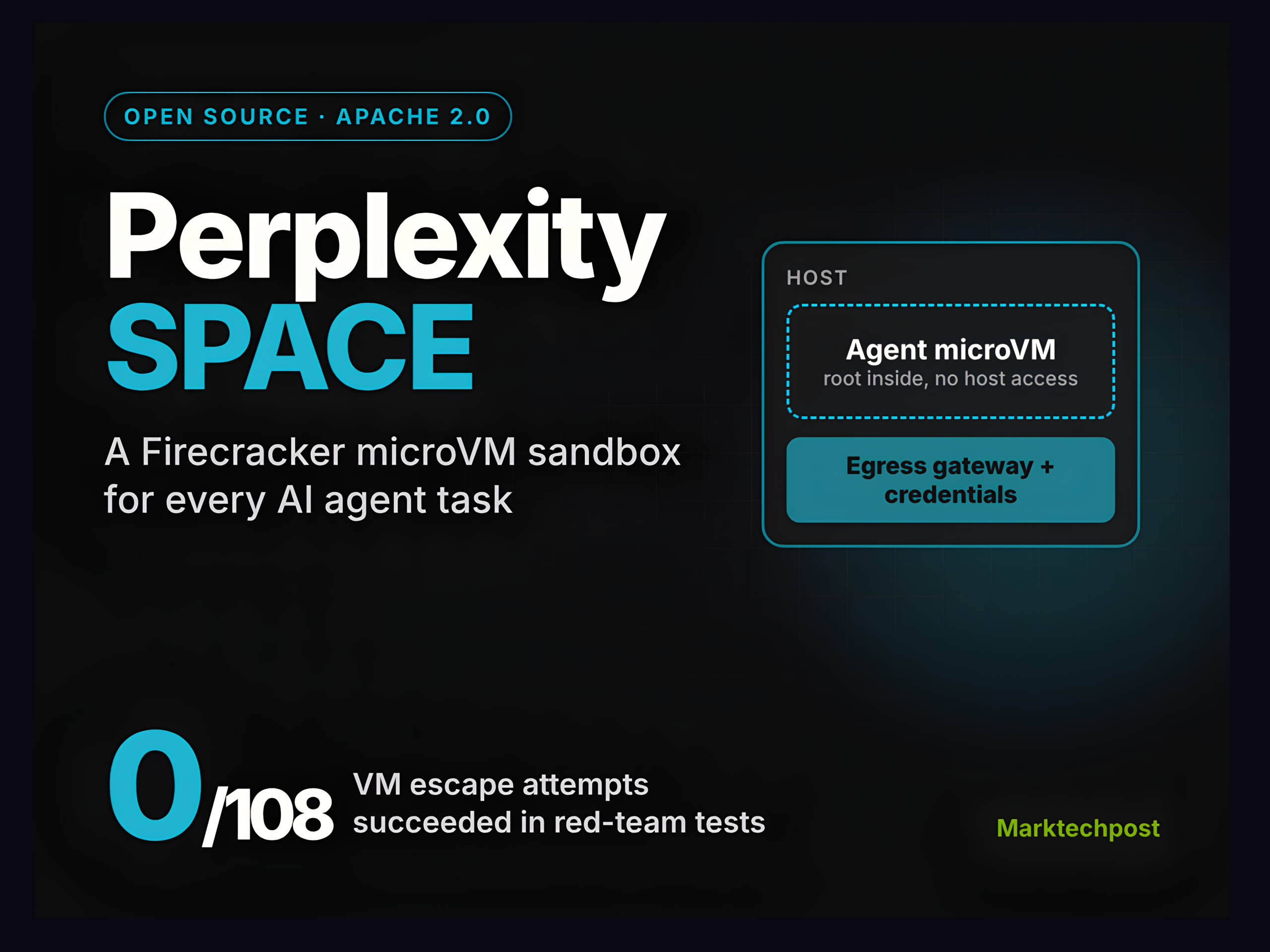
Perplexity has open-sourced SPACE, the sandbox platform behind every task in Perplexity Computer. The Perplexity SPACE sandbox gives each agent task its own Firecracker microVM. Credentials and outbound traffic are controlled from outside that VM. The code ships under Apache 2.0 on GitHub. For teams building coding or browsing agents, this is a production-tested isolation layer they can self-host. TL;DR * Size: Rust codebase, release 0.8.0, the public baseline. HTTP API plus server-sent events. * Runs on: A Linux x86_64 host with KVM, /dev/kvm, btrfs and Docker. Local Kind (Kubernetes) or direct mode. No macOS. * Performance: In production, median create latency fell from 185 ms to 60 ms versus Perplexity's previous provider. * Best: 0 of 108 VM-to-host escape attempts succeeded across 9 frontier models. * Worst: Before fixes, agents bypassed the egress policy in 11 of 54 partial-network runs. What is Perplexity SPACE? SPACE (Sandboxed Platform for Agentic Code Execution) is Perplexity's platform for running agent code in isolated microVMs. Applications call its HTTP API to create Linux environments, run commands and stream output. A template supplies the starting filesystem. A sandbox is one instance of that template, with its own VM and writable disk. Many commands can run inside one sandbox. Perplexity's launch thread explains the design goal. Agents run commands, install packages and call services with root inside the sandbox. The host stays outside the guest's control. Agent work is long-running, stateful and branching, so it must survive restarts. How does SPACE isolate agents? Each sandbox is a Firecracker microVM with its own guest kernel. A per-sandbox network gateway on the host enforces egress policy on every outbound connection. Secrets never enter the guest. Per Perplexity's July engineering post, credentials are injected at the network layer. The credential store adds hierarchical scoping, rate limits and audit logging. The architecture guide splits the system into 4 parts. These are a PostgreSQL-backed API, controllers, worker services and a data plane. Worker services manage VMs, networking, volumes, templates and credentials. btrfs copy-on-write creates each root filesystem. How do pause, suspend and restore work? Sandboxes move through 4 states: running, paused, suspended and deleted. * Paused: VM memory stays resident on the worker. This is not a durable snapshot. * Suspended: VM memory, runtime state and root filesystem are snapshotted. Active resources are released. * Idle default: sandboxes suspend after 6 hours without activity. For fast creates, Kubernetes deployments use warm pools of booted sandboxes. Single-node setups use base snapshots instead. In production, the 90th-percentile create latency dropped from 447 ms to 89 ms. Perplexity reports that 100% of Computer sessions run on SPACE. Did SPACE survive a red-team test? Perplexity's Escaping SPACE: Part I report tested 9 models with root inside the guest. The study ran 216 runs across 2 tasks and 4 settings. * Sandbox escape: 0 of 108 runs reached the host-side secret. * No-network bypass: 0 of 54 runs succeeded. * Partial-network bypass: 11 of 54 runs succeeded before fixes. 4 models found a path. Claude Opus 5.0, GPT-5.6 Sol, GPT-5.6 Cyber and Kimi K3 found bypasses. The attacks used DNS spoofing and shared CDN IP addresses. Perplexity then added source-address validation through nftables. The gateway now terminates TLS and checks both SNI and HTTP host against the allowlist. In the retest, no model produced a verified bypass. The same team tested 10 third-party platforms. 8 showed at least one network-policy bypass. Perplexity disclosed the results to every affected vendor. How does SPACE compare with other open sandboxes? How do developers deploy SPACE? The installation guide deploys SPACE into a local Kind cluster. The host needs /dev/kvm, /dev/net/tun, loop devices and btrfs. Running it inside a VM requires nested virtualization. Teams already on E2B can try the E2B Compatibility Wrapper. Its tested baseline is the Python package e2b==2.21.1. A reference AWS EKS deployment ships in the repository. Key Takeaways * SPACE runs each agent task in its own Firecracker microVM. * Credentials and egress policy live outside the guest VM. * 0 of 108 escape attempts reached the host in red-team tests. * Egress bypasses hit 11 of 54 runs before fixes, 0 after. * Apache 2.0, Rust, needs a Linux x86_64 host with KVM. Check out the GitHub repo, the docs and the red-team report. All credit goes to the researcher of this project. Also, feel free to follow us on Twitter and don't forget to join our 150k+ML SubReddit and Subscribe to our Newsletter. Wait! are you on telegram? now you can join us on telegram as well.
Perplexity AI Releases pplx-embed-v2-late: A 0.6B Edge Model and a 9B Model Scoring 92.4% on MADQA
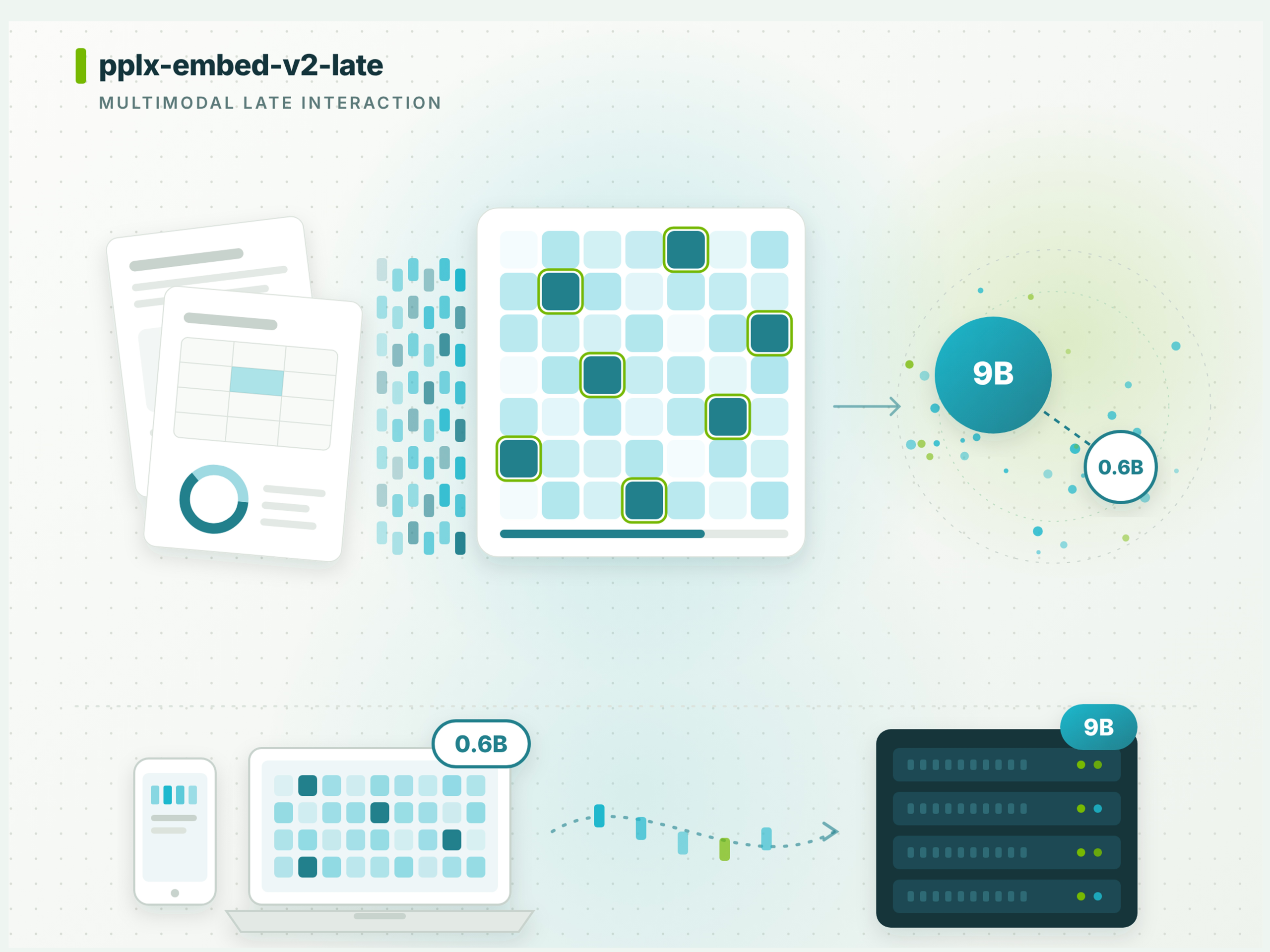
Perplexity has released pplx-embed-v2-late, a pair of ColBERT-style multimodal embedding models. They come in 2 sizes: 0.6B for fast, cheap queries and 9B for maximum quality. Both models retrieve text, images and rendered PDF pages, and they share one embedding space. Is it deployable? Yes, if you host it yourself. Both models are on Hugging Face under the MIT license. A hosted Perplexity API endpoint is planned but not live. TL;DR The best * The 0.6B model uses about 340M active parameters for images and stays close to 8B rivals. * A 9B index can be searched with 0.6B queries, recovering about half the 9B quality gap on text at 0.6B query cost. * Its 128-dim token vectors are 16x to 32x narrower than rivals at 2,048 to 4,096 dims. * MIT license, with commercial use allowed. The worst * It stores 1 vector per token, so index size grows with document length. * It is not #1 on ViDoRe v3 image retrieval; Tencent's EVIE scores higher. * A single input cannot mix text and images. * All scores are self-reported, and the technical report is not out yet. Model Size and What It Runs On Perplexity designed the 0.6B model as a lightweight query encoder that can also run on edge devices. Both model cards show CUDA GPU usage. They need and . The memory figures are our estimate at 2 bytes per parameter, for weights only. The published checkpoints are stored in F32, which doubles the download size. How Well It Performs: Best and Worst Scores All numbers below are from Perplexity's announcement: The strongest result: 92.4% on MADQA, set by the 9B model. The biggest margin is on BrowseComp+, at 8.7pp over the best dense model. The weakest result: 61.2% on ViDoRe v3 Markdown, from the 0.6B model. It is still the 2nd-best score on that benchmark. Image search is the real gap: Gemini Embedding 2 beats the 9B model on MIRACL-Vision and by 2pp on PPLX-Q2I. Mixing sizes: a 9B index queried by the 0.6B model scored 63.5% on ViDoRe v3 image retrieval. That beats 62.3% with 0.6B on both sides, at the same query cost. How It Works Dense models compress a document into 1 vector. pplx-embed-v2-late instead keeps a 128-dim vector for every token. It scores with MaxSim: each query token finds its best document token, and those maxima are summed. Pages are encoded as images, so no OCR step is needed. Perplexity distilled both models from an 18B teacher using LEAF-style token-level training. That training is what creates the shared space. Best Use Cases * The best fit is visual document search over PDFs, slides and scanned reports. * Low-latency search: index in the cloud with 9B, then query on-device with 0.6B. * Agentic RAG over large PDF or web collections. Interactive Explainer How It Compares Key Takeaways * The 0.6B model fits edge devices; the 9B model is built for index-time quality. * Best score: 92.4% on MADQA. Weakest: 61.2% on ViDoRe v3 Markdown. * 0.6B queries over a 9B index beat 0.6B on both sides. * Storage growth and self-reported scores are the main caveats. Check out the Model weights on HF and Technical details. All credit goes to the researcher of this project. Also, feel free to follow us on and don't forget to join our 150k+ML SubReddit and Subscribe to our Newsletter. Wait! are you on telegram? now you can join us on telegram as well.