News & Updates
The latest news and updates from companies in the WLTH portfolio.
xAI sues Grok user over AI-generated explicit imagery of minors - Cryptopolitan
he outcome could set a template for how the industry handles users who weaponize generative tools. Elon Musk's xAI has taken a South Carolina man to federal court in Texas, accusing him of using the Grok chatbot to create sexually explicit deepfakes of minors, marking the very first time an AI company will sue one of its own users over content generated using its platform. The defendant, Terry Harwood, was arrested in February on separate charges of sexually exploiting minors, according to Reuters. xAI's civil complaint was filed on Tuesday April 14, and will now be alongside whatever criminal case develops from that arrest. xAI's lawsuit The filing says that he opened several accounts under fake identities, and then fed the AI tool regular photographs of both adults and children before writing prompts meant to turn those images into sexual content. According to Al Jazeera, the subjects used in these acts had not consented and did not know their pictures were being used. xAI claims the system pushed back against the act. Grok refused the requests, flagging them as violations of its content rules. Harwood's response, according to the complaint, was to keep rewriting the prompts and trying again. "Defendant's actions were a calculated scheme to weaponize Plaintiff's tool for criminal ends, exposing real victims to profound and lasting harm," xAI wrote in the lawsuit, quoted by Reuters. The company also alleges he produced non-consensual sexual images of adults. The AI company requested two things from the court in the lawsuit filing. These include monetary damages with no particular figure attached, and an order that bars Harwood from ever using the Grok product again. xAI also used the filing to state the scale of its enforcement work against bad actors. The company said it suspended 52,222 accounts this year and sent 73,604 reports to the National Center for Missing & Exploited Children, referrals that led to at least 244 arrests in 2026. Grok remains under wider scrutiny xAI had already been under pressure over what Grok can produce before this case came up. Regulators in Europe have scrutinized the AI tool, while lawmakers in Washington have raised multiple concerns. Both Malaysia and Indonesia have banned the chatbot due to sexually explicit output, Al Jazeera reported. Elon Musk himself denied the underlying problem earlier this year. "I [am] not aware of any naked underage images generated by Grok. Literally zero," he wrote on X in January. I not aware of any naked underage images generated by Grok. Literally zero. Obviously, Grok does not spontaneously generate images, it does so only according to user requests. When asked to generate images, it will refuse to produce anything illegal, as the operating principle... https://t.co/YBoqo7ZmEj -- Elon Musk (@elonmusk) January 14, 2026 A recently created legal pathway called the DEFIANCE Act has also led to an increase in these such cases. The act, signed in 2024, gives victims of non-consensual intimate deepfakes a way to sue, and several states have passed individual laws to this effect.

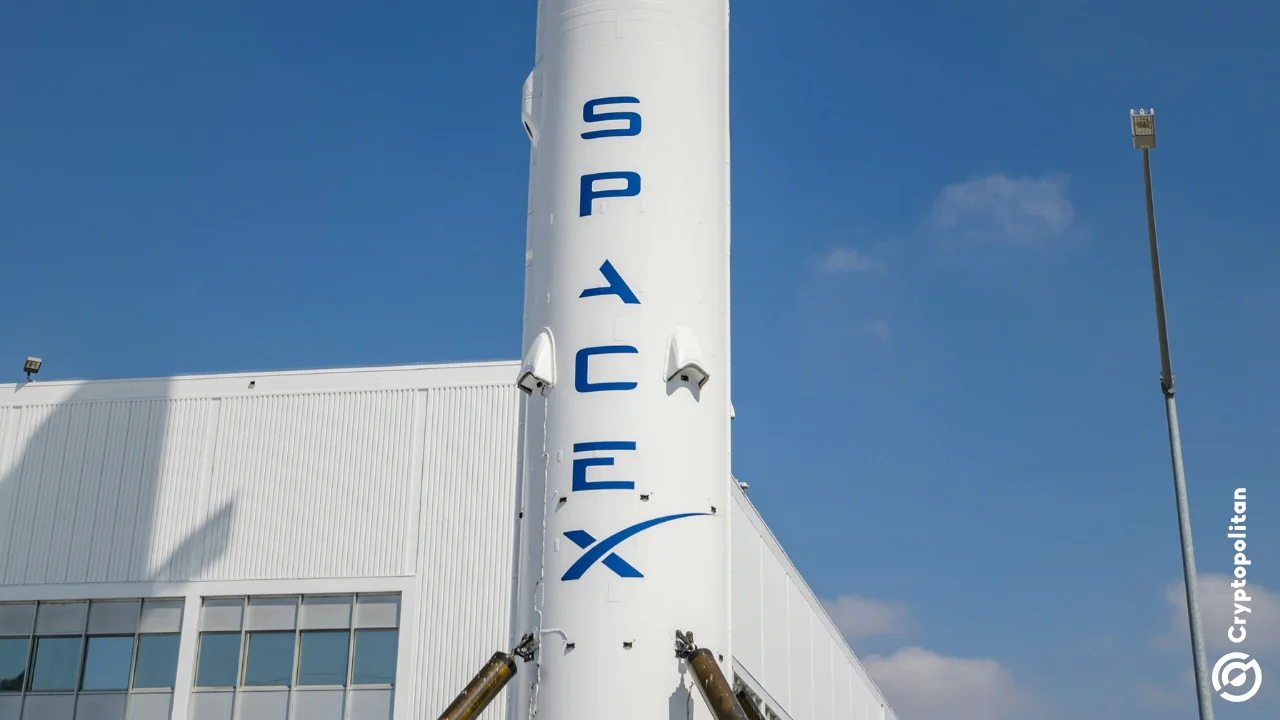
SpaceX's AI empire is built on data centers, not satellites - Cryptopolitan
Analysts caution that the contracts carry termination clauses and that space computing is still 10 years or more away. SpaceX's AI returns over the next few years will not come from space. According to Wall Street analysts, the money is coming from Earth data centers rather than the orbital compute that Elon Musk has promised. This reframes SpaceX (NASDAQ: SPCX) as primarily an infrastructure company. Space computing is a bet for the future, not now, for anyone considering SpaceX as an AI play. SpaceX already charges for computing. Reuters reported that the company signed enterprise deals for its Colossus supercomputer clusters with Anthropic, Alphabet's Google, and Reflection AI. Those contracts alone are expected to generate more than $28 billion annually. SpaceX's AI revenue in 2025 is ~$3.2 billion, which is significantly higher than the new deals. The compute contracts also outperformed SpaceX's earnings from rocket launches and Starlink, when counted separately. The contracts, however, include termination clauses, so analysts caution against reading them as recurring revenue. What SpaceX spent to get here SpaceX invested ~$18 billion in AI infrastructure and research in 2025. According to company filings, ~$12.7 billion was spent on capital expenditures and $5.1 billion on research and development. That expenditure outpaced spending on space and connectivity lines. Colossus and a second cluster, Colossus II, together provide ~1 gigawatt of AI compute. That makes SpaceX one of the world's largest compute operators. J.P. Morgan predicts that terrestrial capacity will reach ~9 gigawatts by 2029, which is equivalent to four times the output of the Hoover Dam. Brokerages cited by Reuters pointed to its $60 billion purchase of AI coding startup Cursor as a sign the company wants to sell AI applications, not just the machines that run them. The deal ties into Musk's model plans on the software side. A separate Cryptopolitan report said Musk's lab, now renamed SpaceXAI, built its Grok 4.5 model jointly with Cursor, and Musk has said SpaceX is buying the startup for that same $60 billion figure. Why orbit is still a distant bet Musk has proposed a future in which computers run in space. Analysts Reuters spoke with view this as a later chapter. "The narrative that (orbital) will fundamentally disrupt terrestrial data centers is a little bit overblown," said Anthony Milovantsev, a partner at consultancy Altman Solon, who estimated that any real displacement of ground-based data centers would take "ten years plus." The case is based on hardware that does not currently exist at scale. Orbital computing relies on SpaceX's Starship flying frequently and cheaply, lower launch costs, and better satellites, according to analysts. Ground clusters continue to run regardless of direction. BofA analysts were more blunt, calling the long term viability of orbital data centers "unproven and heavily reliant on key technological milestones that have yet to be realized." If the engineering is delivered, the appeal will be valid. Starships could eventually launch solar computing satellites into orbit, avoiding ground based costs such as energy, cooling, and land use. Analysts aren't asking if SpaceX can build and sell AI infrastructure. J.P. Morgan's estimate of ~9 gigawatts in 2029 remains the benchmark for establishing a business beyond Earth.