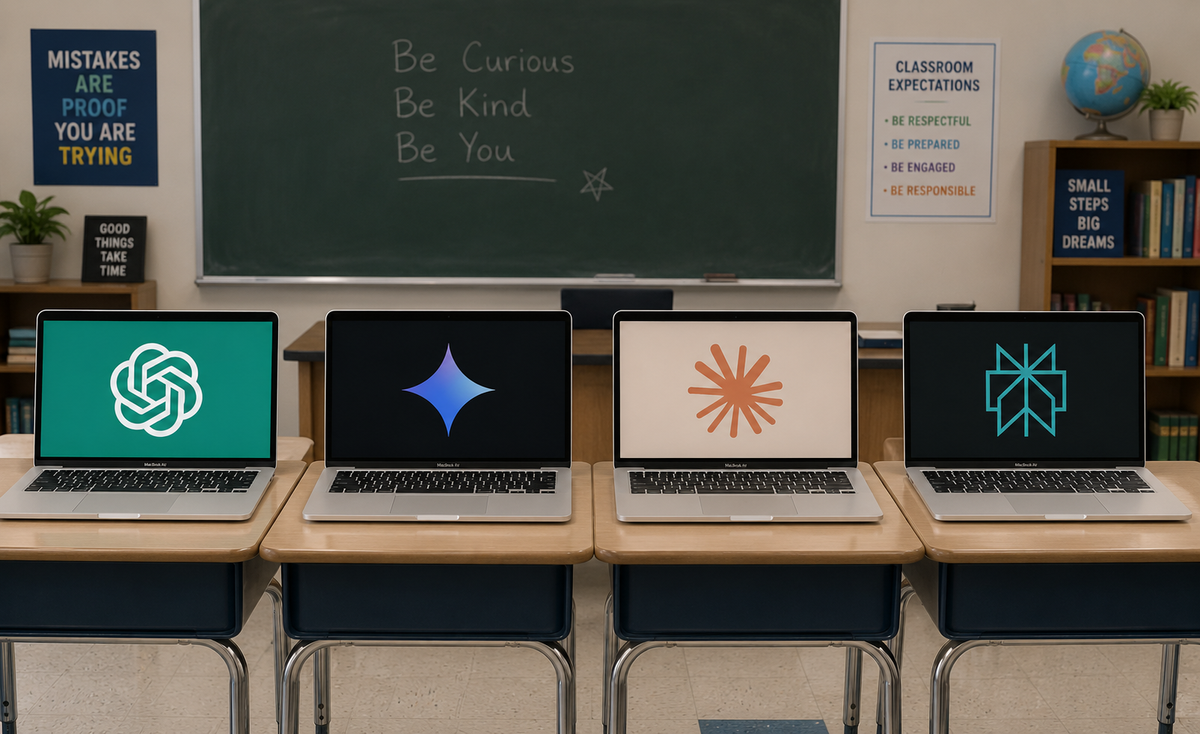
I asked ChatGPT, Gemini, Claude and Perplexity what they really think of each other -- and their responses revealed their biggest strengths (and weaknesses)
The AI tools that have earned a permanent place among my tabs lineup are ChatGPT, Gemini, Claude and Perplexity.
Every day, a lightbulb idea either wakes me out of my sleep or hits me while I'm tending to something totally unrelated (it's amazing how experimental concepts invade your brain while you're making toast). I've gotten used to using ChatGPT to generate productivity routines, Gemini for Google Workspace-related tasks and Claude & Perplexity for deep research assignments. And all in all, they handle those duties pretty well and successfully fill their roles as digital assistants.
I got another bright idea when I started pondering how to test my AI partners. The question circling my mind ended up being, "I wonder what all of those chatbots think about their competition?" And with that, I inserted this prompt into each AI tool to see just how honest they'd be in their responses: "What is your honest, unfiltered opinion of [insert names of AI rivals here]?"
Not only did each chatbot speak their mind on their rivals' biggest strengths, but they also made sure to bring up their most notable weaknesses.
ChatGPT's answer
When I asked ChatGPT how it honestly feels about Gemini, Claude and Perplexity, it stated where each chatbot shines, where they fall short and who they're best for.
It pointed out that Gemini is great for research since it benefits from Google's deep knowledge well. But ChatGPT also noted that Google's chatbot sometimes prioritizes breadth over depth, giving users comprehensive answers that don't always go as deep as some would like.
As for Claude, it championed it as the most naturally flowing writer among all the major AI assistants but also stated how it could occasionally be overly cautious or verbose with its responses.
And finally, it recognized Perplexity for being able to blend search and AI in a way that's easy to trust since users can inspect its sources. As far as a single weakness goes, ChatGPT said that Perplexity falls short in comparison to itself and Claude when handling long collaborative projects.
ChatGPT brought its AI model comparison session to a close with the following statements: Rather than thinking of one as "the best," it's more accurate to think of them as tools with different design priorities. The best choice depends on whether you're writing, researching, coding, organizing information, or integrating with the apps you already use.
Gemini's response
When the time arrived for Gemini to give its opinions about ChatGPT, Claude and Perplexity, it initially offered a breakdown of each one's core strengths, pitted them against each other for head-to-head comparisons across everyday tasks and noted when it's best to use one for certain situations.
Here are the core strengths Gemini alluded to for each chatbot:
-
ChatGPT (OpenAI): The Swiss Army knife. It is the best all-around tool for generation, execution, and structured outputs. It has the strongest ecosystem (Canvas, voice mode, image generation via DALL-E, and data analysis). If you need to create something from scratch, write code, or automate a task, ChatGPT is the default choice.
-
Claude (Anthropic): The thoughtful writer and deep reasoner. It excels at parsing long documents, maintaining context, and producing natural, less "AI-sounding" prose. Its nuance and ability to handle complex logic make it the preferred tool for editing, strategy, and producing high-quality written content.
-
Perplexity: The research engine. It is not designed to be a conversational chatbot or a creative writer; it is an AI-powered search engine built on retrieval-augmented generation (RAG). Its core strength lies in finding information on the live web and providing verified, clickable citations for every claim.
When I asked Gemini a follow-up question about revealing each chatbot's biggest weaknesses, it offered the following descriptions:
-
ChatGPT (OpenAI): ChatGPT is designed as a broad, execution-focused generalist. Its weaknesses stem from trying to do too many things simultaneously and prioritizing speed and output generation over meticulous fact-checking.
-
Claude (Anthropic): Claude is built to be a careful reasoner and long-context synthesizer. Its weaknesses largely stem from its heavy emphasis on safety guardrails and its lack of deep integration with real-time tools.
-
Perplexity: Perplexity is an AI search engine built on retrieval-augmented generation (RAG). Its weaknesses appear immediately when users try to use it as a traditional chatbot rather than a research tool.
Gemini was none too kind to each chatbot when laying out their faults. For example, it listed poor conversational memory, low creativity and citation hallucinations as the three biggest weaknesses stemming from users' experiences with Perplexity.
Claude's reply
I was amazed to see Claude start its analysis of ChatGPT, Gemini, and Perplexity by pointing out its bias with this honest declaration:
Fair question, but I'll flag my own bias upfront: I'm made by Anthropic, so take my take with a grain of salt -- I'm not exactly a neutral party. I haven't used these products myself. I don't have hands-on experience with ChatGPT's interface, Gemini's integration with Google services, or Perplexity's search flow. Anything I say is inference from what's publicly known, not firsthand comparison.
Claude accepted ChatGPT as the market leader among other AI tools due to its broad capabilities, strong voice mode feature, vast plugins/GPTs ecosystem and penchant for shipping flashy features before its rivals. As for its weaknesses, it pointed to ChatGPT agreeing too readily rather than pushing back on its users' questions and how its quality feels inconsistent across its model updates in ways that frustrate its power users.
In Gemini's case, Claude noted that its biggest edge is its Google search engine and Google Workspace integration. Claude also brought up Gemini's strong multimodal abilities and ability to handle long-context work. The most noteworthy weakness that was mentioned is how some users complain about its lack of a personality (it doesn't have the strongest conversational abilities, in my opinion) in comparison to other AI tools.
To end its analysis of its three biggest AI competitors, Claude presented this statement aimed at focusing on the bigger picture of the current-day AI arms race:
These companies are trading the lead constantly -- whoever's "best" shifts every few months as new models ship. Anyone (including me) who tells you one is definitively superior across the board right now is probably overselling it or hasn't checked recently. Your actual best move is checking recent independent benchmarks or just trying them on the tasks you care about, since "best" is pretty task-dependent.
Perplexity's rebuttal
Perplexity got straight to the point when the time came for it to be as blunt as possible about its opinions on ChatGPT, Gemini, and Claude. It noted how they're all strong across the board, but feel different in personality, reliability, and what they're best at.
It pointed to ChatGPT's citation consistency across encyclopedic, community and legacy editorial domains, such as Wikipedia and Reddit. The main weakness Perplexity connected to ChatGPT was how it occasionally tries to "smooth over" its knowledge gaps instead of simply saying "I don't know."
Gemini got a digital pat on the back for offering its users a wealth of information and integration with live Google Search data. But it also got knocked for its less-than-reliable reasoning depth and giving out answers that can feel shallow or generic.
As for Claude, Perplexity gave it high marks for offering users depth, clarity, and safety when explaining complex topics. As for its central weakness, Claude got knocked down a peg for being overly cautious or verbose with its responses. Perplexity also remarked how Claude can sometimes avoid giving direct answers.
At the end of its evaluation, this is how Perplexity summarized the other three chatbots it's always compared to:
ChatGPT: most well-rounded and adaptable.
Gemini: strongest for up-to-date info and ecosystem integration.
Claude: strongest for deep thinking and careful writing.
If you forced a blunt summary: ChatGPT is the best generalist, Claude is the best thinker, and Gemini is the best connected.
The takeaway
I have to hand it to all four chatbots -- they remained professional in their responses, gave credit where credit is due when bringing up the other AI tools' strengths and didn't get into a digital mud-slinging match when speaking on their rivals' weaknesses.
Their honest examinations of each other stood out to me as a go-to guide for me when deciding what tasks to present to them from that point forward. I'm sure as time goes on, each of those AI tools will get more refined and get past their shortcomings -- at least a lack of honesty isn't among them.
Follow Tom's Guide on Google News and add us as a preferred source to get our up-to-date news, analysis, and reviews in your feeds. Subscribe to Tom's Guide on YouTube and follow us on TikTok.