Samsung Taps Perplexity To Upgrade Bixby In Appliances - Gear
Samsung is integrating Perplexity AI into Bixby for select home appliances, as it looks to make its assistant more conversational and useful beyond basic voice commands.
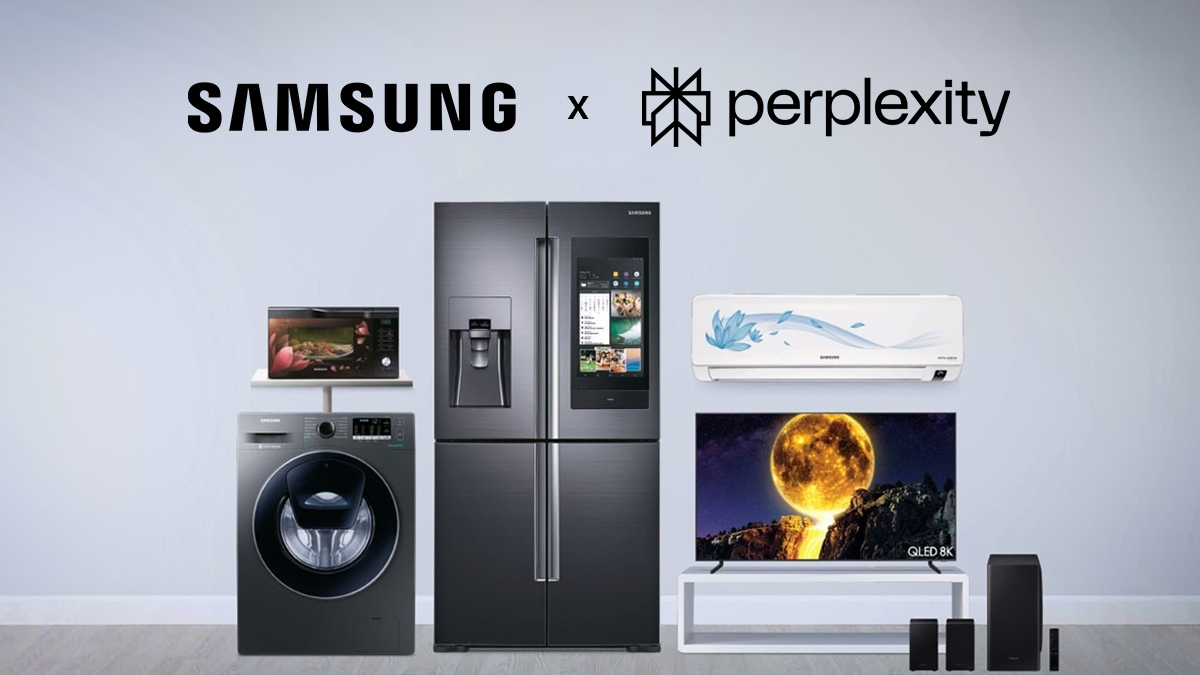
Announced in South Korea, the company said the updated Bixby will be applied to appliances with built-in displays, including refrigerators, washing machines, robot vacuums, and air conditioners. The focus is on enabling more natural interactions directly on these devices.
Bixby Now Handles Queries, Context, And Follow-Ups
Bixby is being upgraded with large language model capabilities, allowing it to understand natural language, process follow-up questions, and respond with context instead of relying on fixed commands.
Perplexity's integration adds an information layer to this. Users can ask open-ended questions or seek explanations while interacting with appliances, instead of limiting usage to control functions like temperature or wash settings.
The assistant is being positioned to interpret intent and provide responses, not just execute instructions.
Appliances Get A More Practical AI Interface
Home appliances operate within repeat use cases such as cooling, cleaning, and maintenance. These scenarios benefit more from contextual interaction than command-based inputs.
Most smart appliance features have seen limited usage due to rigid controls or dependency on apps. A conversational interface reduces that friction, provided responses remain accurate and consistent in real-world conditions.
The Same Multi-AI Direction Seen On Galaxy S26 Carries Forward
Samsung has already started moving towards a multi-AI approach with its latest flagship lineup, where Bixby works alongside external platforms like Google and Perplexity instead of operating in isolation.
Bringing Perplexity into appliances follows the same structure. Bixby continues as the interface layer across Samsung devices, while external models handle information and reasoning tasks.
This indicates that Samsung is applying a similar AI framework across categories, not limiting it to smartphones.
Bixby's Role Shifts Within Samsung's Ecosystem
Bixby has struggled to compete as a standalone assistant against more established ecosystems.
With this update, its role becomes more defined. It acts as the interaction layer across Samsung devices, while integrations like Perplexity strengthen its capabilities without requiring a full rebuild of the assistant.
This allows Samsung to retain control over the user experience while expanding functionality through partnerships.
Users can interact with appliances using natural language instead of predefined commands. Tasks such as adjusting settings, asking questions, or troubleshooting can be handled through conversation rather than apps or menus.
The experience will depend on how consistently this works across devices, languages, and everyday usage scenarios.
Expansion of Samsung Ecosystem
Samsung is extending the same AI approach seen on its latest smartphones into appliances, rather than building separate experiences for each category. The integration of Perplexity into Bixby shows a shift towards a layered AI model, where different systems handle different roles within the same interface.
If this scales beyond initial deployments, the value of AI in Samsung's ecosystem will depend less on individual features and more on how seamlessly it works across devices.