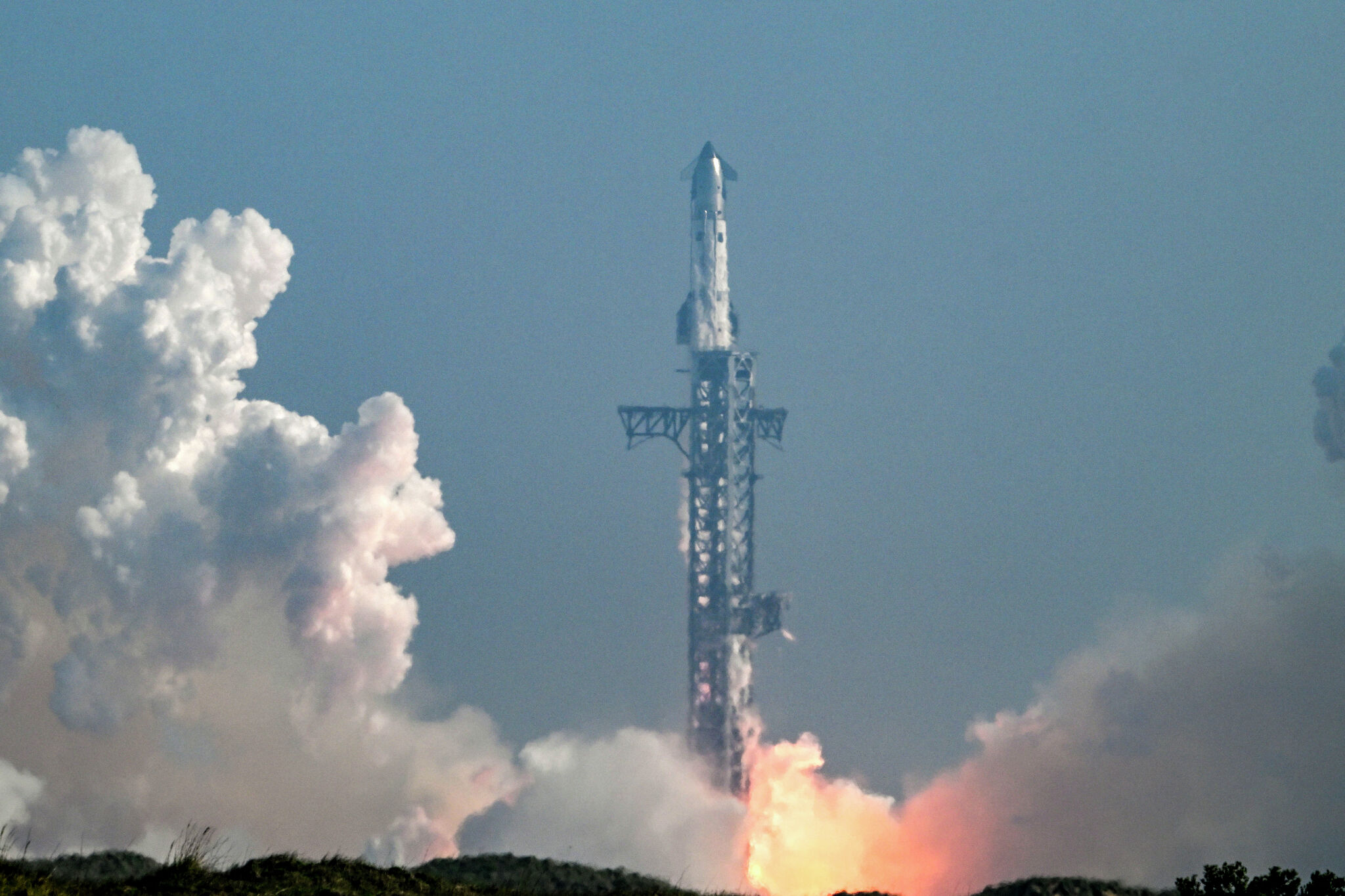
SpaceX could launch Starship this week. Here's what's different
SpaceX could launch its next Starship into space as soon as Thursday, according to the company's website and social media posts by CEO Elon Musk.
If the launch of the 13th test flight of Starship/Super Heavy proceeds as planned, it would be the quickest turnaround time between launches for the spacefaring company that recently went public and made Musk the world's first trillionaire. It's also expected to mark another first for SpaceX -- the first time that Starship will carry functional Starlink satellites into space.
"The upcoming flight will aim to complete similar objectives targeted on the previous flight test... while also carrying next-generation Starlink V3 satellites for the first time," SpaceX said on its website on a page dedicated to upcoming launches.
SpaceX last launched a Starship from its Starbase headquarters on May 22. Flight 12 was the first flight of 2026, and the first time that the company deployed its third-generation Starship configuration. Before that, SpaceX hadn't launched a ship since October 13, 2025.
But not everything went according to plan during May's test flight. It's something SpaceX acknowledged on the Flight 13 launch page. An error "in engine startup" on Starship during what is known as "hot staging" caused the booster to rotate off kilter by 90 degrees when the two vehicles separated. Further, five of Super Heavy's 33 Raptor engines failed to relight when it attempted its boostback burn, which was meant to point the rocket back toward Earth for a splashdown in the Gulf of Mexico. One of Starship's Raptors also died after separation.
SpaceX said it has since corrected both errors. And those corrections were crucial in meeting a federal regulatory prerequisite before Starship could take to the skies again. After the May 22 launch, the Federal Aviation Administration grounded Starship and ordered SpaceX to investigate the so-called "mishap." On Monday, July 13, the FAA officially closed the mishap investigation, paving the way for SpaceX to proceed with Flight 13.
"The final mishap report cites two most probable root causes for the loss of the Super Heavy booster as heat effects on propulsion system components during the ascent and erroneous engine alarm system settings," the FAA said in a statement Monday.
For the first time, Starship will carry live Starlink satellites into space and attempt to connect them with the existing Starlink network. Until now, SpaceX has relied on its unmanned Falcon 9 reusable rockets to launch the communications satellites into low Earth orbit.
"Starship is planned to deploy 20 satellites which will extend solar arrays and antennas and will attempt to connect with the larger Starlink constellation via high-capacity lasers," SpaceX said.
But the satellites will not remain in orbit. Instead, they're expected to burn up in the Earth's atmosphere.
SpaceX is targeting a 90-minute launch window that's expected to begin at about 5:45 p.m. local time on Thursday, July 16. However, the company has selected July 17 and July 18 as potential backup dates, according to several notices to airmen, or NOTAMs, the FAA published announcing airspace restrictions on those dates.