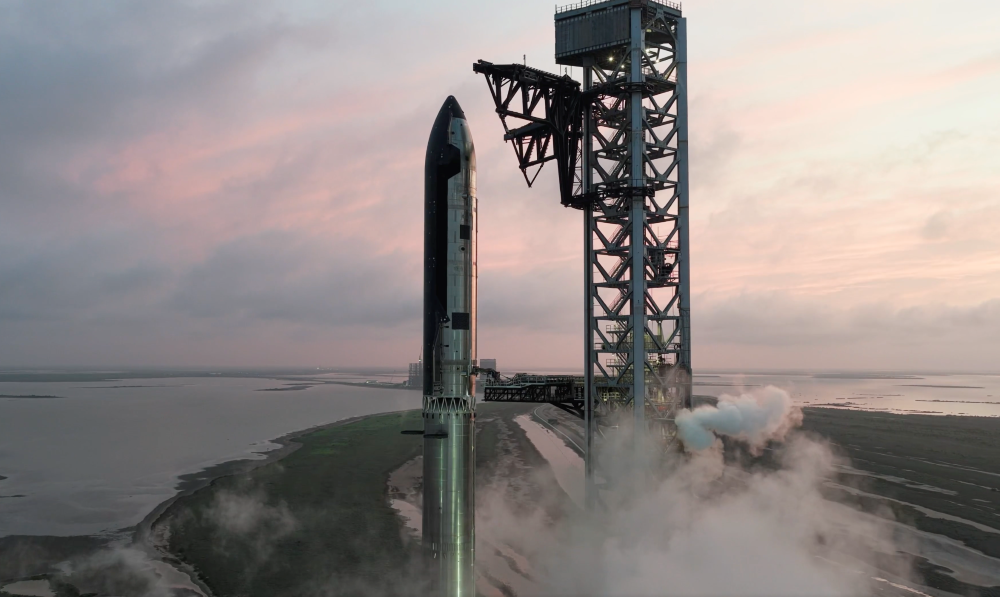
SpaceX Gears Up For Starship Flight Test July 16 | Aviation Week
The FAA has closed its mishap investigation into SpaceX's last Starship-Super Heavy flight test, clearing the company for another attempt to demonstrate its next-generation reusable superheavy lift system as early as July 16.
Starship Flight 13 is slated to launch between 6:45 -8:15 p.m. EDT/5:45-7:15 p.m. local time from SpaceX's Starbase facility in southern Texas.
The goals of Flight 13 largely duplicate what was intended during Flight 12 on May 22, which was marred by problems with the new Starship Version 3 (V3) Raptor engines. On that flight, the Super Heavy booster deployed the upper stage Starship into a suborbital trajectory but failed to execute engine burns as expected for a soft splashdown in the Gulf of Mexico.
"Slight differences in engine startup on the ship caused the directional flip of the booster to be off by approximately 90 deg.," SpaceX wrote in a July 13 update posted on its website.
The Super Heavy booster attempted to perform a boostback burn for a controlled descent and splashdown, but five of its 33 engines failed to relight, cutting short the maneuver. "The Super Heavy on this upcoming flight has hardware modifications to improve re-light reliability, along with updates to engine alarms and aborts to match the conditions seen in the multi-engine flight environment," SpaceX said.
Those include modifications to the engine startup sequence to make it "more robust to timing variability and more reliably flip in the desired direction, which is done to increase overall performance," it noted.
The FAA said SpaceX's mishap report cited two most probable root causes for the loss of the Super Heavy booster: heat effects on propulsion system components during the ascent, and erroneous engine alarm system settings.
"SpaceX identified four corrective actions, including vehicle hardware and software configuration updates to prevent a reoccurrence of the event," the FAA said in a statement on July 13.
The Starship upper stage also experienced an engine issue during Flight 12, causing SpaceX to skip a planned engineering demonstration to relight the new Raptor 3 engine in flight -- a prelude to orbital flight and reentry.
That test will be attempted during Flight 13. In addition, instead of flying and deploying dummy Starlink satellites, Starship for the first time will carry operational spacecraft. Following deployment into Starship's planned suborbital trajectory, 20 Starlink V3 satellites will extend their solar arrays and antennas and then attempt to connect with the larger Starlink constellation via high-capacity lasers. Since the satellites will be on the same suborbital trajectory as Starship, they are expected to reenter the atmosphere about 20 min. after deployment.
"Six of the satellites have been modified with a suite of cameras to scan Starship's heat shield and transmit imagery ... to operators to continue testing methods of analyzing Starship's heat shield readiness for return to launch site on future missions," SpaceX said.
As part of the test, several tiles on Starship have been painted white to simulate missing tiles and serve as imaging targets, it said.
SpaceX also plans some tests of Starship's heat shield itself. The shield includes load-sensing tiles that will collect data as Starship experiences higher dynamic pressure during ascent than on previous flights, the company said.