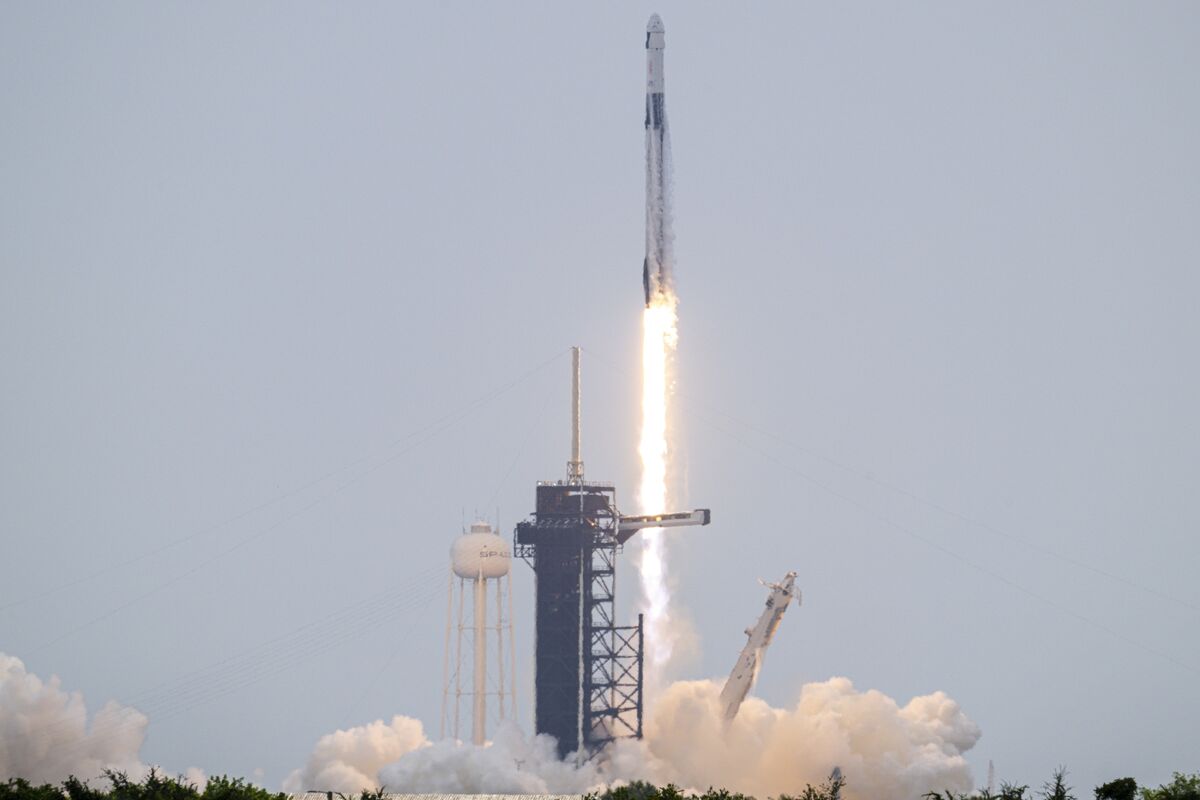
SpaceX Heralds New Era of Mega IPOs. Buyers Beware
The next 12 months are expected to bring a bumper crop of mega initial public offerings to market. Billionaire Elon Musk's rocket, satellite and AI company SpaceX has reportedly filed for a potentially record-breaking offering. OpenAI and Anthropic PBC are expected to follow suit sometime in the near future, giving investors the opportunity to finally invest in some of the most groundbreaking -- and maybe also overhyped? -- companies in the world today.
History tells us to tread very, very carefully, both when investing in these companies and evaluating what they tell us about the stock market overall.
In as much as these IPOs sometimes do well, the beneficiaries are generally the institutional players who get shares before public trading starts -- not the retail investors who chase these opportunities in the open market. That may be especially true this time around, with SpaceX reportedly seeking a more than $2 trillion valuation in its IPO and OpenAI and Anthropic already valued at $852 billion and $380 billion, respectively, in recent funding rounds.
Among companies in the top percentile by offering size each year, the average excess return over five years was about 60% (roughly 9.8% annualized). That's great, but much of the outperformance comes on the very first day. The statistics are also juiced by extreme outliers such as Mastercard Inc. (2006) and Alphabet Inc. (2004). Using a trimmed-mean statistic and excluding the Day 1 "pop," the outperformance falls to about 17% (3.2% annualized). And by that metric, these stocks tend to find their groove only in the fourth or fifth year.
What's even wilder, however, is the way that excess returns have collapsed in recent times. The offering of Facebook (now Meta Platforms Inc.) was in many ways a sea-change moment. At the time, it was the quintessential example of a venture capital-backed firm that was allowed to balloon in private hands, a formula that's since become commonplace. After a rocky start to public life, Meta eventually delivered for its shareholders, but subsequent waves of such companies have left little on the table for investors.
No wonder mom-and-pop investors who can't get VC exposure often feel like the game is increasingly rigged. On average, mega IPOs have underperformed the market since the Facebook milestone.
Admittedly, the post-Facebook cohort of mega IPOs is relatively small and includes names such as Athene Holding Ltd. (retirement services) and Elanco Animal Health Inc. (veterinary drugs) that aren't really comparable to hot technology stocks. Here's a more representative sample of the largest tech and tech-adjacent IPOs in recent years so you can see the underperformance in greater detail. They have reliably been duds in their first five years of public life.
The other question is whether these offerings tell us the bull market is getting a little long in the tooth. I suspect there might be something to that as well.
Time series data suggest that we've had a handful of noteworthy boom periods for mega IPOs. There was the 1999-2000 period at the peak of the dot-com bubble and, later, the big credit card companies in 2006 and 2008. There was also the government-backed General Motors Co. offering in 2010; the Facebook moment in 2012; and then the 2019-2021 streak that included Uber Technologies Inc. and Airbnb Inc.
Needless to say, GM was a special case since it had been bailed out and taken public with government involvement. Many of the other examples marked significant market tops, including Goldman Sachs Group Inc. in 1999, Visa Inc. in 2008 and Rivian Automotive Inc. in 2021. On average, the market has gained a somewhat paltry 6% a year after these major events (see below). Granted, this is a very small sample that's subject to a lot of randomness and bad luck, including a financial crisis and a pandemic. But there's a certain logic to the idea that mega-cap IPOs may be something of a contrarian sell signal.
Consider the reasons these companies waited so long to go public in the first place. With private funding abundant in the post-Facebook era, founders are more than happy to avoid regulatory scrutiny and the demands of quarterly reports to investors. Many of them only go public because their employees and VC backers demand a "liquidity event."
From a founder's standpoint, you're incentivized to wait and wait -- and then wait some more -- until your banker calls you up and says, "Hey, guys, there's a real risk that the window is about to close; it's now or never!" Obviously, bankers don't want their clients to sell at the tippy-top -- it's bad for their relationships with the buyside. Still, oftentimes it seems to work out that way.
Inevitably, some observers will conclude that OpenAI, Anthropic and SpaceX are in a league of their own. After all, they're the dominant companies in a technological revolution that boosters say will transform our economy and fundamentally change the way humans live and work. Maybe so. But investors also thought earlier mega IPOs, to varying degrees, marked once-in-a-lifetime opportunities, and their performance has tended to underwhelm more often than not.
This time around, it behooves investors to view all the hype with an extra measure of caution, because the most extraordinary returns may have already been earned by the end of the first day of trading.
More From Bloomberg Opinion:
-
Matt Levine's Money Stuff: OpenAI Is Almost Public
-
Private Credit's Pain Will Be The Market's Gain: Aaron Brown
-
Are US Recessions Going Extinct? That's So 2003: Jonathan Levin
Want more Bloomberg Opinion? OPIN