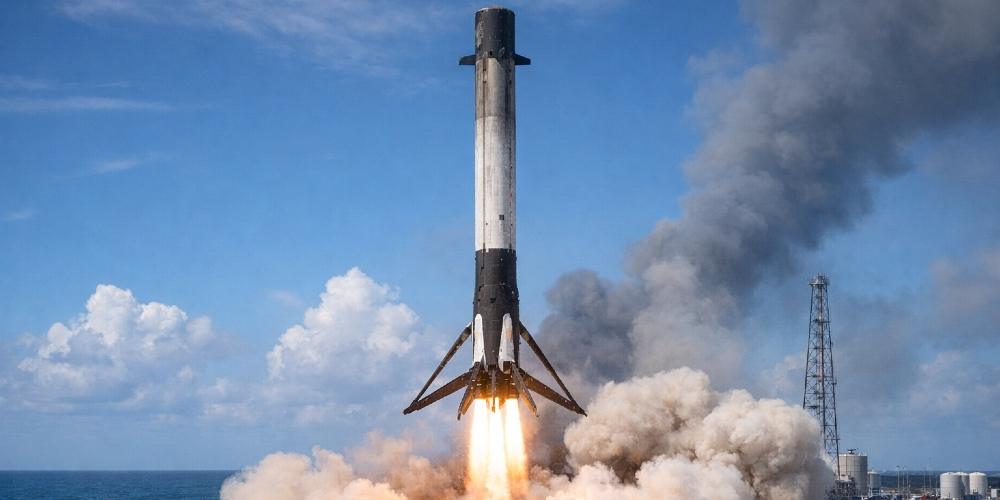
SpaceX IPO Details Release With June Roadshow Planned
The long-anticipated public debut of SpaceX is no longer a matter of speculation but of timing. According to recent reporting, the private aerospace giant is preparing for an initial public offering, with an early June roadshow now on the table. For years, founder Elon Musk resisted the idea of taking SpaceX public, citing the short-term pressures of quarterly earnings and the long arc required for interplanetary ambitions. So what changed?
More importantly, what does this shift reveal -- not just about SpaceX, but about the broader relationship between innovation, capital markets, and the political economy shaping both?
From its inception, SpaceX has operated as something of a paradox. It is a private company undertaking what are effectively public missions: satellite deployment, national security launches, and even NASA partnerships. It has disrupted legacy aerospace players while relying heavily on government contracts. It is both a symbol of free-market ingenuity and a beneficiary of federal spending.
For years, Musk argued that remaining private insulated SpaceX from the distortions of public markets. And he was not wrong. Quarterly earnings expectations often force companies into incremental thinking, sacrificing long-term breakthroughs for short-term stock performance. That tension is especially acute for a company whose ultimate goal -- colonizing Mars -- is measured in decades, not quarters.
Yet even a company as successful as SpaceX cannot escape the gravitational pull of capital markets forever. The sheer scale of its ambitions -- Starship development, global satellite networks via Starlink, and deep-space exploration -- requires funding on a level that private markets alone struggle to sustain indefinitely.
The IPO, then, is not a betrayal of principle. It is a concession to reality.
But let's ask the uncomfortable question: why now?
The answer likely lies as much in Washington as in Hawthorne. The modern American economy is increasingly shaped by a fusion of government policy, regulatory frameworks, and corporate strategy. SpaceX operates at the center of that nexus.
Federal contracts -- particularly through NASA and the Department of Defense -- have provided billions in revenue. At the same time, regulatory battles over satellite deployment and spectrum allocation have intensified. Starlink's global footprint places SpaceX squarely in the crosshairs of geopolitical tensions, from Ukraine to Taiwan.
Going public may provide not just capital, but political insulation. A publicly traded SpaceX becomes less of a singularly controlled entity and more of a broadly held national asset. Institutional investors, pension funds, and retail shareholders all become stakeholders. In an era when political scrutiny often follows concentrated power, dispersing ownership can be a strategic advantage.
In other words, the IPO is not merely financial -- it is defensive.
Here is where the irony sharpens.
For decades, progressives have argued that capitalism must be restrained, regulated, and redirected toward social goals. Yet it is precisely the discipline of markets -- competition, efficiency, and risk-taking -- that enabled SpaceX to succeed where government-run programs stagnated.
NASA itself increasingly relies on private contractors like SpaceX because they deliver results faster and cheaper. The very institution that once symbolized state-driven innovation now outsources its most ambitious missions to a private firm.
And now, that firm turns to public markets -- the same markets often maligned by the political left -- for its next phase of growth.
The contradiction is difficult to ignore. If markets are so inherently flawed, why do even the most ambitious technological endeavors ultimately depend on them?
SpaceX's IPO also signals something deeper: a cultural shift in how America approaches innovation.
The 20th century was defined by large-scale, government-led projects -- the Manhattan Project, the Apollo program, the interstate highway system. These were collective efforts, driven by national urgency and centralized planning.
The 21st century, by contrast, increasingly relies on private actors to achieve similar scale. Companies like SpaceX, Tesla, and others operate with a speed and flexibility that government agencies struggle to match.
But this shift comes with trade-offs. Private companies are accountable to shareholders, not voters. Their priorities, while often aligned with national interests, are ultimately driven by profitability and strategic positioning.
The IPO will only intensify that dynamic. Once SpaceX answers to Wall Street, its decisions will be scrutinized not just for their technological merit, but for their financial returns.
Will Mars still matter if margins shrink? Will long-term exploration survive short-term market pressures?
These are not hypothetical questions. They are the central tension of modern capitalism.
There is also a philosophical layer to consider.
Human exploration has always carried a moral dimension. From the biblical mandate in Genesis to "have dominion" over the earth, to the age of discovery, to the space race, exploration reflects a fundamental aspect of human nature: the desire to push beyond known boundaries.
SpaceX embodies that impulse. Its mission is not merely commercial; it is civilizational.
Yet when such a mission becomes entangled with market incentives, the risk is that higher purposes are subordinated to lower ones. Profit is not inherently immoral, but it is an insufficient guide for endeavors that shape the future of humanity.
As Scripture reminds us, "Where there is no vision, the people perish" (Proverbs 29:18, KJV). The question facing SpaceX -- and its future shareholders -- is whether that vision can endure in a system that rewards immediate returns over distant horizons.
For investors, the SpaceX IPO will undoubtedly be one of the most significant market events in years. Demand will be immense. The company's track record, combined with its dominance in both launch services and satellite internet, makes it a rare asset.
But for citizens, the implications are broader.
SpaceX is not just another tech company. It is a central player in national security, global communications, and the future of space exploration. Its transition to a public company raises questions about accountability, governance, and the role of private enterprise in shaping public outcomes.
Will public ownership democratize its mission, or dilute it? Will market pressures sharpen its efficiency, or constrain its ambition?
These are not questions with easy answers. But they are questions worth asking -- precisely because the stakes extend far beyond any stock ticker.
In the end, SpaceX's IPO represents both an opportunity and a test.
It is an opportunity to bring one of the most transformative companies of our time into the public sphere, allowing broader participation in its success. But it is also a test of whether America's market-driven model can sustain truly long-term, visionary projects.
Can a company dedicated to reaching Mars remain faithful to that mission while answering to quarterly earnings calls?
Or will the same forces that drive innovation ultimately constrain it?
The answer will not come from Wall Street alone. It will come from the interplay of markets, policy, culture -- and the willingness to prioritize vision over convenience.
Reaching the stars has always required sacrifice. The question now is what kind of sacrifice we are willing to make.