SpaceX satellite breakup highlights concerns over 'megaconstellation'
For the second time in three months, a SpaceX satellite has failed and broken up over Earth, highlighting concerns over the company's plan to increase its network to more than a million satellites.
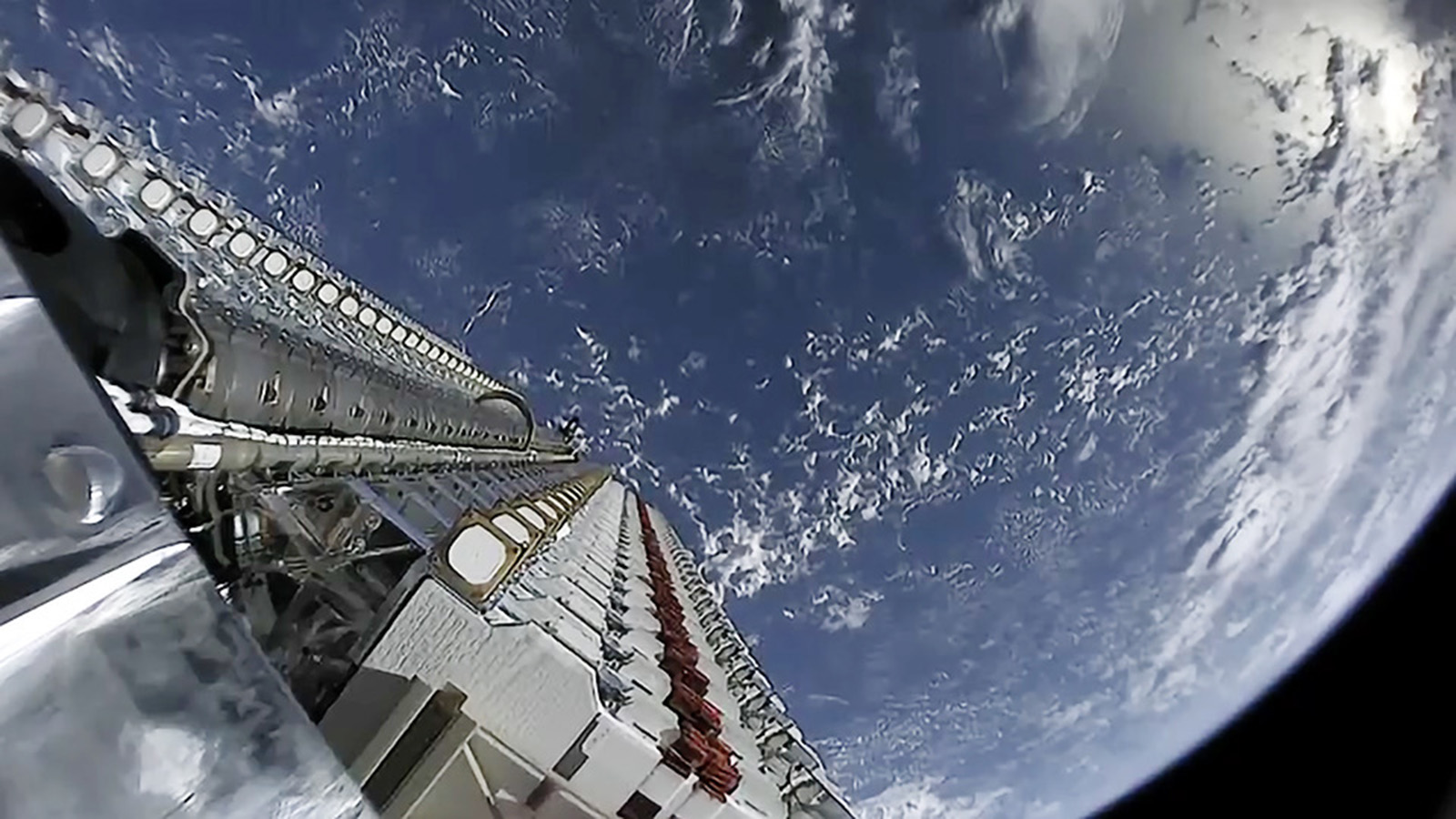
The spacecraft that malfunctioned this week was one of more than 10,000 currently operated by Starlink, SpaceX's satellite internet service that has a growing manufacturing facility in Bastrop County.
The Elon Musk-owned company said on X that "satellite 34343 experienced an anomaly on-orbit, resulting in loss of communications with the satellite at ~560 km above Earth."
Satellite 34343 was launched in May from Vandenberg Space Force Base in California. It was a type of Starlink satellite called a "V2 Mini." Their bodies are slightly larger than a small car, weigh about 1,760 pounds and have solar panels that can extend about 100 feet.
Leolabs, a space monitoring firm, said its radar network "immediately detected tens of objects in the vicinity of the satellite after the event," and that the breakup appeared to be "caused by an internal energetic source rather than a collision with space debris or another object."
It predicted that the fragments would fall out of orbit in the next few weeks.
Leolabs said the event was comparable to a Starlink failure in December. That satellite's fuel tank apparently malfunctioned and sent the craft spinning out of control and tumbling back into Earth's atmosphere.
The latest breakup didn't threaten the International Space Station or any upcoming rocket launches, but Starlink said it "will continue to monitor the satellite along with any trackable debris and coordinate with (NASA) and the (U.S. Space Force)."
The mishap comes as critics blast SpaceX's plan to create a new constellation of up to a million satellites to be used as space-based data centers. The firm applied to the Federal Communications Commission in January to create what it's calling the "SpaceX Orbital Data Center system."
"We just recently gave a request for FCC licensing for up to a million (artificial intelligence) satellites," SpaceX President and Chief Operating Officer Gwynne Shotwell said in a recent interview with Time. "I'm surprised that didn't get more news. I don't know if we'll get to a million, but it's much easier to ask at the beginning and then march toward that goal."
The plan calls for the satellites to orbit at altitudes between about 310 miles and 1,240 miles above Earth. They'll fly in 31-mile-tall bands in orbits above the planet's equator or in paths over the poles.
SpaceX's Starship mega-rocket will play a major role in the company's drive to create the orbital data system and grow its Starlink network. Musk recently said "launching AI satellites from Earth is the immediate focus" for the giant rocket being developed at Starbase in South Texas.
Each Starship is expected to be able to carry as much as 150 tons into space, about seven times the amount the company's workhorse, the Falcon 9. The mega-rocket has successfully deployed dummy Starlink satellites into space during its last two launches.
The orbital data center system will be in addition to the Starlink constellation, which currently has 10,139 satellites. The company plans to triple that to as many as 34,400 of the craft in orbit.
SpaceX currently launches about two dozen Starlinks aboard a Falcon 9 rocket every few days from Florida or California.
Astronomers and scientists previously have criticized the growing constellation, pointing out the effect on views of the night sky, risks for collision with other spacecraft and environmental concerns over satellites burning up in the atmosphere.
The FCC has received more than 1,500 comments about SpaceX's latest request to create the orbital data center, according to the American Astronomical Society, which opposes the plan. That group said SpaceX hasn't adequately addressed concerns about how thousands more satellites in orbit will interfere with views of space.
It said the system "would result in tens of thousands of sunlit satellites being visible at any given location and at any given time" and "SpaceX does not provide even a concept for how the ... brightness of these satellites could be mitigated to protect professional and amateur astronomical observations."
The society also warned of potential interference with infrared and radio telescopes, pollution and risks of collisions in space.
"SpaceX has failed to demonstrate that its proposed megaconstellation would not compromise investments of billions of taxpayer dollars," it said.
MORE SPACE: SpaceX in talks to get its own terminal at Port of Brownsville
Scientists with the Center for Space Environmentalism, an advocacy group, called on the FCC to reject the plan and add more regulatory scrutiny.
It questioned the satellite's anti-collision systems and said SpaceX's "'stacking' approach creates unprecedented bottlenecks that could trigger a runaway debris cascade, rendering near-Earth space inaccessible for centuries."
The group also called for a full environmental review of the proposed megaconstellation.
"SpaceX is essentially asking the American public to underwrite the environmental risk of their private AI venture," it said.
Musk and SpaceX began talking about orbital data centers late last year. Musk has said that Earth-based data center demands for power and cooling aren't sustainable and space-based data centers powered by the sun offer a path forward.
"Global electricity demand for AI simply cannot be met with terrestrial solutions, even in the near term, without imposing hardship on communities and the environment," he wrote in a recent update. "In the long term, space-based AI is obviously the only way to scale."
In February, SpaceX acquired xAI, Musk's artificial intelligence firm and parent of social media platform X.
Last month, Musk announced SpaceX and Tesla are building what he says will be the world's largest chip manufacturing plant. The first phase of the project dubbed Terafab will be near Tesla's Gigafactory outside Austin.
The interest in the data center industry comes as SpaceX prepares for its initial public offering. Reportedly valued between $1.5 trillion and $1.75 trillion, SpaceX expects to raise as much as $80 billion in its IPO, which would be the largest ever. The IPO date hasn't been made public yet.