TSMC AI Capex; Allbirds AI Pivot; Anthropic ID Checks
TSMC pushes capex toward $56B as AI demand holds through Iran war supply risks. Allbirds pivots to AI. Anthropic adds passport checks.
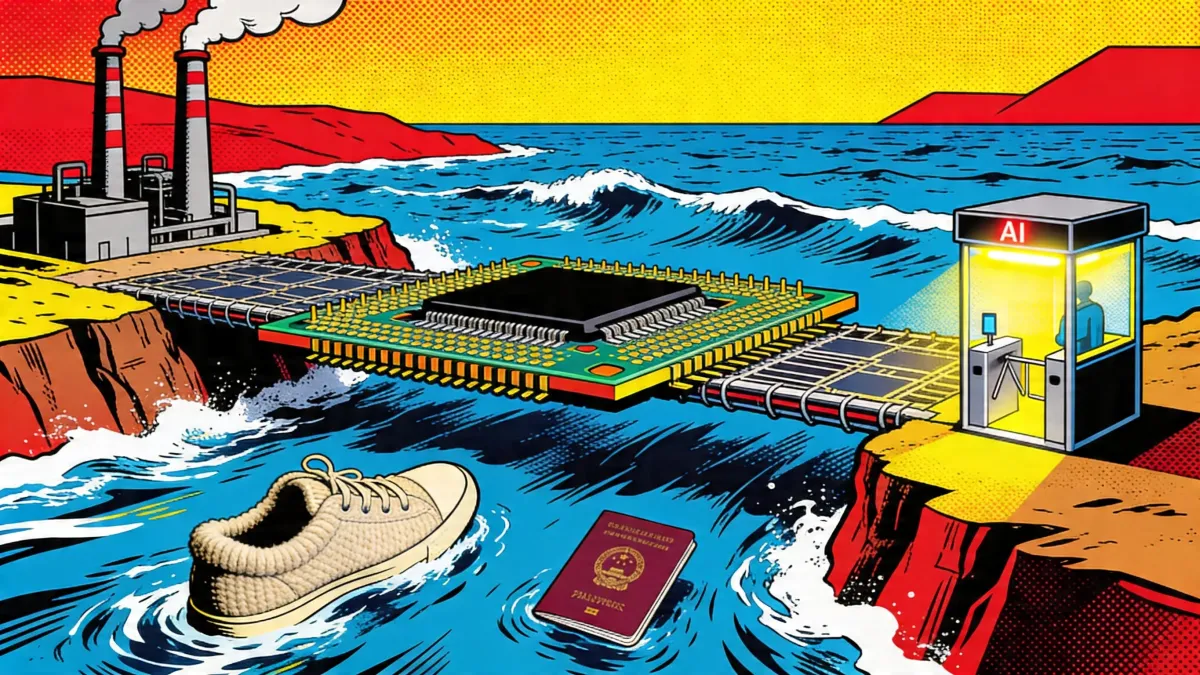
TSMC told the market it will spend toward $56 billion this year because AI customers keep buying capacity even as the Iran war drags LNG, helium and hydrogen into the chip supply story. Gross margin hit 66.2%. Revenue guidance moved higher. The confidence is real, and so is the narrowing bridge underneath it.
Allbirds announced it will sell its shoe brand for $39 million and rename the public shell NewBird AI. The stock jumped 700%. The investor, the operator and the incoming COO remain unnamed.
Anthropic, the company that gained a million sign-ups a day by refusing a Pentagon surveillance contract, started asking some Claude users for a passport and a selfie.
TSMC raised 2026 revenue guidance above 30% growth and pushed capital spending toward the high end of its $52 billion to $56 billion range. The signal underneath the earnings beat is harder: LNG, helium, and hydrogen are now part of the quarterly call.
The numbers would look strong in any cycle. First-quarter revenue hit $35.9 billion. Gross margin reached 66.2%, above guidance. High-performance computing, which includes AI, accounted for 61% of revenue. Chips at 7 nanometers, and below made up 74% of wafer sales.
That makes TSMC less like a supplier riding the AI cycle and more like the bridge the cycle must cross. The company is choosing to build more capacity while a shooting war exposes how fragile the inputs behind that capacity can be. Management said Taiwan had enough LNG through at least May and that specialty gases come from multiple suppliers. That is the right answer for one quarter. It is not the same as saying the risk has gone away.
Why This Matters:
Allbirds is selling its shoe brand for $39 million and renaming the public shell NewBird AI to chase the compute infrastructure market. The stock exploded. The people behind the new venture have not been identified.
An unnamed institutional investor is providing up to $50 million in senior secured convertible notes at 12% interest. The investor gets conversion rights, a blocked control account for lease payments, and the right to appoint a COO. The AI infrastructure counterparty is also unnamed.
AI compute is a real market. CoreWeave, Lambda, Oracle, and the hyperscalers are fighting over it. The question is whether NewBird brings experienced operators or a ticker symbol attached to the right buzzword.
Why This Matters:
Prompt: Ultra-realistic mirror selfie portrait of a young Korean girl, fair smooth skin, fit athletic build, exactly matching the reference photo's pose. Playful pouty expression, bright sparkling eyes, slightly messy short-to-medium casual hairstyle. A smudge of white flour on her nose and cheek, hands lightly dusted with flour, one finger pointing toward the camera. Wearing a plain pink t-shirt and tiny pajama shorts, barefoot, leaning over a kitchen island counter with elbows resting on the surface. Messy kitchen background, bright overhead kitchen lights, a bowl of dough, scattered flour on the counter, cracked eggshells. Playful domestic vibe, hyper-detailed natural skin texture, hyper-detailed flour dust on skin and hands --ar 4:5 --raw --stylize 50
Anthropic started requiring government photo ID and live selfies for some Claude users through third-party vendor Persona Identities. The move comes two months after Claude drew a surge in privacy-conscious users during Anthropic's Pentagon standoff.
The company says verification applies to selected capabilities, platform integrity reviews, and safety or compliance measures. Anthropic says it does not store the images, though Persona holds them, and Anthropic can access records when needed. Discord used a similar vendor last year. That vendor got breached. Seventy thousand government ID photos leaked.
Users came to Claude because Anthropic refused surveillance. Now the company that earned their trust is asking for the oldest surveillance token: their papers.
Why This Matters:
How to Search, Summarize, and Write Across All Your Tabs with Dia Browser
Dia is an AI-native web browser from the team behind Arc. The address bar doubles as an AI chat, so typing a question returns a direct answer instead of a list of links. Open any page and ask the sidebar to summarize it, compare it with another tab, or draft a reply based on what you are reading. Built-in Skills handle writing and coding tasks without copy-pasting into a separate tool. Free to use on Mac with an optional Pro tier for heavy AI usage.
You matched three days ago. The conversation started strong, died after six messages, and now you are staring at a thread that ended on "haha yeah totally." You do not want to send "hey" again.
That bakery near you -- Saturday morning? I will buy the sourdough, you tell me what is actually good there.
Dating threads die when both people wait for the other to escalate. The prompt skips the small talk loop by forcing a specific callback to something she said, plus a plan she can say yes or no to. One message, one decision.
Claude is better at tone, it avoids sounding desperate or overproduced. ChatGPT tends to add emoji and exclamation marks you will want to delete. Paste the full thread for context, not just the last message.
Google's parent company holds roughly 5% of SpaceX, a position that could be worth $100 billion if the rocket company reaches its projected $2 trillion IPO valuation. Alphabet's stake has slipped from 6.11% at the end of 2025 as SpaceX has raised additional capital.
China's imports of semiconductor equipment from Singapore rose 17% to $5.7 billion in 2025 while imports from Malaysia more than doubled to $3.4 billion. Direct imports from the United States fell 34% to roughly $2 billion, marking a supply chain realignment around US export controls.
Amazon Web Services and Microsoft are championing a $90 billion data center buildout in Spain's Aragón region, now Europe's fastest-growing AI infrastructure hub. Residents are pushing back over water use, environmental impact, and rural transformation.
Hackers are using stolen biometric data and virtual camera software distributed through Telegram to defeat bank KYC facial recognition during remote account onboarding. MIT Technology Review traced the operations to fraud centers in Cambodia exploiting lax verification practices.
Alibaba's newly formed Token Hub unit has released Happy Oyster, an AI world model that generates photorealistic 3D environments, interactive videos, and game assets. The system simulates real-world physics to create immersive content with minimal manual input.
India produces over 1.5 million computer science graduates a year, but AI-powered coding tools have eroded the traditional advantage of scale in IT talent. Infosys and other major firms are overhauling recruitment to prioritize AI literacy and new programming skills.
Martin Cascado, who leads Andreessen Horowitz's AI investment team, told the Financial Times that recent AI breakthroughs represent a once-in-century shift comparable to steam power. He warned that institutions and workforce adaptation are not keeping pace with the technology.
YouTube rolled out a feature allowing users to set the Shorts feed limit to zero, effectively removing Shorts from iOS and Android apps. The update replaces the previous minimum of 15 minutes and gives users full control to opt out of short-form video.
Voice actors across multiple countries are organizing to fight AI-generated dubbing as Hollywood studios accelerate adoption of synthetic voice tools for non-English markets. Unions warn that automated dubbing threatens jobs and erases cultural depth in international storytelling.
A growing field of interpretability research aims to explain how neural networks arrive at decisions, using techniques such as feature attribution and mechanistic analysis. The work is gaining urgency as AI systems enter healthcare, finance, and defense.
Synera deploys AI agents that run complex engineering workflows autonomously, and NASA, BMW, and Airbus already let them. 🏭
Founders
Dr. Moritz Maier, Sebastian Möller-Lafore, and Daniel Siegel started the company in 2018 in Bremen, Germany, originally under the name ELISE. Maier holds a PhD in engineering and spent years watching product development teams waste weeks on tasks that should take minutes. The company expanded to Boston through Germany's federal accelerator program and employs an estimated 50-plus people.
Product
Synera's platform connects to more than 80 computer-aided design and engineering tools, then orchestrates AI agents that handle design, simulation, and optimization across the full product lifecycle. The company calls it "JARVIS for engineers." Everything runs on-premises, so proprietary engineering data never leaves a customer's infrastructure. At BMW, the system extended robot operating life while cutting carbon dioxide emissions by 60%. At Hyundai, it delivered 47% weight reduction and compressed development time by 80%. Annual recurring revenue doubled in 2025, with 60% of new sales coming from the AI offering.
Competition
Autodesk, PTC, Siemens, and Dassault Systèmes all embed AI into their platforms but focus on single-tool automation rather than cross-tool orchestration. Altair, SimScale, and ESI Group compete in simulation. Synera's edge is tool-agnostic integration: it sits on top of existing infrastructure instead of replacing it, which removes the rip-and-replace barrier that stalls most enterprise AI deployments.
Financing 💰
$40 million Series B led by Revaia, with Capgemini, UVC Partners, BMW iVentures, Cherry Ventures, and Spark Capital participating. Total raised stands at $58.1 million.
Future ⭐⭐⭐⭐
Frost & Sullivan handed the company a 2025 Global Transformational Innovation Leadership award. The customer list reads like a defense contractor's dream, and the doubled ARR suggests pull rather than push. The risk: those 80 tool integrations become 80 maintenance burdens as vendors ship their own agents. 🏭
Anthropic began asking some Claude users to verify their identity with a government photo ID and a live selfie, using third-party vendor Persona Identities. The company says verification applies to "selected capabilities, platform integrity reviews, and safety or compliance measures."
Accepted documents include passports and driver's licenses. The requirement arrives weeks after Claude's privacy-driven user surge hit one million sign-ups a day, triggered by CEO Dario Amodei's decision to reject a Pentagon surveillance contract. Daily active users tripled since the start of 2026.
💡 February: Anthropic rejects the Pentagon over surveillance concerns.
💡 March: a million people a day sign up because they trust the company that said no to surveillance.
💡 April: Anthropic asks those same users for a passport photo and a live selfie, routed through a third-party vendor.
Discord used a similar vendor last year. That vendor got breached. Seventy thousand government ID photos leaked.
Anthropic says it will not store the images, which is reassuring right up until you remember that Discord said the same thing. The privacy company gained its privacy-conscious users by being the privacy company. It is now asking them to hold their driver's license up to a webcam. The Pentagon did not get its data. Persona Identities did. 🤷♀️