Unconventional superconductivity in the presence of long-range interactions in transition metal dichalcogenide moiré heterobilayers - Scientific Reports
Effective Hamiltonian and comparison with analytical estimates
Here we provide explicitly the form of the effective Hamiltonian as obtained in the considered situation. From the minimization condition imposed on the ground state energy (13) one can derive the following form of the effective Hamiltonian
where the effective hopping, effective chemical potential, and the effective superconducting gap parameters are defined through the corresponding relations
where and is the chemical potential in the correlated state. The effective model parameters have the following form
From Eq. 22 one can explicitly see that both and parameters modulate the two contributions to the pairing originating from the and terms, respectively.
To analyze in more detail the influence of the term on superconductivity, here, we consider a simplified situation for which , meaning that we have purely real, negative hoppings and an exchange interaction term without the contribution originating from the Dzyaloshinskiiâ€"Moriya interaction. In such a case, the pairing is of spin-singlet character only and the SC gap in the effective Hamiltonian has the following form
Hence, the effective interaction works in favor of Cooper pairing when , meaning that . For the case of model when the double occupancies are projected out from the system, one can use Eqs. (12, 15 and 18) to derive the following simple form of the renormalization parameters
Substituting the above expressions to Eq. (24) we obtain the dependence of the effective pairing parameter in the form
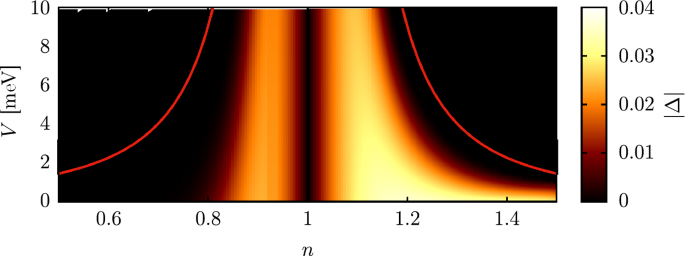
This allows us to analytically determine the area in the (n, V) plane for a given J, for which the necessary condition for the pairing to appear is fulfilled (). In Fig. 11, the solid red line marks the boundary between the attractive interaction that leads to pairing (below the curve) and the repulsive interaction in which the SC state cannot be stable (above the curve). It is clearly shown that the higher the V, the narrower the stability range of the SC state when it comes to band filling. For the sake of completeness, we also show the numerical calculations for the considered case in the figure. The bright region which marks the stability region of the numerically determined SC state does not exceed the analytical requirement for the pairing to exist. The numerical data do not exactly coincide with the analytically determined condition because the latter does not take into account the details of the electronic structure itself. Namely, the stability of the SC state is significantly determined by the value of the density of states around the Fermi energy. For the situation considered here, the van Hove singularity appears at the Fermi energy for . That is why the SC stability region determined numerically is wider at the side of the diagram. Nevertheless, the general feature of narrowing the SC stability region with increasing V is seen both in the necessary analytic condition and the numerical result.
For the sake of completeness, we analyze the significance of long-range hoppings and exchange interactions separately, for the case of the t-J-U model. In Fig. 12, we show the influence of the longer-range hoppings without the inclusion of the terms and . Furthermore, in Fig. 13 we present the dependence of the and of the SC gap amplitudes up to the values corresponding to ten times the realistic ones. As one can see, the influence of the long-range hoppings is significant, while exchange terms can be neglected for the case of realistic set of parameters, which are marked by the dashed vertical line. Therefore, the suppression of the SC gap seen in Fig. 5(a) is caused mainly by the second and third nearest-neighbor hoppings. The fact that the additional hoppinngs suppress the SC gap can be understood by looking at the density of states. Namely, as we show in Fig. 6 the density of states acquires smaller values in the band-filling range of the SC phase for the case where the additional hoppings are taken into account.