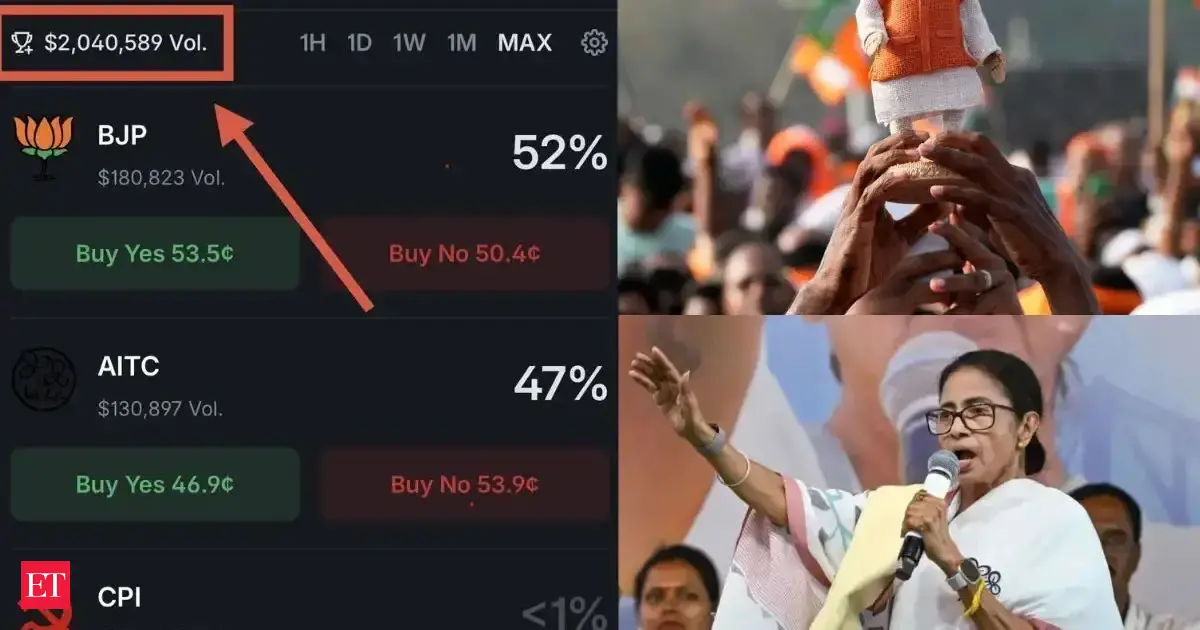
West Bengal Elections 2026 who will win? US-based Polymarket betting site shows BJP 52%, TMC 47%; bets cross $2 million
As voting begins for the first phase of West Bengal's Assembly election, an unusual trend has surfaced far beyond the state's borders: global traders are pouring money into predicting the outcome. More than $2 million has already been wagered on West Bengal election results contract on an online prediction platform, making it the most actively traded Indian state poll on such markets. Even as these platforms remain off-limits for Indian users under current law, the platform has registered strong interest from bettors.
What makes this election stand out is not just the scale on the ground, but the attention it has drawn online. On Polymarket, a US-based prediction platform, the West Bengal election has seen trading volumes cross $2.3 million, far ahead of other Indian state elections.
According to widely shared screenshots on social media, traders currently give the BJP a slight edge with a 52 per cent chance of winning, while Mamata Banerjee's Trinamool Congress follows closely at 47 per cent. The CPI is barely in the picture, trading at under one per cent.
A personal finance account on X highlighted this surge, noting that Bengal now leads all Indian state elections in trading activity on the platform.
Prediction markets work differently from opinion polls. Instead of answering surveys, participants put real money behind their expectations. Prices fluctuate in real time, reflecting what traders believe is the likelihood of an outcome.
For instance, if a party's contract trades at around 53 cents, it implies a perceived 53 per cent chance of victory. If the prediction turns out correct, traders earn the difference.
Supporters of such markets argue that financial stakes make them sharper than traditional surveys. Some platforms even claim high accuracy rates well before results are declared.
Here is where things get complicated.
India banned prediction markets in 2025 under the Promotion and Regulation of Online Gaming Act (PROGA). The law prohibits platforms that allow betting on real-world events, including elections, from operating in the country or accepting Indian users.
This means the heavy trading seen in the West Bengal election is almost entirely driven by users outside India, mainly from the US and Europe. Any participation by Indian citizens would violate the law.
Among ongoing state elections, including Tamil Nadu, Kerala, Assam, and Puducherry, West Bengal has clearly attracted the most attention. Tamil Nadu, for example, has seen comparatively lower trading volumes of around $370,000.
This difference signals something deeper.
Higher trading activity often points to uncertainty. When outcomes appear predictable, markets tend to be quieter. But when a contest looks tight, participation increases as traders try to anticipate the result.
That uncertainty mirrors the situation on the ground.
The ruling Trinamool Congress continues to rely on its strong grassroots network and welfare programmes, which have helped it stay in power since 2011. At the same time, the BJP has steadily expanded its presence in the state, especially after the 2019 general elections, turning the race into a direct contest.
Local issues such as employment, rural distress, and governance are expected to play a key role in influencing undecided voters.
While prediction markets offer an interesting lens, they are not foolproof. The participants are largely global and may not fully grasp local dynamics, caste equations, or last-mile campaigning.
Still, they reflect one clear sentiment: this election is wide open.
The first phase of polling is underway, covering 152 constituencies across 16 districts. Voting is scheduled between 7 am and 6 pm.
A total of 1,478 candidates, including 167 women, are contesting in this round. Around 3.6 crore voters are eligible to vote, with polling being conducted at 44,376 booths. Among these, nearly 3,000 are auxiliary booths, and 5,444 are being managed entirely by women.
The remaining seats will go to polls on April 29, with counting set for May 4.
(ET.com does not endorse, encourage, or facilitate participation in prediction markets. Such platforms are banned in India under PROGA.)