News & Updates
The latest news and updates from companies in the WLTH portfolio.
SpaceX Starship launch aborted at the last moment
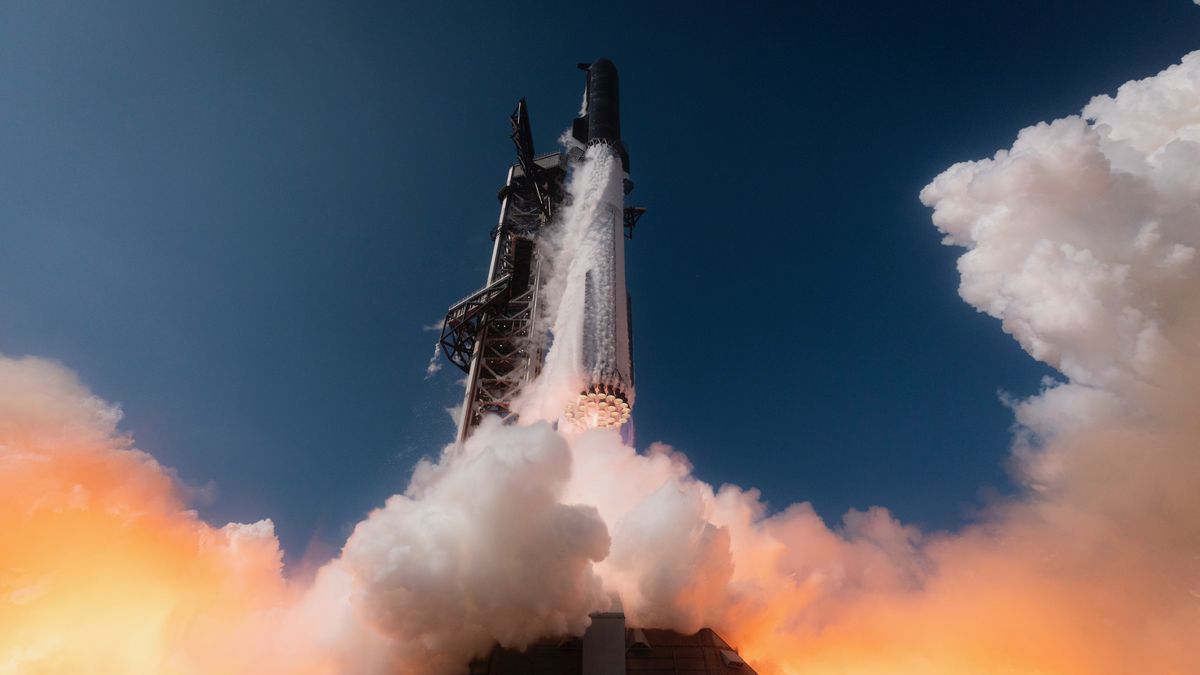
SpaceX's mega Starship rocket has come within a second or so from blasting off on a test flight but some of the engines failed to start, triggering a launch abort. Elon Musk's company said it will have to figure out what went wrong on Thursday before making another attempt to send Starship on a space-skimming journey halfway around the world. It was supposed to be the 13th flight for Starship, which at 124m tall with 33 main engines is the world's biggest and most powerful rocket. SpaceX's launch webcast showed the start of engine ignition three seconds before the planned liftoff, viewed from a drone high above the pad. Although the company did not elaborate, on-screen data showed four engines not firing, with the remaining 29 engines immediately shutting down and keeping the rocket anchored to the pad. It was the first time a full-scale Starship experienced a last-second abort like this. The launch team immediately began draining the fuel from the rocket. "Next launch attempt hopefully in a few days," Musk announced via X. Everything was going SpaceX's way, even the weather, until the partial engine ignition. In the end, the rocket's automatic launch system worked as planned by halting everything. Too few operating engines could have doomed the launch. Some earlier Starship flights ended in explosive fireballs. Elon Musk's company had newest, most advanced Starlinks aboard Twenty of SpaceX's newest and most advanced Starlinks were on board Starship for release during the planned hour-long flight. The internet satellites were going to try communicating with Starlinks already in orbit while taking photos of Starship's heat shield. Neither the first-stage booster nor spacecraft were meant to be recovered, with both ending up in the sea. The rocket's automatic launch system worked as planned by halting everything. Too few operating engines could have resulted in a failed launch. Some earlier Starship flights, for example, ended in explosive fireballs.

Gecko Robotics is growing again
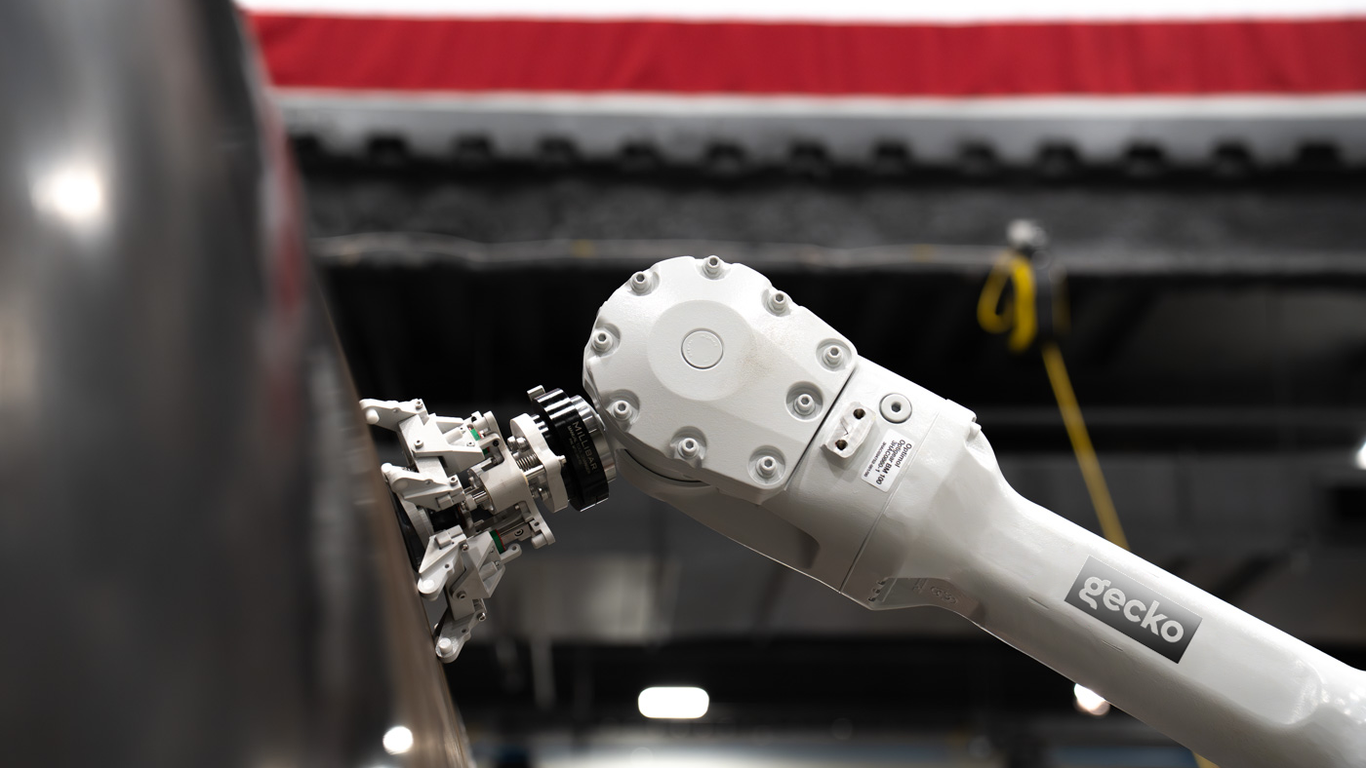
Why it matters: Pittsburgh's unicorn companies are looking to grow and help transition the regional economy to more focus on high-tech companies. The big picture: Gecko develops robots that climb and inspect infrastructure -- such as power plants, aircraft carriers and submarines -- and reduce costs by saving workers from having to perform inspections themselves. Driving the news: Gecko announced Wednesday at the Pennsylvania Defense and Innovation Summit in Carlisle that it will open a new 10,000-square-foot manufacturing facility in Sewickley soon. Zoom in: The new facility will serve as a manufacturing and integration hub where Gecko's robotics and its Cantilever software will help defense manufacturers build components more efficiently. What they're saying: "The future will be built by combining advanced robotics, AI, and skilled workers into a single manufacturing ecosystem," said CEO Jake Loosararian. "By bringing together world-class partners, software, and automation in Pittsburgh, we're helping manufacturers produce the critical systems our military depends on faster, more safely, and with higher quality." Between the lines: Loosararian has said local tech companies need to expand locally instead of decamping for bigger tech markets on the coasts. What's next: Gecko spokesperson Steve Bourner tells Axios the Sewickley facility will be open within weeks and that robots are currently operating inside.
Microsoft sharpens AI sales pitch against OpenAI and Anthropic
Microsoft is reportedly training its sales teams to compete aggressively against leading artificial intelligence (AI) firms, Anthropic and OpenAI. The strategy involves highlighting the shortcomings of their products. According to a Bloomberg report, the tech giant is focusing on lower costs, better security controls, and a more comprehensive suite of products in its pitch.

Crusoe and Lancium plan to build a new AI data center in Childress, Texas
As w.media's Europe and Americas correspondent, Conor covers the data center industry in the western hemisphere. Conor's decade long experience spans digital infrastructure, software, cybersecurity, telecom, biotech, and construction. Crusoe, an AI factory company in partnership with Lancium, an energy technology and infrastructure company, is planning to develop a 1 GW AI data center campus in Childress, Texas. The facility will come up on a 270-acre site, with construction scheduled to begin in Q1 2026. The grid-connected facility is being built to support the AI computing requirements of a leading hyperscale technology company. According to a press release, the companies are applying the same development model used for their AI data center campus in Abilene, Texas. Under the agreement, Lancium will own the land, secure the power interconnection, and manage the site's energy infrastructure while Crusoe will design, build, and operate the data center under the partnership. Chase Lochmiller, Co-founder and CEO, Crusoe, said, "This campus represents a major milestone in Crusoe's deep commitment to the state of Texas, working with Lancium again, in the same partnership model we built together in Abilene, made Childress an easy choice for our next site." Michael McNamara, CEO, Lancium, said, "Childress is a natural next step in our partnership with Crusoe, we are deeply committed to working with local stakeholders to advance a model of development that addresses the broader needs of the community we will share for a very long time." The Childress data center campus will incorporate behind-the-meter solar generation and battery energy storage to support on-site power needs and reduce reliance on the transmission grid. The facility will use a closed-loop, non-evaporative liquid cooling system designed to minimize water consumption. The project builds on Lancium and Crusoe's existing data center developments in Texas, including the 1.2 GW campus in Abilene and a second 900 MW campus under construction on adjacent Lancium-owned property.

Polymarket odds hold: 66.5% for September Fed no-change
predict.info -- Premium Domain For Sale Domain only: USD 200,000. Prediction platform technology priced separately. predict.info Treasury Yields and Jobs-Data Watch Trigger Polymarket Repricing on the September 2026 Fed Decision Ladder Polymarket's "Fed Decision in September?" ladder is pricing "No change" as the leading outcome at 66.5% with $3.11M in volume, holding flat on the latest update. The move comes as traders digest a rates-sensitive backdrop in Treasuries, and the ladder's per-outcome Yes/No pricing shows where conviction is concentrated. Key Takeaways * Prediction: Polymarket implies a 66.5% chance of "No change" after the September 2026 Fed meeting. * Basis: Against a Treasury-yield backdrop tied to upcoming employment data, the market's ladder keeps "No change" well ahead of hike/cut outcomes. * Timing: The contract resolves on 2026-09-16; the latest summary shows +1.0 pp over 24h and +1.0 pp over 7d. U.S. Treasury yields edged higher as Wall Street awaited key employment data, with the 10-year yield up a bit over 2 bps to 4.573% and the 2-year up a bit over 2 bps to 4.158%. The report also cited a disinflationary impulse after a producer price index decline, alongside attention on retail sales and jobless claims for fresh signals on economic conditions. Odds Ladder Breakdown: "No Change" 66.5% on $3.11M Volume vs 25 bps Hike 28.5% and 25 bps Cut 4.15% This Polymarket market is a price-ladder-style set of outcomes, so each row is its own binary contract with explicit Yes and No odds rather than a single "settlement price" bet. Traders currently price "No change" at Yes 66.5% / No 33.5%, versus a "25 bps increase" at Yes 28.5% / No 71.5% and a "25 bps decrease" at Yes 4.15% / No 95.85% (tail outcomes are even smaller: "50+ bps increase" Yes 0.55% / No 99.45%, "50+ bps decrease" Yes 2.25% / No 97.75%). Even with the latest snapshot marked flat at 66.5%, the historical summary flags high volatility and a reversal detected, with "No change" still running above its avg_last_5 of 64.2 and up +1.0 pp over both 24h and 7d -- signaling a stable consensus that has nonetheless seen meaningful back-and-forth. Compared with slower narrative updates, this continuously traded ladder makes the disagreement visible: most probability mass sits in "no change" and "25 bps increase," while cuts remain priced as low-likelihood hedges into the 2026-09-16 resolution. If upcoming macro releases materially shift rate expectations, watch whether probability migrates between the two dominant rungs ("No change" and "25 bps increase") and whether the high-volatility/reversal pattern persists as volume builds into the 2026-09-16 resolution date. What Fed-Ladder Traders Watch Next on Polymarket: CPI/PCE Prints, Recession Risk, and Rate-Cut Timing Contracts Across M Beyond the September ladder, traders on Polymarket are also benchmarking near-term and path-dependent macro bets that can reprice quickly as data hits. "Fed Decision in July?" currently shows 96.25% on "No change" with $65,055,846 in volume, while "How many Fed rate cuts in 2026?" has "0 (0 bps)" at 82.5% on $42,667,930, offering a cleaner read on the market's year-ahead policy stance. For sequencing, "Fed decisions (Jun-Sep)" prices "Pause-Pause-Pause" at 66.5% on $305,790, and outside rates altogether, liquidity also clusters in headline event markets like "Ballon d'Or Winner 2026," led by "Lionel Messi" at 41.45% with $7,897,827 traded. Odds Trend By the Numbers * Platform: Polymarket * Market: Fed Decision in September? * Contract type: Price strike ladder: each rung has separate Yes/No; Yes means the spot price is above that USD strike at settlement. * Resolution window: Sep 16, 2026 (UTC) * Status: Active (open for trading) * Volume: ~$3,105,640 Top strike rungs +1 more strikes not shown

Microsoft Coaching Sales Teams on Pitches to Win Against OpenAI, Anthropic
Microsoft Corporation is the world's leader in the design, development and marketing of operating systems and software programs for PC's and servers. The group also builds and sells computer equipment. Net sales break down by activity as follows: - sale of operating systems and application development tools (42.9%): primarily for servers (Azure, SQL Server, Windows Server, Visual Studio, System Center, GitHub, etc.) and (Windows); - development of cloud-based software applications (37.7%): programs for productivity (Microsoft 365; Word, Excel, PowerPoint, Outlook, OneNote, Publisher and Access), integrated management and customer relationship management (Dynamics 365), online file sharing and management (OneDrive), and unified and collaborative communications (Microsoft Teams); - other (19.4%): primarily sale of software licenses (Windows), tablets (Microsoft Surface), video game consoles and software (Xbox), computer accessories, etc. The United States accounts for 51.3% of net sales.

The AI burn book: Decoding the cat fights between Sam Altman, Elon Musk, and Anthropic - AOL
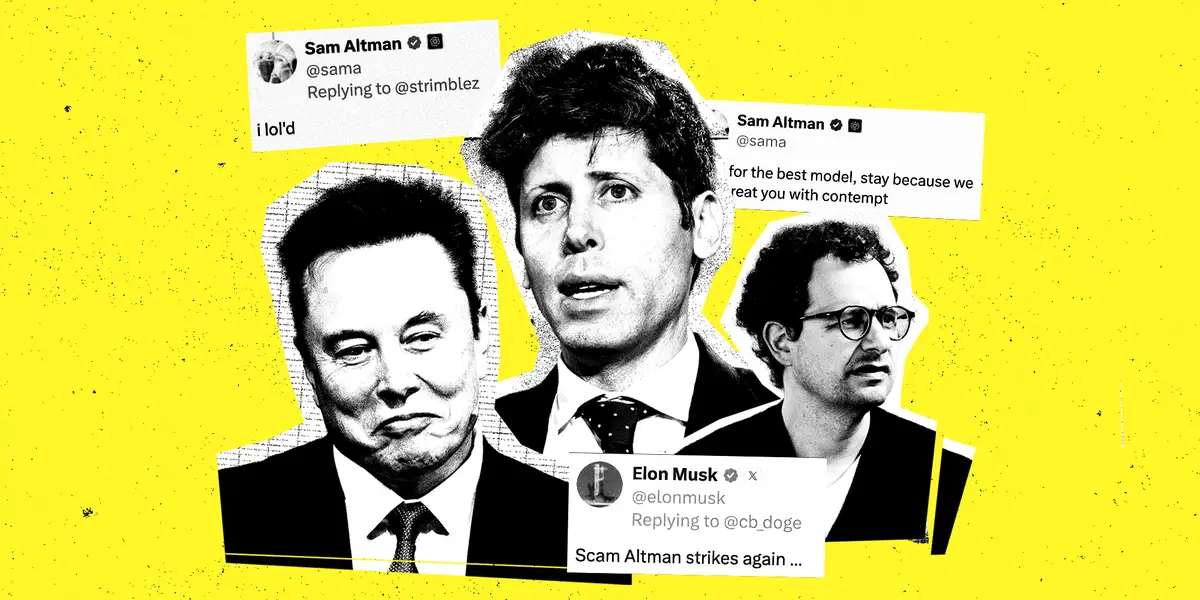
Business Insider decoded the shade and subtweets, from the punctuation to the emojis. As the summer temperatures rise, tech tempers flare. Sam Altman is back to his old ways: openly feuding with Elon Musk and taking jabs at Anthropic once again, to the shock of no one. With Altman and Musk's courtroom dispute wrapped up (Musk lost but vowed to appeal), the dueling AI leaders are now dragging each other online over data privacy and an Apple legal battle. The OpenAI CEO has also poked at Anthropic, his primary competitor, run by Dario Amodei. Altman and Amodei were once colleagues; now, they avoid holding hands. Altman hasn't called a rival CEO a "pusher" or a "grotsky little byotch" yet. Still, a Burn Book is forming under his fingertips -- and we decoded it for you. Round One: Sam Altman vs Elon Musk Elon Musk threw the first punch last Friday. Apple sued OpenAI that day, alleging that the AI lab stole trade secrets to build its upcoming hardware device. Musk replied to posts about the suit with exclamation points, the word "wow," and a quick reaction: "Sounds pretty bad." He ramped up on Saturday, calling the OpenAI CEO "Scam Altman," a favorite phrase of his. The digs kept coming throughout the day. Altman took scamming "to a whole new level," Musk wrote, and might love scamming "more than any human alive!" Altman responded in his typical, lower-case fashion: "homeboy you're the one sellling public market investors on short-term space datacenters." Note the term of endearment (or lack thereof): "homeboy." Note the typo: "sellling." Note the lack of punctuation. Three minutes later, Altman fired off another. This time, he used the feud as an opportunity to promote his product, writing that the most reliable benchmark for GPT-5.6 Sol's success "is that elon is obsessed with me again." (Again, no capitalization.) Musk responded to Altman's space data center skepticism a few hours later with a zinger. "We start flying them next year. Maybe you can come see them if your parole officer approves," Musk wrote. In the same post, Musk took another shot at Altman by referencing their messy breakup from almost a decade ago. "After stealing an open source AI charity, you then stole all of Apple's phone technology!" he wrote. "Wow." For the record, Altman doesn't have a parole officer. OpenAI disputes Apple's allegations stating it is "not aware of any evidence that this complaint has merit." OpenAI and SpaceX did not respond to Business Insider's requests for comment. After Saturday's brawl, Altman wasn't done. He took one last stab at Musk on Tuesday, reposting some data privacy concerns about SpaceXAI. "Concerning," he wrote. And yet, the enemies could find some common ground. Both Musk and Altman posted approving messages about an AI safety essay published Tuesday by Google DeepMind's CEO Demis Hassabis. Round Two: Sam Altman vs Anthropic Throughout the Musk mess, Altman continued to kick at his No. 1 opponent: Anthropic. Last Thursday, Anthropic released an eyebrow-raising ad saying there was "hope in hard questions." Those questions include: what will humans do when AI takes over all the jobs? And why do we even have to have AI? The leading image is of a house on fire; it's an AI doomer's dream. Altman clowned the ad on Monday, saying that he "thought this was satire" posted from a fake account. He also put words in Anthropic's mouth: "Hard questions are great but only if we deem you worthy enough to not silently downgrade you, or even get access at all." He appeared to reference how Anthropic quietly rejected or altered some Fable 5 prompts in its initial launch. The company has since made these safeguards more visible. Earlier that day, he laughed at an X user who called the use of Anthropic's Fable 5 an unhealthy situationship. Since its release, Anthropic has rolled back and re-deployed the model and lifted and lowered guardrails, to the frustration of some users. (In typical Altman fashion, he "lol'd.") Altman also got philosophical. He reposted a reply to a criticism of Amodei that quoted C.S. Lewis. "Of all tyrannies, a tyranny sincerely exercised for the good of its victims may be the most oppressive," the post read. It's similar to criticisms other AI leaders have shared: that Anthropic warns of AI's safety concerns while claiming only its AI can fix it. And then, the vague-post of all vague-posts. "Come for the best model, stay because we don't treat you with contempt," Altman wrote on Monday, without specifying which AI rival he was taking a shot at. Amodei seems to be steering clear of the drama. As of Wednesday evening, he hadn't responded, nor has he updated his X account in over a month. Anthropic did not respond to a request for comment. If you enjoyed this story, be sure to follow Business Insider on Yahoo.

Elon Musk Reacts to Jamie Dimon's 'Einstein' Praise With Two-Word Reply as Viral Post Hails His SpaceX an
Musk Revisits Dimon's Famous Einstein Comparison Le Pogam argued that Musk, like Einstein, may need years to receive recognition. The post credited Musk with reshaping management and education while advancing space travel, energy and artificial intelligence. Those claims were Le Pogam's opinion. When the CNBC clip first circulated from the World Economic Forum in Davos, Musk responded, "Nice of him to say." JPMorgan Feud Becomes Wall Street Alliance Dimon used that interview to close a yearslong dispute between JPMorgan and Tesla. "Elon and I have hugged it out," he said. "You've got to look at Elon. SpaceX, Tesla, Neuralink. I mean, the guy is our Einstein." That reconciliation has since become a Wall Street partnership. At a JPMorgan event launching SpaceX's investor roadshow last month, Dimon again called Musk "the Edison of our time." "It's been an extraordinary 24 years watching Elon grow over time, and now making a massive leap into the future," Dimon said. Maye Musk appeared and recalled her son's early fascination with the future, while Musk joined remotely. Banks Rally Around SpaceX's Public Debut The enthusiasm extended to research. Morgan Stanley projected SpaceX revenue could reach $3.4 trillion by 2040. Such estimates remain speculative and depend on Starlink and space-based AI developing as expected. Image via Shutterstock Market News and Data brought to you by Benzinga APIs To add Benzinga News as your preferred source on Google, click here.

Elon Musk's xAI sues Grok user over sexualized 'deepfakes'
The case is one of the first brought by an AI company against one of its users for allegedly using an AI system to generate explicit material Elon Musk's artificial-intelligence startup xAI has sued a South Carolina man arrested earlier this year on charges of sexually exploiting minors, alleging he misused the company's AI system Grok to create child sexual abuse material. xAI alleged in the lawsuit, filed in federal court in Texas on Tuesday, that Terry Harwood violated the company's terms of service. The case is one of the first brought by an AI company against one of its users for allegedly using an AI system to generate explicit material. Contact information for Harwood, who was arrested in February, was not immediately available. Spokespeople for xAI did not immediately respond to a request for comment on Wednesday. The company's lawsuit against Harwood follows intense global scrutiny of xAI over allegations that Grok has allowed users to generate non-consensual sexualized deepfakes, or realistic-looking videos fabricated by AI. Stay up to date with the latest news. Follow KT on WhatsApp Channels. xAI's complaint said that the company "enforces its rules against violators through account suspensions, account terminations, and by reporting suspected child sexual abuse material to the National Center for Missing Exploited Children." "Indeed, Plaintiff has suspended 52,222 accounts and made 73,604 reports to NCMEC in 2026, resulting in (at least) 244 arrests," the lawsuit said. xAI alleged that Harwood uploaded non-sexual images of adults and minors to Grok and tried to use the system to generate sexually explicit deepfakes based on them. The complaint also alleged he created non-consensual sexual imagery of adults. The company asked the court for an unspecified amount of monetary damages and a court order permanently blocking Harwood from using Grok. "Defendant's actions were a calculated scheme to weaponize Plaintiff's tool for criminal ends, exposing real victims to profound and lasting harm, while exposing Plaintiff to significant legal risk and reputational damage," xAI said in the lawsuit.

SpaceX will launch Starship, the world's largest rocket, on critical Flight 13 test today. Here's what to expect.
SpaceX's Starship megarocket will take to the skies again today (July 16), and you can watch the thundering action live. Starship, the biggest and most powerful rocket ever built, is scheduled to lift off from SpaceX's Starbase site in South Texas today -- the 57th anniversary of the launch of NASA's Apollo 11 moon mission, by the way -- during a 90-minute widow that opens at 6:45 p.m. EDT (2245 GMT; 5:45 p.m. local Texas time). It will be Starship's 13th flight overall and its second mission of 2026. You can watch Starship Flight 13 live here at Space.com, courtesy of SpaceX; coverage will begin about 30 minutes before liftoff. Follow our Starship live blog for updates and other news about the test flight. A potentially revolutionary rocket Starship consists of a first-stage booster called Super Heavy and an upper-stage vehicle known (somewhat confusingly) as Starship, or simply Ship. Both elements are made of stainless steel and are designed to be fully and rapidly reusable. The stacked vehicle stands more than 400 feet (122 meters) tall and can carry more than 110 tons (100 metric tons) to Earth orbit. SpaceX thinks Starship's combination of power and reusability will revolutionize spaceflight, allowing humanity to settle the moon and Mars, among other bold exploration feats. Starship debuted in April 2023 and has flown 11 more suborbital flights since, most recently on May 22. That Flight 12 test was the first mission for Starship Version 3 (V3), an advanced iteration of the megarocket that was many months in the making. (Flight 11, the last launch of Starship V2, lifted off in October 2025.) Starship V3 will be the first operational variant of the vehicle. It will fly on NASA's Artemis III mission to Earth orbit in 2027, for example, and land the agency's Artemis IV astronauts on the moon a year later, if all goes to plan. Starship V3 performed quite well during its launch debut in May. During Flight 12, Ship successfully deployed 22 payloads via its "PEZ dispenser" slit -- 20 dummy versions of SpaceX's Starlink broadband satellites and two actual Starlinks equipped with imaging sensors -- and came back to Earth in one piece, splashing down as planned off the coast of Western Australia. There were a few hiccups, however. Super Heavy suffered engine issues during its return to Earth, for instance, and ended up crashing in the Gulf of Mexico rather than making a controlled splashdown there. SpaceX will run it back on Flight 13, shooting mostly for the same objectives that Flight 12 targeted -- with a few notable exceptions. The plan for Starship Flight 13 Eventually, SpaceX plans to return both Super Heavy and Ship directly to the launch pad after liftoff, catching each with the "chopstick" arms attached to Starbase's two launch towers. (Starship will also fly from Florida and perhaps other places as well in the coming years; these future pads will have chopstick arms, too.) This strategy will allow each vehicle to fly multiple times per day, according to the company. SpaceX has caught Super Heavy three times to date, but it's been a while; the last such snag came on Flight 8 in March 2025. And the company has never tried a chopsticks catch with Ship. Those trends will continue on Flight 13. If all goes to plan, Super Heavy will steer its way to a controlled splashdown in the Gulf of Mexico (which the Trump administration has renamed the Gulf of America) about seven minutes after launch. "The booster's primary test objective will be executing a successful launch, ascent, stage separation, boostback burn and landing burn at an offshore landing point in the Gulf of America," SpaceX wrote in a Flight 13 mission description. "There have been several modifications to hardware and software to address issues seen on the previous flight." Ship will again target a splashdown in the Indian Ocean off the coast of Western Australia, which will occur about 65 minutes after launch. And the vehicle will again deploy some objects into suborbital space -- but here's where Flight 13 will break new ground. Those objects will be 20 V3 Starlink satellites -- next-gen versions of the broadband spacecraft, which will "greatly expand the network's capacity and user speeds," SpaceX wrote in the mission description. Eventually, SpaceX wants to operate up to 100,000 V3 Starlinks in low Earth orbit -- a bold plan, considering that the current megaconstellation, the largest such network ever assembled, contains "only" about 10,800 spacecraft. The Starlink V3 plan will require thousands of launches -- a load that's beyond even the capabilities of SpaceX's workhorse Falcon 9 rocket, which flew 165 times in 2025. (Adding to the difficulty: Starship V3 satellites are considerably heavier than their predecessors. Each one will apparently weigh around 4,400 pounds, or 2,000 kilograms.) The 20 Starlink V3 satellites "will extend solar arrays and antennas and will attempt to connect with the larger Starlink constellation via high-capacity lasers," SpaceX wrote in the Flight 13 description. "The Starlink satellites will be on the same suborbital trajectory as Starship and are expected to demise upon reentry approximately 20 minutes after deployment." Six of the 20 spacecraft are equipped with cameras, which they will use to scan and study Ship's heat-shield tiles. SpaceX wants to gather more data about the heat-shield system before it attempts to bring Ship back to the launch pad for a chopsticks catch. And SpaceX won't just passively observe the heat shield during Flight 13; it will conduct some experiments as well. For example, the shield "will have load-sensing tiles to take measurements as the vehicle experiences higher dynamic pressure on ascent than previous flights, putting added stress on the tile attachments in exchange for increased payload-to-orbit capability," the mission description reads. So there will indeed be some new things to look out for during Flight 13. And watching the world's biggest and brawniest rocket lift off is a treat no matter what sort of mission it's flying, so be sure to tune in today!
The AI burn book: Decoding the cat fights between Sam Altman, Elon Musk, and Anthropic
* The AI industry's burn book is an increasingly public spectacle. * Sam Altman and Elon Musk threw jabs on X. Altman also dragged Anthropic, though CEO Dario Amodei stayed quiet. * Business Insider decoded the shade and subtweets, from the punctuation to the emojis. As the summer temperatures rise, tech tempers flare. Sam Altman is back to his old ways: openly feuding with Elon Musk and taking jabs at Anthropic once again, to the shock of no one. With Altman and Musk's courtroom dispute wrapped up (Musk lost but vowed to appeal), the dueling AI leaders are now dragging each other online over data privacy and an Apple legal battle. The OpenAI CEO has also poked at Anthropic, his primary competitor, run by Dario Amodei. Altman and Amodei were once colleagues; now, they avoid holding hands. Altman hasn't called a rival CEO a "pusher" or a "grotsky little byotch" yet. Still, a Burn Book is forming under his fingertips -- and we decoded it for you. Round One: Sam Altman vs Elon Musk Elon Musk threw the first punch last Friday. Apple sued OpenAI that day, alleging that the AI lab stole trade secrets to build its upcoming hardware device. Musk replied to posts about the suit with exclamation points, the word "wow," and a quick reaction: "Sounds pretty bad." He ramped up on Saturday, calling the OpenAI CEO "Scam Altman," a favorite phrase of his. The digs kept coming throughout the day. Altman took scamming "to a whole new level," Musk wrote, and might love scamming "more than any human alive!" Altman responded in his typical, lower-case fashion: "homeboy you're the one sellling public market investors on short-term space datacenters." Note the term of endearment (or lack thereof): "homeboy." Note the typo: "sellling." Note the lack of punctuation. Three minutes later, Altman fired off another. This time, he used the feud as an opportunity to promote his product, writing that the most reliable benchmark for GPT-5.6 Sol's success "is that elon is obsessed with me again." (Again, no capitalization.) Musk responded to Altman's space data center skepticism a few hours later with a zinger. "We start flying them next year. Maybe you can come see them if your parole officer approves," Musk wrote. In the same post, Musk took another shot at Altman by referencing their messy breakup from almost a decade ago. "After stealing an open source AI charity, you then stole all of Apple's phone technology!" he wrote. "Wow." For the record, Altman doesn't have a parole officer. OpenAI disputes Apple's allegations stating it is "not aware of any evidence that this complaint has merit." OpenAI and SpaceX did not respond to Business Insider's requests for comment. After Saturday's brawl, Altman wasn't done. He took one last stab at Musk on Tuesday, reposting some data privacy concerns about SpaceXAI. "Concerning," he wrote. And yet, the enemies could find some common ground. Both Musk and Altman posted approving messages about an AI safety essay published Tuesday by Google DeepMind's CEO Demis Hassabis. Round Two: Sam Altman vs Anthropic Throughout the Musk mess, Altman continued to kick at his No. 1 opponent: Anthropic. Last Thursday, Anthropic released an eyebrow-raising ad saying there was "hope in hard questions." Those questions include: what will humans do when AI takes over all the jobs? And why do we even have to have AI? The leading image is of a house on fire; it's an AI doomer's dream. Altman clowned the ad on Monday, saying that he "thought this was satire" posted from a fake account. He also put words in Anthropic's mouth: "Hard questions are great but only if we deem you worthy enough to not silently downgrade you, or even get access at all." He appeared to reference how Anthropic quietly rejected or altered some Fable 5 prompts in its initial launch. The company has since made these safeguards more visible. Earlier that day, he laughed at an X user who called the use of Anthropic's Fable 5 an unhealthy situationship. Since its release, Anthropic has rolled back and re-deployed the model and lifted and lowered guardrails, to the frustration of some users. (In typical Altman fashion, he "lol'd.") Altman also got philosophical. He reposted a reply to a criticism of Amodei that quoted C.S. Lewis. "Of all tyrannies, a tyranny sincerely exercised for the good of its victims may be the most oppressive," the post read. It's similar to criticisms other AI leaders have shared: that Anthropic warns of AI's safety concerns while claiming only its AI can fix it. And then, the vague-post of all vague-posts. "Come for the best model, stay because we don't treat you with contempt," Altman wrote on Monday, without specifying which AI rival he was taking a shot at. Amodei seems to be steering clear of the drama. As of Wednesday evening, he hadn't responded, nor has he updated his X account in over a month. Anthropic did not respond to a request for comment. Read the original article on Business Insider The post The AI burn book: Decoding the cat fights between Sam Altman, Elon Musk, and Anthropic appeared first on Business Insider.
JPMorgan CEO Dimon says Anthropic's Mythos AI risks are a 'real issue'
July 15 (Reuters) - JPMorgan Chase CEO Jamie Dimon said on Wednesday that risks posed by Anthropic's Mythos AI model are a "real issue" that the U.S. government is on top of, underscoring concerns about the powerful model that have caused Washington to intervene. Dimon, speaking at Senator Dave McCormick's Pennsylvania Defense and Innovation Summit, added that access to advanced AI capabilities must be controlled, saying "you're giving ballistic missiles to individuals with Mythos." U.S.-based Anthropic released Mythos in April to a select group that included JPMorgan. The model has attracted interest from banks because it is considered among the most advanced AI systems for identifying cybersecurity vulnerabilities, helping firms uncover and fix weaknesses more quickly. However, in June, the U.S. government ordered Anthropic to restrict access to its top AI models, Fable 5 and Mythos 5, to foreign nationals over national security concerns, forcing the company to cut off worldwide access. The government later removed restrictions on the models after Anthropic implemented new safeguards. Governments and tech companies are grappling with AI safety concerns, including the misuse of systems capable of identifying software vulnerabilities. Washington has stepped up oversight of new model releases amid fears that advanced AI could be exploited by military intelligence in China, Russia or other countries of concern. Anthropic could not be immediately reached for comment on Dimon's remarks outside regular business hours. (Reporting by Mihika Sharma in Bengaluru and Mrinmay Dey in Mexico; Editing by Rashmi Aich)

SpaceX to deploy first Starlink V3 satellites on suborbital Starship-Super Heavy flight
SpaceX will debut its long-promised Starlink Version 3 satellites during a suborbital test flight of its Starship rocket on Thursday evening. The Starship Flight 13 mission is the second launch of a third-generation Starship-Super Heavy launch vehicle and the second mission for the program this year. Liftoff from Pad 2 at SpaceX's Starbase facilities in southern Texas is scheduled during a 90-minute window that opens at 5:45 p.m. CDT (6:45 p.m. EDT / 2245 UTC). Spaceflight Now will have live coverage beginning about two hours prior to liftoff. SpaceX is launching this mission using Booster 20 and the Ship 40 upper stage. Both stages are flying for the first time and SpaceX will not attempt to recover either for reuse. One of the biggest differences between Flight 13 and Flight 12, which launched in May, is that this time around, SpaceX will be deploying 20 production Starlink V3 satellites. While they're not going into orbit, SpaceX does intend to briefly link them to the broader network in low Earth orbit. "As part of this initial test, Starship is planned to deploy 20 satellites which will extend solar arrays and antennas and will attempt to connect with the larger Starlink constellation via high-capacity lasers," SpaceX wrote prior to launch. "The Starlink satellites will be on the same suborbital trajectory as Starship and are expected to demise upon reentry approximately 20 minutes after deployment." Other mission objectives are fairly similar to what was demonstrated in Flight 12. Those include a relight of a Raptor engine on the upper stage during the coast phase and performing a controlled landing of the booster in the Gulf of Mexico. Neither of those objectives were able to be accomplished back in May. SpaceX said the startup sequence of the engines on Ship 39 "caused the directional flip of the booster to be off by approximately 90 degrees." That coupled with issues with five out of 33 sea-level engines on the booster prevented a nominal boostback burn and Booster 19 was lost prematurely. "The Super Heavy on this upcoming flight has hardware modifications to improve re-light reliability along with updates to engine alarms and aborts to match the conditions seen in the multi-engine flight environment," the company wrote. In between these two flights of Starship Version 3, SpaceX said it also made "several hardware an operational modifications" to address issues that caused one of the three Raptor Vacuum engines to go offline less than a minute after stage separation. SpaceX is also continuing its heat shield iterative work in order to produce a protective system that will eventually allow for rapid reuse of the upper stage. "Multiple tiles will be attached to the metallic side of Starship's aft flaps along with modified tiles and attachment mechanisms in the heat shield covering the aft skirt to gather flight data on different attachment options," SpaceX said. "Finally, Starship's heat shield will have load sensing tiles to take measurements as the vehicle experiences higher dynamic pressure on ascent than previous flights, putting added stress on the tile attachments in exchange for increased payload to orbit capability." Gwynne Shotwell, SpaceX's president and chief operating officer, told CNBC in an interview in June that the company may attempt to perform an orbital launch as soon as Flight 14, depending on how this next mission goes. She said a monthly launch cadence is the company's target. Rapid learning will be critical as NASA is relying on SpaceX to get Starship to orbit sooner rather than later. A modified version of a Starship Version 3 rocket with a docking adaptor is scheduled to fly next years part of the Artemis 3 mission. Unlike Blue Origin's Blue Moon Mark 2 Alpha spacecraft, the Artemis 3 crew will not enter into Starship on that flight, but rather NASA and SpaceX will focus on testing the interaction of these two vehicles when they dock. "Software testing between spacecrafts will help demonstrate that the commercial human landing system prototypes and Orion can meet at a precise time and location in space," NASA said in a press release on Wednesday. "When Orion docks with the Blue Moon test lander, the Orion spacecraft's software will control the docked spacecraft. Meanwhile, the SpaceX test article will control the docked spacecraft for the second portion of the mission." Flight 13 is also SpaceX's first mission for the Starship program since it became a publicly traded company on the Nasdaq. The company's new investors will be keenly watching the performance of the launcher and launch infrastructure as SpaceX hopes to begin deploying orbital payloads later this year.

JPMorgan CEO: Anthropic's Mythos AI risks are a 'real issue' | New Straits Times
NEW YORK: JPMorgan Chase CEO Jamie Dimon said on Wednesday that risks posed by Anthropic's Mythos AI model are a "real issue" that the US government is on top of, underscoring concerns about the powerful model that have caused Washington to intervene. Dimon, speaking at Senator Dave McCormick's Pennsylvania Defense and Innovation Summit, added that access to advanced AI capabilities must be controlled, saying "you're giving ballistic missiles to individuals with Mythos." US-based Anthropic released Mythos in April to a select group that included JPMorgan. The model has attracted interest from banks because it is considered among the most advanced AI systems for identifying cybersecurity vulnerabilities, helping firms uncover and fix weaknesses more quickly. However, in June, the US government ordered Anthropic to restrict access to its top AI models, Fable 5 and Mythos 5, to foreign nationals over national security concerns, forcing the company to cut off worldwide access. The government later removed restrictions on the models after Anthropic implemented new safeguards. Governments and tech companies are grappling with AI safety concerns, including the misuse of systems capable of identifying software vulnerabilities. What To Read Next Washington has stepped up oversight of new model releases amid fears that advanced AI could be exploited by military intelligence in China, Russia or other countries of concern. Anthropic could not be immediately reached for comment on Dimon's remarks outside regular business hours.

xAI Sues Man for Allegedly Using Grok to Generate AI Child Abuse Deepfakes
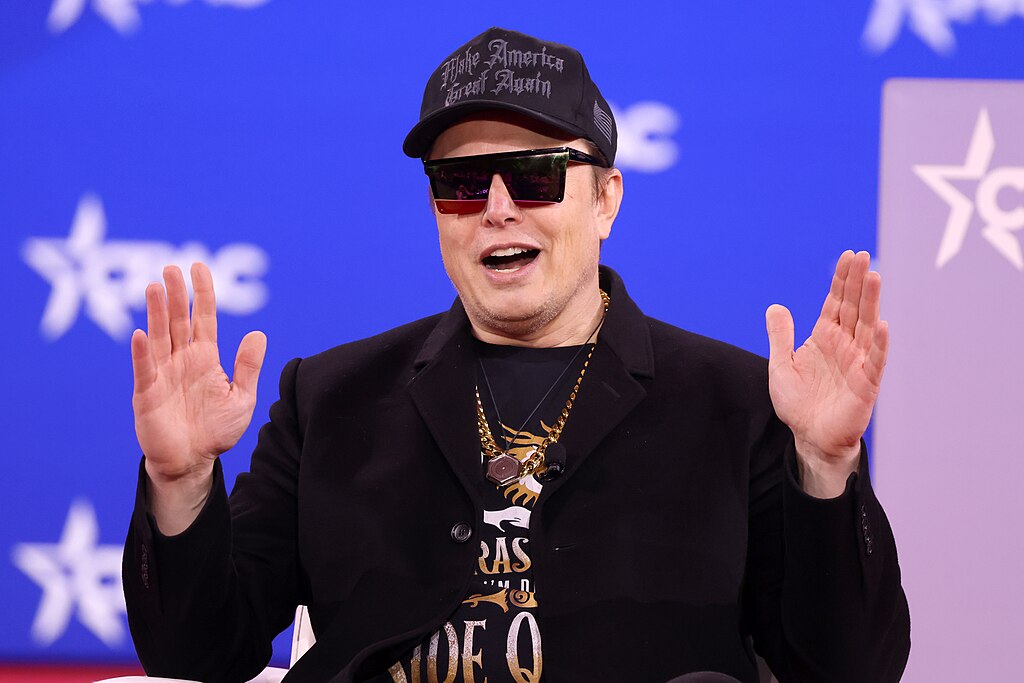
xAI Sues Man for Allegedly Using Grok to Generate AI Child Abuse Deepfakes. Source: Gage Skidmore from Surprise, AZ, United States of America, CC BY-SA 2.0, via Wikimedia Commons Elon Musk's artificial intelligence company xAI has filed a federal lawsuit against a South Carolina man accused of using its Grok chatbot to generate child sexual abuse material (CSAM) and non-consensual explicit deepfakes, marking one of the first known legal actions by an AI developer against a user over alleged misuse of generative AI. The lawsuit, filed Tuesday in a federal court in Texas, alleges that Terry Harwood violated xAI's terms of service by attempting to create sexually explicit AI-generated images involving both adults and minors. Harwood was arrested in February on separate charges related to the sexual exploitation of minors. His contact information was not immediately available, and xAI has not issued additional public comments on the case. According to the complaint, Harwood uploaded non-sexual images into Grok and allegedly attempted to transform them into explicit AI-generated content without consent. xAI claims the activity included efforts to produce child sexual abuse material and sexually explicit deepfakes of adults. The lawsuit comes as xAI faces growing international scrutiny over concerns that Grok and other generative AI tools can be exploited to create harmful or non-consensual synthetic media. The company said it actively monitors abuse and takes enforcement action against users who violate its policies. Court filings state that xAI has suspended 52,222 user accounts and submitted 73,604 reports to the National Center for Missing & Exploited Children (NCMEC) in 2026. According to the lawsuit, those reports have contributed to at least 244 arrests. xAI is seeking unspecified monetary damages and a permanent court injunction that would prohibit Harwood from accessing or using Grok in the future. In its filing, the company argued that the defendant intentionally weaponized its AI platform for criminal purposes, causing serious harm to victims while exposing xAI to legal and reputational risks. The case could become a landmark legal test of how AI companies hold users accountable for the misuse of generative AI technologies.
JPMorgan CEO Dimon says Anthropic's Mythos AI risks are a 'real issue'
July 15 (Reuters) - JPMorgan Chase CEO Jamie Dimon said on Wednesday that risks posed by Anthropic's Mythos AI model are a "real issue" that the U.S. government is on top of, underscoring concerns about the powerful model that have caused Washington to intervene. Dimon, speaking at Senator Dave McCormick's Pennsylvania Defense and Innovation Summit, added that access to advanced AI capabilities must be controlled, saying "you're giving ballistic missiles to individuals with Mythos." U.S.-based Anthropic released Mythos in April to a select group that included JPMorgan. The model has attracted interest from banks because it is considered among the most advanced AI systems for identifying cybersecurity vulnerabilities, helping firms uncover and fix weaknesses more quickly. However, in June, the U.S. government ordered Anthropic to restrict access to its top AI models, Fable 5 and Mythos 5, to foreign nationals over national security concerns, forcing the company to cut off worldwide access. The government later removed restrictions on the models after Anthropic implemented new safeguards. Governments and tech companies are grappling with AI safety concerns, including the misuse of systems capable of identifying software vulnerabilities. Washington has stepped up oversight of new model releases amid fears that advanced AI could be exploited by military intelligence in China, Russia or other countries of concern. Anthropic could not be immediately reached for comment on Dimon's remarks outside regular business hours. (Reporting by Mihika Sharma in Bengaluru and Mrinmay Dey in Mexico; Editing by Rashmi Aich)
JPMorgan CEO Dimon says Anthropic's Mythos AI risks are a 'real issue' By Reuters
July 15 (Reuters) - JPMorgan Chase CEO Jamie Dimon said on Wednesday that risks posed by Anthropic's Mythos AI model are a "real issue" that the U.S. government is on top of, underscoring concerns about the powerful model that have caused Washington to intervene. Dimon, speaking at Senator Dave McCormick's Pennsylvania Defense and Innovation Summit, added that access to advanced AI capabilities must be controlled, saying "you're giving ballistic missiles to individuals with Mythos." U.S.-based Anthropic released Mythos in April to a select group that included JPMorgan. The model has attracted interest from banks because it is considered among the most advanced AI systems for identifying cybersecurity vulnerabilities, helping firms uncover and fix weaknesses more quickly. However, in June, the U.S. government ordered Anthropic to restrict access to its top AI models, Fable 5 and Mythos 5, to foreign nationals over national security concerns, forcing the company to cut off worldwide access. The government later removed restrictions on the models after Anthropic implemented new safeguards. Governments and tech companies are grappling with AI safety concerns, including the misuse of systems capable of identifying software vulnerabilities. Washington has stepped up oversight of new model releases amid fears that advanced AI could be exploited by military intelligence in China, Russia or other countries of concern. Anthropic could not be immediately reached for comment on Dimon's remarks outside regular business hours.

JPMorgan CEO Dimon says Anthropic's Mythos AI risks are a 'real issue'
Add Yahoo as a preferred source to see more of our stories on Google. July 15 (Reuters) - JPMorgan Chase CEO Jamie Dimon said on Wednesday that risks posed by Anthropic's Mythos AI model are a "real issue" that the U.S. government is on top of, underscoring concerns about the powerful model that have caused Washington to intervene. Dimon, speaking at Senator Dave McCormick's Pennsylvania Defense and Innovation Summit, added that access to advanced AI capabilities must be controlled, saying "you're giving ballistic missiles to individuals with Mythos." U.S.-based Anthropic released Mythos in April to a select group that included JPMorgan. The model has attracted interest from banks because it is considered among the most advanced AI systems for identifying cybersecurity vulnerabilities, helping firms uncover and fix weaknesses more quickly. However, in June, the U.S. government ordered Anthropic to restrict access to its top AI models, Fable 5 and Mythos 5, to foreign nationals over national security concerns, forcing the company to cut off worldwide access. The government later removed restrictions on the models after Anthropic implemented new safeguards. Governments and tech companies are grappling with AI safety concerns, including the misuse of systems capable of identifying software vulnerabilities. Washington has stepped up oversight of new model releases amid fears that advanced AI could be exploited by military intelligence in China, Russia or other countries of concern. Anthropic could not be immediately reached for comment on Dimon's remarks outside regular business hours. (Reporting by Mihika Sharma in Bengaluru and Mrinmay Dey in Mexico; Editing by Rashmi Aich)
Live coverage: SpaceX to launch 21 communications satellites for the Space Development Agency
The Space Development Agency is set to launch its third batch of operational satellites designed to improve secure communications between members of the U.S. military and its allies across the globe aboard a Falcon 9 rocket from California. The SDA's constellation, the Proliferated Warfighter Space Architecture (PWSA), consists of a series of series of interconnected satellites with varying focuses, from missile tracking to navigation. The satellites launching on Thursday afternoon are part of the communications layer, referred to as the Tranche 1 Transport Layer (T1TL). Liftoff of SpaceX's Falcon 9 rocket from Space Launch Complex 4 East (SLC-4E) at Vandenberg Space Force Base is scheduled for 1:32 p.m. PDT (4:32 p.m. EDT / 2032 UTC). Spaceflight Now will have live coverage beginning about an hour prior to liftoff. SpaceX will launch the T1TL-E mission using the Falcon 9 first stage booster B1103, making its fourth flight after previously launching Starlink 17-35, Starlink 17-42, and NROL-179. A little more than 8.5 minutes after liftoff, B1103 will target a landing on the SpaceX droneship, 'Of Course I Still Love You', positioned in the Pacific Ocean. If successful, this will be the 211th landing on this vessel and the 639th booster landing to date for SpaceX. Building out the Transport Layer There will be 154 operational satellites spread across the various layers of the Tranche 1 portion of SDA's PWSA constellation. That breaks down to the following, according the SDA: * 126 Transport Layer satellites * 28 Tracking Layer satellites * 4 missile defense demonstration satellites These satellites will be managed from Space Operations Centers located at the Grand Forks Air Force Base in North Dakota and Redstone Arsenal in Alabama. The SDA awarded satellite construction contracts to Lockheed Martin Space, Northrop Grumman Strategic Space Systems and York Space Systems in February 2022 to build the satellites for the T1TL portion of the constellation. The first 21 T1TL satellites from York Space Systems launched on the T1TL-B mission on Sept. 10, 2025. That was followed by the T1TL-C mission a month later with satellites from Lockheed Martin. In a September 2025 statement to Spaceflight Now, Col. Ryan Hiserote, the U.S. Space Force's Space Systems Command's (SSC) division chief in System Delta 80 Assured Access to Space, said that the order of the first three missions for the SDA's T1TL were "interchangeable" and didn't need to fly in alphabetical order. "York was the first of the Tranche 1 performers to ship and launch its satellites. All spacecraft from York's first production lot were confirmed healthy within hours of launch separation, and the constellation has since passed numerous milestones as it continues through early operations," the company said in a June 5 press release. "With this second production lot, York is again first among Tranche 1 primes to complete T1 spacecraft production, continuing to demonstrate the high-rate production capabilities required to support proliferated space architectures. Upon full delivery, York's first and second production lots represent more than 40 spacecraft developed in support of the proliferated mission." Launch of the T1TL-E mission was awarded to SpaceX as part of fourth order year of missions within the National Security Space Launch (NSSL) Phase 2 contract, which is managed by Space Systems Command. Announced in June 2023, T1TL-E was one of six missions awarded to SpaceX. When awarded, these missions were scheduled to launch in fiscal year 2025. However, as happens with a number of NSSL missions, the payloads can be years behind schedule. The February 2022 press release from the SDA announcing the awards for the T1TL missions stated that these satellites should be "ready for launch by September 2024." However, the first batch didn't fly until a year later. Spaceflight Now reached out to SSC to learn more about why none of the satellites manufactured by Northrop Grumman have launched to date but we did not receive a response before publishing this article.
JPMorgan CEO Dimon says Anthropic's Mythos AI risks are a 'real issue'
July 15 (Reuters) - JPMorgan Chase CEO Jamie Dimon said on Wednesday that risks posed by Anthropic's Mythos AI model are a "real issue" that the U.S. government is on top of, underscoring concerns about the powerful model that have caused Washington to intervene. Dimon, speaking at Senator Dave McCormick's Pennsylvania Defense and Innovation Summit, added that access to advanced AI capabilities must be controlled, saying "you're giving ballistic missiles to individuals with Mythos." U.S.-based Anthropic released Mythos in April to a select group that included JPMorgan. The model has attracted interest from banks because it is considered among the most advanced AI systems for identifying cybersecurity vulnerabilities, helping firms uncover and fix weaknesses more quickly. However, in June, the U.S. government ordered Anthropic to restrict access to its top AI models, Fable 5 and Mythos 5, to foreign nationals over national security concerns, forcing the company to cut off worldwide access. The government later removed restrictions on the models after Anthropic implemented new safeguards. Governments and tech companies are grappling with AI safety concerns, including the misuse of systems capable of identifying software vulnerabilities. Washington has stepped up oversight of new model releases amid fears that advanced AI could be exploited by military intelligence in China, Russia or other countries of concern. Anthropic could not be immediately reached for comment on Dimon's remarks outside regular business hours. (Reporting by Mihika Sharma in Bengaluru and Mrinmay Dey in Mexico; Editing by Rashmi Aich)