News & Updates
The latest news and updates from companies in the WLTH portfolio.
Is SpaceX Planning to Make a Smartphone to Rival the iPhone?
Space Exploration Technologies (SPCX 2.24%), also known as just SpaceX, is a company that could disrupt many different industries, including space travel and telecom. But one that investors may not have considered is the smartphone market. While its Starlink service offers mobile internet for smartphones, CEO Elon Musk has also hinted that entering the smartphone market may be a possibility. The company reportedly has a prototype for a device that's similar to an iPhone According to a recent report from the Wall Street Journal, SpaceX has been working on a device that has a slimmer design than Apple's iPhone. While it's designed to help people interact with artificial intelligence (AI), its capabilities could certainly extend beyond that, as it's expected to use a Snapdragon chipset from Qualcomm. The device is nowhere near launching, and there is no certainty that it will even come to market. But with Musk being critical of Apple's restrictive app store policies, it also wouldn't be surprising if he were to want to bring his own smartphone or similar device to market, one that could rival Apple's popular devices. He has suggested in the past that while he isn't thrilled with the idea of doing so, he may feel compelled. "The idea of making a phone makes me want to die. But if we have to make a phone, we will. But we will aspire not to make a phone." Is SpaceX the ultimate growth stock to own? One of the most compelling reasons to invest in SpaceX despite its high valuation is that it has some tremendous growth opportunities. Not only can its reusable rockets revolutionize space travel, but its Starlink business could make it a big player in the telecom sector. And its biggest opportunities are in artificial intelligence (AI), with the company planning to put data centers into space. SpaceX arguably already has too many places to spend and invest in as it is. A smartphone may be a possibility down the road, but I wouldn't expect that to be a focus for the business at this stage. SpaceX has already been incurring billions in losses, and investing in too many different areas at once could prove to be costly and risky. While making risky investments can work for large tech companies with massive resources and strong financials, that strategy may not be as sound for a company such as SpaceX, which still needs to find its way out of the red. SpaceX may be an exciting stock to own, but it's also a highly risky one, and there are arguably far better growth stocks out there for investors that offer a better mix of growth and safety.

SpaceX's slide risks turning blockbuster IPO into confidence test
NEW YORK, July 15 (Reuters) - SpaceX's slip close to its initial public offering price risks turning a marquee stock-market debut into a confidence test, potentially unsettling retail investors and complicating decisions for other companies weighing high-profile listings. Elon Musk's company, spanning rockets to AI, debuted on June 12 and soared in the ensuing days, at one point valuing the company at well above $2 trillion. Since then, trading has been rocky. The stock has slipped below its $150 opening price, but remained above the $135 offer price, with concerns about lofty tech stock valuations continuing to weigh on global indexes. SpaceX shares are at risk of falling below that level. They ended on Tuesday down 2.2% at $136.08, their lowest closing level since the IPO, a week after they started trading as part of the Nasdaq 100 index <.NDX>. The stock dipped as low as $135.52. A break below the IPO price would be a psychological blow for SpaceX shares, said Matthew Maley, chief market strategist at Miller Tabak. "It raises the narrative that the stock is up on fluff, on speculation, on froth, and not on real fundamentals," Maley said. Investors who bought into the excitement around SpaceX's listing, "hoping to 'make a killing' will be disappointed," said Greg Halter, director of research at Carnegie Investment Counsel. He said weakness in SpaceX would put it more in line with 30 years of heavily hyped IPOs, where average and median returns over the first month are often negative. SpaceX did not immediately respond to a request for comment. PRICE DISCOVERY NOT PANIC? A drop below the IPO price would not be unusual for a newly listed company. Shares of Cerebras Systems, which went public in May, have dropped below the IPO price, and Meta, formerly known as Facebook, fell similarly after its debut. Investors often fixate on IPO prices and early trading, said Ryan Lee, senior vice president of product and strategy at financial services firm Direxion. "The reality is, (SpaceX) is still undergoing some of this price discovery process," Lee said. A fall for SpaceX below $135 would reflect "normal, albeit painful" market mechanics, especially as investors, venture capitalists and employees sell shares after lockups expire, said Gabriel Shahin, CEO at Falcon Wealth Planning. "A near-term dip below the $135 threshold would not fundamentally alter our current positioning or cause us to panic-sell," he said. CAUTION OR GREEN LIGHT FOR NEXT IPOS Some investors think SpaceX's stock performance could influence the market for future public listings. OpenAI and Anthropic are eyeing the public markets. Neither company responded to a request for comment. Carnegie's Halter said companies and investment banks considering large IPOs this year are watching SpaceX closely. "No one wants an IPO to flop or have the initial price be ratcheted down," Halter said. He suspects some IPOs would be pulled rather than priced at lower valuations. But Direxion's Lee said SpaceX's capital raise could encourage some companies with large funding needs to move faster. "If I'm OpenAI or if I'm Anthropic and I'm in this true arms race to build the frontier AI model and I need capital, I'm going to try to beat the other one out the door," Lee said. RISKING RETAIL TRADERS' SKEPTICISM A drop below the IPO price could hit retail investors, who received about 20% of the allocation, hard. "Many novice investors have approached SpaceX with a 'meme stock' mentality, buying in with capital they cannot afford to lose," Shahin said, warning that losses could fuel perceptions that markets favor insiders. "The market needs to understand that post-IPO volatility is normal." SpaceX's first earnings report will be a major test for the stock. Underwriters typically support stocks in the first 30 days and may do more for SpaceX given the deal's size, the public attention and the fact other high-profile offerings are imminent, said Maria Llerena, director of financial research at Domini Impact Investments. "Loss-making companies without a clear path to profitability are typically volatile and can fall below their IPO price," said Llerena. (Reporting by Laura Matthews in New York; Additional reporting by Lewis Krauskopf in New York; editing by Megan Davies and Rod Nickel)

Amazon Leo beats SpaceX Starlink to South Africa
Amazon Leo has partnered with Herotel, South Africa's largest ISP, to help connect rural population. Starlink is not available in the country. Amazon has announced that its satellite internet constellation, Leo, will provide connectivity for South Africa's largest internet service provider (ISP), Herotel. The company said that Leo will help to connect homes and small businesses that are too uneconomical to get connected with fiber and fixed wireless. Herotel will use Amazon Leo's technology as part of a new service it is offering called Evry. Evry will launch commercially in 2027 to get more residential customers connected to the net. Interestingly, this is the first agreement of this kind for Amazon Leo in Africa. While internet connectivity is a given for most people in places like the United States and Europe, the situation is different in South Africa. According to 2024 data from the International Telecommunication Union (ITU), only 78.4% of individuals are using the internet in South Africa. Amazon notes this "persistent challenge", saying that millions of people who live on farms, in small towns, and in rural communities, still lack reliable internet access due to distance, terrain, and low population density, which make traditional infrastructure impractical and expensive. With Amazon Leo, customers can connect to the net via compact antennas and there is no need for fiber or fixed wireless infrastructure at their premises. Amazon Leo satellites orbit the Earth at 590 kilometers above the planet and deliver internet speeds capable of video calls, streaming, remote work, and online learning. The fact that Amazon Leo is powering this service is good news. Due to the cost of getting satellite constellations into orbit, there are relatively few organizations offering this type of service. The leader of the pack is SpaceX with its Starlink constellation, but others offer similar services, including Eutelsat OneWeb. Notably, Starlink is not available to customers in South Africa yet. By introducing more competition, theoretically we could see prices come down for these services. In some countries, Starlink can be more than twice as expensive as broadband, so lower prices would be nice.
With a Nearly 7% Dividend Yield, Is Verizon Stock a Buy on SpaceX Fears?
Mobile operator Verizon (NYSE: VZ) has seen its shares sell off in the wake of the SpaceX (NASDAQ: SPCX) IPO, lifting Verizon's dividend yield to 6.7%. The sell-off looks overdone in my view, making the stock an attractive buy at current levels. Investors worry that SpaceX will use its leadership in satellite internet to challenge traditional mobile carriers like Verizon. However, there are multiple hurdles to this happening. Two of the biggest are technology constraints and regulatory issues. Missed Nvidia in 2009? This Rare Signal Is Flashing Again. In 2009, a "Double Down" signal flashed for a little-known chipmaker called Nvidia. For the first time in years, that same "Total Conviction" signal is flashing for a company 1/100th the size of Nvidia. Continue " Image source: The Motley Fool. A look at the potential threat Cellular networks, like Verizon's, use dense, localized cell towers and small cell antennas that reuse spectrum thousands of times within a single city. Low-earth-orbit (LEO) satellites like those SpaceX deploys, on the other hand, project massive beams over large areas. If millions of people in a dense city or suburb tried to stream video via direct-to-cell satellite at the same time, capacity would collapse. Meanwhile, modern green building initiatives, such as reinforced concrete, steel, and low-e glass used in office buildings, block satellite signals. Even SpaceX's VP for satellite engineering, Michael Nicolls, stated this at the company's Mobile World Conference: "Satellite is complementary to terrestrial networks; it cannot provide the data density that terrestrial networks have. But it can augment terrestrial networks in areas where they cannot reach. Or when terrestrial networks need additional capacity." Meanwhile, after discussing the potential for SpaceX to offer a mobile network with a former FCC attorney, BNP Paribas analyst Sam McHugh concluded there were few ways for SpaceX to enter the mobile space unless those companies struck a deal with SpaceX. He noted that current FCC rules prevent Elon Musk's company from requiring carriers to enter wholesale network agreements or to provide roaming access. While there is a risk SpaceX gets into space by acquiring a carrier like T-Mobile, the three big carriers did form a joint venture to help address coverage gaps in the U.S. by pooling spectrum, looking to fend off any risk from satellite companies. Bundling opportunity ahead Putting aside SpaceX's concerns, Verizon has a big opportunity ahead as it starts to cross-sell and bundle wireless and broadband services to the customers it gained when it acquired Frontier Communications earlier this year. This should be a nice subscriber and revenue growth driver, as only about 20% of its customers have both wireless and broadband subscriptions. Meanwhile, Verizon's dividend is safe and well covered, with the company having low leverage and a dividend (around $12 billion projected this year) that is easily covered by its free cash flow ($21.5 billion forecast). With a nearly 7% yield and a forward price-to-earnings (P/E) ratio of 8.6 based on 2026 earnings estimates, I think this dividend stock looks like a buy on its recent price dip. Should you buy stock in Verizon Communications right now? Before you buy stock in Verizon Communications, consider this: The Motley Fool Stock Advisor analyst team just identified what they believe are the 10 best stocks for investors to buy now... and Verizon Communications wasn't one of them. The 10 stocks that made the cut could produce monster returns in the coming years. Consider when Netflix made this list on December 17, 2004... if you invested $1,000 at the time of our recommendation, you'd have $398,160!* Or when Nvidia made this list on April 15, 2005... if you invested $1,000 at the time of our recommendation, you'd have $1,249,202!* Now, it's worth noting Stock Advisor's total average return is 918% -- a market-crushing outperformance compared to 209% for the S&P 500. Don't miss the latest top 10 list, available with Stock Advisor, and join an investing community built by individual investors for individual investors. See the 10 stocks " *Stock Advisor returns as of July 15, 2026. Geoffrey Seiler has no position in any of the stocks mentioned. The Motley Fool recommends T-Mobile US and Verizon Communications. The Motley Fool has a disclosure policy. The views and opinions expressed herein are the views and opinions of the author and do not necessarily reflect those of Nasdaq, Inc.

Anthropic Makes Claude Free for All US K-12 Teachers With Standards-Aligned Agentic AI
Free access comes with state-standards alignment, agentic scheduling, and nine edtech connectors. Verified U.S. K-12 teachers can now claim a full year of free premium Claude AI -- not a trimmed-down chatbot, but the same agentic platform that runs Claude Code and Cowork -- as Anthropic on Tuesday launched Claude for Teachers, a product that pairs free premium access with a curriculum database covering every academic standard in all 50 states, nine edtech platform integrations, and FERPA-aligned data terms co-developed with the American Federation of Teachers. Any educator who signs up before June 30, 2027 gets a full year of access at no cost. The launch arrives in a market where Anthropic's biggest competitors have been giving away comparable tools for months. ChatGPT for Teachers launched in November 2025 and is also free for verified U.S. K-12 educators through June 2027. What distinguishes Claude for Teachers is not the free tier, but the architecture underneath it: a standards-aligned data layer called Learning Commons, an open-source library of pedagogy-grounded teaching skills, and nine integrations implemented as Model Context Protocol (MCP) connectors -- the same standardized protocol Anthropic has been building as industry infrastructure since late 2024. This is the same protocol now adopted by OpenAI and Google DeepMind as the de facto standard for connecting AI agents to external systems. This Is Not a Lesson-Plan Generator Claude for Teachers works differently from a general-purpose AI assistant because it knows the specific thing a teacher is working toward before it generates anything. When an educator asks for a lesson on, say, constructing linear functions, Claude queries Learning Commons -- a structured database that maps each of the roughly 150,000 academic standards across all 50 states to the smaller learning competencies each standard contains and the developmental order students typically learn them in -- and scaffolds the lesson accordingly, rather than generating plausible-sounding content that a teacher must then verify against their actual curriculum. Trusted open curricula -- specifically OpenSciEd for science and IM v.360 from Illustrative Mathematics -- are also accessible as sources Claude can draw from when building lessons, adding a layer of subject-matter rigor that distinguishes this from general-purpose AI output. Research supports the design choice. A March 2026 review of more than 800 academic papers on AI and K-12 education from Stanford's SCALE Initiative found that AI tools built with pedagogical guardrails -- systems that guide student reasoning rather than providing direct answers -- showed more promising outcomes than general-purpose chatbots. The 2026 OECD Digital Education Outlook similarly found that co-designing AI tools with teachers can amplify instructional capacity in ways that neither teachers nor AI achieve independently. How the Nine Edtech Integrations Actually Work The nine edtech partners -- ASSISTments, Brisk Teaching, Canva Education, Coteach, Diffit, Eedi, MagicSchool, Snorkl, and TeachFX -- connect to Claude through Anthropic's Model Context Protocol, an open standard the company introduced in November 2024 and donated to the Linux Foundation in December 2025. MCP works by having each partner run an MCP server that advertises specific tools and data resources; Claude's MCP client queries those servers as needed and injects the results into its context window, as described in Anthropic's technical introduction to the protocol. This is the same protocol now adopted by OpenAI and Google DeepMind as the de facto standard for connecting AI agents to external systems. In practical classroom terms: ASSISTments generates auto-scored, standards-aligned math problems for practice and assessment. Eedi surfaces diagnostic questions in both English and Spanish that reveal why a student got a problem wrong, not just that they did. TeachFX gives personalized instructional feedback grounded in real classroom audio. The breadth signals Anthropic's strategic intent. By building these connections on an open protocol and simultaneously releasing an open-source teaching skills repository, Anthropic is positioning Claude as an integration layer for K-12 AI tools -- not just another product competing alongside them. Other education-technology builders can implement the same MCP standard to make their tools Claude-compatible, compounding the network effect. Agentic Scheduling: AI That Works After School Hours Claude for Teachers includes full access to Claude Code and Cowork, the agentic components of Anthropic's platform that let Claude carry multi-step work forward without continuous human prompting. In the context of teaching, this means a teacher can hand Claude a folder of exit tickets, attendance data, and class notes before leaving school, set a recurring task to run at 4 p.m. each school day, and receive a synthesized picture of what each student mastered and a proposed adaptation for the next day's lesson plan -- without prompting Claude again, as SQ Magazine's review of the launch documents. This is a substantive shift from how AI assistance has worked in education. Most classroom AI tools are reactive: a teacher types a request, the AI responds, the teacher decides what to do with it. Agentic workflows are proactive: the teacher sets parameters once, and the AI executes repeatedly and autonomously. That distinction matters because it changes what kind of cognitive labor teachers are doing -- from prompting and reviewing to designing the task upfront and reviewing the output. Whether that shift improves or displaces teacher judgment is a live research question. Stanford's SCALE review found limited causal evidence specifically on agentic teacher tools, given how recently such tools have become available. Privacy Architecture and What FERPA-Aligned Actually Means Education technology has an established and concerning track record on student data. In December 2024, hackers exfiltrated more than 62 million student records and nearly 10 million teacher records from PowerSchool -- a student information system serving approximately 16,000 schools -- in the largest breach of children's data in U.S. history. The perpetrator was sentenced in October 2025; as TechPolicy Press documented, the systemic vulnerabilities that made the breach possible remain largely unaddressed in the industry. Anthropic has built Claude for Teachers with that history in mind. Teacher account data is not used for model training. Student information is covered by a K-12 Data Processing Addendum -- a contractual document published at anthropic.com/legal/k12-dpa -- written to comply with FERPA's requirements. The product is restricted to educators only, consistent with Claude's existing policy requiring users to be at least 18 years old, meaning students cannot interact with the system directly. Anthropic also specifies a service level agreement for deleting stored conversations containing student data. A critical word choice matters here. Anthropic describes these protections as "FERPA-aligned" -- not "FERPA-compliant." The distinction is legal, not semantic. Alignment means the contractual terms are written with FERPA's requirements in mind. Compliance is a determination that applies to each specific district's implementation. Whether a given school's use of Claude for Teachers actually satisfies FERPA depends on that district's specific data governance setup, which teachers should confirm with district administrators and legal counsel rather than assuming the addendum settles the question under federal FERPA law. Anthropic is also working with the American Federation of Teachers to develop a "Gold Standard" for industry best practices on AI safety and privacy in K-12 education. AFT President Randi Weingarten offered measured support for the launch, saying the union has been working with Anthropic toward those standards and welcomed its commitment to them, according to Benzinga's coverage of the announcement. Notably, while the AFT is collaborating with Anthropic, OpenAI, and Microsoft on privacy and educator training, it is not doing so with Google -- which recently struck a separate deal with Utah's state education board to bring Gemini AI into every K-12 school in the state, as Chalkbeat reported. Claude for Teachers vs. ChatGPT for Teachers Anthropic is entering a market where OpenAI arrived first. ChatGPT for Teachers launched in November 2025 and is also free for verified U.S. K-12 educators through at least June 2027, with similar FERPA-aligned commitments, admin controls for district leaders, and integrations with Google Workspace and Microsoft 365. The programs are structurally similar: both trade free access to educators for product feedback, privacy reputation, and future district-tier business. Claude for Teachers differentiates in three specific ways. First, the Learning Commons layer provides standards-aligned lesson scaffolding at a finer granularity than general-purpose AI -- not just state standards but the learning progressions beneath each standard. Second, the agentic scheduling capabilities (Claude Code + Cowork) are not present in the current ChatGPT for Teachers offering. Third, Anthropic is releasing its teaching skills library as open-source, inviting other builders to construct compatible tools rather than closing the ecosystem around its own product. The competitive pressure is accelerating. Use of AI among teachers has roughly doubled: Chalkbeat reported that an Education Week survey found around 61 percent of teachers reported using AI in some capacity in 2025, compared with approximately 32 percent in 2024. Detroit Pilot Will Test What the Evidence Actually Shows Anthropic will pilot Claude for Teachers in the Detroit Public Schools Community District, beginning with the next school year. Detroit was selected in part because the district was already using Claude products and had adopted them in what Anthropic described as a human-centric way. Teachers at a small number of schools will receive training, after which Anthropic will formally evaluate how the product shapes instructional practice and educator wellbeing. The pilot is notable because the evidence base for AI tools specifically designed for teachers -- as opposed to student-facing tutoring systems -- is still thin in terms of rigorous causal studies. The Stanford SCALE 2026 review found the existing evidence on educator-facing tools is suggestive but limited; most studies are observational rather than experimental. The Detroit pilot, if run with the rigor implied by the Gates Foundation partnership framing, could add meaningfully to that base. Skeptics remain. Education researchers have raised concerns that AI-assisted lesson planning, if not carefully implemented, risks reducing the kind of deep content engagement that produces expertise over time, and that the automation of instructional decisions introduces accountability gaps when an AI-adapted plan produces poor results. Those concerns apply most sharply to student-facing AI; the evidence on teacher-facing tools is more favorable. Norway's government, which banned generative AI for students in grades one through seven starting August 2026 after citing declining test scores, drew an explicit line between student-facing and teacher-facing use -- a distinction aligned with where current research points, as TechTimes reported in June 2026. These efforts are part of Anthropic's partnership with the Gates Foundation to co-develop tools that improve educational outcomes for K-12 students. How to Sign Up Claude for Teachers is available now to verified individual K-12 educators in the United States at the Claude for Teachers signup page. Teachers who sign up before June 30, 2027 receive a full year of access at no cost. A separate offering for schools and districts is in development and not yet available. In the meantime, districts can continue accessing Claude through the Claude for Nonprofits program. Alongside the product, Anthropic released a free AI Fluency for K-12 Teachers course co-developed with Teach for America, and a train-the-trainer module co-developed with the AFT -- both Creative Commons-licensed and designed to work with any AI model, not only Claude. Frequently Asked Questions How is Claude for Teachers different from ChatGPT for Teachers? Both products are free for verified U.S. K-12 educators through mid-2027 and both carry FERPA-aligned data commitments. Claude for Teachers differentiates through three technical features absent in the current ChatGPT for Teachers offering: a structured academic standards database (Learning Commons) that grounds lesson generation in state-specific learning progressions rather than general knowledge; agentic scheduling via Claude Code and Cowork, which allows recurring instructional tasks -- such as daily exit-ticket review -- to run automatically without a new prompt from the teacher; and an open-source teaching skills library on GitHub that allows other edtech builders to create Claude-compatible tools. ChatGPT for Teachers launched eight months earlier, in November 2025, and includes district-level admin controls and Microsoft 365/Google Workspace integrations that the Claude product does not yet match at the district tier. Why is Anthropic offering this for free, and what is the catch? Anthropic's business incentive is explicit in its design. Free individual teacher access generates two things money cannot easily buy: real classroom product feedback through the Detroit pilot and individual signups, and a privacy reputation co-signed by the American Federation of Teachers. Both compound if the product performs well in classrooms. Both become liabilities if a data incident occurs before Anthropic builds out a separately negotiated district-tier product with its own contracts. Districts evaluating whether to adopt Claude should treat the current FERPA-aligned addendum as a contractual starting point and confirm compliance with their own legal counsel -- particularly because the district-level offering and its associated terms are not yet available, as SQ Magazine's analysis notes. What student data does Claude for Teachers actually collect and how is it protected? According to Anthropic's documentation, Claude for Teachers data is not used for model training purposes, and student information is covered by a K-12 Data Processing Addendum written to comply with FERPA. Anthropic specifies a service level agreement for deleting stored conversations containing student data. The product is restricted to teachers only -- students cannot interact with it directly. What the addendum does not address is the data flows that occur when Claude queries MCP-connected third-party tools such as ASSISTments or TeachFX; teachers should confirm with each integration partner what data leaves their platform and under what terms. The edtech industry's most significant recent breach -- the December 2024 PowerSchool incident affecting 62 million individuals -- originated with a third-party student information system, not the primary AI platform, as TechPolicy Press analyzed. What does the nine-platform edtech integration actually enable? The integrations are built on Anthropic's Model Context Protocol, an open standard adopted by major AI companies as a way to connect AI agents to external tools without custom per-pairing integration code. Each partner runs an MCP server that Claude queries on demand; Claude's context window is populated with data from the partner system as needed. In practice: ASSISTments can generate auto-scored, standards-aligned math practice problems; Eedi surfaces bilingual diagnostic questions that reveal specific student misconceptions; TeachFX analyzes real classroom audio to give teachers feedback on their own instructional practice; Snorkl provides assignment and class-level progress data. All of this is detailed in Anthropic's Claude for Teachers announcement. The MCP architecture means other edtech developers can build Claude-compatible connections using the same open standard, potentially expanding the integration ecosystem beyond the nine partners at launch.

With a Nearly 7% Dividend Yield, Is Verizon Stock a Buy on SpaceX Fears?
Mobile operator Verizon (NYSE: VZ) has seen its shares sell off in the wake of the SpaceX (NASDAQ: SPCX) IPO, lifting Verizon's dividend yield to 6.7%. The sell-off looks overdone in my view, making the stock an attractive buy at current levels. Investors worry that SpaceX will use its leadership in satellite internet to challenge traditional mobile carriers like Verizon. However, there are multiple hurdles to this happening. Two of the biggest are technology constraints and regulatory issues. Missed Nvidia in 2009? This Rare Signal Is Flashing Again. In 2009, a "Double Down" signal flashed for a little-known chipmaker called Nvidia. For the first time in years, that same "Total Conviction" signal is flashing for a company 1/100th the size of Nvidia. Continue " A look at the potential threat Cellular networks, like Verizon's, use dense, localized cell towers and small cell antennas that reuse spectrum thousands of times within a single city. Low-earth-orbit (LEO) satellites like those SpaceX deploys, on the other hand, project massive beams over large areas. If millions of people in a dense city or suburb tried to stream video via direct-to-cell satellite at the same time, capacity would collapse. Meanwhile, modern green building initiatives, such as reinforced concrete, steel, and low-e glass used in office buildings, block satellite signals. Even SpaceX's VP for satellite engineering, Michael Nicolls, stated this at the company's Mobile World Conference: "Satellite is complementary to terrestrial networks; it cannot provide the data density that terrestrial networks have. But it can augment terrestrial networks in areas where they cannot reach. Or when terrestrial networks need additional capacity." Meanwhile, after discussing the potential for SpaceX to offer a mobile network with a former FCC attorney, BNP Paribas analyst Sam McHugh concluded there were few ways for SpaceX to enter the mobile space unless those companies struck a deal with SpaceX. He noted that current FCC rules prevent Elon Musk's company from requiring carriers to enter wholesale network agreements or to provide roaming access. While there is a risk SpaceX gets into space by acquiring a carrier like T-Mobile, the three big carriers did form a joint venture to help address coverage gaps in the U.S. by pooling spectrum, looking to fend off any risk from satellite companies. Bundling opportunity ahead Putting aside SpaceX's concerns, Verizon has a big opportunity ahead as it starts to cross-sell and bundle wireless and broadband services to the customers it gained when it acquired Frontier Communications earlier this year. This should be a nice subscriber and revenue growth driver, as only about 20% of its customers have both wireless and broadband subscriptions.
SpaceX stock falls 33% from peak, slips below $135 IPO price: Here's why
SpaceX shares have fallen below their IPO (Initial Public Offering) price, raising concerns among investors who bought the stock during its market debut. The company's shares closed at $136.08 on Tuesday, just above the IPO price of $135, and later slipped below that level. The IPO price is important because it is the price at which investors first bought the company's shares when it went public. Falling below the IPO price is seen as a negative sign because it means early investors are now losing money on their investment. SpaceX had a very strong stock market debut. The company completed the world's biggest IPO and raised more than $85 billion after the overallotment option was exercised, according to The Motley Fool. According to Bloomberg, the stock has fallen by almost one-third from its highest price after the IPO. This has erased nearly $850 billion in the company's market value. SpaceX was already very popular with investors before its IPO because of its space technology business and the leadership of Elon Musk. The company has three main businesses: rocket launches, satellite internet services, and artificial intelligence. Elon Musk is one of the main reasons many people want to invest in SpaceX. Some investors do not agree with all of his plans, but many others believe in his vision for the future. SpaceX also continued to grow last year. According to The Motley Fool, the company made more than $18 billion in revenue, which was over 30% higher than the year before. Even though SpaceX made more money, the company still lost $4.9 billion. This is because it is spending a lot of money to build new space technology. The company may continue spending heavily because making advanced space technology is very expensive. Later this year, SpaceX plans to launch its fully reusable Starship rocket with payloads. This will be an important step for the company's future plans. Also read: Why are oil and gas prices so high? US is the world's top oil producer and consumer explained Ken Mahoney, CEO of Mahoney Asset Management, said he does not believe the stock has reached its lowest point yet. He said investors should watch whether enough buyers are willing to purchase the additional shares entering the market, according to Bloomberg. Even after the recent decline, Wall Street remains largely optimistic about SpaceX. More than 80% of analysts covering the company have Buy ratings on the stock. The average analyst price target is $236.25, which is over 70% higher than Tuesday's closing price. Several major investment banks, including Morgan Stanley, JPMorgan Chase and Goldman Sachs, started coverage with positive ratings. SpaceX was recently added to the Nasdaq-100 Index through the exchange's fast-entry rules, another major milestone for the company. Seven of those companies posted double-digit losses, while the average decline was around 12%. The report said that if SpaceX follows this historical trend, a $10,000 investment made near the IPO could be worth about $8,800 after one year. The history suggests investors should not rush into IPO stocks, as better buying opportunities may appear after the initial excitement fades. Bloomberg noted that many of the biggest U.S. IPOs this year have also struggled. Six of the ten largest offerings are now trading below the price at which they closed on their first trading day. Talley Leger, chief market strategist at Wealth Consulting Group, said he may consider buying SpaceX shares if the stock falls further, because he likes the company's long-term vision, according to Bloomberg. For now, investors are closely watching whether SpaceX can recover above its IPO price or continue its recent downward trend.
Needham raises SpaceX stock price target to $250 on AI, Starship By Investing.com
Investing.com - Needham raised its price target on SpaceX (NASDAQ:SPCX) to $250 from $200 while maintaining a Buy rating on Tuesday. The upgrade comes as shares trade at $136, near their 52-week low of $135.52, following an 8.2% decline over the past week. According to InvestingPro analysis, the stock appears undervalued at current levels, potentially offering investors an attractive entry point. The firm cited the company's release of Grok 4.5 on July 8, SpaceX's first AI model built for coding and agentic work. The model was trained on Cursor developer data and has received strong reviews on third-party AI benchmarks. Needham noted the model does not quite match leading models from Anthropic or OpenAI but puts SpaceXAI back on track after Elon Musk said in March the company had to completely rebuild its AI program. SpaceX announced its Starship flight 13 is scheduled to launch as early as July 16. The flight will deliver 20 full-size Starlink V3 test units to orbit and advance Ship and Booster re-usability. Needham said AI model performance and Starship success to orbit are key unlocks for the company's total addressable market. The firm raised its price target on increased confidence in execution. InvestingPro data reveals analysts predict the company will turn profitable this year, with 13 additional ProTips available to subscribers. In other recent news, flyExclusive, Inc. has completed its acquisition of aviation assets from Jet.AI. This transaction includes Jet.AI's Jet Card members, two HondaJets, one Citation CJ4, and three future Citation CJ3 delivery positions valued at approximately $4.1 million. Additionally, flyExclusive gained approximately $6.1 million in securities through indirect ownership of Space Exploration Technologies Corp. shares and about $5.3 million in cash. Meanwhile, SpaceX has received significant attention from analysts. Evercore ISI initiated coverage on SpaceX with an "outperform" rating and set a price target of $230. Stifel reiterated a "Buy" rating with a $190 price target, highlighting the upcoming Starship Flight 13 launch. Raymond James also reiterated a "Strong Buy" rating with an $800 price target, noting a significant reduction in the time between recent Starship flights. Deutsche Bank released an analysis suggesting that SpaceX could achieve cost parity between orbital and terrestrial data centers by the early 2030s. This article was generated with the support of AI and reviewed by an editor. For more information see our T&C.

A SpaceX vet raised $65M to pull wire harnesses out of the Cold War era
When Senra CEO Jordan Black was a SpaceX engineer, he took on the job of scaling up the company's wire harnesses to support production of Starship, the company's next-generation rocket. Wire harnesses are what they sound like: the internal electrical cabling that runs through a rocketship, car, plane, or tractor and becomes increasingly important the smarter those vehicles get. They're bespoke, put together by technicians who are, functionally, experienced craftspeople. "I traveled all over the world to go visit wire harness companies," Black told TechCrunch last month. "It really hasn't changed since the Cold War era of wooden tables [and] manual processes." Black and co-founder Benjamin Shanahan started Senra in 2023 to offer a more modern solution to vehicle manufacturers. Today, the startup is announcing a $65 million Series B round, co-led by Lowercarbon and Interlagos with participation from General Catalyst, Sequoia Capital, Andreessen Horowitz, and Founders Fund, among others. Serna isn't looking to take humans out of the handmaking process -- at least not while robots find manipulating wires a challenge and relevant training data remains scarce. Instead, it's turning to software tools and other forms of automation to modernize aspects of the traditional manual work. The company is benefiting from the surge of money into U.S. manufacturing, particularly the defense industrial base. While Black couldn't disclose customers, he said they include builders of "anything from submarines and maritime vehicles, to defense vehicle systems on land, to launch vehicles, to satellites." If it doesn't sound immediately important, consider a recent wire harness disaster. In 2023, Boeing discovered that its Starliner spacecraft's wiring was held together with flammable tape, forcing an expensive delay while the entire wiring system was redone. Black points to that experience as a reason to raise the standards for wire harnessing, using automated systems to track materials and engineering changes. "Having it all in the same software is probably the most important thing, because it's all the little inputs that happen that can make a catastrophic change down the road," he said. Senra uses Amp, a proprietary software platform, to standardize the inputs throughout the wiring process and produce a digital twin to guide its technicians, who are trained by the company in what Black says is the only federally certified wire harness training program. The company is also, as it scales, finding ways to automate more of the process. "It goes back to the Elon principle of, 'automation is last,'" Black told TechCrunch. "We're working on it now, but a lot of it the standardization and the foundation building that made SpaceX be able to scale something like rockets, which you could only build one a year if you were lucky, and now they do hundreds a year." Senra -- which, by the way, is "harness" spelled backwards, minus the "h" and "s," because Black says the company takes the "horsesh*t" out of harnesses -- produces 1,000 each month across two different factories and plans to increae production to 10,000 a month in 2027.

SpaceX's IPO Is Drifting Back Toward Its Offer Price
In an IPO, the offer price is the anchor many buyers judge the deal against, even though a new stock is still "finding" its level. SpaceX has cooled from its early pop: shares closed at $136.08 after dipping near $135, below the $150 opening trade, as investors debate how much future growth is already baked into big-name tech. Reuters notes that IPO banks often try to steady trading in the first few weeks through price-stabilization trades and the "gre.. enshoe" option, which lets underwriters buy shares to limit early selling pressure. That support is temporary, so if the stock is still leaning on $135 as the initial window fades, the market can start to focus more on the next wave of supply, like shares that can be sold later when lockups end. A clean break below the offer price can also change the story around the listing, making it harder for other mega-IPO hopefuls that bankers have been watching to justify aggressive valuations. Why should I care? For markets: SpaceX's $135 level becomes a bigger test once the early IPO "training wheels" come off. The offer price matters because it's where underwriters have the most incentive to keep the stock orderly right after the listing, when they can use stabilization and greenshoe-related buying to absorb some selling. But that backstop is time-bound. If SpaceX is still hovering around $135 as that period ends, the balance can tilt toward regular post-IPO forces, including later selling by early holders once lockups expire. And when a high-profile deal starts trading below its offer price in that phase, future issuers and banks often have to offer a larger discount to attract buyers, or delay a launch altogether, which is why the market is treating SpaceX as a read-through for the next big listings.

Reditus readies first spacecraft for SpaceX launch
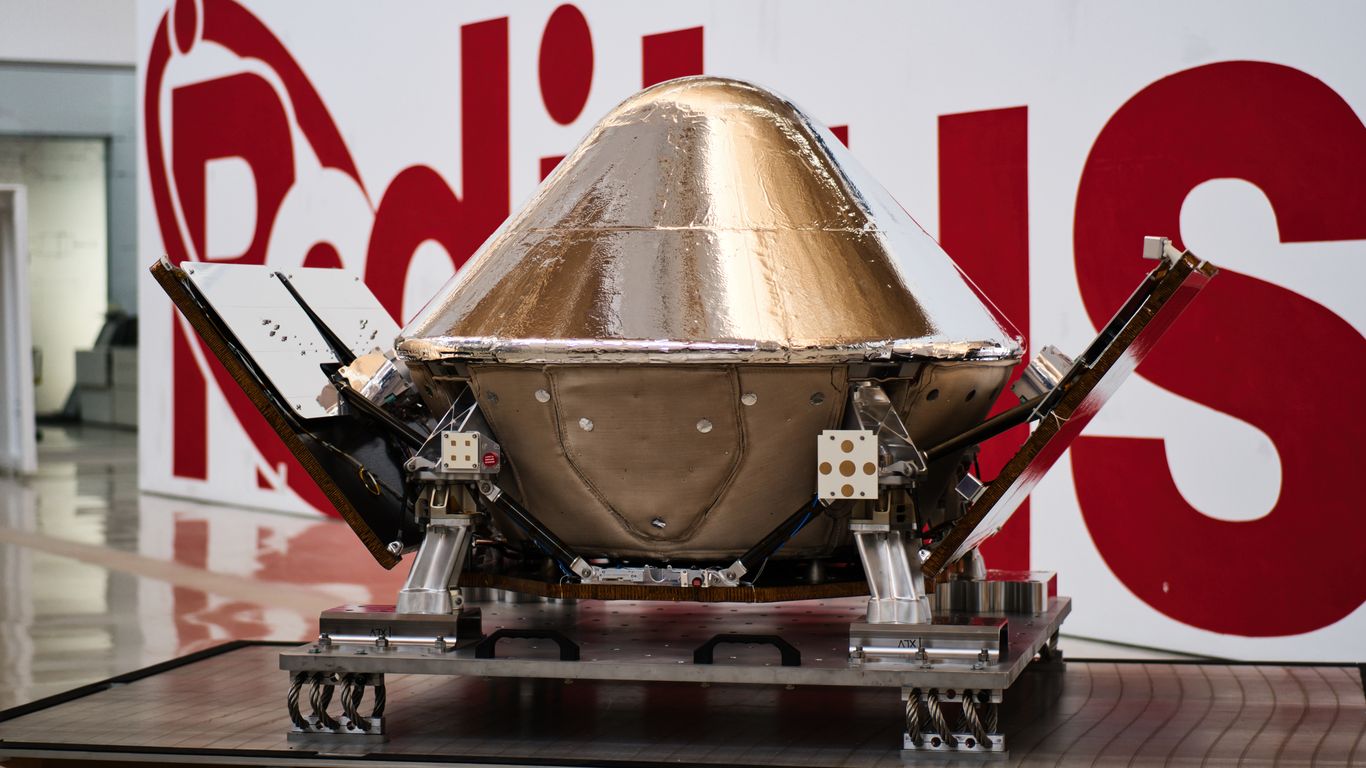
"Hypersonics is one of the areas where there has been a tremendous amount of development in recent years," Crum said in an interview. Driving the news: Reditus recently completed construction of its first spacecraft, ENOS. It has been sent to Vandenberg Space Force Base, California, and is scheduled to launch aboard a SpaceX rideshare this fall. * ENOS, weighing some 440 pounds, is expected to stay in orbit for two months, after which it will de-orbit and splash down off Florida for recovery. * "As we re-enter, we have the relatively unique capability of hitting the atmosphere at north of Mach 25," Crum said. "There are very few things in human existence that go that quickly." Zoom in: Reditus is billing this first mission, focused on commercial microgravity research and manufacturing, as a demonstration, proving to the world it can bring things back from space. * "Things are going to get higher in altitude, faster -- and this is just part of the infrastructure that is needed to keep up," Crum said. State of play: Reditus raised a little more than $7 million last year. * The startup, based in Atlanta, employs around 12 people. What we're watching: The progress of Trump 2.0's Golden Dome, and to what degree the $185 billion promise is influencing defense-industrial business decisions.
Why SpaceX Is Quietly Becoming an Infrastructure Giant
For years, SpaceX (SPCX) has been viewed as the world's leading commercial launch company, celebrated for reusable rockets that dramatically lowered the cost of reaching orbit. That description is still accurate, but it is no longer the whole story. The more interesting case to make is that SpaceX may be evolving into something far larger than an aerospace manufacturer. Through Starlink, Starshield, launch services, and an expanding artificial intelligence strategy, the company is steadily assembling businesses that look less like traditional industrial operations and more like critical infrastructure. That distinction matters because history shows infrastructure companies tend to become some of the most valuable businesses in the world. Railroads powered industrialization. Electric utilities enabled modern cities. Cloud computing became the backbone of the digital economy. The question investors should now be asking is whether SpaceX is beginning a similar transition. Infrastructure Has Changed When most people think about infrastructure, highways, bridges, airports, and power grids come to mind. But that definition has expanded considerably over the past two decades. Digital infrastructure now includes cloud computing platforms, payment networks, fiber-optic cables, and wireless communications, all systems that millions of individuals, businesses, and governments rely on every day without necessarily thinking about who owns them. Space is increasingly becoming another layer of that stack. Reliable launch services, global satellite communications, secure military networks, and eventually orbital computing are turning into strategic assets for both governments and private enterprises. SpaceX now operates across each of those areas, which makes the company increasingly difficult to classify as simply a rocket manufacturer. Rockets Are the Foundation, Not the Business SpaceX's breakthrough was never just about building rockets. It was about changing the economics of getting to space. Elon Musk has long argued that reusability is the key to making space commercially viable, drawing comparisons to every other major mode of transportation. "Every mode of transport is reusable," he has said, making the case that rockets should follow the same economic logic rather than being discarded after a single flight. That philosophy worked. The company's reusable Falcon rockets slashed launch costs and increased launch frequency, fundamentally reshaping the commercial space industry in the process. But lower launch costs created something more valuable than an efficient rocket business. They provided the economic foundation for SpaceX to build entirely new businesses that depend on affordable access to orbit. The rockets, in other words, are increasingly the enabling layer rather than the primary source of long-term value. Starlink Has Changed the Investment Narrative Nothing illustrates this transformation better than Starlink. Originally conceived as a satellite broadband network, it has evolved into a global communications platform serving residential customers, airlines, maritime operators, remote industrial sites, governments, and emergency responders. Unlike launch services, which generate revenue project by project, satellite connectivity produces recurring subscription income, and that changes the financial profile of the business considerably. Recurring revenue is more predictable, more scalable, and typically commands higher valuation multiples than cyclical industrial businesses. The importance of Starlink extends beyond its financial contribution. Every satellite launched strengthens the network, improves coverage, and expands the ecosystem, reinforcing SpaceX's competitive position in ways that are genuinely difficult to replicate. The company is also pursuing a substantial expansion of the constellation, recently seeking regulatory approval for a next-generation network that would dramatically increase the scale of its orbital infrastructure. Governments Are Becoming Long-Term Customers Infrastructure becomes especially valuable when governments depend on it, and SpaceX has been steadily deepening its public-sector relationships. Through NASA missions, defense launches, and national security programs, the company has built a government customer base that tends to be long-term and far less cyclical than commercial markets. Starshield, its government-focused satellite business, reflects a broader trend in which public agencies increasingly purchase commercial infrastructure rather than building every capability internally. As geopolitical tensions rise and nations prioritize resilient communications and space capabilities, commercial providers like SpaceX are becoming harder to replace. That raises a question worth sitting with: at what point does a private aerospace company effectively become part of a nation's critical infrastructure? The Platform Keeps Expanding SpaceX's ambitions are also stretching beyond communications and launch services. The company has outlined plans to leverage technology developed for Starlink to support future orbital AI computing, arguing that many of the building blocks are already in place. "There is not some magic that is necessary," Musk said during a company presentation. "A lot of this is technology we've already made for the Starlink V3 satellites. We don't think this is a super hard problem compared to the things we already do." Whether orbital computing becomes commercially viable in the near term remains an open question. Several Wall Street analysts believe SpaceX's more immediate AI opportunity lies in terrestrial computing infrastructure, and the company has already been investing heavily in that direction alongside its launch and satellite businesses. Either way, the strategic direction is becoming clearer. SpaceX increasingly treats launch, connectivity, and AI as interconnected businesses rather than separate ventures, each one reinforcing the others. Why It Matters for Investors Public market investors still cannot easily buy shares of SpaceX directly, but the company's evolution has implications well beyond its own valuation. Lower launch costs reshape the economics of satellite operators. Expanding communications networks influence telecommunications markets. Defense spending increasingly intersects with commercial space. Future advances in orbital infrastructure could create ripple effects across aerospace, semiconductors, and AI. History suggests investors often only recognize infrastructure businesses after they have already become indispensable. Railroads, electric utilities, cloud platforms, and payment networks all followed similar paths, underestimated early and irreplaceable later. SpaceX may now be entering that same category. If it is, the company's greatest achievement may not turn out to be making rockets reusable. It may be quietly building one of the defining infrastructure platforms of the twenty-first century.

Anthropic safety hiring targets nuclear and bio harm
Anthropic keeps warning its own AI could help end civilisation. Its latest safety hiring spells out the fear in job titles: enforcement analysts for nuclear, chemical, biological, and cyber harm, brought in to stop Claude ever teaching anyone how to build a weapon. Critics call the lab a doomsayer. It is now spending mid-six-figure salaries to prove it means it. A look at Anthropic safety hiring shows exactly what it fears: analysts brought in to stop its models teaching anyone how to build nuclear, chemical, and biological weapons. Most job ads sell a mission. Anthropic's read like a threat assessment. The company has posted a run of openings for enforcement analysts whose job is to keep its AI from helping people build weapons, run scams, or commit cybercrime, Axios first reported. One listing seeks an "Enforcement Analyst focused on Radiological & Nuclear Harms." Others cover chemicals and explosives, financial fraud, and more. The pay lands in the mid- to upper-$200,000s. The work is not coding. Anthropic wants real-world expertise in fields like biology and explosives. It also wants people who can think like an attacker trying to slip past its defences. Naming the harm on purpose The blunt job titles are deliberate. "Ensuring our models don't provide potentially harmful information is central to responsible development," a spokesperson said. The company said it regularly hires experts in sensitive fields to stress-test its models before a release. Spelling out the exact harm, it added, is how you recruit the right people. Anthropic says hundreds of staff now work on safety, probing for weak spots and patching them. This is the company that critics call the industry's biggest doomsayer. The pattern in Anthropic safety hiring is its answer to that label. It is spending real money on the risks it keeps describing. The catastrophe Amodei keeps describing Chief executive Dario Amodei has spent months sketching the downside. In a January essay he called biological attacks the scenario that worries him most. "I do not think biological attacks will necessarily be carried out the instant it becomes widely possible," he wrote. "But added up across millions of people and a few years of time, I think there is a serious risk of a major attack, with casualties potentially in the millions or more." He has also warned about AI helping cybercriminals and empowering authoritarian states. Earlier this year Anthropic broke with the US Defense Department over the use of its technology for mass surveillance and autonomous weapons. The labs are writing their own rules OpenAI is doing the same. It is hiring a researcher on biological and chemical risks, at a base salary of up to $445,000. As models grow more capable, every serious lab is racing to staff a red team. That race is happening in a vacuum. The US still has no comprehensive AI safety law. Congress has tried for years and passed nothing. Some want a referee: Google's Demis Hassabis has floated a Wall Street-style watchdog for frontier models. Fewer than one in a hundred AI PhDs go into government, so the expertise sits inside the companies. The result is a strange kind of self-regulation. The firms building the most dangerous capability are also the ones deciding how to fence it in. Amodei has named that tension himself, calling AI companies the next tier of risk after hostile states. His careers page is the argument and the warning in one place. The people best placed to stop the catastrophe work for the company that could help cause it.

SpaceX's slide risks turning blockbuster IPO into confidence test - AOL
NEW YORK, July 15 (Reuters) - SpaceX's slip close to its initial public offering price risks turning a marquee stock-market debut into a confidence test, potentially unsettling retail investors and complicating decisions for other companies weighing high-profile listings. Elon Musk's company, spanning rockets to AI, debuted on June 12 and soared in the ensuing days, at one point valuing the company at well above $2 trillion. Since then, trading has been rocky. The stock has slipped below its $150 opening price, but remained above the $135 offer price, with concerns about lofty tech stock valuations continuing to weigh on global indexes. SpaceX shares are at risk of falling below that level. They ended on Tuesday down 2.2% at $136.08, their lowest closing level since the IPO, a week after they started trading as part of the Nasdaq 100 index <.NDX>. The stock dipped as low as $135.52. A break below the IPO price would be a psychological blow for SpaceX shares, said Matthew Maley, chief market strategist at Miller Tabak. "It raises the narrative that the stock is up on fluff, on speculation, on froth, and not on real fundamentals," Maley said. Investors who bought into the excitement around SpaceX's listing, "hoping to 'make a killing' will be disappointed," said Greg Halter, director of research at Carnegie Investment Counsel. He said weakness in SpaceX would put it more in line with 30 years of heavily hyped IPOs, where average and median returns over the first month are often negative. SpaceX did not immediately respond to a request for comment. PRICE DISCOVERY NOT PANIC? A drop below the IPO price would not be unusual for a newly listed company. Shares of Cerebras Systems, which went public in May, have dropped below the IPO price, and Meta, formerly known as Facebook, fell similarly after its debut. Investors often fixate on IPO prices and early trading, said Ryan Lee, senior vice president of product and strategy at financial services firm Direxion. "The reality is, (SpaceX) is still undergoing some of this price discovery process," Lee said. A fall for SpaceX below $135 would reflect "normal, albeit painful" market mechanics, especially as investors, venture capitalists and employees sell shares after lockups expire, said Gabriel Shahin, CEO at Falcon Wealth Planning. "A near-term dip below the $135 threshold would not fundamentally alter our current positioning or cause us to panic-sell," he said. CAUTION OR GREEN LIGHT FOR NEXT IPOS Some investors think SpaceX's stock performance could influence the market for future public listings. OpenAI and Anthropic are eyeing the public markets. Neither company responded to a request for comment. Carnegie's Halter said companies and investment banks considering large IPOs this year are watching SpaceX closely. "No one wants an IPO to flop or have the initial price be ratcheted down," Halter said. He suspects some IPOs would be pulled rather than priced at lower valuations. But Direxion's Lee said SpaceX's capital raise could encourage some companies with large funding needs to move faster. "If I'm OpenAI or if I'm Anthropic and I'm in this true arms race to build the frontier AI model and I need capital, I'm going to try to beat the other one out the door," Lee said. RISKING RETAIL TRADERS' SKEPTICISM A drop below the IPO price could hit retail investors, who received about 20% of the allocation, hard. "Many novice investors have approached SpaceX with a 'meme stock' mentality, buying in with capital they cannot afford to lose," Shahin said, warning that losses could fuel perceptions that markets favor insiders. "The market needs to understand that post-IPO volatility is normal." SpaceX's first earnings report will be a major test for the stock. Underwriters typically support stocks in the first 30 days and may do more for SpaceX given the deal's size, the public attention and the fact other high-profile offerings are imminent, said Maria Llerena, director of financial research at Domini Impact Investments. "Loss-making companies without a clear path to profitability are typically volatile and can fall below their IPO price," said Llerena. (Reporting by Laura Matthews in New York; Additional reporting by Lewis Krauskopf in New York; editing by Megan Davies and Rod Nickel)

With a Nearly 7% Dividend Yield, Is Verizon Stock a Buy on SpaceX Fears?
Mobile operator Verizon (VZ 0.49%) has seen its shares sell off in the wake of the SpaceX (SPCX 2.24%) IPO, lifting Verizon's dividend yield to 6.7%. The sell-off looks overdone in my view, making the stock an attractive buy at current levels. Investors worry that SpaceX will use its leadership in satellite internet to challenge traditional mobile carriers like Verizon. However, there are multiple hurdles to this happening. Two of the biggest are technology constraints and regulatory issues. A look at the potential threat Cellular networks, like Verizon's, use dense, localized cell towers and small cell antennas that reuse spectrum thousands of times within a single city. Low-earth-orbit (LEO) satellites like those SpaceX deploys, on the other hand, project massive beams over large areas. If millions of people in a dense city or suburb tried to stream video via direct-to-cell satellite at the same time, capacity would collapse. Meanwhile, modern green building initiatives, such as reinforced concrete, steel, and low-e glass used in office buildings, block satellite signals. Even SpaceX's VP for satellite engineering, Michael Nicolls, stated this at the company's Mobile World Conference: "Satellite is complementary to terrestrial networks; it cannot provide the data density that terrestrial networks have. But it can augment terrestrial networks in areas where they cannot reach. Or when terrestrial networks need additional capacity." Meanwhile, after discussing the potential for SpaceX to offer a mobile network with a former FCC attorney, BNP Paribas analyst Sam McHugh concluded there were few ways for SpaceX to enter the mobile space unless those companies struck a deal with SpaceX. He noted that current FCC rules prevent Elon Musk's company from requiring carriers to enter wholesale network agreements or to provide roaming access. While there is a risk SpaceX gets into space by acquiring a carrier like T-Mobile, the three big carriers did form a joint venture to help address coverage gaps in the U.S. by pooling spectrum, looking to fend off any risk from satellite companies. Bundling opportunity ahead Putting aside SpaceX's concerns, Verizon has a big opportunity ahead as it starts to cross-sell and bundle wireless and broadband services to the customers it gained when it acquired Frontier Communications earlier this year. This should be a nice subscriber and revenue growth driver, as only about 20% of its customers have both wireless and broadband subscriptions. Meanwhile, Verizon's dividend is safe and well covered, with the company having low leverage and a dividend (around $12 billion projected this year) that is easily covered by its free cash flow ($21.5 billion forecast). With a nearly 7% yield and a forward price-to-earnings (P/E) ratio of 8.6 based on 2026 earnings estimates, I think this dividend stock looks like a buy on its recent price dip.
SpaceX's slide risks turning blockbuster IPO into confidence test
NEW YORK, July 15 (Reuters) - SpaceX's (SPCX.O), opens new tab slip close to its initial public offering price risks turning a marquee stock-market debut into a confidence test, potentially unsettling retail investors and complicating decisions for other companies weighing high-profile listings. Elon Musk's company, spanning rockets to AI, debuted on June 12 and soared in the ensuing days, at one point valuing the company at well above $2 trillion. Since then, trading has been rocky. The stock has slipped below its $150 opening price, but remained above the $135 offer price, with concerns about lofty tech stock valuations continuing to weigh on global indexes. SpaceX shares are at risk of falling below that level. They ended on Tuesday down 2.2% at $136.08, their lowest closing level since the IPO, a week after they started trading as part of the Nasdaq 100 index <.NDX, opens new tab>. The stock dipped as low as $135.52. A break below the IPO price would be a psychological blow for SpaceX shares, said Matthew Maley, chief market strategist at Miller Tabak. "It raises the narrative that the stock is up on fluff, on speculation, on froth, and not on real fundamentals," Maley said. Investors who bought into the excitement around SpaceX's listing, "hoping to 'make a killing' will be disappointed," said Greg Halter, director of research at Carnegie Investment Counsel. He said weakness in SpaceX would put it more in line with 30 years of heavily hyped IPOs, where average and median returns over the first month are often negative. SpaceX did not immediately respond to a request for comment. PRICE DISCOVERY NOT PANIC? A drop below the IPO price would not be unusual for a newly listed company. Shares of Cerebras Systems, which went public in May, have dropped below the IPO price, and Meta, formerly known as Facebook, fell similarly after its debut. Investors often fixate on IPO prices and early trading, said Ryan Lee, senior vice president of product and strategy at financial services firm Direxion. "The reality is, (SpaceX) is still undergoing some of this price discovery process," Lee said. A fall for SpaceX below $135 would reflect "normal, albeit painful" market mechanics, especially as investors, venture capitalists and employees sell shares after lockups expire, said Gabriel Shahin, CEO at Falcon Wealth Planning. "A near-term dip below the $135 threshold would not fundamentally alter our current positioning or cause us to panic-sell," he said. CAUTION OR GREEN LIGHT FOR NEXT IPOS Some investors think SpaceX's stock performance could influence the market for future public listings. OpenAI and Anthropic are eyeing the public markets. Neither company responded to a request for comment. Carnegie's Halter said companies and investment banks considering large IPOs this year are watching SpaceX closely. "No one wants an IPO to flop or have the initial price be ratcheted down," Halter said. He suspects some IPOs would be pulled rather than priced at lower valuations. But Direxion's Lee said SpaceX's capital raise could encourage some companies with large funding needs to move faster. "If I'm OpenAI or if I'm Anthropic and I'm in this true arms race to build the frontier AI model and I need capital, I'm going to try to beat the other one out the door," Lee said. RISKING RETAIL TRADERS' SKEPTICISM A drop below the IPO price could hit retail investors, who received about 20% of the allocation, hard. "Many novice investors have approached SpaceX with a 'meme stock' mentality, buying in with capital they cannot afford to lose," Shahin said, warning that losses could fuel perceptions that markets favor insiders. "The market needs to understand that post-IPO volatility is normal." SpaceX's first earnings report will be a major test for the stock. Underwriters typically support stocks in the first 30 days and may do more for SpaceX given the deal's size, the public attention and the fact other high-profile offerings are imminent, said Maria Llerena, director of financial research at Domini Impact Investments. "Loss-making companies without a clear path to profitability are typically volatile and can fall below their IPO price," said Llerena. Reporting by Laura Matthews in New York; Additional reporting by Lewis Krauskopf in New York; editing by Megan Davies and Rod Nickel Our Standards: The Thomson Reuters Trust Principles., opens new tab

SpaceX's slide risks turning blockbuster IPO into confidence test
SpaceX's (SPCX-Q) slip close to its initial public offering price risks turning a marquee stock-market debut into a confidence test, potentially unsettling retail investors and complicating decisions for other companies weighing high-profile listings. Elon Musk's company, spanning rockets to AI, debuted on June 12 and soared in the ensuing days, at one point valuing the company at well above US$2-trillion. Since then, trading has been rocky. The stock has slipped below its US$150 opening price, but remained above the US$135 offer price, with concerns about lofty tech stock valuations continuing to weigh on global indexes. SpaceX shares are at risk of falling below that level. They ended on Tuesday down 2.2 per cent at US$136.08, their lowest closing level since the IPO, a week after they started trading as part of the Nasdaq 100 index. The stock dipped as low as US$135.52. A break below the IPO price would be a psychological blow for SpaceX shares, said Matthew Maley, chief market strategist at Miller Tabak. "It raises the narrative that the stock is up on fluff, on speculation, on froth, and not on real fundamentals," Maley said. Investors who bought into the excitement around SpaceX's listing, "hoping to 'make a killing' will be disappointed," said Greg Halter, director of research at Carnegie Investment Counsel. He said weakness in SpaceX would put it more in line with 30 years of heavily hyped IPOs, where average and median returns over the first month are often negative. SpaceX did not immediately respond to a request for comment. A drop below the IPO price would not be unusual for a newly listed company. Shares of Cerebras Systems, which went public in May, have dropped below the IPO price, and Meta, formerly known as Facebook, fell similarly after its debut. Investors often fixate on IPO prices and early trading, said Ryan Lee, senior vice president of product and strategy at financial services firm Direxion. "The reality is, (SpaceX) is still undergoing some of this price discovery process," Lee said. A fall for SpaceX below US$135 would reflect "normal, albeit painful" market mechanics, especially as investors, venture capitalists and employees sell shares after lockups expire, said Gabriel Shahin, CEO at Falcon Wealth Planning. "A near-term dip below the US$135 threshold would not fundamentally alter our current positioning or cause us to panic-sell," he said. Some investors think SpaceX's stock performance could influence the market for future public listings. OpenAI and Anthropic are eyeing the public markets. Neither company responded to a request for comment. Carnegie's Halter said companies and investment banks considering large IPOs this year are watching SpaceX closely. "No one wants an IPO to flop or have the initial price be ratcheted down," Halter said. He suspects some IPOs would be pulled rather than priced at lower valuations. But Direxion's Lee said SpaceX's capital raise could encourage some companies with large funding needs to move faster. "If I'm OpenAI or if I'm Anthropic and I'm in this true arms race to build the frontier AI model and I need capital, I'm going to try to beat the other one out the door," Lee said. A drop below the IPO price could hit retail investors, who received about 20 per cent of the allocation, hard. "Many novice investors have approached SpaceX with a 'meme stock' mentality, buying in with capital they cannot afford to lose," Shahin said, warning that losses could fuel perceptions that markets favor insiders. "The market needs to understand that post-IPO volatility is normal." SpaceX's first earnings report will be a major test for the stock. Underwriters typically support stocks in the first 30 days and may do more for SpaceX given the deal's size, the public attention and the fact other high-profile offerings are imminent, said Maria Llerena, director of financial research at Domini Impact Investments. "Loss-making companies without a clear path to profitability are typically volatile and can fall below their IPO price," said Llerena.

xAI's Colossus 2 Power Plant Operated Without Federal Air Permits
Fifty-Nine Turbines, No Federal Permits Elon Musk's xAI installed 59 natural gas turbines to power its Colossus 2 data center without securing federal clean air permits, according to correspondence between regulators and company representatives. That number is roughly double what the company has publicly acknowledged. At least 57 of the turbines run in Southaven, Mississippi, minutes across the state line from the Memphis facility they feed. Their potential emissions land far above the threshold that triggers a federal permit requirement, in communities already carrying high rates of lung disease. Key Takeaways * Manufacturer emissions profiles for just 30 of the 59 turbines indicate they could release nearly 2,500 short tons of nitrogen oxide, 4,000 short tons of carbon monoxide, and 22 short tons of formaldehyde annually at 80 percent capacity, against a Clean Air Act permitting threshold of 100 short tons. * Within five miles of the Mississippi site, roughly 46 percent of DeSoto County residents are Black against 33 percent countywide; across the Tennessee line, about 94 percent are Black against 52 percent in Shelby County. * The Justice Department filed on June 15 arguing that restricting the turbines could threaten national security because xAI's systems support US military operations, including operations involving Iran. The company said in January it was running 27 unpermitted turbines for Colossus 2 and has argued throughout that no permits are needed. The records tell a different count. Those records came from a public records request and include emails between Trinity Consultants, representing xAI and subsidiary MZX Tech, and the Mississippi Department of Environmental Quality. They show 57 off-grid turbines installed in Southaven and two more at an unidentified site. xAI did not respond to a request for comment. How Big This Is Ben King, an analyst at the think tank Rhodium Group, reviewed the emissions analysis. "This looks to be an unprecedented level of behind-the-meter gas being installed in one place," he said, using the term for off-grid gas plants serving a single customer. Nicholas Mailloux, a postdoctoral researcher at the University of Wisconsin-Madison who studies air quality, said the nitrogen oxide figure for roughly half the plant would put the facility "up there with some of the heaviest polluting natural gas power plants across the entire country." He said it would rank on par with the top 25 US gas plants for nitrogen oxide, citing EPA data on actual emissions. Nitrogen oxides feed smog and inflame airways. Carbon monoxide starves the body of oxygen. Formaldehyde causes cancer. The Mobile Turbine Argument Mississippi regulators issued a permit in March for 41 permanent gas-fired turbines at the site, three weeks after the state's only public hearing on the project. The 59 now running are separate and unpermitted. xAI and state regulators argue in court filings that the turbines are exempt because they are mobile and meant to operate on site for less than a year. "MDEQ has determined that portable/temporary turbines do not require an air permit," the agency told reporters. The Environmental Protection Agency said in January 2026 that temporary turbines exceeding emissions thresholds must be permitted. The agency now says it is weighing "regulatory flexibilities" for portable units while protecting public health. A Clean Air Act permit would have exposed the project to years of review and public comment. The Lawsuit The NAACP and the Southern Environmental Law Center, represented by Earthjustice, sued xAI in April to stop the turbines, arguing the emissions fall under the Clean Air Act and are polluting homes, schools, and churches. "The scale of it is astonishing," said Patrick Anderson, an attorney with the Southern Environmental Law Center. "This is an absolutely huge Clean Air Act violation that threatens public health." "This sets up scenarios where the government can create sacrifice zones and tell communities they have to breathe illegal air pollution," said Mary Rock, a senior attorney for Earthjustice. The complaint filed on behalf of the national NAACP and its Mississippi State Conference asks the court to halt the unpermitted units, order best available control technology, and assess penalties for every day of violation. An earlier round of legal pressure worked: after a notice of intent to sue over the original Colossus site, xAI pulled its unpermitted turbines there and permitted the remainder. Advocates noted at the time that the Southaven build repeated the same sequence a few miles south, with no public input and no notice to neighbors. xAI, now owned by SpaceX, has not detailed how a planned third Memphis-area data center would be powered. The People Living With It In Colonial Hills, a Southaven neighborhood, the turbines run around the clock and fire off bursts residents compare to jet engines. Ervin Laws, a resident in his 20s, said the noise wakes him at night. "I can't do anything about it, because he's got more money than me," he said, referring to Musk. The health baseline was already poor. In 27 of 28 census tracts within five miles of the site, spanning both states, estimated asthma rates exceeded countywide figures. In 24 tracts, chronic obstructive pulmonary disease rates did too. Five miles is a standard radius in environmental health research for capturing populations exposed to a stationary source. Shelby County and parts of DeSoto County have previously failed federal ozone standards and remain under EPA-approved plans to keep them from slipping back. Nitrogen oxide is a key ingredient in ozone formation. "Given this community struggles with high asthma rates, additional NOx exposure at such high rates could exacerbate public health issues in a community that is already seeing more than its fair share of exposure to toxic air pollution," said Victoria Nelson, an independent environmental engineer formerly at EPA. "This is a massive amount of turbines and an unfathomable amount of air pollution," Southaven resident Shannon Samsa said. "It's not a hypothetical," she added, "that air pollution is bad for you." Jayajit Chakraborty, a professor at the University of California, Santa Barbara, said the demographic analysis matches research showing communities of color face higher exposure to fossil fuel pollution. A 2022 study by UCLA and Columbia researchers published in Nature Energy found that previously redlined neighborhoods now face disproportionately high exposure to pollutants from fossil fuel facilities. "Air pollution from these and other sources contributes to systemic racial disparities in chronic disease and ultimately shorter lives," Lara Cushing, a UCLA public health professor who co-authored the study, said. Sarah Gladney, 72, has watched xAI expand from her home in Boxtown, a historically Black Memphis neighborhood near the original Colossus site built in 2024. "Once they got their foot in the door in Memphis, I feel like it's going to be a continuous movement of xAI into these other communities," she said. "It's all about the money, and it's not about the health or wellness of the people that live in or near these communities." Why This Case Matters Beyond Memphis The turbines are one node in a national buildout. Scores of off-grid power plants for data centers are proposed or under construction across the country, and local authorities routinely approve them in weeks rather than the years of study grid-connected plants face. xAI's cluster is already among the largest of them. Noise has been its own front. Residents living near the Southaven plant spent months documenting the sound before the company built a barrier, and neighbors nicknamed the $7 million wall the "Temu sound wall" after it failed to help. That episode also surfaced how thin the paper trail is: records requests to the city about noise ordinance exemptions came back empty. The same pattern of fast approvals and thin oversight is why communities across the country have started blocking data center projects outright. The commercial stakes explain the hurry. Colossus and Colossus 2 together supply roughly one gigawatt of compute, and analysts now argue that SpaceX's near-term AI value rests on those ground facilities rather than orbital plans, with compute contracts projected above $28 billion a year. The Memphis clusters also run Musk's Macrohard project, an agent system built to imitate entire software companies. Every quarter of delay costs money, and permits take years. xAI, the MDEQ, and the EPA did not answer questions about pollution impacts on communities of color. The court will decide how environmental law applies to an industry building faster than the rules were written for.

Anya Taylor-Joy's 'Lucky' releases on Apple TV: All about the unconventional plot, cast, and episodes
Anya Taylor-Joy steps into a fierce character embroiled in crime with high-octane action sequences after her unconventional childhood in the brand-new mini-series, 'Lucky.' The 30-year-old leads the seven-episode limited series. While torn between choosing a lifestyle, circumstances keep her freedom and security at stake. Here's a closer look at Anya Taylor-Joy's new mini-series, 'Lucky.'Anya Taylor-Joy dons the role of Lucky (Luciana Anderson) in the new mini-series, released on Apple TV. The first two episodes were released on the OTT platform on July 15, 2026, keeping the thrill alive with weekly releases every Wednesday until the season finale on August 19, 2026, per Deadline. Episode 1: 'No Shortcuts,' Wednesday, July 15, 2026Episode 2: 'Make 'Em Dance,'' Wednesday, July 15, 2026Episode 3 - Wednesday, July 22, 2026Episode 4 - Wednesday, July 29, 2026Episode 5 - Wednesday, August 5, 2026Episode 6 - Wednesday, August 12, 2026Episode 7 - Wednesday, August 19, 2026Despite season 1 being limited to seven episodes, the show is adapted from Marissa Stapley's novel. She is currently working on the follow-up novel from the same world, leaving room for a project revolving around the Lucky-verse. Lucky's startling upbringing - her father is a con artist, and her mother is an FBI agent - sets the tone for her life decisions. Aiming for a million-dollar heist, the plan falls apart, leading her to use the skills she learnt from her father to flee the site. However, she must remain discreet from her FBI agent mother and a mob boss on her trail - for opposite reasons. Created by Jonathan Tropper, Anya Taylor-Joy takes the lead as Lucky, while Drew Starkey plays her husband, Cary. The con artist father is played by Timothy Olyphant, and the FBI agent mother is played by Billie Rand. Meanwhile, the mob boss is played by Annette Bening.

SpaceX's slide risks turning blockbuster IPO into confidence test By Reuters
NEW YORK, July 15 (Reuters) - SpaceX's slip close to its initial public offering price risks turning a marquee stock-market debut into a confidence test, potentially unsettling retail investors and complicating decisions for other companies weighing high-profile listings. Elon Musk's company, spanning rockets to AI, debuted on June 12 and soared in the ensuing days, at one point valuing the company at well above $2 trillion. Since then, trading has been rocky. The stock has slipped below its $150 opening price, but remained above the $135 offer price, with concerns about lofty tech stock valuations continuing to weigh on global indexes. SpaceX shares are at risk of falling below that level. They ended on Tuesday down 2.2% at $136.08, their lowest closing level since the IPO, a week after they started trading as part of the Nasdaq 100 index (NDX). The stock dipped as low as $135.52. A break below the IPO price would be a psychological blow for SpaceX shares, said Matthew Maley, chief market strategist at Miller Tabak. "It raises the narrative that the stock is up on fluff, on speculation, on froth, and not on real fundamentals," Maley said. Investors who bought into the excitement around SpaceX's listing, "hoping to 'make a killing' will be disappointed," said Greg Halter, director of research at Carnegie Investment Counsel. He said weakness in SpaceX would put it more in line with 30 years of heavily hyped IPOs, where average and median returns over the first month are often negative. SpaceX did not immediately respond to a request for comment. PRICE DISCOVERY NOT PANIC? A drop below the IPO price would not be unusual for a newly listed company. Shares of Cerebras Systems, which went public in May, have dropped below the IPO price, and Meta, formerly known as Facebook, fell similarly after its debut. Investors often fixate on IPO prices and early trading, said Ryan Lee, senior vice president of product and strategy at financial services firm Direxion. "The reality is, (SpaceX) is still undergoing some of this price discovery process," Lee said. A fall for SpaceX below $135 would reflect "normal, albeit painful" market mechanics, especially as investors, venture capitalists and employees sell shares after lockups expire, said Gabriel Shahin, CEO at Falcon Wealth Planning. "A near-term dip below the $135 threshold would not fundamentally alter our current positioning or cause us to panic-sell," he said. CAUTION OR GREEN LIGHT FOR NEXT IPOS Some investors think SpaceX's stock performance could influence the market for future public listings. OpenAI and Anthropic are eyeing the public markets. Neither company responded to a request for comment. Carnegie's Halter said companies and investment banks considering large IPOs this year are watching SpaceX closely. "No one wants an IPO to flop or have the initial price be ratcheted down," Halter said. He suspects some IPOs would be pulled rather than priced at lower valuations. But Direxion's Lee said SpaceX's capital raise could encourage some companies with large funding needs to move faster. "If I'm OpenAI or if I'm Anthropic and I'm in this true arms race to build the frontier AI model and I need capital, I'm going to try to beat the other one out the door," Lee said. RISKING RETAIL TRADERS' SKEPTICISM A drop below the IPO price could hit retail investors, who received about 20% of the allocation, hard. "Many novice investors have approached SpaceX with a 'meme stock' mentality, buying in with capital they cannot afford to lose," Shahin said, warning that losses could fuel perceptions that markets favor insiders. "The market needs to understand that post-IPO volatility is normal." SpaceX's first earnings report will be a major test for the stock. Underwriters typically support stocks in the first 30 days and may do more for SpaceX given the deal's size, the public attention and the fact other high-profile offerings are imminent, said Maria Llerena, director of financial research at Domini Impact Investments. "Loss-making companies without a clear path to profitability are typically volatile and can fall below their IPO price," said Llerena.
