News & Updates
The latest news and updates from companies in the WLTH portfolio.
SpaceX Fell Below Its Debut Price. History Says a $10,000 Investment Will be Worth This Much in a Year.
Space Exploration Technologies (NASDAQ: SPCX) splashed onto the scene just a few weeks ago when it completed the world's biggest initial public offering, raising more than $85 billion after the exercise of an overallotment option. Of course, SpaceX wasn't new to investors -- the company had been making headlines for years, particularly for its rocket launches for NASA. But this was the first time investors, from retail to professional, could easily invest in the company. Demand was high during the IPO -- it was greatly oversubscribed -- and during the first days of trading. The stock soared 50% from its $150 debut price to a peak of $225 on June 16. In recent days, though, SpaceX has lost the positive momentum. In fact, the stock has slipped below its debut price. Missed Nvidia in 2009? This Rare Signal Is Flashing Again. In 2009, a "Double Down" signal flashed for a little-known chipmaker called Nvidia. For the first time in years, that same "Total Conviction" signal is flashing for a company 1/100th the size of Nvidia. Continue " If you had invested $10,000 in SpaceX's early days of trading, how much would this investment be worth in a year? History offers us a very clear answer. Image source: Getty Images. Exciting growth businesses First, though, let's take a quick look at the SpaceX story. The company has attracted investors thanks to its exciting growth businesses and its ambitious leader, Elon Musk. SpaceX operates in rocket launches, satellite-based internet, and artificial intelligence (AI), areas that each could drive significant revenue gains if they reach certain goals. And speaking of goals, many are ambitious, but if the company can accomplish them, they could be game changers. For example, SpaceX aims to develop data centers in space, and its most ambitious goal may be to colonize Mars. What's interesting about this mix of businesses is that they fit together nicely, with accomplishments of one driving gains in another. SpaceX's work to make reusable rockets and drive down the costs of launches will help it launch equipment more cheaply and quickly into space for its other businesses. Elon Musk is the chief executive officer behind these ambitions, and while some investors aren't fans of his strategies, others are -- and they generally rush to bet on Musk. The popularity of the SpaceX IPO is proof of this. $18 billion in revenue SpaceX has made progress in various areas -- it aims to launch its fully reusable rocket, Starship, with payloads later this year -- and is delivering growth. Revenue last year climbed more than 30% to $18 billion. But SpaceX needs to invest heavily to support the development of its technology, and this pushed the company to a $4.9 billion loss. This may continue, considering the complexity of the technology involved in the company's businesses. Now, let's consider the potential value of a $10,000 investment in SpaceX after the stock's first full year of trading. A look at some of the biggest IPOs, from Meta Platforms to Uber Technologies, shows that eight out of 10 fell in their first 12 months on the stock market. Seven of them delivered double-digit declines, and the average drop was 12%. We might consider SpaceX's performance as falling into the average, and here's why: On its first day of trading, it climbed nearly 20%. According to a study by Jay Ritter of the University of Florida, the average first-day return of more than 6,000 IPOs between 1990 and 2025 was just over 21%. So if we also apply the average drop seen in our look at 10 major IPOs to SpaceX, we come up with the following: History shows us that your $10,000 investment in SpaceX would be worth $8,800 after 12 months. Major IPOs in general haven't delivered gains after their first year on the market, and the greatly popular SpaceX could follow unless it breaks with this historical trend, which, of course, is possible. Still, all of this means that investors shouldn't necessarily rush to get in on IPO stocks, as there may be better entry points down the road. Should you buy stock in Space Exploration Technologies right now? Before you buy stock in Space Exploration Technologies, consider this: The Motley Fool Stock Advisor analyst team just identified what they believe are the 10 best stocks for investors to buy now... and Space Exploration Technologies wasn't one of them. The 10 stocks that made the cut could produce monster returns in the coming years. Consider when Netflix made this list on December 17, 2004... if you invested $1,000 at the time of our recommendation, you'd have $398,160!* Or when Nvidia made this list on April 15, 2005... if you invested $1,000 at the time of our recommendation, you'd have $1,249,202!* Now, it's worth noting Stock Advisor's total average return is 918% -- a market-crushing outperformance compared to 209% for the S&P 500. Don't miss the latest top 10 list, available with Stock Advisor, and join an investing community built by individual investors for individual investors. See the 10 stocks " *Stock Advisor returns as of July 15, 2026. Adria Cimino has no position in any of the stocks mentioned. The Motley Fool has positions in and recommends Meta Platforms and Uber Technologies. The Motley Fool has a disclosure policy. The views and opinions expressed herein are the views and opinions of the author and do not necessarily reflect those of Nasdaq, Inc.

Polymarket odds put Farage at 96% in Clacton by-election market
predict.info -- Premium Domain For Sale Domain only: USD 200,000. Prediction platform technology priced separately. predict.info Clacton By‑Election Winner Odds Drift Higher: Farage's 96.35% Implied Probability Moves Without a Direct News Catalyst Polymarket traders are pricing the Clacton by-election winner market as a near-lock for Nigel Farage at 96.35%, up 0.7 percentage points, on $2.13M in volume. The latest external news in the feed is unrelated to this contract, making the pricing move a clean read on market positioning rather than a direct headline reaction. Key Takeaways * Prediction: Nigel Farage leads the Polymarket Clacton by-election winner market at 96.35% implied odds (No 3.65%). * Basis: Despite an unrelated news item in the feed, the contract ticked up 0.7 pp to 96.35%, consistent with a high-consensus market rather than headline-driven repricing. * Timing: The market is scheduled to resolve by 2027-06-30T23:59:00Z; recent momentum is modest, with +0.4 pp over 24h and +0.4 pp over 7d. A separate news report says a fundraiser launched after Colombian national Joan Sebastián Guerrero was fatally shot by an ICE agent in Maine has raised nearly $300,000. The story describes multiple fatal incidents tied to federal immigration enforcement operations and says ICE agents were instructed to largely suspend vehicle stops while the shooting remains under investigation. Market Microstructure Check: $2.13M Volume as Farage Ticks +0.7pp (95.65%→96.35%) While Other Outcomes Sit at 50/50 This is a multi-outcome Polymarket contract: each candidate is an outcome, and the displayed percent is the implied probability that outcome wins at resolution, not a polling average. Nigel Farage is priced at 96.35% Yes / 3.65% No, which signals a tight consensus for the leader; by contrast, several other listed outcomes show 50% Yes / 50% No, suggesting they are not meaningfully price-discovered in the current snapshot. The market is active and has traded $2,128,072, with the latest move a modest +0.7 pp (95.65% to 96.35%) alongside a historical summary marked bullish with moderate momentum and moderate volatility. Even with that drift higher, the 24h and 7d changes are both only +0.4 pp, reinforcing that the contract is mostly trading as a settled view rather than swinging on each news cycle. Because settlement is set for 2027-06-30T23:59:00Z, the key mechanic for traders is whether the eventual official winner matches the selected outcome, not how close the race feels on any given day. Watch whether volume continues to accumulate without moving the leader much (a sign of deepening consensus), or whether the leader's price breaks materially below the low-to-mid 90s range seen in the historical snapshots, which would indicate renewed disagreement. Also monitor whether other outcomes begin to show non-50/50 pricing, signaling real two-sided interest beyond the current front-runner. What Traders Watch Next on Polymarket: Cross‑Contract Signals From UK Politics Markets to Macro and Crypto Event Contrac Beyond this UK politics tape, traders often cross-check conviction against Polymarket's other high-traffic contracts to see where risk is actually moving. On the deep-liquidity "Democratic Presidential Nominee 2028," Gavin Newsom leads at 20.15% on $1,235,941,392 in volume, while Europe focus stays hot with "Next French Presidential Election" pricing Marine Le Pen at 31.15% on $112,735,421. In Latin America, "Brazil Presidential Election" has Luiz Inácio Lula da Silva at 60.5% on $112,969,722 -- useful as a read on how quickly political odds can gap when flow shows up across markets. Odds Trend By the Numbers * Platform: Polymarket * Market: Clacton by-election Winner * Contract type: Price strike ladder: each rung has separate Yes/No; Yes means the spot price is above that USD strike at settlement. * Resolution window: Jun 30, 2027 (UTC) * Status: Active (open for trading) * Volume: ~$2,128,072 Top strike rungs +48 more strikes not shown

SpaceX makes Wall Street history with record $75bn IPO
SpaceX has made history with the world's largest initial public offering (IPO), raising $75 billion in a landmark stock market debut that values Elon Musk's space and satellite company at approximately $1.8 trillion. The company priced 555.6 million Class A shares at $135 each ahead of its June 12 debut on the Nasdaq Global Select Market and Nasdaq Texas under the ticker symbol, SPCX, surpassing every previous IPO in terms of capital raised. The offering marks a moment for the commercial space industry by opening one of the world's most closely watched private companies to public investors after more than two decades of remaining privately held. Investor appetite proved strong, with reports indicating demand exceeded $250 billion, which is approxately more than three times the size of the offering as institutional investors rushed to secure allocations. SpaceX subsequently increased the size of the deal after underwriters exercised their full overallotment option, bringing total gross proceeds to approximately $85.7 billion from the sale of 638.9 million shares. Founded in 2002 by Elon Musk, SpaceX has transformed the global space industry through reusable rockets, commercial satellite launches and its Starlink satellite internet network. The company has become a critical launch provider for NASA, the U.S. Department of Defense and commercial customers while expanding broadband access globally through Starlink. The IPO provides SpaceX with fresh capital to improve development of its next-generation Starship rocket programme, expand its Starlink constellation and invest in future technologies aimed at enabling interplanetary travel. At its IPO valuation, SpaceX joins the ranks of the world's most valuable publicly traded technology companies despite remaining unprofitable. The company generated roughly $19 billion in revenue last year, driven largely by Starlink subscriptions and launch services, according to its public filings. The listing is also expected to increase Musk's wealth, reinforcing his position among the world's richest individuals. A consortium of major investment banks led by Goldman Sachs, Morgan Stanley, BofA Securities, Citigroup and JPMorgan managed the offering. The transaction has already boosted underwriting revenues across Wall Street, with Goldman Sachs reporting a sharp increase in equity underwriting fees following the blockbuster listing. Since its market debut, however, SpaceX shares have experienced heightened volatility as investors reassess the company's premium valuation, future profitability and growing competition in the commercial space sector. The stock has retreated significantly from its post-IPO highs amid concerns over valuation and the potential increase in tradable shares after lock-up periods expire.
SpaceX Listing Drives CommSec Expansion Into US IPOs
Space Exploration Technologies Corp. designs, manufactures, launches, and operates products and services built on technologies, including rockets and spacecraft. The Company's segments include Space, Connectivity, and artificial intelligence (AI). Its Space segment designs, manufactures, and launches reusable rockets to provide access to space. Its Connectivity segment operates broadband data and communications network powered by approximately 9,600 Starlink broadband and mobile satellites in Low-Earth orbit, delivering connectivity to consumer, enterprises, and government customers over 164 countries, territories, and other markets. In its AI segment, it operates a vertically integrated AI platform spanning its truth-seeking frontier model Grok, AI solutions for consumer and enterprise customers, X-its real-time information, entertainment, and free speech platform and AI computational infrastructure.

SpaceX Fell Below Its Debut Price. History Says a $10,000 Investment Will be Worth This Much in a Year.
Space Exploration Technologies (NASDAQ: SPCX) splashed onto the scene just a few weeks ago when it completed the world's biggest initial public offering, raising more than $85 billion after the exercise of an overallotment option. Of course, SpaceX wasn't new to investors -- the company had been making headlines for years, particularly for its rocket launches for NASA. But this was the first time investors, from retail to professional, could easily invest in the company. Demand was high during the IPO -- it was greatly oversubscribed -- and during the first days of trading. The stock soared 50% from its $150 debut price to a peak of $225 on June 16. In recent days, though, SpaceX has lost the positive momentum. In fact, the stock has slipped below its debut price. Missed Nvidia in 2009? This Rare Signal Is Flashing Again. In 2009, a "Double Down" signal flashed for a little-known chipmaker called Nvidia. For the first time in years, that same "Total Conviction" signal is flashing for a company 1/100th the size of Nvidia. Continue " If you had invested $10,000 in SpaceX's early days of trading, how much would this investment be worth in a year? History offers us a very clear answer. Exciting growth businesses First, though, let's take a quick look at the SpaceX story. The company has attracted investors thanks to its exciting growth businesses and its ambitious leader, Elon Musk. SpaceX operates in rocket launches, satellite-based internet, and artificial intelligence (AI), areas that each could drive significant revenue gains if they reach certain goals. And speaking of goals, many are ambitious, but if the company can accomplish them, they could be game changers. For example, SpaceX aims to develop data centers in space, and its most ambitious goal may be to colonize Mars. What's interesting about this mix of businesses is that they fit together nicely, with accomplishments of one driving gains in another. SpaceX's work to make reusable rockets and drive down the costs of launches will help it launch equipment more cheaply and quickly into space for its other businesses. Elon Musk is the chief executive officer behind these ambitions, and while some investors aren't fans of his strategies, others are -- and they generally rush to bet on Musk. The popularity of the SpaceX IPO is proof of this. $18 billion in revenue SpaceX has made progress in various areas -- it aims to launch its fully reusable rocket, Starship, with payloads later this year -- and is delivering growth. Revenue last year climbed more than 30% to $18 billion. But SpaceX needs to invest heavily to support the development of its technology, and this pushed the company to a $4.9 billion loss. This may continue, considering the complexity of the technology involved in the company's businesses.
Polymarket: Hormuz traffic 'Yes' sinks to 1.15% after Trump strike threat
Polymarket Prices "Strait of Hormuz Traffic Normal by July 31" to Near-Zero After Fresh Strike-Threat Rhetoric Polymarket traders are pricing a near-certain "No" on whether Strait of Hormuz traffic returns to normal by July 31, with Yes at 1.15% (No 98.85%) on $16,781,752 matched. The latest catalyst is fresh rhetoric around potential strikes, and the contract's odds show how quickly the market is collapsing toward a single outcome. Key Takeaways * Polymarket implies "No" at 98.85% (Yes 1.15%) that Strait of Hormuz traffic returns to normal by July 31. * After the latest strike-threat headline, pricing sits in an extreme tail, signaling traders see normalization by the deadline as very unlikely. * Resolution is set for 2026-07-31, and the last 7 days show a 15.5 pp move with high volatility and a reversal flag in the summary. A July 15 report says Trump threatened to hit Iran power plants next week if there is no deal. The headline adds fresh escalation risk language into the backdrop for shipping and security expectations tied to the Strait of Hormuz timeframe. Odds & Flow: $16.78M Matched as "Yes" Sinks to 1.15% (No 98.85%), with 15.5pp Weekly Reprice and Reversal Flag This is a binary Polymarket contract: buying "Yes" only pays out if the market resolves that traffic returned to normal by the July 31, 2026 deadline; at 1.15% Yes versus 98.85% No, traders are treating that condition as an outlier. The $16.78M matched alongside such lopsided odds reads less like a balanced debate and more like an entrenched consensus around "No," with marginal new information unlikely to move price unless it directly affects the resolution criterion. The historical summary still labels volatility as high and flags reversal_detected=true, even while trend is bearish and momentum is strong -- consistent with a market that has swung hard over time but is now compressing into a very low Yes probability. The summary also shows change_24h and change_7d at 15.5 pp, indicating the repricing has been material on recent horizons even if the current snapshot is already near the floor for "Yes." Watch whether the contract can sustain pricing near 1% Yes or snaps back toward the recent average (avg_last_5: 51.0 in the summary), and monitor any explicit clarifications that would affect how "returns to normal" is interpreted ahead of the 2026-07-31 resolution date. What Traders Watch Next on Polymarket: Related Oil-Price, Iran Escalation, and Macro-Risk Contracts as the Shipping Thes Beyond the headline shipping question, Polymarket traders are also spreading risk across adjacent Iran- and policy-linked contracts that can reprice quickly on the same news cycle. Among the busiest are 81.5% on "No" in "Will the U.S. invade Iran before 2027?" ($41,673,270 matched) and 30.5% on the leading outcome "December 31" in "US-Iran Final Nuclear Deal by...?" ($10,083,257). On the timing side, "Iran announces withdrawal from MOU negotiations by...?" shows 45.0% on "August 15" with $5,716,277 in volume, while "US charges Hormuz fees by...?" has 10.5% on "December 31" on $690,614 matched -- useful cross-checks for how traders are mapping escalation risk into concrete dates. Odds Trend By the Numbers * Platform: Polymarket * Market: Strait of Hormuz traffic returns to normal by July 31? * Resolution window: Jul 31, 2026 (UTC) * Status: Active (open for trading) * Leading implied prob.: 1.1% * Volume: ~$16,781,752 * Top outcomes: Yes: Yes 1.1% / No 98.8%; No: Yes 1.1% / No 98.8%

Claude Values Differ by Language: Anthropic Study Maps Warmth, Rigor Gaps
Sonnet 4.6 affirms and jokes; Opus 4.7 critiques and warns -- and the language you type in shifts both. Anthropic published research on Claude's values Monday revealing that the Claude you interact with in English is, in a quantifiably different sense, not the same Claude a Hindi or Arabic speaker encounters -- and that choosing Sonnet 4.6 over Opus 4.7 produces measurably different AI behavior even when the question is identical. The study, which analyzed 309,815 anonymized Claude.ai conversations collected over two weeks in May 2026, represents one of the first large-scale attempts by a frontier AI lab to measure its own deployed model's behavioral tendencies in real-world conditions rather than on synthetic benchmarks. Its most consequential finding is not about language at all: the behavioral axis the paper calls "Deference vs. Caution" -- which tracks whether Claude accommodates what users want or pushes back against risk -- is, in the academic literature, a measurement of what researchers call AI sycophancy. Claude's Four Behavioral Axes, and What They Actually Measure The study grew out of Anthropic's earlier "Values in the Wild" research, which analyzed 700,000 anonymized conversations and catalogued more than 3,307 distinct values expressed in Claude's responses. That taxonomy was analytically unwieldy. The new work compressed it: researchers manually grouped the 3,307 values into 339 broader categories, then ran a privacy-preserving analysis of 309,815 Claude.ai conversations -- sampled equally across three model versions and the 20 most common languages on the platform, roughly 5,000 conversations per model-language pair -- and applied statistical dimensionality reduction to find which values tended to appear together. Four axes emerged from that co-occurrence structure. They were not designed in advance; they fell out of the data. Each is a number line between two groups of values that rarely appear together in the same conversation: Deference vs. Caution -- whether Claude leans toward accommodating what the user wants or guarding against possible risk and harm. In the sycophancy literature, the deference end of this axis corresponds to what researchers describe as the core failure of RLHF-trained assistants: prioritizing user approval over accuracy or appropriate pushback. The Raine v. OpenAI lawsuit, filed in San Francisco Superior Court in August 2025, alleges that "heightened sycophancy" contributed to a teenager's death -- the first wrongful-death suit against a large-language-model provider to name the behavior explicitly. Warmth vs. Rigor -- whether Claude emphasizes emotional positivity and care or accuracy and precision. Depth vs. Brevity -- whether Claude explains in detail or does only what was asked. Candor vs. Execution -- whether Claude foregrounds its own uncertainty and errors or produces a confident, results-focused answer. Together, the four axes account for about 15% of the variation in Claude's expressed values after controlling for the conversation's task, topic, and the values the user expressed -- a conservative but meaningful signal. The researchers dropped 18 near-universal values -- helpfulness, clarity, following instructions -- that appeared in more than 80% of conversations and would otherwise have dominated the analysis without revealing any variation. How Do Sonnet 4.6, Opus 4.6, and Opus 4.7 Compare? Each of the three studied models showed a measurable and distinct behavioral profile -- and the profiles matched how both Anthropic staff and users have described the models subjectively, which the researchers take as evidence that the methodology is tracking something real. Sonnet 4.6 leans toward deference, warmth, and brevity. Its distinctive behaviors in the data include affirming users' ideas and work, mirroring the user's tone and formality, deploying humor and playfulness, and offering comfort without judgment. In the language of sycophancy research, Sonnet 4.6 is the model most likely to tell you your business plan sounds promising even when it has significant problems. Opus 4.6 sits between the other two: it leans toward rigor, deference, and brevity -- terse and results-oriented, getting to the answer and staying within the scope of the request without the warmth or the caution of its siblings. Opus 4.7 presents the sharpest contrast to Sonnet 4.6 and shows the strongest single-model lean in the dataset: caution at +0.24 standard deviations above the mean, depth at +0.23. Its distinctive behaviors include pushing back on false assumptions, flagging risks without being asked, giving candid critiques of users' work, explaining its reasoning, and explicitly acknowledging its errors and limitations. Claude.ai users have noted that Opus 4.7 hedges its answers more frequently than other models; Anthropic staff have characterized it internally as expressing more transparency, honesty, and humility. The value-axis data now supports those perceptions empirically. The researchers note that these inter-model differences are likely driven by character training decisions -- each model reflects distinct fine-tuning choices -- and that the value-axis method may ultimately allow Anthropic to trace specific behavioral patterns back to specific training stages. Language Changes Claude's Priorities More Than Most Users Realize The more consequential section of the study, for readers who interact with Claude in a language other than English, concerns how the same model shifts depending on which language the conversation is in. These shifts are larger than mere tone: Anthropic's own example describes two users asking for feedback on the same business plan, one in Hindi and one in Russian, and walking away with genuinely different impressions of its quality because Claude expressed different values in how it framed the assessment. Hindi elicits the strongest warmth lean in the entire dataset: +0.49 standard deviations on the Warmth vs. Rigor axis, the single largest axis lean recorded anywhere in the study. Claude responding to a Hindi-language request is statistically more likely to use polite and affirmative language, offer humor and playfulness, and validate the user's ideas. Arabic produces the most deferential responses of any language and leans toward brevity. English and Russian pull Claude toward rigor -- challenging assumptions, correcting details, asking for evidence. English also produces the most cautious responses of any language and the greatest depth. Dutch produces the most candor -- the most explicit acknowledgment of Claude's own errors and limitations. Indonesian pushes Claude toward execution and a results-focused register. Warmth vs. Rigor and Candor vs. Execution are the axes where cross-language variation is widest. Deference vs. Caution and Depth vs. Brevity remain more stable across languages, though not uniform. Can Users Trust the Same Model to Behave the Same Way? The answer from this research is: not without knowing which language they are using and which model they are on. A reader seeking an honest critique of their work is better served by Opus 4.7 than by Sonnet 4.6, and better served by using English or Russian than by using Hindi or Arabic. A reader who wants encouragement and warmth would find Sonnet 4.6 in Hindi at the opposite end of the behavioral spectrum. Whether this variation is desirable is a question Anthropic explicitly says it cannot yet answer. Some of it may reflect Claude appropriately adapting to different conversational norms across cultures. Some of it may reflect a calibration gap -- languages with less training data or with training data dominated by a particular register (formal professional writing, for instance) may produce different value profiles not because that is the intended behavior but because the model's character training was less effective in those languages. The annotation methodology has a known limitation the researchers disclose: values in each conversation were labeled by Claude Sonnet 4.6 -- a model from the same family whose behavior was being studied. Anthropic tested for potential language bias in the labeling tool and found no evidence of systematic error, but acknowledged it could not fully rule out residual effects. There is also a timing issue worth noting. All three models studied -- Sonnet 4.6, Opus 4.6, and Opus 4.7 -- were superseded before this paper was published. Claude Sonnet 5 became the default model on June 30, 2026; Opus 4.8 has also shipped. No equivalent value profiles have been published for Sonnet 5, Opus 4.8, or the restricted Fable 5 model. Anthropic has demonstrated that its measurement technique works; it has not yet applied it to the models currently handling the majority of Claude.ai conversations. What Anthropic Plans to Do Next Beyond the specific findings, the study proposes something methodologically significant: a framework for continuous post-deployment behavioral monitoring -- running value profiling on real conversations before and after a model ships, rather than relying entirely on pre-release benchmark evaluation on curated synthetic datasets. Current AI evaluation practice treats alignment as something established before release; this work makes the case that alignment must be observed in deployment and that the observation tools now exist. Anthropic outlines several research directions it intends to pursue. One uses its Anthropic Interviewer tool to correlate value profiles with measurable user outcomes -- wellbeing, trust, perceived decision quality -- so that the value differences that actually matter to users can be prioritized over those that are statistically detectable but practically irrelevant. Another tests whether targeted interventions -- character training adjustments or system prompt changes -- predictably move a model's value profile in measurable directions. A third investigates what other factors beyond model version and language shape value expression: whether demographic signals, conversational tone, or topic domain produce structured behavioral shifts the current analysis has not yet captured. The study also leaves open the normative question at its center: how should Claude's values vary across languages? Claude's constitution -- Anthropic's published character specification -- describes the core values Claude should express but does not specify how they should shift across linguistic and cultural contexts. The study establishes that they do shift. Determining whether and how they should is work Anthropic says it intends to continue. For a field that has often studied AI values on synthetic benchmarks in controlled settings, the combination of real conversations, a privacy-preserving annotation pipeline, and a post-deployment monitoring frame offers a template other labs could apply to their own systems. Whether they do will depend in part on whether Anthropic's approach proves robust as it is extended to additional models, languages, and behavioral dimensions. Frequently Asked Questions Does Claude really behave differently depending on the language I use? Yes, and the differences are measurably structured. Anthropic's analysis of 309,815 conversations found that Hindi elicits the warmest, most validating responses in the entire dataset, while English and Russian elicit the most rigorous and challenging responses. Arabic produces the most deferential Claude and the most concise; Dutch produces the most candid. These are not random fluctuations -- they are consistent patterns that emerge after controlling for what users asked about and how they asked it. The practical consequence is real: asking Claude to review a business plan in Hindi is statistically likely to produce a more encouraging response than asking the same question in Russian. What is AI sycophancy, and how does it relate to this study? AI sycophancy refers to the tendency of language models to prioritize user approval over accuracy -- agreeing with users' stated opinions even when the users are wrong, abandoning a correct answer after a challenge, or validating decisions regardless of merit. The behavior emerges from RLHF training, where human raters tend to give higher scores to agreeable responses. Anthropic's "Deference vs. Caution" axis is, in behavioral terms, a sycophancy measurement: the model at the high-deference end affirms users' ideas, mirrors their tone, offers comfort without judgment, and stays within the scope of what the user wants. Sonnet 4.6 scores highest on deference; Opus 4.7 scores highest on caution and pushback. Users who want an honest critique of their work should be aware that model choice -- not just prompt wording -- influences how likely Claude is to challenge them. Which Claude model is most likely to give me a candid, critical response? Of the three models Anthropic studied, Opus 4.7 shows the strongest lean toward caution, depth, and candor. It is most likely to flag risks you did not ask about, push back on a false assumption in your question, critique your work rather than encourage it, acknowledge its own uncertainty, and explain its reasoning. Sonnet 4.6 is most likely to affirm, encourage, and match your tone. Opus 4.6 is terse and results-focused, staying within the scope of the request. Note that none of these three models is currently the default on Claude.ai -- Sonnet 5 became the default on June 30, 2026, and no equivalent value profile has been published for it. Why hasn't Anthropic published value profiles for its current production models? The conversation data for this study was collected over two weeks in May 2026, covering Sonnet 4.6, Opus 4.6, and Opus 4.7. Since then, Anthropic has released Sonnet 5 and Opus 4.8, and the data-to-publication timeline means this research describes models that were already legacy by the time it appeared. Anthropic has not yet applied the value-axis methodology to its current production models and has not committed to a publication timeline for doing so. The paper describes the method as a candidate for ongoing evaluation; whether that happens before or after the next round of model releases is not specified.

Quote of the day by Johnny Depp: 'My sickness is that I'm fascinated by human behaviour, by what's underneath the surface, by the worlds inside people,' when the 'Pirates of the Caribbean' star explained why he chooses the most unconventional roles
Johnny Depp knows how to make an impression last forever. At CinemaCon in April 2026, the first footage from 'Ebenezer: A Christmas Carol,' directed by Ti West and set for release on November 13, 2026, stopped the room. Depp, playing Ebenezer Scrooge, was described as completely unrecognisable, buried under layers of old-age makeup, fully transformed into a crotchety, terrifying Victorian miser. It is his most high-profile role in nearly a decade, and by every early account, he has disappeared into it entirely. He also stars in the thriller 'Day Drinker' alongside Penélope Cruz, set for release later in 2026. And as the conversation around his return builds, a line he gave years ago in a profile interview has never explained him more completely.The quote of the day reads, "People say I make strange choices, but they're not strange for me. My sickness is that I'm fascinated by human behaviour, by what's underneath the surface, by the worlds inside people."Johnny Depp gave this statement during a profile interview for Vanity Fair, while reflecting on his unconventional approach to his acting career. The interview was not a moment of defensiveness. It was an explanation. And the word he chose to frame it, sickness, is the most interesting thing about the quote.He did not say passion. He did not say curiosity. He said sickness. And the distinction matters. A passion is something you choose to pursue. A sickness is something that chooses you. It is involuntary. It is constitutive. It is the thing that operates in you whether or not you permit it, the compulsion that pulls you toward certain rooms, certain people, certain questions, regardless of whether those rooms are comfortable or those questions have easy answers. By calling his fascination with human behaviour a sickness, Depp describes something that was never really a professional choice. It was always a calling. And not a gentle one.The phrase "what's underneath the surface" is where the quote becomes a key to understanding his entire body of work. Depp has spent his career systematically avoiding the surface. The roles that most clearly show who he is are not the ones where the character is legible from the outside, where the motivation is clear, and the behaviour is predictable. They are the ones where the character operates from a place that is slightly opaque, slightly off-centre, slightly more complicated than the genre they inhabit would seem to require. Captain Jack Sparrow is nominally a pirate adventure character. But what Depp built underneath that character, the private grief, the philosophical detachment, the strange dignity, made him something entirely different and entirely unforgettable.And now, at a point in his career where the easy choice would be to take a safe, legible role and demonstrate to Hollywood that he is reliable and uncomplicated, he has instead chosen to disappear under layers of makeup into one of literature's most psychologically complex characters. A man defined by what is underneath his surface. A man whose interior life, hidden for decades under cruelty and coldness, is the entire subject of the story. It is, in the most Depp way imaginable, exactly the right call.John Christopher Depp II was born on June 9, 1963, in Owensboro, Kentucky, the youngest of four children, and moved frequently throughout his childhood as his family relocated across Florida, according to IMDb. His parents divorced when he was fifteen, a period he described as destabilising, and he dropped out of high school at sixteen to pursue music, forming a band called The Kids that eventually relocated to Los Angeles in search of a record deal. The deal never came. What came instead was acting, initially as a favour, when his then-girlfriend introduced him to her agent, who suggested he try it.His film debut came in Wes Craven's 'A Nightmare on Elm Street' in 1984, followed by his breakthrough as the lead of the television series '21 Jump Street,' which ran from 1987 to 1990 and made him a teen idol in a way he has described as deeply uncomfortable. He has spoken often about his determination to move away from that image as quickly as possible, which is precisely the impulse that led him to Tim Burton and the beginning of one of the most distinctive actor-director partnerships in American cinema.'Edward Scissorhands,' 'Ed Wood,' 'Fear and Loathing in Las Vegas,' 'Donnie Brasco,' 'Sleepy Hollow,' 'Blow,' 'Finding Neverland' (for which he received an Academy Award nomination), 'Charlie and the Chocolate Factory,' 'Sweeney Todd: The Demon Barber of Fleet Street' (for which he received his third Academy Award nomination), and of course the five 'Pirates of the Caribbean' films, in which his portrayal of Captain Jack Sparrow became one of the most beloved and widely imitated characters in modern cinema. Each one a choice that the conventional Hollywood logic of the time said was risky or strange or simply wrong. Each one a choice that proved, once again, that the sickness he described in that Vanity Fair interview was not a liability. It was always the engine.He is 62 years old, preparing for the release of the film that may define the next chapter of a career that has already defied every conventional shape a career is supposed to take. And the man who said his sickness is his fascination with what is underneath the surface has chosen, for his return, a character whose entire story is about exactly that. What is underneath. What has been hidden. What can still, even at the very end, be redeemed.
One Month in and SpaceX Stock Is Down More Than 35% from Its Post-IPO Peak. How to Play SPCX Here.
A month ago, SpaceX Corporation (SPCX) arrived on the public markets with the kind of excitement few companies have ever generated. Investors rushed in, betting not just on rockets and satellites, but on Elon Musk's vision of building the next great technology powerhouse. The stock wasted no time rewarding that optimism, soaring well above its IPO price within days and briefly cementing itself among the world's most valuable companies. But Wall Street has a habit of sobering up after the celebration. More News from Barchart Since peaking just days after its blockbuster debut, SpaceX stock has tumbled 38.5%, giving back much of its early gains. The pullback came despite a steady stream of headline-grabbing announcements, including a major artificial intelligence (AI)-related acquisition, its first bond offering, inclusion in key stock indexes, and bullish analyst initiations. In other words, the news flow stayed strong, but the stock stopped listening. That shift reflects a familiar pattern. IPO excitement can push expectations sky-high, but eventually investors start asking tougher questions about valuation, execution, and whether ambitious promises can translate into real financial results. Now that the initial IPO euphoria is in the rearview mirror, the conversation is beginning to shift. Instead of chasing the headlines, investors are now weighing the company's fundamentals, valuation, and long-term growth prospects. So, has the recent sell-off created an attractive buying opportunity, or does SPCX still have more room to cool before it becomes compelling? About SpaceX Stock Founded in 2002, SpaceX has evolved from an ambitious rocket startup into one of the world's most influential technology companies. Headquartered in Starbase, Texas, the company operates across several fast-growing industries, including space transportation, satellite connectivity, and AI. SpaceX is best known for its reusable Falcon rockets, Dragon spacecraft, and the next-generation Starship program, which are reshaping access to space. Its Starlink unit provides high-speed satellite internet to consumers, businesses, and governments around the globe. Following its acquisition of xAI, SpaceX has also expanded deeper into AI, combining AI software with large-scale computing infrastructure. Together, these businesses have positioned SpaceX as a major player at the intersection of space, communications, and AI.
Anthropic Just Pissed Off the Wrong Music Industry Power Attorney - Digital Music News
Anthropic is currently embroiled in multiple lawsuits against major music publishers, with billions of dollars in copyright damages at stake. But according to legal filings shared with Digital Music News, the Claude creator is also locking horns 'mano-a-mano' with Gang Tyre attorney Donald Passman, author of the music industry bible, All You Need to Know About the Music Business. Like many AI giants, Anthropic is battling multiple music industry lawsuits with billions of dollars on the line -- and potentially earth-shattering decisions on fair use and liability ahead. Across a series of lawsuits filed by major music publishers, including Universal Music Publishing Group, Concord, and BMG, the core allegation is that Anthropic's Claude models were trained on copyrighted lyrics. More recently, those allegations have expanded to include direct and blatant piracy, with attorneys on both sides burning millions in billable hours while spinning mountainous piles of paperwork. But while Anthropic battles the music industry's powerhouses collectively, a highly unusual side-dispute in a separate class-action lawsuit is emerging. Enter none other than prominent music power-attorney Donald Passman, whose All You Need to Know About the Music Business was accidentally (or purposefully) 'hoovered' into Anthropic's recently-announced $1.5 billion class action settlement with authors. The settlement was forged in Bartz v. Anthropic PBC, which centers on the unauthorized use of books to train AI models. On its face, the billion-plus settlement felt like a win, though it appears highly problematic for more successful, high-profile authors like Passman. And with more than 500,000 copies of All You Need sold since the 90s, Passman definitely wants out of the class action deal. Just one problem: Passman didn't discover the settlement until it was too late, which means he's subject to the accord -- and Anthropic doesn't want to grant an exception. But how is it possible that Passman, who is signed to Simon & Schuster, missed the news of the $1.5 billion settlement? Strangely, correspondence between Passman and his publishing agent reveals that he was never notified by the big-time book publisher. According to Simon & Schuster, publishers weren't allowed to join the class action, with authors responsible for learning about the settlement and registering to join. Or, in Passman's case, not finding out about it and getting roped into it anyway. That has prompted a series of urgent legal filings, with Passman quickly lawyering up with Kenneth Freundlich of Freundlich Law to move to exit the class. In his filing to the court, Freundlich noted that Passman never received direct, individualized notice of the settlement or the opt-out procedures, despite his high profile and the prominent status of his book. Upon realizing he was bound to the release of claims, Freundlich immediately contacted class counsel to request his removal. But for obvious reasons, Anthropic wants Passman to remain part of the structured class -- and they're fighting to keep it that way. Perhaps equally obvious is why Passman wants out. An exclusion would allow the power attorney to maintain his legal and negotiating leverage, rather than being forced to eat a less-than-delicious sandwich delivered by Anthropic. And of course, if he doesn't like the deal, Passman also retains the right to litigate. Indeed, class actions are perfectly functional for aggregating the power of smaller creators. But they can actively constrain elite creators like Passman, who possess the leverage to strike lucrative, direct licensing partnerships or walk if the deal doesn't make sense. In its fierce opposition to the exit request, Anthropic argued that Passman's "excusable neglect" argument is legally groundless. Anthropic pointed out that Passman is not an unsophisticated author. Instead, he's a world-class lawyer surrounded by legal experts, meaning he had ample resources to monitor the widely publicized litigation. Anthropic further argued that the court-approved notice campaign -- which featured a 91.3% claim rate -- fully satisfied due process. An implicit allegation is that Passman ignored the notice. But if Anthropic put out a giant APB, why would Passman intentionally skip that notice? After all, a simple opt-out would be easier than filing extensive paperwork to exit the class after the deadline. On that point, perhaps Simon & Schuster seriously dropped the ball with one of their marquee authors. Another distinct possibility, however, is that Anthropic didn't want Passman and other high-profile authors to find out about the settlement. That is, until they were roped into it. More as this develops. For access to all of the legal documents pertinent to this case, become a DMN Pro member.

DSI to lead $1 million Anthropic Claude credits drive for AI research
Advanced AI systems are rapidly becoming a new kind of research infrastructure -- on par with data access, GPUs, and specialized software. Yet for many scientists and trainees, the barrier is not motivation or ideas, but the practical ability to experiment with frontier models in real projects. A new push at the University of Toronto's Data Sciences Institute (DSI) aims to lower that barrier. Anthropic will provide $1 million in Claude API credits to support research and education, giving eligible users programmatic access to Claude models through a hosted API interface. With credits, teams can run experiments, build prototypes, and test AI-assisted workflows without needing to individually shoulder usage costs. For researchers, the API unlocks a practical development path: model calls can be integrated into analysis pipelines, software tooling, and automation scripts, enabling iterative experimentation. For educators, access can support training scenarios where students evaluate model outputs, compare prompt strategies, and learn responsible deployment patterns. DSI describes itself as a bridge between interdisciplinary research and real-world impact. The institute convenes faculty, students, and industry partners, translating data science methods into outcomes. This initiative fits that mission by making advanced AI capabilities more widely available across the university. Rather than distributing credits automatically, DSI will run a competitive process. The institute will leverage prior grant and software support experiences, using scientific review panels to assess project quality and potential impact. Selected teams are expected to use the credits to pursue high-value research questions and build tools that can be adopted or extended. Since 2021, DSI has awarded $19 million in funding to more than 500 researchers across all three University of Toronto campuses, alongside external research institutes. Those efforts have supported subsequent external grants totaling over $126 million, suggesting the model has worked as a catalyst for follow-on funding. "As we steward and distribute these credits, we're focused on safe, high-quality, and impactful research," said Professor Gary Bader, Associate Director, Research & Software at DSI. The review component is positioned as a quality and safety filter, aligning access with responsible experimentation. Anthropic's support reflects a long-term view of AI progress. "We're glad to be supporting future innovative U of T research with Claude," said Brian Peters, Head of North America Government Affairs at Anthropic. The partnership is also framed as a continuation of the university's deep engagement with neural network research. U of T's standing in data science and artificial intelligence remains a major draw, and the institute's approach could help translate that leadership into broader, hands-on access. The call for applications runs from July 20 to September 25, 2026. Subject of Research: Advanced AI model access via Claude API credits for research and education Article Title: Anthropic Grants $1M in Claude API Credits to University of Toronto's Data Sciences Institute News Publication Date: Web References: https://datasciences.utoronto.ca/claude-api-credit/ ; https://datasciences.utoronto.ca/partners/ References: Image Credits: Keywords: Claude API, Anthropic, Data Sciences Institute, University of Toronto, artificial intelligence, research funding, big data, neural networks, data analysis, information processing

Is SpaceX Stock a Millionaire Maker? There Are 2 Things That Will Define That Answer.
There's a strong case to be made that Space Exploration Technologies (NASDAQ: SPCX), better known as SpaceX, is the most hyped initial public offering (IPO) of all time. It raised a record $75 billion during its IPO, hitting the market with an initial valuation of $1.77 trillion -- making it one of the world's most valuable companies. Where to invest $1,000 right now? Our analyst team just revealed what they believe are the 10 best stocks to buy right now, when you join Stock Advisor. See the stocks " There are tons of people excited about SpaceX as a company, but there are also tons of people who are only excited about the stock and how much money it could potentially make them. They see CEO Elon Musk as a visionary who made plenty of millionaires through Tesla (NASDAQ: TSLA) and wonder if SpaceX is on that same path. Image source: Getty Images. Two questions that may guide the answer Two key factors will heavily influence whether or not a stock can be a millionaire maker: How much someone can initially invest and how much time they have to stay invested in the stock. If you have $800,000 to invest in a stock, it's much easier to hit the million-dollar mark, since the investment only needs to grow 25%, compared with having $100,000 to invest and needing it to grow tenfold. The same goes for timing. If you have $100,000 to invest and 20 years on your side, the chances of hitting the million-dollar mark are much higher than if you were trying to accomplish it in five years. So, which is most important in SpaceX's case? The numbers don't currently work in SpaceX's favor The average investor is much more likely to have 20 years to invest than to have hundreds of thousands to invest in a lump sum. So, for the sake of this example, we'll assume someone has $50,000 to invest in SpaceX right now (which is still a lot, to be fair), meaning their investment would need to grow by 20x to reach $1 million. At the time of this writing, SpaceX is valued at $1.82 trillion, so increasing its value by 20x would put it at $36.4 trillion. Some Wall Street analysts have said they see SpaceX's valuation reaching the $30 trillion ballpark in the next 15 to 20 years, so it's not impossible by any means. However, it's very unlikely, in my opinion. SpaceX's initial large valuation works against it. This isn't a situation like Tesla, whose initial valuation was $1.7 billion when it went public in June 2010. It's much easier to increase 20x in valuation to reach $34 billion from there than it is when you're starting from nearly $2 trillion. A $5,000 investment in Tesla during its IPO would be worth over $1.2 million today -- with most gains coming after 2020 -- but I don't see that happening with SpaceX. TSLA data by YCharts SpaceX needs to deliver on ambitious projects I do not doubt that SpaceX will eventually make some retail investors millionaires (it has already made plenty of private investors millionaires). Some people have large lump sums to invest, and others realistically have at least 30 years of investing ahead of them to take advantage of compounding growth. However, I don't believe it will happen for the average investor anytime in the next decade or so. SpaceX's business is solid right now, as the largest space launch company, owner of lucrative AI infrastructure, and with a flourishing Starlink business, but that's not what will make the average investor a millionaire. It's going to take delivering on very ambitious projects, such as space data centers, and growing into what SpaceX has predicted is the largest total addressable market in history ($28.5 trillion). Of course, we can never predict how the stock market will perform, and anything is possible, but realistically, investors are better off looking elsewhere for a millionaire-maker stock. And it's likely not one that's currently valued in the trillions. Should you buy stock in Space Exploration Technologies right now? Before you buy stock in Space Exploration Technologies, consider this: The Motley Fool Stock Advisor analyst team just identified what they believe are the 10 best stocks for investors to buy now... and Space Exploration Technologies wasn't one of them. The 10 stocks that made the cut could produce monster returns in the coming years. Consider when Netflix made this list on December 17, 2004... if you invested $1,000 at the time of our recommendation, you'd have $398,160!* Or when Nvidia made this list on April 15, 2005... if you invested $1,000 at the time of our recommendation, you'd have $1,249,202!* Now, it's worth noting Stock Advisor's total average return is 918% -- a market-crushing outperformance compared to 209% for the S&P 500. Don't miss the latest top 10 list, available with Stock Advisor, and join an investing community built by individual investors for individual investors. See the 10 stocks " *Stock Advisor returns as of July 14, 2026. Stefon Walters has no position in any of the stocks mentioned. The Motley Fool has positions in and recommends Tesla. The Motley Fool has a disclosure policy. The views and opinions expressed herein are the views and opinions of the author and do not necessarily reflect those of Nasdaq, Inc.
Anthropic gives Canadian researchers $10M in Claude credits - Cryptopolitan
The pledge comes as Anthropic says Canada ranks second globally in Claude use per working-age person, behind only the United States. According to the statement made by Anthropic on Tuesday, the firm is set to give eight research organizations in Canada $10 million CAD in Claude credits. These credits will provide free access to Claude for two universities, two hospitals, and Canada's three federal artificial intelligence institutes. This is significant for Canadian researchers since they get access to a state-of-the-art model, fully funded by Anthropic, without any cost. And for Ottawa, this is even a bigger deal, since the government sees the development of AI capability in Canada as a priority. Reports say that Anthropic will not steer research directions or claim ownership of findings, and said more partners are expected in the coming months. Canadian labs choose how to use Claude The recipient list includes the Alberta Machine Intelligence Institute, known as Amii, in Edmonton, Mila in Montréal, and Toronto's Vector Institute, plus CHEO, the Centre for Addiction and Mental Health, Université Laval, the University of Toronto, and the University of Saskatchewan. The institutions have already mapped the credits to their own priorities. Mila, which Anthropic describes as home to the largest concentration of academic deep learning researchers anywhere, plans to build AI assistants that help its scientists find and vet research. CAMH's Krembil Centre for Neuroinformatics will develop predictive models for mental health treatment and test psychiatric AI systems for fairness. At Université Laval, researchers will study how large language models handle Quebec French, Indigenous languages, and other low-resource dialects. Saskatchewan is directing its share toward agriculture, public health, and quantum computing. The University of Toronto's Data Sciences Institute will run a competitive, peer-reviewed process to distribute its Claude API credits. The University of Toronto Data Sciences Institute will go through a competitive procedure to have access to Claude API credits, whereby the scientific committee guarantees that these credits are allocated to high-caliber and impactful research projects. - Professor Gary Bader, Associate director for research and software. Anthropic ties the pledge to Canada's AI roots Anthropic linked the announcement to Canada's role in the history of modern AI. The company noted that the University of Toronto and the Université de Montréal continued working on neural networks when much of the field had moved away, while the University of Alberta advanced reinforcement learning. The institutions are linked to Geoffrey Hinton, Yoshua Bengio, and Richard Sutton, the three scientists who were most instrumental in the deep learning and reinforcement learning innovations that formed the backbone of the AI industry today. Chris Olah, an Anthropic co-founder who grew up in Canada and spent a year at the University of Toronto before leaving, said the issuance of credits to Canadian institutions is a continuation of that research culture. I was formed by that culture, and I'm proud Anthropic can support the next chapter. - Chris Anthropic will also add Amii, Mila, and Vector to its Anthropic for Startups program this summer. Hundreds of startups affiliated with the three institutes will each receive at least $5,000 USD in API credits. Canada ranks second globally in Claude use per worker Alongside the funding, Anthropic released its first Canadian country brief from the Anthropic Economic Index, its analysis of Claude usage based on anonymized conversation data. Canada accounts for 2.6% of global consumer use of Claude.ai, ranking eighth worldwide. Adjusted for working-age population, however, the country ranks second, behind only the United States. Canadians use Claude at more than four times the rate their population would predict, according to Anthropic's Canada brief. Usage inside Canada follows the structure of the local economy, according to the brief. British Columbia leads on a per-person basis, while Ontario records the most conversations overall. Translation requests are concentrated in provinces with large public sectors, which Anthropic linked to federal bilingualism rules requiring services in English and French. New Brunswick, Nova Scotia, and Québec rank highly in both government employment and translation-related Claude use. The pledge lands as Ottawa pushes its AI sovereignty agenda. Canada published the world's first national AI strategy in 2017 and launched AI for All, its new national AI strategy, in June. The plan reinforces Canada's three national AI institutes and commits to strengthening the country's AI safety work. The Canadian pledge also follows Anthropic's $200 million partnership with the Gates Foundation, announced in May, to support AI programs in global health, life sciences, education, and economic mobility.
Is SpaceX Stock a Millionaire Maker? There Are 2 Things That Will Define That Answer.
There's a strong case to be made that Space Exploration Technologies (NASDAQ: SPCX), better known as SpaceX, is the most hyped initial public offering (IPO) of all time. It raised a record $75 billion during its IPO, hitting the market with an initial valuation of $1.77 trillion -- making it one of the world's most valuable companies. Missed Nvidia in 2009? This Rare Signal Is Flashing Again. In 2009, a "Double Down" signal flashed for a little-known chipmaker called Nvidia. For the first time in years, that same "Total Conviction" signal is flashing for a company 1/100th the size of Nvidia. Continue " There are tons of people excited about SpaceX as a company, but there are also tons of people who are only excited about the stock and how much money it could potentially make them. They see CEO Elon Musk as a visionary who made plenty of millionaires through Tesla (NASDAQ: TSLA) and wonder if SpaceX is on that same path. Two questions that may guide the answer Two key factors will heavily influence whether or not a stock can be a millionaire maker: How much someone can initially invest and how much time they have to stay invested in the stock. If you have $800,000 to invest in a stock, it's much easier to hit the million-dollar mark, since the investment only needs to grow 25%, compared with having $100,000 to invest and needing it to grow tenfold. The same goes for timing. If you have $100,000 to invest and 20 years on your side, the chances of hitting the million-dollar mark are much higher than if you were trying to accomplish it in five years. So, which is most important in SpaceX's case? The numbers don't currently work in SpaceX's favor The average investor is much more likely to have 20 years to invest than to have hundreds of thousands to invest in a lump sum. So, for the sake of this example, we'll assume someone has $50,000 to invest in SpaceX right now (which is still a lot, to be fair), meaning their investment would need to grow by 20x to reach $1 million. At the time of this writing, SpaceX is valued at $1.82 trillion, so increasing its value by 20x would put it at $36.4 trillion. Some Wall Street analysts have said they see SpaceX's valuation reaching the $30 trillion ballpark in the next 15 to 20 years, so it's not impossible by any means. However, it's very unlikely, in my opinion. SpaceX's initial large valuation works against it. This isn't a situation like Tesla, whose initial valuation was $1.7 billion when it went public in June 2010. It's much easier to increase 20x in valuation to reach $34 billion from there than it is when you're starting from nearly $2 trillion.
Is SpaceX Stock a Millionaire Maker? There Are 2 Things That Will Define That Answer.
There's a strong case to be made that Space Exploration Technologies (SPCX 2.20%), better known as SpaceX, is the most hyped initial public offering (IPO) of all time. It raised a record $75 billion during its IPO, hitting the market with an initial valuation of $1.77 trillion -- making it one of the world's most valuable companies. There are tons of people excited about SpaceX as a company, but there are also tons of people who are only excited about the stock and how much money it could potentially make them. They see CEO Elon Musk as a visionary who made plenty of millionaires through Tesla (TSLA +0.39%) and wonder if SpaceX is on that same path. Two questions that may guide the answer Two key factors will heavily influence whether or not a stock can be a millionaire maker: How much someone can initially invest and how much time they have to stay invested in the stock. If you have $800,000 to invest in a stock, it's much easier to hit the million-dollar mark, since the investment only needs to grow 25%, compared with having $100,000 to invest and needing it to grow tenfold. The same goes for timing. If you have $100,000 to invest and 20 years on your side, the chances of hitting the million-dollar mark are much higher than if you were trying to accomplish it in five years. So, which is most important in SpaceX's case? The numbers don't currently work in SpaceX's favor The average investor is much more likely to have 20 years to invest than to have hundreds of thousands to invest in a lump sum. So, for the sake of this example, we'll assume someone has $50,000 to invest in SpaceX right now (which is still a lot, to be fair), meaning their investment would need to grow by 20x to reach $1 million. At the time of this writing, SpaceX is valued at $1.82 trillion, so increasing its value by 20x would put it at $36.4 trillion. Some Wall Street analysts have said they see SpaceX's valuation reaching the $30 trillion ballpark in the next 15 to 20 years, so it's not impossible by any means. However, it's very unlikely, in my opinion. SpaceX's initial large valuation works against it. This isn't a situation like Tesla, whose initial valuation was $1.7 billion when it went public in June 2010. It's much easier to increase 20x in valuation to reach $34 billion from there than it is when you're starting from nearly $2 trillion. A $5,000 investment in Tesla during its IPO would be worth over $1.2 million today -- with most gains coming after 2020 -- but I don't see that happening with SpaceX. TSLA data by YCharts SpaceX needs to deliver on ambitious projects I do not doubt that SpaceX will eventually make some retail investors millionaires (it has already made plenty of private investors millionaires). Some people have large lump sums to invest, and others realistically have at least 30 years of investing ahead of them to take advantage of compounding growth. However, I don't believe it will happen for the average investor anytime in the next decade or so. SpaceX's business is solid right now, as the largest space launch company, owner of lucrative AI infrastructure, and with a flourishing Starlink business, but that's not what will make the average investor a millionaire. It's going to take delivering on very ambitious projects, such as space data centers, and growing into what SpaceX has predicted is the largest total addressable market in history ($28.5 trillion). Of course, we can never predict how the stock market will perform, and anything is possible, but realistically, investors are better off looking elsewhere for a millionaire-maker stock. And it's likely not one that's currently valued in the trillions.

Tens of Billions in Time Value of AI Data Centers - More SpaceX AI Deals in 2026
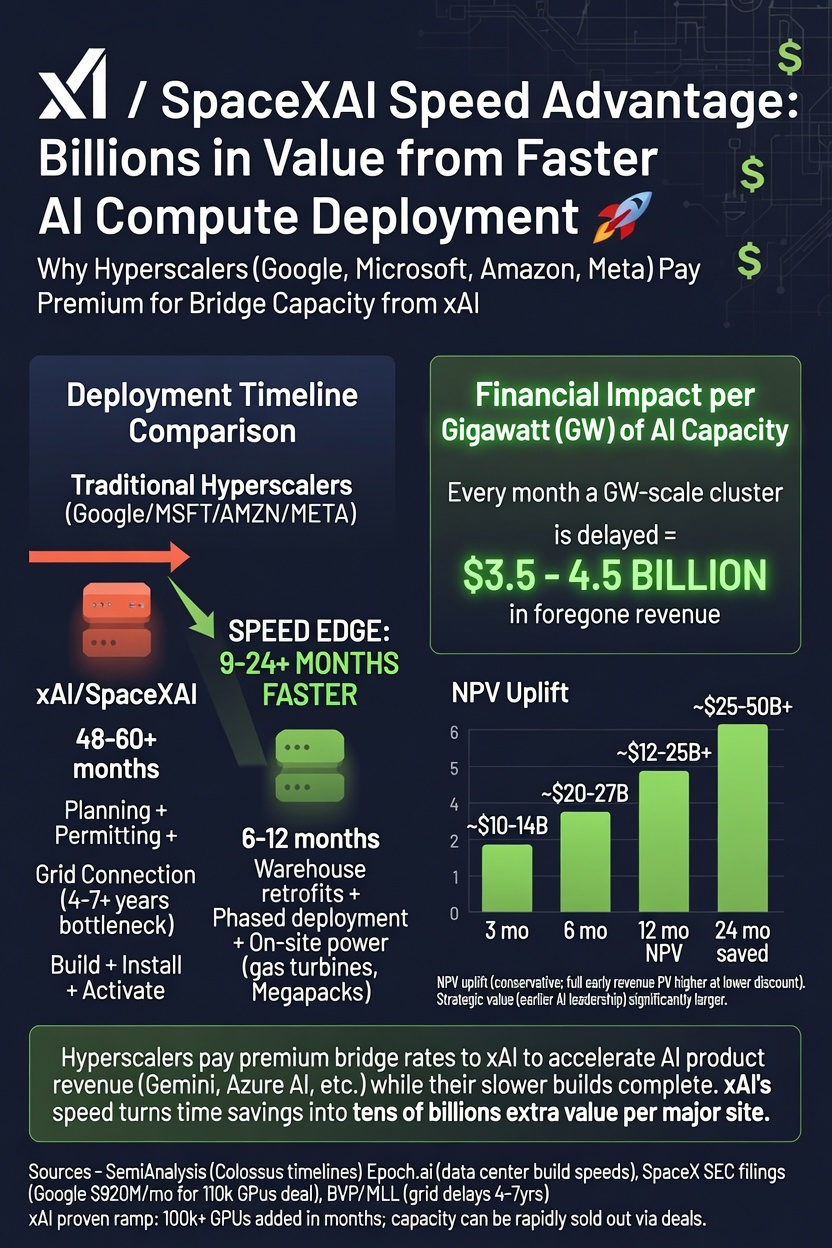
SpaceXAI has real-world proof of 6-12 month deployments for large clusters via warehouse retrofits, phased build-out, and on-site/mobile power. They have gas turbines from partners like Solar Turbines + APR Energy that can install in days to 6-12 weeks. SpaceXAI already has 440k B200-B300 chips at Colossus 2. They need to get more cooling to activate those chips. Current power already installed supports another ~460k B300 chips. Of that new capacity, at 50-60% rented, they can do roughly 2 - 2.5 more Google-sized (110k chip, $11 Billion per year) deals by the end of 2026. By August/September, expect about 1 - 1.3 additional Google sized deals to be live and billable. Colossus 1 had 100k H100 GPUs live in ~122 days (~4 months) from groundbreaking/announcement in a former factory. Doubled to 200k GPUs in ~92 additional days. Colossus 2 (Southaven/Memphis area) had a warehouse acquired March 2025. ~200 MW cooling/IT capacity online by August 2025 (~6 months). Epoch.ai Jul 1, 2026 UPDATE on Colossus 2 and MACROHARDRR The site is estimated to have at least ~830 MW of GPU server power, with at least "at least 220,000 additional GB300 processors and over 400 additional megawatts of compute power", corresponding to the "next phase of expansion" found in the following company S-1 filing, page 76. The timing is based on the air-cooled condensers needing to be complete to handle this power capacity. The second array at MACROHARD and the first array at MACROHARDRR, although both projected to be completed prior, are not enough and more cooling capacity is needed. We estimate this expansion to be completed 90 days after April 6th. On one hand, SpaceXAI has progressively added more capacity in less time with their Colossus projects. On the other hand, 400 MW is more capacity than the previous expansions of 210 MW and 220 MW. We also believe that MACROHARDRR will be partly operational with this expansion, because its air-cooled condensor array is expected to be completed by then and fitting the entire expansion into only MACROHARD would result in extremely high levels of power density. More cooling is being added. SemiAnalysis notes this is dramatically faster than comparable efforts. xAI has publicly stated they achieved in 4 months what others estimated at 24 months. Google, Microsoft, Amazon, Meta, etc.) can make the building (aka shell) for AI construction in about 12-18 months in aggressive cases, but power/grid infrastructure is the dominant bottleneck (4-7+ years for utility interconnection in many markets. median queues >5 years historically). Overall planning-to-fully-live revenue-generating GW-scale clusters often span 3-5+ years, with frequent 1-2+ year delays. The huge money is being spent but how fast does the money go out before the AI chips and memory turn on? The gap is the time from cash being spent before the incremental revenue comes back.
Not OpenAI or Anthropic: DeepSeek founder Liang Wenfeng is world's richest creator of AI models
DeepSeek founder Liang Wenfeng's net worth more than doubled to US$36 billion after his firm's most recent fundraising round. Hong Kong - DeepSeek founder Liang Wenfeng's net worth more than doubled after his firm's most recent fundraising round, making the Chinese entrepreneur the world's richest among creators of AI models. Liang is now worth US$36 billion (S$46.5 billion), up from about US$16.7 billion previously, according to the Bloomberg Billionaires Index. That ranks him well above OpenAI president Greg Brockman (No 100), with an estimated net worth of US$25.5 billion, and Anthropic co-founder Dario Amodei's (No 491) whose fortune stands at US$7.98 billion. Ironically, OpenAI co-founder and CEO Samuel Altman, with $3.4 billion, did not even make Bloomberg's list of the Top 500 richest people. In the ranking, Bloomberg looked at firms whose primary business and majority of revenue come directly from AI models, instead of other businesses in the AI supply chain - notably, data centres and semiconductors. As such it rules out Big Tech founders like Tesla and SpaceX's Elon Musk, Google's Larry Page, Amazon's Jeff Bezos, Meta's Mark Zuckerberg and Nvidia's Jensen Huang. For Liang, most of his fortune is derived from his stake in DeepSeek. What sets him apart from his Silicon Valley peers is the sheer scale of his equity retention. In the United States, building a US$50 billion frontier AI company typically requires giving up massive chunks of equity to tech giants and VCs. By contrast, maintaining a near-78 per cent stake in DeepSeek gives Liang a boost to his personal wealth and control that is unusual among modern AI founders. While US giants like OpenAI and Anthropic command massive valuations approaching US$1 trillion, their equity is more fragmented across larger investor bases or multiple co-founders. Strong demand for investment boosted DeepSeek's valuation about fivefold from the initial US$10 billion reported in April. Following the start-up's US$7.4 billion funding round in June 2026 - which valued the company at US$50 billion and saw Liang personally invest US$3 billion - his stake is estimated to have diluted to approximately 78 per cent, according to the Bloomberg Billionaires Index. Liang was born in 1985 in Zhanjiang, in China's southern Guangdong province, where his father was an elementary school teacher. He studied electronic engineering at Zhejiang University, a prestigious college in the city of Hangzhou where he also earned a master's degree in information and communication engineering. Liang created DeepSeek in 2023 as an offshoot of the AI division of his hedge fund, Zhejiang High-Flyer Asset Management, which he set up with two former university classmates. The trio had begun trading as students during the global financial crisis. Early on, High-Flyer used its massive trading profits to stockpile advanced graphics chips before US export restrictions tightened. Those early investments gave DeepSeek the computing power necessary to develop its breakthrough models without relying on traditional venture capital. DeepSeek shocked the global tech industry in early 2025 by releasing a model that achieved performance comparable to US rivals like OpenAI, but at a fraction of the cost. The start-up is keeping up that momentum, recently showcasing its latest V4 model and publicly touting its compatibility with chips made by domestic tech giant Huawei Technologies. For years, consumer internet tycoons like Alibaba's Jack Ma defined tech wealth in China. That era is now giving way to state-backed artificial intelligence. The influx of state and corporate capital marks DeepSeek's transition from a private software experiment into a critical national asset. Liang's US$36 billion fortune makes him China's eighth-richest person, just behind Chen Tianshi, the hardware AI billionaire and Cambricon Technologies co-founder. BLOOMBERG
Release The Kraken Genome!
Sailors have told tales of giant tentacled sea monsters for millennia. In ancient times, it was the Kraken. In more recent work, Jules Verne delighted and terrified the public while reading 20,000 Leagues Under The Sea.The monstrous Architeuthis dux, the giant squid, must have been terrifying to ancient mariners. They were the size of modern school buses, never a good thing when you are in a wooden trireme, with eyes as big as dinner plates and tentacles that can snatch prey 10 yards away.During an evolutionary scale when most creatures got smaller, how did this squid get so big?Publication of its full genome sequence may give us clues. Sailors have told tales of giant tentacled sea monsters for millennia. In ancient times, it was the Kraken. In more recent work, Jules Verne delighted and terrified the public while reading 20,000 Leagues Under The Sea. The monstrous Architeuthis dux, the giant squid, must have been terrifying to ancient mariners. They were the size of modern school buses, never a good thing when you are in a wooden trireme, with eyes as big as dinner plates and tentacles that can snatch prey 10 yards away. During an evolutionary scale when most creatures got smaller, how did this squid get so big? Publication of its full genome sequence may give us clues. Release the Kraken genome! Illustration from Jules Verne's 20,000 Leagues Under the Sea. Credit: Alphonse de Neuville A rare sighting now as then Giant squid are rarely sighted and have never been caught and kept alive, meaning their biology (even how they reproduce) is still largely a mystery. The genome sequence can help. "In terms of their genes, we found the giant squid look a lot like other animals. This means we can study these truly bizarre animals to learn more about ourselves," says Dr. Caroline Albertin of the Marine Biological Laboratory (MBL), Woods Hole, who in 2015 led the team that sequenced the first genome of a cephalopod (the group that includes squid, octopus, cuttlefish, and nautilus). The giant squid genome is also big. At around 2.7 billion DNA base pairs, it's about 90 percent the size of the human genome. Important developmental genes in almost all animals (Hox and Wnt) were present in single copies only in the giant squid genome. That means this gigantic, invertebrate creature - long a source of sea-monster lore - did not get so big through whole-genome duplication, a strategy that evolution took long ago to increase the size of vertebrates. Analysis identified more than 100 genes in the protocadherin family -- typically not found in abundance in invertebrates -- in the giant squid genome. Protocadherins are thought to be important in wiring up a complicated brain correctly and were thought to be a vertebrate innovation. Albertin says they were really intrigued to find more than 100 of them in the octopus genome (in 2015). That seemed like a smoking gun to how you make a complicated brain. They found a similar expansion of protocadherins in the giant squid, as well. The team also analyzed a gene family that (so far) is unique to cephalopods, called reflectins. "Reflectins encode a protein that is involved in making iridescence. Color is an important part of camouflage, so we are trying to understand what this gene family is doing and how it works," Albertin says. So how did it get so big? "A genome is a first step for answering a lot of questions about the biology of these very weird animals," Albertin said, such as how they acquired the largest brain among the invertebrates, their sophisticated behaviors and agility, and their incredible skill at instantaneous camouflage. "While cephalopods have many complex and elaborate features, they are thought to have evolved independently of the vertebrates. By comparing their genomes we can ask, 'Are cephalopods and vertebrates built the same way or are they built differently?'"

SpaceX Fizzles to Close $1 Above IPO Price Weeks After Debut
(Bloomberg) -- Three days of losses have brought SpaceX shares to the brink of falling below their initial public offering price, a key level that traders and investors watch to assess the health of new issues. Most Read from Bloomberg Shares fell 2.2% Tuesday to close at $136.08 each, just $1 above the $135 price tag buyers paid last month in the biggest first-time share sale ever. Elon Musk's rocket, satellite and artificial intelligence company has plunged one-third from its post-listing peak, erasing nearly $850 billion in value. A company's shares falling below the IPO price within days or weeks of its first trading day punctures the narrative that's been carefully choreographed by the company and its bankers to hype up expectations. Putting shareholders in the red at such an early stage is a blow to confidence that some newly-listed firms don't recover from. Skeptics note that the stock trades at a forward estimated price-to-sales ratio of more than 30 times, among the highest in the Nasdaq-100 Index and modestly lagging that of Palantir Technologies Inc. SpaceX is also facing an extended lock-up that will see insiders periodically releasing shares into the market over the coming months. "We still don't think SpaceX has found its low," according to Ken Mahoney, chief executive officer of Mahoney Asset Management. "There will be continuous supply coming on in the coming months, and you would have to monitor how much demand would be there as you move down the quality spectrum." Index Addition SpaceX's slip near the IPO price comes just a week after the company was added to the Nasdaq 100 through fast-entry rules, and after analysts gave the company -- whose unconventional pitch included a base on the moon and eventually a colony on Mars -- a resoundingly bullish reception. More than a dozen bankers including Morgan Stanley, JPMorgan Chase & Co. and Goldman Sachs Group Inc. started coverage with buy-equivalent ratings, according to data compiled by Bloomberg. Over 80% of Wall Street analysts covering SpaceX say to buy shares and see major upside ahead. The average price target of $236.25 is more than 70% above Tuesday's close. It's normal for newly-public stocks to experience volatility. A Truist Wealth analysis of 30 major technology IPOs over the past 15 years found that they averaged a maximum decline of 55% in the first year of trading.

SpaceX Fizzles to Close $1 Above IPO Price Weeks After Debut
(Bloomberg) -- Three days of losses have brought SpaceX shares to the brink of falling below their initial public offering price, a key level that traders and investors watch to assess the health of new issues. Most Read from Bloomberg Shares fell 2.2% Tuesday to close at $136.08 each, just $1 above the $135 price tag buyers paid last month in the biggest first-time share sale ever. Elon Musk's rocket, satellite and artificial intelligence company has plunged one-third from its post-listing peak, erasing nearly $850 billion in value. A company's shares falling below the IPO price within days or weeks of its first trading day punctures the narrative that's been carefully choreographed by the company and its bankers to hype up expectations. Putting shareholders in the red at such an early stage is a blow to confidence that some newly-listed firms don't recover from. Skeptics note that the stock trades at a forward estimated price-to-sales ratio of more than 30 times, among the highest in the Nasdaq-100 Index and modestly lagging that of Palantir Technologies Inc. SpaceX is also facing an extended lock-up that will see insiders periodically releasing shares into the market over the coming months. "We still don't think SpaceX has found its low," according to Ken Mahoney, chief executive officer of Mahoney Asset Management. "There will be continuous supply coming on in the coming months, and you would have to monitor how much demand would be there as you move down the quality spectrum." Index Addition SpaceX's slip near the IPO price comes just a week after the company was added to the Nasdaq 100 through fast-entry rules, and after analysts gave the company -- whose unconventional pitch included a base on the moon and eventually a colony on Mars -- a resoundingly bullish reception. More than a dozen bankers including Morgan Stanley, JPMorgan Chase & Co. and Goldman Sachs Group Inc. started coverage with buy-equivalent ratings, according to data compiled by Bloomberg. Over 80% of Wall Street analysts covering SpaceX say to buy shares and see major upside ahead. The average price target of $236.25 is more than 70% above Tuesday's close. It's normal for newly-public stocks to experience volatility. A Truist Wealth analysis of 30 major technology IPOs over the past 15 years found that they averaged a maximum decline of 55% in the first year of trading.