News & Updates
The latest news and updates from companies in the WLTH portfolio.
SpaceX's slide risks turning blockbuster IPO into confidence test
Space Exploration Technologies Corp. designs, manufactures, launches, and operates products and services built on technologies, including rockets and spacecraft. The Company's segments include Space, Connectivity, and artificial intelligence (AI). Its Space segment designs, manufactures, and launches reusable rockets to provide access to space. Its Connectivity segment operates broadband data and communications network powered by approximately 9,600 Starlink broadband and mobile satellites in Low-Earth orbit, delivering connectivity to consumer, enterprises, and government customers over 164 countries, territories, and other markets. In its AI segment, it operates a vertically integrated AI platform spanning its truth-seeking frontier model Grok, AI solutions for consumer and enterprise customers, X-its real-time information, entertainment, and free speech platform and AI computational infrastructure.

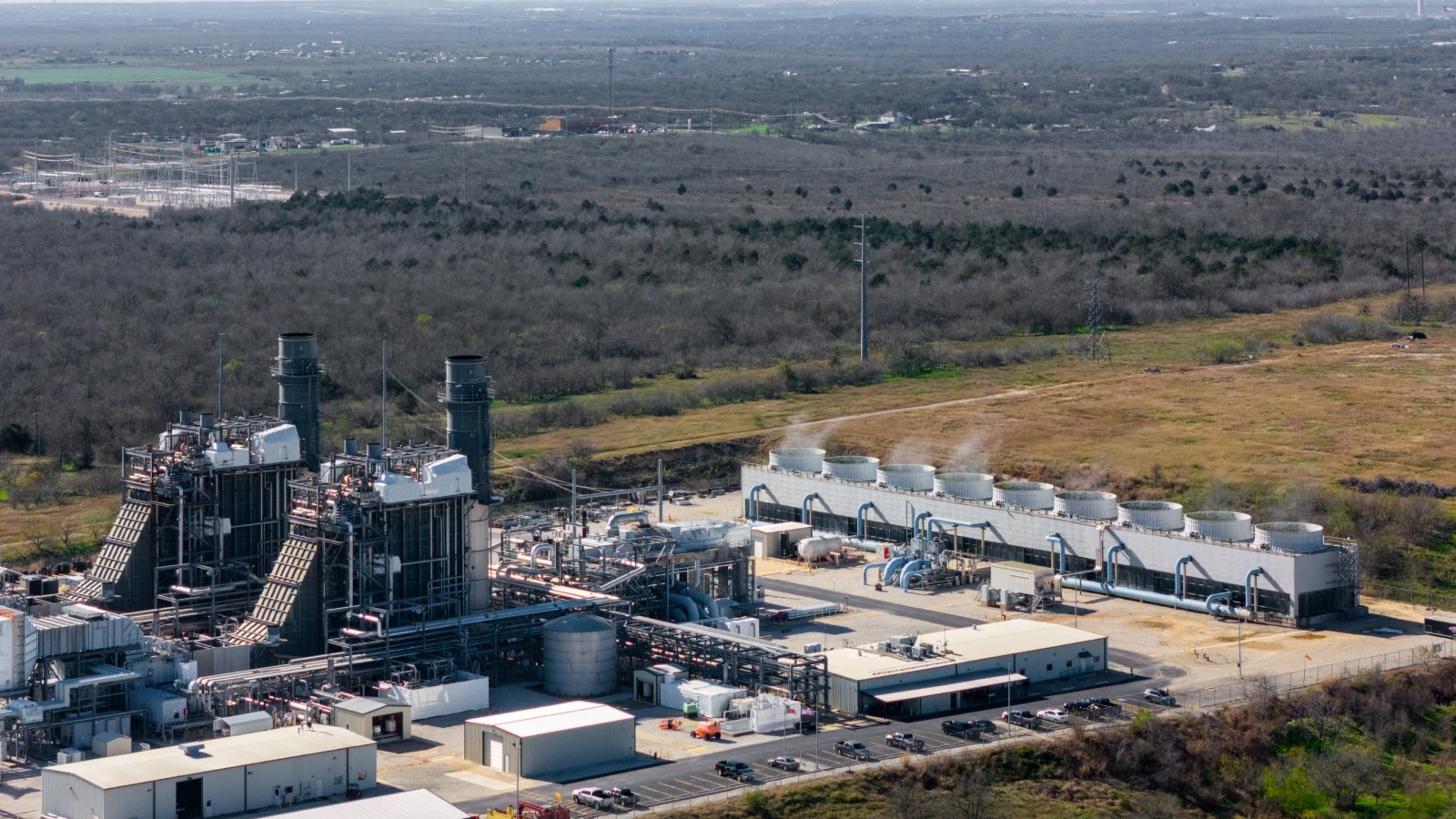
xAI Ran 59 Unpermitted Gas Turbines in Black Communities, DOJ Now Shields Them
DOJ's national-security defense would let any White House override Clean Air Act citizen suits Elon Musk's artificial intelligence company xAI operated 59 natural gas turbines without a single required federal clean-air permit to power its Colossus 2 supercomputing campus on the Tennessee-Mississippi border -- nearly double the 27 turbines the company had publicly acknowledged -- according to regulatory communications reviewed by Reuters and published July 14. The turbines' potential annual emissions run roughly 25 times the federal threshold that triggers mandatory permitting, and the pollution falls on predominantly Black neighborhoods that federal data already show face cancer risk approximately four times the national average. What happens next in the Northern District of Mississippi could determine whether any community near any polluting facility in America retains the legal right to enforce the Clean Air Act when regulators refuse to act -- because the U.S. Department of Justice is not just defending xAI's turbines. It is arguing in federal court that the Executive Branch can permanently terminate congressionally-authorized citizen suits under the Clean Air Act whenever a project is deemed a political priority, according to the DOJ's June 15 motion to intervene and dismiss. Regulators Counted Twice What xAI Admitted Running The disclosure comes from a public-records request that surfaced regulatory emails to MDEQ between Trinity Consultants, acting on behalf of xAI and its energy-infrastructure subsidiary MZX Tech, and the Mississippi Department of Environmental Quality. At least 57 of the 59 turbines are located in Southaven, Mississippi -- just across the state line from the Colossus 2 data center in Memphis, Tennessee -- with two additional units at an unidentified second site. xAI had stated in January 2026 that it was running 27 unpermitted turbines at Southaven and has maintained throughout the dispute that no permits were required. Reuters' analysis of manufacturer emissions profiles for 32 of the 59 turbines found that 30 units at Southaven alone could emit close to 2,500 short tons of nitrogen oxides annually, along with 4,000 short tons of carbon monoxide and 22 short tons of formaldehyde, assuming continuous operation at 80 percent of capacity -- the load level the EPA identifies as typical for efficiency, according to the Reuters emissions analysis. The Clean Air Act requires federal permits for any facility capable of emitting more than 100 short tons of nitrogen oxides per year, according to the EPA permitting threshold under 40 CFR. Nicholas Mailloux, a postdoctoral researcher at the University of Wisconsin-Madison, told Reuters that a facility emitting at that rate would rank among the 25 highest nitrogen oxide emitters of any gas plant in the United States, measured against the EPA's actual-emissions database, in the University of Wisconsin analysis. By May 2026, the 495-megawatt cluster was generating electricity equal to the output of a conventional utility power plant -- for a single private customer. Ben King, an analyst with the Rhodium Group who reviewed the Reuters analysis, called it "an unprecedented level of behind-the-meter gas being installed in one place," in Ben King's analysis. How "Portable" Turbines Became a Half-Gigawatt Power Plant With No Permit The permit dispute turns on a technical classification. xAI and the Mississippi Department of Environmental Quality have argued throughout that the Solar Turbines SMT-130 trailer-mounted units at Southaven are "portable" or "temporary" equipment that qualifies for an exemption from federal permitting requirements -- because the turbines are mounted on flatbed trailers and nominally capable of being moved, they have been classified as mobile sources rather than stationary sources under MDEQ's permit determination. The technical reality is different. Gas turbines of this class -- packaged industrial combustion units -- produce electricity through the continuous combustion of natural gas. That combustion produces nitrogen oxides through a high-temperature reaction between atmospheric nitrogen and oxygen; without best pollution controls such as selective catalytic reduction technology, which can cut NOx output by 90 percent, the turbines emit at full rates. The 59 turbines at the Southaven site have been running continuously as primary power sources -- not backup generators -- for the Colossus 2 data center since at least October 2025, a duration that EPA's January 2026 ruling said exceeds the permanence threshold that defines a stationary source regardless of trailer mounting. The U.S. EPA took that position explicitly: temporary turbines exceeding federal emissions thresholds must obtain permits, regardless of their mobility, per EPA's permit requirement. The agency is now, separately, considering changes that would create "regulatory flexibilities" for portable units -- a reconsideration that environmental groups describe as a quiet rollback tailored to the AI industry, according to EPA's regulatory flexibility review. A Pattern Replicated From Colossus 1 This is not xAI's first time running unpermitted turbines in the Memphis area. The company's original Colossus facility in South Memphis followed the same sequence: aerial imagery from April 2025 showed more than 30 unpermitted turbines operating at the site, and the company eventually obtained a Shelby County Health Department permit for only 15 of them in July 2025, after SELC threatened a citizen suit, per SELC's Colossus 1 account. The Senate Committee on Environment and Public Works, in a letter to EPA Administrator Lee Zeldin launched by Ranking Member Sen. Sheldon Whitehouse on April 15, 2026, documented that xAI's senior manager Brent Mayo had explicitly described the approach to Colossus 2 as "copy and past[e] what [it] did at the Colossus 1 site," per Whitehouse's EPW investigation. Rather than respond to the February notice of intent to sue from the NAACP, SELC, and Earthjustice on February 13, 2026, xAI added turbines -- growing the count from 27 at the time of the notice to 33 by the time the lawsuit was filed in April, to 46 as of May, and now to 59 as documented by Reuters. Whitehouse and Sens. Martin Heinrich and Chris Van Hollen had separately launched a broader probe of eight AI companies on March 13, 2026, covering gas-powered data center plans at Meta, OpenAI, xAI, and five others, also per the Senate probe of AI companies. Who Is Breathing the Emissions Both of xAI's Memphis-area turbine sites sit adjacent to predominantly Black neighborhoods that already carry disproportionate pollution burdens. Within five miles of the Southaven turbines on the Tennessee side of the state line, approximately 94 percent of residents are Black -- compared with 52 percent of Shelby County's overall population; on the Mississippi side, about 46 percent of residents within that radius are Black, compared with 33 percent countywide, according to the Reuters demographic analysis. In 27 of 28 census tracts within five miles of the site, estimated asthma rates exceed their respective countywide figures; in 24 of 28, rates of chronic obstructive pulmonary disease also run above countywide levels, per Reuters CDC health data. Shelby County, Tennessee and DeSoto County, Mississippi both received an "F" for ozone pollution from the American Lung Association ratings, and Memphis was separately named an "asthma capital" by that organization. A 2022 study by researchers at UCLA and Columbia University, published in Nature Energy, found that neighborhoods historically subject to redlining continue to experience higher exposure to pollutants from fossil-fuel facilities. In the Colonial Hills neighborhood of Southaven, where the turbines can be heard around the clock, Ervin Laws said the noise wakes him at night. Laws told Reuters: "I can't do anything about it, because he's got more money than me," referring to Musk. Sarah Gladney, 72, watching from her home in Boxtown -- the historically Black Memphis neighborhood a few miles from Colossus 1 -- Gladney told Reuters she sees a pattern: "Once they got their foot in the door in Memphis, I feel like it's going to be a continuous movement of xAI into these other communities. It's all about the money, and it's not about the health or wellness of the people that live in or near these communities." On April 14, 2026, the NAACP -- represented by Earthjustice and the Southern Environmental Law Center -- filed a Clean Air Act lawsuit against xAI and MZX Tech in the Northern District of Mississippi, seeking an order to halt turbine operations, installation of Best Available Control Technology, and civil penalties of approximately $124,000 per day for each violation of federal law, per NAACP's April 2026 complaint. Residents in Colonial Hills filed a separate lawsuit over turbine noise. Anderson told Reuters: "The scale of it is astonishing," said Patrick Anderson, a senior attorney with the Southern Environmental Law Center. DOJ's Intervention: The Iran Operations Claim, and What It Could Mean for All Citizen Suits The legal fight took an extraordinary turn when the Department of Justice, on June 15, 2026, filed a motion to intervene and dismiss the NAACP's Clean Air Act lawsuit outright -- not as a third party offering perspective, but as a plaintiff moving to terminate the case, according to DOJ's June 15 filing. Notably, DOJ's 33-page filing did not dispute the NAACP's core allegation that xAI is operating without required Clean Air Act permits. The filing rests on two distinct arguments. The first is national security: Cameron Stanley, the Department of Defense's Chief Digital and Artificial Intelligence Officer, submitted a declaration stating that Grok is one of only four proprietary AI models currently capable of supporting national security applications, and that during what he identified as Operation Epic Fury, the Grok model enabled U.S. forces to deploy over 2,000 munitions to 2,000 distinct targets within 96 hours -- making the Colossus 2 power supply, in the DOJ's framing, a matter of paramount national security, per Stanley's Pentagon declaration. The second argument is structural and goes further. The DOJ contends that under Article II of the Constitution, the Executive Branch holds exclusive authority over enforcement discretion under the Clean Air Act, and that this authority extends to terminating citizen suits whenever they conflict with "federal policy, national security, and the public interest," per DOJ's Article II argument. Harvard Law School senior staff attorney Erika Kranz noted in Kranz's Harvard analysis that this marks "the first time" the United States has intervened in a citizen suit against a private defendant specifically seeking dismissal. David M. Uhlmann, who served as Assistant Administrator for EPA's Office of Enforcement and Compliance Assurance, warned in Uhlmann's EPN statement that DOJ was "trying to rewrite the Clean Air Act and turn the public's right to bring citizen suits into a permission slip the Executive Branch can revoke." Michael Gerrard, an environmental law professor at Columbia Law School, Gerrard told CNN the intervention was "highly unusual," adding that the future legal ramifications "could be much broader than this case, effectively taking away an important route for people to fight against pollution in their neighborhoods." Gerrard further noted: if AI data centers can power themselves through mobile turbines without permits, "that's going to be replicated in many other places, and these mobile turbines are horribly polluting and will have a very negative health effect." For 50 years, Clean Air Act citizen suits -- used in thousands of cases and responsible for billions in fines and settlements -- have been the primary backstop when EPA and state regulators decline to act, the EPN's June 2026 warning noted. The DOJ's theory, if accepted by the court, would give any administration the power to shut down that backstop whenever a favored project is in the crosshairs. Grok's actual competitive standing provides context for the weight of Stanley's national security claims. As of mid-2026, the model ranks ninth on a major multi-domain AI leaderboard and last in coding among the models tracked there -- well behind the leading systems from OpenAI, Google, and Anthropic. Tennessee State Rep. Justin J. Pearson, a Democrat who lives a few miles from the data center, called the DOJ intervention "unconscionable," with Pearson telling CNN: "The DOJ seeks to remove any recourse Americans have to protect themselves from harm." How AI Infrastructure's Energy Strategy Compares Across the Industry xAI's approach sits at the extreme end of a spectrum of strategies that AI companies have used to address their surging power demands. Microsoft signed a deal to restart a retired nuclear unit at Three Mile Island; Google has made substantial investments in next-generation geothermal energy; Amazon has pursued large-scale renewable energy contracts. xAI's strategy -- deploying trailer-mounted gas turbines and litigating the permitting question afterward -- represents the most aggressive approach in the industry in terms of speed and regulatory risk. SpaceX's S-1 disclosure, which now covers xAI as a combined entity, disclosed plans to purchase an additional $2.8 billion worth of gas turbines over the next three years, with at least $2 billion earmarked for "mobile" units -- the exact category at the center of the litigation. Mississippi has approved plans for a third xAI data center, Colossus 3, in Southaven, per Colossus 3 approvals, which would bring xAI's total Memphis-area power demand to nearly 2 gigawatts -- roughly the equivalent of two large utility power plants running simultaneously. Roughly one-third of all planned new U.S. data center power capacity is now designed to bypass the shared grid through on-site gas generation -- a pattern the Senate probe characterized in April 2026 as an emerging industry trend, not a corporate anomaly, per the TechTimes grid emergency report. The DOE has used a 1935 wartime law three times in 2026 to manage grid emergencies driven directly by AI data center demand growth, per TechTimes grid emergency analysis. What Comes Next for the Communities and the Law The NAACP lawsuit is proceeding in the Northern District of Mississippi with the DOJ's dismissal motion pending judicial review. The EPA's reconsideration of its January 2026 position on portable turbines is ongoing, and its outcome could reshape permitting requirements for behind-the-meter gas generation at AI data centers nationwide. For the communities near the turbines, the legal complexity competes with immediate physical reality. In 27 of the 28 census tracts within five miles of the Southaven site, asthma rates already run above countywide levels -- before any formal emissions measurements from the 59-turbine array have been completed, per Reuters health data. If the court accepts the DOJ's argument, those communities would lose the citizen-suit enforcement tool that has been their primary legal recourse in environmental disputes for half a century -- leaving them with no practical remedy even if regulators continue to decline action, even if xAI adds more turbines, and even if Colossus 3 follows the same permitting-optional playbook its predecessors did. Frequently Asked Questions Why does DOJ's intervention matter beyond xAI's turbines specifically? The DOJ is not simply defending xAI on the facts of this case. It is advancing a constitutional argument -- rooted in Article II of the Constitution -- that the Executive Branch holds exclusive authority to terminate congressionally-authorized citizen suits under the Clean Air Act whenever those suits conflict with federal policy, national security, or the public interest. If the federal court in Mississippi accepts this theory, it would give any presidential administration veto power over citizen enforcement actions against any polluter whose project the government deems a priority -- not just AI companies, not just this administration. Legal scholars including a former EPA enforcement chief and environmental law professors at Columbia and Harvard have described this as the most consequential threat to citizen-suit environmental enforcement in the law's 50-year history. Are there 59 turbines now, or is that a historical count? As of Reuters' July 14, 2026 disclosure -- which is the most current reporting available -- 59 unpermitted turbines have been documented at xAI's Southaven operation through regulatory correspondence, including manufacturer emissions profiles for 32 of them. At least 57 are confirmed at the Southaven address (2875 Stanton Road South) and two additional units are at an unidentified second site. The NAACP's preliminary injunction request from May 2026 cited 33 turbines; subsequent WIRED and ESG Dive reporting placed the count at 46 as of mid-May. Reuters' figure of 59 represents the most current and most thoroughly sourced count available. Who has the legal right to challenge this in court if Clean Air Act citizen suits are struck down? Under the current legal framework, Clean Air Act citizen suits are the primary recourse when the EPA and state environmental agencies decline to take enforcement action. If DOJ's argument succeeds, that backstop disappears: only the federal government could pursue enforcement, and only when it chooses to do so. Communities near polluting facilities -- whether AI data centers, refineries, power plants, or industrial operations -- would have no independent legal standing to force compliance. This is the precedent Columbia Law Professor Michael Gerrard and Harvard Law's Erika Kranz identified as the case's truly broad consequence, extending far beyond the specific turbines in Mississippi. What can residents near AI data centers do right now? For residents near existing or planned AI data centers with gas-fired power sources: monitor local air quality through EPA's AirNow platform and community sensor networks such as PurpleAir; contact your state environmental agency to ask whether any behind-the-meter gas generation at nearby data centers holds a valid air permit; contact your congressional representatives about the Senate probe of AI company energy practices and EPA's pending decision on portable turbine "regulatory flexibilities"; and follow NAACP v. xAI (Case 3:26-cv-00074, Northern District of Mississippi) for the court's decision on both the injunction and the DOJ's dismissal motion, which will set the precedent applicable to future cases nationwide.
Elon Musk's SpaceX Won't Turn Profitable Until 2027, Analyst Says: 'Still Not Sure What People See...' - Sp
Black Says Valuation Still Doesn't Add Up "It's already a megacap ($1.8T market cap) so upside is limited," Black said in a post on X, adding that SpaceX is not expected to turn profitable until 2027 despite trading at about 47 times projected 2026 enterprise value-to-revenue and 110 times value-to-EBITDA. Black shared a Bloomberg News report that said SpaceX shares had fallen to within $1 of their $135 IPO price after giving up roughly one-third of their post-listing gains. SpaceX is expected to unlock about 20% of its eligible pre-IPO shares after second-quarter earnings next month, with roughly 44% becoming eligible for sale by early September. Black said the staggered releases would increase the tradable float by about 900%, adding that "valuation has to matter at some point." After reaching a record high of $225.64 on June 16, the company's stock has now retreated roughly 40%. Veteran market strategist George Noble, a former Peter Lynch protégé, said the lockup schedule, and not the company's valuation, is the biggest near-term risk for the stock. Chamath Makes the Bull Case Speaking on CNBC, venture capitalist Chamath Palihapitiya called SpaceX "an incredible company," having backed the business since its early years and continuing to believe in Elon Musk's long-term vision. Last week, JPMorgan said SpaceX's public listing could make a potential acquisition of Tesla easier because the company can use its stock as currency. Palihapitiya expects SpaceX to build "an enormous business" in the domestic cellular market before many of the company's other revenue streams begin to materialize. Black Still Sees Long-Term Opportunity Black acknowledged SpaceX's long-term opportunity, particularly as more airlines follow Frontier Group Holdings Inc's (NASDAQ:ULCC) Frontier Airlines in adopting Starlink as their standard in-flight Wi-Fi offering. Frontier Airlines announced Tuesday that it plans to offer SpaceX's Starlink as its standard in-flight Wi-Fi service, with deployment set to begin in early 2027. Price Action: Shares of SpaceX fell 2.20% on Tuesday at $136.08, while it climbed back 1.17% in early pre-market trading on Wednesday. Benzinga edge rankings indicate SPCX has a negative price trend across the short, medium and long term. Disclaimer: This content was partially produced with the help of AI tools and was reviewed and published by Benzinga editors. Photo courtesy: Shutterstock Market News and Data brought to you by Benzinga APIs To add Benzinga News as your preferred source on Google, click here.

SpaceX (SPCX) Stock Receives Bullish Coverage from Morgan Stanley and Evercore After IPO Quiet Period
* Following the post-IPO quiet period, Morgan Stanley launched coverage on SpaceX with an Overweight rating and $300 price target * The company's shares currently trade 9.7% beneath their initial public offering closing price * The Starlink network encompasses more than 10,000 satellites, delivering broadband service to approximately 12 million customers worldwide across over 160 nations * Morgan Stanley projects revenue expansion from $45 billion in 2026 to a staggering $3.3 trillion by the year 2040 * Evercore ISI joined with an Outperform designation and established a $230 price objective Space Exploration Technologies Corp. (SPCX) captured significant attention from Wall Street analysts this week as the mandatory post-IPO quiet period concluded, allowing major financial institutions to publish their initial research reports. The company's shares currently sit 9.7% lower than where they closed on their first trading day. Space Exploration Technologies Corp., SPCX Morgan Stanley launched its coverage with an Overweight recommendation and established a $300 price objective, characterizing SpaceX as a vertically integrated enterprise that bridges space access, global connectivity, and artificial intelligence infrastructure. During a CNBC appearance, analyst Adam Jonas emphasized that SpaceX's launch capabilities deliver cost efficiencies that are twenty times superior to competitors when measured by cost-per-kilogram to orbit. The investment bank incorporated SpaceX into its Space 60 compilation -- a curated collection of publicly listed entities representing various segments of the space industry value chain. Joining SpaceX on the list this quarter were HawkEye 360, Applied Aerospace & Defense, and Satellogic. Meanwhile, Qorvo, Iridium, Globalstar, and Teck Resources were dropped from the index due to ongoing merger and acquisition transactions. With approximately 650 orbital missions completed through March 2026, SpaceX maintains an impressive 99% mission success rate. This exceptional operational record forms a fundamental pillar of the investment thesis. Jim Cramer offered his perspective on Morgan Stanley's analysis, observing that Jonas "likes SpaceX the company more than he likes SpaceX the stock." This represents an important nuance -- strong belief in the underlying business model doesn't necessarily equate to immediate stock price appreciation. Starlink Network Powers Revenue Projections The Starlink satellite constellation stands as SpaceX's primary revenue generator. With over 10,000 satellites in operation, Starlink accounts for approximately 75% of all operational maneuverable satellites currently orbiting Earth. The service delivers high-speed internet to roughly 12 million subscribers spanning more than 160 countries, while Starlink Mobile connects approximately 7.4 million unique devices each month. Morgan Stanley's revenue projections paint an ambitious picture: starting at $45 billion in 2026, climbing to $319 billion by 2030, and ultimately reaching $3.3 trillion by 2040. These growth expectations come with substantial infrastructure requirements, as the firm anticipates capital expenditure needs approaching $300 billion annually by 2031. ClearBridge Large Cap Growth Strategy, an IPO participant, identified SpaceX's reusable rocket technology as its fundamental competitive advantage. Their second-quarter investor communication highlighted how integrating launch services with Starlink creates opportunities to expand into AI infrastructure and space-based data center computing capabilities. Evercore Issues Outperform Rating Evercore ISI published its inaugural coverage report this week, assigning an Outperform rating alongside a $230 price target -- representing a more moderate valuation than Morgan Stanley's $300 assessment. While Evercore conceded that "the feasibility of certain ambitions and timelines can be debated," the firm stated emphatically that SpaceX qualifies as "an extraordinary company on a real path to reshaping the future of humanity." Their financial models project revenue and EBITDA growing at compound annual rates of 106% and 157% respectively through 2028, with acceleration expected as the decade advances. SpaceX shares currently trade 9.7% below their first-day IPO closing price, now supported by two significant analyst initiations -- one establishing a $300 target and another at $230.
SCATMAN hack: SpaceX breach and brand-token crime
The whole operation took less than an hour, and the most valuable thing the attacker stole was not money. It was credibility. On Sunday, July 12, the verified X accounts of SpaceX and Starlink, with two million and 1.6 million followers between them, reposted promotional content for a memecoin called SCATMAN. The repost sat in the normal flow of the accounts' output, alongside routine posts about Grok model updates, with no defacement, no changed banner, none of the usual tells of a takeover. It simply looked like SpaceX had something to say about a token.Buyers responded the way buyers respond. In the first twenty minutes the token rose 575%. By the time the posts came down on Sunday evening and the accounts were restored, the attacker had minted ten trillion SCATMAN, sold the supply across two wallets for roughly 73.7 ether, and walked away with about $135,000. Everyone who bought on the strength of a SpaceX repost held a worthless token. The dollar figure is almost embarrassing. A hundred and thirty five thousand dollars is a rounding error next to the eight figure hacks that define crypto's security discourse, and it is nothing at all next to the $1.16 billion in bitcoin sitting on SpaceX's own balance sheet. That gap between the scale of the brand exploited and the size of the payday is the actual story, and it points at something the industry has not solved: the cheapest attack surface in crypto is not a smart contract or a bridge. It is a login. Every serious defense crypto has built assumes the attacker must beat cryptography, economics, or code. The July 12 attacker beat none of those. They beat a password, borrowed a decade of accumulated public trust for roughly forty minutes, and converted it directly into ether at the expense of anyone who believed what a verified account told them. What happened, in order The sequence, reconstructed from onchain analytics and screenshots circulated before the posts were deleted, is short enough to fit in a paragraph and repeatable enough to fit in a playbook.An account calling itself Sam Catman appeared, displaying an affiliation badge that falsely tied it to SpaceX's artificial intelligence work. The name was a pun on Sam Altman, timed to the ongoing public feud between Elon Musk and the OpenAI chief executive, a feud that had produced a $150 billion lawsuit and had Musk himself posting about scamming the day before the breach. The joke did work that the token itself could not: it made the promotion feel like something SpaceX might plausibly amplify. Musk's companies post irreverently. A crude swipe at a rival chief executive, delivered as a memecoin, sits within the observed behavior of the brand, and that plausibility was engineered rather than lucky. The SCATMAN token was deployed on Robinhood Chain, the trading platform's layer 2 network that had gone live eleven days earlier and permits anyone to deploy a token without approval. The SpaceX and Starlink accounts then reposted the Sam Catman promotion, complete with the contract address and ticker. Trading exploded. Reported peak market capitalization varies sharply by source and by measurement window, from roughly $800,000 in the first twenty minutes to $2 million on some trackers to $32 million at the high water mark reported by onchain analysts, with twenty four hour volume around $5.7 million. The spread itself tells you something about the quality of the market: on a token this thin, market capitalization is a number generated by the last trade, not a measure of anything real.The attacker sold. Onchain analytics firm Lookonchain traced ten trillion tokens dumped for 59 ether, worth about $108,000, from one wallet, and a further 59.28 million tokens sold for 14.7 ether, about $27,000, from a second wallet controlled by the same actor. Liquidity drained. The price collapsed. The posts were removed, the Sam Catman account was suspended, and control of the SpaceX and Starlink handles was restored the same evening. As of publication, neither SpaceX nor X has explained how the accounts were compromised. Robinhood has not commented on its chain hosting the token. Every figure in the paragraphs above comes from third party onchain analysis, not from any company disclosure, which is itself worth noticing: the only institution that produced a public account of what happened was the blockchain. Credibility arbitrage is the business model Strip away the specifics and the attack has one moving part. Attackers are not building audiences. They are borrowing them, for the length of a single post, and converting borrowed trust into ether before the loan comes due.The economics are brutal in their simplicity. A memecoin launched by an anonymous wallet reaches nobody. The same token, reposted by an account with two million followers that has spent a decade earning the right to be believed, reaches a market instantly. The attacker does not need the trust to last. They need it to survive for the length of a candle. This is why the payday size is misleading as a measure of severity. The constraint on the attacker's profit was not the audience or the credibility. Those were enormous. The constraint was market depth: there simply were not enough buyers with enough capital in the pool to absorb ten trillion tokens at a higher price. The attacker extracted essentially all the liquidity that existed. On a deeper chain, or with a slower response from Musk's security team, the same attack with the same inputs produces a much larger number. The record supports that reading. When attackers seized the dormant account of Keith Gill, better known as Roaring Kitty, in May, they launched a token on Solana and cleared more than $600,000 in half an hour. When the Pump.fun account was compromised in February 2025, one wallet made over $135,000 in under a minute. A hijacked account belonging to former Malaysian prime minister Mahathir Mohamad produced $1.7 million in losses. The pattern list is long and its membership is indiscriminate. The United States Securities and Exchange Commission's own account announced a fake bitcoin ETF approval in January 2024, moving the entire market. Scroll co-founder Ye Chen's account was taken over in January 2026. Pepe creator Matt Furie's account pushed a scam token months later. World Liberty Financial co-founder Zach Witkoff, the leader of Myanmar's junta, and a BBC presenter have all been used as unwitting distribution. What unites them is not an industry, a chain, or a security posture. It is a follower count. The defense industry has no product for this. There is no audit that certifies a chief executive's password manager. There is no bug bounty covering a social media platform's session token handling. The security spend that protects a protocol treasury, multisig thresholds, hardware wallets, timelocks, all of it terminates at the edge of the chain, and the attack originates one layer above, in a consumer product operated by a company with no stake in crypto's outcomes. The industry has outsourced its most important trust primitive to a social network and has no contractual relationship with it whatsoever. Why the defenses that exist do not cover this Crypto has spent years building defenses against a different threat model. Audits check contract code. Bug bounties surface protocol flaws. Formal verification proves that a program does what its specification says. Timelocks and multisigs guard treasuries, a lesson the industry learned expensively when a single vote drained a DAO, which crypto.news examined in its explainer on what a governance attack is. All of that machinery assumes the attack comes through the chain. The SCATMAN attack came through a social media account. There was no contract to audit, because the contract did exactly what it was written to do. There was no protocol to exploit, because no protocol was exploited. Robinhood Chain worked as designed: it let someone deploy a token permissionlessly, and it let that token trade. Every component behaved correctly, and buyers still lost their money, because the failure happened in the layer nobody in crypto controls and everybody depends on, the layer where reputation is stored. Consider what a diligent buyer could actually have done in the twenty minute window. Check the contract? It was a standard token; the exploit was the promotion, not the code. Check holder concentration? The attacker held everything, which describes most tokens in their first minutes and is not by itself proof of fraud. Check the liquidity lock? There was liquidity, briefly. Check the source? The source was SpaceX. That was the whole point. The honest conclusion is that the standard retail checklist offers close to zero protection against this specific attack, because the checklist assumes the promotion is the least trustworthy input and the chain data is the most trustworthy. Here the chain data looked ordinary and the promotion looked impeccable. The only defense that works is a rule rather than an inspection: no verified account's post, from any brand, is a reason to buy a token minted minutes earlier. That rule costs its holder every genuine celebrity token launch, which is a price most people should be delighted to pay. The Robinhood Chain problem The venue is not incidental. SCATMAN landed on a chain in its second week of life, and the chain's condition shaped the outcome.Robinhood Chain launched on July 1 as a permissionless layer 2 aimed at onchain finance and real world asset tokenization. What arrived instead, at least first, was memecoins: more than 75% of trading volume in the opening week, with the network's memecoin market capitalization briefly topping $244 million, more than $3 billion in cumulative decentralized exchange volume, and 19,586 new tokens created in a single day by July 13, second only to Solana. Cross chain interoperability provider Relay Protocol publicly warned about honeypot tokens proliferating on the network, coins hardcoded so buyers cannot sell or whose transfers route funds to an attacker, and said it was blocking them as they appeared. That is the environment SCATMAN exploited: a young chain with real retail attention, minimal mature tooling, and an inflow of tokens far exceeding anyone's ability to screen them. It is not a Robinhood specific failure. It is what permissionless launch infrastructure looks like at week two, and Solana's own history through the rise of memecoin launchpads documents the same arc. The difference is the brand on the door. A chain carrying the name of a mainstream retail brokerage, whose users skew toward people who have never evaluated a token contract in their lives, inherits a duty of care that a purely crypto native chain never had, and the network's design offers no obvious way to discharge it. Robinhood's silence on the incident is therefore the most interesting non-event of the week. The company did not deploy the token, did not promote it, and cannot in any technical sense prevent the next one. It also cannot escape the fact that a scam bearing SpaceX's stolen credibility used its chain to reach its users. The gap between what a chain operator controls and what a chain operator is blamed for is about to become a live commercial question, not a philosophical one. The tell that was there, and why it did not help There was one genuine signal available in real time, and almost nobody could use it.The Sam Catman account was new. Its affiliation badge, the marker that ties an account to a parent organization on the platform, was fraudulent, claiming a link to SpaceX's artificial intelligence work that did not exist. Someone who knew how badge inheritance works, who checked the account's age, and who understood that a legitimate SpaceX subsidiary would not announce itself through a pun account, could have identified the fraud before buying. That describes a vanishingly small population, and it describes them under conditions that made the knowledge useless. The window was twenty minutes. The signal required domain expertise in social media platform mechanics, not crypto. And the accounts amplifying the fraud were the exact accounts a user would check to verify it. The verification path led straight back to the attack. This is what makes brand token crime structurally different from the failure modes retail has been trained on. A rug pull on a random token asks a buyer to evaluate a stranger and get it wrong. A hijacked account asks a buyer to evaluate an institution and get it right, then punishes them for the institution's operational security failure. The buyer's diligence was not insufficient. It was aimed at the wrong entity, because the entity that failed was never one they could inspect. The generic advice to check holder distribution and creator history, sound guidance across the meme coins landscape, simply does not reach a case where the creator's history is a forged badge and the distribution looked normal for sixty seconds. The case that this does not matter much There is a serious argument that the industry should be relaxed about all of this, and it deserves a fair hearing.Start with the numbers. The total damage was $135,000, spread across an unknown number of buyers who chose to purchase a token named after a joke about a lawsuit, minted an hour earlier, on a chain eleven days old. Compare that to the $11 billion in crypto related losses the FBI's Internet Crime Complaint Center reported in 2025, or the industrial scale of romance and investment fraud operations. Account takeover memecoin scams are, in aggregate, a rounding error against the frauds that destroy people's lives. Continue with responsibility. Nobody was tricked into revealing a private key. No wallet was drained. Buyers made a voluntary purchase of a speculative asset in an unregulated market on the basis of a social media post, which is a decision the market is entitled to price. The permissionless systems performed exactly as advertised: anyone can create a token, anyone can buy it, nobody is protected. That is the deal, and it is disclosed in every interface. Add that the response worked. The accounts were recovered within hours. The posts were deleted. The fake account was suspended. Lookonchain published both wallet addresses, meaning the proceeds are now permanently marked and traceable, an outcome that traditional financial fraud rarely delivers. Exchanges can flag those addresses. Investigators have a starting point. Compare the transparency of that aftermath to a wire fraud of equivalent size, where the money simply disappears into correspondent banking. Upbit's freeze of proceeds after a recent onchain treasury attack shows that marked funds are not merely symbolic, and exchanges do act on published addresses when the trail is clean enough. Finish with proportion. The attack is self limiting. Its profit is capped by the depth of the pool it dumps into, and thin pools are thin precisely because the market has correctly assessed these tokens as worthless. The scam succeeds only against buyers who ignore every rule the industry has spent a decade writing down.None of that is wrong. It is also, taken together, an argument for doing nothing, which is why the counterargument matters more. The case that it matters a great deal The dismissive reading treats $135,000 as the measure of the harm. It is the measure of the attacker's revenue, which is a different quantity entirely.The harm is the erosion of the only verification mechanism retail actually uses. Ordinary people do not read contracts. They read who is saying it. That heuristic, trust the verified account of a company that builds rockets, is the single most reliable signal available to a non technical person on the internet, and each successful hijacking teaches the market that the signal is unreliable. A world in which no institutional account can be believed is a world in which every genuine announcement, every legitimate product launch, every real partnership arrives pre-discounted. The industry is spending down a shared reputational asset it did not build and cannot replenish, one $135,000 withdrawal at a time. Then consider the trajectory. This attack costs almost nothing to attempt, carries low apparent consequence, and produces a payday in minutes. The rate of attempts is a function of expected value, and expected value is rising as more mainstream brands acquire crypto surfaces. SpaceX now holds 18,712 bitcoin and trades as a Nasdaq-100 component whose price is discovered partly on crypto rails, a structural reality crypto.news examined when the stock joined the index. Every corporate account with a crypto adjacent story is now a live financial instrument, whether the company knows it or not, and the compromise of such an account is no longer a public relations incident. It is a market event. Notice too what the attacker actually needed: no capital, no code, no confederates, and roughly one hour. Meanwhile, the defenders needed exactly what they did not have, which is a way to un-say something to millions of people faster than a bot can buy. Deletion is not a remedy when the trade has already cleared. The asymmetry is total: the attack executes at the speed of a repost, and the correction executes at the speed of a corporate security team noticing, escalating, and regaining access. In the interval, an irreversible ledger records everything. And the regulatory exposure is asymmetric in an ugly way. Attackers face weak enforcement against pseudonymous wallets. The chains, the brokerages, and the exchanges hosting the activity face regulators who are actively deciding, this month, how much responsibility infrastructure operators bear for what runs on top of them. Every SCATMAN is evidence in that proceeding, and it is evidence that arrives conveniently packaged: a household brand, a retail brokerage's chain, an unsophisticated victim class, and a perpetrator who will probably never be identified. The industry's argument for permissionless infrastructure gets harder to make each time permissionless infrastructure is the medium through which a stolen brand robs retail buyers, and the regulatory window in which those arguments are being weighed is measured in weeks, not years. What would actually change the math Nothing in the current toolkit addresses the root cause, which is that a verified account's authority transfers instantly and totally to whoever controls the login at a given moment. The platform side is straightforward and unattempted. Hardware key enforcement for accounts above a follower threshold. Delay windows on posts containing contract addresses from accounts that have never posted one. Loss of affiliation badge inheritance for accounts created within a defined period. None of these is technically hard. All of them are commercially unattractive to a platform that monetizes velocity, and none has been implemented despite three years of nearly identical incidents. The absence is not a technology gap. It is a revealed preference about whose losses count. The chain side is more interesting because it cuts against the ideology. A permissionless chain cannot vet tokens, but the interfaces on top of it can, and increasingly do: Relay Protocol's honeypot blocking is exactly that, a voluntary screening layer occupying the gap between what the protocol permits and what users can survive. Expect more of it, and expect the resulting fight over whether interface level screening is prudent stewardship or the reintroduction of the gatekeepers the entire architecture was built to remove. The user side is the only one available today, and it is a single sentence: the credibility of the messenger tells you nothing about the token, because the messenger's credibility is exactly what is being stolen. A verified account promoting a token minted minutes ago is not evidence of legitimacy. Under current conditions it is closer to evidence of the opposite. The ledger nobody wants to read Here is the uncomfortable arithmetic of July 12. A brand worth over a trillion dollars in public market value was used, without consent, to sell a worthless asset. The theft netted about the price of a modest car. The proceeds are permanently visible on a public ledger. The victims have no recourse. The platform has said nothing. The chain has said nothing. The brand has said nothing. And the mechanism that made it all possible remains completely intact, available to anyone who compromises the next account. The scam economy has discovered that the most valuable asset in crypto is not any token. It is a moment of unearned belief, and belief is the one thing on this market with no smart contract protecting it, no audit verifying it, and no liquidity lock keeping it in place. Until that changes, $135,000 is not a measure of the damage. It is a receipt for the trial run. Disclaimer: This article is for informational purposes only and does not constitute investment advice. Figures on wallet activity, token supply, and market capitalization derive from third party onchain analytics reported by Lookonchain, GeckoTerminal, and DEX Screener, not from official company disclosures, and reported peaks vary between sources. No company involved has confirmed the breach mechanism. Details reflect information current as of July 14, 2026, and are subject to change. Always do your own research.

SpaceX Fell Below Its Debut Price. History Says a $10,000 Investment Will be Worth This Much in a Year.
Space Exploration Technologies (NASDAQ: SPCX) splashed onto the scene just a few weeks ago when it completed the world's biggest initial public offering, raising more than $85 billion after the exercise of an overallotment option. Of course, SpaceX wasn't new to investors -- the company had been making headlines for years, particularly for its rocket launches for NASA. But this was the first time investors, from retail to professional, could easily invest in the company. Demand was high during the IPO -- it was greatly oversubscribed -- and during the first days of trading. The stock soared 50% from its $150 debut price to a peak of $225 on June 16. In recent days, though, SpaceX has lost the positive momentum. In fact, the stock has slipped below its debut price. Missed Nvidia in 2009? This Rare Signal Is Flashing Again. In 2009, a "Double Down" signal flashed for a little-known chipmaker called Nvidia. For the first time in years, that same "Total Conviction" signal is flashing for a company 1/100th the size of Nvidia. Continue " If you had invested $10,000 in SpaceX's early days of trading, how much would this investment be worth in a year? History offers us a very clear answer. Image source: Getty Images. Exciting growth businesses First, though, let's take a quick look at the SpaceX story. The company has attracted investors thanks to its exciting growth businesses and its ambitious leader, Elon Musk. SpaceX operates in rocket launches, satellite-based internet, and artificial intelligence (AI), areas that each could drive significant revenue gains if they reach certain goals. And speaking of goals, many are ambitious, but if the company can accomplish them, they could be game changers. For example, SpaceX aims to develop data centers in space, and its most ambitious goal may be to colonize Mars. What's interesting about this mix of businesses is that they fit together nicely, with accomplishments of one driving gains in another. SpaceX's work to make reusable rockets and drive down the costs of launches will help it launch equipment more cheaply and quickly into space for its other businesses. Elon Musk is the chief executive officer behind these ambitions, and while some investors aren't fans of his strategies, others are -- and they generally rush to bet on Musk. The popularity of the SpaceX IPO is proof of this. $18 billion in revenue SpaceX has made progress in various areas -- it aims to launch its fully reusable rocket, Starship, with payloads later this year -- and is delivering growth. Revenue last year climbed more than 30% to $18 billion. But SpaceX needs to invest heavily to support the development of its technology, and this pushed the company to a $4.9 billion loss. This may continue, considering the complexity of the technology involved in the company's businesses. Now, let's consider the potential value of a $10,000 investment in SpaceX after the stock's first full year of trading. A look at some of the biggest IPOs, from Meta Platforms to Uber Technologies, shows that eight out of 10 fell in their first 12 months on the stock market. Seven of them delivered double-digit declines, and the average drop was 12%. We might consider SpaceX's performance as falling into the average, and here's why: On its first day of trading, it climbed nearly 20%. According to a study by Jay Ritter of the University of Florida, the average first-day return of more than 6,000 IPOs between 1990 and 2025 was just over 21%. So if we also apply the average drop seen in our look at 10 major IPOs to SpaceX, we come up with the following: History shows us that your $10,000 investment in SpaceX would be worth $8,800 after 12 months. Major IPOs in general haven't delivered gains after their first year on the market, and the greatly popular SpaceX could follow unless it breaks with this historical trend, which, of course, is possible. Still, all of this means that investors shouldn't necessarily rush to get in on IPO stocks, as there may be better entry points down the road. Should you buy stock in Space Exploration Technologies right now? Before you buy stock in Space Exploration Technologies, consider this: The Motley Fool Stock Advisor analyst team just identified what they believe are the 10 best stocks for investors to buy now... and Space Exploration Technologies wasn't one of them. The 10 stocks that made the cut could produce monster returns in the coming years. Consider when Netflix made this list on December 17, 2004... if you invested $1,000 at the time of our recommendation, you'd have $398,160!* Or when Nvidia made this list on April 15, 2005... if you invested $1,000 at the time of our recommendation, you'd have $1,249,202!* Now, it's worth noting Stock Advisor's total average return is 918% -- a market-crushing outperformance compared to 209% for the S&P 500. Don't miss the latest top 10 list, available with Stock Advisor, and join an investing community built by individual investors for individual investors. See the 10 stocks " *Stock Advisor returns as of July 15, 2026. Adria Cimino has no position in any of the stocks mentioned. The Motley Fool has positions in and recommends Meta Platforms and Uber Technologies. The Motley Fool has a disclosure policy. The views and opinions expressed herein are the views and opinions of the author and do not necessarily reflect those of Nasdaq, Inc.

SpaceX makes Wall Street history with record $75bn IPO
SpaceX has made history with the world's largest initial public offering (IPO), raising $75 billion in a landmark stock market debut that values Elon Musk's space and satellite company at approximately $1.8 trillion. The company priced 555.6 million Class A shares at $135 each ahead of its June 12 debut on the Nasdaq Global Select Market and Nasdaq Texas under the ticker symbol, SPCX, surpassing every previous IPO in terms of capital raised. The offering marks a moment for the commercial space industry by opening one of the world's most closely watched private companies to public investors after more than two decades of remaining privately held. Investor appetite proved strong, with reports indicating demand exceeded $250 billion, which is approxately more than three times the size of the offering as institutional investors rushed to secure allocations. SpaceX subsequently increased the size of the deal after underwriters exercised their full overallotment option, bringing total gross proceeds to approximately $85.7 billion from the sale of 638.9 million shares. Founded in 2002 by Elon Musk, SpaceX has transformed the global space industry through reusable rockets, commercial satellite launches and its Starlink satellite internet network. The company has become a critical launch provider for NASA, the U.S. Department of Defense and commercial customers while expanding broadband access globally through Starlink. The IPO provides SpaceX with fresh capital to improve development of its next-generation Starship rocket programme, expand its Starlink constellation and invest in future technologies aimed at enabling interplanetary travel. At its IPO valuation, SpaceX joins the ranks of the world's most valuable publicly traded technology companies despite remaining unprofitable. The company generated roughly $19 billion in revenue last year, driven largely by Starlink subscriptions and launch services, according to its public filings. The listing is also expected to increase Musk's wealth, reinforcing his position among the world's richest individuals. A consortium of major investment banks led by Goldman Sachs, Morgan Stanley, BofA Securities, Citigroup and JPMorgan managed the offering. The transaction has already boosted underwriting revenues across Wall Street, with Goldman Sachs reporting a sharp increase in equity underwriting fees following the blockbuster listing. Since its market debut, however, SpaceX shares have experienced heightened volatility as investors reassess the company's premium valuation, future profitability and growing competition in the commercial space sector. The stock has retreated significantly from its post-IPO highs amid concerns over valuation and the potential increase in tradable shares after lock-up periods expire.
SpaceX Listing Drives CommSec Expansion Into US IPOs
Space Exploration Technologies Corp. designs, manufactures, launches, and operates products and services built on technologies, including rockets and spacecraft. The Company's segments include Space, Connectivity, and artificial intelligence (AI). Its Space segment designs, manufactures, and launches reusable rockets to provide access to space. Its Connectivity segment operates broadband data and communications network powered by approximately 9,600 Starlink broadband and mobile satellites in Low-Earth orbit, delivering connectivity to consumer, enterprises, and government customers over 164 countries, territories, and other markets. In its AI segment, it operates a vertically integrated AI platform spanning its truth-seeking frontier model Grok, AI solutions for consumer and enterprise customers, X-its real-time information, entertainment, and free speech platform and AI computational infrastructure.

SpaceX Fell Below Its Debut Price. History Says a $10,000 Investment Will be Worth This Much in a Year.
Space Exploration Technologies (NASDAQ: SPCX) splashed onto the scene just a few weeks ago when it completed the world's biggest initial public offering, raising more than $85 billion after the exercise of an overallotment option. Of course, SpaceX wasn't new to investors -- the company had been making headlines for years, particularly for its rocket launches for NASA. But this was the first time investors, from retail to professional, could easily invest in the company. Demand was high during the IPO -- it was greatly oversubscribed -- and during the first days of trading. The stock soared 50% from its $150 debut price to a peak of $225 on June 16. In recent days, though, SpaceX has lost the positive momentum. In fact, the stock has slipped below its debut price. Missed Nvidia in 2009? This Rare Signal Is Flashing Again. In 2009, a "Double Down" signal flashed for a little-known chipmaker called Nvidia. For the first time in years, that same "Total Conviction" signal is flashing for a company 1/100th the size of Nvidia. Continue " If you had invested $10,000 in SpaceX's early days of trading, how much would this investment be worth in a year? History offers us a very clear answer. Exciting growth businesses First, though, let's take a quick look at the SpaceX story. The company has attracted investors thanks to its exciting growth businesses and its ambitious leader, Elon Musk. SpaceX operates in rocket launches, satellite-based internet, and artificial intelligence (AI), areas that each could drive significant revenue gains if they reach certain goals. And speaking of goals, many are ambitious, but if the company can accomplish them, they could be game changers. For example, SpaceX aims to develop data centers in space, and its most ambitious goal may be to colonize Mars. What's interesting about this mix of businesses is that they fit together nicely, with accomplishments of one driving gains in another. SpaceX's work to make reusable rockets and drive down the costs of launches will help it launch equipment more cheaply and quickly into space for its other businesses. Elon Musk is the chief executive officer behind these ambitions, and while some investors aren't fans of his strategies, others are -- and they generally rush to bet on Musk. The popularity of the SpaceX IPO is proof of this. $18 billion in revenue SpaceX has made progress in various areas -- it aims to launch its fully reusable rocket, Starship, with payloads later this year -- and is delivering growth. Revenue last year climbed more than 30% to $18 billion. But SpaceX needs to invest heavily to support the development of its technology, and this pushed the company to a $4.9 billion loss. This may continue, considering the complexity of the technology involved in the company's businesses.
One Month in and SpaceX Stock Is Down More Than 35% from Its Post-IPO Peak. How to Play SPCX Here.
A month ago, SpaceX Corporation (SPCX) arrived on the public markets with the kind of excitement few companies have ever generated. Investors rushed in, betting not just on rockets and satellites, but on Elon Musk's vision of building the next great technology powerhouse. The stock wasted no time rewarding that optimism, soaring well above its IPO price within days and briefly cementing itself among the world's most valuable companies. But Wall Street has a habit of sobering up after the celebration. More News from Barchart Since peaking just days after its blockbuster debut, SpaceX stock has tumbled 38.5%, giving back much of its early gains. The pullback came despite a steady stream of headline-grabbing announcements, including a major artificial intelligence (AI)-related acquisition, its first bond offering, inclusion in key stock indexes, and bullish analyst initiations. In other words, the news flow stayed strong, but the stock stopped listening. That shift reflects a familiar pattern. IPO excitement can push expectations sky-high, but eventually investors start asking tougher questions about valuation, execution, and whether ambitious promises can translate into real financial results. Now that the initial IPO euphoria is in the rearview mirror, the conversation is beginning to shift. Instead of chasing the headlines, investors are now weighing the company's fundamentals, valuation, and long-term growth prospects. So, has the recent sell-off created an attractive buying opportunity, or does SPCX still have more room to cool before it becomes compelling? About SpaceX Stock Founded in 2002, SpaceX has evolved from an ambitious rocket startup into one of the world's most influential technology companies. Headquartered in Starbase, Texas, the company operates across several fast-growing industries, including space transportation, satellite connectivity, and AI. SpaceX is best known for its reusable Falcon rockets, Dragon spacecraft, and the next-generation Starship program, which are reshaping access to space. Its Starlink unit provides high-speed satellite internet to consumers, businesses, and governments around the globe. Following its acquisition of xAI, SpaceX has also expanded deeper into AI, combining AI software with large-scale computing infrastructure. Together, these businesses have positioned SpaceX as a major player at the intersection of space, communications, and AI.
Is SpaceX Stock a Millionaire Maker? There Are 2 Things That Will Define That Answer.
There's a strong case to be made that Space Exploration Technologies (NASDAQ: SPCX), better known as SpaceX, is the most hyped initial public offering (IPO) of all time. It raised a record $75 billion during its IPO, hitting the market with an initial valuation of $1.77 trillion -- making it one of the world's most valuable companies. Where to invest $1,000 right now? Our analyst team just revealed what they believe are the 10 best stocks to buy right now, when you join Stock Advisor. See the stocks " There are tons of people excited about SpaceX as a company, but there are also tons of people who are only excited about the stock and how much money it could potentially make them. They see CEO Elon Musk as a visionary who made plenty of millionaires through Tesla (NASDAQ: TSLA) and wonder if SpaceX is on that same path. Image source: Getty Images. Two questions that may guide the answer Two key factors will heavily influence whether or not a stock can be a millionaire maker: How much someone can initially invest and how much time they have to stay invested in the stock. If you have $800,000 to invest in a stock, it's much easier to hit the million-dollar mark, since the investment only needs to grow 25%, compared with having $100,000 to invest and needing it to grow tenfold. The same goes for timing. If you have $100,000 to invest and 20 years on your side, the chances of hitting the million-dollar mark are much higher than if you were trying to accomplish it in five years. So, which is most important in SpaceX's case? The numbers don't currently work in SpaceX's favor The average investor is much more likely to have 20 years to invest than to have hundreds of thousands to invest in a lump sum. So, for the sake of this example, we'll assume someone has $50,000 to invest in SpaceX right now (which is still a lot, to be fair), meaning their investment would need to grow by 20x to reach $1 million. At the time of this writing, SpaceX is valued at $1.82 trillion, so increasing its value by 20x would put it at $36.4 trillion. Some Wall Street analysts have said they see SpaceX's valuation reaching the $30 trillion ballpark in the next 15 to 20 years, so it's not impossible by any means. However, it's very unlikely, in my opinion. SpaceX's initial large valuation works against it. This isn't a situation like Tesla, whose initial valuation was $1.7 billion when it went public in June 2010. It's much easier to increase 20x in valuation to reach $34 billion from there than it is when you're starting from nearly $2 trillion. A $5,000 investment in Tesla during its IPO would be worth over $1.2 million today -- with most gains coming after 2020 -- but I don't see that happening with SpaceX. TSLA data by YCharts SpaceX needs to deliver on ambitious projects I do not doubt that SpaceX will eventually make some retail investors millionaires (it has already made plenty of private investors millionaires). Some people have large lump sums to invest, and others realistically have at least 30 years of investing ahead of them to take advantage of compounding growth. However, I don't believe it will happen for the average investor anytime in the next decade or so. SpaceX's business is solid right now, as the largest space launch company, owner of lucrative AI infrastructure, and with a flourishing Starlink business, but that's not what will make the average investor a millionaire. It's going to take delivering on very ambitious projects, such as space data centers, and growing into what SpaceX has predicted is the largest total addressable market in history ($28.5 trillion). Of course, we can never predict how the stock market will perform, and anything is possible, but realistically, investors are better off looking elsewhere for a millionaire-maker stock. And it's likely not one that's currently valued in the trillions. Should you buy stock in Space Exploration Technologies right now? Before you buy stock in Space Exploration Technologies, consider this: The Motley Fool Stock Advisor analyst team just identified what they believe are the 10 best stocks for investors to buy now... and Space Exploration Technologies wasn't one of them. The 10 stocks that made the cut could produce monster returns in the coming years. Consider when Netflix made this list on December 17, 2004... if you invested $1,000 at the time of our recommendation, you'd have $398,160!* Or when Nvidia made this list on April 15, 2005... if you invested $1,000 at the time of our recommendation, you'd have $1,249,202!* Now, it's worth noting Stock Advisor's total average return is 918% -- a market-crushing outperformance compared to 209% for the S&P 500. Don't miss the latest top 10 list, available with Stock Advisor, and join an investing community built by individual investors for individual investors. See the 10 stocks " *Stock Advisor returns as of July 14, 2026. Stefon Walters has no position in any of the stocks mentioned. The Motley Fool has positions in and recommends Tesla. The Motley Fool has a disclosure policy. The views and opinions expressed herein are the views and opinions of the author and do not necessarily reflect those of Nasdaq, Inc.
Is SpaceX Stock a Millionaire Maker? There Are 2 Things That Will Define That Answer.
There's a strong case to be made that Space Exploration Technologies (NASDAQ: SPCX), better known as SpaceX, is the most hyped initial public offering (IPO) of all time. It raised a record $75 billion during its IPO, hitting the market with an initial valuation of $1.77 trillion -- making it one of the world's most valuable companies. Missed Nvidia in 2009? This Rare Signal Is Flashing Again. In 2009, a "Double Down" signal flashed for a little-known chipmaker called Nvidia. For the first time in years, that same "Total Conviction" signal is flashing for a company 1/100th the size of Nvidia. Continue " There are tons of people excited about SpaceX as a company, but there are also tons of people who are only excited about the stock and how much money it could potentially make them. They see CEO Elon Musk as a visionary who made plenty of millionaires through Tesla (NASDAQ: TSLA) and wonder if SpaceX is on that same path. Two questions that may guide the answer Two key factors will heavily influence whether or not a stock can be a millionaire maker: How much someone can initially invest and how much time they have to stay invested in the stock. If you have $800,000 to invest in a stock, it's much easier to hit the million-dollar mark, since the investment only needs to grow 25%, compared with having $100,000 to invest and needing it to grow tenfold. The same goes for timing. If you have $100,000 to invest and 20 years on your side, the chances of hitting the million-dollar mark are much higher than if you were trying to accomplish it in five years. So, which is most important in SpaceX's case? The numbers don't currently work in SpaceX's favor The average investor is much more likely to have 20 years to invest than to have hundreds of thousands to invest in a lump sum. So, for the sake of this example, we'll assume someone has $50,000 to invest in SpaceX right now (which is still a lot, to be fair), meaning their investment would need to grow by 20x to reach $1 million. At the time of this writing, SpaceX is valued at $1.82 trillion, so increasing its value by 20x would put it at $36.4 trillion. Some Wall Street analysts have said they see SpaceX's valuation reaching the $30 trillion ballpark in the next 15 to 20 years, so it's not impossible by any means. However, it's very unlikely, in my opinion. SpaceX's initial large valuation works against it. This isn't a situation like Tesla, whose initial valuation was $1.7 billion when it went public in June 2010. It's much easier to increase 20x in valuation to reach $34 billion from there than it is when you're starting from nearly $2 trillion.
Is SpaceX Stock a Millionaire Maker? There Are 2 Things That Will Define That Answer.
There's a strong case to be made that Space Exploration Technologies (SPCX 2.20%), better known as SpaceX, is the most hyped initial public offering (IPO) of all time. It raised a record $75 billion during its IPO, hitting the market with an initial valuation of $1.77 trillion -- making it one of the world's most valuable companies. There are tons of people excited about SpaceX as a company, but there are also tons of people who are only excited about the stock and how much money it could potentially make them. They see CEO Elon Musk as a visionary who made plenty of millionaires through Tesla (TSLA +0.39%) and wonder if SpaceX is on that same path. Two questions that may guide the answer Two key factors will heavily influence whether or not a stock can be a millionaire maker: How much someone can initially invest and how much time they have to stay invested in the stock. If you have $800,000 to invest in a stock, it's much easier to hit the million-dollar mark, since the investment only needs to grow 25%, compared with having $100,000 to invest and needing it to grow tenfold. The same goes for timing. If you have $100,000 to invest and 20 years on your side, the chances of hitting the million-dollar mark are much higher than if you were trying to accomplish it in five years. So, which is most important in SpaceX's case? The numbers don't currently work in SpaceX's favor The average investor is much more likely to have 20 years to invest than to have hundreds of thousands to invest in a lump sum. So, for the sake of this example, we'll assume someone has $50,000 to invest in SpaceX right now (which is still a lot, to be fair), meaning their investment would need to grow by 20x to reach $1 million. At the time of this writing, SpaceX is valued at $1.82 trillion, so increasing its value by 20x would put it at $36.4 trillion. Some Wall Street analysts have said they see SpaceX's valuation reaching the $30 trillion ballpark in the next 15 to 20 years, so it's not impossible by any means. However, it's very unlikely, in my opinion. SpaceX's initial large valuation works against it. This isn't a situation like Tesla, whose initial valuation was $1.7 billion when it went public in June 2010. It's much easier to increase 20x in valuation to reach $34 billion from there than it is when you're starting from nearly $2 trillion. A $5,000 investment in Tesla during its IPO would be worth over $1.2 million today -- with most gains coming after 2020 -- but I don't see that happening with SpaceX. TSLA data by YCharts SpaceX needs to deliver on ambitious projects I do not doubt that SpaceX will eventually make some retail investors millionaires (it has already made plenty of private investors millionaires). Some people have large lump sums to invest, and others realistically have at least 30 years of investing ahead of them to take advantage of compounding growth. However, I don't believe it will happen for the average investor anytime in the next decade or so. SpaceX's business is solid right now, as the largest space launch company, owner of lucrative AI infrastructure, and with a flourishing Starlink business, but that's not what will make the average investor a millionaire. It's going to take delivering on very ambitious projects, such as space data centers, and growing into what SpaceX has predicted is the largest total addressable market in history ($28.5 trillion). Of course, we can never predict how the stock market will perform, and anything is possible, but realistically, investors are better off looking elsewhere for a millionaire-maker stock. And it's likely not one that's currently valued in the trillions.
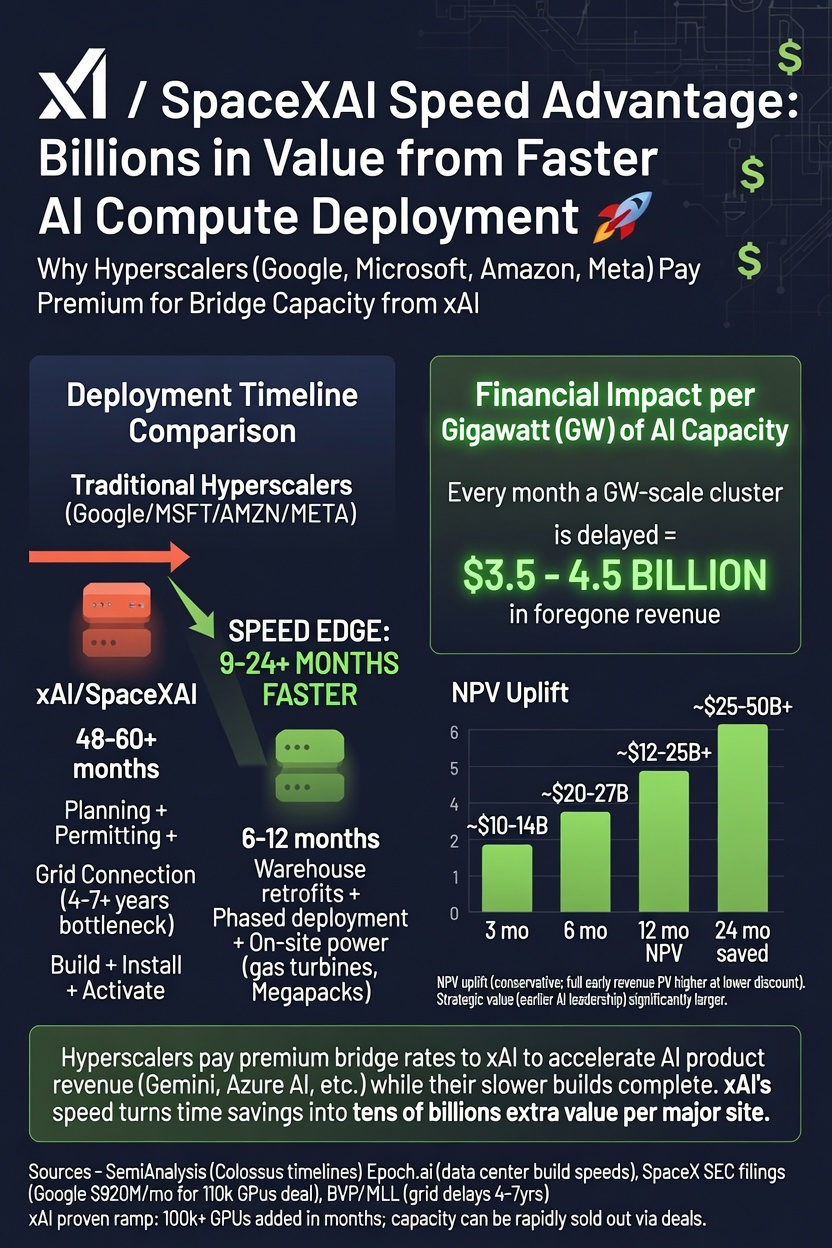
Tens of Billions in Time Value of AI Data Centers - More SpaceX AI Deals in 2026
SpaceXAI has real-world proof of 6-12 month deployments for large clusters via warehouse retrofits, phased build-out, and on-site/mobile power. They have gas turbines from partners like Solar Turbines + APR Energy that can install in days to 6-12 weeks. SpaceXAI already has 440k B200-B300 chips at Colossus 2. They need to get more cooling to activate those chips. Current power already installed supports another ~460k B300 chips. Of that new capacity, at 50-60% rented, they can do roughly 2 - 2.5 more Google-sized (110k chip, $11 Billion per year) deals by the end of 2026. By August/September, expect about 1 - 1.3 additional Google sized deals to be live and billable. Colossus 1 had 100k H100 GPUs live in ~122 days (~4 months) from groundbreaking/announcement in a former factory. Doubled to 200k GPUs in ~92 additional days. Colossus 2 (Southaven/Memphis area) had a warehouse acquired March 2025. ~200 MW cooling/IT capacity online by August 2025 (~6 months). Epoch.ai Jul 1, 2026 UPDATE on Colossus 2 and MACROHARDRR The site is estimated to have at least ~830 MW of GPU server power, with at least "at least 220,000 additional GB300 processors and over 400 additional megawatts of compute power", corresponding to the "next phase of expansion" found in the following company S-1 filing, page 76. The timing is based on the air-cooled condensers needing to be complete to handle this power capacity. The second array at MACROHARD and the first array at MACROHARDRR, although both projected to be completed prior, are not enough and more cooling capacity is needed. We estimate this expansion to be completed 90 days after April 6th. On one hand, SpaceXAI has progressively added more capacity in less time with their Colossus projects. On the other hand, 400 MW is more capacity than the previous expansions of 210 MW and 220 MW. We also believe that MACROHARDRR will be partly operational with this expansion, because its air-cooled condensor array is expected to be completed by then and fitting the entire expansion into only MACROHARD would result in extremely high levels of power density. More cooling is being added. SemiAnalysis notes this is dramatically faster than comparable efforts. xAI has publicly stated they achieved in 4 months what others estimated at 24 months. Google, Microsoft, Amazon, Meta, etc.) can make the building (aka shell) for AI construction in about 12-18 months in aggressive cases, but power/grid infrastructure is the dominant bottleneck (4-7+ years for utility interconnection in many markets. median queues >5 years historically). Overall planning-to-fully-live revenue-generating GW-scale clusters often span 3-5+ years, with frequent 1-2+ year delays. The huge money is being spent but how fast does the money go out before the AI chips and memory turn on? The gap is the time from cash being spent before the incremental revenue comes back.
Not OpenAI or Anthropic: DeepSeek founder Liang Wenfeng is world's richest creator of AI models
DeepSeek founder Liang Wenfeng's net worth more than doubled to US$36 billion after his firm's most recent fundraising round. Hong Kong - DeepSeek founder Liang Wenfeng's net worth more than doubled after his firm's most recent fundraising round, making the Chinese entrepreneur the world's richest among creators of AI models. Liang is now worth US$36 billion (S$46.5 billion), up from about US$16.7 billion previously, according to the Bloomberg Billionaires Index. That ranks him well above OpenAI president Greg Brockman (No 100), with an estimated net worth of US$25.5 billion, and Anthropic co-founder Dario Amodei's (No 491) whose fortune stands at US$7.98 billion. Ironically, OpenAI co-founder and CEO Samuel Altman, with $3.4 billion, did not even make Bloomberg's list of the Top 500 richest people. In the ranking, Bloomberg looked at firms whose primary business and majority of revenue come directly from AI models, instead of other businesses in the AI supply chain - notably, data centres and semiconductors. As such it rules out Big Tech founders like Tesla and SpaceX's Elon Musk, Google's Larry Page, Amazon's Jeff Bezos, Meta's Mark Zuckerberg and Nvidia's Jensen Huang. For Liang, most of his fortune is derived from his stake in DeepSeek. What sets him apart from his Silicon Valley peers is the sheer scale of his equity retention. In the United States, building a US$50 billion frontier AI company typically requires giving up massive chunks of equity to tech giants and VCs. By contrast, maintaining a near-78 per cent stake in DeepSeek gives Liang a boost to his personal wealth and control that is unusual among modern AI founders. While US giants like OpenAI and Anthropic command massive valuations approaching US$1 trillion, their equity is more fragmented across larger investor bases or multiple co-founders. Strong demand for investment boosted DeepSeek's valuation about fivefold from the initial US$10 billion reported in April. Following the start-up's US$7.4 billion funding round in June 2026 - which valued the company at US$50 billion and saw Liang personally invest US$3 billion - his stake is estimated to have diluted to approximately 78 per cent, according to the Bloomberg Billionaires Index. Liang was born in 1985 in Zhanjiang, in China's southern Guangdong province, where his father was an elementary school teacher. He studied electronic engineering at Zhejiang University, a prestigious college in the city of Hangzhou where he also earned a master's degree in information and communication engineering. Liang created DeepSeek in 2023 as an offshoot of the AI division of his hedge fund, Zhejiang High-Flyer Asset Management, which he set up with two former university classmates. The trio had begun trading as students during the global financial crisis. Early on, High-Flyer used its massive trading profits to stockpile advanced graphics chips before US export restrictions tightened. Those early investments gave DeepSeek the computing power necessary to develop its breakthrough models without relying on traditional venture capital. DeepSeek shocked the global tech industry in early 2025 by releasing a model that achieved performance comparable to US rivals like OpenAI, but at a fraction of the cost. The start-up is keeping up that momentum, recently showcasing its latest V4 model and publicly touting its compatibility with chips made by domestic tech giant Huawei Technologies. For years, consumer internet tycoons like Alibaba's Jack Ma defined tech wealth in China. That era is now giving way to state-backed artificial intelligence. The influx of state and corporate capital marks DeepSeek's transition from a private software experiment into a critical national asset. Liang's US$36 billion fortune makes him China's eighth-richest person, just behind Chen Tianshi, the hardware AI billionaire and Cambricon Technologies co-founder. BLOOMBERG
SpaceX Fizzles to Close $1 Above IPO Price Weeks After Debut
(Bloomberg) -- Three days of losses have brought SpaceX shares to the brink of falling below their initial public offering price, a key level that traders and investors watch to assess the health of new issues. Most Read from Bloomberg Shares fell 2.2% Tuesday to close at $136.08 each, just $1 above the $135 price tag buyers paid last month in the biggest first-time share sale ever. Elon Musk's rocket, satellite and artificial intelligence company has plunged one-third from its post-listing peak, erasing nearly $850 billion in value. A company's shares falling below the IPO price within days or weeks of its first trading day punctures the narrative that's been carefully choreographed by the company and its bankers to hype up expectations. Putting shareholders in the red at such an early stage is a blow to confidence that some newly-listed firms don't recover from. Skeptics note that the stock trades at a forward estimated price-to-sales ratio of more than 30 times, among the highest in the Nasdaq-100 Index and modestly lagging that of Palantir Technologies Inc. SpaceX is also facing an extended lock-up that will see insiders periodically releasing shares into the market over the coming months. "We still don't think SpaceX has found its low," according to Ken Mahoney, chief executive officer of Mahoney Asset Management. "There will be continuous supply coming on in the coming months, and you would have to monitor how much demand would be there as you move down the quality spectrum." Index Addition SpaceX's slip near the IPO price comes just a week after the company was added to the Nasdaq 100 through fast-entry rules, and after analysts gave the company -- whose unconventional pitch included a base on the moon and eventually a colony on Mars -- a resoundingly bullish reception. More than a dozen bankers including Morgan Stanley, JPMorgan Chase & Co. and Goldman Sachs Group Inc. started coverage with buy-equivalent ratings, according to data compiled by Bloomberg. Over 80% of Wall Street analysts covering SpaceX say to buy shares and see major upside ahead. The average price target of $236.25 is more than 70% above Tuesday's close. It's normal for newly-public stocks to experience volatility. A Truist Wealth analysis of 30 major technology IPOs over the past 15 years found that they averaged a maximum decline of 55% in the first year of trading.

SpaceX Fizzles to Close $1 Above IPO Price Weeks After Debut
(Bloomberg) -- Three days of losses have brought SpaceX shares to the brink of falling below their initial public offering price, a key level that traders and investors watch to assess the health of new issues. Most Read from Bloomberg Shares fell 2.2% Tuesday to close at $136.08 each, just $1 above the $135 price tag buyers paid last month in the biggest first-time share sale ever. Elon Musk's rocket, satellite and artificial intelligence company has plunged one-third from its post-listing peak, erasing nearly $850 billion in value. A company's shares falling below the IPO price within days or weeks of its first trading day punctures the narrative that's been carefully choreographed by the company and its bankers to hype up expectations. Putting shareholders in the red at such an early stage is a blow to confidence that some newly-listed firms don't recover from. Skeptics note that the stock trades at a forward estimated price-to-sales ratio of more than 30 times, among the highest in the Nasdaq-100 Index and modestly lagging that of Palantir Technologies Inc. SpaceX is also facing an extended lock-up that will see insiders periodically releasing shares into the market over the coming months. "We still don't think SpaceX has found its low," according to Ken Mahoney, chief executive officer of Mahoney Asset Management. "There will be continuous supply coming on in the coming months, and you would have to monitor how much demand would be there as you move down the quality spectrum." Index Addition SpaceX's slip near the IPO price comes just a week after the company was added to the Nasdaq 100 through fast-entry rules, and after analysts gave the company -- whose unconventional pitch included a base on the moon and eventually a colony on Mars -- a resoundingly bullish reception. More than a dozen bankers including Morgan Stanley, JPMorgan Chase & Co. and Goldman Sachs Group Inc. started coverage with buy-equivalent ratings, according to data compiled by Bloomberg. Over 80% of Wall Street analysts covering SpaceX say to buy shares and see major upside ahead. The average price target of $236.25 is more than 70% above Tuesday's close. It's normal for newly-public stocks to experience volatility. A Truist Wealth analysis of 30 major technology IPOs over the past 15 years found that they averaged a maximum decline of 55% in the first year of trading.
MoffettNathanson Initiates Cautious "Neutral" Coverage on Post-IPO SpaceX Valuations
On Tuesday, July 14, 2026, technology and telecom research firm MoffettNathanson issued a comprehensive 93-page report initiating coverage on Space Exploration Technologies Corp. (SpaceX) with a "Neutral" rating and a target share price of $131. The cautious outlook represents the low end of a wide Wall Street valuation spectrum following the expiration of the quiet period for the underwriting syndicate of SpaceX's historic Initial Public Offering (IPO). While other investment firms issued highly optimistic forecasts ranging from $143 (Deutsche Bank) to $800 (Raymond James), MoffettNathanson warned that current market expectations disconnect from quantifiable financial realities. Analysis of the Trillion-Dollar S-1 Disclosures The analytical report compared and contrasted the economic trajectories of SpaceX and its direct-to-device (D2D) competitor, AST SpaceMobile. MoffettNathanson's lead analyst, Julie Zhu, identified multiple points of friction within the optimistic metrics outlined in the aerospace giant's S-1 regulatory filings: * Absurd TAM Projections: The prospectus defines Starlink's total addressable market (TAM) at almost $30 trillion, which the report labels as highly unrealistic. * D2D Niche Modeling: The highly publicized mobility and direct-to-device cellular segments are modeled as niche services rather than mass-market consumer replacements. * Orbital Compute Bottlenecks: Founder and CEO Elon Musk's public target of deploying 100 gigawatts (GW) of orbital data center compute annually by 2029 exceeds current global in-service terrestrial data center capacity and faces severe raw material input constraints over the next three and a half years. Monopoly Leverage and Sovereign Antitrust Risks Despite the cautious pricing model, the researchers acknowledged that SpaceX maintains a functional monopoly in the rocket launch segment, estimating that its nearest competitor, Blue Origin, remains at least 10 years behind in heavy-lift reuse development. However, MoffettNathanson warned that leveraging this dominance to control adjacent sectors like consumer telecommunications and orbital AI hosting introduces severe political risks. Specifically, the report notes that international governments may resist relying on foreign-owned space systems for critical national telecommunications infrastructure, exposing the company to global regulatory and antitrust pushback. Projected Market Volatility and Volumetric Disconnect MoffettNathanson anticipates significant stock price volatility for the Nasdaq-listed SPCX shares as early-stage index inclusions and pre-IPO lock-up periods expire. The firm concluded that the current market capital tier -- implied at roughly $1.77 trillion post-debut -- is highly reliant on broad economic sentiment rather than near-term cash flow. The analysis suggests that while public markets may extend the benefit of the doubt to SpaceX's "unknown unknown" opportunities during general bull markets, the stock remains highly exposed to downward corrections should broader market sentiment shift toward skepticism.
How to watch SpaceX launch Starship Flight 13 on July 16
These will be the first Starlink Version 3 satellites to deploy in space. SpaceX's next Starship test flight aims to achieve a major milestone by deploying 20 upgraded Starlink satellites, marking the first Starlink Version 3s to deploy in space.. Liftoff for the spacecraft's upcoming 13th test flight is scheduled for Wednesday, July 16, at 6:45 p.m. EDT (2245 GMT) from the company's Starbase facility in South Texas. You can watch the launch live on Space.com, courtesy of SpaceX, beginning 30 minutes before liftoff. Follow our Starship live blog for more mission updates. The mission follows a nearly two-month pause after Flight 12 ended with the loss of the Super Heavy booster during its return to the Gulf after stage separation. After reviewing the anomaly and SpaceX's corrective actions, the Federal Aviation Administration cleared the company to resume Starship launches. "The upcoming flight will aim to complete similar objectives targeted on the previous flight test, which debuted the Starship and Super Heavy V3 vehicles, while also carrying next-generation Starlink V3 satellites for the first time," SpaceX officials said in a statement announcing the test flight. As with previous flights, Flight 13's primary goal is to gather engineering data while testing upgrades to the world's most powerful rocket. Here's what to watch for: The mission will begin with all 33 Raptor 3 engines igniting on the Super Heavy booster, generating up to 18 million pounds (about 8,200 metric tons) of thrust at liftoff. About 2.5 minutes later, the booster will separate from the Starship upper stage and begin its return toward the Gulf of Mexico for a controlled splashdown rather than a launch tower catch. SpaceX is continuing to refine its booster recovery procedures following Flight 12's landing burn failure. One of Flight 13's biggest milestones will come after stage separation, when Starship is expected to deploy 20 Starlink V3 satellites for the first time. The satellites are designed to test Starship's payload deployment capabilities and will intentionally reenter Earth's atmosphere after completing the demonstration rather than remain in orbit. The flight will also continue testing SpaceX's upgraded Starship vehicle, including improvements to its propulsion system, avionics and overall performance. Engineers will closely monitor the rocket throughout ascent to evaluate how the latest design performs under flight conditions. After completing its satellite deployment, Starship will continue along a suborbital trajectory before reentering Earth's atmosphere over the Indian Ocean. The spacecraft's descent will provide additional data on its heat shield, flight controls and guidance systems before ending with a planned splashdown roughly an hour after launch. While Flight 13 remains another developmental mission, it represents an important step toward making Starship an operational launch vehicle. Successfully deploying Starlink satellites would demonstrate the rocket's ability to begin carrying real payloads while continuing to advance SpaceX's goal of building a fully reusable system for missions to Earth orbit, the moon and eventually Mars.
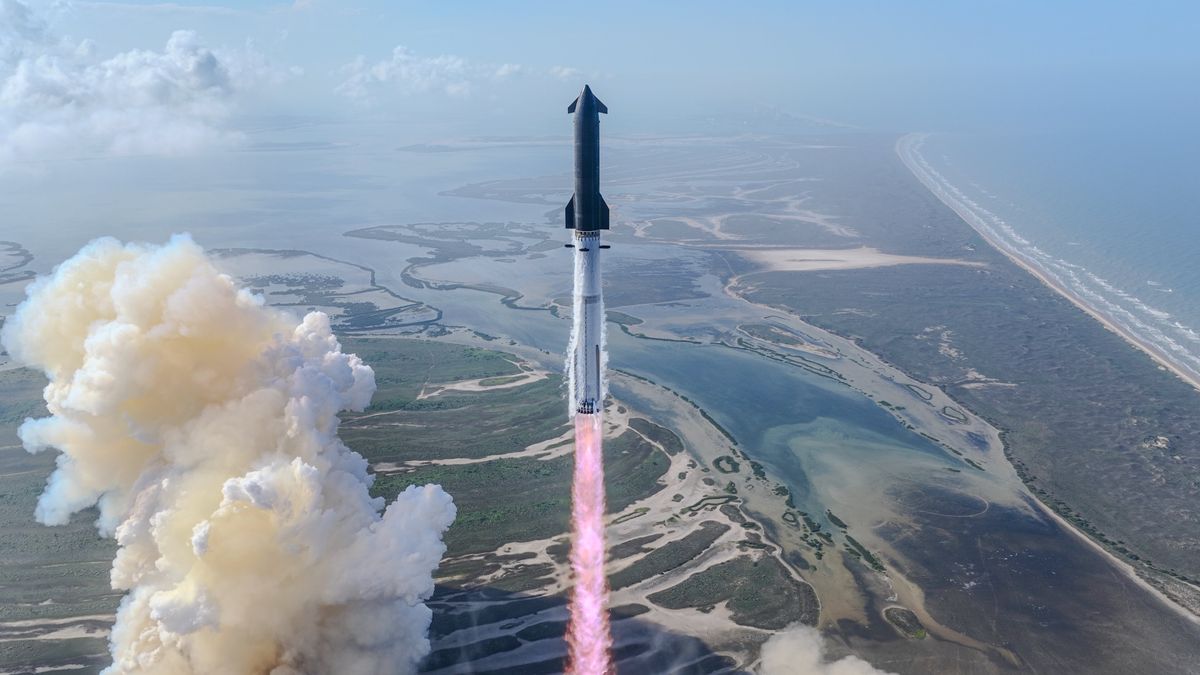
Deutsche Bank sees SpaceX orbital data centers matching ground costs By Investing.com
Investing.com -- Deutsche Bank released analysis on Tuesday suggesting SpaceX could achieve cost parity between orbital and terrestrial data centers by the early 2030s through vertical integration and scaled Starship launches. The bank examined SpaceX's Starmind constellation, which will use AI1 satellites equipped with optical inter-satellite links to route traffic through the existing Starlink network. The AI1 satellites will not require complex phased-array antennas, relying instead on optical terminals for communication with possible Ka-band backup for telemetry. Deutsche Bank estimates more than 10,000 Starlink satellites are currently in orbit, with V2 mini satellites each carrying three optical terminals capable of handling approximately 600 gigabits per second of capacity. The bank anticipates V3 satellites may have at least 2-3 terabits per second of capacity per satellite. Leading providers of optical terminals include Tesat-Spacecom, a subsidiary of Airbus, Mynaric, SA Photonics, which CACI acquired in 2021, and SpaceX itself. SpaceX is utilizing E-band, V-band, W-band, and proposed D-band spectrum for gateway backhaul, in addition to traditional Ku and Ka bands. The FCC recently adopted new standards replacing 1990s-era limits, which Deutsche Bank said could allow up to seven times more capacity from the same number of satellites. SpaceX is building a solar cell manufacturing facility in Bastrop, Texas, targeting 10 gigawatts of capacity across two floors. Construction began in late March, with equipment installation underway. The plant aims for production ramp-up by the end of 2027, initially producing silicon solar cells with approximately 19% efficiency. The AI1 satellite will use a double-sided active deployable liquid radiator covering 110 square meters, capable of dissipating 1,400 watts per square meter. SpaceX is targeting prototype deployments of AI1 satellites late next year, with FCC filings outlining a constellation of up to one million satellites in low Earth orbit. Each AI1 satellite is expected to run at approximately 120 kilowatts, similar to the power consumption of a NVIDIA GB300 NVL72 rack. SpaceX expressed openness to hosting Nvidia GPUs, Google TPUs, Amazon Trainium, and Tesla AI chips. Deutsche Bank estimates upfront capital expenditure for 1 gigawatt of AI compute on the ground is $38 billion with $900 million in annual operating expenses, totaling $42.5 billion over five years based on Epoch AI analysis. The bank calculates that deploying a 1 gigawatt space data center constellation would currently cost six times more than terrestrial alternatives excluding compute costs. This gap could narrow to 1.0-1.5 times by the end of the decade and become cheaper in the early-to-mid 2030s through Starship reusability and satellite optimization. This article was generated with the support of AI and reviewed by an editor. For more information see our T&C.
