News & Updates
The latest news and updates from companies in the WLTH portfolio.
Cathie Wood's Ark Invest Buys the SpaceX Dip and Dumps $8.6 Million Worth of Surging AMD Stock - SpaceX (
The SpaceX buy came as the Elon Musk-led company's stock retreated from its first-week debut highs. Shares have fallen 28.9% from a peak of $225.64, though SpaceX still commands a market value of about $2.1 trillion, placing it among the world's most valuable companies. The AMD Trade The chipmaker's rally came as Japanese autonomous driving startup Turing Inc. said it raised $79 million in an extension of its Series A round, adding AMD Ventures as a new investor and expanding use of AMD's AI accelerators. The funding valued Turing at about $600 million. Other Key Trades Benzinga Edge Stock Rankings indicate SpaceX Stock doesn't check out on Short, Medium, and Long Price Trends. Image via Shutterstock Market News and Data brought to you by Benzinga APIs To add Benzinga News as your preferred source on Google, click here.

SpaceX's two lead underwriters have a $1 trillion chasm in their valuation as quiet period ends
Morgan Stanley sets $300 price target on Space as Goldman Sachs arrives at $205 What's SpaceX worth? Analysts at underwriters now have their say. The two lead underwriters on SpaceX's initial public offering, Goldman Sachs and Morgan Stanley, have a valuation gap of more than $1 trillion as they both initiated coverage at the equivalent of buy. Goldman Sachs analysts led by Eric Sheridan set a price target of $205 on the rocket-launching company, while Morgan Stanley analysts led by Adam Jonas set a $300 target, as the 25-day quiet period expired for SpaceX's underwriters. SpaceX (SPCX)closed Monday at $160.42, more than 25% below the post-IPO high of $225.64 but still above the IPO valuation of $135. The ironic aspect is that Goldman actually is forecasting better financial performance than Morgan Stanley. SpaceX won't become free-cash-flow positive until 2031 on Goldman's numbers, but is forecast to double revenue this year with adjusted earnings before interest, tax, depreciation and amortization reaching $352 billion, from last year's $6.58 billion, by the end of the decade. The Morgan Stanley team have a more conservative approach to the near term - they see SpaceX's adjusted EBITDA to be $162 billion by 2029, and they don't expect SpaceX to become free cash flow positive until 2035. The difference, then, is how they translate those estimates into a price target. Morgan Stanley discounts cash flow by each division over 15 years "with triangulation/support through multiples," while Goldman's valuation is based on 2029 numbers. Each team does acknowledge the gap between their numbers and the current reality. "Space is hard," say Jonas and team, as they say the outlook depends on several technologies not yet proven at commercial scale, like fully reusable Starships capable of hitting thousands of launches a year and orbital compute. Sheridan makes a similar point. "In many ways, SpaceX presents a track record of building toward solutions which many industry experts had previously viewed to be implausible (albeit with this execution not being as linear as public market investors typically desire), particularly with regard to their ability to be the low cost provider of various infrastructure as a service offerings," says the Goldman note. -Steve Goldstein This content was created by MarketWatch, which is operated by Dow Jones & Co. MarketWatch is published independently from Dow Jones Newswires and The Wall Street Journal. (END) Dow Jones Newswires 07-07-26 0420ET Copyright (c) 2026 Dow Jones & Company, Inc.

Elon Musk's xAI is now officially called SpaceXAI
Remember when Twitter was Twitter? Then Elon Musk bought it, renamed it to X, launched an AI company called xAI, which acquired X, and then Musk's space company SpaceX merged with xAI, which has now been renamed to SpaceXAI. At some point, it may become practical to just lump it all together as "that Musk thing." To clarify: SpaceX is the public company and the parent corporate entity that towers above it all; SpaceXAI is a subsidiary of SpaceX, and X is a subsidiary of SpaceXAI (there's another layer between these called X Holdings, but perhaps it's best not to complicate things any further). The change, alongside a new logo for the company, has been announced on SpaceXAI's official X account, which has also been changed to @SpaceXAI. SpaceX acquired xAI in February 2026, shortly before SpaceX's monster IPO in June, which immediately propelled the company to a valuation of roughly $1.8 trillion (it currently stands at about $2.1 trillion). The acquisition was (officially) about Musk's idea of creating huge AI data centers in space. The company plans to start demoing Starmind (as this infrastructure will be called) in late 2027, with actual commercial deployment starting in 2028. We'd never mention the fact that xAI was burning money and needed a wealthy parent company to keep it afloat.

Wall Street warms to SpaceX ahead of Nasdaq 100 inclusion
By Purvi Agarwal and Rashika Singh July 7 (Reuters) - SpaceX's addition to the Nasdaq 100 on Tuesday is expected to unleash billions in passive buying, as brokerages kick off coverage of the $2 trillion-plus rocket and satellite company with broadly bullish views. The company joins the index just 15 days after its stock market debut on June 12 - among the fastest inclusions ever - thanks to the Nasdaq's revised rules for newly listed companies looking to enter widely tracked benchmarks. Its debut in the tech-heavy index is set to create another source of demand for its shares as index funds and exchange-traded funds (ETFs) tied to the Nasdaq 100 will need to buy shares to match the benchmark's new composition. Active managers who track the index closely may also adjust their positions. Many retail investors prefer investing in funds to diversify their holdings. Over $587 billion is benchmarked in funds tracking the Nasdaq 100, including Invesco's QQQ and QQQM, which will now have to make room for SpaceX. J.P. Morgan estimated last month that SpaceX's addition to the index could draw $4.3 billion in passive inflows. QUIET PERIOD ENDS Investors are awaiting a wave of reports from Wall Street brokerages making their first attempt to value SpaceX as a publicly traded company, applying traditional valuation metrics to a business that's largely been assessed by investors' belief in Musk's long-term bets. The industry-mandated quiet period ends for analysts at banks that underwrote the blockbuster IPO - led by Goldman Sachs, Morgan Stanley, BofA Securities, Citigroup and J.P. Morgan. Both Morgan Stanley and Goldman Sachs started coverage on the stock on Tuesday with their top ratings, with Morgan Stanley dubbing the company "AI's final frontier." "We see the company as well-positioned to scale its differentiated advantages across space, connectivity, and AI," Goldman analysts said, betting each market has the potential to become a multi-trillion-dollar opportunity over a five-year-plus horizon. Brokerages RBC, Bernstein, and Stifel also initiated coverage with their top ratings, betting on the success of Starship, SpaceX's next-generation rocket that is designed to be fully reusable. "The Starship is the flywheel that powers SpaceX's ambitions," RBC analysts said. Earlier this month, Oppenheimer became the first to initiate coverage with an "outperform" rating. INVESTORS BET ON AI CAPABILITIES Investors are betting SpaceX can evolve into a hyperscale AI infrastructure provider in the near term, using cash generated to fund the development of Grok as it takes on OpenAI's GPT models and Anthropic's Claude. They also see significant room for Starlink to expand its dominance in satellite communications, while much of the company's longer-term ambitions depend on the successful development of its next-generation Starship rocket. However, not everyone is bullish on SpaceX. Morningstar analysts pegged the company's valuation at about $780 billion, citing uncertainty around its AI business, including xAI and social media platform X. With a market capitalization of $2.1 trillion, SpaceX is the sixth-largest U.S. company, and CEO Elon Musk the world's first trillionaire. FTSE Russell added the stock to its U.S. indexes last month, with funds such as iShares Russell 1000 ETF already giving investors a piece of the biggest IPO in U.S. history. However, S&P Global declined to create a similar fast-track process for the benchmark S&P 500 in June, and it is expected to take at least a year before SpaceX joins the world's most widely tracked index. SpaceX shares have gained more than 6% since their debut in their short ride marked by post-IPO volatility. (Reporting by Purvi Agarwal, Rashika Singh and Akash Sriram in Bengaluru; Editing by Anil D'Silva and Saumyadeb Chakrabarty)

SpaceX Is Joining the Nasdaq-100 This Week. What This Means for Invesco QQQ Investors.
Space Exploration Technologies (SPCX 0.97%), otherwise known as SpaceX, is joining the Nasdaq-100 index today. This means that exchange-traded funds (ETFs) tracking the index, including the Invesco QQQ Trust (QQQ +1.43%), will soon own the stock indirectly. J.P. Morgan, part of JPMorgan Chase, expects this index inclusion to trigger about $4.3 billion in passive buying from index-tracking funds. Although this will serve as a clear near-term demand catalyst for SpaceX, Invesco QQQ Trust investors are also getting exposure to a founder-controlled company with a limited number of publicly traded shares (float) and an unprofitable business. Why SpaceX's Nasdaq-100 entry matters for QQQ investors Invesco QQQ Trust tracks the Nasdaq-100, which includes the 100 largest non-financial companies listed on Nasdaq. SpaceX's quick entry became possible because the Nasdaq-100 changed its inclusion rules in 2026. Starting May 1, large newly public companies like SpaceX can be added after just 15 trading days if they rank among the top 40 eligible Nasdaq-listed companies. However, if only a limited number of shares are publicly traded, Nasdaq can limit how much weight the stock gets in the index. The change reflects today's market, where some very large companies stay private for longer and list with only a limited number of shares available for public investors. SpaceX's Nasdaq-100 inclusion will give Invesco QQQ Trust investors exposure to the space, satellite broadband, and artificial intelligence (AI) infrastructure company before S&P 500 (^GSPC +0.72%) index fund investors get it automatically. Reuters reported that SpaceX would need at least 12 months of public trading history, generally accepted accounting principles (GAAP) profitability, and a public float of at least 10% before it can be considered for inclusion in the S&P 500. However, according to Reuters' estimates, SpaceX's public float is only 3% to 4%. The company also posted a $4.94 billion net loss in 2025. Since only a small portion of SpaceX shares is available for public trading, buying by funds that track the Nasdaq-100 can have a bigger effect on the stock price. But once that buying is complete, the same limited supply of tradable shares can also make the stock move more sharply if investors start selling. So, Invesco QQQ Trust investors should ask whether SpaceX's Nasdaq-100 inclusion has already lifted the stock enough to limit its near-term gains. Starlink is the key business to watch The best reason for Invesco QQQ Trust investors to take SpaceX seriously is its Starlink satellite internet business. SpaceX generated $18.7 billion of revenue in 2025, with the Starlink-powered connectivity business accounting for about 60% of total sales. The business had about 10.3 million users across roughly 9,600 satellites at the end of the first quarter. Starlink is SpaceX's clearest profit engine and is helping offset losses from the company's other growth initiatives. In the first quarter, the connectivity segment generated $1.2 billion of operating profit. But SpaceX still reported a total operating loss of $1.9 billion on $4.7 billion of revenue. SpaceX's reusable Falcon 9 rocket has helped make the company a leading launch provider for NASA, the Pentagon, and commercial customers. According to Reuters, SpaceX has gone from one launch in 2006 to more than two launches per week, giving it a much faster launch pace than its rivals. The Federal Communications Commission has approved SpaceX to deploy another 7,500 second-generation Starlink satellites, bringing the approved Gen2 satellite count to 15,000. More satellites should give Starlink more network capacity, which can support faster broadband and mobile connectivity service, as well as growth in aviation, maritime, enterprise, and government markets. Additionally, if the next-generation reusable rocket system, Starship, works at commercial scale, it could lower launch costs and help SpaceX deploy larger, higher-capacity satellites faster. Investors are getting growth, but also uncertainty The biggest risk is that Invesco QQQ Trust is being required to buy an expensive story. SpaceX currently trades at nearly 81 times trailing-12-month sales, even though it is a money-losing business. SpaceX's AI business could become a major long-term growth engine, especially after Anthropic agreed to pay SpaceX $1.25 billion per month through May 2029 for compute capacity. But investors should not treat that as guaranteed revenue. Reuters reported that either company can terminate the agreement with 90 days' notice, and that fees are lower during the ramp-up period. The company is also spending heavily on an AI infrastructure business that is not yet profitable. In the first quarter, the AI segment reported an operating loss of nearly $2.5 billion on $818 million of revenue. Additionally, Chief Executive Officer Elon Musk accounts for 82.3% of SpaceX's voting power. Hence, although public investors may own the stock, they will have little control over major company decisions. So, Invesco QQQ Trust investors are getting automatic exposure to a company where major decisions will remain heavily shaped by Musk, not by public shareholders. NASA's inspector general said SpaceX's Artemis III Starship work has faced delays, while refueling the vehicle in space remains one of the biggest technical challenges. With Starship being crucial to SpaceX's plan to launch more satellites at lower cost and support NASA's moon missions, it also adds to the company's execution risk. Invesco QQQ Trust investors should not panic over one index addition. SpaceX will likely be a modest initial QQQ position because of its limited float. But investors should recognize that QQQ is becoming a slightly more aggressive fund, with higher valuation risk, more execution risk, and more Musk-specific governance risk. While SpaceX's addition is not a reason to abandon the ETF, it should also remind investors that the Invesco QQQ Trust is not a broad-market fund. Investors should watch Starlink profits, AI losses, Starship progress, and future earnings reports before assuming this index addition is automatically good news.

SpaceX's lead underwriters face $1T valuation gap as quiet period ends
Goldman Sachs and Morgan Stanley released wildly divergent revenue forecasts for the newly public space giant, and the difference comes down to one word: AI When two of Wall Street's most powerful banks can't agree on what a company is worth, and the gap between their estimates stretches to roughly $1 trillion, investors should probably pay attention. SpaceX's post-IPO quiet period ended in early July, unleashing a flood of analyst reports from the underwriters who shepherded the largest public offering in history. Goldman Sachs and Morgan Stanley, the two lead underwriters, published their inaugural coverage notes within days of each other. The numbers that don't add up Goldman Sachs projects SpaceX will generate $474 billion in total revenue by 2030. Morgan Stanley pegs that figure at $330 billion. That's a $144 billion disagreement on a four-year outlook. The core of the disagreement sits squarely on AI. Goldman attributes $322 billion of its 2030 revenue estimate to AI operations, while Morgan Stanley sees that segment contributing $190 billion. A $132 billion gap in a single revenue line item. Zoom out to 2040 and the divergence gets genuinely absurd. Morgan Stanley forecasts $3.4 trillion in revenue and over $2.7 trillion in adjusted EBITDA by that year. If Goldman's more aggressive growth assumptions hold through the decade, the implied valuation gap between the two banks' models balloons to around $1 trillion. The IPO that broke records SpaceX priced its IPO at $135 per share on June 11, 2026, raising $75 billion in one of the most anticipated public offerings ever. The greenshoe option pushed the total raise to $85.7 billion. Only about 4% of the company was sold to the public. When trading began on June 12, shares surged enough to push SpaceX's market capitalization to approximately $2.1 trillion. The implied equity valuation at offering was about $1.77 trillion, meaning the market added roughly $330 billion in perceived value on day one alone. The underwriting fees tell their own story. At under 0.75% of the total raise, SpaceX negotiated a fee structure well below the typical 3-7% charged on large IPOs. Even so, the sheer size of the deal meant the total fee pool landed somewhere between $500 million and $650 million. Goldman Sachs and Morgan Stanley each captured approximately 20% of that pool, meaning each bank walked away with north of $100 million for their efforts. Why the AI bet matters for everyone The two banks are effectively placing opposite-end bets on how quickly AI capabilities can be monetized at scale through satellite infrastructure and space-based computing. Goldman's model assumes AI operations become the dominant revenue driver within four years, essentially dwarfing the launch and satellite connectivity businesses that made SpaceX famous. Morgan Stanley's model treats AI as a significant but not overwhelming contributor, keeping more weight on legacy revenue streams. Investors watching SpaceX should focus on the quarterly AI revenue disclosures that will begin arriving later this year. The first few earnings reports will start revealing which bank's crystal ball is less foggy. If AI revenue tracks closer to Goldman's projections, the stock likely has room to run. If Morgan Stanley's estimates prove more accurate, the current $2.1 trillion market cap could face pressure.
SpaceX Is Joining the Nasdaq-100 This Week. What This Means for Invesco QQQ Investors.
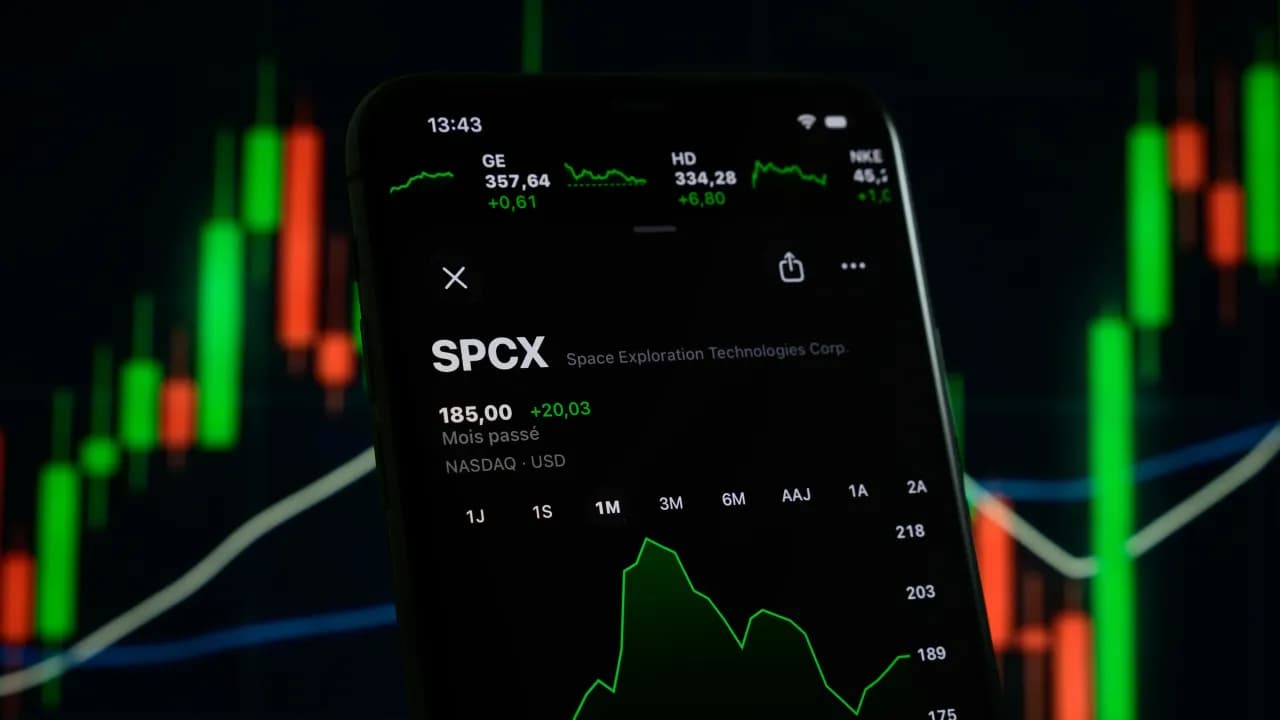
Space Exploration Technologies (NASDAQ: SPCX), otherwise known as SpaceX, is joining the Nasdaq-100 index today. This means that exchange-traded funds (ETFs) tracking the index, including the Invesco QQQ Trust (NASDAQ: QQQ), will soon own the stock indirectly. J.P. Morgan, part of JPMorgan Chase, expects this index inclusion to trigger about $4.3 billion in passive buying from index-tracking funds. Although this will serve as a clear near-term demand catalyst for SpaceX, Invesco QQQ Trust investors are also getting exposure to a founder-controlled company with a limited number of publicly traded shares (float) and an unprofitable business. Missed Nvidia in 2009? This Rare Signal Is Flashing Again. In 2009, a "Double Down" signal flashed for a little-known chipmaker called Nvidia. For the first time in years, that same "Total Conviction" signal is flashing for a company 1/100th the size of Nvidia. Continue " Why SpaceX's Nasdaq-100 entry matters for QQQ investors Invesco QQQ Trust tracks the Nasdaq-100, which includes the 100 largest non-financial companies listed on Nasdaq. SpaceX's quick entry became possible because the Nasdaq-100 changed its inclusion rules in 2026. Starting May 1, large newly public companies like SpaceX can be added after just 15 trading days if they rank among the top 40 eligible Nasdaq-listed companies. However, if only a limited number of shares are publicly traded, Nasdaq can limit how much weight the stock gets in the index. The change reflects today's market, where some very large companies stay private for longer and list with only a limited number of shares available for public investors. SpaceX's Nasdaq-100 inclusion will give Invesco QQQ Trust investors exposure to the space, satellite broadband, and artificial intelligence (AI) infrastructure company before S&P 500 (SNPINDEX: ^GSPC) index fund investors get it automatically. Reuters reported that SpaceX would need at least 12 months of public trading history, generally accepted accounting principles (GAAP) profitability, and a public float of at least 10% before it can be considered for inclusion in the S&P 500. However, according to Reuters' estimates, SpaceX's public float is only 3% to 4%. The company also posted a $4.94 billion net loss in 2025. Since only a small portion of SpaceX shares is available for public trading, buying by funds that track the Nasdaq-100 can have a bigger effect on the stock price. But once that buying is complete, the same limited supply of tradable shares can also make the stock move more sharply if investors start selling. So, Invesco QQQ Trust investors should ask whether SpaceX's Nasdaq-100 inclusion has already lifted the stock enough to limit its near-term gains.
Wall Street warms to SpaceX ahead of Nasdaq 100 inclusion By Reuters
By Purvi Agarwal and Rashika Singh July 7 (Reuters) - SpaceX's addition to the Nasdaq 100 on Tuesday is expected to unleash billions in passive buying, as brokerages kick off coverage of the $2 trillion-plus rocket and satellite company with broadly bullish views. The company joins the index just 15 days after its stock market debut on June 12 - among the fastest inclusions ever - thanks to the Nasdaq's revised rules for newly listed companies looking to enter widely tracked benchmarks. Its debut in the tech-heavy index is set to create another source of demand for its shares as index funds and exchange-traded funds (ETFs) tied to the Nasdaq 100 will need to buy shares to match the benchmark's new composition. Active managers who track the index closely may also adjust their positions. Many retail investors prefer investing in funds to diversify their holdings. Over $587 billion is benchmarked in funds tracking the Nasdaq 100, including Invesco's QQQ and QQQM, which will now have to make room for SpaceX. J.P. Morgan estimated last month that SpaceX's addition to the index could draw $4.3 billion in passive inflows. QUIET PERIOD ENDS Investors are awaiting a wave of reports from Wall Street brokerages making their first attempt to value SpaceX as a publicly traded company, applying traditional valuation metrics to a business that's largely been assessed by investors' belief in Musk's long-term bets. The industry-mandated quiet period ends for analysts at banks that underwrote the blockbuster IPO - led by Goldman Sachs, Morgan Stanley, BofA Securities, Citigroup and J.P. Morgan. Both Morgan Stanley and Goldman Sachs started coverage on the stock on Tuesday with their top ratings, with Morgan Stanley dubbing the company "AI's final frontier." "We see the company as well-positioned to scale its differentiated advantages across space, connectivity, and AI," Goldman analysts said, betting each market has the potential to become a multi-trillion-dollar opportunity over a five-year-plus horizon. Brokerages RBC, Bernstein, and Stifel also initiated coverage with their top ratings, betting on the success of Starship, SpaceX's next-generation rocket that is designed to be fully reusable. "The Starship is the flywheel that powers SpaceX's ambitions," RBC analysts said. Earlier this month, Oppenheimer became the first to initiate coverage with an "outperform" rating. INVESTORS BET ON AI CAPABILITIES Investors are betting SpaceX can evolve into a hyperscale AI infrastructure provider in the near term, using cash generated to fund the development of Grok as it takes on OpenAI's GPT models and Anthropic's Claude. They also see significant room for Starlink to expand its dominance in satellite communications, while much of the company's longer-term ambitions depend on the successful development of its next-generation Starship rocket. However, not everyone is bullish on SpaceX. Morningstar analysts pegged the company's valuation at about $780 billion, citing uncertainty around its AI business, including xAI and social media platform X. With a market capitalization of $2.1 trillion, SpaceX is the sixth-largest U.S. company, and CEO Elon Musk the world's first trillionaire. FTSE Russell added the stock to its U.S. indexes last month, with funds such as iShares Russell 1000 ETF already giving investors a piece of the biggest IPO in U.S. history. However, S&P Global declined to create a similar fast-track process for the benchmark S&P 500 in June, and it is expected to take at least a year before SpaceX joins the world's most widely tracked index. SpaceX shares have gained more than 6% since their debut in their short ride marked by post-IPO volatility.

Wall Street warms to SpaceX ahead of Nasdaq 100 inclusion
The Nasdaq-100 inclusion is expected to attract billions in passive investment for the company amid strong brokerage optimism. NEW YORK: SpaceX's addition to the Nasdaq 100 on Tuesday is expected to unleash billions in passive buying, as brokerages kick off coverage of the US$2 trillion-plus rocket and satellite company with broadly bullish views. The company joins the index just 15 days after its stock market debut on June 12 - among the fastest inclusions ever - thanks to the Nasdaq's revised rules for newly listed companies looking to enter widely tracked benchmarks. Its debut in the tech-heavy index is set to create another source of demand for its shares as index funds and exchange-traded funds (ETFs) tied to the Nasdaq 100 will need to buy shares to match the benchmark's new composition. Active managers who track the index closely may also adjust their positions. Many retail investors prefer investing in funds to diversify their holdings. Over US$587 billion is benchmarked in funds tracking the Nasdaq 100, including Invesco, which will now have to make room for SpaceX. JP Morgan estimated last month that SpaceX's addition to the index could draw US$4.3 billion in passive inflows. Quiet period ends Investors are awaiting a wave of reports from Wall Street brokerages making their first attempt to value SpaceX as a publicly traded company, applying traditional valuation metrics to a business that's largely been assessed by investors' belief in Musk's long-term bets. The industry-mandated quiet period ends for analysts at banks that underwrote the blockbuster IPO - led by Goldman Sachs, Morgan Stanley, BofA Securities, Citigroup and JP Morgan. Both Morgan Stanley and Goldman Sachs started coverage on the stock on Tuesday with their top ratings, with Morgan Stanley dubbing the company "AI's final frontier." "We see the company as well-positioned to scale its differentiated advantages across space, connectivity, and AI," Goldman analysts said, betting each market has the potential to become a multi-trillion-dollar opportunity over a five-year-plus horizon. Brokerages RBC, Bernstein, and Stifel also initiated coverage with their top ratings, betting on the success of Starship, SpaceX's next-generation rocket that is designed to be fully reusable. "The Starship is the flywheel that powers SpaceX's ambitions," RBC analysts said. Earlier this month, Oppenheimer became the first to initiate coverage with an "outperform" rating. Investors bet on AI capabilities Investors are betting SpaceX can evolve into a hyperscale AI infrastructure provider in the near term, using cash generated to fund the development of Grok as it takes on OpenAI's GPT models and Anthropic's Claude. They also see significant room for Starlink to expand its dominance in satellite communications, while much of the company's longer-term ambitions depend on the successful development of its next-generation Starship rocket. However, not everyone is bullish on SpaceX. Morningstar analysts pegged the company's valuation at about US$780 billion, citing uncertainty around its AI business, including xAI and social media platform X. With a market capitalization of US$2.1 trillion, SpaceX is the sixth-largest US company, and CEO Elon Musk the world's first trillionaire. FTSE Russell added the stock to its US indexes last month, with funds such as iShares Russell 1000 ETF already giving investors a piece of the biggest IPO in US history. However, S&P Global declined to create a similar fast-track process for the benchmark S&P 500 in June, and it is expected to take at least a year before SpaceX joins the world's most widely tracked index. SpaceX shares have gained more than 6% since their debut in their short ride marked by post-IPO volatility.
Elon Musk's xAI Officially Rebrands as SpaceXAI
Elon Musk's artificial intelligence company xAI has officially changed its name to SpaceXAI, five months after SpaceX acquired the business. SpaceXAI announced the change through a post on X and also introduced a new logo. The company's account on the social network now carries the SpaceXAI name. However, SpaceX continues to operate a separate account covering its rockets, spacecraft, and launches. Merger Completed Musk first disclosed the SpaceXAI name in May, when he said xAI would no longer operate as a separate company and would instead become SpaceX's artificial intelligence business. SpaceX officially acquired xAI in February 2026. The company's public offering documents describe xAI as the foundation of SpaceX's AI division and part of a broader plan to combine artificial intelligence with its space and connectivity businesses. The xAI website has already been updated with the SpaceXAI name and logo. However, according to Stocktwits, the new branding has not yet appeared in official corporate filings. Orbital Data Centers SpaceXAI plans to develop data centers in space as demand for the electricity required to operate AI infrastructure continues to rise. When SpaceX acquired xAI, Musk argued that terrestrial infrastructure would not be able to meet global AI electricity demand. He described moving power-intensive data-center operations into space as the logical solution. SpaceX had already filed an application with the US Federal Communications Commission before announcing the acquisition. The filing seeks permission to launch and operate up to one million satellites as part of an orbital data-center system. The proposed satellites would operate at altitudes ranging from 500 kilometres to 2,000 kilometres and communicate through high-bandwidth optical links. X Also Comes Under SpaceXAI The combined business also includes a social media platform, X. xAI acquired X in 2025, meaning the platform became part of SpaceX when it purchased xAI. It now sits under the wider SpaceXAI structure alongside Grok and the company's other AI products. Public Market Debut SpaceX, including its acquired xAI and X businesses, went public in June 2026. The company's shares closed their first trading day at $160.95, or approximately $161, giving SpaceX a market value of around $2.1 trillion, according to f. The SpaceXAI rebrand formally brings Musk's space, artificial intelligence, and social media operations under one corporate identity, although SpaceX will continue to use its established name for its space-related activities.
'Compute lasts forever': SpaceX gets fresh Wall Street coverage
Investing.com -- Several Wall Street banks initiated coverage of Space Exploration Technologies on Tuesday, setting price targets ranging from $190 to $300, with the spread largely reflecting how differently analysts value SpaceX's AI and satellite businesses. Morgan Stanley set the highest bar, starting the stock at Overweight with a $300 target, flanked by an "intentionally wide $75 bear case and $600 bull case." Analysts led by Adam Jonas pitched SpaceX as holding "an 'X of 1' position in space infrastructure," and argued the market is underappreciating the company's terrestrial data-center economics, where it estimates costs run at half the industry average. They also flagged the funding gap behind that growth, projecting SpaceX will need roughly $84 billion a year in outside capital from 2027 through 2034 before the business turns free-cash-flow positive. RBC initiated at Outperform with a $225 target, based on about 15 times its 2029 EBITDA estimate. The broker's thesis centers on compute as a durable moat, writing that "AI models and applications may come and go, but compute lasts forever." RBC named Starship's flight-test cadence as the top near-term catalyst for the stock, alongside the pending Cursor acquisition and the rollout of Starlink's next-generation V3 satellites. Stifel initiated coverage with a Buy rating and a $190 target, the lowest of the four. The firm's thesis is built around launch economics, arguing that "lowest cost to orbit wins everything above it." Stifel credits Falcon 9's reusability with pushing launch costs to roughly $3,000 per kilogram, a level it says no competitor has matched, but applies a lighter multiple to the AI segment specifically, citing execution risk around orbital data centers that remain unproven at commercial scale. Finally, UBS set its target at $210 with a Buy rating, sizing the combined launch, connectivity and AI opportunity at nearly $30 trillion if Starship performs as expected. The bank forecast revenue and EBITDA growing at roughly 70% and 90% annual rates through 2031, with launch costs falling to about $200 per kilogram from roughly $1,000 currently. UBS views the stock as offering investors "a call option" on Elon Musk's plans to make life multiplanetary, while keeping that scenario outside its base case. The fresh coverage comes less than a month after SpaceX's Nasdaq debut. The company priced its IPO at $135 a share on June 12 and raised about $86 billion, the largest offering on record. Shares have traded above that level since, closing Monday at $160.42, though still well below the roughly $225 high the stock reached in its first weeks of trading.

Wall Street warms to SpaceX ahead of Nasdaq 100 inclusion
SpaceX's addition to the Nasdaq 100 on Wall Street today is expected to unleash billions in passive buying, as brokerages kick off coverage of the $2 trillion-plus rocket and satellite company with broadly bullish views. The company joins the index just 15 days after its stock market debut on June 12 - among the fastest inclusions ever - thanks to the Nasdaq's revised rules for newly listed companies looking to enter widely tracked benchmarks. Its debut in the tech-heavy index is set to create another source of demand for its shares as index funds and exchange-traded funds (ETFs) tied to the Nasdaq 100 will need to buy shares to match the benchmark's new composition. Active managers who track the index closely may also adjust their positions. Many retail investors prefer investing in funds to diversify their holdings. Over $587 billion is benchmarked in funds tracking the Nasdaq 100, including Invesco's QQQ and QQQM, which will now have to make room for SpaceX. JP Morgan estimated last month that SpaceX's addition to the index could draw $4.3 billion in passive inflows. Investors are waiting for a wave of reports from Wall Street brokerages making their first attempt to value SpaceX as a publicly traded company, applying traditional valuation metrics to a business that has largely been assessed by investors' belief in Musk's long-term bets. The industry-mandated quiet period ends for analysts at banks that underwrote the blockbuster IPO - led by Goldman Sachs, Morgan Stanley, BofA Securities, Citigroup and JP Morgan. Both Morgan Stanley and Goldman Sachs started coverage on the stock today with their top ratings, with Morgan Stanley dubbing the company "AI's final frontier." "We see the company as well-positioned to scale its differentiated advantages across space, connectivity, and AI," Goldman analysts said, betting each market has the potential to become a multi-trillion-dollar opportunity over a five-year-plus horizon. Brokerages RBC, Bernstein, and Stifel also initiated coverage with their top ratings, betting on the success of Starship, SpaceX's next-generation rocket that is designed to be fully reusable. "The Starship is the flywheel that powers SpaceX's ambitions," RBC analysts said. Earlier this month, Oppenheimer became the first to initiate coverage with an "outperform" rating. Investors bet on AI capabilities Investors are betting SpaceX can evolve into a hyperscale AI infrastructure provider in the near term, using cash generated to fund the development of Grok as it takes on OpenAI's GPT models and Anthropic's Claude. They also see significant room for Starlink to expand its dominance in satellite communications, while much of the company's longer-term ambitions depend on the successful development of its next-generation Starship rocket. However, not everyone is bullish on SpaceX. Morningstar analysts pegged the company's valuation at about $780 billion, citing uncertainty around its AI business, including xAI and social media platform X. With a market capitalisation of $2.1 trillion, SpaceX is the sixth-largest US company, and CEO Elon Musk the world's first trillionaire. FTSE Russell added the stock to its US indexes last month, with funds such as iShares Russell 1000 ETF already giving investors a piece of the biggest IPO in US history. However, S&P Global declined to create a similar fast-track process for the benchmark S&P 500 in June, and it is expected to take at least a year before SpaceX joins the world's most widely tracked index. SpaceX shares have gained more than 6% since their debut in their short ride marked by post-IPO volatility.

Wall Street warms to SpaceX ahead of Nasdaq 100 inclusion
July 7 (Reuters) - SpaceX's (SPCX.O), opens new tab addition to the Nasdaq 100 on Tuesday is expected to unleash billions in passive buying, as brokerages kick off coverage of the $2 trillion-plus rocket and satellite company with broadly bullish views. The company joins the index just 15 days after its stock market debut on June 12 - among the fastest inclusions ever - thanks to the Nasdaq's revised rules for newly listed companies looking to enter widely tracked benchmarks. Its debut in the tech-heavy index is set to create another source of demand for its shares as index funds and exchange-traded funds (ETFs) tied to the Nasdaq 100 (.NDX), opens new tab will need to buy shares to match the benchmark's new composition. Active managers who track the index closely may also adjust their positions. Many retail investors prefer investing in funds to diversify their holdings. Over $587 billion is benchmarked in funds tracking the Nasdaq 100, including Invesco's QQQ (QQQ.O), opens new tab and QQQM (QQQM.O), opens new tab, which will now have to make room for SpaceX. J.P. Morgan estimated last month that SpaceX's addition to the index could draw $4.3 billion in passive inflows. QUIET PERIOD ENDS Investors are awaiting a wave of reports from Wall Street brokerages making their first attempt to value SpaceX as a publicly traded company, applying traditional valuation metrics to a business that's largely been assessed by investors' belief in Musk's long-term bets. The industry-mandated quiet period ends for analysts at banks that underwrote the blockbuster IPO - led by Goldman Sachs, Morgan Stanley, BofA Securities, Citigroup and J.P. Morgan. Both Morgan Stanley and Goldman Sachs started coverage on the stock on Tuesday with their top ratings, with Morgan Stanley dubbing the company "AI's final frontier." "We see the company as well-positioned to scale its differentiated advantages across space, connectivity, and AI," Goldman analysts said, betting each market has the potential to become a multi-trillion-dollar opportunity over a five-year-plus horizon. Brokerages RBC, Bernstein, and Stifel also initiated coverage with their top ratings, betting on the success of Starship, SpaceX's next-generation rocket that is designed to be fully reusable. "The Starship is the flywheel that powers SpaceX's ambitions," RBC analysts said. Earlier this month, Oppenheimer became the first to initiate coverage with an "outperform" rating. INVESTORS BET ON AI CAPABILITIES Investors are betting SpaceX can evolve into a hyperscale AI infrastructure provider in the near term, using cash generated to fund the development of Grok as it takes on OpenAI's GPT models and Anthropic's Claude. They also see significant room for Starlink to expand its dominance in satellite communications, while much of the company's longer-term ambitions depend on the successful development of its next-generation Starship rocket. However, not everyone is bullish on SpaceX. Morningstar analysts pegged the company's valuation at about $780 billion, citing uncertainty around its AI business, including xAI and social media platform X. With a market capitalization of $2.1 trillion, SpaceX is the sixth-largest U.S. company, and CEO Elon Musk the world's first trillionaire. FTSE Russell added the stock to its U.S. indexes last month, with funds such as iShares Russell 1000 ETF (IWB.P), opens new tab already giving investors a piece of the biggest IPO in U.S. history. However, S&P Global (SPGI.N), opens new tab declined to create a similar fast-track process for the benchmark S&P 500 (.SPX), opens new tab in June, and it is expected to take at least a year before SpaceX joins the world's most widely tracked index. SpaceX shares have gained more than 6% since their debut in their short ride marked by post-IPO volatility. Reporting by Purvi Agarwal, Rashika Singh and Akash Sriram in Bengaluru; Editing by Anil D'Silva and Saumyadeb Chakrabarty Our Standards: The Thomson Reuters Trust Principles., opens new tab * Suggested Topics: * U.S. Markets Rashika Singh Thomson Reuters Rashika reports on brokerages and financial markets, alongside technology and corporate developments for Reuters, with a focus on U.S. and global companies. Her coverage spans analyst actions, earnings-driven stock moves, semiconductors, artificial intelligence, aerospace and defense, and high‑growth technology stocks, often through breaking news and market‑moving "hot stock" coverage. Her reporting primarily appears in the Technology, Business, and Markets sections of the Reuters website and wire service, examining how brokerage research, corporate strategy and earnings influence investor sentiment and global competition. She regularly contributes to Reuters' spot and breaking‑news coverage, rather than a named column or standalone newsletter.

Wall Street warms to SpaceX ahead of Nasdaq 100 inclusion
SpaceX to join Nasdaq-100 15 days after debut; among fastest inclusions SpaceX's addition to the Nasdaq 100 on Tuesday is expected to unleash billions in passive buying, as brokerages kick off coverage of the $2 trillion-plus rocket and satellite company with broadly bullish views. The company joins the index just 15 days after its stock market debut on June 12 - among the fastest inclusions ever - thanks to the Nasdaq's revised rules for newly listed companies looking to enter widely tracked benchmarks. Its debut in the tech-heavy index is set to create another source of demand for its shares as index funds and exchange-traded funds (ETFs) tied to the Nasdaq 100 will need to buy shares to match the benchmark's new composition. Active managers who track the index closely may also adjust their positions. Many retail investors prefer investing in funds to diversify their holdings. Over $587 billion is benchmarked in funds tracking the Nasdaq 100, including Invesco's QQQ and QQQM, which will now have to make room for SpaceX. J.P. Morgan estimated last month that SpaceX's addition to the index could draw $4.3 billion in passive inflows. QUIET PERIOD ENDS Investors are awaiting a wave of reports from Wall Street brokerages making their first attempt to value SpaceX as a publicly traded company, applying traditional valuation metrics to a business that's largely been assessed by investors' belief in Musk's long-term bets. The industry-mandated quiet period ends for analysts at banks that underwrote the blockbuster IPO - led by Goldman Sachs, Morgan Stanley, BofA Securities, Citigroup and J.P. Morgan. Both Morgan Stanley and Goldman Sachs started coverage on the stock on Tuesday with their top ratings, with Morgan Stanley dubbing the company "AI's final frontier." "We see the company as well-positioned to scale its differentiated advantages across space, connectivity, and AI," Goldman analysts said, betting each market has the potential to become a multi-trillion-dollar opportunity over a five-year-plus horizon. Brokerages RBC, Bernstein, and Stifel also initiated coverage with their top ratings, betting on the success of Starship, SpaceX's next-generation rocket that is designed to be fully reusable. "The Starship is the flywheel that powers SpaceX's ambitions," RBC analysts said. Earlier this month, Oppenheimer became the first to initiate coverage with an "outperform" rating. INVESTORS BET ON AI CAPABILITIES Investors are betting SpaceX can evolve into a hyperscale AI infrastructure provider in the near term, using cash generated to fund the development of Grok as it takes on OpenAI's GPT models and Anthropic's Claude. They also see significant room for Starlink to expand its dominance in satellite communications, while much of the company's longer-term ambitions depend on the successful development of its next-generation Starship rocket. However, not everyone is bullish on SpaceX. Morningstar analysts pegged the company's valuation at about $780 billion, citing uncertainty around its AI business, including xAI and social media platform X. With a market capitalization of $2.1 trillion, SpaceX is the sixth-largest U.S. company, and CEO Elon Musk the world's first trillionaire. FTSE Russell added the stock to its U.S. indexes last month, with funds such as iShares Russell 1000 ETF already giving investors a piece of the biggest IPO in U.S. history. However, S&P Global declined to create a similar fast-track process for the benchmark S&P 500 in June, and it is expected to take at least a year before SpaceX joins the world's most widely tracked index. SpaceX shares have gained more than 6% since their debut in their short ride marked by post-IPO volatility. (Reporting by Purvi Agarwal, Rashika Singh and Akash Sriram in Bengaluru; Editing by Anil D'Silva and Saumyadeb Chakrabarty)

'Compute lasts forever': SpaceX gets fresh Wall Street coverage
Investing.com -- Several Wall Street banks initiated coverage of Space Exploration Technologies on Tuesday, setting price targets ranging from $190 to $300, with the spread largely reflecting how differently analysts value SpaceX's AI and satellite businesses. Morgan Stanley set the highest bar, starting the stock at Overweight with a $300 target, flanked by an "intentionally wide $75 bear case and $600 bull case." Analysts led by Adam Jonas pitched SpaceX as holding "an 'X of 1' position in space infrastructure," and argued the market is underappreciating the company's terrestrial data-center economics, where it estimates costs run at half the industry average. They also flagged the funding gap behind that growth, projecting SpaceX will need roughly $84 billion a year in outside capital from 2027 through 2034 before the business turns free-cash-flow positive. RBC initiated at Outperform with a $225 target, based on about 15 times its 2029 EBITDA estimate. The broker's thesis centers on compute as a durable moat, writing that "AI models and applications may come and go, but compute lasts forever." RBC named Starship's flight-test cadence as the top near-term catalyst for the stock, alongside the pending Cursor acquisition and the rollout of Starlink's next-generation V3 satellites. Stifel initiated coverage with a Buy rating and a $190 target, the lowest of the four. The firm's thesis is built around launch economics, arguing that "lowest cost to orbit wins everything above it." Stifel credits Falcon 9's reusability with pushing launch costs to roughly $3,000 per kilogram, a level it says no competitor has matched, but applies a lighter multiple to the AI segment specifically, citing execution risk around orbital data centers that remain unproven at commercial scale. Finally, UBS set its target at $210 with a Buy rating, sizing the combined launch, connectivity and AI opportunity at nearly $30 trillion if Starship performs as expected. The bank forecast revenue and EBITDA growing at roughly 70% and 90% annual rates through 2031, with launch costs falling to about $200 per kilogram from roughly $1,000 currently. UBS views the stock as offering investors "a call option" on Elon Musk's plans to make life multiplanetary, while keeping that scenario outside its base case. The fresh coverage comes less than a month after SpaceX's Nasdaq debut. The company priced its IPO at $135 a share on June 12 and raised about $86 billion, the largest offering on record. Shares have traded above that level since, closing Monday at $160.42, though still well below the roughly $225 high the stock reached in its first weeks of trading.
'Compute lasts forever': SpaceX gets fresh Wall Street coverage
Investing.com -- Several Wall Street banks initiated coverage of Space Exploration Technologies on Tuesday, setting price targets ranging from $190 to $300, with the spread largely reflecting how differently analysts value SpaceX's AI and satellite businesses. Morgan Stanley set the highest bar, starting the stock at Overweight with a $300 target, flanked by an "intentionally wide $75 bear case and $600 bull case." Analysts led by Adam Jonas pitched SpaceX as holding "an 'X of 1' position in space infrastructure," and argued the market is underappreciating the company's terrestrial data-center economics, where it estimates costs run at half the industry average. They also flagged the funding gap behind that growth, projecting SpaceX will need roughly $84 billion a year in outside capital from 2027 through 2034 before the business turns free-cash-flow positive. RBC initiated at Outperform with a $225 target, based on about 15 times its 2029 EBITDA estimate. The broker's thesis centers on compute as a durable moat, writing that "AI models and applications may come and go, but compute lasts forever." RBC named Starship's flight-test cadence as the top near-term catalyst for the stock, alongside the pending Cursor acquisition and the rollout of Starlink's next-generation V3 satellites. Stifel initiated coverage with a Buy rating and a $190 target, the lowest of the four. The firm's thesis is built around launch economics, arguing that "lowest cost to orbit wins everything above it." Stifel credits Falcon 9's reusability with pushing launch costs to roughly $3,000 per kilogram, a level it says no competitor has matched, but applies a lighter multiple to the AI segment specifically, citing execution risk around orbital data centers that remain unproven at commercial scale. Finally, UBS set its target at $210 with a Buy rating, sizing the combined launch, connectivity and AI opportunity at nearly $30 trillion if Starship performs as expected. The bank forecast revenue and EBITDA growing at roughly 70% and 90% annual rates through 2031, with launch costs falling to about $200 per kilogram from roughly $1,000 currently. UBS views the stock as offering investors "a call option" on Elon Musk's plans to make life multiplanetary, while keeping that scenario outside its base case. The fresh coverage comes less than a month after SpaceX's Nasdaq debut. The company priced its IPO at $135 a share on June 12 and raised about $86 billion, the largest offering on record. Shares have traded above that level since, closing Monday at $160.42, though still well below the roughly $225 high the stock reached in its first weeks of trading.
'Compute lasts forever': SpaceX gets fresh Wall Street coverage
Investing.com -- Several Wall Street banks initiated coverage of Space Exploration Technologies on Tuesday, setting price targets ranging from $190 to $300, with the spread largely reflecting how differently analysts value SpaceX's AI and satellite businesses. Morgan Stanley set the highest bar, starting the stock at Overweight with a $300 target, flanked by an "intentionally wide $75 bear case and $600 bull case." Analysts led by Adam Jonas pitched SpaceX as holding "an 'X of 1' position in space infrastructure," and argued the market is underappreciating the company's terrestrial data-center economics, where it estimates costs run at half the industry average. They also flagged the funding gap behind that growth, projecting SpaceX will need roughly $84 billion a year in outside capital from 2027 through 2034 before the business turns free-cash-flow positive. RBC initiated at Outperform with a $225 target, based on about 15 times its 2029 EBITDA estimate. The broker's thesis centers on compute as a durable moat, writing that "AI models and applications may come and go, but compute lasts forever." RBC named Starship's flight-test cadence as the top near-term catalyst for the stock, alongside the pending Cursor acquisition and the rollout of Starlink's next-generation V3 satellites. Stifel initiated coverage with a Buy rating and a $190 target, the lowest of the four. The firm's thesis is built around launch economics, arguing that "lowest cost to orbit wins everything above it." Stifel credits Falcon 9's reusability with pushing launch costs to roughly $3,000 per kilogram, a level it says no competitor has matched, but applies a lighter multiple to the AI segment specifically, citing execution risk around orbital data centers that remain unproven at commercial scale. Finally, UBS set its target at $210 with a Buy rating, sizing the combined launch, connectivity and AI opportunity at nearly $30 trillion if Starship performs as expected. The bank forecast revenue and EBITDA growing at roughly 70% and 90% annual rates through 2031, with launch costs falling to about $200 per kilogram from roughly $1,000 currently. UBS views the stock as offering investors "a call option" on Elon Musk's plans to make life multiplanetary, while keeping that scenario outside its base case. The fresh coverage comes less than a month after SpaceX's Nasdaq debut. The company priced its IPO at $135 a share on June 12 and raised about $86 billion, the largest offering on record. Shares have traded above that level since, closing Monday at $160.42, though still well below the roughly $225 high the stock reached in its first weeks of trading.
SPCX Stock Slides Ahead Of Nasdaq-100 Debut: Billionaire Value Investor Says Its 'Third-Rate' AI Is Getting 'Kicked Around' By Anthropic, OpenAI
SpaceX will join the Nasdaq-100 on Tuesday, creating automatic demand from ETFs and mutual funds tied to the index, including QQQ. * Its initial index weight is expected to be limited to about 1% to 1.3% because less than 5% of shares were sold publicly. * Insider lockups could create future selling pressure, with some restrictions expected to expire 70 to 135 days after the June 12 IPO. * Jeremy Grantham criticized SpaceX's valuation, calling it the "craziest IPO in the history of man" and saying the company is "rolling in red ink." SpaceX entered its Nasdaq-100 debut week under pressure, with passive index demand set to kick in even as Jeremy Grantham questioned whether the company's AI-driven valuation can withstand scrutiny. Add Asianet Newsable as a Preferred Source SPCX stock fell 1% on Monday, extending a pullback after losing another 1% over the past week. Shares were also down 2% overnight late Monday. SpaceX Joins Nasdaq-100 SpaceX is set to enter the Nasdaq-100 at the start of trading on Tuesday, triggering automatic demand from index-linked mutual funds and ETFs, including Invesco's QQQ. The company was fast-tracked into the benchmark under rules designed to include newly public megacap companies sooner. Still, its initial index weight is expected to be limited by its small public float. SpaceX sold less than 5% of its shares in last month's public offering, while employee and insider lockups restrict additional supply. Since Nasdaq adjusts weights based on free float, SpaceX is expected to enter with an index weight of about 1% to 1.3%, far below what its $2 trillion market value would otherwise imply. The Nasdaq-100 debut also comes with a future supply risk. Some insider lockups are expected to expire in tranches between 70 and 135 days after SpaceX's June 12 IPO, while CEO Elon Musk's shares and certain large-holder restrictions are expected to remain locked for about a year. Jeremy Grantham Slams SPCX Valuation The index debut comes as Grantham, investment strategist at GMO, criticized SpaceX's valuation. Grantham is a legendary value investor known for repeatedly warning about major market bubbles, from Japan in 1989 and the dot-com peak in 2000 to the 2008 housing crisis and today's AI-driven valuations. In a Morningstar interview, Grantham called SpaceX the "craziest IPO in the history of man," arguing that investors may look back on the prospectus decades from now as a symbol of market excess. He said the company is "rolling in red ink" despite its towering valuation, and argued that much of the long-term case rests on aggressive AI assumptions. Grantham said 90% of the projection depends on SpaceX's "currently third-rate AI offering," which he said is being "kicked around the block" by Anthropic and OpenAI. xAI, acquired by SpaceX in an all-stock deal in February 2026 and now being rebranded as SpaceXAI, gained further momentum in June with SpaceX's $60 billion all-stock acquisition of Cursor parent Anysphere. The deal is expected to bolster Grok by combining Cursor's coding intelligence and developer data with xAI's Colossus supercluster. The AI push is unfolding as rival AI leaders Anthropic and OpenAI prepare for mega public listings, with private valuations of about $965 billion and $852 billion, respectively. Grantham acknowledged that index inclusion could lift the stock in the short run as forced buying may outstrip available supply: "So supply and demand being what it is, it's hard to imagine the price won't go up, and perhaps it will go up a lot." But he warned that the longer-term risk remains severe, saying he would "bet at least 90%" on a crash rather than SpaceX ultimately justifying its current valuation. Grantham also questioned SpaceX's broader AI and space assumptions, saying some productivity claims show "no idea what they're talking about" and that much of the space-travel ambition in the prospectus would be viewed by serious physicists as "utterly inconceivable." How Do Retail Traders Feel About SPCX? On Stocktwits, retail sentiment for SPCX flipped to 'bearish' levels over the past week from 'extremely bullish' levels at the time of listing amid a massive 26,150% surge in message volumes over the past month. One user said, "$SPCX The 'Forced' Buying begins. Puts will go to ZERO." View this Stocktwits post Another user said, "$SPCX only about 10% of the inclusion has actually happened. The largest bulk will occur tomorrow around 3 PM." View this Stocktwits post For updates and corrections, email newsroom[at]stocktwits[dot]com.<
SpaceXAI Announces Name Change Following Merger with SpaceX
The merged entity plans to deploy AI compute satellites as space data centers starting 2028, aiming to expand AI infrastructure The AI company xAI, led by Tesla CEO Elon Musk, has changed its name to SpaceXAI. xAI announced the name change on the social media platform X (formerly Twitter) on the 6th (local time), stating, "We are now SpaceXAI." Musk's space company SpaceX, which recently entered Nasdaq through the largest-ever initial public offering (IPO), merged with xAI in February to integrate its space, AI, and social media businesses. The company plans to integrate AI into its space business in the long term, aiming to expand its AI infrastructure business, including space data centers. Although xAI is currently running losses, SpaceX has assessed that the AI business has significant growth potential. The company stated, "We plan to deploy AI compute satellites serving as space data centers starting in 2028."
Anti-Musk retail investors scramble to keep SpaceX out of their portfolios
Christopher Bejnar has spent the last couple of months combing through the fine print of exchange-traded funds, emailing financial advisers and moving money into European stocks - all to keep SpaceX out of his $1 million portfolio. As Elon Musk's newest public company heads into Nasdaq's stock indexes this week, the 46-year-old software engineer in Philadelphia is making sure that none of his money is backing the Tesla and SpaceX founder who recently became the world's first trillionaire. To stay away, Bejnar said he's moved $50,000 into European index funds and bought shares of Rocket Lab Corp, a SpaceX rival. "I'm on the anti-Elon side," Bejnar said, pointing to Musk's inflammatory political activism, and his extensive borrowing to support what Bejnar views as unproven technology at SpaceX. "Even if I'm only exposed by a tenth of a percent, I still wouldn't want that going to him." Across Reddit, TikTok and online forums, investors like Bejnar have been swapping advice on how to avoid SpaceX as it enters flagship benchmarks like Russell 1000 Index and CRSP U.S. Total Market Index, even if that means abandoning familiar ETFs or paying more for customized portfolios. They are all part of the financial and personal maneuvering provoked by the rise of Musk, one of the most polarizing figures on Wall Street, if not the world. The shares of Musk's first public company, Tesla, have been sent into the stratosphere by Musk's loyal fan base of retail investors. That same crowd allowed SpaceX to make its spectacular debut on the stock market in June as the largest initial public offering in history. Australia's richest person Gina Rinehart described Musk as a "truly exceptional person," and in June said she made a "significant investment" in SpaceX from her company Hancock Prospecting. Betting against the staying power of these believers has been a dangerous endeavor in the past, as many Tesla short sellers have learned. An investor who put $10,000 into Tesla would have roughly $3.5 million today, according to Bloomberg calculations. That success, though, has led to some vehement critics. Musk's role in President Donald Trump's second administration and his strident participation in the culture wars have prompted protests, boycotts and a cottage industry of anti-Musk bumper stickers, turning opposition to the trillionaire into a movement that is spilling over into investor portfolios. The strong personal feelings are compounded by the significant financial and occasional regulatory risks attached to Musk's companies. SpaceX and Musk's other public company, Tesla, both sit at valuations that dwarf peers and worry analysts. SpaceX surged right after it went public, but then fell as much as 24%, underscoring concerns that expectations had run ahead of fundamentals. SpaceX and Musk didn't respond to requests for comment. The problem for Musk skeptics is that his stocks are so big they are becoming default holdings in most standard portfolios. Tesla already ranks among the largest companies in the S&P 500 and Nasdaq 100, which dictate the holdings of the broad-market ETFs that sit at the core of many retirement accounts. The electric carmaker accounts for 2% of the popular $980-billion Vanguard S&P 500 ETF (VOO) and more than 3% of the $490-billion Invesco QQQ Trust Series 1. SpaceX's entry into the public markets raises the stakes further. With a roughly $2.1 trillion market capitalization - 1.4 times that of Tesla - the company vaulted into the top tier of U.S. stocks almost overnight. After trading closes on Monday, SpaceX will be added to the Nasdaq 100 index following its previous entrance into the FTSE Russell and MSCI Inc. indexes. The moves are triggering billions of dollars of mechanical buying and put the stock into millions of passive investment portfolios. At a time when the shares are under pressure, they are likely to be buoyed by at least $5.4 billion of buying from index-tracking funds. The unusually rapid addition of SpaceX to the indexes has sparked criticism because several providers made exceptions or revised their methodologies to accommodate the company despite its relatively small public float. That float means that SpaceX's weighting in major indexes will initially be relatively small, making up less than 1% in most indexes - well below Tesla. Still, financial advisers say they've fielded questions from a wide array of clients who want no part of a company controlled by Musk. "I don't think we'd be having this conversation if it wasn't him," said Emily Green, head of wealth management at Ellevest, who likened the current anti-Musk sentiment to the public fallout Meta Platforms faced after a series of scandals following the 2016 election. "There's a number of people that didn't want to own Tesla over the past couple of years" and they're asking the same with SpaceX. Direct indexing is the solution Ellevest offers clients - buying a basket of individual stocks that mirror an index, making it possible to exclude shares of companies an investor doesn't want. Green said restricting just one or two stocks in a broad portfolio shouldn't affect the overall performance due to returns from other holdings, and her clients who sought to avoid Tesla were at peace with the stock's rise. "How we do it is we buy about 300 individual positions that span U.S. large cap, mid cap, small cap and developed-market international stocks," Green said. "People can customize it in a deep way and it can be a very personal thing." Bejnar said he wasn't as concerned about having money in Tesla, but SpaceX changed the balance for him because of the way the company is borrowing and banking on Musk's big but untested vision. "It almost to me feels like he's opening up credit cards to pay off other credit cards," he said. "What I didn't anticipate is that these index funds would change the rules to actually help him out." In recent weeks, Reddit posts about dodging SpaceX exposure have sprung up in subreddit groups like r/investing, r/ETFs and r/EnoughMuskSpam, generating reams of heated threads like one titled, "How to avoid investing in Elon Musk Companies." One of the posters was David Greer, a 30-year-old data analyst, who said he moved his $650,000 in retirement savings out of U.S. index funds into international ones in April. Greer has been disillusioned with the second Trump administration and views Musk as "Trump of the tech world." With Trump threatening to exit the North Atlantic Treaty Organization and exerting his "America First" foreign policy, Greer has lost confidence that the U.S. will continue having the same strength, and stock returns, as before. "I don't think it's necessarily SpaceX exclusively that I'm trying to avoid," said Greer, who lives in Davis, California. "But when it became clear that SpaceX was going to the market and that I would be invested, it felt like the straw that broke the camel's back." Omar Qureshi, a financial adviser, has stayed away from buying SpaceX shares himself because he feels Musk is "an evil human being." But as managing director at Hightower Signature Wealth, he's helped clients participate in the IPO. To him, the debate goes beyond Musk and highlights the consequences of the passive investing boom that has transformed Wall Street over the past two decades. As more retirement savings automatically flow into passively managed funds, index inclusion has become increasingly valuable, Qureshi said. The biggest companies receive a disproportionate share of new money, helping support their stock prices and making it harder for active managers to outperform. "If you're one of the big boys, you're guaranteed to get flow," said Qureshi. "It becomes a self-fulfilling prophecy. The inflows drive performance, which drives more money into the indexes." Still, neither Greer nor Bejnar wants to turn to actively managed funds. Greer prefers doing his own research and is still fond of the "set it and forget it" strategy with index funds. Bejnar, meantime, discussed options with his financial advisor before putting money from his managed brokerage account into a subset of ETFs that won't contain SpaceX. His advisor cautioned that if the stock does well and gets added to every benchmark, it'll become harder to avoid. Bejnar believes it won't be added to the S&P 500 any time soon given the index provider's 12-month seasoning period and requirements for profitability and public float. SpaceX's $25 billion debt sale in late June reinforced his conviction that it's helping prop up debt associated with Musk's broader business empire. He's been encouraging friends and others on Reddit to join the anti-Musk exodus. And what if SpaceX shares climb in the long run? "I would not feel bad about never buying SpaceX, no matter how well it does," he said. (With assistance from Henry Ren.) Copyright 2026 Tribune Content Agency. All Rights Reserved. This story was originally published July 6, 2026 at 7:06 PM.