News & Updates
The latest news and updates from companies in the WLTH portfolio.
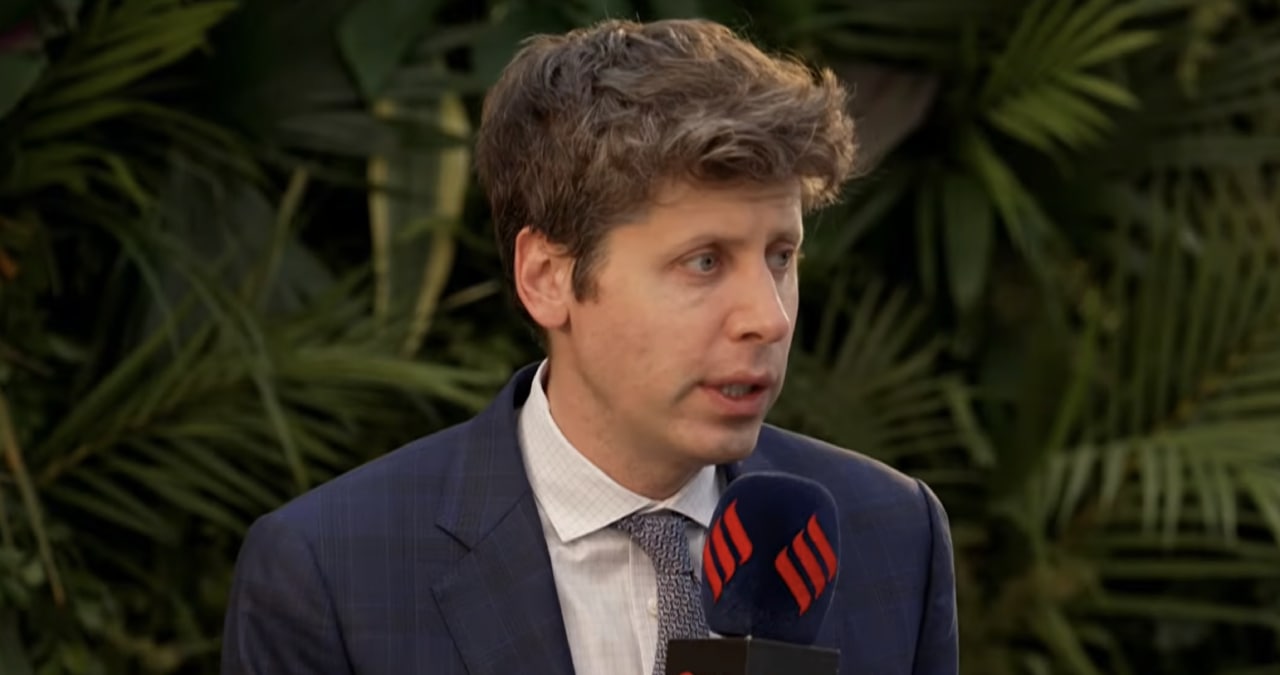
Sam Altman mocks Anthropic's 'hard questions' campaign -- 'I thought this was satire'
After an amusing exchange of words with SpaceXAI's Elon Musk, Sam Altman has now taken a fresh jab at another competitor - Anthropic. In his latest post on X, Altman dismissed a new promotional video from Anthropic, touting it as what he initially assumed to be satire, but it wasn't. The video, which asks Anthropic's users to pose the toughest of questions to AI, caught Altman's attention, leading him to call out Anthropic for silently downgrading its service and withholding access. In the post, Altman went on to say, "i thought this was satire, kept looking for the handle to be spelled c1audeai or something." In another follow-up post, he added, "hard questions are great but only if we deem you worthy enough to not silently downgrade you, or even get access at all". Altman's comment comes a day after his heated exchange of words with Elon Musk, who accused the OpenAI CEO of scamming people, with Altman calling out Musk for selling public market investors on "short-term data centres". What Anthropic's video says about AI The original Anthropic post promotes a cinematic advertising-style video and initiative inviting the public to submit their toughest, most uncomfortable questions about AI. Titled "There's hope in hard questions," the 90-second film features real voices from surveys and user conversations raising concerns such as: "Can AI be trusted?", "Will it benefit the majority of people?", impacts on jobs and society, misuse risks, and broader philosophical issues about humanity and technology. Anthropic positioned the campaign as a commitment to transparent AI. The video is based on extensive research, including a 52,000-person US survey and feedback from over 81,000 ClaudeClaude users, promising to publicly track progress on addressing these questions while admitting shortcomings. The company directs people to claude.com/hard-questions to participate. Altman accuses Anthropic of hypocrisy, gatekeeping Altman's response to Anthropic highlights the ongoing rivalry between the two AI safety-focused labs. Previously, Altman has criticised Anthropic for what he sees as an elitist approach, i.e., serving premium products to wealthier users while allegedly restricting broader access and controlling AI usage (such as blocking certain companies from their coding tools). This comes at a time when Anthropic is witnessing runaway success with its Claude Fable - an AI model that's considered among the most powerful ones available to humans today. OpenAI followed suit with its GPT-5.6 models, promising similar levels of AI processing performance. The timing of Altman's comments adds extra spice to Altman's slew of controversies, which reemerged after a while over a renewed public feud with Elon Musk. Over the weekend, Musk accused Altman of scamming, especially in light of an Apple lawsuit against OpenAI alleging trade secret theft. Musk posted jabs like "Scam Altman strikes again" and referenced alleged theft of "open source AI charity" and Apple's technology. Altman responded by highlighting benchmarks suggesting that OpenAI's latest model (5.6 Sol) as potentially the world's best, adding that "the most reliable way to tell is that elon is obsessed with me again." Musk retorted about upcoming orbital data centers and parole officer quips.
Govt denies reports of delaying OpenAI, Anthropic cybersecurity AI deployment
Report claimed a temporary pause, but the government rejected the claim. The Indian government has asked all ministries to prepare a list of the AI tools they need so these tools can be provided to them. A recent report claimed that the Ministry of Electronics and Information Technology (MeitY) advised ministries not to use cybersecurity AI models made by OpenAI and Anthropic for now. The report did not explain the reason for this advice. Furthermore, the report also claimed that the ban is at the timing of deployment and not on the tools. However, the Indian government has denied the report and said no such halt has been ordered. PIB debunks claim The Press Information Bureau (PIB), which is also the official fact-check agency for the Indian government, recently posted on its official X handle and stated that MeitY had not issued any direction or advisory asking ministries to stop the rollout or use of OpenAI or Anthropic's AI models. Furthermore, the agency also urged the citizens to rely only on official government websites and verified sources for authentic information. Also read: OpenAI asks court to make Elon Musk's xAI pay over Rs 9.5 crore after lawsuit dismissal What the report claimed about OpenAI and Anthropic AI tools According to the report, a department under MeitY had circulated an office memorandum asking ministries not to deploy cybersecurity models developed by OpenAI and Anthropic for the time being. It claimed the development came days after representatives of both companies met officials from several ministries to promote their AI tools. However, the report said it could not independently confirm how many ministries were approached or the level of those meetings. Not only that but it also claims that the Ministry of Finance had written to the department seeking approval to explore the use of agentic AI and OpenAI's GPT 5.5 model for cybersecurity work. And the ministry also outlined the possible applications of AI in the letter, including finding software vulnerabilities, strengthening cyber defence and supporting security operations. Also read: Sam Altman pokes fun at Anthropic's Claude commercial, says he thought it was satire The report also claimed that the department responded with a memorandum declining the proposal for now. However, a source quoted in the report said the response should not be considered a permanent ban. Instead, the concern was about deploying the technology too early rather than blocking its use altogether.

'Stop AI Race': Workers, students protest at OpenAI, Anthropic, Google's US offices as layoffs surge
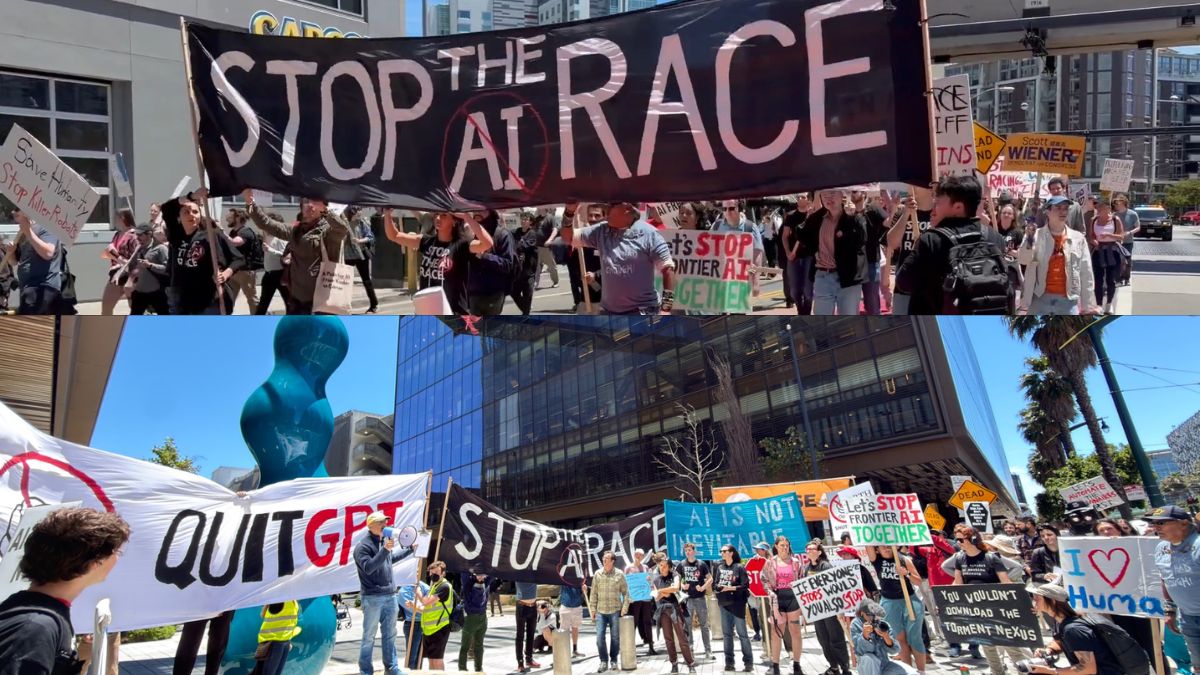
People working in artificial intelligence and students were among a San Francisco crowd of about 400 protestors marching outside the offices of prominent tech companies OpenAI, Anthropic and Google DeepMind, which are leading the AI boom while thousands of employees continue to lose their jobs in the technology sector. The high-emotion march targeting AI companies on July 11 was organised by 'Stop the AI Race.' As established on its website, the group has a single demand: "Every major AI lab CEO must publicly commit to pausing frontier model development if every other major lab in the world credibly does the same." The same message was carried this weekend as a diverse group of protestors called for greater regulation of the AI industry, demanding that companies restrict all new AI model training. Anti-AI marchers cited concerns over rising rents, job cuts, existential risk and environmental harm, as seen in a video amplified by Reuters. Anti-AI protests at OpenAI, Anthropic and Google offices in San Francisco At first demonstrators gathered in front of the Mission Bay headquarters of Sam Altman's AI startup before marching to the offices of Anthropic and Google DeepMind on Saturday (US time), according to photos of the development shared by San Francisco-based nonprofit news site Mission Local. Protesters voiced their concerns through messages displayed on the many signs and banners they carried during the event, as they condemned the rise of artificial intelligence and the subsequent phasing out of the human workforce. Some of these anti-AI messages seen during the march were: * "Stop the AI Race" * "AI is a weapon of mass destruction" * "Survival over profits" * "Pause AI" * "AI is not inevitable" * "It would be bad to get into an arms race over AI" * "Stop slop" * "It's not too late to regulate" * "In a race off a cliff no one wins" Who was behind the 'Stop the AI Race' protests in San Francisco? The Stop the AI Race march was led by activist and former AI researcher Michael Trazzi. He first gained attention for going on a hunger strike last year outside Google DeepMind's office in London while demanding that AI development be frozen. On Saturday, Trazzi ended up leading the group of AI-hating protestors to chant expletives against OpenAI's Sam Altman and Anthropic CEO Dario Amodei, the San Francisco Chronicle reported. "We are in an emergency," he told others. "The problem is they can't stop the race, unless other people stop." Before this weekend's demonstration, the former AI researcher marched on Anthropic, OpenAI and Elon Musk's xAI, calling for a conditional pause on the advancing tech, in March as well. Although neither company has directly responded to the group's demands, the 'Stop the AI Race' website alludes to DeepMind CEO Demis Hassabis reacting to calls for a collective pause on development in an interview with a Bloomberg journalist. The January interaction caught the tech leader saying, "I think so." Elsewhere, Anthropic's CEO Dario Amodei has also repeatedly brought up dangers linked to AI. His assessment even landed the company in trouble with the Donald Trump administration as Anthropic and the Pentagon clashed over the military's use of AI. "Fundamentally, the enormous returns to intelligence in terms of power in the world, combined with the rapid pace of AI's progress, creates a perfect storm for a surprise seizure of power by a range of dangerous actors," Amodei wrote in a June blog post. "The danger could take a variety of specific technological or operational forms, but what they all have in common is the idea that AI could suddenly confer enormous power while routing around existing mechanisms of democratic oversight." "A fully automated drone army that sounds like science fiction today could, in the future, obey unlawful orders and allow governments to unilaterally entrench their power; professionally-trained humans are more likely to object to such illegal direction." The rising streak of 'Stop the AI Race' protests is a lot like the recent viral trend of fresh graduates "booing" numerous tech leaders addressing their university commencement speeches at a series of graduation ceremonies this year. Several top executives in their field, including former Google CEO Eric Schmidt and Tavistock Development VP Gloria Caulfield, faced relentless backlash in real time as they prompted the inevitability of AI at US universities. On its website, the Stop the AI Race group asserts "protest marches are just the start" of the calculated retaliatory efforts against architects of AI systems who continue to obsess over one-upping each other in a cut-throat competition of their own creation. The surge in criticism against artificial intelligence aligns with massive layoff waves across the industry, costing employees their jobs. As Big Tech firms like Microsoft, Meta, and many more assume a more AI-first business strategy, more than 120,000 employees have already been laid off across 228 tech companies as of this week, according to the live layoff tracker Layoffs.fyi.
Grok gets creative tools as Musk pushes xAI deeper into image and video generation
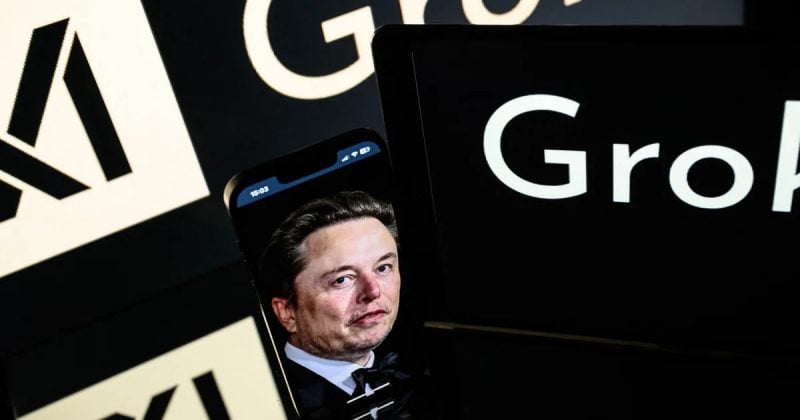
The integration of Imagine into Grok's agentic mode signals xAI's aggressive expansion into autonomous content creation, with potential ripple effects across digital asset markets. Elon Musk just gave his AI chatbot a paintbrush. And a camera. And, if he's to be believed, eventually a director's chair. On July 8, Musk announced that Grok, the conversational AI built by his company xAI, will integrate the Imagine tool for autonomous image and video generation. The key detail: Grok will be able to call Imagine dynamically in "agentic mode," meaning the AI decides on its own when to generate visual content rather than waiting for explicit user commands. What Grok's agentic mode actually means The Imagine tool itself has been evolving rapidly. Grok Imagine Video 1.5 launched around June 16-17, bringing what Musk described as significant improvements in both quality and speed. Some updates have enabled image-to-video generation in under 15 seconds. Musk predicted that Grok could produce full movies by the end of 2026. The AI content creation arms race The competitive landscape in AI-generated video has intensified dramatically over the past year, with OpenAI's Sora, Google's Veo, and a constellation of smaller startups all racing to build tools that can produce broadcast-quality video from text prompts. What makes the Grok-Imagine integration notable isn't just the technology itself. It's the distribution. Grok lives inside X (formerly Twitter). If Imagine's video generation reaches even a fraction of that audience through agentic mode, xAI instantly becomes one of the largest deployments of AI video generation in the world. Where crypto and digital assets enter the picture Musk's announcement contained zero references to cryptocurrency, blockchain, tokens, or any digital asset infrastructure. Not a single one. xAI isn't launching a token. Imagine isn't minting NFTs. There's no on-chain component to any of this.
NVIDIA Vera CPU Demand Rises as Perplexity Backs Its AI Inference Performance - OnMSFT
NVIDIA Vera CPU demand is rising as more AI firms look for faster processors built for inference and agentic AI workloads, with Perplexity now joining the list of companies backing NVIDIA's latest data center CPU. According to Reuters, Perplexity VP Nate Kupp said Vera was a strong fit for the company's core workloads, as the chip delivered around 1.5 times faster performance than traditional CPUs in agentic AI coding tasks. Why NVIDIA Vera Matters for AI Workloads NVIDIA has positioned Vera as a CPU built for AI inference, where speed, predictable latency, and strong single-threaded performance matter more than simply adding more cores. Agentic AI workloads run in repeated loops, where the CPU handles a task, sends results back, and then helps the model decide the next step. NVIDIA says conventional CPUs do not handle this pattern well because more cores do not always reduce the time each step takes. Vera uses NVIDIA's custom Olympus cores and brings 50% higher IPC than Grace, which means each core can handle more instructions while staying efficient under load. Vera Focuses on Single-Threaded Speed NVIDIA describes Vera as a "Max Single-Threaded" CPU at scale, with strong per-core performance, high memory bandwidth, and predictable latency across workloads. The chip pairs its 88 cores with up to 1.2TB/s of LPDDR5X memory bandwidth while keeping memory power below 40W. NVIDIA also says Vera's monolithic compute die provides 3.4TB/s of core-to-core bandwidth, which helps reduce bottlenecks during demanding AI tasks. Perplexity's early results show why AI companies are paying attention. NVIDIA also claims stronger results in concurrent sandboxes, SQL analytics, and real-time streaming workloads when compared with traditional x86 CPU offerings. With Vera already reaching companies such as OpenAI, xAI, Oracle, Anthropic, and Perplexity, NVIDIA is now pushing deeper into the CPU market while preparing Rosa, its next-generation data center CPU with the newer Rigel core architecture.
