News & Updates
The latest news and updates from companies in the WLTH portfolio.
Trump Kharg Island remarks hit Hormuz outlook as Polymarket Yes sinks to 4.5%
Trump Cites Kharg Island Attack, Blockade Threat -- Polymarket Shifts to "No" on Strait of Hormuz Normalization by July 3 Comments attributed to Donald Trump about a U.S. attack on Iran's Kharg Island and a possible reinstatement of a blockade of Iranian ports are being reflected in Polymarket pricing on whether Strait of Hormuz traffic returns to normal by July 31. The contract's odds have shifted sharply toward a "No" outcome as traders weigh renewed disruption risk. Key Takeaways * Polymarket prices a 95.5% chance that Strait of Hormuz traffic does not return to normal by July 31, versus 4.5% for "Yes." * The market repriced after a report citing Trump saying the U.S. attacked Kharg Island and may reinstate a blockade of Iranian ports. * The contract is set to resolve on July 31, 2026, and "Yes" odds are down 37.5 percentage points to 4.5% from 42.0%. A report cited Donald Trump saying the United States attacked Iran's Kharg Island the prior night. The report also said Trump raised the prospect that Washington could reinstate a blockade of Iranian ports. The comments pointed to a possible escalation affecting maritime activity tied to Iranian exports. The report framed the statements as a signal of potential new restrictions on shipping access. The developments come as traders monitor risks to regional sea lanes connected to the Strait of Hormuz. Polymarket Odds and Volume: "No" at 95.5%, "Yes" at 4.5% After 37.5-Point Swing on $13.33M Traded On Polymarket, the "Strait of Hormuz traffic returns to normal by July 31?" contract is trading at 4.5% for Yes and 95.5% for No, making No the clear leading outcome. The market has seen about $13.33 million in volume, with pricing implying traders see normalization by the July 31, 2026 resolution date as a low-probability scenario. The current odds reflect a steep drop in Yes pricing from a previous 42.0%, a 37.5 percentage-point swing toward No. Whether the Yes price can recover from 4.5% will likely hinge on subsequent trade flow signals ahead of the July 31, 2026 resolution date and any further repricing in the implied probabilities. Beyond the Strait of Hormuz: Other High-Volume Geopolitical and Macro Contracts Polymarket Traders Are Watching Beyond the immediate shipping-risk trade, Polymarket activity is also clustering around a broader set of Iran-linked geopolitical bets. In "Will the U.S. invade Iran before 2027?", "No" leads at 84.5%, while "Iran leader end of 2026?" shows Mojtaba Khamenei at 83.05%. Traders are also tracking diplomacy timelines, with 36.5% on a "US-Iran Final Nuclear Deal by...?" resolving on December 31, and 32.0% pointing to August 15 as the leading outcome in "Iran announces withdrawal from MOU negotiations by...?". Odds Trend By the Numbers * Platform: Polymarket * Market: Strait of Hormuz traffic returns to normal by July 31? * Resolution window: Jul 31, 2026 (UTC) * Status: Active (open for trading) * Leading implied prob.: 4.5% * Volume: ~$13,325,314 * Top outcomes: Yes: Yes 4.5% / No 95.5%; No: Yes 4.5% / No 95.5%

3 Forgotten Space Economy Stocks That Could Deliver Colossal Gains Over the Next 10 Years
The space economy is a popular investing topic right now, as Space Exploration Technologies completed its record-setting initial public offering. SpaceX stock remains a hot commodity, with the company sporting a market capitalization of more than $2 trillion. But while SpaceX is soaking up a lot of attention, several other companies are also playing important roles in building out the space economy. And while they're flying somewhat under the radar right now, I think AST SpaceMobile (NASDAQ: ASTS), Intuitive Machines (NASDAQ: LUNR), and Redwire (NYSE: RDW) have compelling cases to deliver big returns over the next decade. Missed Nvidia in 2009? This Rare Signal Is Flashing Again. In 2009, a "Double Down" signal flashed for a little-known chipmaker called Nvidia. For the first time in years, that same "Total Conviction" signal is flashing for a company 1/100th the size of Nvidia. Continue " Image source: Getty Images. 1. AST SpaceMobile The only profitable division for SpaceX right now is Starlink, the company's space-based internet and mobile connectivity network. But AST SpaceMobile is a primary competitor in the direct-to-cell satellite business. The two companies have different approaches. SpaceX currently has a constellation of 9,600 satellites in low-Earth orbit and about 10.2 million customers worldwide. AST SpaceMobile, meanwhile, aims to have a network of 45 larger BlueBird satellites in orbit this year to support its agreements with nearly 60 mobile network operators worldwide. AST announced that BlueBirds 11, 12, and 13, each measuring about 2,400 square feet, are scheduled to launch in August. "With each successful launch, we move closer to our goal of making space-based cellular broadband accessible wherever people live, work, and travel," AST SpaceMobile president Scott Wisniewski said. AST reported first-quarter revenue of $14.7 million, up from $718,000 a year ago, with a net loss of $191.01 million, or $0.66 per share. But it's growing quickly -- management projects full-year revenue of $150 million to $200 million. The company ended the quarter with $3.5 billion in cash and cash equivalents. 2. Intuitive Machines Intuitive Machines is a major NASA contractor and the first commercial company to soft-land a spacecraft on the Moon. The company successfully achieved a soft landing on the lunar surface in 2024 during its IM-1 mission, which carried the Odysseus lander. The company builds satellites and landers and is involved in NASA's Power and Propulsion Element (PPE), which is being repurposed to support NASA's planned 2028 Mars mission. Intuitive is also in a growth spurt, having recently closed its acquisition of spacecraft manufacturer Lanteris Space Systems. That allowed Intuitive to report record quarterly revenue of $186.7 million in the first quarter, nearly three times higher and driven primarily by the Lanteris deal, management said. The company reported a net loss of $52.5 million and $0.25 per share in the quarter but now has a backlog of $1.1 billion, up $852 million from Dec. 31. "The next phase of the space economy will not be defined only by who reaches new destinations," CEO Steve Altemus said. "It will be defined by who can build the infrastructure, connect it reliably, and operate it at scale. That is what Intuitive Machines is building." 3. Redwire Redwire also played a major role in a recent Moon mission, as its optical imaging and Sun sensor technologies were used in NASA's Artemis II mission, which completed a manned flyby of the Moon this year. The company is essential to figuring out how to grow food in space -- something that will be important if humanity is to realize the dream of extended spaceflight and, one day, inhabiting the Moon or other planets. It operates a greenhouse on the International Space Station, the first commercially owned facility in space to grow crops. The company reported revenue of $97 million in the first quarter, up 57.9% year over year, and projected revenue of $450 million to $500 million for the full year. Redwire had a backlog of $498.1 million at the end of the quarter. Redwire is also set up for success over the next decade, as it was one of 14 companies selected by the Space Force to compete for contracts under the 10-year Andromeda program that tracks and identifies objects in Earth orbit. The task order's size increased from $1.8 billion to $6 billion, giving Redwire plenty of opportunities to win work against a limited field of competitors. Should you buy stock in AST SpaceMobile right now? Before you buy stock in AST SpaceMobile, consider this: The Motley Fool Stock Advisor analyst team just identified what they believe are the 10 best stocks for investors to buy now... and AST SpaceMobile wasn't one of them. The 10 stocks that made the cut could produce monster returns in the coming years. Consider when Netflix made this list on December 17, 2004... if you invested $1,000 at the time of our recommendation, you'd have $410,833!* Or when Nvidia made this list on April 15, 2005... if you invested $1,000 at the time of our recommendation, you'd have $1,208,693!* Now, it's worth noting Stock Advisor's total average return is 917% -- a market-crushing outperformance compared to 209% for the S&P 500. Don't miss the latest top 10 list, available with Stock Advisor, and join an investing community built by individual investors for individual investors. See the 10 stocks " *Stock Advisor returns as of July 8, 2026. Patrick Sanders has no position in any of the stocks mentioned. The Motley Fool has positions in and recommends AST SpaceMobile and Intuitive Machines. The Motley Fool has a disclosure policy. The views and opinions expressed herein are the views and opinions of the author and do not necessarily reflect those of Nasdaq, Inc.

Wall Street Banks Are Sky-High About SpaceX, But Investors Remain Cautious
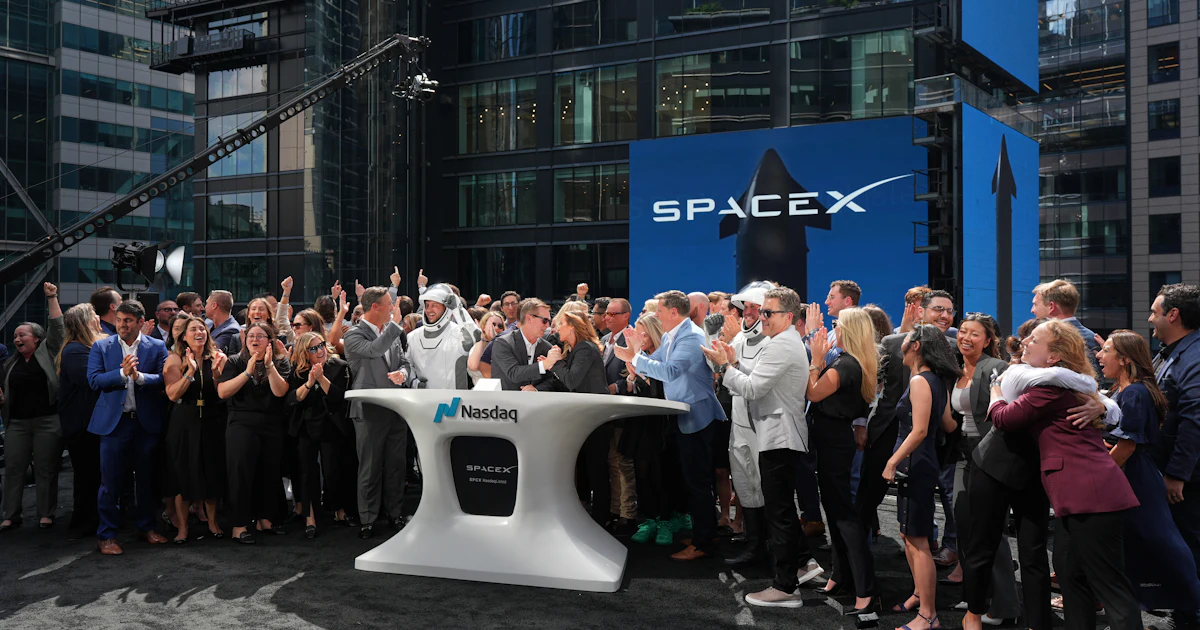
NEW YORK (AP) -- Wall Street banks have high hopes for SpaceX, but, at the moment, shares of Elon Musk's rocket market appear to be earthbound. Many of the investment firms that underwrote SpaceX's initial public offering issued their first research notes about the company Tuesday, and almost all recommended that investors buy the stock and forecast it to trade above $200 in the next 12 to 18 months. But after topping $200 in its first week of trading, the stock is trading around $150 per share, where it opened on June 12, its IPO day. Investors may be looking cautiously at the same factors that have Wall Street so enthusiastic about the stock. Analysts are focused on SpaceX's potential to lead the market for space transportation and infrastructure. The company's reusable rockets allow it to transport people and cargo into Earth's orbit and it is aiming for deeper exploration of the solar system. Most of the company's revenue currently comes from its Starlink satellites, and AI innovations are expected to advance that technology. "SpaceX's ambitions, and potential impact on humanity, are bigger than any company's we've ever seen," said a analysts from J.P. Morgan, in a research report. The bank expects the stock price to reach $225 by the end of 2027. It cited the company's competitive advantage in space transportation, with about 670 orbital launches and a nearly 99% success rate with its Falcon rockets. Most payloads launched into orbit since 2023 were through SpaceX. The company has dominated the reusable space rocket market with its Falcon 9, but its gigantic Starship rocket is the key to launching bigger pieces of cargo, including data centers. Investment bank Raymond James is by far the most optimistic. Its analysts expect the stock to eventually reach $800 per share and consider SpaceX a key industrial company for the 21st century. "Just as railroads, electric grids, and the Internet reshaped prior economic eras, we believe SpaceX is building the foundational platform for the next generation of industrial capacity," the analysts wrote in a research report. SpaceX founder Elon Musk decided to take the company public because it needs money to fund its ambitions, including putting more satellites and eventually data centers into space. It's more ambitious goals include establishing a colony on Mars. For now, Starship is still in the test phase and no technology exists to put data centers in space or send people to Mars. Wall Street analysts acknowledge that a delay or failure to establish a steady schedule of launches for Starship is a risk that could torpedo their forecasts. SpaceX ended its first day on Wall Street in June with a market value of more than $2 trillion and is still sitting around that level. That made Musk the world's first trillionaire, though his net worth has since fallen back below $1 trillion, according to Forbes. A few banks on Wall Street are more cautious about the company's prospects. Equity research firm MoffettNathanson said it sees the potential, but has given the company a more "neutral" rating and sees the stock eventually sitting at $131 per share. The concerns are over many of the unknowns related to regulatory issues, technology and demand. "It is, in short, a bet on any and all things made possible by a virtual lock on rocket manufacturing and launch," MoffettNathanson said in a report.
3 Forgotten Space Economy Stocks That Could Deliver Colossal Gains Over the Next 10 Years
The space economy is a popular investing topic right now, as Space Exploration Technologies completed its record-setting initial public offering. SpaceX stock remains a hot commodity, with the company sporting a market capitalization of more than $2 trillion. But while SpaceX is soaking up a lot of attention, several other companies are also playing important roles in building out the space economy. And while they're flying somewhat under the radar right now, I think AST SpaceMobile (NASDAQ: ASTS), Intuitive Machines (NASDAQ: LUNR), and Redwire (NYSE: RDW) have compelling cases to deliver big returns over the next decade. Missed Nvidia in 2009? This Rare Signal Is Flashing Again. In 2009, a "Double Down" signal flashed for a little-known chipmaker called Nvidia. For the first time in years, that same "Total Conviction" signal is flashing for a company 1/100th the size of Nvidia. Continue " 1. AST SpaceMobile The only profitable division for SpaceX right now is Starlink, the company's space-based internet and mobile connectivity network. But AST SpaceMobile is a primary competitor in the direct-to-cell satellite business. The two companies have different approaches. SpaceX currently has a constellation of 9,600 satellites in low-Earth orbit and about 10.2 million customers worldwide. AST SpaceMobile, meanwhile, aims to have a network of 45 larger BlueBird satellites in orbit this year to support its agreements with nearly 60 mobile network operators worldwide. AST announced that BlueBirds 11, 12, and 13, each measuring about 2,400 square feet, are scheduled to launch in August. "With each successful launch, we move closer to our goal of making space-based cellular broadband accessible wherever people live, work, and travel," AST SpaceMobile president Scott Wisniewski said. AST reported first-quarter revenue of $14.7 million, up from $718,000 a year ago, with a net loss of $191.01 million, or $0.66 per share. But it's growing quickly -- management projects full-year revenue of $150 million to $200 million. The company ended the quarter with $3.5 billion in cash and cash equivalents. 2. Intuitive Machines Intuitive Machines is a major NASA contractor and the first commercial company to soft-land a spacecraft on the Moon. The company successfully achieved a soft landing on the lunar surface in 2024 during its IM-1 mission, which carried the Odysseus lander. The company builds satellites and landers and is involved in NASA's Power and Propulsion Element (PPE), which is being repurposed to support NASA's planned 2028 Mars mission.
How TeraWulf's Anthropic Deal Booted Up a $19B AI Empire
Artificial intelligence is hitting a severe physical barrier. The language models are getting exponentially smarter, and the silicon is processing data faster than ever before, but the physical electrical grid cannot deliver power fast enough to keep up with demand. Hyperscalers require multi-gigawatt power drops and large liquid-cooling systems to train their next-generation models, and they need these facilities to be fully operational immediately. Enter the Bitcoin mining sector. For years, cryptocurrency miners have spent billions building high-density energy fortresses in remote locations. Now, operators with the right infrastructure are realizing they hold the exact real estate that artificial intelligence (AI) developers are desperate to acquire. → 3 High-Yield Dividend Stocks With Real Capital Gains Potential in 2026 The $19 Billion Jolt: Rewiring the AI Infrastructure Trade TeraWulf Inc. (NASDAQ: WULF) just provided the definitive proof of concept for this entire infrastructure crossover thesis. TeraWulf recently executed a landmark 20-year lease agreement with artificial intelligence powerhouse Anthropic, securing an estimated $19 billion in contracted revenue over the initial term. Investors should see this as more than a standard commercial real estate transaction. It represents a fundamental structural shift in how digital infrastructure operators can monetize stranded power assets. By transitioning from the highly cyclical nature of cryptocurrency mining to utility-grade data center yield, TeraWulf is setting an entirely new operational precedent for the high-performance computing (HPC) sector. → Flash Crash or Cash? The AI Hardware Reset Investors Can't Ignore Flipping the Switch: Funding a $19B Hyperscaler Empire To understand the magnitude of this transition, investors must look at the specific mechanics of the Anthropic agreement and how TeraWulf is actively funding the buildout. The 20-year lease centers on the Justified Data campus in Hawesville, Kentucky, which is a purpose-built facility designed to handle 401 megawatts of critical IT load.
Anthropic Launches Paid Fellowship Placing AI-Skilled Talent at Nonprofits | EURweb | Black News, Culture, Entertainment & More
*Anthropic wants to pay you to learn AI and put it to work for a good cause. The company behind Claude has launched Claude Corps, a fully funded, 12-month paid fellowship that places early-career talent inside mission-driven nonprofits. The program reportedly pays $85,000 with full benefits. The eligibility bar is refreshingly low. Applicants must be 18 or older, authorized to work in the United States, and have under two years of full-time work experience. No college degree is required. No coding background is needed either. Fellows work full-time on projects that help nonprofits use Claude across areas such as workforce development, public health, housing, food security, veterans services, and education. Projects might include streamlining intake processes, surfacing insights from data, or building tools that free up staff for direct service. Three organizations run the program together. Anthropic funds it and provides Claude expertise. CodePath, a national nonprofit focused on technical education, recruits, trains, and employs fellows. Social Finance administers the philanthropic capital and leads evaluation. So what are they looking for? Fast learners who already use AI tools in daily life, communicate clearly, work well with others, and have shown up for a cause they care about. Every fellow completes a Claude-focused training program before placement, so expertise is not expected. The application includes a short form, two Anthropic courses on AI fluency, and two short-answer questions. Candidates who advance complete a take-home assessment, a 25-minute conversation, and two final interviews. Selected fellows then interview with two to three host organizations to find the best fit. The deadline for the first cohort is July 17, 2026, with a start date of October 19, 2026. Applications remain open on a rolling basis for January 2027 and August 2027 cohorts. All first-cohort placements are in person, and relocation costs are covered. Visit the website for more information and apply to the program. MORE NEWS ON EURWEB.COM: Tech Leaders Signal the Beginning of the End for Smartphones

After SpaceX, what investors must know about OpenAI and Anthropic IPOs
OpenAI and Anthropic, two of the leading artificial intelligence giants, are gearing up to hit the stock market for the first time through initial public offerings (IPO). The $2 trillion SpaceX IPO has shown that investor enthusiasm for AI companies is at fever pitch. While the shares in the rocket tech and AI firm have fallen back since, the fact that they shot up from the $135 IPO price to top $200 illustrates this, despite falling back somewhat afterwards. So what does that mean for OpenAI and Anthropic? This is a trillion-dollar question. Both companies have already made their 'S1 filings' in America, which acts as the regulatory starting gun on an IPO. There is no exact timeline announced for either company though, with estimates ranging from this autumn to the beginning of 2027. It was earlier thought that the OpenAI deal would follow very soon after SpaceX and take place in late summer or early Autumn. A change of plan has occurred though, with reports indicating executives including CEO Sam Altman decided it is still too early to get the best possible outcome from an IPO. With the company targeting a valuation of over a trillion dollars, they are wary of getting the timing wrong by going to the market when investor appetites are still recovering from the SpaceX deal, and while the huge volatility that shares in the rocket company have seen may have scared some investors away. It has also been reported that OpenAI revenues are not yet high enough to secure the stock market valuation its team wants, but may be so by next year. Anthropic is still expected to push ahead with its plans to do its IPO soon, with October suggested as the likeliest timeframe. Buying shares in either OpenAI or Anthropic - once available - is arguably one of the purest, most direct ways to profit from the AI boom in the long run. Owning a piece of either company would give you a stake in the future of AI. How much you believe in this future, and how profitable it will be for the companies involved, is the question you must contend with if considering an investment. While it is all far from guaranteed, if even a small proportion of the vast potential of AI is delivered upon in the coming years, whichever companies are at the forefront are sure to make huge amounts of money, and shares in them will potentially rise significantly over time. OpenAI's ChatGPT and Anthropic's Claude services have already shown impressive capabilities, and the companies are raking in billions of dollars in subscription fees from their users. That certainly shows these companies have moved far beyond theory and speculation - but it does not guarantee continued progress. Both companies are very well established already, both in practical terms such as securing relationships with key infrastructure suppliers, and in establishing their brand as cutting-edge AI firms. It will be hard for new players to overthrow them. The biggest concern over investing in OpenAI or Anthropic is execution risk, or the possibility that the business project isn't carried out as successfully as planned. The companies are both essentially being valued on what they will do in the future rather than what they do now and predicting whether they can deliver on their potential plans is not certain. Both companies have already produced groundbreaking technology and are continuing to innovate at pace, but what they have done so far does not justify the kind of trillion-dollar-plus valuations they are expected to target in their IPOs. While both firms are making significant revenues through subscriptions to their services, that is not the same as profits - because they are spending cash at phenomenal rates. The computer components required to run cutting edge AI models cost billions of dollars to buy at scale, and also have large electricity costs attached to running them. That is before you even pay the people who are working for the companies. There is also a large shadow cast over all American AI companies in the shape of China. The arrival of DeepSeek AI models last year was a wake-up call to American firms and investor, highlighting the risk that Chinese companies could offer similar AI services at much lower cost, or even for free. Another significant risk relating specifically to the IPOs is the share price volatility that may occur. SpaceX shares moved up and down dramatically in the days that followed the IPO and there is every chance OpenAI and Anthropic shares will too. Buying at the wrong time could leave you with a hefty paper loss, at least in the short term. The SpaceX IPO was made available to UK investors via some of the major investment platforms. It is likely to be similar for OpenAI and Anthropic when the IPOs take place. Once you have an account with a platform that offers IPO access, it is relatively simple to follow the menu system on their website and find the specific details of how to take part. While you cannot invest in either company directly before the IPOs it is straightforward to get exposure to many of the companies involved in AI via thematic exchange-traded funds (ETFs). There are many ETFs that offer exposure to the AI theme broadly, or specific parts on the industry such as semiconductors or GPUs, the computer chips which the likes of GPT and Claude are run on. Another option if you do not want to wait is to target the AI firms which already offer listed shares, such as Google (Alphabet), Meta Platforms, SpaceX and Microsoft.

Morgan Stanley sends strong signal on SpaceX stock price target
SpaceX priced its IPO at $135 on June 12, raised $85.7 billion, and watched the stock run to $225 in its first week of trading before it pulled back to $160. Twenty-five days later, the mandatory quiet period for IPO underwriters expired. The analyst notes started landing at dawn on July 7. By the time US markets opened, six major banks had initiated coverage of SpaceX ($SPCX), every one of them with a buy-equivalent rating. The same morning, SpaceX joined the Nasdaq-100. JPMorgan estimates the index inclusion alone sent roughly $4.3 billion in passive buying into the stock. What Morgan Stanley's $300 target is actually saying Adam Jonas, who led the Morgan Stanley coverage, set his base case at $300, representing 87% upside from the July 7 price of $160.42, according to Yahoo Finance. He left room for a $600 bull case. The bear case sits at $75. Morgan Stanley called the range intentionally wide, and it is: a $75 to $600 spread on a single stock is not a forecast, it's an acknowledgment that nobody really knows. The thesis is not primarily about rockets. Jonas is betting on vertical integration at a scale that has never been attempted. The note describes SpaceX as one of the few companies that can link orbital real estate, global connectivity, and computing capacity into one infrastructure stack. The word "frontier" in the report's title refers to AI, not space. More Elon Musk: "SpaceX can convert energy into intelligence at scale and monetize it through diverse consumer and enterprise solutions, leading the next era of AI," Morgan Stanley analysts wrote, according to Yahoo Finance. Morgan Stanley also flagged Cursor's estimated $4 billion in annual recurring revenue as an asset the market is undervaluing. SpaceX acquired Cursor's parent company Anysphere in a $60 billion deal, as TheStreet reported. On revenue, Jonas projects SpaceX hitting $319 billion by 2030 and $3.3 trillion by 2040. The company posted $18.67 billion in revenue in 2025 at a net loss of $4.94 billion. Goldman Sachs came in lower and the gap is enormous Goldman Sachs analyst Eric Sheridan set a $205 target, still a Buy, but the difference in implied valuation between $205 and $300 on a company the size of SpaceX works out to more than $1 trillion. Both men work at firms that underwrote the IPO, Quartz reported, which is worth keeping in mind when reading either note. Goldman's projections are aggressive on their own terms. The bank expects SpaceX to double sales this year, reach $352 billion in adjusted EBITDA by 2030, and turn free cash flow positive by 2031. Morgan Stanley's model doesn't reach positive free cash flow until 2035. Goldman also projects SpaceX's AI revenue growing from $3.2 billion in 2025 to $322 billion by 2030, roughly a hundredfold. That depends almost entirely on the February 2026 merger with xAI and on Musk's ambitions for orbital data centers actually working at commercial scale. Goldman is bullish, but as TheStreet reported, the bank is clear that SpaceX still needs to scale Starship, prove space-based AI compute, keep Starlink growing, and manage heavy capital needs without reliable positive cash flow. The bull case is big. So is the burden of proof. Raymond James went to $800 and the rest of the Street piled in Raymond James opened at $800 with a Strong Buy, calling SpaceX "one of the defining industrial infrastructure companies of the 21st Century," according to CNBC. That is the highest target on the street. Citi came in at $200 with a path to $900 or more. UBS set $210, Macquarie $250, Wells Fargo $230, Bank of America $235. LSEG data showed buy and strong buy ratings making up roughly two-thirds of all analyst recommendations on SpaceX by the end of July 7. SpaceX joining the Nasdaq-100 that same morning added another layer of demand. The company qualified under Nasdaq's revised fast-track rules, allowing newly listed companies to enter the index after just 15 trading days rather than waiting for the quarterly rebalance, as TheStreet reported. JPMorgan estimates the inclusion pushed $4.3 billion in passive inflows into the stock from funds benchmarked to the index. What investors need to weigh before acting on any of this SpaceX is trading at a price-to-sales ratio above 112. The stock has seen double-digit daily swings in multiple sessions since its June debut. Insider lockup expirations and the company's small public float create near-term volatility risk that no price target fully accounts for. The first major insider sell window opens with second-quarter earnings in August, when 20% of insiders become eligible to sell. On the target ranges alone, even the bears on Wall Street see upside. The lowest buy-side target, Goldman's $205, still implies roughly 28% upside from where the stock was trading on July 7. Morgan Stanley's $300 implies 87%. Raymond James at $800 implies the stock quintuples from here. Both Morgan Stanley and Goldman Sachs were lead underwriters on the $85.7 billion IPO. Banks in that position have a financial interest in the stock performing well in the aftermarket. That doesn't make their analysis wrong, but it is a relevant fact when six buy ratings land on the same morning the quiet period expires. The Arena Media Brands, LLC THESTREET is a registered trademark of TheStreet, Inc. This story was originally published July 8, 2026 at 9:33 AM.
Morgan Stanley sends strong signal on SpaceX stock price target
SpaceX priced its IPO at $135 on June 12, raised $85.7 billion, and watched the stock run to $225 in its first week of trading before it pulled back to $160. Twenty-five days later, the mandatory quiet period for IPO underwriters expired. The analyst notes started landing at dawn on July 7. By the time US markets opened, six major banks had initiated coverage of SpaceX ($SPCX), every one of them with a buy-equivalent rating. The same morning, SpaceX joined the Nasdaq-100. JPMorgan estimates the index inclusion alone sent roughly $4.3 billion in passive buying into the stock. What Morgan Stanley's $300 target is actually saying Adam Jonas, who led the Morgan Stanley coverage, set his base case at $300, representing 87% upside from the July 7 price of $160.42, according to Yahoo Finance. He left room for a $600 bull case. The bear case sits at $75. Morgan Stanley called the range intentionally wide, and it is: a $75 to $600 spread on a single stock is not a forecast, it's an acknowledgment that nobody really knows. The thesis is not primarily about rockets. Jonas is betting on vertical integration at a scale that has never been attempted. The note describes SpaceX as one of the few companies that can link orbital real estate, global connectivity, and computing capacity into one infrastructure stack. The word "frontier" in the report's title refers to AI, not space. More Elon Musk: "SpaceX can convert energy into intelligence at scale and monetize it through diverse consumer and enterprise solutions, leading the next era of AI," Morgan Stanley analysts wrote, according to Yahoo Finance. Morgan Stanley also flagged Cursor's estimated $4 billion in annual recurring revenue as an asset the market is undervaluing. SpaceX acquired Cursor's parent company Anysphere in a $60 billion deal, as TheStreet reported. On revenue, Jonas projects SpaceX hitting $319 billion by 2030 and $3.3 trillion by 2040. The company posted $18.67 billion in revenue in 2025 at a net loss of $4.94 billion. Goldman Sachs came in lower and the gap is enormous Goldman Sachs analyst Eric Sheridan set a $205 target, still a Buy, but the difference in implied valuation between $205 and $300 on a company the size of SpaceX works out to more than $1 trillion. Both men work at firms that underwrote the IPO, Quartz reported, which is worth keeping in mind when reading either note. Goldman's projections are aggressive on their own terms. The bank expects SpaceX to double sales this year, reach $352 billion in adjusted EBITDA by 2030, and turn free cash flow positive by 2031. Morgan Stanley's model doesn't reach positive free cash flow until 2035. Goldman also projects SpaceX's AI revenue growing from $3.2 billion in 2025 to $322 billion by 2030, roughly a hundredfold. That depends almost entirely on the February 2026 merger with xAI and on Musk's ambitions for orbital data centers actually working at commercial scale. Goldman is bullish, but as TheStreet reported, the bank is clear that SpaceX still needs to scale Starship, prove space-based AI compute, keep Starlink growing, and manage heavy capital needs without reliable positive cash flow. The bull case is big. So is the burden of proof. Raymond James went to $800 and the rest of the Street piled in Raymond James opened at $800 with a Strong Buy, calling SpaceX "one of the defining industrial infrastructure companies of the 21st Century," according to CNBC. That is the highest target on the street. Citi came in at $200 with a path to $900 or more. UBS set $210, Macquarie $250, Wells Fargo $230, Bank of America $235. LSEG data showed buy and strong buy ratings making up roughly two-thirds of all analyst recommendations on SpaceX by the end of July 7. SpaceX joining the Nasdaq-100 that same morning added another layer of demand. The company qualified under Nasdaq's revised fast-track rules, allowing newly listed companies to enter the index after just 15 trading days rather than waiting for the quarterly rebalance, as TheStreet reported. JPMorgan estimates the inclusion pushed $4.3 billion in passive inflows into the stock from funds benchmarked to the index. What investors need to weigh before acting on any of this SpaceX is trading at a price-to-sales ratio above 112. The stock has seen double-digit daily swings in multiple sessions since its June debut. Insider lockup expirations and the company's small public float create near-term volatility risk that no price target fully accounts for. The first major insider sell window opens with second-quarter earnings in August, when 20% of insiders become eligible to sell. On the target ranges alone, even the bears on Wall Street see upside. The lowest buy-side target, Goldman's $205, still implies roughly 28% upside from where the stock was trading on July 7. Morgan Stanley's $300 implies 87%. Raymond James at $800 implies the stock quintuples from here. Both Morgan Stanley and Goldman Sachs were lead underwriters on the $85.7 billion IPO. Banks in that position have a financial interest in the stock performing well in the aftermarket. That doesn't make their analysis wrong, but it is a relevant fact when six buy ratings land on the same morning the quiet period expires. The Arena Media Brands, LLC THESTREET is a registered trademark of TheStreet, Inc. This story was originally published July 8, 2026 at 8:33 AM.
Morgan Stanley sends strong signal on SpaceX stock price target
SpaceX priced its IPO at $135 on June 12, raised $85.7 billion, and watched the stock run to $225 in its first week of trading before it pulled back to $160. Twenty-five days later, the mandatory quiet period for IPO underwriters expired. The analyst notes started landing at dawn on July 7. By the time US markets opened, six major banks had initiated coverage of SpaceX ($SPCX), every one of them with a buy-equivalent rating. The same morning, SpaceX joined the Nasdaq-100. JPMorgan estimates the index inclusion alone sent roughly $4.3 billion in passive buying into the stock. What Morgan Stanley's $300 target is actually saying Adam Jonas, who led the Morgan Stanley coverage, set his base case at $300, representing 87% upside from the July 7 price of $160.42, according to Yahoo Finance. He left room for a $600 bull case. The bear case sits at $75. Morgan Stanley called the range intentionally wide, and it is: a $75 to $600 spread on a single stock is not a forecast, it's an acknowledgment that nobody really knows. The thesis is not primarily about rockets. Jonas is betting on vertical integration at a scale that has never been attempted. The note describes SpaceX as one of the few companies that can link orbital real estate, global connectivity, and computing capacity into one infrastructure stack. The word "frontier" in the report's title refers to AI, not space. More Elon Musk: "SpaceX can convert energy into intelligence at scale and monetize it through diverse consumer and enterprise solutions, leading the next era of AI," Morgan Stanley analysts wrote, according to Yahoo Finance. Morgan Stanley also flagged Cursor's estimated $4 billion in annual recurring revenue as an asset the market is undervaluing. SpaceX acquired Cursor's parent company Anysphere in a $60 billion deal, as TheStreet reported. On revenue, Jonas projects SpaceX hitting $319 billion by 2030 and $3.3 trillion by 2040. The company posted $18.67 billion in revenue in 2025 at a net loss of $4.94 billion. Goldman Sachs came in lower and the gap is enormous Goldman Sachs analyst Eric Sheridan set a $205 target, still a Buy, but the difference in implied valuation between $205 and $300 on a company the size of SpaceX works out to more than $1 trillion. Both men work at firms that underwrote the IPO, Quartz reported, which is worth keeping in mind when reading either note. Goldman's projections are aggressive on their own terms. The bank expects SpaceX to double sales this year, reach $352 billion in adjusted EBITDA by 2030, and turn free cash flow positive by 2031. Morgan Stanley's model doesn't reach positive free cash flow until 2035. Goldman also projects SpaceX's AI revenue growing from $3.2 billion in 2025 to $322 billion by 2030, roughly a hundredfold. That depends almost entirely on the February 2026 merger with xAI and on Musk's ambitions for orbital data centers actually working at commercial scale. Goldman is bullish, but as TheStreet reported, the bank is clear that SpaceX still needs to scale Starship, prove space-based AI compute, keep Starlink growing, and manage heavy capital needs without reliable positive cash flow. The bull case is big. So is the burden of proof. Raymond James went to $800 and the rest of the Street piled in Raymond James opened at $800 with a Strong Buy, calling SpaceX "one of the defining industrial infrastructure companies of the 21st Century," according to CNBC. That is the highest target on the street. Citi came in at $200 with a path to $900 or more. UBS set $210, Macquarie $250, Wells Fargo $230, Bank of America $235. LSEG data showed buy and strong buy ratings making up roughly two-thirds of all analyst recommendations on SpaceX by the end of July 7. SpaceX joining the Nasdaq-100 that same morning added another layer of demand. The company qualified under Nasdaq's revised fast-track rules, allowing newly listed companies to enter the index after just 15 trading days rather than waiting for the quarterly rebalance, as TheStreet reported. JPMorgan estimates the inclusion pushed $4.3 billion in passive inflows into the stock from funds benchmarked to the index. What investors need to weigh before acting on any of this SpaceX is trading at a price-to-sales ratio above 112. The stock has seen double-digit daily swings in multiple sessions since its June debut. Insider lockup expirations and the company's small public float create near-term volatility risk that no price target fully accounts for. The first major insider sell window opens with second-quarter earnings in August, when 20% of insiders become eligible to sell. On the target ranges alone, even the bears on Wall Street see upside. The lowest buy-side target, Goldman's $205, still implies roughly 28% upside from where the stock was trading on July 7. Morgan Stanley's $300 implies 87%. Raymond James at $800 implies the stock quintuples from here. Both Morgan Stanley and Goldman Sachs were lead underwriters on the $85.7 billion IPO. Banks in that position have a financial interest in the stock performing well in the aftermarket. That doesn't make their analysis wrong, but it is a relevant fact when six buy ratings land on the same morning the quiet period expires. The Arena Media Brands, LLC THESTREET is a registered trademark of TheStreet, Inc. This story was originally published July 8, 2026 at 9:33 AM.
Morgan Stanley sends strong signal on SpaceX stock price target
SpaceX priced its IPO at $135 on June 12, raised $85.7 billion, and watched the stock run to $225 in its first week of trading before it pulled back to $160. Twenty-five days later, the mandatory quiet period for IPO underwriters expired. The analyst notes started landing at dawn on July 7. By the time US markets opened, six major banks had initiated coverage of SpaceX ($SPCX), every one of them with a buy-equivalent rating. The same morning, SpaceX joined the Nasdaq-100. JPMorgan estimates the index inclusion alone sent roughly $4.3 billion in passive buying into the stock. What Morgan Stanley's $300 target is actually saying Adam Jonas, who led the Morgan Stanley coverage, set his base case at $300, representing 87% upside from the July 7 price of $160.42, according to Yahoo Finance. He left room for a $600 bull case. The bear case sits at $75. Morgan Stanley called the range intentionally wide, and it is: a $75 to $600 spread on a single stock is not a forecast, it's an acknowledgment that nobody really knows. The thesis is not primarily about rockets. Jonas is betting on vertical integration at a scale that has never been attempted. The note describes SpaceX as one of the few companies that can link orbital real estate, global connectivity, and computing capacity into one infrastructure stack. The word "frontier" in the report's title refers to AI, not space. More Elon Musk: "SpaceX can convert energy into intelligence at scale and monetize it through diverse consumer and enterprise solutions, leading the next era of AI," Morgan Stanley analysts wrote, according to Yahoo Finance. Morgan Stanley also flagged Cursor's estimated $4 billion in annual recurring revenue as an asset the market is undervaluing. SpaceX acquired Cursor's parent company Anysphere in a $60 billion deal, as TheStreet reported. On revenue, Jonas projects SpaceX hitting $319 billion by 2030 and $3.3 trillion by 2040. The company posted $18.67 billion in revenue in 2025 at a net loss of $4.94 billion. Goldman Sachs came in lower and the gap is enormous Goldman Sachs analyst Eric Sheridan set a $205 target, still a Buy, but the difference in implied valuation between $205 and $300 on a company the size of SpaceX works out to more than $1 trillion. Both men work at firms that underwrote the IPO, Quartz reported, which is worth keeping in mind when reading either note. Goldman's projections are aggressive on their own terms. The bank expects SpaceX to double sales this year, reach $352 billion in adjusted EBITDA by 2030, and turn free cash flow positive by 2031. Morgan Stanley's model doesn't reach positive free cash flow until 2035. Goldman also projects SpaceX's AI revenue growing from $3.2 billion in 2025 to $322 billion by 2030, roughly a hundredfold. That depends almost entirely on the February 2026 merger with xAI and on Musk's ambitions for orbital data centers actually working at commercial scale. Goldman is bullish, but as TheStreet reported, the bank is clear that SpaceX still needs to scale Starship, prove space-based AI compute, keep Starlink growing, and manage heavy capital needs without reliable positive cash flow. The bull case is big. So is the burden of proof. Raymond James went to $800 and the rest of the Street piled in Raymond James opened at $800 with a Strong Buy, calling SpaceX "one of the defining industrial infrastructure companies of the 21st Century," according to CNBC. That is the highest target on the street. Citi came in at $200 with a path to $900 or more. UBS set $210, Macquarie $250, Wells Fargo $230, Bank of America $235. LSEG data showed buy and strong buy ratings making up roughly two-thirds of all analyst recommendations on SpaceX by the end of July 7. SpaceX joining the Nasdaq-100 that same morning added another layer of demand. The company qualified under Nasdaq's revised fast-track rules, allowing newly listed companies to enter the index after just 15 trading days rather than waiting for the quarterly rebalance, as TheStreet reported. JPMorgan estimates the inclusion pushed $4.3 billion in passive inflows into the stock from funds benchmarked to the index. What investors need to weigh before acting on any of this SpaceX is trading at a price-to-sales ratio above 112. The stock has seen double-digit daily swings in multiple sessions since its June debut. Insider lockup expirations and the company's small public float create near-term volatility risk that no price target fully accounts for. The first major insider sell window opens with second-quarter earnings in August, when 20% of insiders become eligible to sell. On the target ranges alone, even the bears on Wall Street see upside. The lowest buy-side target, Goldman's $205, still implies roughly 28% upside from where the stock was trading on July 7. Morgan Stanley's $300 implies 87%. Raymond James at $800 implies the stock quintuples from here. Both Morgan Stanley and Goldman Sachs were lead underwriters on the $85.7 billion IPO. Banks in that position have a financial interest in the stock performing well in the aftermarket. That doesn't make their analysis wrong, but it is a relevant fact when six buy ratings land on the same morning the quiet period expires. The Arena Media Brands, LLC THESTREET is a registered trademark of TheStreet, Inc. This story was originally published July 8, 2026 at 8:33 AM.
Morgan Stanley sends strong signal on SpaceX stock price target
SpaceX priced its IPO at $135 on June 12, raised $85.7 billion, and watched the stock run to $225 in its first week of trading before it pulled back to $160. Twenty-five days later, the mandatory quiet period for IPO underwriters expired. The analyst notes started landing at dawn on July 7. By the time US markets opened, six major banks had initiated coverage of SpaceX ($SPCX), every one of them with a buy-equivalent rating. The same morning, SpaceX joined the Nasdaq-100. JPMorgan estimates the index inclusion alone sent roughly $4.3 billion in passive buying into the stock. What Morgan Stanley's $300 target is actually saying Adam Jonas, who led the Morgan Stanley coverage, set his base case at $300, representing 87% upside from the July 7 price of $160.42, according to Yahoo Finance. He left room for a $600 bull case. The bear case sits at $75. Morgan Stanley called the range intentionally wide, and it is: a $75 to $600 spread on a single stock is not a forecast, it's an acknowledgment that nobody really knows. The thesis is not primarily about rockets. Jonas is betting on vertical integration at a scale that has never been attempted. The note describes SpaceX as one of the few companies that can link orbital real estate, global connectivity, and computing capacity into one infrastructure stack. The word "frontier" in the report's title refers to AI, not space. More Elon Musk: "SpaceX can convert energy into intelligence at scale and monetize it through diverse consumer and enterprise solutions, leading the next era of AI," Morgan Stanley analysts wrote, according to Yahoo Finance. Morgan Stanley also flagged Cursor's estimated $4 billion in annual recurring revenue as an asset the market is undervaluing. SpaceX acquired Cursor's parent company Anysphere in a $60 billion deal, as TheStreet reported. On revenue, Jonas projects SpaceX hitting $319 billion by 2030 and $3.3 trillion by 2040. The company posted $18.67 billion in revenue in 2025 at a net loss of $4.94 billion. Goldman Sachs came in lower and the gap is enormous Goldman Sachs analyst Eric Sheridan set a $205 target, still a Buy, but the difference in implied valuation between $205 and $300 on a company the size of SpaceX works out to more than $1 trillion. Both men work at firms that underwrote the IPO, Quartz reported, which is worth keeping in mind when reading either note. Goldman's projections are aggressive on their own terms. The bank expects SpaceX to double sales this year, reach $352 billion in adjusted EBITDA by 2030, and turn free cash flow positive by 2031. Morgan Stanley's model doesn't reach positive free cash flow until 2035. Goldman also projects SpaceX's AI revenue growing from $3.2 billion in 2025 to $322 billion by 2030, roughly a hundredfold. That depends almost entirely on the February 2026 merger with xAI and on Musk's ambitions for orbital data centers actually working at commercial scale. Goldman is bullish, but as TheStreet reported, the bank is clear that SpaceX still needs to scale Starship, prove space-based AI compute, keep Starlink growing, and manage heavy capital needs without reliable positive cash flow. The bull case is big. So is the burden of proof. Raymond James went to $800 and the rest of the Street piled in Raymond James opened at $800 with a Strong Buy, calling SpaceX "one of the defining industrial infrastructure companies of the 21st Century," according to CNBC. That is the highest target on the street. Citi came in at $200 with a path to $900 or more. UBS set $210, Macquarie $250, Wells Fargo $230, Bank of America $235. LSEG data showed buy and strong buy ratings making up roughly two-thirds of all analyst recommendations on SpaceX by the end of July 7. SpaceX joining the Nasdaq-100 that same morning added another layer of demand. The company qualified under Nasdaq's revised fast-track rules, allowing newly listed companies to enter the index after just 15 trading days rather than waiting for the quarterly rebalance, as TheStreet reported. JPMorgan estimates the inclusion pushed $4.3 billion in passive inflows into the stock from funds benchmarked to the index. What investors need to weigh before acting on any of this SpaceX is trading at a price-to-sales ratio above 112. The stock has seen double-digit daily swings in multiple sessions since its June debut. Insider lockup expirations and the company's small public float create near-term volatility risk that no price target fully accounts for. The first major insider sell window opens with second-quarter earnings in August, when 20% of insiders become eligible to sell. On the target ranges alone, even the bears on Wall Street see upside. The lowest buy-side target, Goldman's $205, still implies roughly 28% upside from where the stock was trading on July 7. Morgan Stanley's $300 implies 87%. Raymond James at $800 implies the stock quintuples from here. Both Morgan Stanley and Goldman Sachs were lead underwriters on the $85.7 billion IPO. Banks in that position have a financial interest in the stock performing well in the aftermarket. That doesn't make their analysis wrong, but it is a relevant fact when six buy ratings land on the same morning the quiet period expires. The Arena Media Brands, LLC THESTREET is a registered trademark of TheStreet, Inc. This story was originally published July 8, 2026 at 9:33 AM.
Morgan Stanley sends strong signal on SpaceX stock price target
SpaceX priced its IPO at $135 on June 12, raised $85.7 billion, and watched the stock run to $225 in its first week of trading before it pulled back to $160. Twenty-five days later, the mandatory quiet period for IPO underwriters expired. The analyst notes started landing at dawn on July 7. By the time US markets opened, six major banks had initiated coverage of SpaceX ($SPCX), every one of them with a buy-equivalent rating. The same morning, SpaceX joined the Nasdaq-100. JPMorgan estimates the index inclusion alone sent roughly $4.3 billion in passive buying into the stock. What Morgan Stanley's $300 target is actually saying Adam Jonas, who led the Morgan Stanley coverage, set his base case at $300, representing 87% upside from the July 7 price of $160.42, according to Yahoo Finance. He left room for a $600 bull case. The bear case sits at $75. Morgan Stanley called the range intentionally wide, and it is: a $75 to $600 spread on a single stock is not a forecast, it's an acknowledgment that nobody really knows. The thesis is not primarily about rockets. Jonas is betting on vertical integration at a scale that has never been attempted. The note describes SpaceX as one of the few companies that can link orbital real estate, global connectivity, and computing capacity into one infrastructure stack. The word "frontier" in the report's title refers to AI, not space. More Elon Musk: "SpaceX can convert energy into intelligence at scale and monetize it through diverse consumer and enterprise solutions, leading the next era of AI," Morgan Stanley analysts wrote, according to Yahoo Finance. Morgan Stanley also flagged Cursor's estimated $4 billion in annual recurring revenue as an asset the market is undervaluing. SpaceX acquired Cursor's parent company Anysphere in a $60 billion deal, as TheStreet reported. On revenue, Jonas projects SpaceX hitting $319 billion by 2030 and $3.3 trillion by 2040. The company posted $18.67 billion in revenue in 2025 at a net loss of $4.94 billion. Goldman Sachs came in lower and the gap is enormous Goldman Sachs analyst Eric Sheridan set a $205 target, still a Buy, but the difference in implied valuation between $205 and $300 on a company the size of SpaceX works out to more than $1 trillion. Both men work at firms that underwrote the IPO, Quartz reported, which is worth keeping in mind when reading either note. Goldman's projections are aggressive on their own terms. The bank expects SpaceX to double sales this year, reach $352 billion in adjusted EBITDA by 2030, and turn free cash flow positive by 2031. Morgan Stanley's model doesn't reach positive free cash flow until 2035. Goldman also projects SpaceX's AI revenue growing from $3.2 billion in 2025 to $322 billion by 2030, roughly a hundredfold. That depends almost entirely on the February 2026 merger with xAI and on Musk's ambitions for orbital data centers actually working at commercial scale. Goldman is bullish, but as TheStreet reported, the bank is clear that SpaceX still needs to scale Starship, prove space-based AI compute, keep Starlink growing, and manage heavy capital needs without reliable positive cash flow. The bull case is big. So is the burden of proof. Raymond James went to $800 and the rest of the Street piled in Raymond James opened at $800 with a Strong Buy, calling SpaceX "one of the defining industrial infrastructure companies of the 21st Century," according to CNBC. That is the highest target on the street. Citi came in at $200 with a path to $900 or more. UBS set $210, Macquarie $250, Wells Fargo $230, Bank of America $235. LSEG data showed buy and strong buy ratings making up roughly two-thirds of all analyst recommendations on SpaceX by the end of July 7. SpaceX joining the Nasdaq-100 that same morning added another layer of demand. The company qualified under Nasdaq's revised fast-track rules, allowing newly listed companies to enter the index after just 15 trading days rather than waiting for the quarterly rebalance, as TheStreet reported. JPMorgan estimates the inclusion pushed $4.3 billion in passive inflows into the stock from funds benchmarked to the index. What investors need to weigh before acting on any of this SpaceX is trading at a price-to-sales ratio above 112. The stock has seen double-digit daily swings in multiple sessions since its June debut. Insider lockup expirations and the company's small public float create near-term volatility risk that no price target fully accounts for. The first major insider sell window opens with second-quarter earnings in August, when 20% of insiders become eligible to sell. On the target ranges alone, even the bears on Wall Street see upside. The lowest buy-side target, Goldman's $205, still implies roughly 28% upside from where the stock was trading on July 7. Morgan Stanley's $300 implies 87%. Raymond James at $800 implies the stock quintuples from here. Both Morgan Stanley and Goldman Sachs were lead underwriters on the $85.7 billion IPO. Banks in that position have a financial interest in the stock performing well in the aftermarket. That doesn't make their analysis wrong, but it is a relevant fact when six buy ratings land on the same morning the quiet period expires. The Arena Media Brands, LLC THESTREET is a registered trademark of TheStreet, Inc. This story was originally published July 8, 2026 at 6:33 AM.
Tankers turn back after attacks, Polymarket sees 57.5% Hormuz normal by Dec 31
Strait of Hormuz tanker turnbacks after vessel attacks send Polymarket "traffic returns to normal" odds sliding A report that four oil and gas tankers turned back from the Strait of Hormuz after vessel attacks has coincided with a sharp repricing in Polymarket's "Strait of Hormuz traffic returns to normal by December 31?" contract. The market's implied probability for a return to normal traffic has fallen to 57.5% from 85.5%. Key Takeaways * Polymarket prices a 57.5% chance that Strait of Hormuz traffic returns to normal by Dec. 31, 2026. * Traders marked the contract lower after reports that four oil and gas tankers turned back following vessel attacks. * The market resolves on Dec. 31, 2026; "Yes" is 57.5% and "No" is 42.5% at the latest update. Four oil and gas tankers turned back from the Strait of Hormuz after vessel attacks, according to a report published on July 8, 2026. The incident affected shipping activity linked to energy cargoes moving through the waterway. The report described the vessels as reversing course in response to the attacks. The development highlights the operational risk for commercial traffic in the strait. It also underscores how security incidents can disrupt routing decisions for tankers transiting the area. Polymarket pricing update: Yes drops to 57.5% from 85.5% as matched volume hits $4.55M On Polymarket, the "Strait of Hormuz traffic returns to normal by December 31?" market shows Yes at 57.5% versus No at 42.5%, a 28-point drop from the prior 85.5% reading for Yes. Total matched volume stands at $4,547,172, indicating sustained liquidity even as sentiment shifted. With Yes still leading but only by 15 points, pricing implies traders see a meaningful risk that normal traffic conditions are not restored by the Dec. 31, 2026 resolution date. Traders will watch for further shifts in the Yes/No spread and whether volume accelerates as the market approaches the Dec. 31, 2026 resolution date. Beyond the Strait of Hormuz: other high-volume geopolitical and macro contracts Polymarket traders are watching Beyond the longer-dated Strait question, Polymarket activity is also clustering around adjacent Iran-linked timelines and nearer-term shipping benchmarks. In "US-Iran Final Nuclear Deal by...?", the leading outcome "December 31" implies 36.0% with $8,484,573 matched, while "Iran announces withdrawal from MOU negotiations by...?" has "August 15" at 31.0% on $3,223,750. On the shorter horizon, traders are leaning heavily toward disruption persisting, with "Strait of Hormuz traffic returns to normal by July 31?" pricing "No" at 95.5% on $13,251,093 and "Strait of Hormuz traffic returns to normal by July 15?" at 99.25% for "No" on $8,135,837. Odds Trend By the Numbers * Platform: Polymarket * Market: Strait of Hormuz traffic returns to normal by December 31? * Resolution window: Dec 31, 2026 (UTC) * Status: Active (open for trading) * Leading implied prob.: 57.5% * Volume: ~$4,547,172 * Top outcomes: Yes: Yes 57.5% / No 42.5%; No: Yes 57.5% / No 42.5%

Famed investor Jeremy Grantham says history will end up laughing at SpaceX, the 'craziest IPO in the history of man' that just joined the Nasdaq 100 | Fortune
It is perhaps no surprise, then, that he is unimpressed by the (literally) out-of-this-world intentions of SpaceX. "Everyone's lining up to tell you to buy the craziest IPO in the history of man," Grantham told Morningstar's The Long View podcast in an episode released this morning, "In 50 years, they'll be telling and writing stories about SpaceX, and they'll be quoting you paragraphs from the prospectus, and you will be laughing at it." Even the most bullish of investors might be feeling a reality check since SpaceX launched. At the time of writing, SpaceX is down 7% over the past month, hovering at around $150 a share -- only slightly ahead of the $135 it targeted at launch. Wall Street is split on how high SpaceX can fly, though they generally agree it will soar: Morgan Stanley, for example, has reportedly set the price target at $300, while Goldman Sachs's Eric Sheridan and team wrote in a note seen by Fortune that they see it closer to $205. Sentiments among analysts are, generally, positive. J.P. Morgan wrote that its target is $225 , adding it believes Elon Musk's goal of reaching $1 trillion of revenue by 2031 is possible "but requires strong execution across an ambitious timeline." The note authored by Doug Anmuth, Seth Seifman, Sebastiano Petti, and Richard Choe highlighted some concerns, one of them being the fact that there's "only one Elon." They wrote that Musk's "outsized influence and control (82% voting power) is central to SpaceX's culture, vision, and operational strategy, and we believe his leadership has been a defining driver of the company's success. At the same time, that concentration of control raises governance considerations and exposes the company to leadership-transition risk." Grantham said he was baffled by Wall Street banks' recommendations to buy SpaceX for their clients. He added: "In the end, the reality will come out, and this will turn out to be, of course, one of the landmark historical events that I so value in history looking back. It will be amazing, by the way, if it doesn't collapse, because it will need such massive developments on AI that our entire lives are totally different." Even if the justification for a higher price becomes a reality, the world will be a "strange one" and "we'll be lucky not to be bossed around by our automaton friends." This "rather horrific" outlook is less likely than a crash, Grantham adds, "though both ways it will be historically notable." Fortune has contacted SpaceX for comment. "There'll be a lot of people who have to buy it for any index that is Nasdaq-y" Last month, Nasdaq announced it was launching new fast-track rules for older companies to reflect the changing IPO market. "When large companies stay private for a decade or more before going public, indexes that wait months to add them have less than a full picture of the market they track," the index said. Fast-tracking large IPOs helps "indexes better represent all the public companies that matter to the economy and the stock market," it said. This has had a direct impact on SpaceX's performance, insists Grantham: "What that means is there'll be a lot of people who have to buy it for any index that is Nasdaq-y. So there'll be much more demand than there are sellers. "So supply and demand being what it is, it's hard to imagine the price won't go up, and perhaps it will go up a lot."
Polymarket Adds Spark for Instant Bitcoin Lightning Deposits | BanklessTimes
Joseph is a content writer and editor who has actively participated in crypto for over 6 years. He enjoys educating others about Web3 and covering its updates, regulatory developments, and exciting stories. Polymarket is making it much faster to move Bitcoin into prediction markets by turning on Lightning Network deposits powered by Spark. The platform now lets users fund their accounts with self-custodial BTC almost instantly, instead of waiting for on-chain confirmations. Users can now select a "Bitcoin via Lightning" option within the deposit flow, according to announcements from Spark and Polymarket. If they do, Spark creates a Lightning invoice, the user pays it from any compatible wallet, and the system credits the funds in under a second. Until this, BTC deposits had to go via regular network confirmations, which may take 10 to 60 minutes depending on fees and congestion. Spark calls its model "zero-conf" because it validates the Bitcoin transaction as soon as it is broadcast, rather than waiting for a block. Before approving a deposit, the protocol checks for double-spend risks, fee levels, and replace-by-fee signals. Then it takes the confirmation risk itself, so Polymarket may report a funded balance nearly immediately. Self-Custodial Design and Supported Wallets At the same time, Polymarket keeps the setup self-custodial, which is important to many crypto-native traders. Each user's wallet still links to their keys on the platform's side, while Spark only handles the Lightning payment route in the background. That design means users do not have to park coins on a centralized exchange just to bet on events. Spark also said the feature is compatible with a long list of popular apps that already enable Lightning withdrawals. These include, but are not limited to, Cash App, Coinbase, Kraken, Binance, OKX, Wallet of Satoshi, Tether Wallet, and Cake Wallet. So now many Bitcoin users can jump directly from their normal wallet into Polymarket with just a tiny Lightning payment. Since Polymarket already converts deposits into its pUSD collateral on Polygon, the new BTC path is primarily about speed and convenience rather than trading mechanics. Now, Bitcoin traders who like to hold Bitcoin can use it as their funding asset without worrying about large delays each time they move money. In fact, this can make it easier to react to fast-moving news as users can deposit and place trades within seconds. As Lightning continues to grow, more platforms are experimenting with instant BTC flows into DeFi and betting apps. Polymarket's move suggests that prediction markets want to tap into that liquidity while keeping users in control of their coins.

Investors Who Get In on SpaceX Now Could See Their Money Multiply for 1 Reason
When SpaceX (NASDAQ: SPCX) was preparing for its IPO, Morningstar analysts warned investors that the best buying opportunity may not occur immediately. "We value SpaceX at $63 per share, a 53% discount to the upcoming IPO price," the firm stressed. "Our valuation is the result of mathematics more than skepticism, reflecting a wide range of possible outcomes for the company's financial future." Where to invest $1,000 right now? Our analyst team just revealed what they believe are the 10 best stocks to buy right now, when you join Stock Advisor. See the stocks " Ultimately, Morningstar suggested that investors pass on buying into the IPO. "We think the company has been significantly overvalued and investors will have opportunities to buy the stock at more attractive levels after the IPO," the firm concluded. While SpaceX stock hasn't quite fallen to its initial IPO price of $135 per share, a steep correction has given investors an opportunity to buy in at a hefty discount to the company's post-IPO highs. Investing now could be a wise decision long term for one key reason. Here's why SpaceX stock is attractive after the correction If you're looking to bet on AI, few stocks are as uniquely positioned as SpaceX. Many believe the company to be a rocket maker. And it is. The company's Falcon Heavy rocket has successfully launched more than 600 times, bringing an unprecedented number of payloads to space quickly and relatively cheaply. But rockets are simply a means to an end for SpaceX. The company, after all, used its rockets to launch its Starlink internet service -- a segment that';s posting positive gross margins and impressive revenue growth rates. The most lucrative use of SpaceX's rockets long term, however, will be for launching data centers into space -- so-called orbital data centers. Image source: Getty Images Experts are split on whether orbital data centers are even possible from an economics and physics standpoint. But SpaceX is perhaps the only company on Earth today positioned to make them a reality. The idea here is simple: AI could become one of the largest markets in human history. That will only be possible if there are enough data centers to run the computing capacity required for a globally scaled AI economy. Thus, more data centers need to be built. The problem is that data centers are resource intensive, using massive amounts of land, water, and energy. Putting them into space, at least on paper, has the potential to alleviate most of those terrestrial challenges. With a Starlink connectivity network already in place, SpaceX can easily connect these orbital data centers to ground-based relay centers. Ark Invest, a major SpaceX shareholder, believes SpaceX could generate $300 billion in annual revenue by the end of this decade by renting computing power from orbital data centers. If that comes to pass, suddenly SpaceX's $2 trillion market cap becomes much more palatable. It remains to be seen whether SpaceX can actually pull off this major growth opportunity. But the potential is clearly there. And investors looking to go all in on AI stocks should put SpaceX at the top of their watch list. Should you buy stock in Space Exploration Technologies right now? Before you buy stock in Space Exploration Technologies, consider this: The Motley Fool Stock Advisor analyst team just identified what they believe are the 10 best stocks for investors to buy now... and Space Exploration Technologies wasn't one of them. The 10 stocks that made the cut could produce monster returns in the coming years. Consider when Netflix made this list on December 17, 2004... if you invested $1,000 at the time of our recommendation, you'd have $409,970!* Or when Nvidia made this list on April 15, 2005... if you invested $1,000 at the time of our recommendation, you'd have $1,200,223!* Now, it's worth noting Stock Advisor's total average return is 916% -- a market-crushing outperformance compared to 210% for the S&P 500. Don't miss the latest top 10 list, available with Stock Advisor, and join an investing community built by individual investors for individual investors. See the 10 stocks " *Stock Advisor returns as of July 8, 2026. Ryan Vanzo has no position in any of the stocks mentioned. The Motley Fool has no position in any of the stocks mentioned. The Motley Fool has a disclosure policy. The views and opinions expressed herein are the views and opinions of the author and do not necessarily reflect those of Nasdaq, Inc.
Jeff Bezos Industrial AI Venture Prometheus Valued At $41 Billion - The AI Software Report
Search for articles and insights about software, technology trends, and industry news Industrial software startup Prometheus has raised $12 billion in a Series B round, valuing the venture at $41 billion. The investment represents one of the largest private software financings to date. Backers include JPMorgan, BlackRock, Goldman Sachs, DST Global, and Arch Venture Partners. Founder Jeff Bezos was previously the largest contributor to the company's $6.2 billion Series A round. The 150-employee company builds engineering software focused on pre-production optimization rather than factory automation or robotics. The tools apply AI to early manufacturing stages like prototyping and equipment tuning before full-scale production begins. Prometheus is run alongside former Google executive Vik Bajaj and operates independently from Amazon and Blue Origin, though Bezos cited Blue Origin as a primary customer case study. The software aims to shorten physical product testing cycles. Highlighting long manufacturing lead times, Jeff Bezos stated, "what we're doing is building a set of tools that will empower engineers to compress that cycle time and make that dream-build loop be 10 times faster or even more." Co-founder Vik Bajaj added that the platform expands the engineering workforce, stating, "The pace of our physical creation right now is nowhere near the pace of human imagination." Prometheus declined to address reports regarding a $100 billion holding company designed to buy legacy industrial businesses for their data. The firm also withheld technical training specifics and product release timelines due to a lack of available manufacturing data on the internet.

Kraken Reportedly Seeking Full EU Banking License Via Lithuania
* Kraken has reportedly applied to the Bank of Lithuania (Lithuania's central bank and financial regulator) for a full banking license. * If approved, this would make Kraken the first major crypto exchange to hold full banking status in the EU. * The license would let Kraken offer regulated banking services across the European Economic Area (EEA) -- the EU member states plus Iceland, Liechtenstein, and Norway. * Neither Kraken nor the Bank of Lithuania has confirmed the application as of this report. Kraken, the U.S.-based cryptocurrency exchange, has reportedly applied for a full banking license from the Bank of Lithuania, according to a person familiar with the matter. If confirmed and approved, the license would make Kraken the first major crypto exchange to hold full banking status in Europe, following a regulatory path previously used by fintech company Revolut to scale across the bloc. A full banking license would let Kraken offer regulated banking services across the EEA, extending beyond its existing cryptocurrency trading and custody business. Founded in 2011, Kraken is one of the world's largest cryptocurrency exchanges, offering spot trading, derivatives, custody, and institutional crypto services. Banking authorization would potentially allow Kraken to accept customer deposits, provide lending services, and offer other banking products permitted under EU regulations. Why is Kraken Seeking a Banking License in Lithuania? Lithuania offers a fast route to EU-wide market access through "passporting" -- a system that lets a financial institution licensed in one EEA country offer services across all other EEA member states without separate approvals in each one. Lithuania has positioned itself as a fintech-friendly jurisdiction within the EU to attract companies seeking this kind of access. The Bank of Lithuania granted Revolut a specialized banking license in 2018, which allowed Revolut to expand services -- including current accounts, lending, and investment products -- across the EEA via passporting. By reportedly applying to the same regulator, Kraken appears to be pursuing that same established route rather than seeking separate licenses country by country. How is Kraken Expanding Beyond Cryptocurrency Trading? The reported Lithuanian application fits into a broader pattern of regulatory expansion Kraken has pursued globally. In March 2026, Kraken Financial became the first crypto firm to gain direct access to the U.S. Federal Reserve's payment infrastructure. In May 2026, Kraken's parent company, Payward, secured authorization from the UAE's Virtual Assets Regulatory Authority (VARA). Kraken CEO Arjun Sethi has outlined a 10-year strategy focused on expanding the company's global regulatory footprint, either by acquiring already-licensed businesses or building out licensed operations market by market. Why Does a Banking License Matter Before Kraken's IPO? The timing of the reported Lithuanian banking license application comes as Kraken prepares for a possible U.S. initial public offering (IPO), making regulatory expansion a strategic priority. For public-market investors, banking capabilities and regulatory approvals often serve as signals of operational maturity and risk management. A European banking license, combined with U.S. payment system access and other international authorizations, could strengthen Kraken's positioning as it moves closer to traditional financial markets. Are Crypto Exchanges Becoming Banks? Rival exchange Coinbase received authorization in the United Kingdom to offer traditional investment products alongside its cryptocurrency services. This reflects a broader industry shift: major crypto platforms are increasingly seeking banking, payments, and investment capabilities that bring them closer to traditional financial institutions. As of this report, Kraken's reported Lithuanian banking application remains unconfirmed by both parties. Kraken has not issued a public statement, and the Bank of Lithuania has not disclosed any pending application. Why This Matters The reported Kraken banking license application, if confirmed and approved, would represent a major step in the evolution of crypto exchanges from trading platforms into regulated financial institutions operating within Europe's banking system. Check out DailyCoin's popular crypto scoops right now: SWIFT Brings Back 'Policy Lab', Fast-Tracking XRP Adoption Germany's Top Bank Quietly Expands Its Use of Ripple Tech

Elon Musk's Grok 4.5 AI Model Goes Public Today as SpaceX (SPCX) Stock Struggles
* Elon Musk confirmed Grok 4.5 becomes publicly available Wednesday, July 9 * The AI model is positioned as "Opus-class," with Musk touting superior speed, token efficiency, and cost advantages over Anthropic's Claude * The release leverages xAI's groundbreaking V9 foundation model featuring 1.5 trillion parameters * SpaceX shares dropped almost 7% during their inaugural trading day as a Nasdaq 100 component, showing marginal pre-market gains Wednesday * OpenAI plans to unveil GPT-5.6 Thursday after postponing the launch due to national security considerations Elon Musk revealed Tuesday night that the public rollout of Grok 4.5 would occur Wednesday, July 9. This represents the newest iteration of SpaceXAI's primary artificial intelligence offering, the company previously operating under the xAI brand. Musk took to social platforms to characterize the model as "Opus-class," drawing a direct comparison with Anthropic's Claude by asserting that Grok 4.5 delivers "faster, more token-efficient, and lower cost" performance. The development of Grok 4.5 utilized xAI's cutting-edge V9 foundation architecture, boasting 1.5 trillion parameters. Musk disclosed earlier this July that the system had begun closed beta evaluation at SpaceX and Tesla facilities. Grok 4.3, the prior release, debuted in April. Musk had been signaling an enhanced version was in development since that time. SpaceX's Artificial Intelligence Strategy xAI merged with SpaceX in February 2026, subsequently rebranding as SpaceXAI. The Grok product family now represents a central element of SpaceX's artificial intelligence market expansion, complementing its aerospace and satellite operations. The Grok 4.5 debut arrives amid intensifying competition within the generative AI landscape. OpenAI, Anthropic, and Google have each introduced progressively sophisticated models throughout the previous twelve months. OpenAI has scheduled GPT-5.6's public introduction for Thursday. The company postponed that launch last month following government concerns regarding potential exploitation by malicious entities. Market observers are tracking how rapidly Grok 4.5 can capture consumer and enterprise adoption. Robust market acceptance would bolster SpaceX's artificial intelligence revenue objectives. SPCX Shares Face Selling Pressure Tuesday represented SpaceX stock's debut trading session following its addition to the Nasdaq 100 index. Shares declined nearly 7% during the session, caught in a wider technology sector downturn. Space Exploration Technologies Corp., SPCX Multiple Wall Street research firms launched coverage with Buy recommendations, yet this failed to provide support for the stock. Market participants maintained a cautious outlook. SpaceX equity showed strength immediately following its initial public offering, though those early advances dissipated rapidly. As of Tuesday's trading close, shares have declined approximately 7% from their June 12 market debut. Wednesday's pre-market activity showed the stock advancing 0.12%, representing a slight rebound before the Grok 4.5 availability. SpaceX maintains a Strong Buy consensus among analysts tracked by TipRanks. The consensus price target sits at $212.08, suggesting potential upside of roughly 46% from present valuation levels.