News & Updates
The latest news and updates from companies in the WLTH portfolio.
Claude Cowork expands to mobile and web as Anthropic reveals what people actually use it for
* You can now run Claude Cowork in the cloud, from the web or mobile * Knowledge work now accounts for around half of all Cowork sessions * Traditional local Cowork sessions are still supported Days after reports surfaced that Anthropic could be bringing Claude Cowork to its mobile app, the company has gone one further - users can now start, monitor and complete their agentic workflows from the mobile app and a dedicated web portal. The upgrade is rolling out in beta now for Claude Max subscribers, but the company has plans to bring the functionality to more plans as rollout continues. As part of the upgrade, Cowork sessions will also run in the cloud by default - another beta introduction that means workflows can continue even once a PC goes offline or shuts down. Claude Cowork can now be used virtually anywhere Because the AI agent can run autonomously across things like files and documents, emails and calendars, and other connected apps, many users mostly left Cowork to run independently. However because it ran locally, it required users to keep their desktop session active even when they stepped away. Now, scheduled work no longer requires a device to remain online - though users can still choose to run Cowork locally when access to local files is required, for example. As for why Claude Cowork is being used, Anthropic has revealed that the autonomous agent is mostly being used among knowledge workers despite initially being targeted at coders. "Pulling scattered updates into a single report, building onboarding checklists and reconciling spreadsheets" account for the largest chunk, at around 33% of all use cases across Anthropic's analysis of 1.2 million sessions. Content creation and copywriting (16%) came next, with software development (9%) and DevOps and infrastructure (7%) actually only accounting for much smaller proportions. With knowledge work now accounting for nearly half of all Claude Cowork sessions, the company's research shows agentic AI emerging as an everyday work colleague. Though the company didn't indicate how, or whether, this shift in behavior might impact its pipeline, a shift away from coding as a primary use case could evolve Cowork in different ways to how we might have imagined. Follow TechRadar on Google News and add us as a preferred source to get our expert news, reviews, and opinion in your feeds.

TeraWulf's Rough Week: Meta's Cloud Push, DeepSeek Chips and Crypto's Drop Overshadow Anthropic Deal - Te
* TeraWulf stock is trending lower. Why are WULF shares declining? Broader Sector Headwinds Adding to the pressure, cryptocurrency markets have broadly declined today -- a meaningful headwind for TeraWulf, which still operates a Bitcoin mining business alongside its AI infrastructure pivot. Bitcoin is down 1.68% to $62,087. Meta Enters the AI Cloud Market The Anthropic Deal TeraWulf Shares Edge Lower WULF Price Action: At the time of publication, TeraWulf shares are trading 1.53% lower at $19.92, according to data from Benzinga Pro. Image via Shutterstock This content was partially produced with the help of AI tools and was reviewed and published by Benzinga editors. Market News and Data brought to you by Benzinga APIs To add Benzinga News as your preferred source on Google, click here.

Investors Who Get In on SpaceX Now Could See Their Money Multiply for 1 Reason
When SpaceX (SPCX 6.72%) was preparing for its IPO, Morningstar analysts warned investors that the best buying opportunity may not occur immediately. "We value SpaceX at $63 per share, a 53% discount to the upcoming IPO price," the firm stressed. "Our valuation is the result of mathematics more than skepticism, reflecting a wide range of possible outcomes for the company's financial future." Ultimately, Morningstar suggested that investors pass on buying into the IPO. "We think the company has been significantly overvalued and investors will have opportunities to buy the stock at more attractive levels after the IPO," the firm concluded. While SpaceX stock hasn't quite fallen to its initial IPO price of $135 per share, a steep correction has given investors an opportunity to buy in at a hefty discount to the company's post-IPO highs. Investing now could be a wise decision long term for one key reason. Here's why SpaceX stock is attractive after the correction If you're looking to bet on AI, few stocks are as uniquely positioned as SpaceX. Many believe the company to be a rocket maker. And it is. The company's Falcon Heavy rocket has successfully launched more than 600 times, bringing an unprecedented number of payloads to space quickly and relatively cheaply. But rockets are simply a means to an end for SpaceX. The company, after all, used its rockets to launch its Starlink internet service -- a segment that';s posting positive gross margins and impressive revenue growth rates. The most lucrative use of SpaceX's rockets long term, however, will be for launching data centers into space -- so-called orbital data centers. Experts are split on whether orbital data centers are even possible from an economics and physics standpoint. But SpaceX is perhaps the only company on Earth today positioned to make them a reality. The idea here is simple: AI could become one of the largest markets in human history. That will only be possible if there are enough data centers to run the computing capacity required for a globally scaled AI economy. Thus, more data centers need to be built. The problem is that data centers are resource intensive, using massive amounts of land, water, and energy. Putting them into space, at least on paper, has the potential to alleviate most of those terrestrial challenges. With a Starlink connectivity network already in place, SpaceX can easily connect these orbital data centers to ground-based relay centers. Ark Invest, a major SpaceX shareholder, believes SpaceX could generate $300 billion in annual revenue by the end of this decade by renting computing power from orbital data centers. If that comes to pass, suddenly SpaceX's $2 trillion market cap becomes much more palatable. It remains to be seen whether SpaceX can actually pull off this major growth opportunity. But the potential is clearly there. And investors looking to go all in on AI stocks should put SpaceX at the top of their watch list.

Chinese AI Models Gain Ground in U.S. as Lower Costs Challenge OpenAI and Anthropic
Chinese artificial intelligence models are rapidly gaining acceptance among U.S. businesses as companies seek to reduce soaring AI costs without sacrificing performance, marking a significant shift in a market long dominated by American technology firms. Developers and businesses are increasingly turning to open-source and open-weight AI models from Chinese companies such as DeepSeek, Z.ai and Alibaba's Qwen, attracted by systems that many say now deliver capabilities approaching those of leading U.S. models at a fraction of the cost. The trend is emerging at a sensitive moment for the United States, as the Trump administration weighs tighter oversight of advanced AI technologies while also grappling with the growing global influence of Chinese AI developers. Industry data suggests the shift is no longer confined to experimentation. According to OpenRouter, a platform that allows developers to access and compare AI models from multiple providers, more than 30% of tokens used by U.S. companies each week since February 8 have been processed through Chinese AI models. At one point, that share climbed to 46%. The figures represent a dramatic change from previous usage patterns. Over the preceding 12 months, Chinese models accounted for an average of just 11% of OpenRouter's token usage, while their share fell to only 4.5% during the first half of 2025. The sharp increase shows how quickly developers are reconsidering the economics of artificial intelligence as operating costs become a larger concern. Early enterprise AI adoption was largely driven by access to the most capable models available, regardless of price. Increasingly, companies are evaluating whether premium AI systems justify their significantly higher operating costs. Kyle Chan, a fellow at the John L. Thornton China Center at the Brookings Institution, said rising prices at American AI companies are changing purchasing decisions. "Chinese AI models are particularly attractive to American companies now as AI costs skyrocket," Chan told CNBC. "Where previously U.S. companies were prioritizing AI adoption regardless of model, now they're getting more cost-conscious." That shift is disrupting the status quo. Many of the newest Chinese AI systems are distributed as open-source or open-weight models, allowing developers to inspect, customize, or build applications using technology that is not fully locked behind proprietary platforms. This contrasts with many flagship models from OpenAI, Anthropic and Google, whose internal architectures, training methods and core technologies remain proprietary. The flexibility of open models has become attractive for businesses seeking greater control over their AI infrastructure while reducing dependence on commercial application programming interfaces (APIs). The cost savings can be substantial. According to Justin Summerville, who works on data and analytics at OpenRouter, leading Chinese open-source models are typically between 60% and 90% cheaper than comparable offerings from OpenAI and Anthropic. Those economics are beginning to influence real business decisions. AI startup Lindy recently migrated all of its AI workloads from Anthropic's Claude models to DeepSeek, one of China's fastest-rising AI companies. DeepSeek attracted global attention in early 2025 with a highly competitive reasoning model before introducing another major model upgrade in April. Lindy's Chief Executive Officer, Flo Crivello, said the transition immediately transformed the company's operating costs. "We did it, and you could see that cost curve go down, like, crash to the ground," Crivello told CNBC. He estimated the move would save the company millions of dollars within a matter of months. The growing adoption extends beyond DeepSeek. Developer platform Vercel reported that DeepSeek significantly increased its share of AI token usage between May and June. Even more striking has been the rapid rise of Z.ai's GLM 5.2 model. Released in June, GLM 5.2 recorded the fastest adoption of any AI model tracked by Vercel during 2026. According to Harpreet Arora, the company's Head of Agentic Infrastructure, daily token volume surged approximately 27-fold during the model's first full week after launch, while the number of customers using it increased about 80 times. Arora said economics, rather than ideology, is increasingly determining which models companies deploy. "Price is doing the work here," he said. "When a task doesn't need the best model, teams are beginning to route it to the cheapest one that's good enough, and the recent wave of models coming out of China is winning that trade." This shows that companies are now routing different tasks to different models depending on complexity, accuracy requirements and cost, rather than relying on a single AI provider. Routine customer support, document processing, and software development tasks may be assigned to lower-cost models, while more demanding reasoning or research tasks continue to use premium frontier systems. The approach allows organizations to reduce AI expenses while maintaining performance where it matters most. LaunchLemonade, an AI platform serving regulated industries, has observed the same trend. Although Anthropic's Claude and OpenAI's ChatGPT remain its most widely used models, Z.ai's GLM 5.2 has already entered the platform's five most-used AI systems. Chief Executive Officer Cien Solon said businesses are becoming increasingly pragmatic. "Chinese models like Z.ai and Alibaba's Qwen are becoming options for companies as they offer an attractive combination of performance and cost for specific workloads," Solon told CNBC. "Businesses with more mature AI strategies are increasingly willing to use them where they make technical or commercial sense." The growing interest is not driven by price alone. Researchers say Chinese AI models are closing the performance gap with the industry's leading American systems. Chan estimates that China's most advanced models now trail the top U.S. frontier models by approximately six to nine months while costing only a fraction as much to operate. "The new open-source models are performing well and prove capable for all but the most complex LLM tasks," Summerville said. Independent benchmarks increasingly support those assessments. On one closely watched benchmark measuring autonomous AI agent performance, GLM 5.2 finished within roughly one percentage point of Anthropic's Opus 4.8 while operating at around one-fifth of the cost. Some researchers have also reported that GLM 5.2 performs competitively with leading U.S. models on cybersecurity benchmarks, an area traditionally viewed as one of the most technically demanding applications of generative AI. Lindy's experience echoed those findings. Crivello said migrating to DeepSeek V4 improved performance across many of the company's core AI applications, demonstrating that lower cost did not necessarily require sacrificing capability. The rapid rise of Chinese AI is also complicating U.S. technology policy. As Washington considers tighter controls on advanced AI systems, Chinese open-source models remain widely accessible around the world. At the end of June, OpenAI delayed the rollout of a new family of models following requests from the U.S. government. During the same period, export restrictions affecting Anthropic's cybersecurity-focused Mythos and Fable models were lifted after months of negotiations between the company and the Trump administration. Those policy debates reflect broader concerns about maintaining U.S. leadership in artificial intelligence while limiting the international availability of the country's most advanced technologies. Yet some researchers warn that restricting American AI too aggressively could unintentionally strengthen overseas competitors. Yacine Jernite, Head of Machine Learning at Hugging Face, said businesses increasingly want AI systems that they can modify, deploy independently and control without relying entirely on commercial providers. "We're seeing companies increasingly motivated to turn to cheaper AI stacks they can control and adapt themselves, and given the state of open-source and open-weight models that often means leveraging Chinese options," Jernite told CNBC. He cautioned that enterprises could eventually face an uncomfortable choice. "There is a real risk that users get stuck having to choose between performant but expensive U.S. proprietary models whose price and accessibility can quickly fluctuate, or using Chinese models as the only feasible alternative whenever they want to control costs or own their AI stack." That tension highlights the next phase of the global AI race. While American companies continue to lead in developing the world's most advanced frontier models, Chinese developers are steadily narrowing the capability gap while competing aggressively on price. For businesses focused on controlling costs rather than on possessing the absolute best-performing AI, that combination is proving increasingly difficult to ignore.
Investors Who Get In on SpaceX Now Could See Their Money Multiply for 1 Reason
When SpaceX (NASDAQ: SPCX) was preparing for its IPO, Morningstar analysts warned investors that the best buying opportunity may not occur immediately. "We value SpaceX at $63 per share, a 53% discount to the upcoming IPO price," the firm stressed. "Our valuation is the result of mathematics more than skepticism, reflecting a wide range of possible outcomes for the company's financial future." Missed Nvidia in 2009? This Rare Signal Is Flashing Again. In 2009, a "Double Down" signal flashed for a little-known chipmaker called Nvidia. For the first time in years, that same "Total Conviction" signal is flashing for a company 1/100th the size of Nvidia. Continue " Ultimately, Morningstar suggested that investors pass on buying into the IPO. "We think the company has been significantly overvalued and investors will have opportunities to buy the stock at more attractive levels after the IPO," the firm concluded. While SpaceX stock hasn't quite fallen to its initial IPO price of $135 per share, a steep correction has given investors an opportunity to buy in at a hefty discount to the company's post-IPO highs. Investing now could be a wise decision long term for one key reason. Here's why SpaceX stock is attractive after the correction If you're looking to bet on AI, few stocks are as uniquely positioned as SpaceX. Many believe the company to be a rocket maker. And it is. The company's Falcon Heavy rocket has successfully launched more than 600 times, bringing an unprecedented number of payloads to space quickly and relatively cheaply. But rockets are simply a means to an end for SpaceX. The company, after all, used its rockets to launch its Starlink internet service -- a segment that';s posting positive gross margins and impressive revenue growth rates. The most lucrative use of SpaceX's rockets long term, however, will be for launching data centers into space -- so-called orbital data centers. Experts are split on whether orbital data centers are even possible from an economics and physics standpoint. But SpaceX is perhaps the only company on Earth today positioned to make them a reality. The idea here is simple: AI could become one of the largest markets in human history. That will only be possible if there are enough data centers to run the computing capacity required for a globally scaled AI economy. Thus, more data centers need to be built. The problem is that data centers are resource intensive, using massive amounts of land, water, and energy. Putting them into space, at least on paper, has the potential to alleviate most of those terrestrial challenges. With a Starlink connectivity network already in place, SpaceX can easily connect these orbital data centers to ground-based relay centers.
UST ties up with Anthropic to deploy Claude for clients across sectors
UST will build specialised teams to deploy Claude, with support from Anthropic in the form of enablement, technical guidance and certification. | Image: Bloomberg UST has announced a partnership with Anthropic, under which the mid-tier IT services company will embed Claude into the engineering environments and operational workflows it designs, builds and runs for clients. The partnership is expected to help organisations move from isolated artificial intelligence (AI) pilots to trusted, enterprise-scale AI embedded in the systems that drive their businesses. The alliance combines Claude models with UST's implementation, engineering and domain expertise, enabling customers to adopt Claude more quickly and responsibly within existing enterprise environments. Some of the major sectors where Claude will be deployed include healthcare, telecom and banking. "By combining the capabilities of Claude with UST's engineering, industry knowledge and delivery expertise, we are bringing to market industry-specific platforms and digital and engineering solutions that improve productivity, accelerate business outcomes, and help clients operationalise AI-led decisions in a safe and secure environment," said Krishna Sudheendra, chief executive officer of UST. IT services players have been tying up with frontier model companies such as OpenAI and Anthropic not only to deploy the models in their ecosystems but also to help orchestrate workflows across their clients' business environments. Without integration and support, enterprise adoption of AI is expected to remain slow even as billions are being spent on AI infrastructure. Also Read AI-backed cyberattacks are exposing the limits of enterprise VPNs: Report Why AI-generated spam is becoming a bigger threat to online communities Enterprises are scaling AI while their systems and workforce lag behind DXC Technology's new centre puts India at the heart of its AI pushpremium India on Seiko's watch, to be among top 3 markets by end of 2026 As part of the alliance, UST will also certify 20,000 of its associates on Claude across roles ranging from architects and engineers to consultants, industry specialists and forward-deployed engineers who can work alongside client teams to think, build and solve problems every day. UST will build specialised teams to deploy Claude, with support from Anthropic in the form of enablement, technical guidance and certification. "UST helps the world's banks, telecoms, and manufacturers put new technology to work. They're proving Claude inside their own engineering first, training 20,000 of their own people on it, before bringing it into the systems they build and run for clients," said Paul Smith, chief commercial officer, Anthropic. More From This Section India must bridge regulatory gaps to unlock spices sector: ICRIER Isma rejects misinformation around E20, urges 'evidence-based' discussion ISMA calls E20 petrol safety concerns misleading, factually incorrect India's energy storage requirement to hit 888 GWh by 2035-36: Report LNG emerged as a reliable source of energy security amid West Asia warpremium

SpaceX Bitcoin Transfer Sparks Speculation Over Possible BTC Wallet Reshuffle - TokenPost
SpaceX has reignited speculation across the cryptocurrency market after moving Bitcoin (BTC) on-chain for the first time in six months. Blockchain analytics platform Arkham Intelligence reported that the aerospace company sent a small test transaction worth approximately $88 between two of its tagged Bitcoin wallets, prompting traders to question whether a larger transfer could follow. According to Arkham, the transaction moved BTC from a legacy wallet labeled "15atF" to a newer "bc1q9" address. While the amount involved was insignificant, such test transactions are commonly used to verify new wallet addresses before transferring larger sums of cryptocurrency. Arkham highlighted the move on social media, asking whether SpaceX was preparing for a more substantial Bitcoin transfer. The company has used a similar approach before. In October 2025, SpaceX transferred 2,495 BTC, valued at roughly $257 million, into two newly created wallets after months of inactivity. That movement followed an earlier transfer of around $300 million in Bitcoin to Coinbase Prime custody in July 2025, making investors especially attentive to any new wallet activity. Despite the renewed speculation, there is currently no indication that SpaceX is preparing to sell its Bitcoin holdings. Data from BitcoinTreasuries continues to show the company holding 18,712 BTC, the same amount disclosed in its May 21 S-1 filing before its June 12 IPO. That filing also revealed that SpaceX owned significantly more Bitcoin than blockchain analysts had previously identified. While on-chain trackers had estimated holdings of roughly 8,285 BTC, the IPO filing disclosed an additional 10,427 BTC that had not been linked to publicly tracked wallets. As a result, Arkham's labeled addresses represent only part of the company's overall Bitcoin treasury. Elon Musk is expected to retain more than 85% of SpaceX's ownership, meaning any future decisions regarding Bitcoin accumulation or liquidation remain largely under his control. The timing of the wallet activity has also drawn attention as SpaceX recently joined the Nasdaq-100, while Bitcoin trades near $62,060, significantly below its October peak of $126,080. At current prices, the company's Bitcoin reserve is worth approximately $1.2 billion. For now, the small transfer appears more consistent with routine wallet management than an impending sale. However, market participants will closely monitor the new wallet for additional transactions that could signal a broader restructuring of SpaceX's Bitcoin holdings.
With SpaceX Starship, Japan's Ispace provides ride-share to the moon
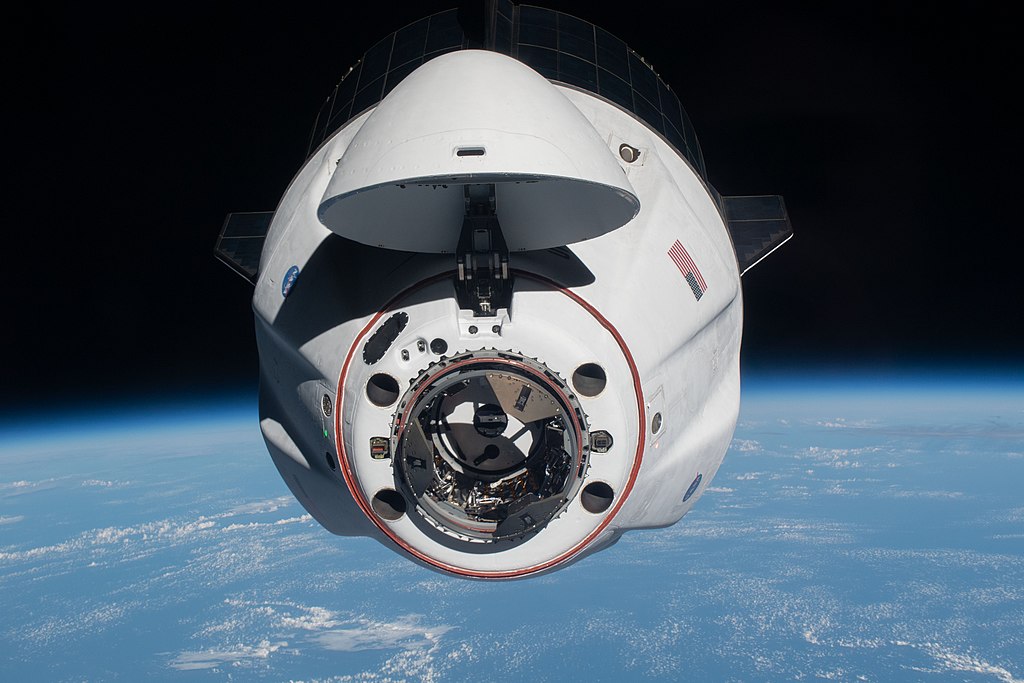
Japanese moon transport company Ispace said Wednesday it would start a new, lower-cost lunar cargo business using the Starship heavy rocket and moon lander developed by Elon Musk's SpaceX. Tokyo-based Ispace has bought 500 kilograms (1,102 pounds) of capacity for $50 million on a Starship that would land on the moon as soon as 2030, and will build a lunar surface vehicle that can host payloads from clients worldwide sharing their ride on Starship to the moon, it said. The new "lunar access integrator" service provides moon-bound "buses" and can complement Ispace's ongoing development of dedicated lunar landers, or "taxis," to the moon's surface, said Ispace Executive Vice President Hideari Kamiya. On previous trips to the moon, Ispace used SpaceX's Falcon 9 rockets for unsuccessful lunar touchdown attempts in 2023 and 2025. The Tokyo-based company now aims to soft-land three landers, called Ultra, onto the moon by 2030, including a mission that is part of NASA's Commercial Lunar Payload Services program. While Ispace carries on its Ultra missions, the tie-up with SpaceX will "exponentially" accelerate its growth in the lunar infrastructure market, Chief Executive Takeshi Hakamada said. SpaceX welcomed the expansion of its relationship with Ispace to fly missions on Starship, a reusable transportation system which, unlike Falcon 9, includes a spacecraft that Musk's company plans to take to the moon and eventually to Mars. "Their integration services provide a valuable pathway for smaller payloads to secure a ride to the Moon today, and we look forward to supporting ispace and their customers as they help expand access to the lunar surface," Stephanie Bednarek, SpaceX's vice president of commercial sales, said in a statement. The relationship is not exclusive. NASA plans to use Starship's first lunar landing in 2028 as part of its Artemis program to send astronauts back to the moon. U.S. lunar rover startup Astrolab has also booked space on a future Starship flight. "SpaceX approached us first" with the integrator business idea, Hakamada said. "While we can't rule out other companies entering the market, few might be able to integrate cargo and keep providing services after touching down on the moon."

$100 invested in SpaceX stock at IPO is now worth
For all the hype surrounding the SpaceX (NASDAQ: SPCX) initial public offering (IPO) and the company's launch valuation, even investing $100 as soon as possible would have proven a middling investment. Specifically, SPCX shares were originally offered at $135 and are, at press time on July 8, trading at $149.52 following a 0.033% extended session rise. Under the circumstances, a $100 investment made already at the IPO would have risen to $110.76 for a $10.76 profit. Investors who got their hands on SpaceX stock at the beginning of the equity's first trading day - June 12 - would have seen their position remain effectively flat, while those who purchased on that evening would have lost $7 as the company ended the day at $160.95. Still, both groups would have been far more fortunate than those who took Jim Cramer's amazement at the rally as a sign to buy - thus also joining Representative Dan Meuser - and purchased close to the all-time high (ATH) of $225.64. Indeed, such investors could only be pleased that they hadn't invested $5,000 or $10,000 in the stock as SPCX shares retraced 33.74%, meaning that $100 would have turned into $66.26 for a $33.74 unrealized loss. What is next for SpaceX stock price in 2026 Elsewhere, the future of SpaceX appears increasingly uncertain at press time on July 8. Since the IPO, the company's extreme launch valuation of $1.77 trillion, paired with revenue below $5 billion and the fact that the firm is operating at a loss, presented a substantial long-term risk factor. More recently, investors might have found themselves alarmed by the fact that SPCX shares failed to see a significant rally even after their official inclusion into the Nasdaq-100 - though it will likely take some time for buying pressure from index funds to be fully reflected in the market. Nonetheless, even if a renewed rally begins in July as many have been expecting since before the SpaceX launch, the company's generous unlocking schedule for wealthy insiders could reverse Elon Musk's corporate rocket once more in August or September.
Elon Musk's SpaceX Moves Bitcoin, Selloff Coming amid SPCX Stock Fell 25%?
Speculation over potential selloffs triggered amid recent Bitcoin sales by Strategy. Elon Musk's SpaceX-linked wallet address moved Bitcoin after 6 months, sparking speculation in crypto and stock markets. The transfer coincided with massive profit booking in SPCX stock that sent the stock below its IPO debut price. Elon Musk's SpaceX Wallet Transfers Bitcoin According to Arkham Intelligence data on July 8, a wallet address linked to Elon Musk's SpaceX moved Bitcoin for the first time in six months. The transfer triggered selling speculations despite the firm moved just $88 worth of BTC. The firm last moved more than 1016 BTC worth nearly $100 million. SpaceX wallet still holds almost 18,712 BTC, valued at $1.16 billion at the current market price. Notably, the destination address now holds 614 BTC worth $38 million. Outflows from SpaceX to other unknown wallets increased significantly last year near the October 10 crypto market crash. The transfers gradually stopped as the firm's focus switched to its SpaceX IPO. The latest transfer comes amid Bitcoin selling by digital asset treasuries such as Michael Saylor's Strategy, MARA Holdings, Nakamoto Holdings, and Sequans Communications. Last week, Michael Saylor's Strategy announced Bitcoin sale worth $216 million. Meanwhile, Bitcoin price is trading above $62K, almost 2% lower amid renewed US-Iran strikes. President Trump cast doubt on the future of the cease-fire with Iran after both sides traded attacks, saying "I think it's over." SPCX Stock Extends Fall to 25% SPCX stock closed 6.83% lower at $149.47 on Tuesday, falling to an intraday low of $148.86 amid massive profit booking. The stock price has dropped below its IPO debut price. The stock dropped despite Elon Musk-led space exploration and AI company SpaceX joined the Nasdaq 100. While it sparked long-term bullish sentiment among investors due to potential influx of investments, but stock remains under selling pressure. SpaceX stock is now down more than 25% within just a month. The stock has climbed 0.49% in premarket trading hours on Wednesday. As CoinGape reported, Wall Street firms, including Morgan Stanley, Goldman Sachs, and Citigroup, initiated coverage of SPCX stock, setting higher price targets. Morgan Stanley analysts are extremely bullish on Elon Musk's SpaceX stock, setting a price target of $300.
SpaceX Officially Joined the Nasdaq-100 and Received a $300 Price Target From Wall Street. Here's Why the Stock Is Falling Anyway.
On July 7, Space Exploration Technologies (NASDAQ: SPCX) joined the Nasdaq-100 -- which is the 100 largest non-financial companies by market cap listed on the Nasdaq stock exchange. It also received a $300 price target from Morgan Stanley, one of the Wall Street banks that underwrote SpaceX's initial public offering (IPO). Being a part of a major index is more than just name recognition. Exchange-traded funds (ETFs) benchmarked to the Nasdaq-100, such as the Invesco QQQ Trust (NASDAQ: QQQ), will begin buying shares of SpaceX. The more indexes a company can be a part of, the more demand is unlocked from ETF inflows -- the crown jewel being the S&P 500 (SNPINDEX: ^GSPC), because the largest ETFs in the world are linked to it. Where to invest $1,000 right now? Our analyst team just revealed what they believe are the 10 best stocks to buy right now, when you join Stock Advisor. See the stocks " Here's why SpaceX was added to the Nasdaq-100 so quickly, and why the growth stock is falling anyway. Image source: Getty Images. SpaceX will soon be a top holding in the Nasdaq-100 The Nasdaq's new fast-track rules are meant to expedite the inclusion of megacap companies that recently had IPOs. If a company is at least as valuable as the 40th-largest Nasdaq listing, which is a market cap of around $121 billion, it can now be added to the Nasdaq-100 after its 15th trading day. SpaceX has a market cap of around $2 trillion and is the world's seventh-most valuable company -- so it clears the size hurdle with ease. SpaceX went public on June 12, but markets were closed on Juneteenth (June 19) and July 3. So, it wasn't added to the Nasdaq-100 until over three weeks after its IPO. However, SpaceX's weight in the Nasdaq-100 isn't its market cap. Rather, it is based on a multiple of the float, which is the number of shares available for trading by the public. SpaceX's float is around just 5% of its market cap. But the float could increase rapidly in the coming months. The vast majority of SpaceX stock is held by insiders who bought in when the company was private -- including institutional investors from previous funding rounds, employees, and founders. SpaceX plans to gradually unlock early-release-eligible shares through a tiered system over the next 180 days, with 20% of shares available for trading two days after the release of its earnings for the quarter ended June 30, and up to 30% if SpaceX's stock price is at least $175.50 per share. More key unlocking events will occur throughout the summer and fall. And eventually, 100% of the early-release shares will be available for trading by Dec. 9 -- which is 180 days after the IPO date. Granted, not all insiders will sell their shares and make them available for trading on public markets. Elon Musk and other significant investors have agreed to hold shares for at least 366 days after May 20, the date of SpaceX's Form S-1 filing with the Securities and Exchange Commission. And many early founders still hold large positions in major tech companies, such as Musk in Tesla or Jeff Bezos in Amazon. Before the recently implemented fast-track process for larger IPOs, the Nasdaq-100 required a free float of at least 10%, meaning at least 10% of the company's shares are publicly tradable. SpaceX should cross that level even if a fraction of early-release-eligible shares are sold and made available on the Nasdaq in the coming months. If I had to guess, I'd expect SpaceX's weighting in the Nasdaq-100 to mirror its market cap by mid-August at the latest. The market is always evolving Once SpaceX is weighted by market cap, it will be a top-10 holding in the Nasdaq-100 and account for around 4% of the index. And as more blockbuster IPOs like Anthropic and OpenAI are fast-tracked into the index and reach the float requirements, they, too, could become key holdings. The rapid restructuring of the Nasdaq-100 has undoubtedly piqued the interest of index and ETF investors, especially those who regularly put their hard-earned savings to work in products benchmarked to the indexes. A common mistake investors will make is assuming that an index is diversified just because it contains hundreds or thousands of stocks. When in reality, the Nasdaq-100 and S&P 500 have become concentrated in a handful of names. And that concentration could increase as megacap IPOs are added. To stay even-keeled no matter what the market is doing, it's important to heed Peter Lynch's advice about knowing what you own and why you own it. That exercise is straightforward with individual stocks, where an investment thesis can anchor a key holding. But even for ETFs, it's worth recognizing some of the major themes and companies that will drive gains (or losses). By design, the major indexes can undergo drastic transformations as the economy evolves. A couple of decades ago, major oil companies, industrial conglomerates, and consumer goods companies dominated the largest S&P 500 and Dow Jones Industrial Average (DJINDICES: ^DJI) companies. But the tech sector now makes up a staggering 38% of the S&P 500. And Alphabet just replaced Verizon Communications in the Dow -- meaning that seven of the 30 Dow components have changed seats in the last six years. SpaceX will continue making waves on public markets SpaceX's growing share of the indexes and lofty price targets from Wall Street banks have more to do with market dynamics than SpaceX's investment thesis. The recent sell-off in the stock is likely due to fading enthusiasm as investors focus more on SpaceX's fundamentals -- which are shaky given its valuation is in the stratosphere. For the stock to be a good long-term buy for new investors, SpaceX needs to make progress on its bold plans to launch constellations of orbital artificial intelligence compute satellites and build the world's largest chip manufacturing plant in Texas in partnership with Tesla. Until that happens, SpaceX is best kept on a watch list. And investors who want to avoid the stock entirely may want to double-check that the ETFs they hold don't begin buying SpaceX, especially as its float increases in the coming months. Should you buy stock in Space Exploration Technologies right now? Before you buy stock in Space Exploration Technologies, consider this: The Motley Fool Stock Advisor analyst team just identified what they believe are the 10 best stocks for investors to buy now... and Space Exploration Technologies wasn't one of them. The 10 stocks that made the cut could produce monster returns in the coming years. Consider when Netflix made this list on December 17, 2004... if you invested $1,000 at the time of our recommendation, you'd have $409,970!* Or when Nvidia made this list on April 15, 2005... if you invested $1,000 at the time of our recommendation, you'd have $1,200,223!* Now, it's worth noting Stock Advisor's total average return is 916% -- a market-crushing outperformance compared to 210% for the S&P 500. Don't miss the latest top 10 list, available with Stock Advisor, and join an investing community built by individual investors for individual investors. See the 10 stocks " *Stock Advisor returns as of July 8, 2026. Daniel Foelber has no position in any of the stocks mentioned. The Motley Fool has positions in and recommends Alphabet, Amazon, and Tesla. The Motley Fool recommends Verizon Communications. The Motley Fool has a disclosure policy. The views and opinions expressed herein are the views and opinions of the author and do not necessarily reflect those of Nasdaq, Inc.

Polymarket races to regain trust with US market re-entry after $112M acquisition
The prediction market giant is betting that rock-bottom fees and a CFTC-approved derivatives exchange can make Americans forget it once kicked them off the platform Polymarket, the crypto-native prediction market that became a cultural phenomenon during the 2024 US election cycle, is making its way back to American users. The platform acquired regulated derivatives exchange QCX for $112 million, giving it the legal scaffolding to offer event contracts stateside. Polymarket didn't leave the US market on its own terms. Back in 2022, the platform was forced to block American users after running into regulatory headwinds. Now it's attempting a comeback, armed with federal approval and a fee structure aggressive enough to make both offshore venues and traditional sportsbooks uncomfortable. The regulatory path back The company secured an amended CFTC order in November that allows it to beta test its US exchange with live trades. The QCX acquisition is the centerpiece of this strategy. By purchasing a regulated derivatives venue for $112 million, Polymarket essentially bought itself a compliance moat rather than trying to convince regulators that prediction markets deserve a novel framework. The US-specific app will initially focus on sports contracts. Politics and crypto markets are planned for later. A fee structure designed to hurt competitors Polymarket's US product features 10 basis point taker fees with zero maker fees. Standard sportsbook vigorish typically runs anywhere from 4% to 10% on most bets. A trader placing a $1,000 position on Polymarket pays $1 in fees. The same economic exposure through a sportsbook would cost somewhere between $40 and $100 in embedded margin. The zero maker fee component means liquidity providers can operate for free, bootstrapping deep order books. Why the trust problem is real American users who were active on the platform before 2022 remember being shown the door. Some found workarounds, using VPNs and non-US accounts, which created its own set of problems when questions about market integrity surfaced during the 2024 election. The fact that US participation was technically prohibited while the platform was being used to forecast US elections created an awkward dynamic that regulators noticed. Now Polymarket has to convince American retail users the platform won't pull the rug again if regulatory winds shift, and institutional participants need to see a compliance infrastructure robust enough to satisfy their own legal teams. A $112 million price tag for a regulated venue signals commitment that's hard to fake. What this means for the broader prediction market landscape Kalshi, the other major US prediction market, has been operating with CFTC approval since 2020 and has fought its own regulatory battles to expand into election contracts. Polymarket's entry as a direct competitor with dramatically lower fees could force Kalshi to reconsider its own pricing. Analysts watching this space see Polymarket's return as a potential inflection point for on-chain prediction markets more broadly. If a CFTC-approved platform with institutional-grade compliance can operate at 10 basis point fees, it validates the entire category as a legitimate financial product rather than an unregulated gray area.

SpaceX Officially Joined the Nasdaq-100 and Received a $300 Price Target From Wall Street. Here's Why the Stock Is Falling Anyway.
On July 7, Space Exploration Technologies (NASDAQ: SPCX) joined the Nasdaq-100 -- which is the 100 largest non-financial companies by market cap listed on the Nasdaq stock exchange. It also received a $300 price target from Morgan Stanley, one of the Wall Street banks that underwrote SpaceX's initial public offering (IPO). Being a part of a major index is more than just name recognition. Exchange-traded funds (ETFs) benchmarked to the Nasdaq-100, such as the Invesco QQQ Trust (NASDAQ: QQQ), will begin buying shares of SpaceX. The more indexes a company can be a part of, the more demand is unlocked from ETF inflows -- the crown jewel being the S&P 500 (SNPINDEX: ^GSPC), because the largest ETFs in the world are linked to it. Missed Nvidia in 2009? This Rare Signal Is Flashing Again. In 2009, a "Double Down" signal flashed for a little-known chipmaker called Nvidia. For the first time in years, that same "Total Conviction" signal is flashing for a company 1/100th the size of Nvidia. Continue " Here's why SpaceX was added to the Nasdaq-100 so quickly, and why the growth stock is falling anyway. SpaceX will soon be a top holding in the Nasdaq-100 The Nasdaq's new fast-track rules are meant to expedite the inclusion of megacap companies that recently had IPOs. If a company is at least as valuable as the 40th-largest Nasdaq listing, which is a market cap of around $121 billion, it can now be added to the Nasdaq-100 after its 15th trading day. SpaceX has a market cap of around $2 trillion and is the world's seventh-most valuable company -- so it clears the size hurdle with ease. SpaceX went public on June 12, but markets were closed on Juneteenth (June 19) and July 3. So, it wasn't added to the Nasdaq-100 until over three weeks after its IPO. However, SpaceX's weight in the Nasdaq-100 isn't its market cap. Rather, it is based on a multiple of the float, which is the number of shares available for trading by the public. SpaceX's float is around just 5% of its market cap. But the float could increase rapidly in the coming months. The vast majority of SpaceX stock is held by insiders who bought in when the company was private -- including institutional investors from previous funding rounds, employees, and founders. SpaceX plans to gradually unlock early-release-eligible shares through a tiered system over the next 180 days, with 20% of shares available for trading two days after the release of its earnings for the quarter ended June 30, and up to 30% if SpaceX's stock price is at least $175.50 per share.
SpaceX buoyed by launch dominance, but Starlink Mobile's future unclear, analysts say
WASHINGTON, July 7, 2026 - SpaceX may have included fanciful projections in its IPO filing, but the company's rocket launch capability is truly second to none, analysts say. "SpaceX is primarily a rocket manufacturing and launch company," MoffettNathanson analysts wrote in an investor report released Tuesday. "And the company has created a near-monopoly in the rocket segment." The 165 orbital launches carried out by the company last year represented 53 percent of all such launches worldwide, the report notes, and almost 70 percent of the mass put into orbit. SpaceX is still controlled by Elon Muskwhich controls a large part of its voting rights after its record IPO. "Facing SpaceX, there are no competing companies, but entire sovereign nations," write the analysts, "and always SpaceX surpasses them all. Combined." That's largely thanks to SpaceX's Falcon 9 rocket's reusable booster, they wrote, which makes repeat launches much cheaper. The company plans to make its Starship rocket fully reusable, which would further reduce costs. MoffettNathanson estimated that this would come to fruition "no sooner than mid-2027," contrary to the company's projections for the end of this year. The report was written by Craig Moffettco-founder of the research firm, and analysts Julie Zhu And Nick Del Deo. The company operates a massive constellation of 10,000 satellites to support its Starlink broadband service. This both aided the development of the Falcon 9 and benefited from internal launch capability, the analysts wrote. They compared SpaceX to satellite broadband provider Amazon Leo and rocket launcher Blue Origin. The former needed a waiver from the Federal Communications Commission because it was unable to ensure launch capability for its nascent constellation, and the latter is "by most estimates a decade or more behind" reusable rockets. SpaceX "is, in short, a bet on everything made possible by a virtual lockdown on rocket manufacturing and launch," the analysts wrote. Directly on the device SpaceX has big plans for its direct-to-device mobile service. It is buying $19.6 billion worth of spectrum from EchoStar to support the service and has asked the FCC for permission to launch an additional 15,000 satellites directly to devices. It also treated mobile as a source of future growth during its IPO. "For this to happen, Starlink cannot remain a complement to terrestrial wireless targeting remote rural areas; this opportunity is not large enough. Instead, it will need to replace terrestrial wireless," the analysts wrote. "We are skeptical." Satellite service alone is extremely unlikely to be competitive with land mobile service, they write, due to the considerable distances involved. The only way for SpaceX to gain market share would be to partner with a carrier through a mobile virtual network operator (MVNO) agreement, they argued. However, each of the mobile carrier CEOs has rejected this idea; The companies also announced earlier this year that they were forming a joint venture focused directly on devices, which analysts saw as a united front against a SpaceX MVNO. Verizon provided MVNOs to Comcast and Charter, and the cable giants became legitimate competitors for mobile customers. Carriers are unlikely to be convinced to let another competitor into the fold, analysts write. There have been reports recently that SpaceX is developing a mobile phone and talking with Charter about a mobile partnership, both interpreted as further signs of the satellite operator's mobile ambitions. According to MoffettNathanson, the most realistic way to convince an operator to grant an MVNO might be to gather valuable spectrum assets that SpaceX could offer as part of the deal. The company's purchase of national spectrum from EchoStar is the most logical bargaining chip for this purpose, they argued, since the airwaves can only really be used in rural areas without superior terrestrial coverage. SpaceX "will continue to negotiate, cajole and, if necessary, coerce, with the goal of reaching an MVNO agreement with one of the Big Three," they wrote. "It is clear, however, that the Big Three fully understand the clear and present danger that would be posed by Starlink's entry into the market as another cable-style hybrid MNO/MVNO." Analysts at LightShed Partners speculated last week that SpaceX could buy EchoStar's now-defunct mobile network as part of its wireless subsidiary's bankruptcy proceedings. This would avoid the hundreds of billions in costs and decades of permitting and construction that would be required to build a mobile network. "It might be difficult for SpaceX to pass up cheap radio assets with which it could negotiate favorable leases," LightShed analysts Walter Piecyk And Joe Gallone wrote.

SpaceX, ClearOne, FuelCell Energy, Cloudflare and Penguin Solutions: Why These 5 Stocks Are on Investors'
Major U.S. indices closed lower on Tuesday, with the Dow Jones Industrial Average slipping 0.25% to 52,925.15, the S&P 500 falling 0.45% to 7,503.85 and the Nasdaq dropping 1.16% to 25,818.69. These are the top stocks that gained the attention of retail traders and investors through the day. Space Exploration Technologies Corp. (NASDAQ:SPCX) SpaceX shares fell 6.83% to $149.47, after trading as high as $159.30 and as low as $148.86; the stock's 52-week range runs from $147.11 to $225.64. In the after-hours trading, the stock gained 1.14% to $151.17. Clearone Inc. (NASDAQ:CLRO) ClearOne surged 97.71% to $13.84, reaching an intraday high of $16.50 and a low of $8.13; its 52-week span is $2.72 to $16.50. The stock gained 5.13% to $14.55 in extended trading. Traders piled in after the company disclosed a definitive merger agreement with Cortigent, a Vivani Medical subsidiary, along with financing plans intended to support the combined business and its shift toward medtech. The merger update and the strategic pivot to medical devices fueled the sharp advance. FuelCell Energy, Inc. (NASDAQ:FCEL) FuelCell Energy dropped 12.68% to $25.96, with an intraday high of $29.18 and a low of $25.72; the stock's 52-week range is $3.78 to $37.88. In the after-hours session, the stock plummeted by 16.76% to $21.61. Cloudflare, Inc. (NYSE:NET) Cloudflare gained 8.60% to $268.83, trading as high as $274 and as low as $254 during the session; the stock's 52-week range stands at $158.83 to $276.82. Penguin Solutions, Inc. (NASDAQ:PENG) Penguin Solutions fell 7.38% to $62.71, after hitting an intraday high of $65.34 and a low of $60.20; the stock's 52-week range is $16.04 to $77.40. The stock popped 3.65% higher at $65 in extended trading. Penguin Solutions raised its full-year fiscal 2026 outlook, forecasting revenue growth of 22%, plus or minus 2%, up from its previous expectation of about 12%, and projected adjusted earnings of $2.60 per share, plus or minus 5 cents, citing strong customer demand driven by agentic AI. Benzinga Edge Stock Rankings indicate SpaceX stock doesn't rank high on Short, Medium and Long-term Price Trends. Photo Courtesy: thanmano on Shutterstock.com Disclaimer: This content was partially produced with the help of AI tools and was reviewed and published by Benzinga editors. Market News and Data brought to you by Benzinga APIs To add Benzinga News as your preferred source on Google, click here.

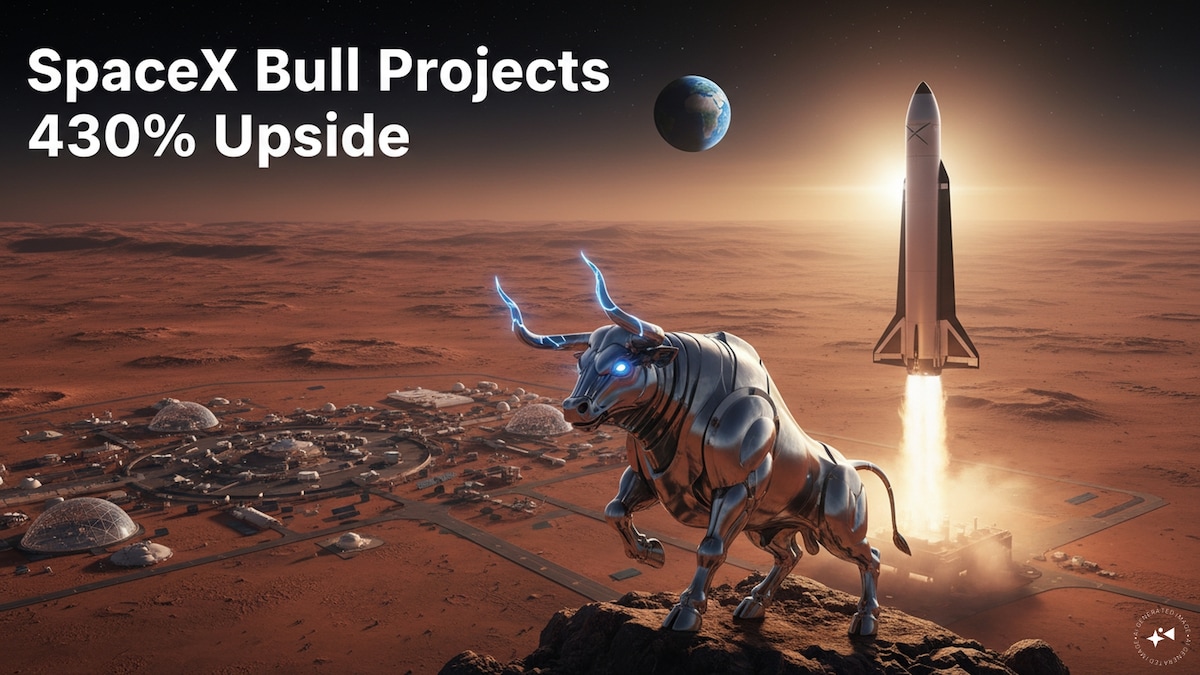
The most bullish SpaceX call projects the stock to rise 430% from current levels - CNBC TV18
SpaceX, the Elon Musk-owned enterprise, which made its debut on the Nasdaq on Tuesday, July 7, received a flurry of bullish initiations as the silent period of managers who ran the IPO came to an end. The one that stood out was from Raymond James. The brokerage initiated coverage on SpaceX with a "strong buy" recommendation and a price target of $800. This is not only the highest among all analysts who have coverage on the recently listed stock, but also projects an upside potential of 430% from current levels. Despite the multiple bullish initiations, shares of SpaceX fell 6.5% on Tuesday to close at $149, tumbling back towards their IPO price of $135, having cooled off from their post-listing high of $225. In case the stock hits that level, it would take its market capitalization to $10.5 trillion, that is more than double of Nvidia's current market capitalization of $4.7 trillion, which makes it the most valuable stock globally. As a result of the fall from its post-listing high, SpaceX's market capitalization is now below the mark of $2 trillion. In its bullish note, Raymond James said that it is seeing SpaceX as one of the defining industrial infrastructure companies of the 21st century, adding that SpaceX is now building the foundational platform for the next generation of industrial capacity, just as railroads, electric grids and internet reshaped the prior economic eras. The brokerage now projects SpaceX's revenue to soar to $5.2 trillion by 2035, from $19 billion that it reported last year. It will be led by the AI segment, currently a smaller part of the business, compared to the rocket or connectivity segments. AI will also become the biggest revenue contributor to SpaceX by 2027 and by 2035, will represent 94% of the company's overall topline, the note added further. However, the bullish forecasts also come with their fair share of risks. Raymond James believes that in case SpaceX experiences launch failures, the stock could even fall to as low as $125, which is below its issue price of $135. Launch failures would "raise concerns about the pace of orbital AI, Starlink Mobile, and Starship-enabled infrastructure optionality," the note said. SpaceX is now tracked by 35 analysts on Wall Street, of which 29 continue to maintain a "buy" rating on the stock. The average analyst price target is just above its post-listing high, at $236.45, which implies an upside of 56% from current levels.
SpaceX Trading Frenzy Sends Tokenized Equity Volume to Record $3.86B
Tokenized equity trading climbed to a record $3.86 billion in June as demand for blockchain-based SpaceX (NASDAQ: $SPCX ) shares turned the aerospace company's public-market debut into the sector's biggest trading event by volume to date. Onchain volume rose 145% from May, according to CoinDesk Data, with tokenized SpaceX products generating $1.19 billion during the month. That represented roughly 31% of all tokenized equity trading and put a newly listed stock ahead of established names including Nvidia (NASDAQ: $NVDA ), Tesla (NASDAQ: $TSLA ) and major index products. The activity followed SpaceX's $75 billion initial public offering, the largest on record, which valued the company at about $1.8 trillion on a fully diluted basis. Crypto platforms had already been building products around the listing, giving onchain traders several ways to gain price exposure as the shares entered public markets. Backpack Securities' SPCX token led the group with $1.08 billion in June volume. xStocks' SPCXx followed with $852 million, while Backpack's full tokenized instrument lineup produced $1.42 billion for the month. SpaceX alone accounted for most of that activity. Nvidia, Tesla, SPY and QQQ remained among the more actively traded tokenized products, but none came close to the demand around SpaceX. The concentration shows how quickly tokenized equity venues can rotate toward the same stories driving traditional markets rather than relying only on a fixed group of megacap stocks. Sector market capitalization also reached a record $1.53 billion in June, up 6.64% from May and marking a fifteenth consecutive month of growth. Tokenized stocks are still small compared with traditional equity markets, and the structure of individual products can differ from direct share ownership. Still, June gave the market its clearest example yet of how onchain equity trading can react to a major listing in real time. Space Exploration Technologies Corp. (NASDAQ: SPCX) is currently trading at $149.55 U.S. per share.
SpaceX Trading Frenzy Sends Tokenized Equity Volume to Record $3.86B
Tokenized equity trading climbed to a record $3.86 billion in June as demand for blockchain-based SpaceX (NASDAQ: $SPCX) shares turned the aerospace company's public-market debut into the sector's biggest trading event by volume to date. Onchain volume rose 145% from May, according to CoinDesk Data, with tokenized SpaceX products generating $1.19 billion during the month. That represented roughly 31% of all tokenized equity trading and put a newly listed stock ahead of established names including Nvidia (NASDAQ: $NVDA), Tesla (NASDAQ: $TSLA) and major index products. The activity followed SpaceX's $75 billion initial public offering, the largest on record, which valued the company at about $1.8 trillion on a fully diluted basis. Crypto platforms had already been building products around the listing, giving onchain traders several ways to gain price exposure as the shares entered public markets. More From Cryptoprowl: Backpack Securities' SPCX token led the group with $1.08 billion in June volume. xStocks' SPCXx followed with $852 million, while Backpack's full tokenized instrument lineup produced $1.42 billion for the month. SpaceX alone accounted for most of that activity. Nvidia, Tesla, SPY and QQQ remained among the more actively traded tokenized products, but none came close to the demand around SpaceX. The concentration shows how quickly tokenized equity venues can rotate toward the same stories driving traditional markets rather than relying only on a fixed group of megacap stocks. Sector market capitalization also reached a record $1.53 billion in June, up 6.64% from May and marking a fifteenth consecutive month of growth. Tokenized stocks are still small compared with traditional equity markets, and the structure of individual products can differ from direct share ownership. Still, June gave the market its clearest example yet of how onchain equity trading can react to a major listing in real time. Space Exploration Technologies Corp. (NASDAQ: SPCX) is currently trading at $149.55 U.S. per share.
SpaceX's biggest bull sees valuation soaring above $10 trillion
Raymond James analyst Brian Gesuale initiated coverage on SpaceX with a strong buy. He set an $800 price target, projecting significant future stock appreciation. Gesuale sees SpaceX revenue soaring to $5.2 trillion by 2035. This growth is primarily based on its nascent artificial intelligence business. The analyst believes AI will become SpaceX's largest revenue source by 2027. New York: SpaceX has no shortage of fans on Wall Street, but one analyst stands out among the rest as by far the most bullish: Raymond James' Brian Gesuale. Gesuale initiated coverage on the rocket, satellite, and artificial intelligence company Tuesday with a strong buy rating and an $800 price target, the highest among Wall Street analysts and roughly 430% above where the stock is trading in Tuesday's selloff. Should the shares hit that level, the company's market valuation would balloon to roughly $10.5 trillion. US MarketsPowered By As on 08 Jul 2026, 01:30 AM IST S&P 500 Top Gainers Cognizant Tech Solns43.94(6.21%) Occidental Petroleum51.68(5.88%) Cboe Global Markets258.64(5.53%) Gilead Sciences136.36(5.21%) Gainers" S&P 500 Top Losers Intel110.39(-9.66%) Teradyne343.11(-9.59%) Solstice Advanced Mat62.10(-8.74%) Coterra Energy32.56(-8.62%) Losers" At the moment, SpaceX's market valuation is less than $2 trillion. "We see the company as one of the defining industrial infrastructure companies of the 21st century," Gesuale wrote in a note to clients on Tuesday. "Just as railroads, electric grids, and the Internet reshaped prior economic eras, we believe SpaceX is building the foundational platform for the next generation of industrial capacity." The projection is based on some eye-popping assumptions. For example, SpaceX posted revenues of $19 billion last year. Gesuale sees that soaring to $5.2 trillion by 2035. What's more, that growth isn't tied to the company's high profile rocket or connectivity segments. Rather it's based on its nascent artificial intelligence business. Right now, AI accounts for $16 billion of SpaceX's revenue, up from $3 billion in 2024 when "substantially all AI revenue came from X, primarily through advertising, subscriptions, and data licensing," Gesuale wrote. Raymond James estimates that the figure will rise to about $650 billion by 2031, "making AI the company's largest business by revenue beginning in 2027, and by 2035 it will represent nearly 94% of SpaceX's revenue, or $4.9 trillion, Gesuale wrote. Shifting toward a business model that focuses on monetising compute rather than space travel is how Gesuale believes SpaceX will achieve his revenue targets. "That growth is underpinned by a rapid expansion in installed compute capacity, initially through terrestrial AI infrastructure before progressively extending into orbital compute later in the decade," he wrote. Gesuale notes that the bullish forecasts aren't without their risks. In a scenario where SpaceX experiences unexpected launch failures, the stock could fall to $125, below its $135 initial public offering price. Launch failures would "raise concerns about the pace of orbital AI, Starlink Mobile, and Starship-enabled infrastructure optionality," Gesuale said.
SpaceX joins Nasdaq-100 15 days after IPO
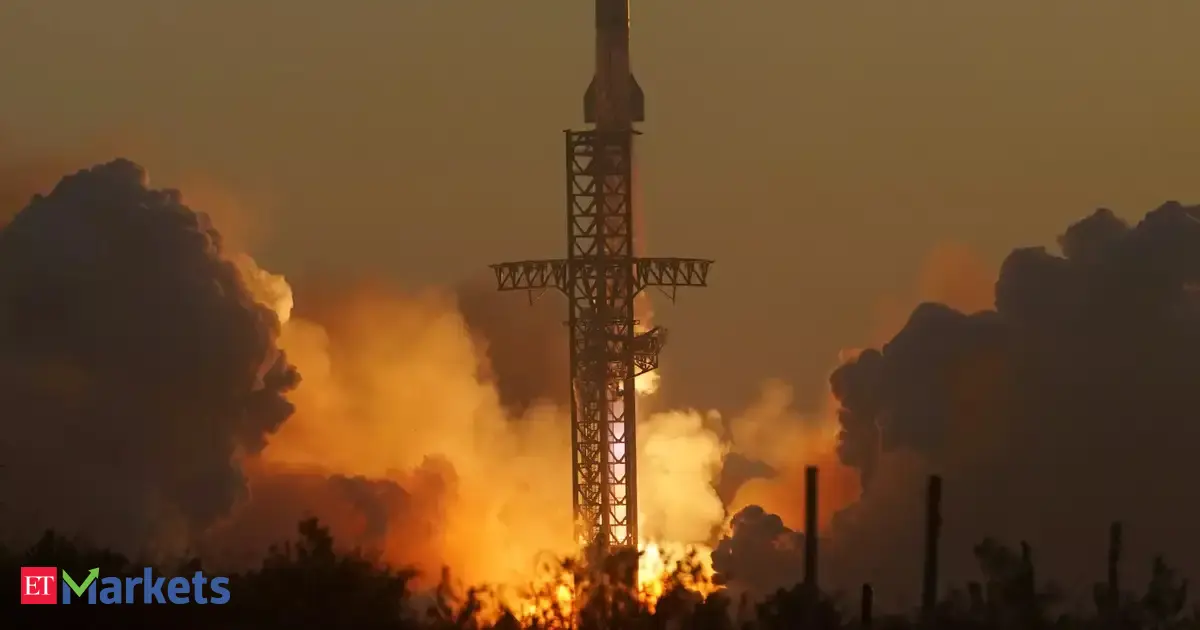
NEW YORK - SpaceX is expected to attract billions of dollars in passive investment inflows after officially joining the Nasdaq-100 Index on Tuesday (7 July). At the same time, several Wall Street brokerages have begun issuing positive recommendations on shares of Elon Musk's space company. According to Reuters, SpaceX shares fell as much as 1.2% in pre-market trading. Nevertheless, the company, which has a market capitalisation of more than US$2 trillion, took just 15 days after its stock market debut on 12 June to be included in the Nasdaq-100, making it one of the fastest index inclusions in history. SpaceX's inclusion in the Nasdaq-100 is expected to generate fresh demand for its shares, as index funds and exchange-traded funds (ETFs) tracking the Nasdaq-100 are required to purchase the stock to align their portfolios with the benchmark index. Active fund managers that track the index are also expected to rebalance their portfolios. More than US$587 billion in assets is currently managed by investment funds tracking the Nasdaq-100, including the Invesco QQQ and QQQM ETFs, which must now add SpaceX shares to their portfolios. JP Morgan previously estimated that SpaceX's inclusion in the Nasdaq-100 could attract around US$4.3 billion in passive investment inflows. The end of the post-IPO quiet period has also allowed the investment banks that underwrote SpaceX's initial public offering (IPO) to begin publishing research and investment recommendations on the stock. Morgan Stanley and Goldman Sachs both initiated coverage with their highest ratings. Morgan Stanley described SpaceX as the "final frontier of artificial intelligence (AI)", while Goldman Sachs said the company was well positioned to extend its leadership in the space, connectivity and AI sectors. Goldman Sachs analysts estimate that each of these sectors could grow into trillion-dollar markets over the next five years. RBC, Bernstein and Stifel also initiated coverage with positive recommendations, driven by optimism over the development of Starship, SpaceX's next-generation fully reusable rocket. "Starship is the flywheel that underpins all of SpaceX's ambitions," RBC analysts wrote. In June, Oppenheimer became the first brokerage to assign an outperform rating to SpaceX shares. However, not all analysts are optimistic. CFRA is the only brokerage to issue a sell recommendation. According to CFRA, SpaceX's current valuation relies too heavily on unproven projects, including Starship and AI company xAI, making the valuation overly aggressive given the significant execution risks and capital requirements. Last month, Morningstar estimated SpaceX's fair value at around US$780 billion, well below its current market capitalisation, citing continued uncertainty surrounding the company's AI business, including xAI and the X social media platform. Investors currently see SpaceX as having the potential to become a major AI infrastructure provider. The company's cash flow is expected to help fund the development of Grok to compete with OpenAI's GPT models and Anthropic's Claude. Meanwhile, Starlink is also seen as having substantial room for growth to strengthen its dominance in the satellite communications industry. At the same time, SpaceX's long-term outlook remains heavily dependent on the successful development of its next-generation Starship rocket. With a market capitalisation of approximately US$2.1 trillion, SpaceX is now the sixth-largest company in the United States, while Chief Executive Elon Musk has become the world's first trillionaire. Last month, FTSE Russell added SpaceX shares to its US equity indices. However, S&P Global has not adopted a similar fast-track inclusion mechanism for the S&P 500, meaning SpaceX is not expected to join that index for at least another year. Since its stock market debut, SpaceX shares have gained more than 6%, although trading has remained volatile in the wake of its IPO. (ARF/LM)
