News & Updates
The latest news and updates from companies in the WLTH portfolio.
Massive SpaceX IPO minted thousands of millionaires -- and left financial advisors with a blueprint for the next mega offer | Mint
Summary With OpenAI and Anthropic waiting in the wings to go public, pre-IPO wealth planning is suddenly urgent. It's estimated that the SpaceX IPO created more than 4,000 millionaires That is roughly 20% of the employee base. And SpaceX, which joined the Nasdaq 100 index on Tuesday, is not likely to be the only mega IPO this year. OpenAI and Anthropic have confidentially filed S-1s for their own offerings. These massive transactions will certainly boost property values in areas like Silicon Valley and south Texas. But they will also boost demand for financial and tax planning advice. Let's see how advisors can help: Planning ahead. It's best when advisors can provide advice before a company goes public. Planning can be helpful in evaluating tax strategies, estate planning, charitable giving, liquidity analysis, and the timing for option exercises. "The biggest mistake is assuming the planning starts after the stock begins trading," says Mark Stancato, a certified financial planner for VIP Wealth Advisors. "In reality, the most important decisions are often made beforehand." Option education. An advisor can help educate the client about various types of equity compensation. This is a specialized area of financial planning and advisors who like the intricacies, might want to consider developing a niche. But it requires keeping up with evolving rules, regulations and tax treatments. Here's a quick rundown of the basics: Options: These allow the client to purchase a certain number of a company's shares at a fixed price, which usually involves a vesting schedule. For example, suppose Mary joins a private company and is granted an option to buy 10,000 shares at a price of $100 per share. The shares vest equally (2,500 shares) each year, which is when she can exercise the option or make a purchase.Restricted Stock Units (RSUs): This is where a company promises to transfer shares to the client, based on conditions or vesting. To continue with the example with Mary, she would receive 2,500 shares each year, assuming there is a four-year vesting schedule.Restricted stock: These shares are similar to RSUs. The main difference is that the company will transfer the stock to the client today, but they will not get actual ownership until conditions or vesting terms are met. If the client leaves before certain dates, the company will usually repurchase the unvested shares. Tax strategy. With RSUs, there is no tax on the grant. But there are ordinary taxes on the fair market value of the shares at the time of vesting. This treatment is the same for restricted stock. There is a strategy that may reduce the taxes owed. It's called an 83(b) election. This means that the client can recognize the income when they receive the shares, when the valuation is likely to be low. If they then sell the shares more than a year later, they will be eligible for long-term capital gains tax treatment. But the client must make the 83(b) election within 30 days of receiving the restricted stock, illustrating the benefit of planning in advance. It's important to understand that this strategy can be risky. If the startup fails, then the client will have paid taxes on stock that ultimately became worthless. Avoiding AMT. With stock options, the taxes depend on the type of the option. One type is nonqualified stock options. The gains are taxed as ordinary income when they are exercised. Another type is incentive stock options (ISOs), which are available only to employees. There is favorable tax treatment if the shares are held for at least two years from the option grant date and at least one year from the exercise date. If these requirements are satisfied, the gain may qualify for long-term capital gains treatment when the shares are eventually sold. Again, clients still need to be cautious. "ISOs can trigger the alternative minimum tax on exercise, and that's where clients often get blindsided," said Jeff Judge, who is a managing partner at Chesapeake Financial Planners. AMT exposure is not necessarily bad. But it does require tax expertise and careful planning. An advisor needs to evaluate the timing of the exercise, the client's income, the size of the spread (the fair market value minus the shares purchased at the exercise price), and the potential liquidity risk. This is especially important with pre-IPO shares because the client may face a tax bill before having an easy way to sell the stock to pay the taxes. Concentration risk. This is often the case with most clients who receive equity compensation. But high-flying stocks can suddenly go cold. A cautionary example is Figma, a graphic design software company. In the summer of 2025, the company launched its IPO, with the shares surging 250% to $111.50 on the first day of trading. Unfortunately, the company suffered challenges in dealing with the potential disruption from AI rivals. The result: the stock now trades at $20. Of course, diversification can protect clients from concentration risk, allowing them to lock in gains, reduce volatility, and avoid having their financial future depend too heavily on a single company's stock. But advisors may find it difficult to convince clients to sell company shares. "Most employees who watched a company grow have enormous attachment to the stock," says Judge. "The conversation I have with clients is this: Concentration got you here, diversification keeps you here." He recommends advisors construct a systematic sale plan over multiple years. That, combined with charitable giving strategies, he explains, "reduces both the tax bite and the resistance to selling." Tom Taulli is the CEO and founder of CorvEquity, which helps startups manage cap tables and option plans. He is also the author of The Personal Finance Guide for Tech Professionals: Building, Protecting, and Transferring Your Wealth and a former broker.

Anthropic Expands in Manhattan, Part of an A.I. Boom in New York
Anthropic, the artificial intelligence company, plans to announce on Tuesday that it will lease a 16-story office building in Lower Manhattan as the company moves to double its work force in New York City to 1,000 people this year. The move into a renovated building at 330 Hudson Street in the Hudson Square neighborhood is part of a major expansion of A.I. companies in New York City. Anthropic, the company behind the chatbot Claude, said that its New York office was already its largest outside its San Francisco headquarters and that the new space had room for more than 1,700 desks. The move is expected to start this summer. Mayor Zohran Mamdani's administration praised the expansion, as did Gov. Kathy Hochul, who said in a statement that it would "cement New York City as a world-class technology hub." Artificial intelligence companies have been adding office space in New York City and going on a hiring spree, even as some elected officials have raised concerns about the technology and how it could displace white-collar workers. Thomas P. DiNapoli, the state comptroller, said recently that he was worried about the disruption A.I. could bring, warning that it could "damage the quality and productivity of a company's work force and, more broadly, add to the large-scale instability of the economy." OpenAI, whose ChatGPT chatbot started the A.I. boom in 2022, announced its move into the Puck Building, less than a mile from Anthropic's new office, in 2024. Harvey, an A.I. start-up for the legal industry, expanded its office at One Madison Avenue in Midtown Manhattan earlier this year. Anthropic's expansion is a further sign of the evolution of artificial intelligence as the technology matures and moves into the economic mainstream. Big A.I. companies are increasingly extending their focus beyond building new software models to pushing other industries to adopt the technology. And New York is home to some of the nation's largest technology customers in finance, health care, consulting, law, media and culture. "New York is a great place for an A.I. company to work and do business," said Mark Muro, a senior fellow at Brookings Metro, a division of the Brookings Institution. Mr. Muro was a co-author of a Brookings report last year that found New York to be a leader among U.S. metro areas in "A.I. readiness," a broad measurement of the capacity to both produce A.I. and adopt it. Chris Lehane, the chief global affairs officer for OpenAI, said in a statement that the company had 90,000 square feet of office space in New York City and would keep expanding. He said the city was a "global hub for A.I." because of its "A.I. talent density, inherent entrepreneurship and the policy leadership from its elected officials." Mr. Mamdani, a democratic socialist, has had a frosty relationship with business leaders over his calls to tax the rich, and has moved to win them over. He has also faced criticism for not yet releasing a detailed plan to address the city's slowing job growth. Jeanny Pak, the interim president of the city's Economic Development Corporation under Mr. Mamdani, said that Anthropic's move would "create hundreds of jobs for New Yorkers, strengthening equitable pathways to economic opportunities and reinforcing that companies continue to choose New York City." New York now has far more tech talent than in the past. Two decades ago, when a computer scientist at Google wanted to create an engineering team in New York, the Silicon Valley company's leaders were skeptical. They told him he could go ahead, but only if could find 15 "Google-worthy" software developers in the city. Today Google employs thousands of engineers in New York. A.I. companies are hiring at a time when young people in particular are having a hard time getting jobs. Anthropic's website has dozens of openings listed in New York. Many of them are in engineering and sales and on the company's legal and marketing teams. Julie Samuels, president of Tech:NYC, a nonprofit industry group, acknowledged that the most advanced A.I. software was still designed primarily in the Bay Area. "But when it comes to how to use the technology in practice, what works and what doesn't in business, they come here," she said. "That's where we are now." Still, many New Yorkers have concerns about A.I., particularly in the progressive circles Mr. Mamdani comes from. Some parents in the city are fighting the use of the technology in public schools. And the debate permeated a congressional primary campaign in Manhattan: Super PACs aligned with A.I. companies spent heavily both for and against one of the Democratic candidates, Alex Bores, who has sought to regulate the industry. (Mr. Bores lost the election last month to Micah Lasher, a fellow state assemblyman.) State lawmakers in New York recently approved a one-year moratorium on new large-scale data centers that power A.I., citing concerns about energy consumption and environmental effects. But Ms. Hochul, a moderate Democrat who is friendly with business leaders, has signaled that she might veto the legislation. Anthropic, which filed last month for an initial public offering, is planning to build a data center in upstate New York with a company called Fluidstack as part of a $50 billion investment in American data centers. A.I. companies have hired veterans of New York City government to help them navigate the city's thorny political landscape. Maxwell Young, a former adviser to Mayor Eric Adams, joined Anthropic in November as the head of policy communications. Peter Ragone, a top adviser to former Mayor Bill de Blasio and to Gov. Gavin Newsom of California, is working for OpenAI. Mark Levine, the city comptroller, released a report in May warning about the impact A.I. could have on jobs in New York City. He called on Mr. Mamdani to outline a vision for making sure that the city benefits from the industry's growth. "We should be the capital of applied A.I., and a more concerted strategy to make that happen is absolutely needed," Mr. Levine said in an interview. The post Anthropic Expands in Manhattan, Part of an A.I. Boom in New York appeared first on New York Times.
Tesla Stock (TSLA) Falls as JPMorgan Calls SpaceX Merger Idea 'Coherent on Paper'
Shares in EV giant Tesla (TSLA) dropped about 4% on Tuesday afternoon. This came after JPMorgan (JPM) noted that a merger with satellite and rocket firm SpaceX (SPCX) overlooks the practical challenges of securing regulatory approvals across multiple jurisdictions. Still, the firm noted that the idea is "strategically coherent on paper." 4th of July Sale - 70% Off * Unlock powerful investing tools and data-driven insights with TipRanks Premium for more confident investment decisions. * Discover top stock picks and new investment opportunities through TipRanks' Smart Investor Newsletter. SpaceX-Tesla Merger Speculation Grows Elon Musk, the world's richest person, is the CEO of both Tesla and SpaceX. The aerospace firm brought artificial intelligence startup xAI under its wings earlier in February and has now renamed it SpaceXAI. This means that social media platform X -- which is owned by xAI -- is also now under SpaceX Earlier this month, SpaceX debuted on Nasdaq in the world's largest-ever initial public offering (IPO). It raised $75 billion from the offering at a valuation of $1.77 trillion. The historic IPO fueled speculation that Musk might also decide to bring Tesla under SpaceX, creating a global tech powerhouse. Why JPMorgan Sees a Possible Merger as Problematic Chipping in, JPMorgan analyst Rajat Gupta noted a merger would make strategic sense. This is because Tesla and SpaceX could complement each other in several high-tech areas. This includes AI, robotics, energy, transportation, and space infrastructure. However, approval in multiple countries would prove very difficult, especially in markets such as China. Gupta reaffirmed his Hold rating on Tesla stock. The analyst's previous price target of $475 on TSLA implies about 16% upside. Who Is Rajat Gupta? Gupta is a four-star analyst who ranks in the top 16% of the more than 12,000 Wall Street analysts tracked on TipRanks. He covers the automotive industry, including carmakers such as Rivian (RIVN) and used-car retailers such as Carvana (CVNA). The analyst currently has a 50% success rate and has generated an average return of 8.80% for investors based on his ratings, as shown in the image below. Is Tesla a Buy or Sell Today? On Wall Street, Tesla's shares currently have a Hold consensus rating from analysts. This is based on 10 Buys, 15 Holds, and three Sells issued by 28 analysts over the past three months. Moreover, the average TSLA price target of $399.71 implies about 1% downside risk (see TSLA stock forecast here).

Zoom: Buying Before The Market Prices In The Anthropic Stake (NASDAQ:ZM) | Seeking Alpha
Valuation implies a solid margin of safety, with DCF-derived fair value at $94.21/share, excluding potential Anthropic IPO upside. The first time I covered Zoom Communications (ZM), highlighting the company's exceptional financial position and significant expansion potential into a diversified work platform, as well as a small Anthropic ( I've been researching companies in-depth for over a decade, from commodities like oil, natural gas, gold and copper to tech like Google or Nokia and many emerging market stocks, which I believe could help me provide useful content for readers. After writing my own blog for about 3 years, I decided to switch to a value investing-focused YouTube channel, where I researched hundreds of different companies so far. I would say my favorite type of company to cover are metals and mining stocks, but I am comfortable with several other industries, such as consumer discretionary/staples, REITs and utilities. Analyst's Disclosure: I/we have no stock, option or similar derivative position in any of the companies mentioned, but may initiate a beneficial Long position through a purchase of the stock, or the purchase of call options or similar derivatives in ZM over the next 72 hours. I wrote this article myself, and it expresses my own opinions. I am not receiving compensation for it (other than from Seeking Alpha). I have no business relationship with any company whose stock is mentioned in this article. Seeking Alpha's Disclosure: Past performance is no guarantee of future results. No recommendation or advice is being given as to whether any investment is suitable for a particular investor. Any views or opinions expressed above may not reflect those of Seeking Alpha as a whole. Seeking Alpha is not a licensed securities dealer, broker or US investment adviser or investment bank. Our analysts are third party authors that include both professional investors and individual investors who may not be licensed or certified by any institute or regulatory body.

SpaceX Borrowed $25 Billion and Is Buying Up AI Companies. Here's What That Means for Every Tech Stock in Your Portfolio.
The June 12 initial public offering of Space Exploration Technologies (NASDAQ: SPCX), better known as SpaceX, shattered the record for the largest Wall Street IPO in history. That was only the beginning of a whirlwind of events for Elon Musk's business. Just days later, on June 16, SpaceX announced its acquisition of artificial intelligence start-up Cursor for a whopping $60 billion. Then on June 22, the company issued its first bonds, selling $25 billion worth of debt. Missed Nvidia in 2009? This Rare Signal Is Flashing Again. In 2009, a "Double Down" signal flashed for a little-known chipmaker called Nvidia. For the first time in years, that same "Total Conviction" signal is flashing for a company 1/100th the size of Nvidia. Continue " These activities illustrate the broader trends occurring across the technology sector. Get ready for a wild ride ahead as tech companies maneuver for dominance in the rapidly evolving artificial intelligence landscape. Image source: Getty Images. SpaceX demonstrates the mounting price for AI The race is on for leadership positions in the artificial intelligence era. Achieving one will be no small task, as SpaceX's recent moves indicate. Its acquisition of Cursor demonstrates that it recognizes the importance of creating a robust AI platform -- but it also shows the high costs involved. Cursor is a software development solution built on artificial intelligence that allows users to significantly accelerate programming tasks. It's proven popular, producing over $1 billion in annualized sales last year. SpaceX is far from alone here. Others in the tech space are rushing to snatch up AI businesses. On June 15, customer relationship management titan Salesforce announced it was spending $3.6 billion to acquire Fin, which provides an AI agent to answer customer inquiries. Along with acquisitions, AI brings other expenses, particularly related to infrastructure. SpaceX's inaugural bond offering is part of the company's financial maneuverings to position it for the capital commitments to come. Building and powering the vast server farms required to create and support increasingly sophisticated AI systems requires enormous levels of capital expenditures. The tech industry's costly AI pursuit Several businesses in the tech sector are facing the stark reality that AI infrastructure is expensive. Oracle, which provides cloud infrastructure for AI, warned, "We must incur significant capital and operating expenditures to increase our existing data center capacity." To fund its AI infrastructure build-out, Google parent Alphabet recently announced a massive $84.75 billion equity capital raise. Tech giant Meta Platforms increased its 2026 capital expenditure projection to a range between $125 billion and $145 billion. Last year, its capex to boost its AI capabilities was $72 billion. Wall Street was taken aback by this year's prodigious spending plan, and sold off Meta shares in response. The stock was down by nearly 20% over the past 12 months through July 2. Accelerating AI costs are hitting many tech companies, even those that aren't directly investing in infrastructure. This year, Uber blew through its annual AI budget in four months, and management is questioning whether the outcomes are worth the expense. Uber's sentiment extended to Wall Street, where concerns over rapidly rising AI costs led to a tech sector sell-off in June. SpaceX shares, which soared to $225.64 post-IPO, crashed to $147.11 on June 23. Until clarity emerges on whether all the AI spending is worth it, volatility is likely to persist across the technology sector. While it does, remember that the smart strategy is to keep a cool head and focus on the long-term performance of the tech companies in your portfolio, not their short-term stock oscillations. Should you buy stock in Space Exploration Technologies right now? Before you buy stock in Space Exploration Technologies, consider this: The Motley Fool Stock Advisor analyst team just identified what they believe are the 10 best stocks for investors to buy now... and Space Exploration Technologies wasn't one of them. The 10 stocks that made the cut could produce monster returns in the coming years. Consider when Netflix made this list on December 17, 2004... if you invested $1,000 at the time of our recommendation, you'd have $409,970!* Or when Nvidia made this list on April 15, 2005... if you invested $1,000 at the time of our recommendation, you'd have $1,200,223!* Now, it's worth noting Stock Advisor's total average return is 916% -- a market-crushing outperformance compared to 210% for the S&P 500. Don't miss the latest top 10 list, available with Stock Advisor, and join an investing community built by individual investors for individual investors. See the 10 stocks " *Stock Advisor returns as of July 7, 2026. Robert Izquierdo has positions in Alphabet, Meta Platforms, Oracle, Salesforce, and Uber Technologies. The Motley Fool has positions in and recommends Alphabet, Meta Platforms, Oracle, Salesforce, and Uber Technologies. The Motley Fool has a disclosure policy. The views and opinions expressed herein are the views and opinions of the author and do not necessarily reflect those of Nasdaq, Inc.

AI company Anthropic plans to open data center in Kentucky
An artificial intelligence company has plans to open a data center in Kentucky.TeraWulf announced on Monday that it signed a lease with Anthropic, an AI safety and research company, at its Justified Data campus in Hawesville, Kentucky. Hawesville is about an hour and a half southwest of Louisville.The lease Anthropic signed is for 20 years and is expected to generate $19 billion of contracted revenue."The Anthropic lease validates our strategy and establishes a long-duration revenue stream with one of the world's leading AI companies. The lease provides approximately $19 billion of contracted lease revenue over its initial term, creates a framework for future expansion, and demonstrates the value of our ability to source power, develop infrastructure, and secure long-term customer commitments," said TeraWulf CEO Paul Prager in a statement.The Kentucky campus will be home to approximately 401 megawatts of IT load and will be developed in multiple phases. It is expected to reach full capacity by early 2028. Anthropic was founded in 2021 and is best known for its AI chatbot Claude. An artificial intelligence company has plans to open a data center in Kentucky. TeraWulf announced on Monday that it signed a lease with Anthropic, an AI safety and research company, at its Justified Data campus in Hawesville, Kentucky. Hawesville is about an hour and a half southwest of Louisville. The lease Anthropic signed is for 20 years and is expected to generate $19 billion of contracted revenue. "The Anthropic lease validates our strategy and establishes a long-duration revenue stream with one of the world's leading AI companies. The lease provides approximately $19 billion of contracted lease revenue over its initial term, creates a framework for future expansion, and demonstrates the value of our ability to source power, develop infrastructure, and secure long-term customer commitments," said TeraWulf CEO Paul Prager in a statement. The Kentucky campus will be home to approximately 401 megawatts of IT load and will be developed in multiple phases. It is expected to reach full capacity by early 2028. Anthropic was founded in 2021 and is best known for its AI chatbot Claude.

Microsoft (MSFT) Stock Gains on Swapping Out OpenAI and Anthropic for Its Own AI Models
Microsoft (MSFT) is starting to use more of its own AI inside key apps such as Excel and Outlook as it aims to cut costs and rely less on outside labs, Bloomberg reported. The company has begun routing several weekly prompts in those apps through its in‑house MAI models instead of OpenAI or Anthropic. Following the news, MSFT stock was up 1.3% on Tuesday. 4th of July Sale - 70% Off * Unlock powerful investing tools and data-driven insights with TipRanks Premium for more confident investment decisions. * Discover top stock picks and new investment opportunities through TipRanks' Smart Investor Newsletter. The shift is still small compared with Microsoft's overall AI use, but it shows the company is making progress on building cheaper, competitive models. At its Build conference in June, Microsoft rolled out seven new MAI models, including one it says can match the coding skills of Anthropic's popular Opus 4.6 model at a lower cost. MAI models are also being used inside GitHub Copilot, and Microsoft plans to bring its own transcription model to Teams and other apps in the coming months. Microsoft burns huge amounts of AI tokens to power tools like Copilot, and its long‑time deal with OpenAI currently gives it discounted access. But that deal will not last forever, and MSFT is working to make sure it is not stuck paying whatever top labs choose to charge down the road. Microsoft's Long‑Term AI Cost Strategy Microsoft is pushing hard to cut its long‑term AI costs as model sizes grow and computing needs explode. A major part of this plan is building its own custom chips like the Maia 200 to lower the cost of running AI models in production. By using these in-house chips for internal AI operations and Copilot products, Microsoft reduces its heavy financial reliance on Nvidia (NVDA). Further, it has put a limit on how much their own engineers can use internal AI tools to avoid wasted tokens and rising internal bills. Overall, the company's goal is to ensure end-to-end integration across the stack. Microsoft is using its Azure cloud to host models and run cloud computing services for other top labs. Is Microsoft a Buy or Sell? Currently, Wall Street has a Strong Buy consensus rating on Microsoft stock based on 36 Buys and one Hold. The average MSFT stock price target of $563.62 indicates an upside potential of 43.93%.

SpaceX Borrowed $25 Billion and Is Buying Up AI Companies. Here's What That Means for Every Tech Stock in Your Portfolio.
The June 12 initial public offering of Space Exploration Technologies (SPCX 6.72%), better known as SpaceX, shattered the record for the largest Wall Street IPO in history. That was only the beginning of a whirlwind of events for Elon Musk's business. Just days later, on June 16, SpaceX announced its acquisition of artificial intelligence start-up Cursor for a whopping $60 billion. Then on June 22, the company issued its first bonds, selling $25 billion worth of debt. These activities illustrate the broader trends occurring across the technology sector. Get ready for a wild ride ahead as tech companies maneuver for dominance in the rapidly evolving artificial intelligence landscape. SpaceX demonstrates the mounting price for AI The race is on for leadership positions in the artificial intelligence era. Achieving one will be no small task, as SpaceX's recent moves indicate. Its acquisition of Cursor demonstrates that it recognizes the importance of creating a robust AI platform -- but it also shows the high costs involved. Cursor is a software development solution built on artificial intelligence that allows users to significantly accelerate programming tasks. It's proven popular, producing over $1 billion in annualized sales last year. SpaceX is far from alone here. Others in the tech space are rushing to snatch up AI businesses. On June 15, customer relationship management titan Salesforce announced it was spending $3.6 billion to acquire Fin, which provides an AI agent to answer customer inquiries. Along with acquisitions, AI brings other expenses, particularly related to infrastructure. SpaceX's inaugural bond offering is part of the company's financial maneuverings to position it for the capital commitments to come. Building and powering the vast server farms required to create and support increasingly sophisticated AI systems requires enormous levels of capital expenditures. The tech industry's costly AI pursuit Several businesses in the tech sector are facing the stark reality that AI infrastructure is expensive. Oracle, which provides cloud infrastructure for AI, warned, "We must incur significant capital and operating expenditures to increase our existing data center capacity." To fund its AI infrastructure build-out, Google parent Alphabet recently announced a massive $84.75 billion equity capital raise. Tech giant Meta Platforms increased its 2026 capital expenditure projection to a range between $125 billion and $145 billion. Last year, its capex to boost its AI capabilities was $72 billion. Wall Street was taken aback by this year's prodigious spending plan, and sold off Meta shares in response. The stock was down by nearly 20% over the past 12 months through July 2. Accelerating AI costs are hitting many tech companies, even those that aren't directly investing in infrastructure. This year, Uber blew through its annual AI budget in four months, and management is questioning whether the outcomes are worth the expense. Uber's sentiment extended to Wall Street, where concerns over rapidly rising AI costs led to a tech sector sell-off in June. SpaceX shares, which soared to $225.64 post-IPO, crashed to $147.11 on June 23. Until clarity emerges on whether all the AI spending is worth it, volatility is likely to persist across the technology sector. While it does, remember that the smart strategy is to keep a cool head and focus on the long-term performance of the tech companies in your portfolio, not their short-term stock oscillations.

SpaceX Borrowed $25 Billion and Is Buying Up AI Companies. Here's What That Means for Every Tech Stock in Your Portfolio.
The June 12 initial public offering of Space Exploration Technologies (NASDAQ: SPCX), better known as SpaceX, shattered the record for the largest Wall Street IPO in history. That was only the beginning of a whirlwind of events for Elon Musk's business. Just days later, on June 16, SpaceX announced its acquisition of artificial intelligence start-up Cursor for a whopping $60 billion. Then on June 22, the company issued its first bonds, selling $25 billion worth of debt. Missed Nvidia in 2009? This Rare Signal Is Flashing Again. In 2009, a "Double Down" signal flashed for a little-known chipmaker called Nvidia. For the first time in years, that same "Total Conviction" signal is flashing for a company 1/100th the size of Nvidia. Continue " These activities illustrate the broader trends occurring across the technology sector. Get ready for a wild ride ahead as tech companies maneuver for dominance in the rapidly evolving artificial intelligence landscape. SpaceX demonstrates the mounting price for AI The race is on for leadership positions in the artificial intelligence era. Achieving one will be no small task, as SpaceX's recent moves indicate. Its acquisition of Cursor demonstrates that it recognizes the importance of creating a robust AI platform -- but it also shows the high costs involved. Cursor is a software development solution built on artificial intelligence that allows users to significantly accelerate programming tasks. It's proven popular, producing over $1 billion in annualized sales last year. SpaceX is far from alone here. Others in the tech space are rushing to snatch up AI businesses. On June 15, customer relationship management titan Salesforce announced it was spending $3.6 billion to acquire Fin, which provides an AI agent to answer customer inquiries. Along with acquisitions, AI brings other expenses, particularly related to infrastructure. SpaceX's inaugural bond offering is part of the company's financial maneuverings to position it for the capital commitments to come. Building and powering the vast server farms required to create and support increasingly sophisticated AI systems requires enormous levels of capital expenditures. The tech industry's costly AI pursuit Several businesses in the tech sector are facing the stark reality that AI infrastructure is expensive. Oracle, which provides cloud infrastructure for AI, warned, "We must incur significant capital and operating expenditures to increase our existing data center capacity." To fund its AI infrastructure build-out, Google parent Alphabet recently announced a massive $84.75 billion equity capital raise.
Analysts Raise TeraWulf (WULF) Stock Price Targets Thanks to a $19 Billion Anthropic Deal
TeraWulf (WULF) stock received a wave of analyst updates after the company revealed a $19 billion deal with Anthropic on Monday. This is a lease agreement that will see Anthropic lease a data center from the digital infrastructure company's Justified Data site in Hawesville, Kentucky. This news was well received by investors, which resulted in major gains for WULF stock yesterday. Now, analysts are following that news up with price target increases and Buy ratings. 4th of July Sale - 70% Off * Unlock powerful investing tools and data-driven insights with TipRanks Premium for more confident investment decisions. * Discover top stock picks and new investment opportunities through TipRanks' Smart Investor Newsletter. What Are the Biggest Analyst Price Target Increases for WULF Stock? Three analysts have increased their price targets for TeraWulf stock in light of the Anthropic deal. That includes: * Four-star ATB Cormark Capital analyst Martin Toner, who increased his price target to $51 from $46, representing a 146.91% upside. * Five-star Rosenblatt Securities analyst Chris Brendler, who boosted his price target to $30 from $27, suggesting a 45.24% upside. * Five-star Needham analyst John Todaro, who raised his price target to $33 from $28, implying a 59.77% upside. Toner listed the Anthropic lease deal as a major reason for his price target increase on TeraWulf stock. He also highlighted the majority sale of the company's Abernathy site to a Fluidstack-led group as another win. The analyst claimed this transaction unlocks significant capital while streamlining the company's portfolio. TeraWulf Stock Movement Today TeraWulf stock was down 7.7% on Tuesday, as the stock settled after yesterday's rally. Even with this drop, the stock has still rallied 78.24% year-to-date and 360.79% over the past 12 months. With today's analyst updates in mind, some investors may view this as a buying opportunity for WULF stock. WULF stock trading activity today was elevated, as some 35 million shares changed hands. For perspective, the company's three-month average daily trading volume was about 27.19 million shares. Is TeraWulf Stock a Buy, Sell, or Hold? Turning to Wall Street, the analysts' consensus rating for TeraWulf is Strong Buy, based on 16 Buy ratings over the past three months. With that comes an average WULF stock price target of $37.50, suggesting a possible 83.37% upside for the shares. (See WULF Stock's Full Forecast)

Cathie Wood's ARK sells AMD stock, buys SpaceX and X-Energy By Investing.com
Cathie Wood's ARK ETF published their daily trades for Tuesday, July 7th, 2026, shedding light on significant moves across its portfolio. The most notable transaction was the purchase of 607,567 shares of X-Energy Inc (NASDAQ:XE) through its ARKK ETF, ARKQ ETF, and ARKX ETF, totaling $11,130,627. This continues a trend from previous days, showing ARK's growing interest in X-Energy. In a substantial sell, ARK offloaded 8,667 shares of Advanced Micro Devices Inc (NASDAQ:AMD) through its ARKK ETF, amounting to $4,784,617. This sale follows a pattern, as ARK sold 15,576 shares of AMD the previous day, indicating a potential shift in strategy regarding this stock. ARK also made a significant purchase of 44,196 shares of Space Exploration Technologies Corp (SPCX) through its ARKK ETF, with a total value of $7,089,922. This marks a considerable addition to their holdings, emphasizing ARK's bullish stance on SpaceX. Another notable buy was 6,354 shares of Eli Lilly and Co (NYSE:LLY) via the ARKG ETF, valued at $7,625,181, highlighting ARK's interest in the pharmaceutical sector. On the selling front, ARK divested 44,330 shares of BioNTech SE (NASDAQ:BNTX) from its ARKG ETF, totaling $4,163,916. This follows a broader trend of reducing positions in biotech firms. ARK's ARKG ETF also saw the sale of 72,323 shares of Adaptive Biotechnologies Corp (NASDAQ:ADPT), valued at $1,554,944, and 39,151 shares of CareDx Inc (NASDAQ:CDNA), worth $1,137,728, further reflecting a strategic shift in the biotech space. Meanwhile, ARK increased its stake in Compass Pathways PLC (NASDAQ:CMPS) by acquiring 191,070 shares through the ARKG ETF, amounting to $2,453,338, suggesting confidence in the potential of mental health therapeutics. Additionally, ARK continued to invest in Generate Biomedicines Inc (GENB) with the purchase of 44,170 shares through the ARKG ETF, valued at $747,356, following previous buys in recent days. Finally, ARK sold 40,787 shares of Illumina Inc (NASDAQ:ILMN) across its ARKK and ARKG ETFs, and 20,992 shares of Natera Inc (NASDAQ:NTRA), totaling $5,957,529, showing a consistent pattern of reducing exposure to these genomics companies. These trades illustrate ARK's dynamic investment strategy, balancing between high-conviction buys and strategic sales to optimize its portfolio in the ever-evolving market landscape. This article was generated with the support of AI and reviewed by an editor. For more information see our T&C.

SpaceX stock now enters the post-honeymoon faith phase
A flood of analyst initiations on SpaceX (SPCX) hit the market Tuesday, 16 trading days after Elon Musk's rocket-telecom-AI-neocloud-social media company made its debut. Most of them were bullish. The stock fell by nearly 7%, closing below $150 for the first time since the SpaceX IPO. I've long called investing in Musk's endeavors faith-based. With SpaceX's IPO, shareholders are called upon to believe as never before. Including today's notes, analysts' average price target for the stock as tracked by Bloomberg is $236.45, 58% above Tuesday's close. Consider a partial list of milestones and hurdles that SpaceX must reach to rally that much and more in the coming years, according to their research notes: * Achieve Starship reusability. SpaceX's model pivots on its ability to launch and reuse rockets, making its ecosystem cost-effective. * Increase Starship payloads. Closely tied to the reusability goal, Starship must be able to carry enough weight on its missions to maximize efficiency. * Make Grok competitive following the closure of the Cursor acquisition. * Successfully and cost-effectively develop solar-powered data centers in space. * Raise $84 billion annually from 2027-2034 to support this build-out, according to Morgan Stanley's Adam Jonas. (Goldman Sachs' Eric Sheridan frames it as $270 billion of debt capital to be raised between 2026 and 2030). * "To make life multi-planetary, leverage the Sun to build out AI in space, & build bases on the Moon and cities on other planets," as JPMorgan's Doug Anmuth writes. No biggie. The uncertainty of these goals is reflected in the wide range of forecasts related to them. For example, JPMorgan (JPM) projects 5,000 Starship launches by 2031; RBC expects 2,440 by 2030. Elon Musk brings out the preacher and the poet in even the most spreadsheet-minded number cruncher on Wall Street: "SpaceX's ambitions -- and potential impact on humanity -- are bigger than any company's we've ever seen." (Doug Anmuth, JPMorgan) "Musk has established himself as one of this generation's greatest innovators, and SpaceX has carried the torch for the U.S. industrial base during a time when peers have struggled." (Louie DiPalma, William Blair) "SpaceX represents in our view the apex of civilizational ambition, oftentimes expressed in steel and fire, bending the arc of history to make humans multiplanetary by building foundational infrastructure across transportation, connectivity, and AI." (Edison Yu, Deutsche Bank, who should consider moonlighting as a sci-fi author).

SpaceX stock now enters the post-honeymoon faith phase
A flood of analyst initiations on SpaceX (SPCX) hit the market Tuesday, 16 trading days after Elon Musk's rocket-telecom-AI-neocloud-social media company made its debut. Most of them were bullish. The stock fell by nearly 7%, closing below $150 for the first time since the SpaceX IPO. I've long called investing in Musk's endeavors faith-based. With SpaceX's IPO, shareholders are called upon to believe as never before. Including today's notes, analysts' average price target for the stock as tracked by Bloomberg is $236.45, 58% above Tuesday's close. Consider a partial list of milestones and hurdles that SpaceX must reach to rally that much and more in the coming years, according to their research notes: * Achieve Starship reusability. SpaceX's model pivots on its ability to launch and reuse rockets, making its ecosystem cost-effective. * Increase Starship payloads. Closely tied to the reusability goal, Starship must be able to carry enough weight on its missions to maximize efficiency. * Make Grok competitive following the closure of the Cursor acquisition. * Successfully and cost-effectively develop solar-powered data centers in space. * Raise $84 billion annually from 2027-2034 to support this build-out, according to Morgan Stanley's Adam Jonas. (Goldman Sachs' Eric Sheridan frames it as $270 billion of debt capital to be raised between 2026 and 2030). * "To make life multi-planetary, leverage the Sun to build out AI in space, & build bases on the Moon and cities on other planets," as JPMorgan's Doug Anmuth writes. No biggie. The uncertainty of these goals is reflected in the wide range of forecasts related to them. For example, JPMorgan (JPM) projects 5,000 Starship launches by 2031; RBC expects 2,440 by 2030. Elon Musk brings out the preacher and the poet in even the most spreadsheet-minded number cruncher on Wall Street: "SpaceX's ambitions -- and potential impact on humanity -- are bigger than any company's we've ever seen." (Doug Anmuth, JPMorgan) "Musk has established himself as one of this generation's greatest innovators, and SpaceX has carried the torch for the U.S. industrial base during a time when peers have struggled." (Louie DiPalma, William Blair) "SpaceX represents in our view the apex of civilizational ambition, oftentimes expressed in steel and fire, bending the arc of history to make humans multiplanetary by building foundational infrastructure across transportation, connectivity, and AI." (Edison Yu, Deutsche Bank, who should consider moonlighting as a sci-fi author).
U.S. charges in Nijjar killing case lift Polymarket to 72.5% on Hormuz fees
U.S. Charges in Nijjar Assassination Probe Push Polymarket "Iran Charges Hormuz Fees by Dec. 31" Odds to 72.5% U.S. authorities announced a sweeping set of criminal charges tied to the 2023 assassination of Sikh activist Hardeep Singh Nijjar in Canada, a killing that had strained Canada-India relations. On Polymarket, traders pushed up the implied odds in the ladder market "Iran charges Hormuz fees by...?" with the top rung "December 31" priced at 72.5%. Key Takeaways * Polymarket's leading rung is "Iran charges Hormuz fees by December 31?" at 72.5% Yes (27.5% No). * Pricing firmed as the market moved higher, with the leading implied odds up to 72.5% from 68.0% on the latest update. * The contract resolves by 2026-08-31 23:59 UTC, while the ladder spans deadline rungs from July 15 through December 31. Law enforcement officials from federal, local and international agencies announced charges against the leader of an Indian criminal group in connection with the assassination in Canada of Sikh activist Hardeep Singh Nijjar, a killing that previously strained diplomatic ties between Canada and India. U.S. Attorney Bill Essayli said the action was part of a broader operation that charged 37 alleged members of India-based transnational organized crime groups accused of crimes including kidnapping, racketeering, extortion, firearms dealing, drug trafficking and murder. Authorities said the investigation involved agencies across the United States, Canada and Europe, and that officials were still searching for fugitives in multiple regions. The charges name Lawrence Bishnoi, 33, and Satinderjeet Singh as accused organizers of Nijjar's 2023 killing outside a temple where he served as president. Bishnoi is in custody, while Singh has not been apprehended, authorities said. Polymarket Ladder Breakdown: $607,465 Volume as Dec. 31 Rung Leads at 72.5% (Oct. 31 68%, Aug. 31 51.5%) Polymarket shows $607,465 in matched volume on the ladder market, with the longest-dated rung "December 31" at 72.5% Yes versus 27.5% No. Traders assign 68.0% Yes / 32.0% No to "October 31," while "August 31" is near a coin flip at 51.5% Yes / 48.5% No. The market prices much lower odds for earlier deadlines, with "July 31" at 12.0% Yes / 88.0% No and "July 15" at 5.25% Yes / 94.75% No, indicating positioning is concentrated on later-timeline outcomes rather than near-term action. Watch whether trading continues to migrate from the August 31 rung toward later dates, and whether volume expands beyond $607,465 as the 2026-08-31 23:59 UTC resolution approaches. Beyond the Nijjar Case: Other High-Volume Geopolitical and Macro Polymarket Contracts Traders Are Watching Beyond the headline contract, traders are also clustering into adjacent Iran- and Hormuz-linked markets that have drawn some of the platform's heaviest flow. In "Will the U.S. invade Iran before 2027?" the leading view is 86.5% No on $39,661,189 in volume, while "US-Iran Final Nuclear Deal by...?" has December 31 leading at 42.0% on $7,786,626. Near-term shipping disruption bets remain lopsided, with "Strait of Hormuz traffic returns to normal by July 31?" priced at 95.5% No on $13,022,471, and diplomacy timing is being tested in "Iran announces withdrawal from MOU negotiations by...?" where August 15 leads at 25.0% on $1,821,438. Odds Trend By the Numbers * Platform: Polymarket * Market: Iran charges Hormuz fees by...? * Contract type: Price strike ladder: each rung has separate Yes/No; Yes means the spot price is above that USD strike at settlement. * Resolution window: Aug 31, 2026 (UTC) * Status: Active (open for trading) * Volume: ~$607,465 Top strike rungs +1 more strikes not shown

Wall Street banks are sky-high about SpaceX, but investors remain cautious
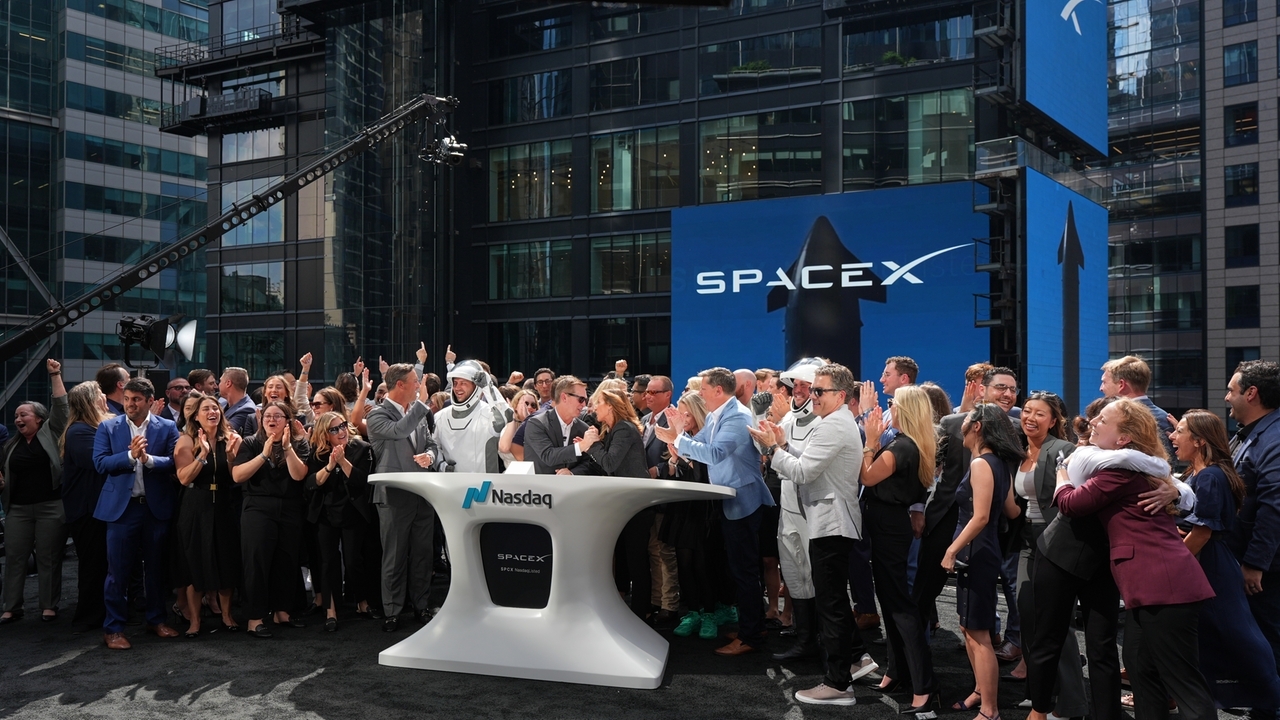
NEW YORK -- Wall Street banks have high hopes for SpaceX but at the moment shares of Elon Musk's rocket market appear to be earthbound. Many of the investment firms that underwrote SpaceX's initial public offering issued their first research notes about the company Tuesday, and almost all recommended that investors buy the stock and forecast it to trade above $200 in the next 12 to 18 months. But after topping $200 in its first week of trading, the stock is trading around $150 per share, where it opened on June 12, its IPO day. Investors may be looking cautiously at the same factors that have Wall Street so enthusiastic about the stock. Analysts are focused on SpaceX's potential to lead the market for space transportation and infrastructure. The company's reusable rockets allow it to transport people and cargo into Earth's orbit and it is aiming for deeper exploration of the solar system. Most of the company's revenue currently comes from its Starlink satellites, and AI innovations are expected to advance that technology. "SpaceX's ambitions, and potential impact on humanity, are bigger than any company's we've ever seen," said a analysts from J.P. Morgan, in a research report. The bank expects the stock price to reach $225 by the end of 2027. It cited the company's competitive advantage in space transportation, with about 670 orbital launches and a nearly 99% success rate with its Falcon rockets. Most payloads launched into orbit since 2023 were through SpaceX. The company has dominated the reusable space rocket market with its Falcon 9, but its gigantic Starship rocket is the key to launching bigger pieces of cargo, including data centers. Investment bank Raymond James is by far the most optimistic. Its analysts expect the stock to eventually reach $800 per share and consider SpaceX a key industrial company for the 21st century. "Just as railroads, electric grids, and the Internet reshaped prior economic eras, we believe SpaceX is building the foundational platform for the next generation of industrial capacity," the analysts wrote in a research report. SpaceX founder Elon Musk decided to take the company public because it needs money to fund its ambitions, including putting more satellites and eventually data centers into space. It's more ambitious goals include establishing a colony on Mars. For now, Starship is still in the test phase and no technology exists to put data centers in space or send people to Mars. Wall Street analysts acknowledge that a delay or failure to establish a steady schedule of launches for Starship is a risk that could torpedo their forecasts. SpaceX ended its first day on Wall Street in June with a market value of more than $2 trillion and is still sitting around that level. That made Musk the world's first trillionaire, though his net worth has since fallen back below $1 trillion, according to Forbes. A few banks on Wall Street are more cautious about the company's prospects. Equity research firm MoffettNathanson said it sees the potential, but has given the company a more "neutral" rating and sees the stock eventually sitting at $131 per share. The concerns are over many of the unknowns related to regulatory issues, technology and demand. "It is, in short, a bet on any and all things made possible by a virtual lock on rocket manufacturing and launch," MoffettNathanson said in a report.
Anthropic expands in New York City with massive 466,000 sq ft office lease
The Claude AI maker is taking over an entire 16-story building in Lower Manhattan, signaling aggressive growth that intersects with crypto-adjacent infrastructure deals Anthropic, the AI company behind the Claude model, is leasing an entire 16-story building at 330 Hudson Street in Lower Manhattan. The deal covers roughly 466,000 square feet of office space, a staggering 30x increase from the company's current New York footprint. For context, Anthropic currently occupies about 15,500 square feet at 155 Avenue of the Americas, a space it leased in 2024. The current lease at 155 Avenue of the Americas has a potential expiration approaching in 2026, making the timing of this deal practical as much as aspirational. From startup footprint to tech giant ambitions Anthropic had been shopping for between 250,000 and 450,000 square feet of Manhattan office space since as early as January 2026. Landing at the top end of that range tells you something about how quickly the company's ambitions scaled during the search process. The company plans to double its New York workforce as part of the move, as confirmed in a July 7, 2026 report by the New York Times. The TeraWulf connection and why crypto investors should pay attention Anthropic recently signed a separate $19 billion, 20-year lease agreement with TeraWulf for AI data center infrastructure in Kentucky. TeraWulf started life as a Bitcoin mining company. It built out substantial power infrastructure and data center capacity to mine cryptocurrency, then increasingly pivoted toward hosting AI workloads as the economics shifted. The company essentially realized that the same cheap power and cooling infrastructure that makes Bitcoin mining profitable also makes it ideal for running the massive GPU clusters that AI companies need. The risk is concentration. A $19 billion, 20-year commitment to a single tenant means TeraWulf's fortunes are now deeply tied to Anthropic's success. Investors should watch whether TeraWulf maintains a balanced portfolio of AI and crypto mining clients or becomes overly dependent on one relationship.

Cathie Wood's Ark Invest Buys the SpaceX Dip and Dumps $8.6 Million Worth of Surging AMD Stock - SpaceX (
The SpaceX buy came as the Elon Musk-led company's stock retreated from its first-week debut highs. Shares have fallen 28.9% from a peak of $225.64, though SpaceX still commands a market value of about $2.1 trillion, placing it among the world's most valuable companies. The AMD Trade The chipmaker's rally came as Japanese autonomous driving startup Turing Inc. said it raised $79 million in an extension of its Series A round, adding AMD Ventures as a new investor and expanding use of AMD's AI accelerators. The funding valued Turing at about $600 million. Other Key Trades Benzinga Edge Stock Rankings indicate SpaceX Stock doesn't check out on Short, Medium, and Long Price Trends. Image via Shutterstock Market News and Data brought to you by Benzinga APIs To add Benzinga News as your preferred source on Google, click here.

SpaceX's two lead underwriters have a $1 trillion chasm in their valuation as quiet period ends
Morgan Stanley sets $300 price target on Space as Goldman Sachs arrives at $205 What's SpaceX worth? Analysts at underwriters now have their say. The two lead underwriters on SpaceX's initial public offering, Goldman Sachs and Morgan Stanley, have a valuation gap of more than $1 trillion as they both initiated coverage at the equivalent of buy. Goldman Sachs analysts led by Eric Sheridan set a price target of $205 on the rocket-launching company, while Morgan Stanley analysts led by Adam Jonas set a $300 target, as the 25-day quiet period expired for SpaceX's underwriters. SpaceX (SPCX)closed Monday at $160.42, more than 25% below the post-IPO high of $225.64 but still above the IPO valuation of $135. The ironic aspect is that Goldman actually is forecasting better financial performance than Morgan Stanley. SpaceX won't become free-cash-flow positive until 2031 on Goldman's numbers, but is forecast to double revenue this year with adjusted earnings before interest, tax, depreciation and amortization reaching $352 billion, from last year's $6.58 billion, by the end of the decade. The Morgan Stanley team have a more conservative approach to the near term - they see SpaceX's adjusted EBITDA to be $162 billion by 2029, and they don't expect SpaceX to become free cash flow positive until 2035. The difference, then, is how they translate those estimates into a price target. Morgan Stanley discounts cash flow by each division over 15 years "with triangulation/support through multiples," while Goldman's valuation is based on 2029 numbers. Each team does acknowledge the gap between their numbers and the current reality. "Space is hard," say Jonas and team, as they say the outlook depends on several technologies not yet proven at commercial scale, like fully reusable Starships capable of hitting thousands of launches a year and orbital compute. Sheridan makes a similar point. "In many ways, SpaceX presents a track record of building toward solutions which many industry experts had previously viewed to be implausible (albeit with this execution not being as linear as public market investors typically desire), particularly with regard to their ability to be the low cost provider of various infrastructure as a service offerings," says the Goldman note. -Steve Goldstein This content was created by MarketWatch, which is operated by Dow Jones & Co. MarketWatch is published independently from Dow Jones Newswires and The Wall Street Journal. (END) Dow Jones Newswires 07-07-26 0420ET Copyright (c) 2026 Dow Jones & Company, Inc.

Elon Musk's xAI is now officially called SpaceXAI
Remember when Twitter was Twitter? Then Elon Musk bought it, renamed it to X, launched an AI company called xAI, which acquired X, and then Musk's space company SpaceX merged with xAI, which has now been renamed to SpaceXAI. At some point, it may become practical to just lump it all together as "that Musk thing." To clarify: SpaceX is the public company and the parent corporate entity that towers above it all; SpaceXAI is a subsidiary of SpaceX, and X is a subsidiary of SpaceXAI (there's another layer between these called X Holdings, but perhaps it's best not to complicate things any further). The change, alongside a new logo for the company, has been announced on SpaceXAI's official X account, which has also been changed to @SpaceXAI. SpaceX acquired xAI in February 2026, shortly before SpaceX's monster IPO in June, which immediately propelled the company to a valuation of roughly $1.8 trillion (it currently stands at about $2.1 trillion). The acquisition was (officially) about Musk's idea of creating huge AI data centers in space. The company plans to start demoing Starmind (as this infrastructure will be called) in late 2027, with actual commercial deployment starting in 2028. We'd never mention the fact that xAI was burning money and needed a wealthy parent company to keep it afloat.

Two traders sue Polymarket over disputed resolution of Strategy bitcoin sale market
We'd love your feedback. Take a 30-second survey to help improve The Block. Two plaintiffs have filed a complaint against Polymarket alleging breach of contract and deceptive practices in the resolution of a prediction market tied to whether Strategy would sell bitcoin by May. The lawsuit, filed by William Wood and Thomas Bush in the New York Supreme Court on July 3, names Polymarket, CEO Shayne Coplan, CMO Matthew Modabber, and other related entities and individuals as the defendants. According to the filing, the plaintiffs held "Yes" shares in a binary market asking whether Strategy would sell any of its bitcoin holdings by May 31. Strategy disclosed in a Form 8-K filing with the U.S. Securities and Exchange Commission that it had sold 32 BTC between May 26 and 31. Per the complaint, Polymarket ultimately resolved the market as "No" after adding clarifying language that plaintiffs allege effectively required public confirmation by the May 31 deadline rather than merely a sale by that date. On June 3, the prediction market's final review concluded in a "No" after a UMA vote, which is used to resolve disputed markets on Polymarket. Breach of contract Plaintiffs claim Polymarket altered the market's terms post-resolution, violating the platform's core promise of rules-based, objective outcomes. They also argue that Strategy's 8-K filing constituted clear proof under the market's stated rules, which designated information from Strategy as the primary resolution source. "If defendants can impose a confirmation-by-deadline requirement after the fact in a market this objective, then the advertised promise of pre-defined, rules-based resolution is materially misleading," the filing said. "A prediction market that will not honor a proven, unambiguous event does not seek truth; it controls payout." Plaintiffs assert claims including breach of contract, breach of the implied covenant of good faith and fair dealing, money had and received, unjust enrichment, and violations of New York General Business Law regarding deceptive acts and false advertising. They seek damages to be determined at trial, including the $1.00-per-share redemption value of their winning "Yes" shares, as well as legal fees and costs. No response from Polymarket has been detailed in the initial court filing. The Block has reached out to Polymarket for comment. Meanwhile, the prediction market platform hit its all-time high record for monthly trading volume in June, with its main platform attracting $10.7 billion, while its U.S. platform reported $3.25 billion, according to The Block's data dashboard.