News & Updates

The latest news and updates from companies in the WLTH portfolio.

OpenAI unveils long-awaited "super app" as rivalry with Anthropic intensifies

OPENAI showcased a new AI agent on Thursday (Jul 9) meant to help white-collar workers access the power of coding tools without the sticker shock. The agent, called ChatGPT Work, combines OpenAI's popular chatbot with its AI coding tool, Codex, to create documents, presentations and websites, the company said. The service is powered by OpenAI's most advanced AI model, GPT-5.6, which also debuted on Thursday. That model's launch was delayed last month at the US government's request over national security fears. ChatGPT Work is a direct answer to Anthropic's Claude Cowork, an agent it launched in January that is capable of planning and executing multi-step tasks autonomously. The launch reflects intensifying competition to build and sell AI tools for professional use, as technology companies seek to capitalise on rising demand for autonomous agents that can complete complex tasks with minimal human input. Anthropic and OpenAI -- both of which are preparing for possible public offerings soon - are fighting for enterprise business, which is more lucrative than selling products to consumers. Both ChatGPT Work and Claude Cowork are designed for non-coders who want to tap into the abilities of AI coding tools, which are often more capable than standard chatbots but require specialised knowledge. OpenAI officials emphasised that its new offerings would be both cheaper and more broadly available than its rivals' products. The company launched three different sizes of its 5.6 model. "You can apply the model's ability to code to solve problems across every industry," said Ty Geri, product manager for ChatGPT Work, in an interview. Geri described OpenAI's 5.6 model as "competitive with models that are far, far more expensive at twice the speed and much, much cheaper." Thursday's announcement also underscores a growing concern among companies about the high cost of using such AI tools. Max Weinbach, analyst at consulting firm Creative Strategies, said the smallest version of OpenAI's new model can complete a task about as well as the largest version - but at one-fifth of the cost. "This is the first time where I've seen the small models complete these kinds of tasks," he said. Before this launch, OpenAI's agentic offerings included Operator and deep research, later consolidated into ChatGPT Agent for individual users, as well as Workspace Agents for enterprise workflow automation. ChatGPT Work will roll out on Thursday on web and mobile, beginning with Pro, Enterprise, and Edu users, and will expand to Plus and Business users over the next few days. OpenAI also announced a new ChatGPT desktop application and a hosted websites feature to let users build and share websites directly through ChatGPT Work. REUTERS
Anthropic
The Business Times4d ago
Read update
OpenAI unveils long-awaited "super app" as rivalry with Anthropic intensifies

Trump thinks Musk will donate SpaceX stock to US child savings scheme

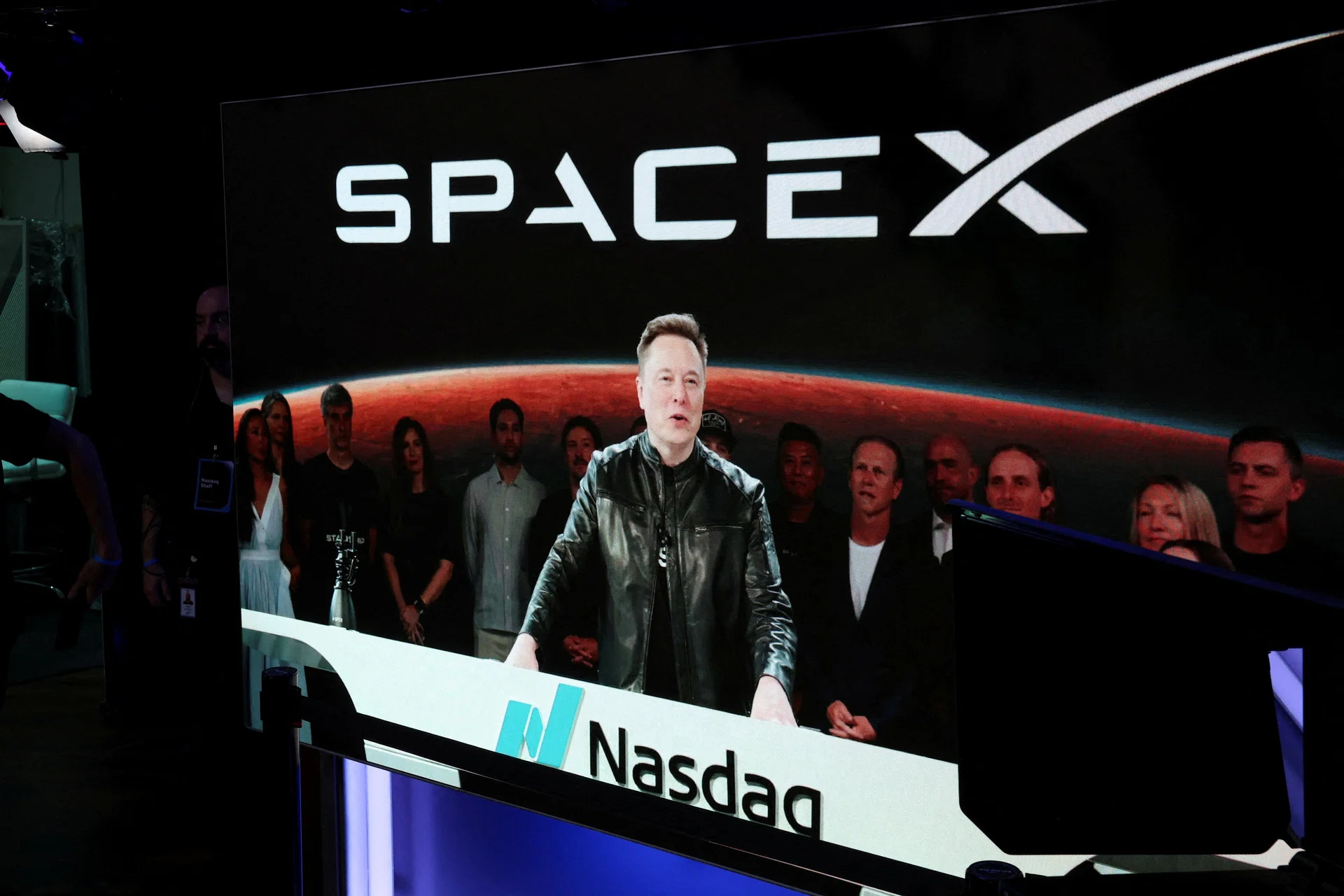
[WASHINGTON] US President Donald Trump said he thinks Elon Musk will donate SpaceX stock to the Trump accounts initiative, following other technology executives who have embraced the new investment vehicles for children. "Well, I think that he will do that," Trump said in an interview on Thursday (Jul 3) on CNBC when asked about the possibility. "Micron, which is a great company, just did it. Michael Dell is a fantastic guy," he added, citing others who have also pledged money to the effort. SpaceX last month made history with the biggest-ever IPO, raising US$86 billion and making Musk, the founder, the world's first trillionaire. Trump said he congratulated Musk on that achievement. "I wrote him a note. I said, 'Congratulations, very good.' I have a very good relationship with Elon. Elon and I had a little disagreement," Trump said. "He liked me, still likes me." He was referring to his complicated history with Musk, the world's richest man. Musk threw his wealth behind Trump's 2024 campaign and went on to spearhead an effort to slash the size of the federal government. They had a falling out over Trump's massive tax-and-spending package last year, which Musk said would raise the US deficit. The two have since repaired their relationship with Musk attending a White House dinner for Saudi Crown Prince Mohammed bin Salman last November. Musk did not immediately respond to a request for comment on Thursday evening. The tax-advantaged Trump savings accounts that the president previously announced will launch on Jul 4. Every US citizen born between 2025 and 2028 - the period covering his second term - can receive an initial US$1,000 investment from the US government, but older children can also use the accounts. Corporate leaders have hailed the initiative with many making pledges to contribute to accounts for the children of employees or others. Micron Technology this week announced a US$250 million investment in the accounts. Dell Technologies founder Dell has said he will give 25 million American children US$250 each to jumpstart their investment accounts. The participation of prominent business executives highlights how the country's corporate and financial elite have moved to curry favour with the president by backing some of his signature initiatives. Next week, executives from Nasdaq and the New York Stock Exchange plan to ring the opening bell from the Oval Office to mark the launch of the Trump accounts. BLOOMBERG

SpaceX
The Business Times11d ago
Read update
Trump thinks Musk will donate SpaceX stock to US child savings scheme

SpaceX's investors are giving up control to buy into Musk's vision

ELON Musk's industrial empire is testing a controversial proposition: that society should tolerate environmental shortcuts and limited shareholder control because the prize is faster innovation. That is the bargain now embedded in SpaceX's listing under the "SPCX" ticker. By the time SpaceX entered public markets, it had already absorbed xAI, Musk's artificial intelligence and social network company. Investors were therefore not buying a clean aerospace story of rockets, Starlink and reusable launch. They were buying into a founder-controlled platform that also included Grok, rapidly expanding terrestrial AI centres and the contested Colossus buildout. The central concern is not simply that xAI has chosen fossil-fuel generation to accelerate AI training. Nor is it that SpaceX's public shareholders have very limited power to influence decisions relating to climate, water or regulatory risks. The concern is the combination: environmental-regulatory arbitrage on the ground, paired with financial-structure arbitrage in the market. In other words, Musk's company is exploiting gaps in energy and environmental policy to power growth, which shifts costs onto global communities, aquifers and the atmosphere. At the same time, it is implementing a share structure that shifts governance risk onto public investors even as overwhelming founder control is preserved. Together, they create a powerful model for scaling frontier technology: move quickly, defer some of the associated cost, capture the upside and leave society to price the damage later. This posture is familiar. Supporters claim this is how innovation happens. The grid is too slow. Obtaining permits is too cumbersome. AI is too strategically important. Space-based compute may eventually solve the terrestrial problem of physical resource constraints. Investors who want exposure to this exciting future must accept unconventional control. Defenders of this approach would argue that many transformative technologies emerged because entrepreneurs moved ahead of existing infrastructure and regulation. Commercial aviation, the Internet and renewable energy all advanced faster than the speed at which policymakers could adapt to them. Yet, the question is not whether risk-taking should be encouraged, but whether the public should bear costs that markets may not fully price. The price of ignoring externalities For decades, developed economies treated externalities as someone else's problem. Carbon went into the atmosphere. Pollution and extraction were pushed into poorer communities and developing countries. Water, land and biodiversity absorbed costs that corporate balance sheets ignored. The gains were immediate and private; the welfare losses were delayed and often borne by those with the least bargaining power. AI now risks repeating that bargain at machine speed. The issue is not whether AI matters. It does. Compute capacity is strategic infrastructure. Frontier models may advance medicine, climate modelling, cybersecurity, industrial productivity and defence. The US cannot afford to fall behind in AI. But ambition does not excuse reckless regulatory arbitrage. The choice by xAI to rely on fossil-fuel generation for massive AI infrastructure was not simply a difficult trade-off forced by an imperfect grid. It was a decision to prioritise speed over environmental safeguards, community exposure and public accountability. Gas turbines may solve a private interconnection problem, but they create public costs: air pollution, carbon emissions, permitting conflict, water stress and local health concerns. The contrast with Google is instructive. Google is hardly a climate saint: Its AI expansion has increased energy demand, complicated emissions targets and raised legitimate questions about whether Big Tech's climate promises can survive the compute boom. But Google's stated approach at least accepts the right frame. In 2020, it committed to 24/7 carbon-free energy by 2030. When designing its data centres, Google works through power-purchase agreements and grid decarbonisation, and discusses water stewardship, alternative water sources and direct-to-chip cooling. In other words, Google treats energy and water as constraints to be engineered and disclosed, not inconveniences to be bypassed with fast fossil infrastructure. That makes xAI's approach harder to defend. The acquisition of xAI before the initial public offering makes the governance question unavoidable. Public investors were not merely buying exposure to a founder who also owned a controversial private AI company. They were buying into a company whose public-market story had already expanded to include AI infrastructure. If Colossus, Grok and orbital data centres help support the valuation narrative, then Colossus-related environmental and regulatory risks belong inside the investor-risk discussion as well. Governance structure can lead to investor risks That should have been a critical issue in the SPCX offering. It was not treated like one. The reason is governance. SpaceX is tightly controlled by Musk. Public shareholders may gain liquidity and exposure to one of the world's most important aerospace companies, but they are not buying conventional accountability. They are buying into a founder-controlled structure in which ordinary investors have little practical ability to pressure Musk on climate risk, environmental compliance, water use, related-party exposure or the boundaries between visionary risk-taking and regulatory arbitrage. That makes the climate issue more material, not less. In a normally governed public company, environmental liabilities can become investor pressure points: shareholder proposals, director votes, engagement campaigns, disclosure demands and proxy contests. At SpaceX, that disciplining mechanism is largely blunted. Investors can voice concerns, sell their holdings or absorb the risk. Their ability to influence strategic direction, however, remains very limited. That is the market failure at the centre of the IPO. Public investors are being offered exposure to a strategically important company, but not meaningful control over the environmental and governance choices that may shape its long-term risk profile. The pattern is recognisable: move first, gain market share and dominance, overwhelm infrastructure, exploit ambiguity and dare regulators to catch up. Sometimes that style produces breakthroughs. Sometimes it produces avoidable harm. AI infrastructure is no longer just software. It is heavy industry. Frontier model training requires electricity, cooling water, land, transmission capacity, chips, minerals and rapid hardware replacement. If faster AI training results in greater fossil-fuel dependence, increased pollution exposure, heightened water stress and potential litigation, investors should view these issues not merely as ESG concerns but as material business risks. The competitive argument is real but incomplete. Yes, AI is a geopolitical race. Yes, grid interconnection is too slow. Yes, clean energy deployment and transmission permitting need reform. But those failures do not justify private fossil workarounds that shift costs onto local communities. Competitiveness cannot become a blanket exemption from environmental responsibility. Nor can the sector pretend that all compute demand is equally valuable. AI for cancer research, grid expansion and resilience, and national security is not the same as AI for spam, synthetic influencers, engagement optimisation or another corporate chatbot. If energy and water are scarce, society has a right to ask which AI workloads deserve priority and which are simply monetising consumer appetite. The planetary dimension is equally important. AI presents itself as weightless, but it depends on minerals, chips, fabrication plants, electricity and cooling water. If the benefits accrue to innovators, wealthy companies and developed-country investors while the costs fall on poorer communities, resource frontiers and climate-vulnerable nations, AI risks reinforcing some of the same distributional imbalances that characterised the fossil-fuel era. The orbital data-centre thesis does not solve this. Space-based compute powered by solar energy and launched by SpaceX's Starship is an elegant idea. It may eventually support specialised workloads. But orbit does not eliminate externalities; it relocates them. Launch emissions, debris risk, spectrum conflicts, radiation hardening, thermal management, re-entry planning, ground infrastructure and hardware replacement remain unresolved. The real choice is not AI versus the environment. It is responsible industrialisation versus another century of externality dumping. Before buying into its investment thesis, regulators and SpaceX investors should have demanded governance worthy of the firm's valuation: transparent energy sourcing, a lawful permitting process, water disclosure, environmental controls, independent board oversight, related-party safeguards and credible climate accountability. Instead, the IPO structure has done the opposite. It gave public investors access to the upside while leaving Musk with overwhelming control over the risks and arbitrage. Musk has often been rewarded for moving faster than incumbents. But speed is not a moral defence. When a company builds first, pollutes now, litigates later and points to future space technology as absolution, it is not escaping the old economy. It is perpetuating it.

SpaceXxAIUnconventional
The Business Times11d ago
Read update
SpaceX's investors are giving up control to buy into Musk's vision

US allows Anthropic to release Mythos AI to 'trusted' US organisations

[WASHINGTON] Anthropic said on Friday (Jun 26) that the US government has allowed it to release its powerful Claude Mythos 5 artifical intelligence model to some "trusted" US organisations, partially reversing an order two weeks ago to suspend access over national security risks. More than 100 companies and institutions will now have access to Mythos 5, incluing many Fortune 500 companies, a source familiar with the new directive said, declining to be identified due to the sensitivity of the matter. Concern that powerful AI systems could be misused by military intelligence users in China, Russia or other countries of concern has prompted President Donald Trump's administration to take an aggressive approach to oversight of releases of Anthropic's and rival OpenAI's frontier models. OpenAI said earlier in the day that it was delaying a full public launch of GPT-5.6 at the US government's request, limiting its access to a small group of vetted partners whose details were shared with the authorities. Anthropic had abruptly disabled its most advanced AI models - Mythos 5 and Fable 5 - for all users after the government's Jun 12 export control order. "Today, the government notified us that Mythos 5, our strongest cybersecurity model, can be redeployed to a set of US organisations that operate and defend critical infrastructure," Anthropic said in a statement on Friday. "We're restoring access for these organisations quickly, and we're continuing to work with the government to expand access to Mythos 5 and make Fable 5 available for general use again," it added. Government criticised for picking who gets access The government's vetting of which companies can gain access to Mythos has drawn much criticism. "No one knows how these companies are picked and why everyone else is excluded," said John Coleman, legislative counsel for the Philadelphia-based nonpartisan free speech organisation, the Foundation for Individual Rights and Expression. "This is putting too much power in the hands of the government. There's little transparency and it raises questions about the rule of law." OpenAI boss Sam Altman echoed concerns about the government's choosing of who gets access to top models in a post on X. Extensive safety testing "is not a bad idea. I just don't like the idea of the government picking the customers," he wrote. Experts have said that Mythos models, in the wrong hands, could dramatically accelerate sophisticated cyberattacks, particularly in sectors such as banking that rely on complex, interconnected, and often decades-old technology systems. A letter from US Commerce Secretary Howard Lutnick to Anthropic said there had been "significant progress" in work done by the company with the government to address "risks associated with the Covered Models." It was not immediately clear what safeguards had been adopted. Anthropic said earlier this month that it understood the government believed there is a method of bypassing, or "jailbreaking," a safeguard that would prevent Fable 5 from being used in identifying software vulnerabilities. No export licence needed for non-US citizens Lutnick said in the letter that an export licence will no longer be needed for Mythos 5 to trusted companies and their employees who are not US citizens, or to Anthropic's employees who are not US citizens, but licensing restrictions will remain in place for companies that are not on the approved list. The source said many of the approved companies are part of Anthropic's Project Glasswing, which includes about 100 well-known tech companies and institutions. The government is also moving towards allowing Anthropic to release Fable soon, although a timeline is unclear, the source said. Both Fable 5 and Mythos use the same underlying AI model, but Fable 5 is designed to be widely available for public use whereas some safeguards are lifted for Mythos. Both Anthropic and OpenAI plan to go public. Anthropic's relationship with the US government has, however, been particularly rocky. The company refused to allow the US military to use its AI models for domestic surveillance and fully autonomous weapons systems and the government retaliated by putting it on a national security blacklist. The government's restrictions on Anthropic and OpenAI follow Trump's signing of an executive order this month establishing a voluntary framework for AI developers to offer "covered frontier models" to the US government for up to 30 days before releasing them to trusted partners. The administration's latest order is "a practical interim step, but leaves unresolved the larger issue of how companies can widely release updated models", said Kate Koren, an analyst at the Center for Strategic and International Studies in Washington and a former Commerce Department official. "The longer there isn't a system in place that will allow US companies to widely release new models, the more likely it is that China will be able to catch up," she said. REUTERS

Anthropic
The Business Times15d ago
Read update
US allows Anthropic to release Mythos AI to 'trusted' US organisations

US allows Anthropic to release Mythos to 'trusted partners'

[WASHINGTON]The US government on Friday (Jun 26) allowed Anthropic to release its powerful Claude Mythos 5 AI model to some "trusted partners," according to a Commerce Department letter seen by Reuters. The action comes two weeks after the government ordered the AI firm to suspend access to some of its models, due to fears they could be deployed by military intelligence users in China, Russia or other countries of concern. More than 100 companies and institutions will now have access to Mythos 5, including many Fortune 500 companies, a source familiar with the new directive said, declining to be identified due to the sensitivity of the matter. Anthropic and the White House did not immediately comment. Anthropic had abruptly disabled its most advanced AI models - Mythos 5 and Fable 5 - for all users after the government's export control order. "Since the issuance of my Jun 12 letter, Anthropic has worked with the US government to address risks associated with the Covered Models. These efforts have yielded significant progress," US Commerce Secretary Howard Lutnick said in the letter to Anthropic. Lutnick added that an export licence will no longer be needed for Claude Mythos five Model to trusted companies and their foreign national employees, or to Anthropic's foreign national employees but restrictions will remain in place for companies that are not on the approved list. "In just two weeks, we have worked diligently to ensure America remains the global leader in AI while safeguarding our security," a Commerce Department spokesperson said. The letter did not mention the status of Fable 5. The government is moving towards allowing Anthropic to release Fable as well, although a timeline is unclear, the source said. IPO-bound Anthropic's relationship with the US government has been rocky this year. The company refused to allow the US military to use its AI models for domestic surveillance and fully autonomous weapons systems and the government retaliated by putting it on a national security blacklist. REUTERS

Anthropic
The Business Times17d ago
Read update
US allows Anthropic to release Mythos to 'trusted partners'

SpaceX, Unitree, Anthropic, OpenAI: Is the ultra-hyped tech listing wave backed by sound fundamentals?

[SINGAPORE] A growing wave of ultra-hyped tech listings is driving investors to assess whether current valuations are supported by economic fundamentals driven by speculative hype. Recent high-profile debuts such as US titan SpaceX, as well as expected filings from generative artificial intelligence pioneers OpenAI and Anthropic, underscore this trend. A surge in humanoid robotics listings, including Unitree Robotics in China, further highlights the phenomenon. However, speculative excess "is becoming impossible to ignore", said Swissquote's Ipek Ozkardeskaya. The senior analyst warned that technology valuations have detached from tangible fiscal metrics, adding that prices no longer reflect actual or forward-looking measures such as sales, revenue, earnings or profits. Conversely, other observers believe that markets remain well-positioned to absorb a new wave of listings. While valuations of individual companies may appear elevated, a Lombard Odier note on Jun 16 argued that strong corporate earnings and a resilient macroeconomic backdrop continue to support equities. The Business Times examines what analysts are saying about current and upcoming initial public offering headliners. SpaceX SpaceX, which went public on Jun 12, has emerged as a major "tactical risk-on catalyst", encouraging investors to rotate into riskier assets such as US growth and AI-related stocks, said Manulife Investment Management in a Jun 18 note. The Elon Musk-led space economy cum AI company's US$75 billion IPO was more than four times subscribed. Its prospects have excited investors. Its Starlink unit pioneered the satellite Internet service market, and its Falcon 9 rockets also dominate the commercial space launch industry. The company also recently agreed to provide compute capacity to Anthropic and Alphabet's Google, and acquired the AI-powered coding platform Cursor. Its rapid appreciation has positioned it as the sixth-largest public company in the US as at Jun 22, trading just below Microsoft and Amazon. However, the counter shed more than S$600 billion in market value over three days. On Tuesday (Jun 23), shares of SpaceX slipped for a third straight day, falling 16 per cent to close at US$154.60 after the company said it would sell investment-grade bonds for the first time. Despite the sell-off, the company's market capitalisation remains over US$2 trillion. Its meteoric rise has drawn intense scrutiny regarding its fiscal sustainability. Ozkardeskaya noted that SpaceX trades at about 160 times its revenue from the previous year, a valuation she considers steep. However, unlike its mega-cap peers, SpaceX remains deeply unprofitable, posting a US$5 billion loss during the same financial period. The company's IPO prospectus also highlighted significant execution risks, warning that its space infrastructure plans may not generate returns within a reasonable timeframe. "The acquisition announcement of Cursor changes nothing in the maths. SpaceX can't be worth US$2.66 trillion. Full stop," Ozkardeskaya said. The IPO's immediate impact may be limited due to its small index weight, with only about 4 per cent of SpaceX's shares being available for public trading. However, Lombard Odier noted that as lock-up restrictions expire and more shares enter circulation, the stock's weighting in major indices is expected to rise, increasing its influence on broader market performance. Unitree Robotics The highly anticipated listing of Chinese robotics firm Unitree represents a different facet of the AI boom - embodied AI. The company passed the Shanghai Stock Exchange listing committee review on Jun 1. It is reportedly seeking a valuation of about 4.2 billion yuan (S$802 million) in its planned Shanghai listing. As the company generated 1.7 billion yuan in revenue in 2025, the valuation implies a price-to-sales multiple of roughly 25 times. Unitree's IPO would be one of China's biggest onshore tech listings in years, and it will test whether physical AI applications can command the same premium as their software counterparts. For now, real-world factory deployment remains limited. Unitree's prospectus said its humanoid industry-application revenue came from mainly enterprise reception and tour guide use, intelligent manufacturing and intelligent inspection, with enterprise tour guide use accounting for roughly 50 to 70 per cent. Morgan Stanley analysts wrote in a Jun 23 note that the focus of the humanoid industry is shifting "from demonstrations to commercialisation and real business value creation". Unlike its Western software peers, Unitree's valuation narrative hinges on manufacturing scale and hardware adoption. Reflecting stronger commercialisation momentum, policy support and positive supplier feedback, Morgan Stanley recently raised its 2026 China humanoid robot shipment forecast to 50,000 units, from a previous estimate of 28,000. Analysts expect half-size humanoid robots, such as Unitree's G1, which currently sells for US$16,000 a unit, to account for roughly 70 per cent of total shipments this year. However, price wars are also imminent, with at least 46 robotics companies in the IPO pipeline ⁠for Hong Kong alone, according to Bloomberg. "Commercial verification, policy support and supply-chain feedback point to faster humanoid adoption in China," the Morgan Stanley report stated, forecasting the domestic market size to reach US$15 billion by 2030. Anthropic Pivoting back to the US software landscape, the AI giant behind Claude filed for a US IPO in June. While it did not disclose the size or terms of the offering, it last raised US$65 billion at a post-money valuation of US$965 billion in late May. It is widely expected to achieve an IPO valuation of US$1 trillion or more. The consequential stock market debut could potentially reshape benchmark indices, investor flows and the broader narrative driving US equities. Currently, open-end funds, closed-end funds and exchange-traded funds are providing bridges to these private market leaders. According to Morningstar data, Anthropic is already held by 131 funds, representing around US$6.9 billion in invested exposure. Dario Amodei, CEO of Anthropic, said in May that the company has reached a growth rate that could make it 80 times as big this year. It has also been signing a series of deals with industry giants, including SpaceX, to obtain more computing power. However, the timing of the filing comes alongside rising bills for enterprises utilising AI. These businesses are increasingly scrutinising the return on investment they are getting from AI, particularly after Anthropic transitioned to token-based pricing earlier this year. OpenAI ChatGPT creator OpenAI submitted its initial registration document shortly after Anthropic. OpenAI also did not disclose the size or terms of the offering, and said a timeline has not yet been determined. A Reuters report noted that OpenAI is targeting a valuation of up to US$1 trillion in a public debut that could come as early as September. In March, OpenAI said it was generating US$2 billion in monthly revenue and growing roughly four times faster than companies that defined the Internet and mobile eras, including Alphabet and Meta. Overcrowded market? For the US-based software giants, analysts broadly observe concerns about a crowded capital market. This supply pressure is compounded by existing tech giants tapping the market for cash. Unlike the tightly regulated domestic capital pools that Chinese hardware companies such as Unitree tap, these American IPOs must vie for liquidity against hyperscaler capital drains. "A growing wave of equity-over-debt issuance from mega cap tech hyperscalers such as Meta and Google-parent Alphabet raises questions of where will the capital come from," said BlackRock Investment Institute in a Jun 15 note. Lombard Odier noted that corporate buyback activity currently sits at its lowest level since 2021. "The combination of large amounts of newly issued shares with few shares withdrawn from the market raises the possibility of a temporary equity oversupply if investor demand fails to keep pace," it said. BlackRock analysts said that while market absorption of this supersized equity issuance is a real risk to watch, it is not on its own a reason to question the AI sector's fundamentals. Aaron Socker, portfolio specialist at William Blair Investment Management, noted that while index mechanics can influence short-term trading dynamics, long-term returns are ultimately driven by business fundamentals. Meanwhile, Monika Calay, director of UK manager research at Morningstar, cautioned investors that as these mega-IPOs hit the market, passive ETFs will become the primary exposure channel. Regarding concerns about whether markets can absorb the additional supply of shares, Julius Baer analysts suggested in a Jun 5 note that such fears are overstated. "In our view, the current revival should therefore be viewed less as a warning sign and more as evidence of improving confidence in capital markets. Selectivity will remain essential, but the next generation of public companies is likely to create attractive opportunities for both active and passive investors," they wrote.

AnthropicSpaceX
The Business Times18d ago
Read update
SpaceX, Unitree, Anthropic, OpenAI: Is the ultra-hyped tech listing wave backed by sound fundamentals?

Anthropic accuses Alibaba of 'illicitly' accessing AI models

ANTHROPIC accused Chinese technology giant Alibaba of waging a large-scale effort to "illicitly" access its Claude artificial intelligence model using thousands of fraudulent accounts that undermine the US AI developer's decision to keep its products out of China. Anthropic claimed that a campaign by operators linked to Alibaba's Qwen AI lab targeted Claude's most prized capabilities, including software engineering and agentic reasoning, according to a letter that the AI startup sent to several US senators and White House officials. The company said that it was the biggest attempt so far by a Chinese company to piggyback on the work of top US labs. In its letter, Anthropic claimed that the effort involved 28.8 million exchanges with Claude between April and June through almost 25,000 fraudulent accounts, according to sources familiar with the document and a copy seen by Bloomberg News. The company said that the Alibaba campaign resembled past efforts by other Chinese developers that Anthropic flagged in a blog post earlier this year. Anthropic warned that Alibaba and other Chinese labs are making systematic and unauthorised use of results from leading US models to develop a rival generation of chatbots at a fraction of the cost via a practice known as adversarial distillation. It cautioned that AI systems built using this method often lack safety guardrails, and the firm urged the Trump administration to step up efforts to halt the practice. "These distillation attacks are carried out illicitly, systematically, and at an industrial scale to harvest US Al capabilities across frontier labs and repackage them as their own without incurring the training and R&D costs required to train US frontier models," Anthropic wrote in its letter. Alibaba had no comment. An Anthropic spokesperson declined to enter into specifics on the letter but emphasised the importance of combating distillation through "coordinated action between government and industry". Anthropic's letter marked the latest call from top American AI companies to rein in some kinds of distillation, where developers train systems using results from another AI model to create similar capabilities in a new one at a far lower cost. While tolerated for training smaller, less-advanced systems, distillation violates AI labs' terms of use when it's employed to replicate a cutting-edge AI model without permission. The practice has alarmed US developers to the point that Anthropic, OpenAI and Alphabet's Google have joined forces to share information about distillation attempts that violate their terms of service. Anthropic and OpenAI have each warned that Chinese AI startups, including DeepSeek and Minimax, have employed distillation to develop their own models. Lawmakers in Washington are moving to address the US industry's concerns. In the Senate, Tennessee Republican Bill Hagerty and New Jersey Democrat Andy Kim plan to introduce an amendment to must-pass defence legislation as soon as Wednesday that would blacklist or sanction any Chinese firm found to be improperly accessing US AI model output to help train competing models, according to a source with the matter. It's unclear whether the amendment would win enough support to be included in the defence bill's final version. A related bipartisan bill in the House, backed by Michigan Republican Bill Huizenga and Democrat Sydney Kamlager-Dove, is also set to be considered for inclusion in the annual defence measure. Those proposals follow initial steps by the Trump administration on the issue. In April, White House Office of Science and Technology Policy Director Michael Kratsios published a memo indicating the US would help to crack down on attempts by Chinese companies to exploit outputs from US models. The memo described it as different from legitimate research practices due to its "industrial scale" and reliance on thousands of proxy accounts. Anthropic said that the Alibaba campaign took place after Kratsios released his memo, in defiance of the administration's warnings. It cautioned that a failure to respond to such attempts risks letting China gain ground on the US in AI, posing a threat to national security. The claims against Alibaba add to growing political pressure in Washington on the company, which earlier this month was added to a US Defense Department blacklist of businesses that allegedly support China's armed forces - a development cited in Anthropic's letter. Alibaba has insisted it has no affiliation with the Chinese military and sued the Pentagon this week to win removal of the designation. For Anthropic, the threat of cheaper imitation products from China that syphon away customers looms large as the company, now valued by private investors at US$965 billion, prepares for an initial public offering. US officials have estimated that unauthorised distillation costs Silicon Valley labs billions of US dollars, Bloomberg has reported. With its letter, Anthropic is urging the US to clarify antitrust guidelines to allow more information sharing by US companies on distillation. It reiterated the company's support for export controls on advanced AI chips and asked for the US to penalise firms using distillation to glean valuable information for creating their own models. Anthropic's calls for additional government support in countering what it sees as unfair practices by Chinese rivals may not find a fully receptive audience with the White House. The company is embroiled in a fresh dispute with the Trump administration, which less than two weeks ago imposed export controls on Anthropic's top two models, citing security concerns. Even after meetings between Anthropic's top technical staff and White House officials last week, little progress has been made to ease tensions and restore service to the company's Fable 5 and Mythos 5 AI systems. The company disabled access to the models more than a week ago, after the Commerce Department imposed restrictions to block foreign persons from using those AI tools. BLOOMBERG

Anthropic
The Business Times19d ago
Read update
Anthropic accuses Alibaba of 'illicitly' accessing AI models