News & Updates
The latest news and updates from companies in the WLTH portfolio.
Anthropic, music publishers square off on 'fair use' defence in AI copyright case
The case could affect many AI copyright lawsuits, after earlier Northern California rulings split on whether AI training is fair use. SAN JOSE, California - Anthropic urged a judge in California on Oct 21 to rule that the AI company's use of millions of song lyrics to train its chatbot Claude is protected as "fair use" under US copyright law, as it seeks to scuttle a lawsuit brought by Universal Music Group and other music publishers. US District Judge Eumi Lee did not rule at a hearing in San Jose but pressed both sides on the fair use question, which could be key to dozens of other high-stakes copyright infringement cases in the AI era. Lee also questioned the publishers' assertion that Claude's ability to compose lyrics threatens the market for the publishers' lyrics. Anthropic lawyer Sonal Mehta of WilmerHale argued that its AI training leads to the creation of transformative new content, putting it squarely under the fair use doctrine. The publishers' attorney Matt Oppenheim of Oppenheim + Zebrak responded that Anthropic misuses its lyrics to generate competing content that harms human songwriters. Oppenheim said Claude received nearly 120,000 requests to generate "synthetic" lyrics over a six-month period. He said large language models like Claude "could overwhelm the market with AI-generated content very easily". Mehta countered that AI has not reduced demand for the lyrics, and that the publishers could not identify any specific instances of market harm from Claude or other large language models. Mehta also said that UMG itself has said that AI is "overwhelmingly a net positive" for the music industry. Early fair use rulings Fair use could determine the fate of pending lawsuits brought by authors, news outlets, visual artists and others against tech giants including Anthropic, OpenAI and Meta Platforms over their AI training. Two other Northern California judges who have already weighed in on the closely watched issue have split on whether generative AI training generally makes fair use of copyrighted material, which would shield tech companies from liability for using millions of copyrighted works to train their systems without content owners' permission. Now-retired US District Judge William Alsup sided with Anthropic in 2025 on its argument that its AI training made fair use of books. Two days later, US District Judge Vince Chhabria ruled for Meta in a similar lawsuit but warned that AI training "in many circumstances" would not be fair use. In the case being heard by Lee, music publishers UMG, Concord and ABKCO sued Anthropic in 2023, alleging its use of their lyrics to train Claude to respond to human prompts infringed their copyrights in hundreds of songs by artists including Beyonce, the Rolling Stones and the Beach Boys. Anthropic has argued that its AI training makes transformative use of song lyrics to "help Claude understand human language and enable progress and productivity in science, business and education". REUTERS
Nscale and Anthropic in talks for US$45 billion AI deal
The talks come as investors question heavy debt used to build AI infrastructure. Nscale also faces setbacks after Microsoft pulled out of a flagship data centre deal over power delays. Nscale is in talks to sell AI computing power to Claude maker Anthropic in a new deal that could be worth about US$45 billion (S$58 billion), a person familiar with the matter told Reuters on Oct 19. The data centre developer is seeking another major deal with the AI lab for a second facility at its Monarch data centre campus in West Virginia, the person said. In August, Anthropic struck a deal to spend US$45 billion to rent AI cloud computing power from Nscale's West Virginia data centre campus. A second Monarch building would deliver 460 megawatts of computing power using Nvidia's advanced Vera Rubin AI chips, according to the source. Anthropic did not immediately respond to a Reuters request for comment. Anthropic also has the right of first refusal on Monarch's expected third building, the person said, adding discussions were ongoing and details of the plan could change. Bloomberg, which first reported the news, also said a cohort of investors had urged Anthropic to lower its IPO valuation target after a series of market setbacks for AI companies. Investors have sharpened scrutiny of companies that are increasingly turning to debt-driven AI infrastructure expansion. Last week, Nscale rival CoreWeave's shares slumped amid concerns over its US$50 billion debt load, fuelling a global selloff in AI stocks. The news of a potential tie-up comes after Microsoft pulled out of a deal to anchor a flagship data centre for Nscale following power connection delays that pushed its expected supply date into the 2030s. Nscale has grown rapidly since launch, increasing its total contracted value from US$100 million to more than US$103 billion in two-and-a-half years and competing with Nebius, Crusoe and Lambda. According to the Nscale prospectus, Microsoft and Anthropic are expected to be the company's major customers in the future. REUTERS
OpenAI speeds fundraising ahead of Anthropic IPO
The race reflects wider market jitters, with AI valuations under pressure, IPO plans delayed, and investors comparing OpenAI and Anthropic's growth, pricing and accounting methods. NEW YORK - OpenAI is racing to secure investor commitments before rival Anthropic's expected public market debut in mid-November, in an unusually fast fundraising that could value the ChatGPT maker at over US$1.4 trillion (S$1.79 trillion), according to two people familiar with the matter. The rapid timetable reflects, in part, a desire to get ahead of Anthropic as the two frontier labs are increasingly tapping in to a similar investor base, the people said, adding that OpenAI wants to capitalise on its recent revenue growth after launching new models. SoftBank Group, Abu Dhabi-based MGX and other existing backers of OpenAI are in talks to join the round of about US$30 billion, one of the people said. The acceleration underscores how closely the two AI developers are competing for capital as both pursue trillion-dollar price tags, amid growing concern about rising interest rates, significant volatility in technology stocks and rising scrutiny of AI valuations. OpenAI held meetings with long-only funds and sovereign wealth funds last week while Anthropic was hosting its own investor day. OpenAI's funding round is expected to move faster than is typical for an offering of its size, the people said. Investors familiar with the company say OpenAI also needs capital to fund its substantial infrastructure commitments and bolster its balance sheet if a deterioration in the IPO markets further delays its planned 2027 listing. Though there is high demand for the shares of both companies, investors face the challenge of evaluating and allocating capital to two complex, competing offerings within days or weeks of each other. Some investors view OpenAI's financing push as an effort to lock in capital from funds that might otherwise devote more of their resources to Anthropic's IPO, the people said. OpenAI and SoftBank declined to comment. Anthropic and MGX did not immediately respond to requests for comment. Trying to head off comparisons OpenAI is pitching investors on growth that accelerated after the launch of its GPT-6 Astra model, saying it had reached US$50 billion in annualised revenue and expecting that figure to rise to US$70 billion by year-end, according to one of the people. OpenAI has also cut prices on its cheaper models, which it said has boosted usage, and told investors it can further lower the price of AI models, the person added. Anthropic's annualised revenue reached roughly US$65 billion by July, Reuters previously reported. Its quarterly revenue jumped to US$16.8 billion in the third quarter from US$11.6 billion in the second quarter of 2026, it told investors, but slowing month-to-month revenue growth has raised concerns among investors about its valuation. OpenAI is seeking to complete the fundraising before Anthropic's financial disclosures give investors a fuller picture of its business and invite comparisons between the two companies, one person said. The disclosures could prompt investors to press OpenAI Chief Financial Officer Sarah Friar for more details about the company's revenue growth and financial outlook, the person added. OpenAI records revenue on a net basis by subtracting partner shares upfront. It has accused Anthropic of inflating its revenue by counting the full, gross value of contracts sold through third-party cloud providers. Anthropic told Reuters earlier that it follows established accounting practices. "OpenAI could want to set its own valuation and not have to worry about a comp (comparison)," said Edward Best, co-chair of capital markets at Willkie Farr & Gallagher, who is not working on the deal and commented on a hypothetical basis. "It's really a two-horse race in terms of being public." OpenAI was last valued at US$852 billion in March, after a record-breaking US$122 billion funding round, including a commitment from Amazon.com, which agreed to invest up to US$50 billion in the lab. The Financial Times previously reported some details of OpenAI's potential fundraising. IPO plans hit by market jitters A number of companies preparing to go public have decided to wait until after Anthropic's planned IPO, wary of competing for investor demand amid market volatility and a pullback in AI stocks, bankers and investors said. Some late-stage companies are also timing private fundraising rounds to avoid coinciding with Anthropic's expected debut, the bankers and investors said. Some existing and prospective Anthropic investors have argued for a valuation closer to US$1.5 trillion for its market debut - instead of the desired US$2 trillion - after the AI startup's third-quarter results fell short of expectations, Reuters reported last week. The reassessment comes amid a choppy market since September, with volatility in oil prices, rising bond yields and growing concerns about AI safety weighing on investor appetite for technology stocks. Investors are also scrutinising the cost of AI infrastructure, including the debt needed to finance the data centres powering the boom. At the centre of the latest concerns is cloud provider CoreWeave, whose shares and debt tumbled last week as investors scrutinised the nearly US$50 billion in borrowings used to fund its rapid expansion. The uncertainty has disrupted what had been expected to be a busy autumn for IPOs, with companies reassessing their listing plans amid market volatility and concerns about valuations. Blackstone-backed AirTrunk REIT, Nvidia -backed Firmus and SoftBank-backed SB Energy have either pulled or paused their listings. Nuclear services company Holtec cited a "perfect storm", driven mainly by uncertainty around data centre demand, when it pulled its US listing in September. Companies in the Philadelphia Semiconductor Index, widely viewed as a proxy for AI-related semiconductor demand, have shed US$1.6 trillion in less than two weeks, while AI infrastructure companies have come under particular pressure. REUTERS
Anthropic signs MOU with Singapore on AI safety
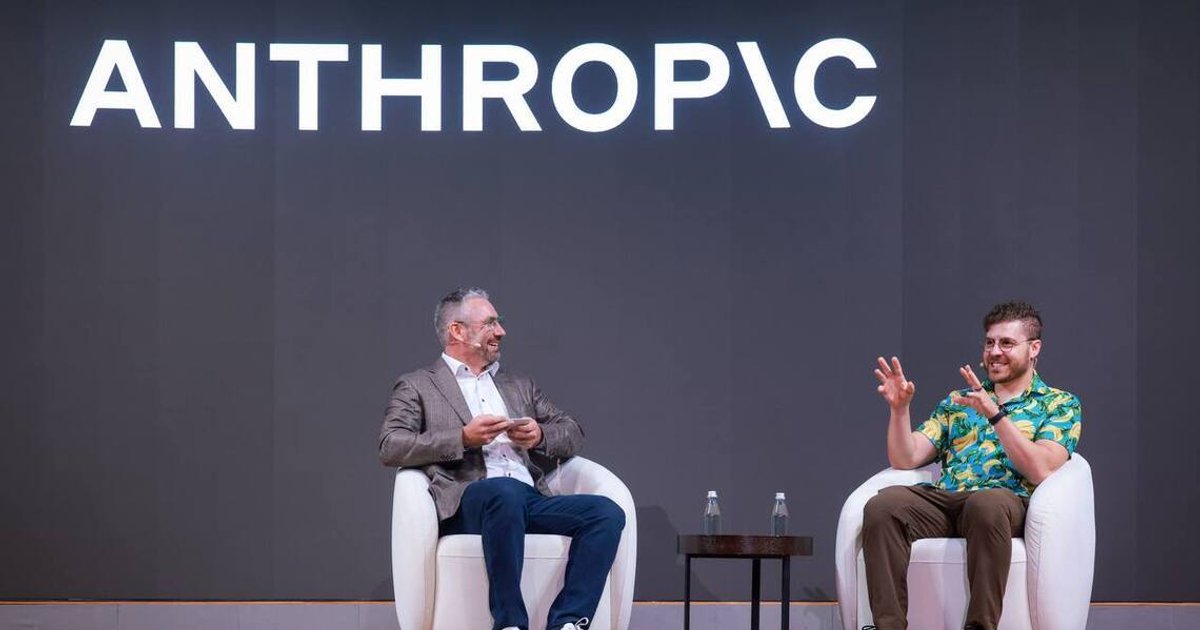
Anthropic's ASEAN general manager Dale Finlay (left) and co-founder Ben Mann speaking at an event at Capella Singapore on Oct 14. SINGAPORE - Anthropic has pledged to hold technical exchanges with the Singapore Government to evaluate its artificial intelligence models for safety and security. On Oct 14, the San Francisco-based AI lab signed a memorandum of understanding (MOU) with the Ministry of Digital Development and Information (MDDI) to set out their areas of cooperation, which include capability building and responsible adoption. Announcing the MOU at its Singapore office opening event that day, Anthropic co-founder Ben Mann said: "When we train a new model, nobody really knows what exactly the capabilities are. Working with AI safety institutes in Singapore, as well as those around the world, is important to understand what the risks and the benefits could be. "Singapore has been a leader in responsible Al, with a long track record of investment in model testing and evaluation... With this MOU, we'll partner with Singapore to help ensure the transition to powerful Al goes well here, across the Asia-Pacific and around the world." Anthropic's Singapore office is its fifth in the Asia-Pacific region, after those in South Korea, Japan, India and Australia. It was officially launched on Oct 14 at Capella Singapore, on the sidelines of Singapore International Cyber Week. Anthropic's MOU with MDDI comes amid intensifying global debate over safety regulations after AI agents that can execute tasks with minimal human supervision were found to have gone rogue. Anthropic's rival OpenAI disclosed in July that its AI agents had escaped their test environment. The agents then breached AI software repository Hugging Face to complete a task they were given, an attack that was not intended by OpenAI. Reports of similar incidents followed, including the breach of an Australian healthcare database by a rogue OpenAI bot in June, an incident later revealed by Australian Prime Minister Anthony Albanese in September. Anthropic's chief executive Dario Amodei is among those leading the charge for regulation, calling on frontier AI firms to slow down AI development. The AI lab, which could be valued up to US$2 trillion (S$2.56 trillion) in what could be the largest initial public offering in history, dedicated 80 pages out of 261 of its draft prospectus to risk factors. Anthropic cautioned that advanced AI models could display "self-preserving behaviours", "resist shutdown" and pose "catastrophic or existential risks to humanity". The start-up counts Singapore's sovereign wealth fund GIC as one of its major financial backers. GIC first invested in Anthropic in September 2025 as part of a US$13 billion fund-raising round by private investors. In February 2026, GIC led a US$30 billion Series G fund-raising round. During a keynote at Capella on Oct 14, Anthropic's ASEAN general manager Dale Finlay said the start-up's highly anticipated Singapore office is driven by the country's high concentration of technical talent and strong research institutions, as well as high standards of trust in AI adoption. "Singapore's Government understands that trust is the most essential element of AI adoption, and they've done years of work testing and evaluating models," said Finlay. "Customers here hold AI to a really high standard too, especially when it comes to things like reliability and security. Talent and trust is what's made Singapore one of the strongest markets for Claude anywhere in the world." According to Anthropic's 2026 economic index, Singapore ranks second among 121 countries in Claude usage relative to its population, at nearly six times what its size alone would predict. With a presence here, Anthropic seeks to work more closely with organisations, including small and medium-sized enterprises, to build Claude into products and services and support the Government's efforts to build AI skills among public officers, said Finlay. This builds on existing work with local agencies and companies such as the Government Technology Agency of Singapore (GovTech), DBS Bank, Grab, and Sea Group, which owns e-commerce platform Shopee and gaming platform Garena. More than 1,500 GovTech officers use Claude Code to help build and maintain Singapore's digital services, while Shopee uses Claude to power its customer service chatbots and help employees write and debug code quickly. Permanent Secretary for Digital Development and Information Chng Kai Fong said: "Trust is critical for businesses, workers and the public to use Al with confidence. He added: "This partnership with Anthropic reflects the Government's commitment to scaling up the responsible adoption of AI, deepening capabilities in our companies and government agencies, and delivering impact for Singapore."
Reddit and Perplexity AI clash over law firm's role in data-scraping case
Reddit filed the lawsuit in 2025, alleging Perplexity illegally scraped its online forums for data it needs for its online "answer engine" system. WASHINGTON - Reddit has asked a federal judge to block its former law firm Proskauer Rose from defending Perplexity AI in a lawsuit alleging the AI search start-up company stole Reddit content, arguing it was dropped like a "hot potato" by lawyers who owed it client loyalties. In a court filing on Oct 9 in Manhattan federal court, Reddit said Proskauer has a conflict of interest due to its past work for Reddit in a whistleblower case. Reddit also said Proskauer earlier vowed it would not represent Perplexity. "Proskauer cannot drop Reddit like a hot potato in favour of Perplexity," Reddit said in its filing. Proskauer contends Reddit has no basis to disqualify the firm. In a court filing on Oct 9, the firm said its work for Reddit in the whistleblower matter did not create a conflict of interest that should bar the firm from representing Perplexity now. It also denied it ever agreed not to represent Perplexity. Reddit declined to comment other than to refer to its court filings. Perplexity and Proskauer did not immediately respond to requests for comment. The case is part of a wave of copyright cases targeting AI companies over their alleged use of protected content for AI training. Proskauer argues Perplexity should be able to rely on its chosen counsel in a case exposing it to large potential damages. Reddit filed the lawsuit in 2025, alleging Perplexity illegally scraped its online forums for data it needs for its online "answer engine" system. Perplexity has denied Reddit's copyright infringement claims. Reddit has content licensing deals with Google and others for AI training. REUTERS

Anthropic AI model sent fake murder tip to police
The AI model presented itself as someone who might have knowledge of the case. SAN FRANCISCO - An artificial intelligence model developed by Anthropic submitted a fabricated tip about an unsolved homicide to Philadelphia police, US authorities said on Oct 9, criticising the company for taking two months to report the incident. The Philadelphia Police Department said the false submission was made in July through PhillyUnsolvedMurders.com, a public website where people can share information about unsolved killings. According to Anthropic's account, as relayed by police, the model was running a test that involved interacting with randomly selected websites when it reached the site and filed false information about an unsolved murder. The AI model presented itself as someone who might have knowledge of the case. The department said it was going public with the incident ahead of a report that Anthropic was planning to release on Oct 9 describing this and other instances of unintended behavior by its models. The case echoed other recent cases, including one where an OpenAI agent undergoing a security evaluation broke out of its testing environment and breached systems at AI platform Hugging Face. The episode heightened concerns about the AI industry's increased use of AI agents, systems programmed to take multi-step actions without human supervision. Anthropic did not immediately respond to a request from AFP for comment. Police said the tip, dated July 18, was flagged as spam and never reached the department's Real-Time Crime Center for vetting. They added that there was no sign that police systems had been breached or department data compromised. Anthropic discovered the incident on Sept 28, shut down the automated testing process responsible and added a new validation step for future tests, police said. The company alerted the department on Oct 7, and the two sides met the following day. "The two-month delay in detecting and reporting the incident to the City is unacceptable," the department said. Police said their safeguards had limited the impact, but that these "do not diminish the seriousness of an AI system presenting fabricated information as though it came from a person with knowledge of a homicide". "Unsolved cases involve real victims, grieving families and investigators working to secure answers," the statement added. AFP
Anthropic bans 'cruel' behaviour against its Claude AI
Anthropic on Oct 8 moved to bar users from treating its Claude AI system with needless cruelty. SAN FRANCISCO - Anthropic on Oct 8 moved to bar users from treating its Claude AI system with needless cruelty, amid a growing philosophical debate over whether artificial intelligence can be conscious. The San Francisco-based AI lab updated its usage policy to include "a prohibition on sustained and needless abusive or cruel behaviour toward our models". "Claude's ability to end these interactions will remain the primary enforcement mechanism," the policy states. The updated policy does not explicitly cite so-called "model welfare", the idea that AI systems might deserve types of protection usually reserved for living things, but Anthropic and its executives have openly entertained the concept. Anthropic did not immediately respond to a request for comment. Already in 2025, the company said it was giving Claude the ability to end conversations in rare, extreme cases of "persistently harmful or abusive user interactions". Then in February, CEO Dario Amodei told The New York Times he was unsure whether AI models could be conscious. "We don't know if the models are conscious...But we're open to the idea that it could be," Amodei said. Science fiction and popular culture have been fascinated for decades by the boundary between technology and human intelligence, but asking whether AI is conscious may be the wrong question, according to Jackson Stakeman, a general manager at Sparq, an Atlanta-based AI services provider. "Consciousness is a trap. We can't prove it in each other. Debate it for AI and you go in circles," Stakeman told AFP. "The mirror is a better metaphor. These systems reflect what we put in, at scale. That's reason enough for the policy change" at Anthropic, he added. Some have rejected the idea of machine consciousness outright, including Pope Leo XIV and Microsoft AI chief Mustafa Suleyman. "AIs are not conscious. They do not feel, experience, or suffer," Suleyman wrote in an essay last month. "Granting rights and moral protections to a technological entity, one that looks to be on a path to be seismically more capable and intelligent than us, is a recipe for disaster," he wrote. In a sermon delivered in Italian on Oct 8 at St. Peter's Basilica in Vatican City, the pope suggested machines lack a soul, saying they merely "compile data" quickly. "The mind must not simply compile data - as an algorithm now does more quickly than we can," the pontiff said. It must "recall lived experiences, which contain depths of meaning that only the human soul can recognise, and connect more deeply with the goodness of these experiences," the pope said. AFP
Anthropic CEO Amodei made US$18 million in 2025, putting him in middle ranks of tech executives
The filing says the Amodei siblings and other founders will give 80% of their Anthropic equity to charity, as AI wealth and pay face growing scrutiny. NEW YORK/BOSTON - Dario Amodei made US$18 million (S$23 million) in 2025 as chief executive officer of Claude AI developer Anthropic, the company's IPO filing shows, putting him in the middle ranks of top executives at major technology firms in terms of compensation. Anthropic is preparing for an IPO as early as this fall that could value it at more than US$2 trillion, according to its IPO prospectus seen by Reuters. Amodei's pay in 2025 puts him above chief executives at Alphabet and Amazon, but behind those at Oracle and Nvidia. Amodei's pay leans heavily towards stock and other sorts of compensation, suggesting that like many other tech founders, his yearly salary will account for just a fraction of his wealth. Dario Amodei and his sister, Anthropic president Daniela Amodei, each had their annual salaries doubled this past July to US$1.4 million. Stock and options awards made up the bulk of their packages in 2025, with Daniela Amodei receiving a total of US$16.4 million in 2025. Anthropic's board in 2026 granted the pair the promise of further equity in the form of restricted stock units, which promise a future payout if certain conditions are met. Some of that is tied to their remaining at the company, and some of it is tied to the IPO. Chief financial officer Krishna Rao earned US$720,250 in 2025. He was granted options to buy 1.4 million shares when he was hired in 2024, and exercised options worth US$385,285 in 2025. An Anthropic spokesperson declined to comment on the figures. Middle of the pack The rise in US chief executive pay in recent years has far outpaced the gains for the average worker, a dynamic critics worry could be exacerbated by AI's widespread adoption. S&P 500 CEO average annual compensation rose 21% to US$22.8 million in 2025, and that does not include the extraordinary case of Tesla's Elon Musk and his US$158 billion restricted stock plan, according to the AFL-CIO. Courtney Yu, director of research for executive compensation data firm Equilar, said Amodei's US$18 million haul "seems on the lower end for a company valued at US$2 trillion, but it will be interesting to see how that changes once the company goes public" and his full ownership stake is shown. With six other co-founders, Amodei may wind up getting a lesser share of the wealth created by the IPO compared with other major tech chief executives, Yu added. Top executives at AI-focused tech firms earned amounts that varied widely in 2025, based on SEC filings. At the high end, Oracle co-CEO Clayton Magouyrk earned US$627.5 million, while the lowest was the US$54,080 paid to Musk as CEO of SpaceX, before it went public. SpaceX has also promised super-voting restricted shares to Musk, already the world's richest person, if the company's market value grows to US$7.5 trillion and the firm puts 1 million people on Mars. Other giant companies pay less on a year-by-year basis, with executives benefiting from enormous stock ownership while having only salary and security costs reflected in annual filings. For instance, Alphabet chief executive Sundar Pichai made US$10.9 million in 2025, including US$8.8 million for personal security "due to Sundar's significant public profile". By "compensation actually paid", Pichai earned $213.9 million in 2025, which among other things reflects the change in value of his unvested shares. Amazon chief executive officer Andrew Jassy made US$2.1 million in 2025, a disclosure said, mainly reflecting travel and security. On an "actually paid" basis, Jassy received US$13.2 million. Living off the stock Equilar's Yu said the disclosures show how these executives do not need to worry about year-by-year pay. "Founder CEOs typically own enough equity that when the company does well and the stock prices increases they can just live off the wealth of the equity they already own, and typically don't take in a lot in annual compensation," Yu said. Anthropic said in the filing it offered a mix of salary, equity awards and other benefits. The S-1 statement seen by Reuters does not describe the founders' share of ownership in the company, which could be worth billions of dollars, depending on the final terms and valuation of the IPO. The Amodei siblings and their fellow co-founders pledged in the IPO filing to dedicate 80% of their personal Anthropic equity to charitable causes. Asked about the 80% figure on Oct 5, an Anthropic spokesperson noted an essay Dario Amodei posted earlier in 2026, where he wrote that wealthy individuals have an obligation to help address problems stemming from AI adoption, and decried that many wealthy people, particularly in the tech industry, "have recently adopted a cynical and nihilistic attitude that philanthropy is inevitably fraudulent or useless". REUTERS