News & Updates
The latest news and updates from companies in the WLTH portfolio.
On Second Test of Its Newest Starship Design, SpaceX Sticks the Landing
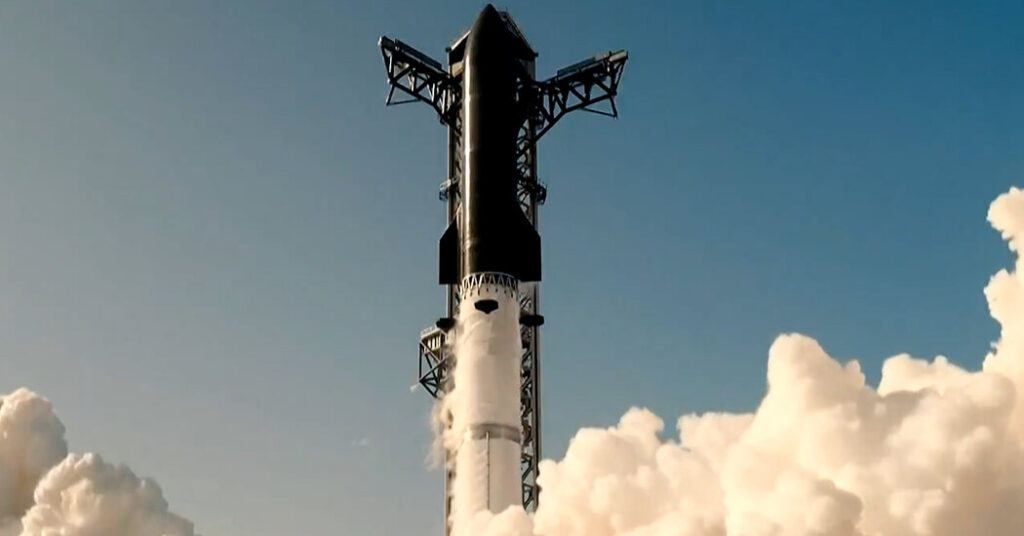
SpaceX completed a successful test flight of its Starship rocket on Friday evening, setting the stage for more ambitious developments in the months to come. The flight was the 13th for Starship but just the second for what SpaceX calls its Version 3, which incorporates a number of changes to improve performance and reliability. Friday's flight appeared to accomplish almost all of its objectives, including correcting problems that occurred during the previous flight in May, deploying Starlink internet satellites and ending its journey bobbing intact in the Indian Ocean. "We're really pumped about this," Kate Tice, one of the hosts of the SpaceX webcast, said after the gentle water landing. This time, in contrast to an aborted attempt eight days earlier, all 33 engines on Starship's booster stage ignited. The 407-foot-tall rocket lifted off at 6:51 p.m. Eastern time from SpaceX's Starbase site in South Texas, near Brownsville. Starship consists of two stages: a booster, known as the Super Heavy, and an upper-stage spacecraft that is also called Starship but is often shortened to Ship. Both stages are designed to be fully reusable, which could greatly reduce the cost of sending satellites to space. On Friday, the return of the booster stage for a simulated landing over the Gulf of Mexico was not entirely successful. Instead of slowing to a hover, the booster appeared to hit the water while still descending at a quick pace. While in space, the upper-stage Ship deployed 20 functioning, next-generation Starlink satellites. Earlier flights released dummy versions to test the deployment mechanism, which resembles a large Pez dispenser, pushing out the satellites one by one. After deploying their solar arrays and antennas, all the satellites successfully connected to the rest of the Starlink constellation via laser communications. The upper-stage Ship also restarted one of the engines for 14 seconds. Demonstration of that capability was a prerequisite before Starship's first orbital flight. An engine burn in orbit will be needed for the upper stage to drop out of orbit safely; otherwise, the spacecraft would be stranded in orbit, slowly dragged down by the friction of the atmosphere, with the possibility that pieces would land on populated areas. By design, all of the flights of Starship so far have traveled along trajectories that re-enter the atmosphere above the Indian Ocean after a journey halfway around the world. On this flight, the accompanying Starlink satellites were traveling along the same suborbital path, so they also re-entered the atmosphere and burned up, just 20 minutes after they had been deployed. Before their demise, six of the Starlink satellites used cameras to scan Starship's heat shield, observing how well the shield performed as temperatures heated up to thousands of degrees. The upper-stage Ship survived its fiery path through the atmosphere. Over the Indian Ocean west of Australia, it slowed down and mimicked the maneuvers of landing in a vertical orientation. And unlike in previous landings, the rocket did not explode in a fireball when it tipped into the water. "This is the first time we've put an intact Starship in the water," said Dan Huot, another host of the SpaceX webcast, describing the fact that the cameras on the spacecraft were still sending back video as "just a little bit surreal." He added, "Wow, lucky No. 13 -- hell of a flight for Starship." If data gathered during the flight does not reveal any major obstacles, SpaceX will be able to move on to the next set of more challenging objectives for Starship: entering orbit around Earth, returning the upper-stage spacecraft to Texas and catching it on the launch tower as it has done with the booster. Starship is key to NASA's moon plans. SpaceX is slated to provide a version of the Ship spacecraft to take its astronauts from lunar orbit to the moon's surface. But work on Starship has taken longer than Mr. Musk and SpaceX originally promised. For the moon mission, SpaceX needs to demonstrate several technological firsts. They include conducting multiple Starship launches over a short period of time, because the lunar-lander version of Starship will need to have its propellant tanks refilled before leaving low-Earth orbit. Transferring ultracold liquid methane and liquid oxygen between two spacecraft in the weightlessness of space has not yet been demonstrated. The successful test flight could also shore up investor confidence in SpaceX, which is planning to use Starship to deploy up to a million data center satellites in orbit. SpaceX debuted on the stock market in June in the largest initial public offering ever. A few days later, the share price shot up to $225.64, a jump of 67 percent over its debut price of $135, but it has slumped since. The stock closed at the end of this week at $115.07. The post On Second Test of Its Newest Starship Design, SpaceX Sticks the Landing appeared first on New York Times.
The AI burn book: Decoding the cat fights between Sam Altman, Elon Musk, and Anthropic
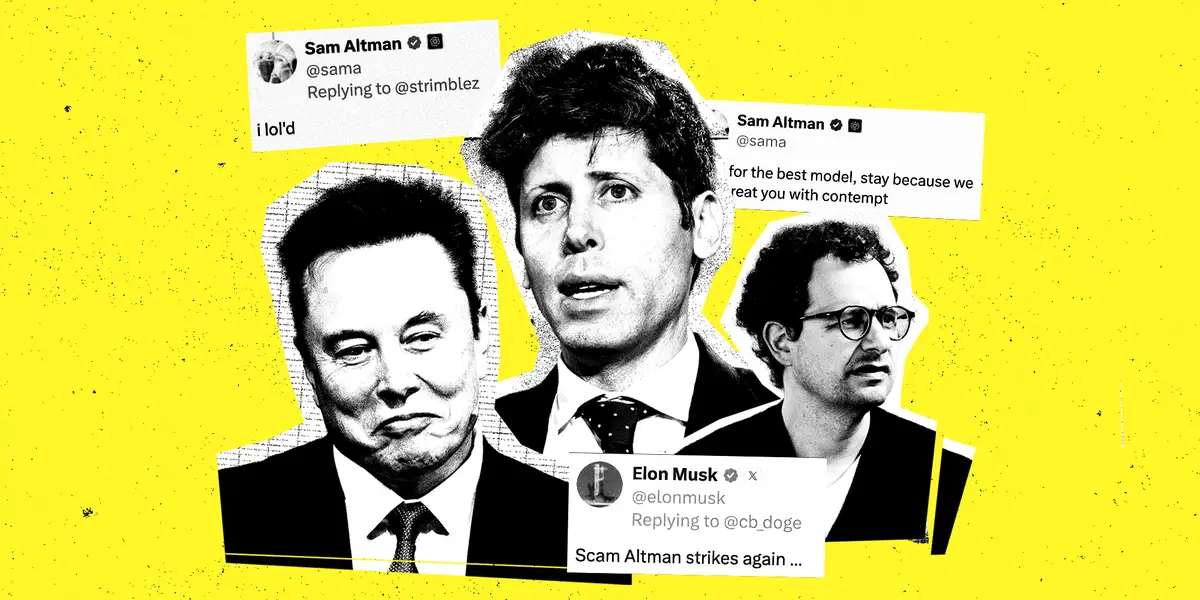
* The AI industry's burn book is an increasingly public spectacle. * Sam Altman and Elon Musk threw jabs on X. Altman also dragged Anthropic, though CEO Dario Amodei stayed quiet. * Business Insider decoded the shade and subtweets, from the punctuation to the emojis. As the summer temperatures rise, tech tempers flare. Sam Altman is back to his old ways: openly feuding with Elon Musk and taking jabs at Anthropic once again, to the shock of no one. With Altman and Musk's courtroom dispute wrapped up (Musk lost but vowed to appeal), the dueling AI leaders are now dragging each other online over data privacy and an Apple legal battle. The OpenAI CEO has also poked at Anthropic, his primary competitor, run by Dario Amodei. Altman and Amodei were once colleagues; now, they avoid holding hands. Altman hasn't called a rival CEO a "pusher" or a "grotsky little byotch" yet. Still, a Burn Book is forming under his fingertips -- and we decoded it for you. Round One: Sam Altman vs Elon Musk Elon Musk threw the first punch last Friday. Apple sued OpenAI that day, alleging that the AI lab stole trade secrets to build its upcoming hardware device. Musk replied to posts about the suit with exclamation points, the word "wow," and a quick reaction: "Sounds pretty bad." He ramped up on Saturday, calling the OpenAI CEO "Scam Altman," a favorite phrase of his. The digs kept coming throughout the day. Altman took scamming "to a whole new level," Musk wrote, and might love scamming "more than any human alive!" Altman responded in his typical, lower-case fashion: "homeboy you're the one sellling public market investors on short-term space datacenters." Note the term of endearment (or lack thereof): "homeboy." Note the typo: "sellling." Note the lack of punctuation. Three minutes later, Altman fired off another. This time, he used the feud as an opportunity to promote his product, writing that the most reliable benchmark for GPT-5.6 Sol's success "is that elon is obsessed with me again." (Again, no capitalization.) Musk responded to Altman's space data center skepticism a few hours later with a zinger. "We start flying them next year. Maybe you can come see them if your parole officer approves," Musk wrote. In the same post, Musk took another shot at Altman by referencing their messy breakup from almost a decade ago. "After stealing an open source AI charity, you then stole all of Apple's phone technology!" he wrote. "Wow." For the record, Altman doesn't have a parole officer. OpenAI disputes Apple's allegations stating it is "not aware of any evidence that this complaint has merit." OpenAI and SpaceX did not respond to Business Insider's requests for comment. After Saturday's brawl, Altman wasn't done. He took one last stab at Musk on Tuesday, reposting some data privacy concerns about SpaceXAI. "Concerning," he wrote. And yet, the enemies could find some common ground. Both Musk and Altman posted approving messages about an AI safety essay published Tuesday by Google DeepMind's CEO Demis Hassabis. Round Two: Sam Altman vs Anthropic Throughout the Musk mess, Altman continued to kick at his No. 1 opponent: Anthropic. Last Thursday, Anthropic released an eyebrow-raising ad saying there was "hope in hard questions." Those questions include: what will humans do when AI takes over all the jobs? And why do we even have to have AI? The leading image is of a house on fire; it's an AI doomer's dream. Altman clowned the ad on Monday, saying that he "thought this was satire" posted from a fake account. He also put words in Anthropic's mouth: "Hard questions are great but only if we deem you worthy enough to not silently downgrade you, or even get access at all." He appeared to reference how Anthropic quietly rejected or altered some Fable 5 prompts in its initial launch. The company has since made these safeguards more visible. Earlier that day, he laughed at an X user who called the use of Anthropic's Fable 5 an unhealthy situationship. Since its release, Anthropic has rolled back and re-deployed the model and lifted and lowered guardrails, to the frustration of some users. (In typical Altman fashion, he "lol'd.") Altman also got philosophical. He reposted a reply to a criticism of Amodei that quoted C.S. Lewis. "Of all tyrannies, a tyranny sincerely exercised for the good of its victims may be the most oppressive," the post read. It's similar to criticisms other AI leaders have shared: that Anthropic warns of AI's safety concerns while claiming only its AI can fix it. And then, the vague-post of all vague-posts. "Come for the best model, stay because we don't treat you with contempt," Altman wrote on Monday, without specifying which AI rival he was taking a shot at. Amodei seems to be steering clear of the drama. As of Wednesday evening, he hadn't responded, nor has he updated his X account in over a month. Anthropic did not respond to a request for comment. Read the original article on Business Insider The post The AI burn book: Decoding the cat fights between Sam Altman, Elon Musk, and Anthropic appeared first on Business Insider.
SpaceX and Amazon are tech dopplegangers worth $4.5 trillion -- and they're headed for a collision
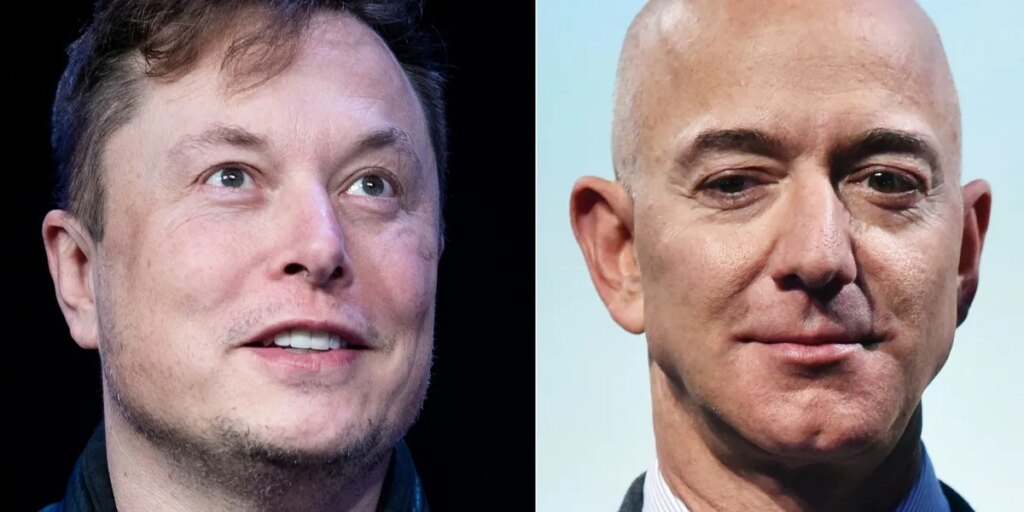
A charismatic founder with near-obsessive conviction, a business that bleeds money, and a stock price based on a wildly optimistic valuation. In 1997, Jeff Bezos took Amazon public at a price of $18 per share at a $438 million valuation. The online bookseller's stock would then crater 90% after the dot-com bubble burst, before flourishing into a $2.6 trillion conglomerate that raked in $77.7 billion last year. Enter SpaceX in 2026. Founded by Elon Musk, the company lost $4.9 billion last year, and went public at $135 a share in June, with a valuation that quickly rose to a sky-high $2 trillion. The two mega-cap companies are primarily known for businesses that have little in common, with Amazon dominating the online retail business while SpaceX has become the world's leading rocket maker. But look a little closer, and the two companies have strikingly similar silhouettes which seem likely to bump up against each other ever more frequently as they compete on the public market stage. Perhaps more than any other tech companies out there today, Amazon and SpaceX are both conglomerates with broad collections of assets and businesses that each believe work together to create a more powerful whole. Both companies offer satellite-beamed high-speed internet access. They're both in the cloud computing and AI infrastructure business with expensive data centers. Chips? Amazon's Trainium and Graviton processors hit an annual revenue run rate above $20 billion in Q1, nearly doubling the $10 billion run rate from the previous quarter. SpaceX has a chip-manufacturing initiative called Terafab with a goal of producing one terawatt of compute hardware each year. Amazon and SpaceX each also have advertising platforms, with Amazon ginning up $68.6 billion in ad revenue last year while SpaceX's X platform -- the social media service formerly known as Twitter -- lived inside the AI segment that posted a $6.4 billion operating loss. If you squint, you can see them as doppelgängers with one big difference -- or to be more accurate, nearly 700 billion differences. Amazon hit $716.9 billion in revenue in 2025 and $80 billion in operating income compared to SpaceX's $18.7 billion of revenue and a $2.6 billion operating loss. Investors are focused on the opportunity ahead, of course. Amazon trades at roughly 3.6 times last year's sales and about 28 times forward earnings. SpaceX trades at about 97 times sales, and had a $4.9 billion net loss. "You're basically buying [SpaceX] at an Amazon valuation when it has one-twentieth the revenue of Amazon," said Jim Lebenthal, a veteran investor and chief markets strategist at Cerity Partners. "SpaceX is an incredibly cool company -- it's amazing, everything they're doing. I also think it's wildly overvalued right now." Looking at the rival companies piece by piece, you can see that in nearly every competitive line of business, Amazon is more profitable and growing. But it was also the company that took a nosedive that nobody wanted to own on the way down. Whether SpaceX can fill its shoes requires an extraordinary amount to go right, said Lebenthal. Here's a look at how the two multi-trillion tech conglomerates stack up. Satellites Starlink, SpaceX's high-speed satellite-based internet service, is the company's current golden child, with $11.4 billion in revenue last year. It counts United Airlines, Carnival, Maersk, and John Deere as customers, and grew 50% year over year, with $4.4 billion in operating income at a 39% margin. Starlink is SpaceX's only profitable segment and a sum-of-the parts analysis from investment bank Stifel last week valued it at $1.25 trillion, just more than half of SpaceX's $2.45 trillion enterprise value. But there's a caveat. FactSet projects SpaceX will need to raise roughly $250 billion in debt over the next four years to fund its growth, according to Lebenthal, so a lot is riding on Starlink's shoulders. Amazon is the runt in this match-up. While Starlink has 9,600 satellites deployed and still in orbit, Amazon's Leo has just started to really get into a groove with about 330 satellites, according to Stifel. But Amazon sees big potential in space. In April, Amazon agreed to acquire Globalstar for $11.6 billion with the goal of expanding Leo's satellite network. And the company recently unveiled enterprise-grade Leo Ultra, which it says is the fastest satellite-internet antenna ever built. Amazon also inkeddeals with Delta Airlines and Jet Blue to expand wi-fi access on hundreds of aircraft in 2028. Cloud and Compute Amazon essentially invented the cloud business, and the company has the clear advantage right now. Amazon Web Services (AWS) posted $128.7 billion in revenue in 2025, with $45.6 billion in operating income at a 35% margin. AWS picked up the pace in the first quarter, growing 28% to $37.6 billion in revenue. Anthropic uses Amazon Trainium 2 chips to train Claude, and Amazon CEO Andy Jassy told investors that AWS's AI revenue run rate topped $15 billion in Q1 2026 and is "ascending rapidly." SpaceX is moving fast though. The company already has Colossus I and II data centers, and has signed lease deals with Anthropic and Google. And the company says its ultimate goal is to send the AI buildout into orbit. In 2025, SpaceX's AI segment generated $3.2 billion in total revenue against a $6.4 billion operating loss and in the first quarter of 2026 it lost $2.5 billion on $818 million in revenue. Dan Niles, founder of Niles Investment Management said SpaceX's compute operation today is more at a level with $5 billion CoreWeave or Amsterdam-based Nebius rather than at the level of AWS. "I don't view them as similar companies at all," said Niles. Justin Menne, a portfolio manager at Harbor Capital, sees it in terms of visibility. Amazon has a contracted backlog of $364 billion and competitive inference chips, he said, while SpaceX has plans to build. "I think in order to believe that the total enterprise value makes sense here, you're inherently giving a lot of credibility to the management team, the engineering team, in order to actually execute," said Menne. The Musk factor Menne said he hadn't done any modeling on how much the Musk premium adds to SpaceX's valuation but the non-technical answer is, "a lot," he said. Lebenthal admires Musk's accomplishments but called him "a source of discomfort" for some value investors. "It's because he says outlandishly optimistic things," Lebenthal said, Musk projected $1 trillion in revenue at SpaceX by 2030, while Lebenthal noted estimated revenues are about $40 billion for 2026. "You can't just say that and $960 billion of incremental revenue is going to come to the table," he said. SpaceX is an innovation stock that really appeals to investors who are dreamers, he added, like Ark Invest's Cathie Wood. On SpaceX's first day of trading, Wood's Ark invested about half a billion in SpaceX, and has purchased more as the price has ebbed since its opening day. Amazon founder Jeff Bezos has a similar larger-than-life profile and reputation for entrepreneurial genius as Musk does. But Bezos transitioned from CEO to executive chairman in 2021 (he still reportedly has some involvement in important priorities like AI, but his day-to-day attention seems focused on Blue Origin, his space exploration company, and Prometheus, a new AI startup he cofounded). Harbor Capital's Menne said there is no equivalent key-man premium at Amazon because "the current value of the company is less reliant on the next five years of executing on something that doesn't already exist." That said, Niles said there's a clear alternative for investors drawn to Musk. The other public company where he serves as CEO, Tesla, has near-term initiatives that include robotics, autonomous fleets, and energy storage which "are likely to come to fruition before a colony on Mars," said Niles. Still, the Musk premium can't be discounted. "Elon has this talent for making money for investors, even if crazy projections don't play out," said Menne. The $28.5 trillion TAM SpaceX's prospectus claims a total addressable market of $28.5 trillion -- roughly the size of the U.S. GDP. Of that, $22.7 trillion is a third-party estimate of the entire global "digital economy." Value-minded Lebenthal noted that "it's earnings you want, not TAM." Menne said the enterprise AI portion "is really hard to underwrite because companies have only just started actually charging for a lot of these services in a way that's not gross-margin negative." Niles added that there's inherent competition in that stratospheric figure. "There are some really pretty good companies in that space," he said. "Maybe you can take all that share from Microsoft and others, but I think Microsoft is a pretty good company." SpaceX is targeting a $1.6 trillion market for connectivity and $26.5 trillion for AI. But Amazon Leo is also gunning for the former. Amazon's AWS generated $128.7 billion in cloud revenue last year, and hosts Anthropic and OpenAI while presiding over a $364 billion contracted backlog. Both can throw down gauntlets over the TAM, but Amazon can point to revenue of $716 billion last year to SpaceX's $18.7 billion. The post SpaceX and Amazon are tech dopplegangers worth $4.5 trillion -- and they're headed for a collision appeared first on Fortune.
Anthropic Expands in Manhattan, Part of an A.I. Boom in New York
Anthropic, the artificial intelligence company, plans to announce on Tuesday that it will lease a 16-story office building in Lower Manhattan as the company moves to double its work force in New York City to 1,000 people this year. The move into a renovated building at 330 Hudson Street in the Hudson Square neighborhood is part of a major expansion of A.I. companies in New York City. Anthropic, the company behind the chatbot Claude, said that its New York office was already its largest outside its San Francisco headquarters and that the new space had room for more than 1,700 desks. The move is expected to start this summer. Mayor Zohran Mamdani's administration praised the expansion, as did Gov. Kathy Hochul, who said in a statement that it would "cement New York City as a world-class technology hub." Artificial intelligence companies have been adding office space in New York City and going on a hiring spree, even as some elected officials have raised concerns about the technology and how it could displace white-collar workers. Thomas P. DiNapoli, the state comptroller, said recently that he was worried about the disruption A.I. could bring, warning that it could "damage the quality and productivity of a company's work force and, more broadly, add to the large-scale instability of the economy." OpenAI, whose ChatGPT chatbot started the A.I. boom in 2022, announced its move into the Puck Building, less than a mile from Anthropic's new office, in 2024. Harvey, an A.I. start-up for the legal industry, expanded its office at One Madison Avenue in Midtown Manhattan earlier this year. Anthropic's expansion is a further sign of the evolution of artificial intelligence as the technology matures and moves into the economic mainstream. Big A.I. companies are increasingly extending their focus beyond building new software models to pushing other industries to adopt the technology. And New York is home to some of the nation's largest technology customers in finance, health care, consulting, law, media and culture. "New York is a great place for an A.I. company to work and do business," said Mark Muro, a senior fellow at Brookings Metro, a division of the Brookings Institution. Mr. Muro was a co-author of a Brookings report last year that found New York to be a leader among U.S. metro areas in "A.I. readiness," a broad measurement of the capacity to both produce A.I. and adopt it. Chris Lehane, the chief global affairs officer for OpenAI, said in a statement that the company had 90,000 square feet of office space in New York City and would keep expanding. He said the city was a "global hub for A.I." because of its "A.I. talent density, inherent entrepreneurship and the policy leadership from its elected officials." Mr. Mamdani, a democratic socialist, has had a frosty relationship with business leaders over his calls to tax the rich, and has moved to win them over. He has also faced criticism for not yet releasing a detailed plan to address the city's slowing job growth. Jeanny Pak, the interim president of the city's Economic Development Corporation under Mr. Mamdani, said that Anthropic's move would "create hundreds of jobs for New Yorkers, strengthening equitable pathways to economic opportunities and reinforcing that companies continue to choose New York City." New York now has far more tech talent than in the past. Two decades ago, when a computer scientist at Google wanted to create an engineering team in New York, the Silicon Valley company's leaders were skeptical. They told him he could go ahead, but only if could find 15 "Google-worthy" software developers in the city. Today Google employs thousands of engineers in New York. A.I. companies are hiring at a time when young people in particular are having a hard time getting jobs. Anthropic's website has dozens of openings listed in New York. Many of them are in engineering and sales and on the company's legal and marketing teams. Julie Samuels, president of Tech:NYC, a nonprofit industry group, acknowledged that the most advanced A.I. software was still designed primarily in the Bay Area. "But when it comes to how to use the technology in practice, what works and what doesn't in business, they come here," she said. "That's where we are now." Still, many New Yorkers have concerns about A.I., particularly in the progressive circles Mr. Mamdani comes from. Some parents in the city are fighting the use of the technology in public schools. And the debate permeated a congressional primary campaign in Manhattan: Super PACs aligned with A.I. companies spent heavily both for and against one of the Democratic candidates, Alex Bores, who has sought to regulate the industry. (Mr. Bores lost the election last month to Micah Lasher, a fellow state assemblyman.) State lawmakers in New York recently approved a one-year moratorium on new large-scale data centers that power A.I., citing concerns about energy consumption and environmental effects. But Ms. Hochul, a moderate Democrat who is friendly with business leaders, has signaled that she might veto the legislation. Anthropic, which filed last month for an initial public offering, is planning to build a data center in upstate New York with a company called Fluidstack as part of a $50 billion investment in American data centers. A.I. companies have hired veterans of New York City government to help them navigate the city's thorny political landscape. Maxwell Young, a former adviser to Mayor Eric Adams, joined Anthropic in November as the head of policy communications. Peter Ragone, a top adviser to former Mayor Bill de Blasio and to Gov. Gavin Newsom of California, is working for OpenAI. Mark Levine, the city comptroller, released a report in May warning about the impact A.I. could have on jobs in New York City. He called on Mr. Mamdani to outline a vision for making sure that the city benefits from the industry's growth. "We should be the capital of applied A.I., and a more concerted strategy to make that happen is absolutely needed," Mr. Levine said in an interview. The post Anthropic Expands in Manhattan, Part of an A.I. Boom in New York appeared first on New York Times.