News & Updates
The latest news and updates from companies in the WLTH portfolio.
History Says It's Time to Buy SpaceX Stock Before It's Too Late
After an incredible post-IPO performance, Space Exploration Technologies (SPCX 4.51%) stock has gradually returned to earth. SpaceX officially priced its June 12 IPO at $135 per share and opened at $150 per share. Shares reached their all-time high of $225.64 three days later. After a steep correction, the stock is now hovering around $145. The space stock is now priced just 7% above its original IPO price, and under the price at which it began trading. Newly published historical data, however, suggest there is more upside to come. History says SpaceX stock is a buy at $145 per share Jay Ritter of the Warrington College of Business at the University of Florida has been tracking the performance of IPO stocks for years. On July 7, Ritter released a new report with fully updated statistics. Diving into the data paints an optimistic picture for SpaceX stock today. From 1980 to 2024, Ritter documented 9,253 IPOs. Over that time, the average IPO stock returned 19.1% over a three-year period. The data is already looking good for SpaceX stock. While history doesn't suggest huge returns for the stock over the next three years, the returns are nonetheless expected to be positive. Breaking down the data even further improves SpaceX's prospects. When including only IPO stocks with trailing annual sales of at least $500 million -- a refinement that narrows the universe down to just 1,500 stocks -- the average three-year return improves to 31.8%. When including only IPO stocks with trailing sales of at least $1 billion, the prospects improve even further. These stocks -- which total 866 in all -- average 32.4% returns over their first three years of trading. To be clear, there's no telling exactly where SpaceX stock will head from here. Even if shares have plenty of upside at today's prices relative to historical IPO performances, there is a wide range of outcomes for any one stock. And there are plenty of reasons to believe SpaceX stock is overvalued, even following the correction. Before the June 12 IPO, analysts at the research firm Morningstar valued SpaceX at $63, representing a 53% discount to its IPO price. "Only the most optimistic Moonshot scenario, which requires a rapidly reusable Starship and commercially competitive orbital data centers, approaches the IPO price. The IPO price implies the Moonshot scenario is highly likely, but we think the outlook is very uncertain." I mostly agree with Morningstar's caution. But SpaceX is a unique business with difficult-to-quantify opportunities ahead. Ark Invest, for example, sees SpaceX generating $300 billion in annual revenue by 2030 through the monetization of orbital data centers. If that happens, SpaceX could easily be valued well above $2 trillion. At the end of the day, investors must acquaint themselves with SpaceX's business prospects and current valuation, and form their own opinion of the company's risk-and-reward dynamic.
SpaceX gears up for Starship Flight 13
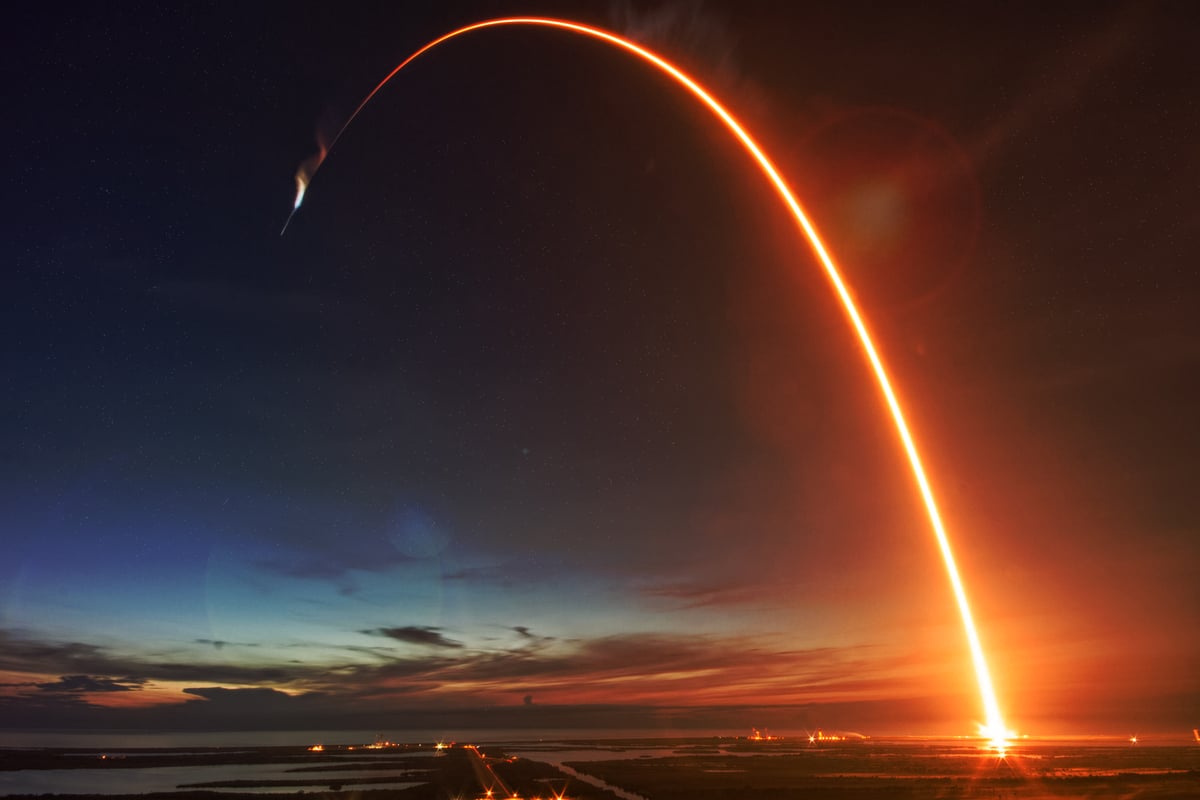
WASHINGTON -- SpaceX plans to conduct its next Starship launch as soon as July 16 to test fixes to issues from the previous flight and deploy functioning Starlink satellites. The company said July 11 it is targeting a launch of the Flight 13 mission in a 90-minute window that opens at 6:45 p.m. Eastern from its Starbase, Texas, site. The announcement came a day after completing a static fire of the Super Heavy booster that will launch the mission. The upcoming mission will fly a similar 65-minute suborbital profile as Flight 12 on May 22. That was the first flight of the upgraded version 3 of the vehicle and was mostly successful, although it experienced some anomalies. The biggest issue was the failure of the Super Heavy booster to perform a controlled "soft" splashdown in the Gulf of Mexico. SpaceX said it traced the issue to how the engines in the Starship upper stage, or ship, ignited while still attached to the booster. "At stage separation on Flight 12, slight differences in engine startup on the ship caused the directional flip of the booster to be off by approximately 90 degrees," the company stated in its preview of Flight 13. Five Raptor engines failed to ignite for a boostback burn, causing the burn to shut down early. The company did not elaborate on how the change in the flip direction affected the startup of the boostback burn. "The startup sequence has been modified to be more robust to timing variability and more reliably flip in the desired direction, which is done to increase overall performance," SpaceX stated. "The Super Heavy on this upcoming flight has hardware modifications to improve relight reliability, along with updates to engine alarms and aborts to match the conditions seen in the multi-engine flight environment." Flight 12 also suffered a Raptor engine failure during the booster's ascent, as well as one on the ship. "Several hardware and operational modifications have been made to address the interconnected causes, with additional reliability improvements planned in upcoming versions of the Raptor engine," the company said, but did not explain what those interconnected causes were. Another change for Flight 13 involves the payloads that it will deploy from the upper stage during the suborbital flight. While several previous launches deployed mass simulators of Starlink V3 satellites, SpaceX said this mission will deploy 20 functioning Starlink V3 satellites. SpaceX said the satellites will deploy solar arrays and antennas and then attempt to connect with both a South African ground station and other Starlink satellites. Those demonstrations will be brief since the satellites will be on the same suborbital trajectory as Starship and will reenter after a handful of minutes in space. One factor in the timing of Flight 13 is the completion of a mishap investigation mandated by the Federal Aviation Administration after Flight 12. As of July 10, the FAA had not announced the completion of the investigation, which focused on the failure of Super Heavy to perform a soft splashdown. If Flight 13 is successful, it may allow SpaceX to perform the first orbital launch of Starship on the next flight. SpaceX is pushing to get Starship into service to deploy Starlink V3 satellites, as well as for Starship's use as a lunar lander for NASA's Artemis lunar exploration campaign.

Elon Musk Admits He Was 'Clearly Wrong' About Anthropic -- and Promises Not to Weaponize SpaceXAI's Compute Access Against the Claude Maker: 'Not My Style'
Benzinga and Yahoo Finance LLC may earn commission or revenue on some items through the links below. Elon Musk publicly reversed his earlier view of Anthropic on Thursday, saying he was "clearly wrong" to doubt the AI company and pledging not to use SpaceXAI's compute leverage to harm a competitor. Musk Calls Anthropic Current AI Leader "I was clearly wrong about Anthropic," Musk wrote on X. "They are obviously currently the leader in AI. No company has released a model as good as Mythos/Fable and they will undoubtedly have Mythos 2 ready soon." TechCrunch reported that Musk was referring to his September 2025 post that said, "winning was never in the set of possible outcomes for Anthropic." I was clearly wrong about Anthropic. They are obviously currently the leader in AI. No company has released a model as good as Mythos/Fable and they will undoubtedly have Mythos 2 ready soon. And I would never cut them off in a way that hurt them badly, even as a competitor.... -- Elon Musk (@elonmusk) July 9, 2026 Musk added that he would not cut off Anthropic's access in a damaging way, even though Anthropic competes with his own AI business. "I would never cut them off in a way that hurt them badly, even as a competitor. That's not my style," he wrote. He cited Tesla's patent pledge, its decision to open the Supercharger network to rivals, SpaceX's pricing for competing satellite launches and X's tolerance for criticism as examples of what he called fair competition. "Even my worst enemies can attack me on this platform," Musk wrote. Anthropic Depends On SpaceXAI Compute Deal The exchange followed a claim on X that SpaceXAI now runs a frontier model competitive with Anthropic's Opus 4.8 while Anthropic depends on short-term compute leased from SpaceXAI. Anthropic signed a May deal for 300 megawatts of compute from xAI's Colossus 1 data center near Memphis, Tennessee, paying $1.25 billion a month through May 2029. SpaceXAI said in May that the partnership gives Anthropic access to Colossus 1, which includes more than 220,000 Nvidia GPUs and is designed for AI training, fine-tuning, inference and high-performance computing. SpaceXAI also said Anthropic plans to use the compute to improve capacity for Claude Pro and Claude Max subscribers.
Reviewing Recent Picks: Lessons from SpaceX, Meta, Micron, Bloom, and Credo (NDX) | Seeking Alpha
This idea was discussed in more depth with members of my private investing community, The Active Investors Forum. Learn More " I thought it would be good investment "hygiene" to assess my recent allocations and judge them as evenhandedly as possible. There are only so many names one can fit in a subject line and David H. Lerner is an analyst with a decade of experience utilizing his professional background in software consulting and technology to identify market trends and provide long and short trade ideas. David employs a combination of technical analysis and market psychology to capitalize on narratives for outsized returns. He also utilizes "Cash Management Discipline," a simple trading style to hedge against the volatility of today's market climate.He leads the investing group Active Investors Forum where he uncovers actionable trading and investing ideas nearly every day. Other features include: long and short swing trade alerts, daily macro analysis, weekly articles, and chat for community interaction and questions. Learn More. Analyst's Disclosure: I/we have a beneficial long position in the shares of MU either through stock ownership, options, or other derivatives. I wrote this article myself, and it expresses my own opinions. I am not receiving compensation for it (other than from Seeking Alpha). I have no business relationship with any company whose stock is mentioned in this article. Seeking Alpha's Disclosure: Past performance is no guarantee of future results. No recommendation or advice is being given as to whether any investment is suitable for a particular investor. Any views or opinions expressed above may not reflect those of Seeking Alpha as a whole. Seeking Alpha is not a licensed securities dealer, broker or US investment adviser or investment bank. Our analysts are third party authors that include both professional investors and individual investors who may not be licensed or certified by any institute or regulatory body.

This Vanguard ETF Would Have Quadrupled Your Money Over the Last Decade. History Says Now Is a Smart Time to Invest. (It's Likely to Outperform SpaceX, Too.)
We're all looking for solid investments for our portfolios, right? It's easy to focus on big-name high-flying stocks, such as Nvidia or Micron Technology. But there's also some risk there, as many highfliers end up overvalued and poised to fall extra-hard in a market pullback. (And a market pullback is far from unlikely these days.) So permit me to suggest a terrific investment that you might not have taken seriously enough: a simple, low-fee S&P 500 index fund. A splendid example is the Vanguard S&P 500 ETF (NYSEMKT: VOO). It's an exchange-traded fund (ETF) -- a fund that trades like a stock. Missed Nvidia in 2009? This Rare Signal Is Flashing Again. In 2009, a "Double Down" signal flashed for a little-known chipmaker called Nvidia. For the first time in years, that same "Total Conviction" signal is flashing for a company 1/100th the size of Nvidia. Continue " Image source: Getty Images. Meet the Vanguard S&P 500 ETF Like any good S&P 500 index fund, the Vanguard S&P 500 ETF features low fees. While some actively managed mutual funds might charge you 1% or more of your assets each year, this fund charges 0.03% -- or just $3 annually for every $10,000 you have invested in it. It tracks the S&P 500, of course -- an index of roughly 500 of the biggest stocks in America. Together, they make up about 80% of the value of the entire U.S. stock market, which is why the S&P 500 is often used as a proxy for the total U.S. stock market. Together, the index's recent top 10 components make up about 38% of the index's value by weight. Here they are as of July 9: Data source: Slickcharts.com, as of July 9, 2026. Like many indexes, the S&P 500 is market-cap-weighted, with bigger companies wielding more influence than smaller ones. The fund has a solid record. Check out its average annual return over the last three, five, and 10 years (as reported by Morningstar on July 9): * Last three years: 21.26% * Last five years: 13.11% * Last 10 years: 15.36% Over the last decade, these compounded annual returns would have quadrupled your money. Why invest in the Vanguard S&P 500 ETF? Here are several reasons to invest: * It's a good time to do so (there's rarely a bad time, if you're a long-term investor). * It makes investing easy, plopping you into roughly 80% of the U.S. stock market with one "buy" order. * It offers diversification -- when one company or industry falls, the others can offset that to some degree. For greater diversification, check out the Invesco S&P 500 Equal Weight ETF (NYSEMKT: RSP), which weights each of the 500 companies in the index equally. * It's likely to outperform many growth stocks, especially overvalued ones -- including, arguably, Space Exploration Technologies, also known as SpaceX. Consider, for example, that the S&P 500's price-to-sales ratio was recently 3.7, while SpaceX's was 74.7. The S&P 500 has a solid track record, averaging annual gains of close to 10% over many decades, but many growth stocks are far less proven. * The index is designed to perform well, as lagging components are regularly removed to make way for up-and-coming companies. Take a closer look at this ETF to see if it's a good fit for your needs. Should you buy stock in Vanguard S&P 500 ETF right now? Before you buy stock in Vanguard S&P 500 ETF, consider this: The Motley Fool Stock Advisor analyst team just identified what they believe are the 10 best stocks for investors to buy now... and Vanguard S&P 500 ETF wasn't one of them. The 10 stocks that made the cut could produce monster returns in the coming years. Consider when Netflix made this list on December 17, 2004... if you invested $1,000 at the time of our recommendation, you'd have $395,679!* Or when Nvidia made this list on April 15, 2005... if you invested $1,000 at the time of our recommendation, you'd have $1,294,805!* Now, it's worth noting Stock Advisor's total average return is 929% -- a market-crushing outperformance compared to 211% for the S&P 500. Don't miss the latest top 10 list, available with Stock Advisor, and join an investing community built by individual investors for individual investors. See the 10 stocks " *Stock Advisor returns as of July 12, 2026. Selena Maranjian has positions in Alphabet, Amazon, Apple, Broadcom, Meta Platforms, Micron Technology, Microsoft, and Nvidia. The Motley Fool has positions in and recommends Alphabet, Amazon, Apple, Broadcom, Meta Platforms, Micron Technology, Microsoft, Nvidia, Tesla, and Vanguard S&P 500 ETF. The Motley Fool has a disclosure policy. The views and opinions expressed herein are the views and opinions of the author and do not necessarily reflect those of Nasdaq, Inc.

Morgan Stanley Says China's Reusable Rocket Progress Poses Long-Term Challenge to SpaceX
Morgan Stanley Says China's Reusable Rocket Progress Poses Long-Term Challenge to SpaceX. Source: Steve Jurvetson, CC BY 2.0, via Wikimedia Commons Morgan Stanley believes China's rapidly advancing reusable rocket program represents the biggest long-term competitive threat to SpaceX, following the country's first successful recovery of an orbital-class rocket booster. The investment bank said the China Aerospace Science and Technology Corp. (CASC) achieved a major milestone by recovering the Long March 10B booster, making it only the third organization after SpaceX and Blue Origin to accomplish the feat. While the demonstration marks significant progress, Morgan Stanley noted that China must still prove it can repeatedly launch, recover, and reuse rockets before establishing a fully operational reusable launch system. According to the brokerage, China's expanding space industry -- supported by both government-backed programs and private companies such as LandSpace, Galactic Energy, and Space Pioneer -- has become the most serious long-term rival to SpaceX's launch business. The country completed 90 orbital launches in 2025, second only to SpaceX's 165 Falcon 9 missions, highlighting its growing presence in the global space sector. Morgan Stanley also pointed to earlier assessments from the U.S. Space Force, which estimated China was still three to five years away from mastering reusable rocket technology. However, the successful Long March 10B recovery could accelerate that timeline and strengthen China's position in the commercial space race. Beyond launch capabilities, China continues expanding its ambitions in satellite infrastructure. Planned low-Earth orbit constellations, including the Guowang and Qianfan projects, aim to deploy roughly 28,000 satellites, while an additional proposal seeks authorization for more than 190,000 non-geostationary satellites. The brokerage also highlighted China's investment in space-based computing, citing the launch of the first satellites for its planned 2,800-satellite "Star Compute" orbital supercomputer network. Despite increasing competition, Morgan Stanley maintained its Overweight rating on SpaceX with a $300 price target. Analysts said the company continues to lead the industry through its unmatched launch frequency, proven reusable rocket technology, and Starlink satellite connectivity. However, the firm cautioned investors not to underestimate China's accelerating technological progress as it works to narrow the gap with the world's leading commercial space company.
SpaceX's ambitions are bigger than most people think | Mint
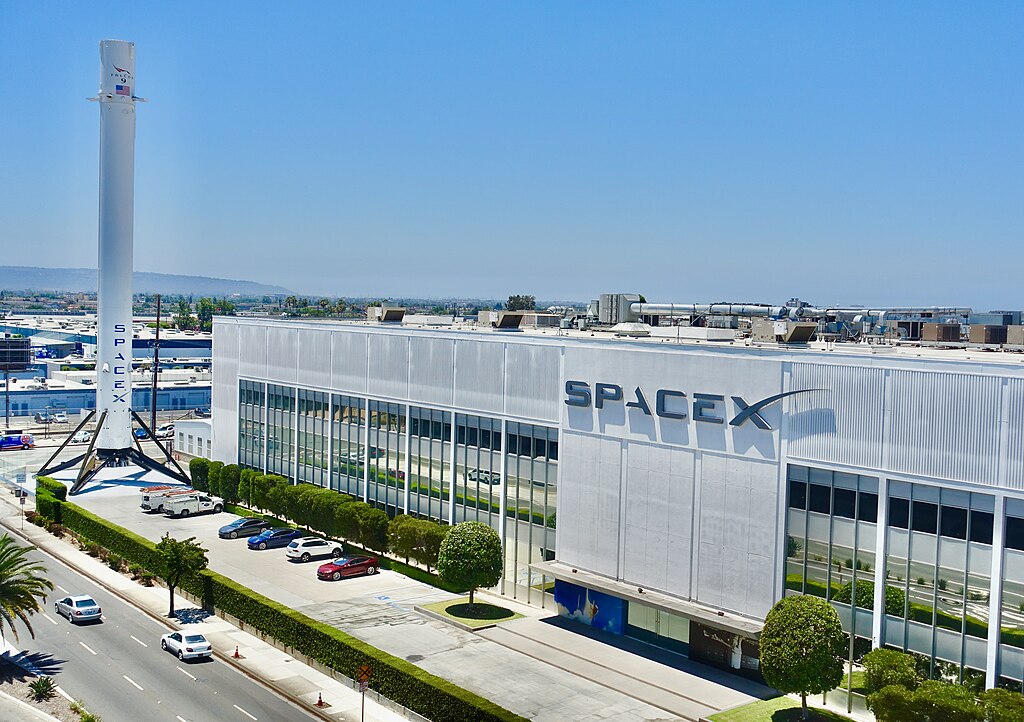
"The amount of ambition around [SpaceX's] industrialization is unlike anything I've ever witnessed," says RBC analyst Ken Herbert. Investors are currently focused on SpaceX's valuation following its record-setting IPO. Elon Musk's rocket, communications, and AI company is currently valued at roughly $2 trillion, despite not being expected to generate free cash flow for a decade or more. That's no problem for Wall Street, with some analyst target prices projecting $10 trillion or more in the coming years. The incredible optimism reflects the incredible scale SpaceX has planned, which investors overly focused on early trading might have missed. It's something to behold. Morgan Stanley analyst Adam Jonas models about 50 Starship launches in 2027. That number rises to 6,000 by 2040. Starship is SpaceX's huge, fully reusable rocket that can cut the cost of reaching space from thousands of dollars per kilogram to hundreds. Starship's low costs are the flywheel underpinning SpaceX's potential. Jonas' 204o projection is massive; conservatively, it represents 600,000 metric tons carried to orbit in one year, or more than 10 times what humanity has put into orbit so far in our civilization's history. That's also more than 100 launches a week, requiring, perhaps, a fleet of 200-plus Starships, powered by some 8,000 engines. That fleet won't all be built in a year. Still, Boeing and Airbus suppliers are struggling to build roughly 3,000 turbofan engines for commercial aircraft a year. It starts at Starbase in Boca Chica, Texas, where SpaceX builds Starship. "You go through that plant, it's like walking into the future...The level of automation, the scale. It's like multiple Costcos, and it's full," RBC analyst Ken Herbert told Barron's. "It's mind-blowing the amount of activity and the amount of tooling. It looks incredibly modern." Herbert is a veteran aerospace analyst and has watched Boeing build commercial jets in huge facilities across America. Still, he used words like "mind-blowing," "holy moly," and "floored" to describe SpaceX operations. "The amount of ambition around the industrialization is unlike anything I've ever witnessed," he added. Key to realizing its space dreams the company's high level of vertical integration. SpaceX does most of its work itself. Roughly 60% of the components on a Boeing jet are sourced from suppliers, estimates Herbert. That number for SpaceX is closer to 10%. The space business is still new. That number of outsourced parts could change as the relatively new commercial space industry matures, but SpaceX doesn't want its growth to be gated by supplier issues. To be sure, not everything will go right for SpaceX. Timelines will shift to the right as inevitable hiccups occur. Still, what SpaceX is trying to accomplish is impressive. "I just remember walking in [Starbase] and feeling like...I'm looking at the future," said Herbert. "If they can pull it off, it's unprecedented." Herbert rates SpaceX stock as Buy and sets a $225 price target for the shares. Jonas rates shares Buy. His price target is $300. The average analyst price target for SpaceX stock currently sits at about $242, valuing all that potential at roughly $3.2 trillion.

China poses biggest long-term competitive threat to SpaceX - Morgan Stanley By Investing.com
Investing.com-- Morgan Stanley said China's rapidly advancing reusable rocket program is emerging as the biggest long-term competitive threat to SpaceX (NASDAQ:SPCX), after the country successfully recovered an orbital-class rocket booster for the first time. The Wall Street brokerage said China's successful recovery of the Long March 10B booster marked a major step toward routine rocket reuse, although it cautioned that Beijing still needs to demonstrate repeated launches and reflights before achieving an operational reusable launch system. Get premium analyst insights, AI-powered research with InvestingPro subscription The brokerage said the China Aerospace Science and Technology Corp. (CASC) became only the third entity after SpaceX and Blue Origin to recover an orbital-class booster, underscoring the country's accelerating ambitions in commercial space. Morgan Stanley analysts said China's deep space ecosystem, spanning state-backed launch programs and private companies such as LandSpace, Galactic Energy and Space Pioneer, makes it the most significant competitive challenge to SpaceX's launch business over the long run. The note highlighted that China carried out 90 orbital launches in 2025, compared with SpaceX's 165 Falcon 9 launches, making it the world's second-largest launch market by activity. U.S. Space Force officials had estimated earlier this year that China was still three to five years away from mastering rocket reusability, although the Long March 10B demonstration could shorten that timeline, Morgan Stanley said. The brokerage also pointed to China's broader space ambitions, including the planned Guowang and Qianfan low-Earth orbit satellite constellations, which together target about 28,000 satellites, as well as a proposed filing for more than 190,000 non-geostationary satellites. Morgan Stanley said China is also investing heavily in space-based computing, citing the launch of the first satellites in the planned 2,800-satellite "Star Compute" orbital supercomputer network. Despite the rising competition, Morgan Stanley maintained its "overweight" rating on SpaceX with a $300 price target, saying the company remains the global leader in launch cadence, reusable rocket technology and satellite connectivity, while warning investors not to underestimate China's progress in narrowing the gap.

SpaceX shares continue to fall. Where will they end up?
You're reading a free article with opinions that may differ from The Motley Fool's Premium Investing Services. Become a Motley Fool member today to get instant access to our top analyst recommendations, in-depth research, investing resources, and more. Learn More Shares in Elon Musk's Space Exploration Technologies Corp (NASDAQ: SPCX), more commonly known as SpaceX, again fell below the company's $150 opening price over the weekend as opinions diverge on where the stock will end up. SpaceX shares still in the black The historically large SpaceX initial public offering priced the company's shares at US$135 apiece, so those who got in before the company listed are still sitting on gains and would have made a tidy profit if they sold out at the US$225.64 high achieved shortly after listing. The shares have generally drifted lower since that peak was reached, however, and closed Friday's session at US$145.30, not far off their lowest mark of US$145.07. This means that almost everyone who bought on-market would be under water on their investment currently. The stock was included in the NASDAQ 100 index on Tuesday last week, however this failed to significantly bolster the stock. So where to from here for SpaceX shares? The Tradingview website has collated the views of 29 analysts with price predictions on SpaceX shares, with the average share price forecast coming out at US$242.21. However this is distorted by one analyst prediction of a price of US$800 per share on SpaceX shares. Perhaps more useful is the fact that 24 analysts have rated the stock a strong buy, three a buy, while one rates it a sell and one a strong sell. Motley Fool US contributor Manali Pradhan has crunched the numbers on SpaceX's 2027 revenue range and forward sales multiple to come up with an implied market capitalisation, and says US$220 per share is a reasonable base case estimate. As she wrote: Analysts expect SpaceX's 2027 revenue to range from $54.8 billion to $85 billion, with an average estimate of $72.4 billion. Applying a forward sales multiple of 38.5 to 41 times to the 2027 base case revenue estimate yields an implied market capitalization of about $2.79 trillion to $2.97 trillion. Using roughly 13.1 billion shares outstanding, that points to a share price in the range of $213 to $227 at the end of 2026. Long-term vision on SpaceX shares needed The difficulty in valuing SpaceX stems from the fact that of its three divisions, only one - the Starlink "connectivity" division is profitable. The rocket launch and AI divisions are still burning money, with investors needing to buy into the promise that they will in time turn a profit. The company's initial public offer prospectus stated that for the first three months of 2026, the Space division lost US$662 million, the AI division lost US$2.47 billion, and the connectivity division made a profit of US$1.19 billion. The company believes its business opportunity is huge however, saying in the prospectus, "We believe that space represents the largest economic frontier in human history", and suggesting that they will be building AI infrastructure in space, powered by the "virtually limitless" power of the sun, for the benefit of mankind.

This Vanguard ETF Would Have Quadrupled Your Money Over the Last Decade. History Says Now Is a Smart Time to Invest. (It's Likely to Outperform SpaceX, Too.)
We're all looking for solid investments for our portfolios, right? It's easy to focus on big-name high-flying stocks, such as Nvidia or Micron Technology. But there's also some risk there, as many highfliers end up overvalued and poised to fall extra-hard in a market pullback. (And a market pullback is far from unlikely these days.) So permit me to suggest a terrific investment that you might not have taken seriously enough: a simple, low-fee S&P 500 index fund. A splendid example is the Vanguard S&P 500 ETF (NYSEMKT: VOO). It's an exchange-traded fund (ETF) -- a fund that trades like a stock. Missed Nvidia in 2009? This Rare Signal Is Flashing Again. In 2009, a "Double Down" signal flashed for a little-known chipmaker called Nvidia. For the first time in years, that same "Total Conviction" signal is flashing for a company 1/100th the size of Nvidia. Continue " Meet the Vanguard S&P 500 ETF Like any good S&P 500 index fund, the Vanguard S&P 500 ETF features low fees. While some actively managed mutual funds might charge you 1% or more of your assets each year, this fund charges 0.03% -- or just $3 annually for every $10,000 you have invested in it. It tracks the S&P 500, of course -- an index of roughly 500 of the biggest stocks in America. Together, they make up about 80% of the value of the entire U.S. stock market, which is why the S&P 500 is often used as a proxy for the total U.S. stock market. Together, the index's recent top 10 components make up about 38% of the index's value by weight. Here they are as of July 9: Data source: Slickcharts.com, as of July 9, 2026. Like many indexes, the S&P 500 is market-cap-weighted, with bigger companies wielding more influence than smaller ones. The fund has a solid record. Check out its average annual return over the last three, five, and 10 years (as reported by Morningstar on July 9): * Last three years: 21.26% * Last five years: 13.11% * Last 10 years: 15.36% Over the last decade, these compounded annual returns would have quadrupled your money. Why invest in the Vanguard S&P 500 ETF? Here are several reasons to invest:
In SpaceX, OpenAI, Anthropic IPOs, how a funding tap could open for Indian start-ups
SpaceX's $75-billion Initial Public Offering (IPO) last month made it the world's largest listing, well ahead of the $25.6 billion raised by Saudi Aramco in late 2019. What SpaceX's IPO also did was to set the stage for what may be equally gargantuan listings in the artificial intelligence (AI) space: OpenAI and Anthropic. And the returns from these three IPOs could open the tap for thirsty Indian start-ups. According to data compiled by private market intelligence platform Tracxn for The Indian Express, the 54 Private Equity (PE) and Venture Capital (VC) firms that have backed SpaceX, Anthropic, and OpenAI have deployed $57.8 billion across 1,376 rounds in Indian technology companies between 2016 and June 2026. Investments in Indian space-tech firms have been just $160 million, with 12 of the 54 participating in four rounds. Apart from validating Elon Musk's confidence in his space-plus-AI company, SpaceX's IPO also made profits for those PE firms and VCs who invested early enough. Consider, for instance, Peter Thiel's Founders Fund, whose $600 million investment in SpaceX was worth more than $50 billion at the company's IPO price of $135, according to a Bloomberg report, which added that Andreessen Horowitz's return from its investment in SpaceX would be the biggest in its history. SpaceX's IPO valued it at $1.8 trillion. In June, both Anthropic and OpenAI had confidentially filed for a listing. While the latter wants to be valued at $1 trillion in its IPO, Anthropic in May said it had raised $65 billion at a valuation of $965 billion. Explained | AI giants, SpaceX gear up for IPOs: Are these companies overvalued, and can Indians invest in them "Historically, successful exits have strengthened the ability of VC and PE firms to raise larger successor funds," said Neha Singh, Tracxn's Co-founder. "Given that India already features in the active portfolios of these 54 firms, a recovery in investment activity is plausible as fresh capital is raised and redeployed." At the same time, Singh cautioned that it is difficult to estimate how much capital may come to India as IPO proceeds are primarily distributed to Limited Partners rather than directly increasing General Partner deployment capacity. The scope However, there are "early signs of capital recycling". Story continues below this ad Take, for instance, Chicago-based VC firm Valor Equity Partners, whose 4% stake in SpaceX was worth around $70 billion at the IPO price. According to reports, Valor is looking to raise $2.5 billion by the end of 2026. But whether any of that money will reach Indian shores is up in the air given Valor's focus on deep tech, defence, and late-stage AI infrastructure in the US, Singh of Tracxn said. Also in Explained | Orbital data centres, extraterrestrial energy: Detailing Musk's ambitions with $1.75 bn SpaceX IPO "As a result, any meaningful increase in India allocations is more likely to emerge over the medium term as successor funds are raised and deployed, rather than as an immediate post-IPO outcome," she added. According to private capital data provider PitchBook, liquidity conditions in Asia-Pacific are improving. This suggests "the region's capital recycling cycle is beginning to repair after several years of constrained realisations," it said in a report late last month. Earlier this year in February, Peak XV had said it had raised $1.3 billion for its new India Seed, India Venture, and APAC funds. Story continues below this ad To be sure, there are differences in how the SpaceX-Anthropic-OpenAI investors have poured money into US and Indian firms. In India, while 71% of the investments of these 54 firms have been at the seed or early stage, 93% of the money in companies such as SpaceX, Anthropic, and OpenAI was at the late-stage. This, Singh of Tracxn said, reflects a "deliberate strategy of concentrating capital behind a small number of category-defining companies rather than following their typical investment pattern" which sees them invest just 12% at the late stage across the US portfolio. Whatever the money and stage, overseas funds will be welcomed not just by the start-ups but even Indian policymakers, with the Indian economy seemingly having sleepwalked into an exodus of foreign capital over the last couple of years as repatriation of past investments piled up rapidly, totalling $150 billion over 2023-24, 2024-25, and 2025-26. This is equal to 61% of gross Foreign Direct Investment (FDI) into the country, resulting in net FDI over the aforementioned three years being a mere $18 billion. Story continues below this ad In 2025-26, Indian start-ups raised $11.7 billion, down 18% from the previous year, according to Tracxn. As it is, private credit is becoming increasingly popular, with Moody's Ratings estimating the size of the Indian market doubled in the last five years to $25 billion at the end of 2025.
This Vanguard ETF Would Have Quadrupled Your Money Over the Last Decade. History Says Now Is a Smart Time to Invest. (It's Likely to Outperform SpaceX, Too.)
We're all looking for solid investments for our portfolios, right? It's easy to focus on big-name high-flying stocks, such as Nvidia or Micron Technology. But there's also some risk there, as many highfliers end up overvalued and poised to fall extra-hard in a market pullback. (And a market pullback is far from unlikely these days.) So permit me to suggest a terrific investment that you might not have taken seriously enough: a simple, low-fee S&P 500 index fund. A splendid example is the Vanguard S&P 500 ETF (VOO +0.46%). It's an exchange-traded fund (ETF) -- a fund that trades like a stock. Meet the Vanguard S&P 500 ETF Like any good S&P 500 index fund, the Vanguard S&P 500 ETF features low fees. While some actively managed mutual funds might charge you 1% or more of your assets each year, this fund charges 0.03% -- or just $3 annually for every $10,000 you have invested in it. It tracks the S&P 500, of course -- an index of roughly 500 of the biggest stocks in America. Together, they make up about 80% of the value of the entire U.S. stock market, which is why the S&P 500 is often used as a proxy for the total U.S. stock market. Together, the index's recent top 10 components make up about 38% of the index's value by weight. Here they are as of July 9: Data source: Slickcharts.com, as of July 9, 2026. Like many indexes, the S&P 500 is market-cap-weighted, with bigger companies wielding more influence than smaller ones. The fund has a solid record. Check out its average annual return over the last three, five, and 10 years (as reported by Morningstar on July 9): * Last three years: 21.26% * Last five years: 13.11% * Last 10 years: 15.36% Over the last decade, these compounded annual returns would have quadrupled your money. Why invest in the Vanguard S&P 500 ETF? Here are several reasons to invest: * It's a good time to do so (there's rarely a bad time, if you're a long-term investor). * It makes investing easy, plopping you into roughly 80% of the U.S. stock market with one "buy" order. * It offers diversification -- when one company or industry falls, the others can offset that to some degree. For greater diversification, check out the Invesco S&P 500 Equal Weight ETF (RSP +0.38%), which weights each of the 500 companies in the index equally. * It's likely to outperform many growth stocks, especially overvalued ones -- including, arguably, Space Exploration Technologies, also known as SpaceX. Consider, for example, that the S&P 500's price-to-sales ratio was recently 3.7, while SpaceX's was 74.7. The S&P 500 has a solid track record, averaging annual gains of close to 10% over many decades, but many growth stocks are far less proven. * The index is designed to perform well, as lagging components are regularly removed to make way for up-and-coming companies. Take a closer look at this ETF to see if it's a good fit for your needs.

NDAQ:SPCX Forum Post | Tradinghands-37050885 | Tesla merger with SpaceX won't save investors | Space Exploration Technologies Corporation
Space Exploration Technologies Corp. provides satellite-based broadband services in the United States, Ireland, Canada, and internationally. The company's Connectivity segment operates a high-speed, low-latency broadband network powered by various Starlink satellites in low-earth orbit, delivering connectivity to various consumer, enterprise, and government customers through its Starlink offering. Its Space segment designs, manufactures, and launches reusable rockets to provide access to space. It offers launch services for the deployment of payloads to intended orbits for commercial and government customers utilizing Falcon 9 and Falcon Heavy; and launch and development for the development of spacecraft and the provision of launch and mission services for government agency space programs utilizing Falcon 9, Falcon Heavy, Starship, and Dragon. The company's AI segment operates a vertically integrated AI platform spanning a frontier LLM Grok; AI solutions for consumer and enterprise ...

Could AI Pay Americans $1 Million Each? New Think Tank Forecast Sparks Jim Chanos' SpaceX Jab: 'Seems Reasonable'
Benzinga and Yahoo Finance LLC may earn commission or revenue on some items through the links below. The AI Futures Project, a non-profit initiative that forecasts the future of artificial intelligence, recently outlined a proposal for a citizen's dividend by the U.S. government following AI-induced unemployment. Citizen's Dividend to Provide $1 Million Per Person By 2035 In the AI 2040 Plan A, the non-profit says that by 2033, AI-induced unemployment would rise due to the advent of millions of AI agents boosting productivity. "Across a variety of companies, there are now 60 million AI agents running continuously at 20x human speed," the project said. The non-profit then mentions a plan that involves the American government distributing the "majority of compute and robot permit fees as a Citizen's Dividend... to all American adults." The plan mentions the dividend starting at $45,000 per person in 2032, but climbing to $1 million per person by 2035 and $10 million by 2040. The plan also predicts AI reaching a labor share of 85% by 2035. The initiative also predicts the U.S. government "distributing an average of $1,200 per person per year to the rest of the world's adult population" of around 4 billion people. The plan excludes China because it would be "experiencing a similar AI wealth boom." The plan says it will reach $10k by 2035. Earlier, OpenAI was reportedly offering the President Donald Trump administration a 5% stake in the company amid CEO Sam Altman's past proposal for a universal basic capital model that involved distributing a small share of AI-generated wealth. Jim Chanos Weighs In Taking to the social media platform X on Thursday, short-seller James Chanos weighed in on the predictions. "At about the same time $SPCX's valuation exceeds global GDP. Seems reasonable," he said, pointing to Space Exploration Technologies Corp.. At about the same time $SPCX's valuation exceeds global GDP. Seems reasonable. https://t.co/cdQb9SpHfR -- James Chanos (@RealJimChanos) July 9, 2026 Trending: Avoid the #1 Investing Mistake: How Your 'Safe' Holdings Could Be Costing You Big Time SpaceX to Be Worth More Than Earth The comments come as SpaceX CEO Elon Musk had said that the company would be worth more than the entire planet in the future. "You don't seem to understand that SpaceX will be worth more than the rest of Earth if we accomplish our goals," Musk had said.
SpaceX's AI empire is built on data centers, not satellites - Cryptopolitan
Analysts caution that the contracts carry termination clauses and that space computing is still 10 years or more away. SpaceX's AI returns over the next few years will not come from space. According to Wall Street analysts, the money is coming from Earth data centers rather than the orbital compute that Elon Musk has promised. This reframes SpaceX (NASDAQ: SPCX) as primarily an infrastructure company. Space computing is a bet for the future, not now, for anyone considering SpaceX as an AI play. SpaceX already charges for computing. Reuters reported that the company signed enterprise deals for its Colossus supercomputer clusters with Anthropic, Alphabet's Google, and Reflection AI. Those contracts alone are expected to generate more than $28 billion annually. SpaceX's AI revenue in 2025 is ~$3.2 billion, which is significantly higher than the new deals. The compute contracts also outperformed SpaceX's earnings from rocket launches and Starlink, when counted separately. The contracts, however, include termination clauses, so analysts caution against reading them as recurring revenue. What SpaceX spent to get here SpaceX invested ~$18 billion in AI infrastructure and research in 2025. According to company filings, ~$12.7 billion was spent on capital expenditures and $5.1 billion on research and development. That expenditure outpaced spending on space and connectivity lines. Colossus and a second cluster, Colossus II, together provide ~1 gigawatt of AI compute. That makes SpaceX one of the world's largest compute operators. J.P. Morgan predicts that terrestrial capacity will reach ~9 gigawatts by 2029, which is equivalent to four times the output of the Hoover Dam. Brokerages cited by Reuters pointed to its $60 billion purchase of AI coding startup Cursor as a sign the company wants to sell AI applications, not just the machines that run them. The deal ties into Musk's model plans on the software side. A separate Cryptopolitan report said Musk's lab, now renamed SpaceXAI, built its Grok 4.5 model jointly with Cursor, and Musk has said SpaceX is buying the startup for that same $60 billion figure. Why orbit is still a distant bet Musk has proposed a future in which computers run in space. Analysts Reuters spoke with view this as a later chapter. "The narrative that (orbital) will fundamentally disrupt terrestrial data centers is a little bit overblown," said Anthony Milovantsev, a partner at consultancy Altman Solon, who estimated that any real displacement of ground-based data centers would take "ten years plus." The case is based on hardware that does not currently exist at scale. Orbital computing relies on SpaceX's Starship flying frequently and cheaply, lower launch costs, and better satellites, according to analysts. Ground clusters continue to run regardless of direction. BofA analysts were more blunt, calling the long term viability of orbital data centers "unproven and heavily reliant on key technological milestones that have yet to be realized." If the engineering is delivered, the appeal will be valid. Starships could eventually launch solar computing satellites into orbit, avoiding ground based costs such as energy, cooling, and land use. Analysts aren't asking if SpaceX can build and sell AI infrastructure. J.P. Morgan's estimate of ~9 gigawatts in 2029 remains the benchmark for establishing a business beyond Earth.
Looking for Exposure to SpaceX Stock (SPCX)? Consider These Two ETFs
After SpaceX's (SPCX) high-profile IPO last month, investors are looking for ways to get exposure to the company's fast growth in launch services, Starlink, and new AI‑compute deals. Following the company's recent inclusion into the Nasdaq-100 Index (NDX) on July 7, several ETFs added the stock to their portfolios. Currently, investors could consider investing in these two ETFs: Roundhill Space & Technology ETF (MARS) and VanEck Space ETF (WARP). TipRanks Welcomes a New ETF - NYSE:RANK * TipRanks has entered a new arena in the investing world, powering the index of an ETF based on its unique data now trading under the ticker RANK on the NYSE. * RANK tracks the performance of the TipRanks US Momentum Analysts Index, a rules-based index of 50 large U.S. companies. Roundhill Space & Technology ETF (MARS) MARS is an actively managed fund that invests in companies tied to the growing space economy. Its portfolio includes firms involved in launch services, satellite networks, space hardware, communications, and emerging orbital technologies. SPCX stock constitutes 22.86% of the ETF's holdings. Some other top holdings in the MARS ETF include Rocket Lab USA (RKLB), AST SpaceMobile (ASTS), and ViaSat (VSAT). Overall, the ETF has $66.72 million in assets under management (AUM) and an expense ratio of 0.75%. On TipRanks, the MARS ETF has a Moderate Buy consensus rating based on 18 Buys and 12 Holds assigned in the last three months. The average MARS ETF price target of $40.18 implies 43.91% upside potential. VanEck Space ETF (WARP) WARP is a passively managed ETF, designed to track the performance of the MarketVector Space Index. The ETF targets four core sectors of the space economy, which include satellite communications, rockets and propulsion systems, Earth observation and data analytics, and space exploration. SpaceX stock accounts for 21.58% of WARP's total holdings. Apart from SPCX, some of the top stocks in the WARP ETF are Iridium (IRDM), Planet Labs (PL), and Rocket Lab. Overall, the ETF has $41.25 million in AUM. Also, it has an expense ratio of 0.5%. Turning to Wall Street, the ETF has a Moderate Buy consensus rating. Of the 21 stocks held, 15 have Buy ratings and six have Hold ratings. The average WARP ETF price target of $32.96 implies a 48.51% upside potential. Bottom Line Investors who want exposure to the space boom around SpaceX can look at MARS and WARP, two ETFs that hold SPCX and offer diversified access to the sector. Both give exposure to companies tied to the same demand drivers, such as satellite growth, launch activity, and new space tech adoption.

Prediction: SpaceX Shares Can Reach $220 by End of 2026
Space Exploration Technologies (NASDAQ: SPCX) has become one of the market's most closely watched stocks after its rapid entry into the Nasdaq-100 index on July 7. Shares are trading close to $149 (as of July 10), still above its $135 IPO price, but nearly 34% below its post-IPO high of $225.60. This share price pullback has not ended investor interest in SpaceX, but it has changed the debate. Investors are now weighing the company's artificial intelligence (AI) compute opportunity, Starlink satellite internet network's room to expand in satellite communications, and progress on the next-generation reusable rocket system, Starship, as they assess where the stock could trade by the end of 2026. Missed Nvidia in 2009? This Rare Signal Is Flashing Again. In 2009, a "Double Down" signal flashed for a little-known chipmaker called Nvidia. For the first time in years, that same "Total Conviction" signal is flashing for a company 1/100th the size of Nvidia. Continue " Image source: Getty Images. SpaceX has growth drivers for its revenue SpaceX is already demonstrating impressive financial momentum. Revenue rose 33% year over year to $18.7 billion in 2025. But the company still reported a net loss of $4.9 billion after merging with money-losing xAI. Starlink remains the key growth engine, supported by roughly 10.3 million users and 9,600 satellites. But AI infrastructure is also becoming the next major catalyst. Alphabet has agreed to pay SpaceX $920 million per month from October 2026 through June 2029 for access to about 110,000 Nvidia GPUs and related computing resources. Anthropic has also signed a major compute-access deal with SpaceX, securing use of SpaceX's Colossus 1 data center. Reuters reported that SpaceX's two deals are worth about $26 billion annually if fully realized. Although not all the AI revenue from these deals is expected to materialize in 2026, it still gives investors a reason to value SpaceX based on future revenue potential rather than solely on 2025 sales. SpaceX's valuation will fall, but remain expensive At the end of 2026, investors will likely be looking toward SpaceX's expected 2027 revenue, since the stock's valuation depends on how quickly Starlink, AI compute, and Starship can expand the company's sales base. SpaceX's market capitalization is close to $2 trillion. Analysts' 2026 revenue estimates range from $34.3 billion on the low end to $43.2 billion on the high end, with a base case estimate of about $38.9 billion. Hence, SpaceX is already trading at roughly 51.4 times base case 2026 sales. By the end of 2026, that multiple will most likely compress, as post-IPO excitement usually cools and investors demand evidence of execution. But it also does not need to collapse if SpaceX continues to show progress in Starlink, AI infrastructure, and Starship. A reasonable base-case assumption is that SpaceX's sales multiple compresses by about 20% to 25% from today's 51.4x 2026 sales multiple. That gives a forward price-to-sales (P/S) multiple range of roughly 38.5 to 41 times expected 2027 sales. Analysts expect SpaceX's 2027 revenue to range from $54.8 billion to $85 billion, with an average estimate of $72.4 billion. Applying a forward sales multiple of 38.5 to 41 times to the 2027 base case revenue estimate yields an implied market capitalization of about $2.79 trillion to $2.97 trillion. Using roughly 13.1 billion shares outstanding, that points to a share price in the range of $213 to $227 at the end of 2026. Hence, $220 is a reasonable base case estimate. It assumes that while SpaceX's valuation multiple compresses, revenue growth offsets the pressure enough to lift the share price. Should you buy stock in Space Exploration Technologies right now? Before you buy stock in Space Exploration Technologies, consider this: The Motley Fool Stock Advisor analyst team just identified what they believe are the 10 best stocks for investors to buy now... and Space Exploration Technologies wasn't one of them. The 10 stocks that made the cut could produce monster returns in the coming years. Consider when Netflix made this list on December 17, 2004... if you invested $1,000 at the time of our recommendation, you'd have $395,679!* Or when Nvidia made this list on April 15, 2005... if you invested $1,000 at the time of our recommendation, you'd have $1,294,805!* Now, it's worth noting Stock Advisor's total average return is 929% -- a market-crushing outperformance compared to 211% for the S&P 500. Don't miss the latest top 10 list, available with Stock Advisor, and join an investing community built by individual investors for individual investors. See the 10 stocks " *Stock Advisor returns as of July 12, 2026. Manali Pradhan, CFA has no position in any of the stocks mentioned. The Motley Fool has positions in and recommends Alphabet and Nvidia. The Motley Fool has a disclosure policy. The views and opinions expressed herein are the views and opinions of the author and do not necessarily reflect those of Nasdaq, Inc.
J.P. Morgan Called a Potential Elon Musk SpaceX-Tesla Merger "Strategically Coherent"
Now that Elon Musk's rocket and satellite company Space Exploration Technologies (NASDAQ: SPCX) trades publicly, Wall Street has started hunting for the next best thing: stocks that can ride its coattails. The most eye-catching call came from J.P. Morgan, whose analysts described a possible combination of SpaceX and Tesla (NASDAQ: TSLA) as "strategically coherent on paper." That single phrase has revived a long-running fantasy among investors, and it's worth understanding what the analyst company actually means before treating any of these names as a back door into SpaceX. Why J.P. Morgan sees logic in a Tesla-SpaceX tie-up J.P. Morgan's argument is that Musk's companies already share engineering talent, an artificial intelligence ambition, and a common leader, so uniting them could let him run one integrated vision across cars, robots, energy, and space. The analysts also noted that SpaceX's blockbuster public debut gives Musk valuable stock to make a deal, and that his growing voting control at Tesla makes him better positioned to push one through. Where to invest $1,000 right now? Our analyst team just revealed what they believe are the 10 best stocks to buy right now, when you join Stock Advisor. See the stocks " Image source: Getty Images. J.P. Morgan was careful, though, and so am I. It flagged real obstacles: securing regulatory approvals across many countries, especially China, where Tesla builds cars; the awkward gap between Musk's near-total control of SpaceX and his smaller stake in Tesla; and the likelihood that any deal would look like SpaceX swallowing Tesla rather than a merger of equals. "Coherent on paper" is a long way from "likely to happen." The other SpaceX-by-association plays Tesla isn't the only name catching the halo. Deutsche Bank started coverage of EchoStar (NASDAQ: ECHO) with a buy rating, framing it as a cheaper way to own SpaceX. EchoStar holds roughly $11 billion of SpaceX shares it received for handing over wireless spectrum, so the bank argues you're effectively buying SpaceX at a discount and getting EchoStar's other assets thrown in. The catch is serious: EchoStar's pay-TV subsidiary recently filed for bankruptcy, and the stock has tumbled. Then there's Charter Communications (NASDAQ: CHTR), which, according to Bloomberg, has held talks with SpaceX about a consumer mobile phone service that would route some traffic through Charter's network. It's a genuine strategic fit, but it's only talk for now. Here's my honest read. Buying a stock because it's linked to a hot company is a strategy built on hope, not fundamentals, and all three of these names are down this year for reasons of their own. A merger that's merely "coherent on paper," a spectrum stake wrapped around a bankruptcy, and a rumored partnership are not the same as durable businesses. If you like Tesla, EchoStar, or Charter, buy them for what they do today, and treat any SpaceX connection as a bonus rather than the thesis. Should you buy stock in Space Exploration Technologies right now? Before you buy stock in Space Exploration Technologies, consider this: The Motley Fool Stock Advisor analyst team just identified what they believe are the 10 best stocks for investors to buy now... and Space Exploration Technologies wasn't one of them. The 10 stocks that made the cut could produce monster returns in the coming years. Consider when Netflix made this list on December 17, 2004... if you invested $1,000 at the time of our recommendation, you'd have $395,679!* Or when Nvidia made this list on April 15, 2005... if you invested $1,000 at the time of our recommendation, you'd have $1,294,805!* Now, it's worth noting Stock Advisor's total average return is 929% -- a market-crushing outperformance compared to 211% for the S&P 500. Don't miss the latest top 10 list, available with Stock Advisor, and join an investing community built by individual investors for individual investors. See the 10 stocks " *Stock Advisor returns as of July 12, 2026. JPMorgan Chase is an advertising partner of Motley Fool Money. Micah Zimmerman has no position in any of the stocks mentioned. The Motley Fool has positions in and recommends JPMorgan Chase and Tesla. The Motley Fool has a disclosure policy. The views and opinions expressed herein are the views and opinions of the author and do not necessarily reflect those of Nasdaq, Inc.
Asia's Rocket Breakthroughs Challenge SpaceX Dominance
China recovers booster with net, Japan achieves vertical landing in reusable tech race Elon Musk's SpaceX (U.S.) has long dominated the reusable launch vehicle market, but now China and Japan are challenging its lead. On July 10, China successfully captured the first-stage booster of a rocket that deployed an actual satellite into space using a large net over the ocean. Japan, on July 11, achieved a vertical takeoff and landing of a small experimental rocket. Reusing the first-stage booster -- the most expensive part of a rocket -- reduces launch costs and increases frequency. This technology is critical for deploying satellite internet constellations and enabling lunar and Martian exploration. While SpaceX remains ahead, the entry of China and Japan signals intensifying global competition in reusable launch systems. ◇ China's Net-Based Booster Recovery China demonstrated the ability to perform a real orbital launch and recover the first-stage booster simultaneously. The China Aerospace Science and Technology Corporation (CASC) launched the Long March-10B from a commercial spaceport in Hainan on July 10, successfully placing a satellite into its designated orbit. The separated first-stage booster reignited its engines to slow its descent toward a designated maritime target. Four hooks attached to the booster were then caught by a large net on a floating platform. This marked the first time China recovered the first stage of a large rocket used in an actual orbital launch, following two previous failed attempts. Unlike SpaceX's Falcon 9, which uses landing legs to touch down on land or a drone ship, the Long March-10B employs a net-based recovery system. This approach reduces weight by eliminating landing legs, allowing for greater payload capacity. The net also accommodates movement from waves and wind, ensuring stable capture. However, full reusability requires repeated inspections and relaunches of recovered boosters. CASC plans to assess the recovered booster and attempt a reflight within the year. ◇ Japan's Low-Altitude Vertical Takeoff and Landing Test Japan validated core reusable rocket technologies -- vertical takeoff and landing, as well as precision flight control -- using a small experimental vehicle. The Japan Aerospace Exploration Agency (JAXA) successfully tested the reusable launch vehicle demonstrator "RV-X" at a test site in Noshiro City, Akita Prefecture, on July 11. The 7.3-meter-tall cylindrical RV-X is equipped with a throttleable engine, autonomous flight control systems, and four shock-absorbing landing legs. During the test, it ascended vertically to 11 meters, moved horizontally 16 meters while maintaining an upright position, and landed vertically. Though the flight lasted less than a minute, it proved the feasibility of key technologies. Japan plans to gradually increase the test altitude to approximately 100 meters and verify engine reignition and repeated flight capabilities. While still in early stages compared to China, the test marks Japan's first step toward entering the reusable rocket market. Foreign media framed these developments as challenges to SpaceX's dominance. Reuters called China's success a "major step forward in challenging the U.S.," while the Associated Press noted Japan's efforts to "secure core technologies for competing in the launch market dominated by SpaceX." ◇ South Korea Aims to Secure Core Reusability Technology by 2032 SpaceX, however, maintains a significant lead. It first landed a Falcon 9 first-stage booster in 2015 and began reusing recovered boosters for missions in 2017. To date, it has achieved over 600 successful booster recoveries and reused individual boosters more than 30 times. South Korea is still in the early stages of developing reusable launch vehicles. The Korea AeroSpace Administration plans to develop a next-generation launch vehicle based on an 80-ton methane engine, investing over 2 trillion Korean won in the project. The goal is to secure core reusability technologies by 2032 and advance toward a fully reusable launch system. With China and Japan achieving successive test successes, experts urge South Korea to accelerate its design and testing processes. "Reusable rockets are essential technology to avoid falling behind in the space race," said one industry source. "While there is consensus on its importance and direction, development must be expedited."
J.P. Morgan Called a Potential Elon Musk SpaceX-Tesla Merger "Strategically Coherent"
Now that Elon Musk's rocket and satellite company Space Exploration Technologies (SPCX 4.51%) trades publicly, Wall Street has started hunting for the next best thing: stocks that can ride its coattails. The most eye-catching call came from J.P. Morgan, whose analysts described a possible combination of SpaceX and Tesla (TSLA +0.22%) as "strategically coherent on paper." That single phrase has revived a long-running fantasy among investors, and it's worth understanding what the analyst company actually means before treating any of these names as a back door into SpaceX. Why J.P. Morgan sees logic in a Tesla-SpaceX tie-up J.P. Morgan's argument is that Musk's companies already share engineering talent, an artificial intelligence ambition, and a common leader, so uniting them could let him run one integrated vision across cars, robots, energy, and space. The analysts also noted that SpaceX's blockbuster public debut gives Musk valuable stock to make a deal, and that his growing voting control at Tesla makes him better positioned to push one through. J.P. Morgan was careful, though, and so am I. It flagged real obstacles: securing regulatory approvals across many countries, especially China, where Tesla builds cars; the awkward gap between Musk's near-total control of SpaceX and his smaller stake in Tesla; and the likelihood that any deal would look like SpaceX swallowing Tesla rather than a merger of equals. "Coherent on paper" is a long way from "likely to happen." The other SpaceX-by-association plays Tesla isn't the only name catching the halo. Deutsche Bank started coverage of EchoStar (ECHO 2.00%) with a buy rating, framing it as a cheaper way to own SpaceX. EchoStar holds roughly $11 billion of SpaceX shares it received for handing over wireless spectrum, so the bank argues you're effectively buying SpaceX at a discount and getting EchoStar's other assets thrown in. The catch is serious: EchoStar's pay-TV subsidiary recently filed for bankruptcy, and the stock has tumbled. Then there's Charter Communications (CHTR 2.69%), which, according to Bloomberg, has held talks with SpaceX about a consumer mobile phone service that would route some traffic through Charter's network. It's a genuine strategic fit, but it's only talk for now. Here's my honest read. Buying a stock because it's linked to a hot company is a strategy built on hope, not fundamentals, and all three of these names are down this year for reasons of their own. A merger that's merely "coherent on paper," a spectrum stake wrapped around a bankruptcy, and a rumored partnership are not the same as durable businesses. If you like Tesla, EchoStar, or Charter, buy them for what they do today, and treat any SpaceX connection as a bonus rather than the thesis.