News & Updates
The latest news and updates from companies in the WLTH portfolio.
Kraken Parent Payward Wins In-Principle Approval For Kazakhstan Expansion
TL;DR: Payward has received in-principle approval for a Kazakhstan business covering digital asset trading, dealing and custody in the AIFC. Final licensing conditions remain relevant, and the announcement gives no customer launch date. Kraken parent Payward has moved closer to establishing a regulated business in Kazakhstan, with preliminary approval for several activities rather than trading alone. In an October 22 announcement, Payward said the Astana Financial Services Authority had granted in-principle approval to license Payward Kazakhstan in the Astana International Financial Centre. The proposed permissions cover operating a digital asset trading facility, dealing in investments as principal and agent, and digital asset custody. The company also said Kazakh traders would gain access to its global order books. It did not give a date for the local service to open. For prospective local customers, the distinction between that plan and a completed launch is the most immediate detail. The License Still Has A Final Stage AFSA's authorization guide explains that in-principle approval sets out conditions and recommendations an applicant must satisfy before receiving its license. The process can involve establishing a legal entity, injecting capital and resolving other regulatory matters. The guide also says applicants must demonstrate sufficient financial and human resources, systems and internal controls for the activities they propose. Those are general licensing requirements; Payward's brief announcement does not disclose the particular conditions attached to its own approval. That makes the announcement evidence of progress through the licensing process. It is not evidence that every planned product is already available or that the same permissions apply outside the AIFC. Customers ultimately need to know which local entity provides a service and exactly what that entity is licensed to do. Local Permissions, A Global Order Book The proposed combination is commercially significant because an exchange serves more than one function. Trading brings buyers and sellers together; dealing permissions concern how the firm participates in transactions; custody concerns responsibility for customers' assets. Those functions can sit behind a single app, but their risks differ. A competitive execution price says little about the handling of a withdrawal dispute, just as a strong custody arrangement does not guarantee a deep trading market. Access to wider order books could be useful if the eventual service connects local demand with more counterparties. That potential benefit should be assessed through actual execution quality, fees and withdrawal arrangements once services are available. The announcement alone cannot establish those outcomes. For traders considering Bitcoin or other digital assets through the planned operation, the next concrete milestone is the final license and a clear description of the products, eligible customers and opening date. The preliminary approval advances that process while leaving those practical questions to the next stage.

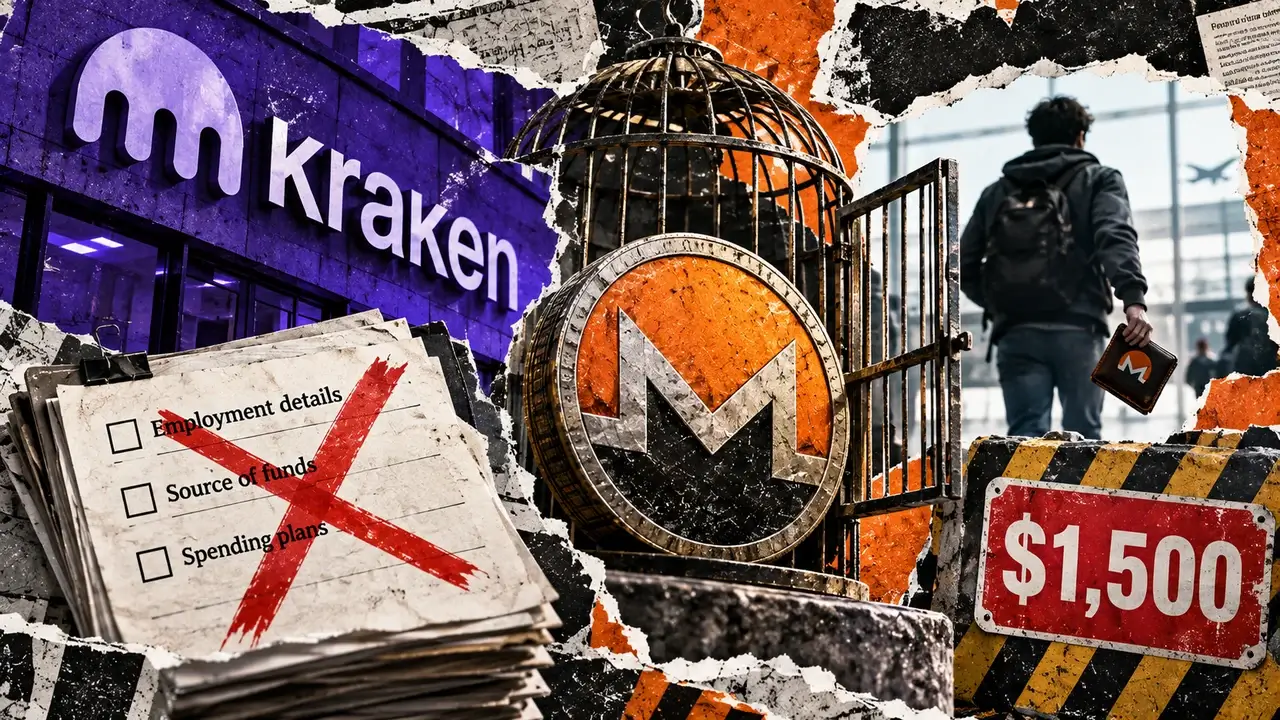
Kraken drops Monero spending questions but keeps a $1,500 rolling 30-day withdrawal cap for individuals
Crypto exchange Kraken has withdrawn intrusive compliance demands sent to Monero customers after its co-CEO admitted the requests were unjustified. On Oct. 24, Arjun Sethi said that customers who purchased and withdrew Monero (XMR) had received emails requesting information about their employers, sources of funds, and intended use of the cryptocurrency. He acknowledged that no... Read the full story on CryptoSlateUnderstand the crypto stories that matter and what to watch next
Kraken Lets Customers Ask ChatGPT About Their Crypto Balances | EconoTimes
The link provides read-only account data, while any purchase still requires customer review and confirmation on Kraken. Kraken customers can now ask ChatGPT about linked balances and account performance, adding an AI interface for portfolio reviews while requiring users to approve any purchase through the exchange. Kraken said customers must connect an account and authorize read-only access to balances to ask account-specific questions. Examples include checking gains for a day or asking which holdings lost money during a month. General questions about prices, charts and news do not require an account connection. A prompt can open Kraken's buy process with an amount already entered, but ChatGPT does not complete the purchase. Customers must review and confirm the order on Kraken. The account connection also cannot transfer funds or change account settings, Kraken said. Kraken says its systems provide the figures in account cards. ChatGPT writes the accompanying explanations, which the exchange says it does not review.

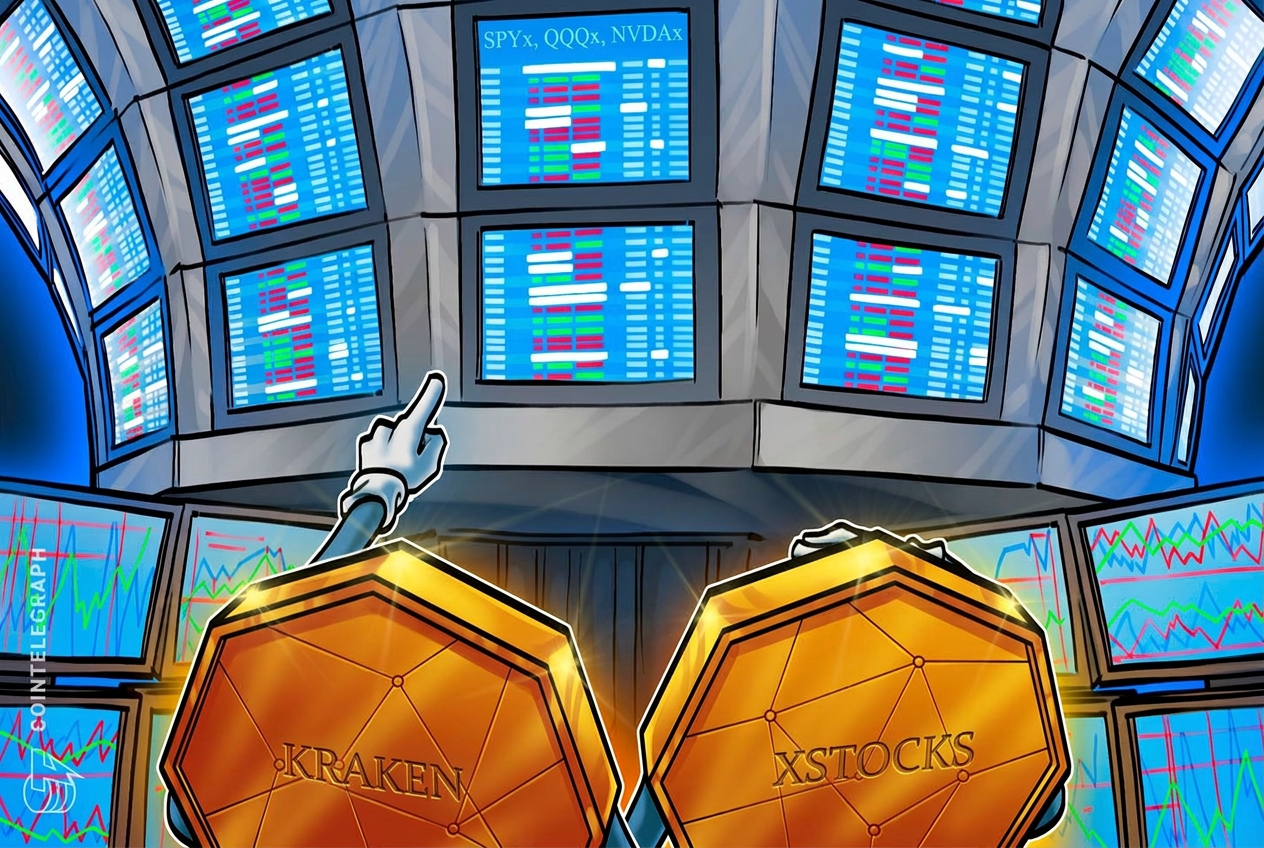
Kraken Lets xStocks Holders Earn Yield Through DeFi
Kraken's new xStocks vaults let investors earn yield on tokenized versions of Nvidia and major US stock market ETFs by lending the assets in DeFi markets. Crypto exchange Kraken has launched onchain yield vaults for select tokenized stocks and ETFs, allowing clients to earn returns by lending the assets through decentralized finance protocols, according to a Monday announcement. The new xStocks vaults support tokenized versions of the SPDR S&P 500 ETF (SPYx), Invesco QQQ ETF (QQQx) and Nvidia (NVDAx), with yield generated by lending the assets through onchain markets. Yield is paid in the deposited xStocks, while withdrawal requests are processed within three days. The vaults use the same infrastructure as Kraken DeFi Earn, which launched in January and has since attracted more than $800 million in deposits, according to the company. The xStocks vaults are powered by Veda, with Sentora designing and managing the lending strategies used to generate yield. Assets are lent through DeFi markets such as Kamino on Solana, with Sentora setting exposure limits and monitoring collateral, liquidity and oracle conditions. The vaults are available to eligible Kraken clients in the European Economic Area and other markets, but are excluded in the United States, United Kingdom, Canada, Australia and the United Arab Emirates. Kraken's launch comes amid rapid growth in tokenized equities. The distributed value of tokenized stocks and ETFs has climbed to about $2.84 billion, up from roughly $540 million a year ago, according to RWA.xyz data.
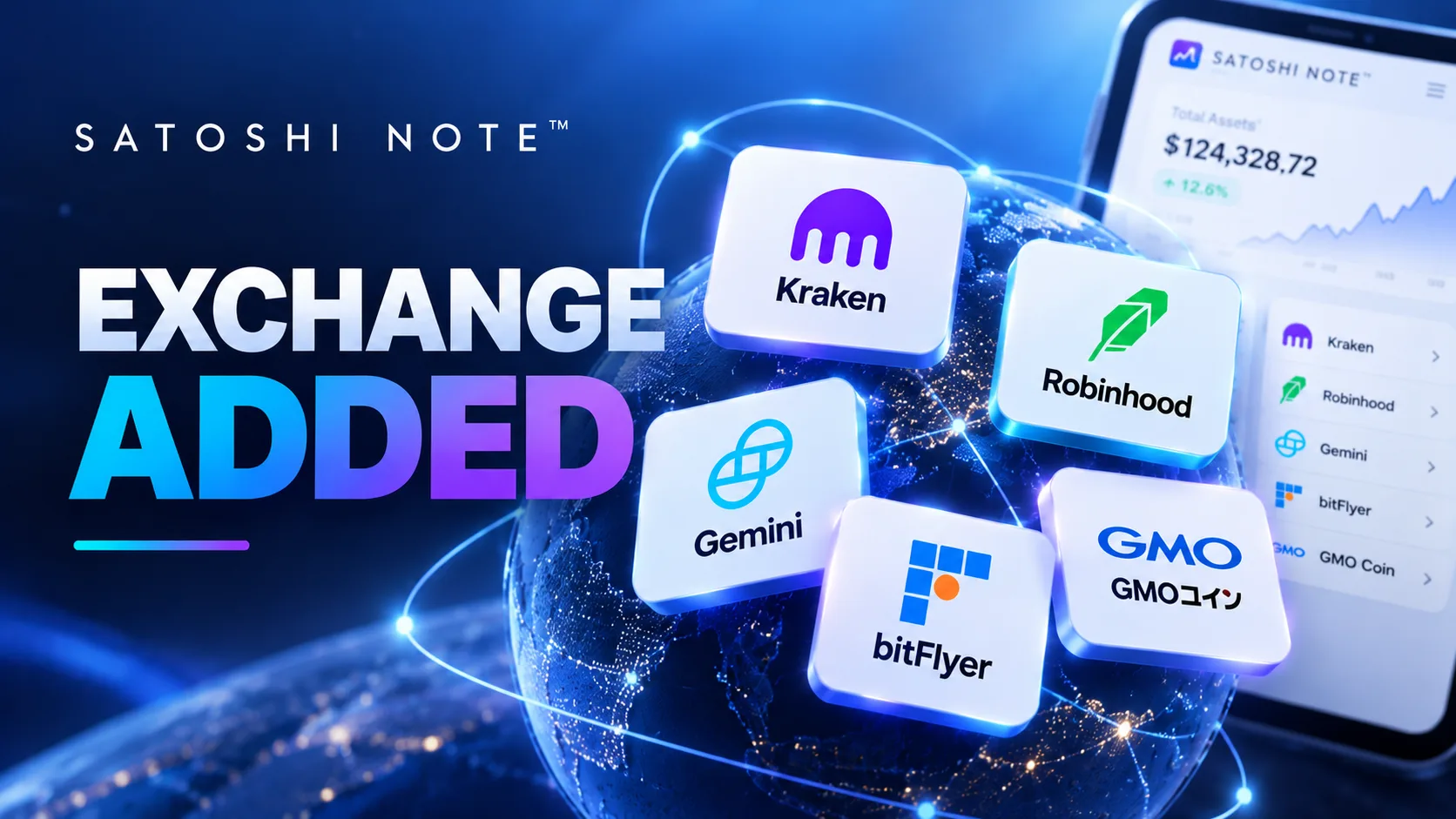
Satoshi Note™ Adds Five Overseas Exchanges Including Kraken, Robinhood and Gemini, Expanding Global Asset Sync | TokenPost
Support now extends to bitFlyer and GMO Coin, bringing the total to 18 exchanges; a new "What gets imported" notice shows each exchange's data range before connecting Satoshi Note (SATOSHI NOTE)™, an integrated digital asset management service, announced on October 23 that it has added five overseas exchanges, expanding its support for global asset sync. The update adds Kraken, Robinhood, Gemini, bitFlyer and GMO Coin. With these additions, Satoshi Note's sync coverage grows to 18 exchanges in Korea and abroad, including those still in preparation. The service also introduced a "What gets imported" notice, which lets users check the time range and the types of trade history that can be retrieved from each exchange before connecting it. Five overseas exchanges added: manage assets across exchanges in one place Satoshi Note lets users view digital assets spread across multiple exchanges and personal wallets on a single screen, and manage buy and sell history, holdings and unrealized profit and loss in one place. By connecting a read-only API key from an exchange, users can import their trade history automatically. Holdings of the same asset on different exchanges are also combined into a single view. This update adds five overseas exchanges that mainly serve the U.S. and Japanese markets. Supported exchanges now total 18: five Korean exchanges and 13 overseas exchanges. Gopax and Bitget are still in preparation, so 16 exchanges can be connected today. Connection guides tailored to each new exchange's API authentication method are also provided. Robinhood in particular requires generating a separate cryptographic key pair and registering the public key, so Satoshi Note offers step-by-step instructions that users can follow through the whole process. Trade history from overseas exchanges is converted at the exchange rate on the trade date, so it can be viewed in one currency alongside records from Korean exchanges and personal wallets. Read-only API sync; global coverage to keep expanding Satoshi Note's exchange sync runs on read-only API keys. Keys with trading or withdrawal permissions enabled are not stored, and registered API keys are kept encrypted. A Satoshi Note representative said, "We are focused on reducing the hassle investors face when they have to log in to each exchange separately just to check their holdings," adding, "We will keep expanding overseas exchange support while clearly showing the scope of data we can retrieve, to provide an even more convenient asset management experience." Alongside automatic exchange sync and consolidated asset views, Satoshi Note offers a calendar for keeping investment records, price alerts, and a "Daily Asset Report" delivered by email every morning. It also provides the "Satoshi Index", which shows the positions of top traders on Hyperliquid, Lighter, dYdX and Pacifica, along with long and short trends by asset. Other asset management features include a calendar for recording and reviewing trades, target price alerts, and shareable return cards. "With these overseas exchanges added, more users can now manage assets spread across multiple exchanges in one place," Satoshi Note said. "We will continue to expand exchange coverage and investment data services to grow into a global digital asset management platform." Satoshi Note is available on PC and mobile web and supports four languages: Korean, English, Japanese and Chinese. More information is available on the official Satoshi Note website.
Payward Secures Initial Approval for Kraken Kazakhstan Expansion
The in-principle approval is a step towards licensing digital asset trading, dealing and custody in the AIFC, though Payward has not given a timeline. Payward, the parent company of cryptocurrency exchange Kraken, has received in-principle approval in Kazakhstan. The Astana Financial Services Authority (AFSA) granted the approval to its local unit, Payward Kazakhstan. As a result, the unit has moved closer to securing a licence in the Astana International Financial Centre (AIFC). However, an in-principle approval is not a full licence. The company has not disclosed when it expects to receive the licence or begin operations. Once licensed, Payward Kazakhstan plans to operate a digital asset trading facility and offer custody of digital assets. In addition, it would deal in investments, both for its own account and on behalf of clients. Traders in Kazakhstan would then gain access to Payward's global orderbooks. These orderbooks cover markets in Europe, the US and Asia. "The AFSA and AIFC teams have been constructive and rigorous throughout this process, and we appreciate the engagement. We're looking forward to serving clients in Kazakhstan, and to broadening what we offer them over time," said Dave Ripley, Co-CEO of Payward and Kraken. According to Payward, the move is part of a wider strategy to build regulated, local operations in major financial centres. The company also aims to link these new markets to its core trading network.

Wild take road losing streak into game against the Kraken
The Minnesota Wild will look to break their three-game road skid in a matchup with the Seattle Kraken Minnesota Wild (6-3-2, in the Central Division) vs. Seattle Kraken (7-3-1, in the Pacific Division) Seattle; Saturday, 10 p.m. EDT BOTTOM LINE: The Minnesota Wild hit the road against the Seattle Kraken looking to break a three-game road losing streak. Seattle has a 7-3-1 record overall and a 3-1-0 record on its home ice. The Kraken have scored 42 total goals (3.8 per game) to rank fifth in league play. Minnesota has a 2-3-2 record in road games and a 6-3-2 record overall. The Wild have a +five scoring differential, with 32 total goals scored and 27 given up. The teams meet Saturday for the first time this season. INJURIES: Kraken: Ryan Lindgren: out (upper body), Jake O'Brien: out (lower-body), Jacob Melanson: out (chest). Wild: Filip Gustavsson: out (hip), Nick Foligno: out (upper body), Maxim Shabanov: day to day (upper body), Marcus Foligno: out (lower body), Brock Faber: out (skull). The Associated Press created this story using technology provided by Data Skrive and data from Sportradar.

Kraken squander third-period lead, bounce back to top Mammoth
Mackie Samoskevich scored the tiebreaking goal at 14:35 of the third period and goaltender Philipp Grubauer made 33 saves as the Seattle Kraken defeated the visiting Utah Mammoth 5-3 on Thursday. Jordan Eberle and Brandon Montour had a goal and an assist apiece and Matty Beniers and Frederick Gaudreau also tallied for the Kraken, who improved to 5-1-1 in their past seven games. Logan Cooley scored twice, Vincent Trocheck added a goal and Mikhail Sergachev had two assists for the Mammoth, who had won four of their previous five. Karel Vejmelka stopped 18 of 22 shots. Samoskevich's winner came after Vejmelka made a save on a Bobby McMann shot on a 2-on-1 rush. Montour tracked down the rebound in the left corner and sent a pass through the slot to McMann, who found Samoskevich alone near the right post to tap the puck into a vacated net. Gaudreau clinched the victory with an empty-netter at 19:00. Trailing 3-1, the Mammoth pulled within a goal on a power-play strike by Cooley just 27 seconds into the third period. Cooley tipped over Grubauer's shoulder a shot by Sergachev from between the top of the faceoff circles. Cooley evened the score at 3-3 at 7:42 on a slap shot from just outside the top of the faceoff circles past a screened Grubauer and into the lower right corner of the net. The Kraken opened the scoring with a fluke goal at 3:38 of the first period. Defenseman Ryker Evans sent a stretch pass down the right wing for Eberle, who took a slap shot from just outside the top of the faceoff circle, with Vejmelka making a skate save. The puck ricocheted off the end boards, over the crossbar and hit the goalie in the back before trickling into the net. The teams then traded power-play goals late in the period. Utah tied it at 17:57. Kailer Yamamoto tracked down a loose puck behind the Kraken net and sent a no-look, backhanded pass to Trocheck, who lifted a shot over Grubauer from the bottom of the left faceoff circle. Seattle regained the lead at 18:23. Berkly Catton kept the puck in the offensive zone and passed to Kaapo Kakko along the goal line on the right wing. Kakko sent a backhanded pass across the top of the crease to Beniers, who tipped it in. The Kraken increased their lead to 3-1 on Montour's slap shot from the top of the left faceoff circle on a 5-on-3 advantage at 2:23 of the second, off an assist from Eberle.

Kraken Launches ChatGPT App With Read-Only Account Access
Kraken went live in ChatGPT on Thursday, letting users ask about account gains and losses through a read-only link that cannot place trades or move money. * Kraken launched an app inside ChatGPT on Thursday that lets users ask questions about their Kraken account, such as what they made in a day or where they lost money in a month. * The account connection is read-only, so ChatGPT cannot place trades or move money, and prices, charts and news are available without logging in, the exchange said. * Kraken's tokenized stock platform, xStocks, said on the same day that more than 1,000 xStocks are now live on Kraken. Crypto exchange Kraken has launched an app inside OpenAI's ChatGPT that lets users ask about their account performance, through a read-only connection that cannot place trades or move funds. The app lets Kraken customers check their gains and losses by asking ChatGPT in plain language. Kraken Keeps ChatGPT Access Read-Only Prices, charts and news are available in the ChatGPT app without logging in, Kraken said. In a reply to its post, Kraken added a standard disclaimer that "geographic restrictions apply," without saying which regions are affected. It defaults to market data, read-only account access and paper trading, and requires explicit acknowledgment before an agent can use services it labels "Dangerous," such as live spot trading, unless a user starts it with an override flag, the documentation said.
Crypto News: Kraken's Owner Buys EU Bank as Pepeto's Live Exchange Targets 100x
If you read crypto news this week, one story should change how you see the market. Kraken's parent company agreed to buy a bank in Lithuania on October 14. Yet many coins still trade far below their highs, with Dogecoin about 89% under its 2021 peak. When Coinbase went public in April 2021, Bitcoin set a record that same day. The headlines go to the big firms, but the real money is usually made one step earlier, in a presale. That is where Pepeto sits, with a live zero fee exchange and a presale past $11.1 million. Why Is Kraken Buying a Bank the Biggest Crypto News This Week? Payward, the company that owns Kraken, agreed on October 14 to buy Saldo Bank in Lithuania, per The Crypto Times. That would make Payward the first crypto firm to take over a bank in Europe. The price was not shared, and the deal should close in 2027 after regulators approve. Saldo held 163.9 million euros in assets at the end of 2025, CryptoTicker reports. This crypto news shows exchanges turning into full banks, which brings everyday savers one step closer to owning coins. Crypto News Winners: Which Coins Gain as Exchanges Grow Up? Is Pepeto's Live Exchange Ready for a Much Bigger Crowd? Kraken spent years building an exchange before it could buy a bank. That shows where the money in crypto ends up: with the platforms people trade on every day. Pepeto is a newer project built on that same idea, so everyday traders keep more of every trade. With a Binance listing approaching, it brings an exchange where anyone can place market, limit, and DCA orders. Most crypto news is about plans. Pepeto's story is that its tools already run. Its swap platform, its bridge, and its scanner all work today, ready for many more users. Here is why that matters for your money. On most exchanges, bots can spot your order and jump in front of it, so you pay more than you should. PepetoSwap sends each trade through a private route that hides it, and that guard is on from the start. Your coins stay in your own wallet the whole time. You can set the exact price you want with a limit order. You can also buy a little at a time with DCA, and the swap fee is zero. Test runs have pushed $50 million through it in a day, and that number keeps growing. So the price you see is the price you get. Right now, Pepeto sells for $0.0000001902 on pepeto. Buyers have sent over $11.1 million, and staking pays 160% APY until listing day, when rewards can be claimed. Analysts project the price could climb 100x after listing, which would turn $300 into $30,000 and leave big names like Dogecoin and Chainlink behind. For the trader who wants the biggest jump from the smallest start, Pepeto is the strongest choice this cycle. Can Dogecoin Dodge Its First Death Cross of 2026? Dogecoin trades at $0.0792 per CoinMarketCap, down 1.70% in a day. Its 50 day average is sliding toward its 200 day line, a cross traders read as a weak sign, 24/7 Wall St. reported on October 17. Still, whales have bought about 600 million DOGE since October 12. A close above $0.0882 could stop the cross. The road back to $0.16 runs through $0.10 first, a long climb for a $12 billion meme coin. Why Is Chainlink Buying Its Own Token While LINK Slips? Chainlink trades at $12.01 per CoinMarketCap, down 2.28% in a day. Its reserve added 89,200 LINK on October 15 and about 431,900 LINK over 30 days, CryptoTicker found. The reserve now holds about 6.29 million LINK, under 1% of the coins out there. Steady buying gives LINK a floor, and the $13.34 high from October 12 is the first test. A slow, safe climb is the likely path from here. Conclusion While the big crypto news has left Dogecoin and Chainlink stuck or slipping, Pepeto keeps growing. Its exchange is live, the presale is filling, and buyers are lining up for a shot at 100x after listing. With a Binance listing approaching, that target gets closer every stage. The people who got rich on Dogecoin bought it under a penny in 2020, before it hit 73 cents. They all made the same choice: they moved while the price was still small. That same choice is open today through the Pepeto official website. One day this price will look like those pennies, and the buyers who moved today will be the ones telling the story. FAQs What is the newest crypto news about Kraken? The newest crypto news about Kraken is its owner's deal to buy Saldo Bank. That would make Payward the first crypto firm to own a European bank. Will Pepeto hit 100x after its listing? Analysts project Pepeto could hit 100x, since a live exchange sits behind a tiny price. Each stage costs more on the Pepeto official website, so early buyers gain most.

Kraken Parent Payward Expands European Banking Footprint
Payward Inc. -- the parent company behind major cryptocurrency exchange Kraken -- has signed a definitive agreement to acquire Finland-based Saldo Bank. According to the report, the strategic acquisition marks one of the clearest examples yet of a top-tier cryptocurrency exchange purchasing a fully licensed European credit institution to deepen its regulatory moat and Fiat-to-crypto integration. Strategic Synergy By integrating Saldo Bank into Payward's corporate structure, Kraken secures direct access to specialized European banking licenses and localized payment rails. Saldo Bank holds a specialized banking license issued by the European Central Bank (ECB) and supervised by the Finnish Financial Supervisory Authority (FIN-FSA). This acquisition enables Payward to offer native IBANs, automated Euro transfers via direct SEPA and SEPA Instant rails, and integrated savings or credit products without relying on third-party intermediary partner banks. The European Competitive Landscape The deal comes at a pivotal moment for European digital asset regulation. As full compliance under the Markets in Crypto-Assets (MiCA) regulation sweeps across member states, major global exchanges are actively consolidating traditional financial infrastructure to meet stringent capital, auditing, and operational resilience requirements. Payward's move parallels similar institutional plays by major banking entities across the Eurozone and positions Kraken to offer seamless, regulated yield and deposit options directly to millions of European retail and institutional clients. Coinidol.com reported earlier that on April 19 the Deutsche Börse Group, one of the world's most powerful exchange organizations, has taken a strategic stake in Kraken with a $200 million investment.

Kraken take win streak into matchup against the Lightning
The Seattle Kraken will look to keep a three-game win streak alive when they take on the Tampa Bay Lightning Seattle Kraken (5-2, in the Pacific Division) vs. Tampa Bay Lightning (4-2, in the Atlantic Division) Tampa, Florida; Thursday, 7 p.m. EDT BOTTOM LINE: The Seattle Kraken aim to keep a three-game win streak alive when they play the Tampa Bay Lightning. Tampa Bay is 4-2 overall and 3-0-0 in home games. The Lightning are 3-1-0 in games they serve fewer penalty minutes than their opponents. Seattle has gone 4-1-0 on the road and 5-2 overall. The Kraken are fifth in the league with 28 total goals (averaging 4.0 per game). The matchup Thursday is the first meeting this season between the two clubs. INJURIES: Lightning: Dennis Hildeby: day to day (undisclosed), Yanni Gourde: out (hip). Kraken: Ryan Lindgren: out (upper body), Jake O'Brien: out (lower-body), Jacob Melanson: out (chest). The Associated Press created this story using technology provided by Data Skrive and data from Sportradar.

Flyers seek to snap out of doldrums vs. high-flying Kraken
The Seattle Kraken are enjoying a successful road trip so far, while the Philadelphia Flyers are not enjoying much of anything these days. The Kraken look to remain perfect on their current trek Tuesday when they visit the winless Flyers. Seattle took its lumps on Oct. 6 with a 6-2 home loss to the Vegas Golden Knights, but the team rebounded quickly with road wins over the Detroit Red Wings and Washington Capitals. In Sunday's 5-3 triumph over the Capitals, the Kraken snapped a late tie on a goal by Jared McCann. Frederick Gaudreau and Ryan Winterton each contributed a goal and an assist for Seattle, while Ben Meyers had two assists. Joey Daccord made 33 saves to earn the win. 'Joey stood on his head a little bit and we scored five, and that was enough,' Meyers said. The Kraken have scored 11 goals in the first two games of their five-game trip, which continues with a Florida leg to play the Lightning and Panthers later this week. 'We're getting pucks at the net and we're banging them home,' said McCann, who leads Seattle with seven points. 'You know things are going in for us right now. We've just got to keep going. We know what makes us successful.' Gaudreau has scored a team-high four times after totaling seven goals in 68 games a season ago. He has scored three times in the first two games of the road trip. 'I think there was some pretty good commitment all over the place,' Seattle coach Lane Lambert said of the effort by Gaudreau and company. 'We had a lot of blocked shots and stuff like that. It was a hard-fought game and our guys did a good job of finding a way to win.' Philadelphia, meanwhile, is 0-5-2 in the early going -- a franchise record for most consecutive losses to begin a campaign. The team has been outscored 28-8 so far, including another lopsided defeat Sunday in a 4-1 home loss to the Carolina Hurricanes. 'It's frustrating, especially to start the year,' Philadelphia captain Sean Couturier said. 'We're out of sync right now. There are not really any excuses, honestly. We're just not winning battles. We've just got to be better overall. ... But we've got to take it one game at a time, even one shift at a time. Just focus on winning each shift, finding a way to put that together for 60 minutes and get a win. And then hopefully build our confidence.' Christian Dvorak scored the Flyers' only goal against the Hurricanes. The team has scored exactly one goal in each of the last four games and has yet to tally more than twice in any game this season. 'We know we've got to turn it around ASAP,' Dvorak said. 'Got to try not to let it snowball here and focus on the next one. We showed at times (Sunday) what we can do, just got to be consistent with it.' The Flyers and Kraken split two meetings a season ago. Owen Tippett scored twice in a 5-2 home victory by Philadelphia before Jordan Eberle and Chandler Stephenson tallied goals in the rematch -- a 4-1 home win by Seattle.

Ethereum Foundation-linked wallets send 4,393 ETH to Kraken
Two wallets tied to the foundation moved roughly $11.13 million in ETH to the exchange, continuing a decade-long pattern Two wallets linked to the Ethereum Foundation moved 4,393 ETH to Kraken on October 12, 2026. At the time of the transfer, that stack was worth approximately $11.13 million. The move was flagged by on-chain tracker EmberCN and picked up by outlets including TechFlow and BlockBeats. Neither the foundation nor Kraken has said anything publicly about it. Following the coins The two sending addresses were identified as 0x4c4...2b94 and 0x999...0229. Together, they accounted for the full 4,393 ETH that landed on Kraken. One of those wallets has a long history. In 2016, it received 59,751 ETH from an Ethereum Foundation address. Over the following ten years, that same wallet has routed 49,751 ETH to Kraken. The research ties that ETH to an average price of approximately $658 per coin. The gap between what the wallet received and what it has sent to Kraken works out to 10,000 ETH. The available on-chain data does not specify where that remainder sits today. This transfer also does not stand alone. EmberCN-style monitoring has caught similar flows from foundation-linked addresses to Kraken in May and August of 2026, as well as in late 2025. Those earlier movements included both larger transfers and smaller test transactions. Why the Ethereum Foundation keeps showing up at Kraken The Ethereum Foundation is the nonprofit that has supported Ethereum's development since its early days. Historically, the foundation has sent funds to centralized exchanges such as Kraken for various operational purposes. Without a statement from the foundation, the exact purpose of this batch remains unclear. The research describes these flows as potential operational activity, possibly connected to future projects or liquidity needs. What this means for ETH holders and the market Prior transfers of this kind have drawn attention from the analytics community without typically producing immediate market impact. Transfers in late 2025, May 2026, August 2026, and now October 2026 suggest a steady cadence of treasury activity. Observers will look for any public explanation from the foundation, any follow-up transfers from the same two addresses, and whether the 10,000 ETH gap from the 2016 allocation shows up anywhere.
Wells Fargo Reports Tuesday: Will Its Kraken Crypto Talks Come Up on the Call? - FinanceFeeds
Wells Fargo reports third-quarter earnings Tuesday morning, and alongside the usual questions about interest income, loan growth and credit, investors have a new one to listen for: whether management says anything about its reported talks with Kraken parent Payward. The bank will release results at approximately 7:00 a.m. ET on October 13 and hold its earnings call at 10:00 a.m. ET, according to Wells Fargo. The call will be analysts' first scheduled opportunity to question management since reports emerged that the $2 trillion-plus bank has discussed using Payward as a liquidity provider for cryptocurrency trading. Those discussions have not produced a publicly announced agreement. Neither Wells Fargo nor Payward has confirmed that a deal will happen, and both declined to comment when the talks were first reported. Wells Fargo Earnings: What Wall Street Expects Tuesday The Street is looking for another year-over-year increase in Wells Fargo's earnings, although current estimates differ slightly by data provider. As of October 11, MarketBeat's analyst consensus stood at $1.85 per share on revenue of $22.31 billion. A TradingView estimate published October 6 put expected earnings at $1.84 per share and revenue at $22.29 billion. The comparison is against a quarter in which Wells Fargo earned $1.73 per share on $21.44 billion of revenue a year earlier. The headline numbers, however, are only part of Tuesday's test. Large U.S. bank shares have been under pressure as Treasury yields have risen, forcing investors to weigh the benefit of higher asset yields against higher funding costs and weaker appetite for borrowing and dealmaking. For Wells Fargo specifically, investors will be watching net interest income, deposit costs, loan growth, credit quality and the capital-markets outlook. Recent industry previews have also focused on whether the stronger loan growth Wells Fargo signaled earlier this year can continue as financing costs remain elevated. What Was Actually Reported About Wells Fargo and Kraken CoinDesk reported on October 7, citing two people familiar with the private discussions, that Wells Fargo was in talks with Payward about the crypto company supplying liquidity for digital-asset trading. The discussions remain just that: discussions. No product, launch date, supported assets, customer group or commercial terms have been announced. FinanceFeeds covered the original report on October 8 in Wells Fargo Is in Talks With Kraken's Parent to Supply Crypto Trading for a $2.3 Trillion Bank. Tuesday's earnings call matters because it is the first obvious forum in which analysts can ask Wells Fargo management directly about the report. Management may still decline to discuss private negotiations. But even a broader answer about whether Wells Fargo wants to offer direct crypto trading, and to which customers, would add information that is currently missing. How a Wells Fargo-Payward Liquidity Model Could Work A liquidity-provider arrangement would not necessarily mean Wells Fargo was building its own cryptocurrency exchange. Payward Services is the business-to-business arm of Kraken's parent company. It offers infrastructure to banks, brokerages, exchanges, asset managers and other financial firms that want access to digital-asset markets without assembling every piece of the trading stack internally. In a potential Wells Fargo arrangement, Payward could supply pricing, liquidity and execution behind the bank's customer-facing service. Wells Fargo could therefore control the client relationship while relying on crypto-native infrastructure for the underlying market access. The exact model remains unknown because neither party has confirmed the reported negotiations. Wells Fargo Already Has a Payward Connection Through Nasdaq The reported talks did not emerge from a completely new relationship. On September 10, Nasdaq Ventures agreed to invest $100 million in Payward as the companies expanded their work on tokenized equities, market surveillance and always-on financial infrastructure. Wells Fargo served as Nasdaq's exclusive capital-markets adviser on that transaction. FinanceFeeds covered the investment in Nasdaq Invests $100M in Kraken Parent Payward to Advance Tokenized Equities. Payward is also reportedly holding separate discussions with BNY over a potentially broader relationship spanning crypto products, custody, wealth management, trading, payments and infrastructure. Those talks, like the Wells Fargo discussions, have not resulted in a publicly confirmed agreement. At the same time, Payward is not rushing toward a public listing. Reports in September said the Kraken parent's U.S. IPO is now unlikely before the second quarter of 2027 at the earliest. FinanceFeeds covered that revised timetable in Kraken Parent Payward Delays IPO to Q2 2027 at the Earliest. Three Crypto Questions to Listen for on the Wells Fargo Call The first question is the most direct: is Wells Fargo actively evaluating Payward or another outside provider for crypto liquidity and execution? RelatedWells Fargo to Launch Tokenized Deposits for Corporate Clients The second is about the customer. If Wells Fargo wants to expand digital-asset trading, is the target its wealth-management clients, institutional customers, or a broader retail banking audience? The economics and regulatory implications differ substantially between those groups. The third is whether management sees crypto liquidity as a standalone product or part of a wider digital-asset infrastructure strategy encompassing tokenized securities, stablecoins, custody and payments. None of those outcomes should be assumed before Tuesday. The reported Payward discussions may never result in an agreement, and Wells Fargo may choose not to address them on the earnings call at all. But after the October 7 report, the 10:00 a.m. call is the first scheduled opportunity for analysts to move the Wells Fargo-Kraken story beyond anonymous-source reporting. That makes what management says -- or declines to say -- one of the less conventional things worth listening for when the bank reports Tuesday.

Wells Fargo in Talks With Kraken Parent Payward on Crypto
CoinDesk's sources said Payward would supply liquidity for digital-asset trading. The report does not say which assets, customer groups or Wells Fargo entities would be involved. It also does not identify custody, settlement, pricing or launch terms. Payward Services markets an institutional execution product with access to Kraken pricing, more than 600 assets and compliance tools covering customer checks, transaction monitoring and sanctions screening. The company says banks can integrate trading into their own services while Payward supplies execution and regulated infrastructure. That model would let Wells Fargo control the customer relationship while using an outside provider for a specialist market function. It would not eliminate the bank's obligations. Wells Fargo would still need to determine product eligibility, disclosures, supervision and how responsibility is divided when execution or settlement fails. Wells Fargo Has Moved Beyond Saying No to Crypto Wells Fargo has taken a cautious route into digital assets. It still prohibits crypto purchases with its credit cards, as FinanceFeeds explained in its guide to major banks' crypto restrictions. Yet the bank already gives eligible wealth clients access to spot bitcoin exchange-traded funds and has invested in crypto compliance and trading-technology companies. CoinDesk also reported that Wells Fargo advised Nasdaq on its $100 million investment in Payward. The bank has discussed blockchain-based deposits and participates in a consortium developing a dollar stablecoin. A liquidity agreement would extend those activities from investment exposure and payments infrastructure into direct trading support. Why a Bank Deal Would Matter to Payward Payward is building a business that sells the infrastructure behind Kraken to banks, fintech firms and brokers. It reported second-quarter adjusted revenue of $508 million, up 17% from a year earlier, alongside $310 billion of transaction volume and 6.6 million funded accounts. Nasdaq's investment valued Payward at approximately $21 billion, according to reporting around the transaction. Payward and Nasdaq disclosed the $100 million investment but did not put the valuation in their public releases. Winning Wells Fargo would give Payward a reference client among the largest U.S. banks and support its effort to be valued as financial infrastructure rather than only as a crypto exchange operator. What Is Still Unknown No definitive agreement has been disclosed. The discussions may stop, change scope or lead to a limited institutional service rather than retail trading. Neither company has said whether Wells Fargo customers would see Kraken branding or whether Payward would operate solely behind the bank's interface. RelatedZcash at $1,494: Kraken Force-Sells UAE Holders Out of ZEC on 25 September Custody is another open question. Supplying market access does not necessarily mean Payward would hold customer assets, and a bank could choose a separate custodian. Fees, routing, spreads and counterparty arrangements are also unknown. The talks show how a large bank could add crypto without recreating years of exchange technology and licensing work. They do not show that Wells Fargo has decided to launch the product. Until the companies sign and disclose an agreement, this remains an infrastructure discussion rather than a new trading service.
Wells Fargo in Talks With Kraken Parent Payward Over Crypto Trading Liquidity - FinanceFeeds
Wells Fargo is reportedly in discussions with Payward, the parent company of cryptocurrency exchange Kraken, over a potential agreement to provide liquidity for digital-asset trading, according to an October 7 report by CoinDesk. The discussions were disclosed by two people familiar with the matter who requested anonymity because negotiations remain private. Neither Wells Fargo nor Payward has publicly confirmed the proposed arrangement, and the talks may not result in a completed agreement. Wells Fargo, the fourth-largest U.S. bank by assets, is exploring the arrangement as major financial institutions expand their involvement in cryptocurrency markets. Under the proposed structure, Payward would supply trading liquidity, potentially allowing Wells Fargo to access established cryptocurrency markets without independently developing every component of its execution infrastructure. However, the report does not establish whether the service would target retail investors, institutional customers or the bank's wealth-management clients. No launch date, commercial terms or list of supported cryptocurrencies has been disclosed. Payward Expands Its Institutional Liquidity Business The potential Wells Fargo agreement follows Payward's broader effort to become a technology and liquidity provider for traditional financial institutions. In September, Payward announced a partnership with SoFi that provides access to Kraken Prime's trading liquidity and supports digital-asset services through the banking group's existing infrastructure. Payward has also reportedly been discussing a broader infrastructure partnership with BNY, covering potential services including cryptocurrency trading, custody, payments and wealth management. These arrangements illustrate a developing business model in which established financial institutions retain their customer relationships while specialized cryptocurrency companies provide market access and execution technology. For banks, the approach can reduce the operational burden associated with building cryptocurrency exchanges, connecting to multiple trading venues and managing liquidity across fragmented markets. For Payward, supplying liquidity to established banking institutions creates another potential revenue channel beyond its consumer-facing Kraken exchange. The company has also expanded through acquisitions and strategic investments, strengthening its presence across derivatives, brokerage and institutional trading. A completed Wells Fargo agreement would represent another significant institutional relationship, although the present discussions should not be interpreted as a confirmed partnership. Wells Fargo Builds on Existing Crypto Exposure Wells Fargo already maintains several connections to the digital-asset industry. The bank offers eligible wealth-management customers access to spot Bitcoin exchange-traded funds and has invested in cryptocurrency compliance company Elliptic and institutional trading technology provider Talos. It also served as Nasdaq's capital-markets adviser on the exchange operator's $100 million investment in Payward in September 2026. That transaction valued Payward at approximately $21 billion and expanded cooperation between Nasdaq and the cryptocurrency company around financial-market infrastructure. The reported liquidity discussions come as banks reassess their digital-asset strategies following changes in U.S. regulatory policy and growing institutional demand for cryptocurrency-related services. RelatedKraken Parent Payward Plans Hyperliquid Perpetual Futures for U.S. Clients Nevertheless, supplying trading liquidity is different from launching a cryptocurrency exchange or offering direct trading to every bank customer. Any eventual Wells Fargo service would depend on the agreement's structure, customer eligibility, custody arrangements and applicable regulatory requirements. The immediate significance is therefore commercial rather than operational: one of America's largest banks is reportedly evaluating Kraken's parent company as a potential supplier of cryptocurrency market infrastructure. Whether those discussions produce a formal agreement remains uncertain, but they demonstrate how relationships between traditional banks and established cryptocurrency trading firms are continuing to develop.

Wells Fargo talks with Kraken parent about crypto trading
Wells Fargo has reportedly entered talks with Kraken parent Payward over a possible arrangement that would give the U.S. banking giant access to liquidity for cryptocurrency trading. CoinDesk reported on Oct. 7, citing two people with direct knowledge of the discussions, that Wyoming-based Payward could provide liquidity to Wells Fargo for trades involving digital assets. The talks remain private, and neither company has confirmed that an agreement will be signed. Both Wells Fargo and Payward declined to comment to CoinDesk. Details including which cryptocurrencies would be covered, who would be able to trade them and how the service would operate have not been disclosed. Wells Fargo could use Payward for crypto liquidity Under the arrangement being discussed, Payward would act as a source of liquidity for crypto trading. In practical terms, the company could provide the market access and execution infrastructure needed to complete customer or institutional orders without Wells Fargo having to operate its own cryptocurrency exchange. Payward already sells that type of service to financial companies. Its institutional platform says banks can offer digital asset trading through their own interfaces while Payward handles execution, custody and compliance behind the scenes. The service gives institutions access to liquidity from the infrastructure used by Kraken. The Wells Fargo discussions have not been publicly linked to a specific Payward Services product, so the exact setup remains unknown. CoinDesk reported only that Payward could supply liquidity for crypto asset trading. A potential agreement would come as Wells Fargo develops its digital asset business. The bank's 2026 proxy statement said management had advanced its digital asset strategy alongside work on payments and liquidity services. Wells Fargo's investment business currently publishes research and educational material covering digital assets for clients. Payward is holding similar talks with BNY Wells Fargo is not the only large U.S. bank speaking with Kraken's parent. Payward is separately discussing a possible infrastructure partnership with BNY, according to earlier reporting on those talks. The potential BNY agreement could cover crypto products, custody, wealth management, trading, payments and other financial infrastructure. The BNY talks remain unfinished. Neither side has announced a signed agreement or launch date. In related crypto.news coverage of Payward's BNY discussions, the proposed relationship was described as spanning six areas of financial services, with Payward Services potentially supplying infrastructure to the custody bank. The report noted that discussions could still end without a transaction. Payward launched its enterprise infrastructure unit in March. The company said the service was built for banks, fintechs and other financial firms that want to add crypto trading, tokenized assets, stablecoin payments, staking and funding tools without creating separate systems for every function. Its banking product currently advertises crypto execution across more than 600 assets, along with segregated custody and compliance tools. Payward says most institutional partners can reach their first transactions within roughly 90 days after signing a contract, though those general service terms do not establish any timeline for Wells Fargo. Wells Fargo already has a link to Payward through Nasdaq The companies have another recent connection through Nasdaq. Nasdaq announced on Sept. 10 that Nasdaq Ventures had agreed to invest $100 million in Payward. The deal expanded work between Nasdaq and the Kraken parent on tokenized equities and market-surveillance technology. Wells Fargo served as Nasdaq's exclusive capital markets adviser on that transaction, according to Nasdaq's official announcement. The bank therefore advised on a major Payward deal less than a month before reports emerged of its own possible liquidity arrangement with the company. Nasdaq and Payward are working on a system called Nasdaq Equity Tokens, or NETs, with a planned second-quarter 2027 launch. Payward is expected to use Nasdaq surveillance technology across markets covering crypto, traditional equities, tokenized shares, futures and options. As detailed in crypto.news coverage of Nasdaq's $100 million Payward investment, the companies are developing infrastructure intended to connect regulated equity markets with tokenized assets. The investment agreement valued Payward at a reported $21 billion. Payward has spent 2026 expanding beyond its core Kraken exchange business. Its second-quarter results showed $508 million in adjusted revenue, while 6.6 million funded accounts held approximately $40 billion in assets across its platforms. Payward is building infrastructure for banks Payward's push into bank infrastructure now covers more than trading. The company filed with the Office of the Comptroller of the Currency in May to establish Payward National Trust Company. If approved, the entity would focus primarily on federally supervised digital asset custody for institutional and individual customers. Payward's national trust charter application, the proposed company would not accept conventional deposits or make standard loans. The filing instead centers on custody and trust services for digital assets. Payward has expanded regulated trading infrastructure through acquisitions as well. Its purchase of Bitnomial added a U.S. derivatives exchange, clearing organization and futures commission merchant regulated by the Commodity Futures Trading Commission. The company's services division now promotes infrastructure that lets banks keep their customer-facing platforms while Payward manages crypto execution, liquidity, custody and regulatory functions. Payward states that no commercial relationship exists until definitive agreements are executed. For Wells Fargo, no definitive agreement has been disclosed. The reported discussions remain ongoing, and the two companies have not announced a timetable, supported assets, customer rollout or commercial terms.
Dormant Wallet Moves 9,618 Ether Worth $24.58 Million to Kraken | TokenPost
The wallet held the Ether for nine years and recorded a $24.21 million profit, a 65-fold gain based on the reported figures. A dormant cryptocurrency wallet identified as pinosaur.eth moved 9,618 Ether (ETH), valued at $24.58 million, to Kraken after holding the tokens for nine years. The wallet's ETH holdings were first traced to April 2017, when 7,459 ETH were withdrawn from Bitfinex at a price of about $50 per token. The reported transaction brings the wallet's profit to $24.21 million, representing a 65-fold return. The transfer involved the wallet address ending in 605A. The movement places a large, long-dormant Ether balance on a major exchange, but the available transaction details do not establish what will happen to the funds next.
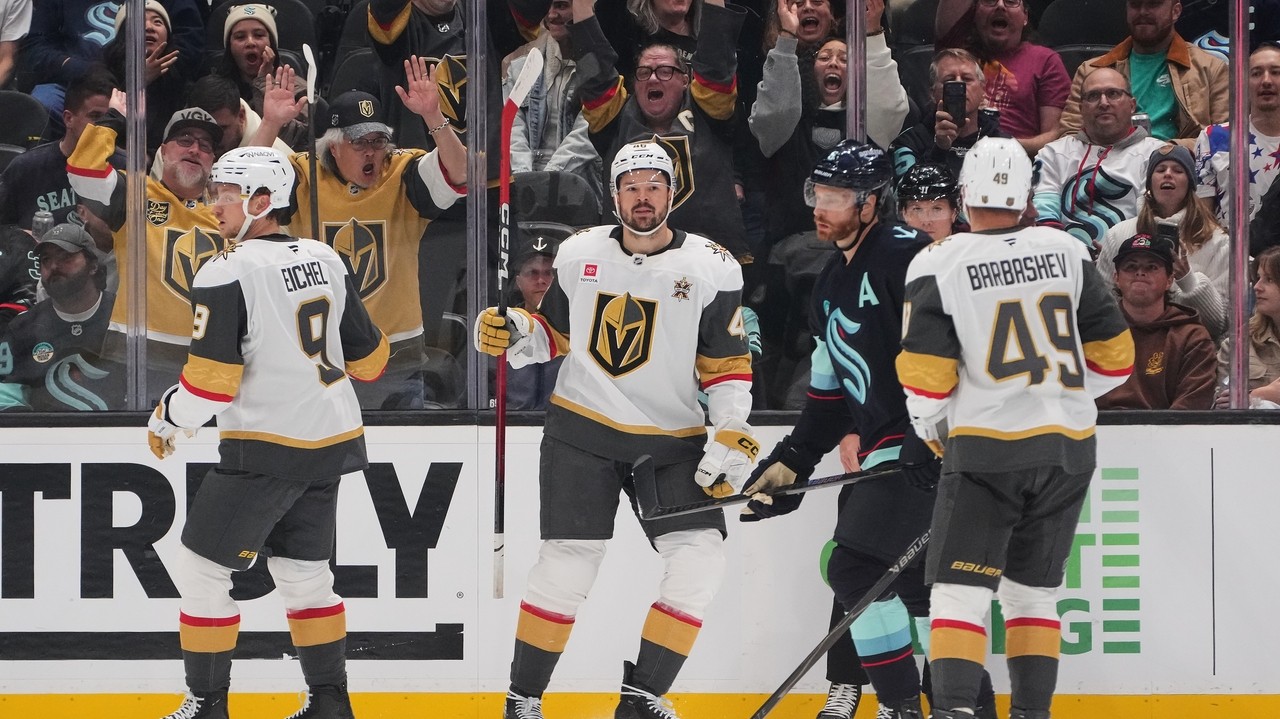
Golden Knights beat Kraken 6-2 behind 2 goals each from Olofsson and Hertl
SEATTLE -- Victor Olofsson and Tomas Hertl scored two goals apiece and the Vegas Golden Knights beat the Seattle Kraken 6-2 on Tuesday night. Mark Stone had a goal and an assist to become the third Vegas player to reach 400 points with the team. Jack Eichel scored a goal and had three assists for the Knights, who were up 5-0 after two periods. Hertl had two assists. Shane Wright and Jared McCann scored third-period goals for the Kraken. Kaapo Kakko assisted on both goals. Olofsson ripped a shot from just inside the blue line on the right wing side to open the scoring with 6:58 left in the first period. He made it 4-0 with 6:53 remaining in the second. Hertl scored a power-play goal with 4:02 left in the first period to make it 2-0, with Stone getting the primary assist. With Vegas short-handed early in the second period, Seattle's Brandon Montour broke his stick on a hard shot from the blue line. Eichel picked up the loose puck, crossing it to Stone coming down the left side. Stone drilled it into the back right corner past Kraken goalie Joey Daccord at 1:43. Stone joined Jonathan Marchessault (417, now with Nashville) and current teammate William Karlsson (403) with 400 points for Vegas. Carter Hart made 25 saves for the Golden Knights. Daccord had 16 saves in two periods for Seattle, then was replaced by Philipp Grubauer at the start of the third. Grubauer made six saves. The third period got chippy. Seattle's Ben Meyers drove Olofsson hard into the boards and was given a five-minute major and game misconduct. Montour and Stone got into a fight, with Montour also being given a misconduct. The Kraken's Ryan Winterton and Vegas' Marc Gatcomb dropped the gloves with 4:57 left. Up next The Kraken begin a five game road trip on Friday at Detroit. Las Vegas returns home to face Toronto on Thursday.