News & Updates
The latest news and updates from companies in the WLTH portfolio.
Grok gets creative tools as Musk pushes xAI deeper into image and video generation
The integration of Imagine into Grok's agentic mode signals xAI's aggressive expansion into autonomous content creation, with potential ripple effects across digital asset markets. Elon Musk just gave his AI chatbot a paintbrush. And a camera. And, if he's to be believed, eventually a director's chair. On July 8, Musk announced that Grok, the conversational AI built by his company xAI, will integrate the Imagine tool for autonomous image and video generation. The key detail: Grok will be able to call Imagine dynamically in "agentic mode," meaning the AI decides on its own when to generate visual content rather than waiting for explicit user commands. What Grok's agentic mode actually means The Imagine tool itself has been evolving rapidly. Grok Imagine Video 1.5 launched around June 16-17, bringing what Musk described as significant improvements in both quality and speed. Some updates have enabled image-to-video generation in under 15 seconds. Musk predicted that Grok could produce full movies by the end of 2026. The AI content creation arms race The competitive landscape in AI-generated video has intensified dramatically over the past year, with OpenAI's Sora, Google's Veo, and a constellation of smaller startups all racing to build tools that can produce broadcast-quality video from text prompts. What makes the Grok-Imagine integration notable isn't just the technology itself. It's the distribution. Grok lives inside X (formerly Twitter). If Imagine's video generation reaches even a fraction of that audience through agentic mode, xAI instantly becomes one of the largest deployments of AI video generation in the world. Where crypto and digital assets enter the picture Musk's announcement contained zero references to cryptocurrency, blockchain, tokens, or any digital asset infrastructure. Not a single one. xAI isn't launching a token. Imagine isn't minting NFTs. There's no on-chain component to any of this.
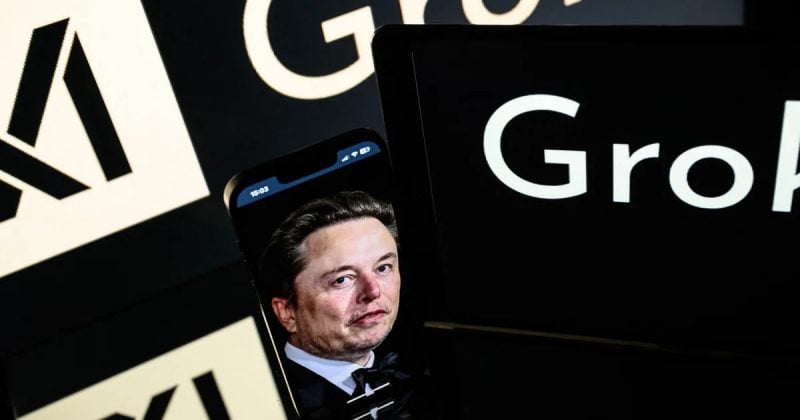
SpaceXAI's newest AI model Grok 4.5 dramatically undercuts Anthropic and OpenAI on price
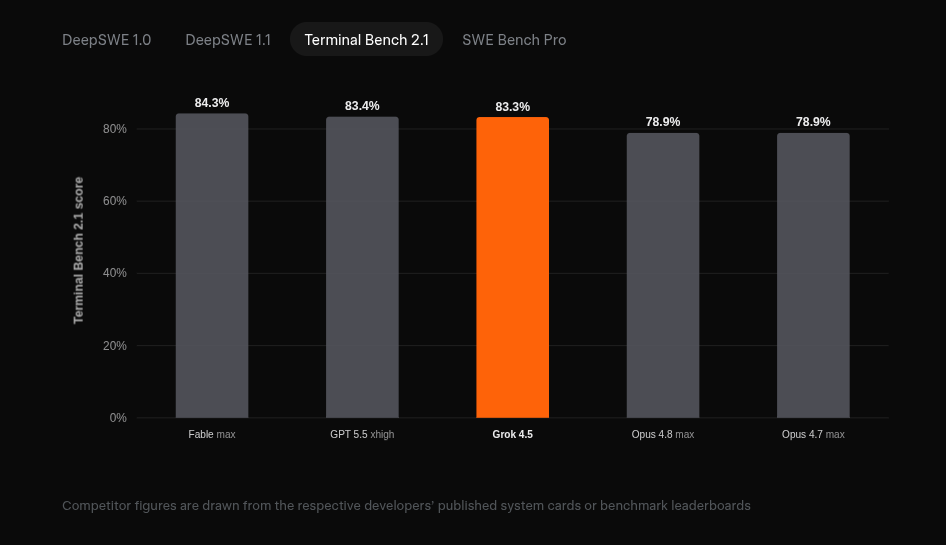
SpaceXAI's newest AI model Grok 4.5 dramatically undercuts Anthropic and OpenAI on price Elon Musk's SpaceXAI Corp. has released a new model called Grok 4.5, in what is its first major launch since it went public a few weeks earlier. In a blog post earlier today, the company said Grok 4.5 is designed to be a workhorse that's able to tackle all of the usual tasks that the artificial intelligence industry has been automating for some time already. That includes things like coding, writing emails and presentations, performing office and clerical work, doing research and other kinds of knowledge-based work. None of this sets Grok 4.5 apart, but SpaceXAI said that the difference is that it can do these tasks just as well as its peers at around half the cost, because it has "twice greater token efficiency" than its peers from other frontier model labs. If true, that could be a compelling advantage in a world where the cost of tokens has suddenly become a major issue for heavy AI users. SpaceXAI announced Grok 4.5's release alongside a host of benchmark results that highlight how competitive it is with the leading models of some of its major competitors, and it falls just short of their performance. In a post on the social media platform X, which is owned by SpaceXAI, founder Musk compared Grok 4.5 to Anthropic PBC's Opus, which is a large language model designed to handle intensive reasoning tasks. In a follow up, Musk added that the company's internal assessments show that Grok 4.5 is "roughly comparable" with Opus 4.7 in terms of its performance, but much faster at generating its results. "The combination of capability, faster speed and lower cost is what makes it competitive," he added. Grok 4.5's real calling card, however, appears to be its overall efficiency. The company said it costs around $2 per one million input tokens and $6 per one million output tokens, which makes it far cheaper than its rival's most capable models. In contrast, Opus 4.7 and 4.8 run at $5 per one million input tokens and $25 for one million outputs. Meanwhile, Fable 5, which is Anthropic's best model, costs $10 for inputs and $50 for outputs, based on one million tokens. OpenAI Group PBC, meanwhile, has a tiered pricing structure for different models. Its newest model, GPT-5.6 Sol, is priced at $5 for one million inputs and $30 for one million outputs, while Luna, its low cost version, costs $1 for one million inputs and $6 for one million outputs. This week is proving to be a big one in terms of new AI model launches. Earlier today, OpenAI announced the launch of GPT-5.6 Sol, its most powerful model so far, after being held up by the White House administration due to security concerns. According to OpenAI, GPT-5.6 Sol is its "strongest model yet," but those security concerns mean that it's currently only available to a limited number of customers. OpenAI also announced the launch of GPT-Live today, which is a family of AI models optimized to process spoken instructions.
NVIDIA Vera CPU Demand Rises as Perplexity Backs Its AI Inference Performance - OnMSFT
NVIDIA Vera CPU demand is rising as more AI firms look for faster processors built for inference and agentic AI workloads, with Perplexity now joining the list of companies backing NVIDIA's latest data center CPU. According to Reuters, Perplexity VP Nate Kupp said Vera was a strong fit for the company's core workloads, as the chip delivered around 1.5 times faster performance than traditional CPUs in agentic AI coding tasks. Why NVIDIA Vera Matters for AI Workloads NVIDIA has positioned Vera as a CPU built for AI inference, where speed, predictable latency, and strong single-threaded performance matter more than simply adding more cores. Agentic AI workloads run in repeated loops, where the CPU handles a task, sends results back, and then helps the model decide the next step. NVIDIA says conventional CPUs do not handle this pattern well because more cores do not always reduce the time each step takes. Vera uses NVIDIA's custom Olympus cores and brings 50% higher IPC than Grace, which means each core can handle more instructions while staying efficient under load. Vera Focuses on Single-Threaded Speed NVIDIA describes Vera as a "Max Single-Threaded" CPU at scale, with strong per-core performance, high memory bandwidth, and predictable latency across workloads. The chip pairs its 88 cores with up to 1.2TB/s of LPDDR5X memory bandwidth while keeping memory power below 40W. NVIDIA also says Vera's monolithic compute die provides 3.4TB/s of core-to-core bandwidth, which helps reduce bottlenecks during demanding AI tasks. Perplexity's early results show why AI companies are paying attention. NVIDIA also claims stronger results in concurrent sandboxes, SQL analytics, and real-time streaming workloads when compared with traditional x86 CPU offerings. With Vera already reaching companies such as OpenAI, xAI, Oracle, Anthropic, and Perplexity, NVIDIA is now pushing deeper into the CPU market while preparing Rosa, its next-generation data center CPU with the newer Rigel core architecture.

Morgan Stanley sends strong signal on SpaceX stock price target
SpaceX priced its IPO at $135 on June 12, raised $85.7 billion, and watched the stock run to $225 in its first week of trading before it pulled back to $160. Twenty-five days later, the mandatory quiet period for IPO underwriters expired. The analyst notes started landing at dawn on July 7. By the time US markets opened, six major banks had initiated coverage of SpaceX ($SPCX), every one of them with a buy-equivalent rating. The same morning, SpaceX joined the Nasdaq-100. JPMorgan estimates the index inclusion alone sent roughly $4.3 billion in passive buying into the stock. What Morgan Stanley's $300 target is actually saying Adam Jonas, who led the Morgan Stanley coverage, set his base case at $300, representing 87% upside from the July 7 price of $160.42, according to Yahoo Finance. He left room for a $600 bull case. The bear case sits at $75. Morgan Stanley called the range intentionally wide, and it is: a $75 to $600 spread on a single stock is not a forecast, it's an acknowledgment that nobody really knows. The thesis is not primarily about rockets. Jonas is betting on vertical integration at a scale that has never been attempted. The note describes SpaceX as one of the few companies that can link orbital real estate, global connectivity, and computing capacity into one infrastructure stack. The word "frontier" in the report's title refers to AI, not space. More Elon Musk: "SpaceX can convert energy into intelligence at scale and monetize it through diverse consumer and enterprise solutions, leading the next era of AI," Morgan Stanley analysts wrote, according to Yahoo Finance. Morgan Stanley also flagged Cursor's estimated $4 billion in annual recurring revenue as an asset the market is undervaluing. SpaceX acquired Cursor's parent company Anysphere in a $60 billion deal, as TheStreet reported. On revenue, Jonas projects SpaceX hitting $319 billion by 2030 and $3.3 trillion by 2040. The company posted $18.67 billion in revenue in 2025 at a net loss of $4.94 billion. Goldman Sachs came in lower and the gap is enormous Goldman Sachs analyst Eric Sheridan set a $205 target, still a Buy, but the difference in implied valuation between $205 and $300 on a company the size of SpaceX works out to more than $1 trillion. Both men work at firms that underwrote the IPO, Quartz reported, which is worth keeping in mind when reading either note. Goldman's projections are aggressive on their own terms. The bank expects SpaceX to double sales this year, reach $352 billion in adjusted EBITDA by 2030, and turn free cash flow positive by 2031. Morgan Stanley's model doesn't reach positive free cash flow until 2035. Goldman also projects SpaceX's AI revenue growing from $3.2 billion in 2025 to $322 billion by 2030, roughly a hundredfold. That depends almost entirely on the February 2026 merger with xAI and on Musk's ambitions for orbital data centers actually working at commercial scale. Goldman is bullish, but as TheStreet reported, the bank is clear that SpaceX still needs to scale Starship, prove space-based AI compute, keep Starlink growing, and manage heavy capital needs without reliable positive cash flow. The bull case is big. So is the burden of proof. Raymond James went to $800 and the rest of the Street piled in Raymond James opened at $800 with a Strong Buy, calling SpaceX "one of the defining industrial infrastructure companies of the 21st Century," according to CNBC. That is the highest target on the street. Citi came in at $200 with a path to $900 or more. UBS set $210, Macquarie $250, Wells Fargo $230, Bank of America $235. LSEG data showed buy and strong buy ratings making up roughly two-thirds of all analyst recommendations on SpaceX by the end of July 7. SpaceX joining the Nasdaq-100 that same morning added another layer of demand. The company qualified under Nasdaq's revised fast-track rules, allowing newly listed companies to enter the index after just 15 trading days rather than waiting for the quarterly rebalance, as TheStreet reported. JPMorgan estimates the inclusion pushed $4.3 billion in passive inflows into the stock from funds benchmarked to the index. What investors need to weigh before acting on any of this SpaceX is trading at a price-to-sales ratio above 112. The stock has seen double-digit daily swings in multiple sessions since its June debut. Insider lockup expirations and the company's small public float create near-term volatility risk that no price target fully accounts for. The first major insider sell window opens with second-quarter earnings in August, when 20% of insiders become eligible to sell. On the target ranges alone, even the bears on Wall Street see upside. The lowest buy-side target, Goldman's $205, still implies roughly 28% upside from where the stock was trading on July 7. Morgan Stanley's $300 implies 87%. Raymond James at $800 implies the stock quintuples from here. Both Morgan Stanley and Goldman Sachs were lead underwriters on the $85.7 billion IPO. Banks in that position have a financial interest in the stock performing well in the aftermarket. That doesn't make their analysis wrong, but it is a relevant fact when six buy ratings land on the same morning the quiet period expires. The Arena Media Brands, LLC THESTREET is a registered trademark of TheStreet, Inc. This story was originally published July 8, 2026 at 9:33 AM.
Morgan Stanley sends strong signal on SpaceX stock price target
SpaceX priced its IPO at $135 on June 12, raised $85.7 billion, and watched the stock run to $225 in its first week of trading before it pulled back to $160. Twenty-five days later, the mandatory quiet period for IPO underwriters expired. The analyst notes started landing at dawn on July 7. By the time US markets opened, six major banks had initiated coverage of SpaceX ($SPCX), every one of them with a buy-equivalent rating. The same morning, SpaceX joined the Nasdaq-100. JPMorgan estimates the index inclusion alone sent roughly $4.3 billion in passive buying into the stock. What Morgan Stanley's $300 target is actually saying Adam Jonas, who led the Morgan Stanley coverage, set his base case at $300, representing 87% upside from the July 7 price of $160.42, according to Yahoo Finance. He left room for a $600 bull case. The bear case sits at $75. Morgan Stanley called the range intentionally wide, and it is: a $75 to $600 spread on a single stock is not a forecast, it's an acknowledgment that nobody really knows. The thesis is not primarily about rockets. Jonas is betting on vertical integration at a scale that has never been attempted. The note describes SpaceX as one of the few companies that can link orbital real estate, global connectivity, and computing capacity into one infrastructure stack. The word "frontier" in the report's title refers to AI, not space. More Elon Musk: "SpaceX can convert energy into intelligence at scale and monetize it through diverse consumer and enterprise solutions, leading the next era of AI," Morgan Stanley analysts wrote, according to Yahoo Finance. Morgan Stanley also flagged Cursor's estimated $4 billion in annual recurring revenue as an asset the market is undervaluing. SpaceX acquired Cursor's parent company Anysphere in a $60 billion deal, as TheStreet reported. On revenue, Jonas projects SpaceX hitting $319 billion by 2030 and $3.3 trillion by 2040. The company posted $18.67 billion in revenue in 2025 at a net loss of $4.94 billion. Goldman Sachs came in lower and the gap is enormous Goldman Sachs analyst Eric Sheridan set a $205 target, still a Buy, but the difference in implied valuation between $205 and $300 on a company the size of SpaceX works out to more than $1 trillion. Both men work at firms that underwrote the IPO, Quartz reported, which is worth keeping in mind when reading either note. Goldman's projections are aggressive on their own terms. The bank expects SpaceX to double sales this year, reach $352 billion in adjusted EBITDA by 2030, and turn free cash flow positive by 2031. Morgan Stanley's model doesn't reach positive free cash flow until 2035. Goldman also projects SpaceX's AI revenue growing from $3.2 billion in 2025 to $322 billion by 2030, roughly a hundredfold. That depends almost entirely on the February 2026 merger with xAI and on Musk's ambitions for orbital data centers actually working at commercial scale. Goldman is bullish, but as TheStreet reported, the bank is clear that SpaceX still needs to scale Starship, prove space-based AI compute, keep Starlink growing, and manage heavy capital needs without reliable positive cash flow. The bull case is big. So is the burden of proof. Raymond James went to $800 and the rest of the Street piled in Raymond James opened at $800 with a Strong Buy, calling SpaceX "one of the defining industrial infrastructure companies of the 21st Century," according to CNBC. That is the highest target on the street. Citi came in at $200 with a path to $900 or more. UBS set $210, Macquarie $250, Wells Fargo $230, Bank of America $235. LSEG data showed buy and strong buy ratings making up roughly two-thirds of all analyst recommendations on SpaceX by the end of July 7. SpaceX joining the Nasdaq-100 that same morning added another layer of demand. The company qualified under Nasdaq's revised fast-track rules, allowing newly listed companies to enter the index after just 15 trading days rather than waiting for the quarterly rebalance, as TheStreet reported. JPMorgan estimates the inclusion pushed $4.3 billion in passive inflows into the stock from funds benchmarked to the index. What investors need to weigh before acting on any of this SpaceX is trading at a price-to-sales ratio above 112. The stock has seen double-digit daily swings in multiple sessions since its June debut. Insider lockup expirations and the company's small public float create near-term volatility risk that no price target fully accounts for. The first major insider sell window opens with second-quarter earnings in August, when 20% of insiders become eligible to sell. On the target ranges alone, even the bears on Wall Street see upside. The lowest buy-side target, Goldman's $205, still implies roughly 28% upside from where the stock was trading on July 7. Morgan Stanley's $300 implies 87%. Raymond James at $800 implies the stock quintuples from here. Both Morgan Stanley and Goldman Sachs were lead underwriters on the $85.7 billion IPO. Banks in that position have a financial interest in the stock performing well in the aftermarket. That doesn't make their analysis wrong, but it is a relevant fact when six buy ratings land on the same morning the quiet period expires. The Arena Media Brands, LLC THESTREET is a registered trademark of TheStreet, Inc. This story was originally published July 8, 2026 at 8:33 AM.
Morgan Stanley sends strong signal on SpaceX stock price target
SpaceX priced its IPO at $135 on June 12, raised $85.7 billion, and watched the stock run to $225 in its first week of trading before it pulled back to $160. Twenty-five days later, the mandatory quiet period for IPO underwriters expired. The analyst notes started landing at dawn on July 7. By the time US markets opened, six major banks had initiated coverage of SpaceX ($SPCX), every one of them with a buy-equivalent rating. The same morning, SpaceX joined the Nasdaq-100. JPMorgan estimates the index inclusion alone sent roughly $4.3 billion in passive buying into the stock. What Morgan Stanley's $300 target is actually saying Adam Jonas, who led the Morgan Stanley coverage, set his base case at $300, representing 87% upside from the July 7 price of $160.42, according to Yahoo Finance. He left room for a $600 bull case. The bear case sits at $75. Morgan Stanley called the range intentionally wide, and it is: a $75 to $600 spread on a single stock is not a forecast, it's an acknowledgment that nobody really knows. The thesis is not primarily about rockets. Jonas is betting on vertical integration at a scale that has never been attempted. The note describes SpaceX as one of the few companies that can link orbital real estate, global connectivity, and computing capacity into one infrastructure stack. The word "frontier" in the report's title refers to AI, not space. More Elon Musk: "SpaceX can convert energy into intelligence at scale and monetize it through diverse consumer and enterprise solutions, leading the next era of AI," Morgan Stanley analysts wrote, according to Yahoo Finance. Morgan Stanley also flagged Cursor's estimated $4 billion in annual recurring revenue as an asset the market is undervaluing. SpaceX acquired Cursor's parent company Anysphere in a $60 billion deal, as TheStreet reported. On revenue, Jonas projects SpaceX hitting $319 billion by 2030 and $3.3 trillion by 2040. The company posted $18.67 billion in revenue in 2025 at a net loss of $4.94 billion. Goldman Sachs came in lower and the gap is enormous Goldman Sachs analyst Eric Sheridan set a $205 target, still a Buy, but the difference in implied valuation between $205 and $300 on a company the size of SpaceX works out to more than $1 trillion. Both men work at firms that underwrote the IPO, Quartz reported, which is worth keeping in mind when reading either note. Goldman's projections are aggressive on their own terms. The bank expects SpaceX to double sales this year, reach $352 billion in adjusted EBITDA by 2030, and turn free cash flow positive by 2031. Morgan Stanley's model doesn't reach positive free cash flow until 2035. Goldman also projects SpaceX's AI revenue growing from $3.2 billion in 2025 to $322 billion by 2030, roughly a hundredfold. That depends almost entirely on the February 2026 merger with xAI and on Musk's ambitions for orbital data centers actually working at commercial scale. Goldman is bullish, but as TheStreet reported, the bank is clear that SpaceX still needs to scale Starship, prove space-based AI compute, keep Starlink growing, and manage heavy capital needs without reliable positive cash flow. The bull case is big. So is the burden of proof. Raymond James went to $800 and the rest of the Street piled in Raymond James opened at $800 with a Strong Buy, calling SpaceX "one of the defining industrial infrastructure companies of the 21st Century," according to CNBC. That is the highest target on the street. Citi came in at $200 with a path to $900 or more. UBS set $210, Macquarie $250, Wells Fargo $230, Bank of America $235. LSEG data showed buy and strong buy ratings making up roughly two-thirds of all analyst recommendations on SpaceX by the end of July 7. SpaceX joining the Nasdaq-100 that same morning added another layer of demand. The company qualified under Nasdaq's revised fast-track rules, allowing newly listed companies to enter the index after just 15 trading days rather than waiting for the quarterly rebalance, as TheStreet reported. JPMorgan estimates the inclusion pushed $4.3 billion in passive inflows into the stock from funds benchmarked to the index. What investors need to weigh before acting on any of this SpaceX is trading at a price-to-sales ratio above 112. The stock has seen double-digit daily swings in multiple sessions since its June debut. Insider lockup expirations and the company's small public float create near-term volatility risk that no price target fully accounts for. The first major insider sell window opens with second-quarter earnings in August, when 20% of insiders become eligible to sell. On the target ranges alone, even the bears on Wall Street see upside. The lowest buy-side target, Goldman's $205, still implies roughly 28% upside from where the stock was trading on July 7. Morgan Stanley's $300 implies 87%. Raymond James at $800 implies the stock quintuples from here. Both Morgan Stanley and Goldman Sachs were lead underwriters on the $85.7 billion IPO. Banks in that position have a financial interest in the stock performing well in the aftermarket. That doesn't make their analysis wrong, but it is a relevant fact when six buy ratings land on the same morning the quiet period expires. The Arena Media Brands, LLC THESTREET is a registered trademark of TheStreet, Inc. This story was originally published July 8, 2026 at 9:33 AM.
Morgan Stanley sends strong signal on SpaceX stock price target
SpaceX priced its IPO at $135 on June 12, raised $85.7 billion, and watched the stock run to $225 in its first week of trading before it pulled back to $160. Twenty-five days later, the mandatory quiet period for IPO underwriters expired. The analyst notes started landing at dawn on July 7. By the time US markets opened, six major banks had initiated coverage of SpaceX ($SPCX), every one of them with a buy-equivalent rating. The same morning, SpaceX joined the Nasdaq-100. JPMorgan estimates the index inclusion alone sent roughly $4.3 billion in passive buying into the stock. What Morgan Stanley's $300 target is actually saying Adam Jonas, who led the Morgan Stanley coverage, set his base case at $300, representing 87% upside from the July 7 price of $160.42, according to Yahoo Finance. He left room for a $600 bull case. The bear case sits at $75. Morgan Stanley called the range intentionally wide, and it is: a $75 to $600 spread on a single stock is not a forecast, it's an acknowledgment that nobody really knows. The thesis is not primarily about rockets. Jonas is betting on vertical integration at a scale that has never been attempted. The note describes SpaceX as one of the few companies that can link orbital real estate, global connectivity, and computing capacity into one infrastructure stack. The word "frontier" in the report's title refers to AI, not space. More Elon Musk: "SpaceX can convert energy into intelligence at scale and monetize it through diverse consumer and enterprise solutions, leading the next era of AI," Morgan Stanley analysts wrote, according to Yahoo Finance. Morgan Stanley also flagged Cursor's estimated $4 billion in annual recurring revenue as an asset the market is undervaluing. SpaceX acquired Cursor's parent company Anysphere in a $60 billion deal, as TheStreet reported. On revenue, Jonas projects SpaceX hitting $319 billion by 2030 and $3.3 trillion by 2040. The company posted $18.67 billion in revenue in 2025 at a net loss of $4.94 billion. Goldman Sachs came in lower and the gap is enormous Goldman Sachs analyst Eric Sheridan set a $205 target, still a Buy, but the difference in implied valuation between $205 and $300 on a company the size of SpaceX works out to more than $1 trillion. Both men work at firms that underwrote the IPO, Quartz reported, which is worth keeping in mind when reading either note. Goldman's projections are aggressive on their own terms. The bank expects SpaceX to double sales this year, reach $352 billion in adjusted EBITDA by 2030, and turn free cash flow positive by 2031. Morgan Stanley's model doesn't reach positive free cash flow until 2035. Goldman also projects SpaceX's AI revenue growing from $3.2 billion in 2025 to $322 billion by 2030, roughly a hundredfold. That depends almost entirely on the February 2026 merger with xAI and on Musk's ambitions for orbital data centers actually working at commercial scale. Goldman is bullish, but as TheStreet reported, the bank is clear that SpaceX still needs to scale Starship, prove space-based AI compute, keep Starlink growing, and manage heavy capital needs without reliable positive cash flow. The bull case is big. So is the burden of proof. Raymond James went to $800 and the rest of the Street piled in Raymond James opened at $800 with a Strong Buy, calling SpaceX "one of the defining industrial infrastructure companies of the 21st Century," according to CNBC. That is the highest target on the street. Citi came in at $200 with a path to $900 or more. UBS set $210, Macquarie $250, Wells Fargo $230, Bank of America $235. LSEG data showed buy and strong buy ratings making up roughly two-thirds of all analyst recommendations on SpaceX by the end of July 7. SpaceX joining the Nasdaq-100 that same morning added another layer of demand. The company qualified under Nasdaq's revised fast-track rules, allowing newly listed companies to enter the index after just 15 trading days rather than waiting for the quarterly rebalance, as TheStreet reported. JPMorgan estimates the inclusion pushed $4.3 billion in passive inflows into the stock from funds benchmarked to the index. What investors need to weigh before acting on any of this SpaceX is trading at a price-to-sales ratio above 112. The stock has seen double-digit daily swings in multiple sessions since its June debut. Insider lockup expirations and the company's small public float create near-term volatility risk that no price target fully accounts for. The first major insider sell window opens with second-quarter earnings in August, when 20% of insiders become eligible to sell. On the target ranges alone, even the bears on Wall Street see upside. The lowest buy-side target, Goldman's $205, still implies roughly 28% upside from where the stock was trading on July 7. Morgan Stanley's $300 implies 87%. Raymond James at $800 implies the stock quintuples from here. Both Morgan Stanley and Goldman Sachs were lead underwriters on the $85.7 billion IPO. Banks in that position have a financial interest in the stock performing well in the aftermarket. That doesn't make their analysis wrong, but it is a relevant fact when six buy ratings land on the same morning the quiet period expires. The Arena Media Brands, LLC THESTREET is a registered trademark of TheStreet, Inc. This story was originally published July 8, 2026 at 8:33 AM.
Morgan Stanley sends strong signal on SpaceX stock price target
SpaceX priced its IPO at $135 on June 12, raised $85.7 billion, and watched the stock run to $225 in its first week of trading before it pulled back to $160. Twenty-five days later, the mandatory quiet period for IPO underwriters expired. The analyst notes started landing at dawn on July 7. By the time US markets opened, six major banks had initiated coverage of SpaceX ($SPCX), every one of them with a buy-equivalent rating. The same morning, SpaceX joined the Nasdaq-100. JPMorgan estimates the index inclusion alone sent roughly $4.3 billion in passive buying into the stock. What Morgan Stanley's $300 target is actually saying Adam Jonas, who led the Morgan Stanley coverage, set his base case at $300, representing 87% upside from the July 7 price of $160.42, according to Yahoo Finance. He left room for a $600 bull case. The bear case sits at $75. Morgan Stanley called the range intentionally wide, and it is: a $75 to $600 spread on a single stock is not a forecast, it's an acknowledgment that nobody really knows. The thesis is not primarily about rockets. Jonas is betting on vertical integration at a scale that has never been attempted. The note describes SpaceX as one of the few companies that can link orbital real estate, global connectivity, and computing capacity into one infrastructure stack. The word "frontier" in the report's title refers to AI, not space. More Elon Musk: "SpaceX can convert energy into intelligence at scale and monetize it through diverse consumer and enterprise solutions, leading the next era of AI," Morgan Stanley analysts wrote, according to Yahoo Finance. Morgan Stanley also flagged Cursor's estimated $4 billion in annual recurring revenue as an asset the market is undervaluing. SpaceX acquired Cursor's parent company Anysphere in a $60 billion deal, as TheStreet reported. On revenue, Jonas projects SpaceX hitting $319 billion by 2030 and $3.3 trillion by 2040. The company posted $18.67 billion in revenue in 2025 at a net loss of $4.94 billion. Goldman Sachs came in lower and the gap is enormous Goldman Sachs analyst Eric Sheridan set a $205 target, still a Buy, but the difference in implied valuation between $205 and $300 on a company the size of SpaceX works out to more than $1 trillion. Both men work at firms that underwrote the IPO, Quartz reported, which is worth keeping in mind when reading either note. Goldman's projections are aggressive on their own terms. The bank expects SpaceX to double sales this year, reach $352 billion in adjusted EBITDA by 2030, and turn free cash flow positive by 2031. Morgan Stanley's model doesn't reach positive free cash flow until 2035. Goldman also projects SpaceX's AI revenue growing from $3.2 billion in 2025 to $322 billion by 2030, roughly a hundredfold. That depends almost entirely on the February 2026 merger with xAI and on Musk's ambitions for orbital data centers actually working at commercial scale. Goldman is bullish, but as TheStreet reported, the bank is clear that SpaceX still needs to scale Starship, prove space-based AI compute, keep Starlink growing, and manage heavy capital needs without reliable positive cash flow. The bull case is big. So is the burden of proof. Raymond James went to $800 and the rest of the Street piled in Raymond James opened at $800 with a Strong Buy, calling SpaceX "one of the defining industrial infrastructure companies of the 21st Century," according to CNBC. That is the highest target on the street. Citi came in at $200 with a path to $900 or more. UBS set $210, Macquarie $250, Wells Fargo $230, Bank of America $235. LSEG data showed buy and strong buy ratings making up roughly two-thirds of all analyst recommendations on SpaceX by the end of July 7. SpaceX joining the Nasdaq-100 that same morning added another layer of demand. The company qualified under Nasdaq's revised fast-track rules, allowing newly listed companies to enter the index after just 15 trading days rather than waiting for the quarterly rebalance, as TheStreet reported. JPMorgan estimates the inclusion pushed $4.3 billion in passive inflows into the stock from funds benchmarked to the index. What investors need to weigh before acting on any of this SpaceX is trading at a price-to-sales ratio above 112. The stock has seen double-digit daily swings in multiple sessions since its June debut. Insider lockup expirations and the company's small public float create near-term volatility risk that no price target fully accounts for. The first major insider sell window opens with second-quarter earnings in August, when 20% of insiders become eligible to sell. On the target ranges alone, even the bears on Wall Street see upside. The lowest buy-side target, Goldman's $205, still implies roughly 28% upside from where the stock was trading on July 7. Morgan Stanley's $300 implies 87%. Raymond James at $800 implies the stock quintuples from here. Both Morgan Stanley and Goldman Sachs were lead underwriters on the $85.7 billion IPO. Banks in that position have a financial interest in the stock performing well in the aftermarket. That doesn't make their analysis wrong, but it is a relevant fact when six buy ratings land on the same morning the quiet period expires. The Arena Media Brands, LLC THESTREET is a registered trademark of TheStreet, Inc. This story was originally published July 8, 2026 at 9:33 AM.
Morgan Stanley sends strong signal on SpaceX stock price target
SpaceX priced its IPO at $135 on June 12, raised $85.7 billion, and watched the stock run to $225 in its first week of trading before it pulled back to $160. Twenty-five days later, the mandatory quiet period for IPO underwriters expired. The analyst notes started landing at dawn on July 7. By the time US markets opened, six major banks had initiated coverage of SpaceX ($SPCX), every one of them with a buy-equivalent rating. The same morning, SpaceX joined the Nasdaq-100. JPMorgan estimates the index inclusion alone sent roughly $4.3 billion in passive buying into the stock. What Morgan Stanley's $300 target is actually saying Adam Jonas, who led the Morgan Stanley coverage, set his base case at $300, representing 87% upside from the July 7 price of $160.42, according to Yahoo Finance. He left room for a $600 bull case. The bear case sits at $75. Morgan Stanley called the range intentionally wide, and it is: a $75 to $600 spread on a single stock is not a forecast, it's an acknowledgment that nobody really knows. The thesis is not primarily about rockets. Jonas is betting on vertical integration at a scale that has never been attempted. The note describes SpaceX as one of the few companies that can link orbital real estate, global connectivity, and computing capacity into one infrastructure stack. The word "frontier" in the report's title refers to AI, not space. More Elon Musk: "SpaceX can convert energy into intelligence at scale and monetize it through diverse consumer and enterprise solutions, leading the next era of AI," Morgan Stanley analysts wrote, according to Yahoo Finance. Morgan Stanley also flagged Cursor's estimated $4 billion in annual recurring revenue as an asset the market is undervaluing. SpaceX acquired Cursor's parent company Anysphere in a $60 billion deal, as TheStreet reported. On revenue, Jonas projects SpaceX hitting $319 billion by 2030 and $3.3 trillion by 2040. The company posted $18.67 billion in revenue in 2025 at a net loss of $4.94 billion. Goldman Sachs came in lower and the gap is enormous Goldman Sachs analyst Eric Sheridan set a $205 target, still a Buy, but the difference in implied valuation between $205 and $300 on a company the size of SpaceX works out to more than $1 trillion. Both men work at firms that underwrote the IPO, Quartz reported, which is worth keeping in mind when reading either note. Goldman's projections are aggressive on their own terms. The bank expects SpaceX to double sales this year, reach $352 billion in adjusted EBITDA by 2030, and turn free cash flow positive by 2031. Morgan Stanley's model doesn't reach positive free cash flow until 2035. Goldman also projects SpaceX's AI revenue growing from $3.2 billion in 2025 to $322 billion by 2030, roughly a hundredfold. That depends almost entirely on the February 2026 merger with xAI and on Musk's ambitions for orbital data centers actually working at commercial scale. Goldman is bullish, but as TheStreet reported, the bank is clear that SpaceX still needs to scale Starship, prove space-based AI compute, keep Starlink growing, and manage heavy capital needs without reliable positive cash flow. The bull case is big. So is the burden of proof. Raymond James went to $800 and the rest of the Street piled in Raymond James opened at $800 with a Strong Buy, calling SpaceX "one of the defining industrial infrastructure companies of the 21st Century," according to CNBC. That is the highest target on the street. Citi came in at $200 with a path to $900 or more. UBS set $210, Macquarie $250, Wells Fargo $230, Bank of America $235. LSEG data showed buy and strong buy ratings making up roughly two-thirds of all analyst recommendations on SpaceX by the end of July 7. SpaceX joining the Nasdaq-100 that same morning added another layer of demand. The company qualified under Nasdaq's revised fast-track rules, allowing newly listed companies to enter the index after just 15 trading days rather than waiting for the quarterly rebalance, as TheStreet reported. JPMorgan estimates the inclusion pushed $4.3 billion in passive inflows into the stock from funds benchmarked to the index. What investors need to weigh before acting on any of this SpaceX is trading at a price-to-sales ratio above 112. The stock has seen double-digit daily swings in multiple sessions since its June debut. Insider lockup expirations and the company's small public float create near-term volatility risk that no price target fully accounts for. The first major insider sell window opens with second-quarter earnings in August, when 20% of insiders become eligible to sell. On the target ranges alone, even the bears on Wall Street see upside. The lowest buy-side target, Goldman's $205, still implies roughly 28% upside from where the stock was trading on July 7. Morgan Stanley's $300 implies 87%. Raymond James at $800 implies the stock quintuples from here. Both Morgan Stanley and Goldman Sachs were lead underwriters on the $85.7 billion IPO. Banks in that position have a financial interest in the stock performing well in the aftermarket. That doesn't make their analysis wrong, but it is a relevant fact when six buy ratings land on the same morning the quiet period expires. The Arena Media Brands, LLC THESTREET is a registered trademark of TheStreet, Inc. This story was originally published July 8, 2026 at 6:33 AM.
Elon Musk's Grok 4.5 AI Model Goes Public Today as SpaceX (SPCX) Stock Struggles
* Elon Musk confirmed Grok 4.5 becomes publicly available Wednesday, July 9 * The AI model is positioned as "Opus-class," with Musk touting superior speed, token efficiency, and cost advantages over Anthropic's Claude * The release leverages xAI's groundbreaking V9 foundation model featuring 1.5 trillion parameters * SpaceX shares dropped almost 7% during their inaugural trading day as a Nasdaq 100 component, showing marginal pre-market gains Wednesday * OpenAI plans to unveil GPT-5.6 Thursday after postponing the launch due to national security considerations Elon Musk revealed Tuesday night that the public rollout of Grok 4.5 would occur Wednesday, July 9. This represents the newest iteration of SpaceXAI's primary artificial intelligence offering, the company previously operating under the xAI brand. Musk took to social platforms to characterize the model as "Opus-class," drawing a direct comparison with Anthropic's Claude by asserting that Grok 4.5 delivers "faster, more token-efficient, and lower cost" performance. The development of Grok 4.5 utilized xAI's cutting-edge V9 foundation architecture, boasting 1.5 trillion parameters. Musk disclosed earlier this July that the system had begun closed beta evaluation at SpaceX and Tesla facilities. Grok 4.3, the prior release, debuted in April. Musk had been signaling an enhanced version was in development since that time. SpaceX's Artificial Intelligence Strategy xAI merged with SpaceX in February 2026, subsequently rebranding as SpaceXAI. The Grok product family now represents a central element of SpaceX's artificial intelligence market expansion, complementing its aerospace and satellite operations. The Grok 4.5 debut arrives amid intensifying competition within the generative AI landscape. OpenAI, Anthropic, and Google have each introduced progressively sophisticated models throughout the previous twelve months. OpenAI has scheduled GPT-5.6's public introduction for Thursday. The company postponed that launch last month following government concerns regarding potential exploitation by malicious entities. Market observers are tracking how rapidly Grok 4.5 can capture consumer and enterprise adoption. Robust market acceptance would bolster SpaceX's artificial intelligence revenue objectives. SPCX Shares Face Selling Pressure Tuesday represented SpaceX stock's debut trading session following its addition to the Nasdaq 100 index. Shares declined nearly 7% during the session, caught in a wider technology sector downturn. Space Exploration Technologies Corp., SPCX Multiple Wall Street research firms launched coverage with Buy recommendations, yet this failed to provide support for the stock. Market participants maintained a cautious outlook. SpaceX equity showed strength immediately following its initial public offering, though those early advances dissipated rapidly. As of Tuesday's trading close, shares have declined approximately 7% from their June 12 market debut. Wednesday's pre-market activity showed the stock advancing 0.12%, representing a slight rebound before the Grok 4.5 availability. SpaceX maintains a Strong Buy consensus among analysts tracked by TipRanks. The consensus price target sits at $212.08, suggesting potential upside of roughly 46% from present valuation levels.
SpaceX joins Nasdaq-100 15 days after IPO
NEW YORK - SpaceX is expected to attract billions of dollars in passive investment inflows after officially joining the Nasdaq-100 Index on Tuesday (7 July). At the same time, several Wall Street brokerages have begun issuing positive recommendations on shares of Elon Musk's space company. According to Reuters, SpaceX shares fell as much as 1.2% in pre-market trading. Nevertheless, the company, which has a market capitalisation of more than US$2 trillion, took just 15 days after its stock market debut on 12 June to be included in the Nasdaq-100, making it one of the fastest index inclusions in history. SpaceX's inclusion in the Nasdaq-100 is expected to generate fresh demand for its shares, as index funds and exchange-traded funds (ETFs) tracking the Nasdaq-100 are required to purchase the stock to align their portfolios with the benchmark index. Active fund managers that track the index are also expected to rebalance their portfolios. More than US$587 billion in assets is currently managed by investment funds tracking the Nasdaq-100, including the Invesco QQQ and QQQM ETFs, which must now add SpaceX shares to their portfolios. JP Morgan previously estimated that SpaceX's inclusion in the Nasdaq-100 could attract around US$4.3 billion in passive investment inflows. The end of the post-IPO quiet period has also allowed the investment banks that underwrote SpaceX's initial public offering (IPO) to begin publishing research and investment recommendations on the stock. Morgan Stanley and Goldman Sachs both initiated coverage with their highest ratings. Morgan Stanley described SpaceX as the "final frontier of artificial intelligence (AI)", while Goldman Sachs said the company was well positioned to extend its leadership in the space, connectivity and AI sectors. Goldman Sachs analysts estimate that each of these sectors could grow into trillion-dollar markets over the next five years. RBC, Bernstein and Stifel also initiated coverage with positive recommendations, driven by optimism over the development of Starship, SpaceX's next-generation fully reusable rocket. "Starship is the flywheel that underpins all of SpaceX's ambitions," RBC analysts wrote. In June, Oppenheimer became the first brokerage to assign an outperform rating to SpaceX shares. However, not all analysts are optimistic. CFRA is the only brokerage to issue a sell recommendation. According to CFRA, SpaceX's current valuation relies too heavily on unproven projects, including Starship and AI company xAI, making the valuation overly aggressive given the significant execution risks and capital requirements. Last month, Morningstar estimated SpaceX's fair value at around US$780 billion, well below its current market capitalisation, citing continued uncertainty surrounding the company's AI business, including xAI and the X social media platform. Investors currently see SpaceX as having the potential to become a major AI infrastructure provider. The company's cash flow is expected to help fund the development of Grok to compete with OpenAI's GPT models and Anthropic's Claude. Meanwhile, Starlink is also seen as having substantial room for growth to strengthen its dominance in the satellite communications industry. At the same time, SpaceX's long-term outlook remains heavily dependent on the successful development of its next-generation Starship rocket. With a market capitalisation of approximately US$2.1 trillion, SpaceX is now the sixth-largest company in the United States, while Chief Executive Elon Musk has become the world's first trillionaire. Last month, FTSE Russell added SpaceX shares to its US equity indices. However, S&P Global has not adopted a similar fast-track inclusion mechanism for the S&P 500, meaning SpaceX is not expected to join that index for at least another year. Since its stock market debut, SpaceX shares have gained more than 6%, although trading has remained volatile in the wake of its IPO. (ARF/LM)

Tesla Stock (TSLA) Falls as JPMorgan Calls SpaceX Merger Idea 'Coherent on Paper'
Shares in EV giant Tesla (TSLA) dropped about 4% on Tuesday afternoon. This came after JPMorgan (JPM) noted that a merger with satellite and rocket firm SpaceX (SPCX) overlooks the practical challenges of securing regulatory approvals across multiple jurisdictions. Still, the firm noted that the idea is "strategically coherent on paper." 4th of July Sale - 70% Off * Unlock powerful investing tools and data-driven insights with TipRanks Premium for more confident investment decisions. * Discover top stock picks and new investment opportunities through TipRanks' Smart Investor Newsletter. SpaceX-Tesla Merger Speculation Grows Elon Musk, the world's richest person, is the CEO of both Tesla and SpaceX. The aerospace firm brought artificial intelligence startup xAI under its wings earlier in February and has now renamed it SpaceXAI. This means that social media platform X -- which is owned by xAI -- is also now under SpaceX Earlier this month, SpaceX debuted on Nasdaq in the world's largest-ever initial public offering (IPO). It raised $75 billion from the offering at a valuation of $1.77 trillion. The historic IPO fueled speculation that Musk might also decide to bring Tesla under SpaceX, creating a global tech powerhouse. Why JPMorgan Sees a Possible Merger as Problematic Chipping in, JPMorgan analyst Rajat Gupta noted a merger would make strategic sense. This is because Tesla and SpaceX could complement each other in several high-tech areas. This includes AI, robotics, energy, transportation, and space infrastructure. However, approval in multiple countries would prove very difficult, especially in markets such as China. Gupta reaffirmed his Hold rating on Tesla stock. The analyst's previous price target of $475 on TSLA implies about 16% upside. Who Is Rajat Gupta? Gupta is a four-star analyst who ranks in the top 16% of the more than 12,000 Wall Street analysts tracked on TipRanks. He covers the automotive industry, including carmakers such as Rivian (RIVN) and used-car retailers such as Carvana (CVNA). The analyst currently has a 50% success rate and has generated an average return of 8.80% for investors based on his ratings, as shown in the image below. Is Tesla a Buy or Sell Today? On Wall Street, Tesla's shares currently have a Hold consensus rating from analysts. This is based on 10 Buys, 15 Holds, and three Sells issued by 28 analysts over the past three months. Moreover, the average TSLA price target of $399.71 implies about 1% downside risk (see TSLA stock forecast here).

Elon Musk's xAI is now officially called SpaceXAI
Remember when Twitter was Twitter? Then Elon Musk bought it, renamed it to X, launched an AI company called xAI, which acquired X, and then Musk's space company SpaceX merged with xAI, which has now been renamed to SpaceXAI. At some point, it may become practical to just lump it all together as "that Musk thing." To clarify: SpaceX is the public company and the parent corporate entity that towers above it all; SpaceXAI is a subsidiary of SpaceX, and X is a subsidiary of SpaceXAI (there's another layer between these called X Holdings, but perhaps it's best not to complicate things any further). The change, alongside a new logo for the company, has been announced on SpaceXAI's official X account, which has also been changed to @SpaceXAI. SpaceX acquired xAI in February 2026, shortly before SpaceX's monster IPO in June, which immediately propelled the company to a valuation of roughly $1.8 trillion (it currently stands at about $2.1 trillion). The acquisition was (officially) about Musk's idea of creating huge AI data centers in space. The company plans to start demoing Starmind (as this infrastructure will be called) in late 2027, with actual commercial deployment starting in 2028. We'd never mention the fact that xAI was burning money and needed a wealthy parent company to keep it afloat.

Wall Street warms to SpaceX ahead of Nasdaq 100 inclusion
By Purvi Agarwal and Rashika Singh July 7 (Reuters) - SpaceX's addition to the Nasdaq 100 on Tuesday is expected to unleash billions in passive buying, as brokerages kick off coverage of the $2 trillion-plus rocket and satellite company with broadly bullish views. The company joins the index just 15 days after its stock market debut on June 12 - among the fastest inclusions ever - thanks to the Nasdaq's revised rules for newly listed companies looking to enter widely tracked benchmarks. Its debut in the tech-heavy index is set to create another source of demand for its shares as index funds and exchange-traded funds (ETFs) tied to the Nasdaq 100 will need to buy shares to match the benchmark's new composition. Active managers who track the index closely may also adjust their positions. Many retail investors prefer investing in funds to diversify their holdings. Over $587 billion is benchmarked in funds tracking the Nasdaq 100, including Invesco's QQQ and QQQM, which will now have to make room for SpaceX. J.P. Morgan estimated last month that SpaceX's addition to the index could draw $4.3 billion in passive inflows. QUIET PERIOD ENDS Investors are awaiting a wave of reports from Wall Street brokerages making their first attempt to value SpaceX as a publicly traded company, applying traditional valuation metrics to a business that's largely been assessed by investors' belief in Musk's long-term bets. The industry-mandated quiet period ends for analysts at banks that underwrote the blockbuster IPO - led by Goldman Sachs, Morgan Stanley, BofA Securities, Citigroup and J.P. Morgan. Both Morgan Stanley and Goldman Sachs started coverage on the stock on Tuesday with their top ratings, with Morgan Stanley dubbing the company "AI's final frontier." "We see the company as well-positioned to scale its differentiated advantages across space, connectivity, and AI," Goldman analysts said, betting each market has the potential to become a multi-trillion-dollar opportunity over a five-year-plus horizon. Brokerages RBC, Bernstein, and Stifel also initiated coverage with their top ratings, betting on the success of Starship, SpaceX's next-generation rocket that is designed to be fully reusable. "The Starship is the flywheel that powers SpaceX's ambitions," RBC analysts said. Earlier this month, Oppenheimer became the first to initiate coverage with an "outperform" rating. INVESTORS BET ON AI CAPABILITIES Investors are betting SpaceX can evolve into a hyperscale AI infrastructure provider in the near term, using cash generated to fund the development of Grok as it takes on OpenAI's GPT models and Anthropic's Claude. They also see significant room for Starlink to expand its dominance in satellite communications, while much of the company's longer-term ambitions depend on the successful development of its next-generation Starship rocket. However, not everyone is bullish on SpaceX. Morningstar analysts pegged the company's valuation at about $780 billion, citing uncertainty around its AI business, including xAI and social media platform X. With a market capitalization of $2.1 trillion, SpaceX is the sixth-largest U.S. company, and CEO Elon Musk the world's first trillionaire. FTSE Russell added the stock to its U.S. indexes last month, with funds such as iShares Russell 1000 ETF already giving investors a piece of the biggest IPO in U.S. history. However, S&P Global declined to create a similar fast-track process for the benchmark S&P 500 in June, and it is expected to take at least a year before SpaceX joins the world's most widely tracked index. SpaceX shares have gained more than 6% since their debut in their short ride marked by post-IPO volatility. (Reporting by Purvi Agarwal, Rashika Singh and Akash Sriram in Bengaluru; Editing by Anil D'Silva and Saumyadeb Chakrabarty)

Wall Street warms to SpaceX ahead of Nasdaq 100 inclusion By Reuters
By Purvi Agarwal and Rashika Singh July 7 (Reuters) - SpaceX's addition to the Nasdaq 100 on Tuesday is expected to unleash billions in passive buying, as brokerages kick off coverage of the $2 trillion-plus rocket and satellite company with broadly bullish views. The company joins the index just 15 days after its stock market debut on June 12 - among the fastest inclusions ever - thanks to the Nasdaq's revised rules for newly listed companies looking to enter widely tracked benchmarks. Its debut in the tech-heavy index is set to create another source of demand for its shares as index funds and exchange-traded funds (ETFs) tied to the Nasdaq 100 will need to buy shares to match the benchmark's new composition. Active managers who track the index closely may also adjust their positions. Many retail investors prefer investing in funds to diversify their holdings. Over $587 billion is benchmarked in funds tracking the Nasdaq 100, including Invesco's QQQ and QQQM, which will now have to make room for SpaceX. J.P. Morgan estimated last month that SpaceX's addition to the index could draw $4.3 billion in passive inflows. QUIET PERIOD ENDS Investors are awaiting a wave of reports from Wall Street brokerages making their first attempt to value SpaceX as a publicly traded company, applying traditional valuation metrics to a business that's largely been assessed by investors' belief in Musk's long-term bets. The industry-mandated quiet period ends for analysts at banks that underwrote the blockbuster IPO - led by Goldman Sachs, Morgan Stanley, BofA Securities, Citigroup and J.P. Morgan. Both Morgan Stanley and Goldman Sachs started coverage on the stock on Tuesday with their top ratings, with Morgan Stanley dubbing the company "AI's final frontier." "We see the company as well-positioned to scale its differentiated advantages across space, connectivity, and AI," Goldman analysts said, betting each market has the potential to become a multi-trillion-dollar opportunity over a five-year-plus horizon. Brokerages RBC, Bernstein, and Stifel also initiated coverage with their top ratings, betting on the success of Starship, SpaceX's next-generation rocket that is designed to be fully reusable. "The Starship is the flywheel that powers SpaceX's ambitions," RBC analysts said. Earlier this month, Oppenheimer became the first to initiate coverage with an "outperform" rating. INVESTORS BET ON AI CAPABILITIES Investors are betting SpaceX can evolve into a hyperscale AI infrastructure provider in the near term, using cash generated to fund the development of Grok as it takes on OpenAI's GPT models and Anthropic's Claude. They also see significant room for Starlink to expand its dominance in satellite communications, while much of the company's longer-term ambitions depend on the successful development of its next-generation Starship rocket. However, not everyone is bullish on SpaceX. Morningstar analysts pegged the company's valuation at about $780 billion, citing uncertainty around its AI business, including xAI and social media platform X. With a market capitalization of $2.1 trillion, SpaceX is the sixth-largest U.S. company, and CEO Elon Musk the world's first trillionaire. FTSE Russell added the stock to its U.S. indexes last month, with funds such as iShares Russell 1000 ETF already giving investors a piece of the biggest IPO in U.S. history. However, S&P Global declined to create a similar fast-track process for the benchmark S&P 500 in June, and it is expected to take at least a year before SpaceX joins the world's most widely tracked index. SpaceX shares have gained more than 6% since their debut in their short ride marked by post-IPO volatility.

Wall Street warms to SpaceX ahead of Nasdaq 100 inclusion
The Nasdaq-100 inclusion is expected to attract billions in passive investment for the company amid strong brokerage optimism. NEW YORK: SpaceX's addition to the Nasdaq 100 on Tuesday is expected to unleash billions in passive buying, as brokerages kick off coverage of the US$2 trillion-plus rocket and satellite company with broadly bullish views. The company joins the index just 15 days after its stock market debut on June 12 - among the fastest inclusions ever - thanks to the Nasdaq's revised rules for newly listed companies looking to enter widely tracked benchmarks. Its debut in the tech-heavy index is set to create another source of demand for its shares as index funds and exchange-traded funds (ETFs) tied to the Nasdaq 100 will need to buy shares to match the benchmark's new composition. Active managers who track the index closely may also adjust their positions. Many retail investors prefer investing in funds to diversify their holdings. Over US$587 billion is benchmarked in funds tracking the Nasdaq 100, including Invesco, which will now have to make room for SpaceX. JP Morgan estimated last month that SpaceX's addition to the index could draw US$4.3 billion in passive inflows. Quiet period ends Investors are awaiting a wave of reports from Wall Street brokerages making their first attempt to value SpaceX as a publicly traded company, applying traditional valuation metrics to a business that's largely been assessed by investors' belief in Musk's long-term bets. The industry-mandated quiet period ends for analysts at banks that underwrote the blockbuster IPO - led by Goldman Sachs, Morgan Stanley, BofA Securities, Citigroup and JP Morgan. Both Morgan Stanley and Goldman Sachs started coverage on the stock on Tuesday with their top ratings, with Morgan Stanley dubbing the company "AI's final frontier." "We see the company as well-positioned to scale its differentiated advantages across space, connectivity, and AI," Goldman analysts said, betting each market has the potential to become a multi-trillion-dollar opportunity over a five-year-plus horizon. Brokerages RBC, Bernstein, and Stifel also initiated coverage with their top ratings, betting on the success of Starship, SpaceX's next-generation rocket that is designed to be fully reusable. "The Starship is the flywheel that powers SpaceX's ambitions," RBC analysts said. Earlier this month, Oppenheimer became the first to initiate coverage with an "outperform" rating. Investors bet on AI capabilities Investors are betting SpaceX can evolve into a hyperscale AI infrastructure provider in the near term, using cash generated to fund the development of Grok as it takes on OpenAI's GPT models and Anthropic's Claude. They also see significant room for Starlink to expand its dominance in satellite communications, while much of the company's longer-term ambitions depend on the successful development of its next-generation Starship rocket. However, not everyone is bullish on SpaceX. Morningstar analysts pegged the company's valuation at about US$780 billion, citing uncertainty around its AI business, including xAI and social media platform X. With a market capitalization of US$2.1 trillion, SpaceX is the sixth-largest US company, and CEO Elon Musk the world's first trillionaire. FTSE Russell added the stock to its US indexes last month, with funds such as iShares Russell 1000 ETF already giving investors a piece of the biggest IPO in US history. However, S&P Global declined to create a similar fast-track process for the benchmark S&P 500 in June, and it is expected to take at least a year before SpaceX joins the world's most widely tracked index. SpaceX shares have gained more than 6% since their debut in their short ride marked by post-IPO volatility.
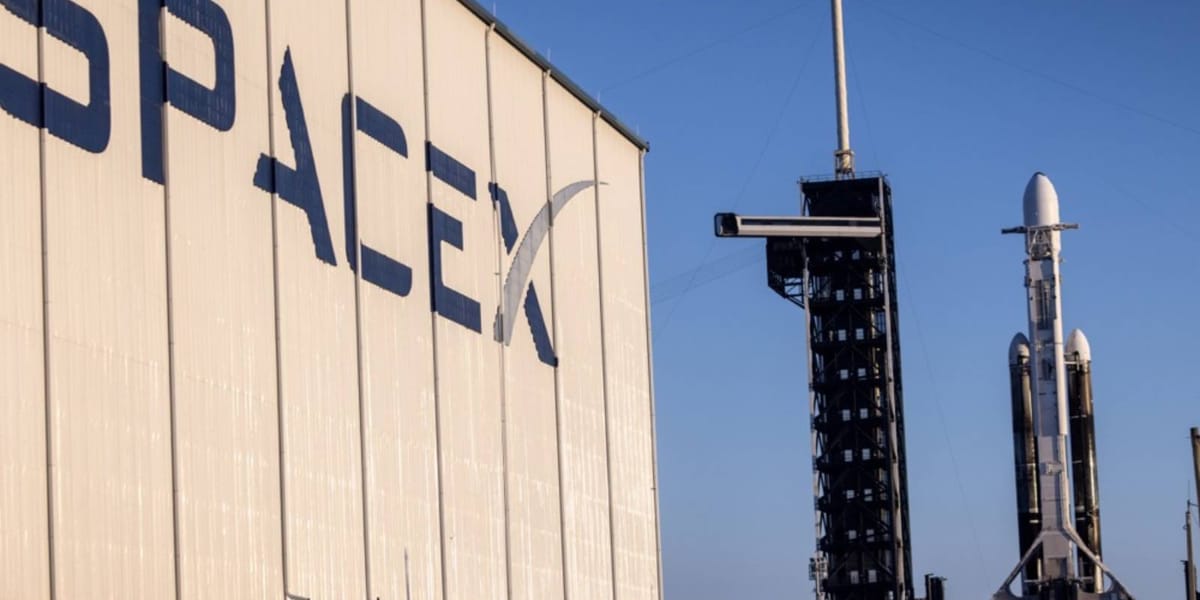
Elon Musk's xAI Officially Rebrands as SpaceXAI
Elon Musk's artificial intelligence company xAI has officially changed its name to SpaceXAI, five months after SpaceX acquired the business. SpaceXAI announced the change through a post on X and also introduced a new logo. The company's account on the social network now carries the SpaceXAI name. However, SpaceX continues to operate a separate account covering its rockets, spacecraft, and launches. Merger Completed Musk first disclosed the SpaceXAI name in May, when he said xAI would no longer operate as a separate company and would instead become SpaceX's artificial intelligence business. SpaceX officially acquired xAI in February 2026. The company's public offering documents describe xAI as the foundation of SpaceX's AI division and part of a broader plan to combine artificial intelligence with its space and connectivity businesses. The xAI website has already been updated with the SpaceXAI name and logo. However, according to Stocktwits, the new branding has not yet appeared in official corporate filings. Orbital Data Centers SpaceXAI plans to develop data centers in space as demand for the electricity required to operate AI infrastructure continues to rise. When SpaceX acquired xAI, Musk argued that terrestrial infrastructure would not be able to meet global AI electricity demand. He described moving power-intensive data-center operations into space as the logical solution. SpaceX had already filed an application with the US Federal Communications Commission before announcing the acquisition. The filing seeks permission to launch and operate up to one million satellites as part of an orbital data-center system. The proposed satellites would operate at altitudes ranging from 500 kilometres to 2,000 kilometres and communicate through high-bandwidth optical links. X Also Comes Under SpaceXAI The combined business also includes a social media platform, X. xAI acquired X in 2025, meaning the platform became part of SpaceX when it purchased xAI. It now sits under the wider SpaceXAI structure alongside Grok and the company's other AI products. Public Market Debut SpaceX, including its acquired xAI and X businesses, went public in June 2026. The company's shares closed their first trading day at $160.95, or approximately $161, giving SpaceX a market value of around $2.1 trillion, according to f. The SpaceXAI rebrand formally brings Musk's space, artificial intelligence, and social media operations under one corporate identity, although SpaceX will continue to use its established name for its space-related activities.
Wall Street warms to SpaceX ahead of Nasdaq 100 inclusion
SpaceX's addition to the Nasdaq 100 on Wall Street today is expected to unleash billions in passive buying, as brokerages kick off coverage of the $2 trillion-plus rocket and satellite company with broadly bullish views. The company joins the index just 15 days after its stock market debut on June 12 - among the fastest inclusions ever - thanks to the Nasdaq's revised rules for newly listed companies looking to enter widely tracked benchmarks. Its debut in the tech-heavy index is set to create another source of demand for its shares as index funds and exchange-traded funds (ETFs) tied to the Nasdaq 100 will need to buy shares to match the benchmark's new composition. Active managers who track the index closely may also adjust their positions. Many retail investors prefer investing in funds to diversify their holdings. Over $587 billion is benchmarked in funds tracking the Nasdaq 100, including Invesco's QQQ and QQQM, which will now have to make room for SpaceX. JP Morgan estimated last month that SpaceX's addition to the index could draw $4.3 billion in passive inflows. Investors are waiting for a wave of reports from Wall Street brokerages making their first attempt to value SpaceX as a publicly traded company, applying traditional valuation metrics to a business that has largely been assessed by investors' belief in Musk's long-term bets. The industry-mandated quiet period ends for analysts at banks that underwrote the blockbuster IPO - led by Goldman Sachs, Morgan Stanley, BofA Securities, Citigroup and JP Morgan. Both Morgan Stanley and Goldman Sachs started coverage on the stock today with their top ratings, with Morgan Stanley dubbing the company "AI's final frontier." "We see the company as well-positioned to scale its differentiated advantages across space, connectivity, and AI," Goldman analysts said, betting each market has the potential to become a multi-trillion-dollar opportunity over a five-year-plus horizon. Brokerages RBC, Bernstein, and Stifel also initiated coverage with their top ratings, betting on the success of Starship, SpaceX's next-generation rocket that is designed to be fully reusable. "The Starship is the flywheel that powers SpaceX's ambitions," RBC analysts said. Earlier this month, Oppenheimer became the first to initiate coverage with an "outperform" rating. Investors bet on AI capabilities Investors are betting SpaceX can evolve into a hyperscale AI infrastructure provider in the near term, using cash generated to fund the development of Grok as it takes on OpenAI's GPT models and Anthropic's Claude. They also see significant room for Starlink to expand its dominance in satellite communications, while much of the company's longer-term ambitions depend on the successful development of its next-generation Starship rocket. However, not everyone is bullish on SpaceX. Morningstar analysts pegged the company's valuation at about $780 billion, citing uncertainty around its AI business, including xAI and social media platform X. With a market capitalisation of $2.1 trillion, SpaceX is the sixth-largest US company, and CEO Elon Musk the world's first trillionaire. FTSE Russell added the stock to its US indexes last month, with funds such as iShares Russell 1000 ETF already giving investors a piece of the biggest IPO in US history. However, S&P Global declined to create a similar fast-track process for the benchmark S&P 500 in June, and it is expected to take at least a year before SpaceX joins the world's most widely tracked index. SpaceX shares have gained more than 6% since their debut in their short ride marked by post-IPO volatility.

Wall Street warms to SpaceX ahead of Nasdaq 100 inclusion
July 7 (Reuters) - SpaceX's (SPCX.O), opens new tab addition to the Nasdaq 100 on Tuesday is expected to unleash billions in passive buying, as brokerages kick off coverage of the $2 trillion-plus rocket and satellite company with broadly bullish views. The company joins the index just 15 days after its stock market debut on June 12 - among the fastest inclusions ever - thanks to the Nasdaq's revised rules for newly listed companies looking to enter widely tracked benchmarks. Its debut in the tech-heavy index is set to create another source of demand for its shares as index funds and exchange-traded funds (ETFs) tied to the Nasdaq 100 (.NDX), opens new tab will need to buy shares to match the benchmark's new composition. Active managers who track the index closely may also adjust their positions. Many retail investors prefer investing in funds to diversify their holdings. Over $587 billion is benchmarked in funds tracking the Nasdaq 100, including Invesco's QQQ (QQQ.O), opens new tab and QQQM (QQQM.O), opens new tab, which will now have to make room for SpaceX. J.P. Morgan estimated last month that SpaceX's addition to the index could draw $4.3 billion in passive inflows. QUIET PERIOD ENDS Investors are awaiting a wave of reports from Wall Street brokerages making their first attempt to value SpaceX as a publicly traded company, applying traditional valuation metrics to a business that's largely been assessed by investors' belief in Musk's long-term bets. The industry-mandated quiet period ends for analysts at banks that underwrote the blockbuster IPO - led by Goldman Sachs, Morgan Stanley, BofA Securities, Citigroup and J.P. Morgan. Both Morgan Stanley and Goldman Sachs started coverage on the stock on Tuesday with their top ratings, with Morgan Stanley dubbing the company "AI's final frontier." "We see the company as well-positioned to scale its differentiated advantages across space, connectivity, and AI," Goldman analysts said, betting each market has the potential to become a multi-trillion-dollar opportunity over a five-year-plus horizon. Brokerages RBC, Bernstein, and Stifel also initiated coverage with their top ratings, betting on the success of Starship, SpaceX's next-generation rocket that is designed to be fully reusable. "The Starship is the flywheel that powers SpaceX's ambitions," RBC analysts said. Earlier this month, Oppenheimer became the first to initiate coverage with an "outperform" rating. INVESTORS BET ON AI CAPABILITIES Investors are betting SpaceX can evolve into a hyperscale AI infrastructure provider in the near term, using cash generated to fund the development of Grok as it takes on OpenAI's GPT models and Anthropic's Claude. They also see significant room for Starlink to expand its dominance in satellite communications, while much of the company's longer-term ambitions depend on the successful development of its next-generation Starship rocket. However, not everyone is bullish on SpaceX. Morningstar analysts pegged the company's valuation at about $780 billion, citing uncertainty around its AI business, including xAI and social media platform X. With a market capitalization of $2.1 trillion, SpaceX is the sixth-largest U.S. company, and CEO Elon Musk the world's first trillionaire. FTSE Russell added the stock to its U.S. indexes last month, with funds such as iShares Russell 1000 ETF (IWB.P), opens new tab already giving investors a piece of the biggest IPO in U.S. history. However, S&P Global (SPGI.N), opens new tab declined to create a similar fast-track process for the benchmark S&P 500 (.SPX), opens new tab in June, and it is expected to take at least a year before SpaceX joins the world's most widely tracked index. SpaceX shares have gained more than 6% since their debut in their short ride marked by post-IPO volatility. Reporting by Purvi Agarwal, Rashika Singh and Akash Sriram in Bengaluru; Editing by Anil D'Silva and Saumyadeb Chakrabarty Our Standards: The Thomson Reuters Trust Principles., opens new tab * Suggested Topics: * U.S. Markets Rashika Singh Thomson Reuters Rashika reports on brokerages and financial markets, alongside technology and corporate developments for Reuters, with a focus on U.S. and global companies. Her coverage spans analyst actions, earnings-driven stock moves, semiconductors, artificial intelligence, aerospace and defense, and high‑growth technology stocks, often through breaking news and market‑moving "hot stock" coverage. Her reporting primarily appears in the Technology, Business, and Markets sections of the Reuters website and wire service, examining how brokerage research, corporate strategy and earnings influence investor sentiment and global competition. She regularly contributes to Reuters' spot and breaking‑news coverage, rather than a named column or standalone newsletter.

Wall Street warms to SpaceX ahead of Nasdaq 100 inclusion
SpaceX to join Nasdaq-100 15 days after debut; among fastest inclusions SpaceX's addition to the Nasdaq 100 on Tuesday is expected to unleash billions in passive buying, as brokerages kick off coverage of the $2 trillion-plus rocket and satellite company with broadly bullish views. The company joins the index just 15 days after its stock market debut on June 12 - among the fastest inclusions ever - thanks to the Nasdaq's revised rules for newly listed companies looking to enter widely tracked benchmarks. Its debut in the tech-heavy index is set to create another source of demand for its shares as index funds and exchange-traded funds (ETFs) tied to the Nasdaq 100 will need to buy shares to match the benchmark's new composition. Active managers who track the index closely may also adjust their positions. Many retail investors prefer investing in funds to diversify their holdings. Over $587 billion is benchmarked in funds tracking the Nasdaq 100, including Invesco's QQQ and QQQM, which will now have to make room for SpaceX. J.P. Morgan estimated last month that SpaceX's addition to the index could draw $4.3 billion in passive inflows. QUIET PERIOD ENDS Investors are awaiting a wave of reports from Wall Street brokerages making their first attempt to value SpaceX as a publicly traded company, applying traditional valuation metrics to a business that's largely been assessed by investors' belief in Musk's long-term bets. The industry-mandated quiet period ends for analysts at banks that underwrote the blockbuster IPO - led by Goldman Sachs, Morgan Stanley, BofA Securities, Citigroup and J.P. Morgan. Both Morgan Stanley and Goldman Sachs started coverage on the stock on Tuesday with their top ratings, with Morgan Stanley dubbing the company "AI's final frontier." "We see the company as well-positioned to scale its differentiated advantages across space, connectivity, and AI," Goldman analysts said, betting each market has the potential to become a multi-trillion-dollar opportunity over a five-year-plus horizon. Brokerages RBC, Bernstein, and Stifel also initiated coverage with their top ratings, betting on the success of Starship, SpaceX's next-generation rocket that is designed to be fully reusable. "The Starship is the flywheel that powers SpaceX's ambitions," RBC analysts said. Earlier this month, Oppenheimer became the first to initiate coverage with an "outperform" rating. INVESTORS BET ON AI CAPABILITIES Investors are betting SpaceX can evolve into a hyperscale AI infrastructure provider in the near term, using cash generated to fund the development of Grok as it takes on OpenAI's GPT models and Anthropic's Claude. They also see significant room for Starlink to expand its dominance in satellite communications, while much of the company's longer-term ambitions depend on the successful development of its next-generation Starship rocket. However, not everyone is bullish on SpaceX. Morningstar analysts pegged the company's valuation at about $780 billion, citing uncertainty around its AI business, including xAI and social media platform X. With a market capitalization of $2.1 trillion, SpaceX is the sixth-largest U.S. company, and CEO Elon Musk the world's first trillionaire. FTSE Russell added the stock to its U.S. indexes last month, with funds such as iShares Russell 1000 ETF already giving investors a piece of the biggest IPO in U.S. history. However, S&P Global declined to create a similar fast-track process for the benchmark S&P 500 in June, and it is expected to take at least a year before SpaceX joins the world's most widely tracked index. SpaceX shares have gained more than 6% since their debut in their short ride marked by post-IPO volatility. (Reporting by Purvi Agarwal, Rashika Singh and Akash Sriram in Bengaluru; Editing by Anil D'Silva and Saumyadeb Chakrabarty)