News & Updates
The latest news and updates from companies in the WLTH portfolio.
SpaceX stock: Which ASX ETF buys you the most?
You're reading a free article with opinions that may differ from The Motley Fool's Premium Investing Services. Become a Motley Fool member today to get instant access to our top analyst recommendations, in-depth research, investing resources, and more. Learn More Now that the initial public offering (IPO) of Elon Musk's Space Exploration Technologies Corp (NASDAQ: SPCX) is complete and bedded down, investors all over the world have a myriad of options at their disposal if they wish to invest in this ambitious company. Yes, SpaceX stock has, at least as of the time of writing, come off the boil a little. Even so, this company remains a behemoth on the world stage, commanding a market capitalisation of US$1.91 trillion. For an investor wishing to get themselves a slice of this company, the most direct way remains buying SpaceX stock themselves. Yes, SpaceX is listed on the American NASDAQ exchange and is thus not available for purchase on the ASX. However, it has arguably never been easier to open a US brokerage account from Australia and put some shares against a name. Even if an investor isn't comfortable with owning a US stock directly, there are locally-based options. These essentially boil down to owning an exchange-traded fund (ETF) that, in turn, owns SpaceX shares. That allows ASX investors to indirectly invest in SpaceX without having to buy US dollars or open an international brokerage account. But which ASX ETF to pick? Well, SpaceX shares haven't qualified for many international index funds just yet. For instance, the company hasn't yet made the cut for either the iShares S&P 500 ETF (ASX: IVV) or the BetaShares Nasdaq 100 ETF (ASX: NDQ). It probably will with time, albeit as one relatively small holding among many. Two ASX ETFs to buy for SpaceX stock However, some ASX ETFs of the thematic persuasion haven't wasted any time in buying SpaceX stock. These ETFs are giving the company a lot of real estate. If that sounds appealing to investors, the first port of call may be the BetaShares Space Industry ETF (ASX: RCKT). This ETF was launched back in May. Although it didn't invest in SpaceX until the IPO, today, the company commands a whopping 26.8% of RCKT's entire portfolio. That means more than one in every four dollars invested in this fund finds its way to SpaceX stock. The other option for ASX investors seeking a substantial but local SpaceX investment is the Global X Space Tech ETF (ASX: MOON). This ETF has just over a month of ASX life to its name. Saying that, MOON's portfolio is dominated by SpaceX stock as well. Space Exploration Technologies Corp makes up 26.7% of the ETF's entire weighted portfolio. Thus, there are a few options for ASX investors who may like to own some SpaceX stock today.
Analysts are still bullish on SpaceX shares after Nasdaq inclusion. Here is what that means for ASX investors
You're reading a free article with opinions that may differ from The Motley Fool's Premium Investing Services. Become a Motley Fool member today to get instant access to our top analyst recommendations, in-depth research, investing resources, and more. Learn More SpaceX shares have had an extraordinary first month. Shares were issued at US$135 before listing on 12 June, and the stock climbed well above US$200, pushing the valuation above US$2 trillion. Since then, SpaceX shares have come back down to earth. Although, the company was then fast-tracked into the Nasdaq-100 index in early July, approximately 15 trading days after listing. Analysts remain bullish. For ASX investors, that matters more than most realise, because a large number of Australians now own a piece of SpaceX without having made any decision to buy it. Reasons to remain bullish on SpaceX shares The core of the bull case is Starlink. According to SpaceX's S-1 filing with the SEC, the Starlink connectivity segment generated US$11.4 billion in revenue in 2025. The segment delivered US$4.4 billion in operating income, representing year-on-year growth of 49.8% and 120.4% respectively. Starlink served 10.3 million subscribers across 164 countries as at 31 March 2026, up from just 2.3 million in 2023. This is a business growing at extraordinary speed with a defensible moat. Launching a satellite constellation of that scale requires launch capability almost no competitor possesses. The Nasdaq-100 inclusion added a further mechanical tailwind. This will force index-tracking funds worldwide to buy SPCX regardless of any individual portfolio manager's view on valuation. Betashares Space Industry ETF The Betashares Space Industry ETF (ASX: RCKT) is the most direct ASX exposure. SpaceX has already been included in RCKT following the fund's fast-track inclusion feature. This allowed it to enter the Solactive Space Industry Index far more quickly than standard timelines would permit. SpaceX now represents approximately 27% of the RCKT portfolio, making it the fund's single largest holding by a wide margin. That concentration deserves a closer look. RCKT is no longer a diversified space economy fund in any meaningful sense. It is now, in effect, a SpaceX fund with 28 other holdings attached, and its performance will be dominated by what SPCX does from here. Betashares Nasdaq 100 ETF The Betashares Nasdaq 100 ETF (ASX: NDQ) is where most Australians now own SpaceX without having chosen to. NDQ is one of the most widely held ETFs in Australia, and SpaceX's Nasdaq-100 inclusion means every NDQ holder automatically gained SpaceX exposure when the index inclusion took effect. The same applies to holders of the Vanguard MSCI International Shares ETF (ASX: VGS) and the iShares S&P 500 ETF (ASX: IVV). What's more, the millions of Australians whose superannuation funds hold international shares benchmarked against major US indices have also gained exposure. For most investors, that exposure will be small relative to the overall portfolio. But it exists, automatically, without any further action required. The risk worth understanding for SpaceX shares SpaceX is not a conventionally profitable company. The company posted a GAAP net loss of US$4.94 billion in 2025, driven by losses in the xAI and Space divisions that offset Starlink's profitability. A company trading above US$2 trillion with significant GAAP losses is a demanding proposition, even for investors genuinely excited by the long-term opportunity. The mechanical index buying that has supported the share price since listing was a one-time event, not a permanent support mechanism. Furthermore, SpaceX bonds issued shortly after the IPO have reportedly sold off to levels comparable with junk-rated borrowers. This is despite investment-grade ratings, a warning sign that the debt market is less enthusiastic than the equity market. Foolish takeaway for SpaceX shares Analysts remain bullish on SpaceX shares, and Starlink's growth justifies significant optimism. But for ASX investors, the more important point is that ownership of SpaceX is now largely automatic rather than chosen. RCKT holders own it heavily, at around 26% of the fund. NDQ, VGS, and IVV holders own it passively. Understanding how much SpaceX exposure you actually have is perhaps a more useful exercise than debating whether to buy it.

SpaceX targets Thursday for new Starship flight test
LOS ANGELES, July 13 (Xinhua) -- SpaceX is targeting Thursday for the 13th flight test of its giant Starship rocket, the company announced on Monday. The 90-minute launch window is scheduled to open at 5:45 p.m. U.S. Central Time. The mission will continue testing the Version 3 Starship and Super Heavy vehicles. The booster's primary objectives include a successful launch, ascent, stage separation, boostback burn and landing burn before splashing down at an offshore landing site in the Gulf of Mexico, according to SpaceX. The Starship upper stage will attempt to deploy 20 next-generation Starlink V3 satellites, relight a single Raptor engine in space, and conduct another controlled reentry, descent and splashdown in the Indian Ocean. The flight will also test several upgrades and experiments related to Starship's heat shield as SpaceX continues developing a fully and rapidly reusable launch system. SpaceX conducted Starship's 12th flight test on May 22. During that mission, the Super Heavy booster failed to complete its planned boostback burn after stage separation and later made a hard splashdown in the Gulf of Mexico, according to the company. Following the test, the U.S. Federal Aviation Administration (FAA) required SpaceX to conduct a mishap investigation into the booster's failure. The FAA announced on Monday that the investigation has been closed, clearing the way for Flight 13 to proceed, provided all safety and licensing requirements are met. According to the FAA, it oversaw and accepted the findings and corrective actions from the SpaceX-led investigation. The final mishap report identified two most probable root causes for the loss of the Super Heavy booster: heat effects on propulsion system components during ascent and erroneous engine alarm system settings. The FAA said SpaceX has identified four corrective actions, including hardware and software configuration updates, to prevent a recurrence of the incident. ■

SpaceX targets Thursday for new Starship flight test
LOS ANGELES, July 13 (Xinhua) -- SpaceX is targeting Thursday for the 13th flight test of its giant Starship rocket, the company announced on Monday. The 90-minute launch window is scheduled to open at 5:45 p.m. U.S. Central Time. The mission will continue testing the Version 3 Starship and Super Heavy vehicles. The booster's primary objectives include a successful launch, ascent, stage separation, boostback burn and landing burn before splashing down at an offshore landing site in the Gulf of Mexico, according to SpaceX. The Starship upper stage will attempt to deploy 20 next-generation Starlink V3 satellites, relight a single Raptor engine in space, and conduct another controlled reentry, descent and splashdown in the Indian Ocean. The flight will also test several upgrades and experiments related to Starship's heat shield as SpaceX continues developing a fully and rapidly reusable launch system. SpaceX conducted Starship's 12th flight test on May 22. During that mission, the Super Heavy booster failed to complete its planned boostback burn after stage separation and later made a hard splashdown in the Gulf of Mexico, according to the company. Following the test, the U.S. Federal Aviation Administration (FAA) required SpaceX to conduct a mishap investigation into the booster's failure. The FAA announced on Monday that the investigation has been closed, clearing the way for Flight 13 to proceed, provided all safety and licensing requirements are met. According to the FAA, it oversaw and accepted the findings and corrective actions from the SpaceX-led investigation. The final mishap report identified two most probable root causes for the loss of the Super Heavy booster: heat effects on propulsion system components during ascent and erroneous engine alarm system settings. The FAA said SpaceX has identified four corrective actions, including hardware and software configuration updates, to prevent a recurrence of the incident. ■
SpaceX Shares Sink Lowest Level Since Nasdaq Debut
This article first appeared on GuruFocus. Space Exploration Technologies (NASDAQ:SPCX) shares fell about 4% in Monday morning trading, extending their recent decline and trading near the company's initial public offering price. The stock changed hands around $139, its lowest level since listing on Nasdaq about one month ago. Shares have retreated more than 38% from their intraday peak of $225.64 reached on June 16, reducing much of the gains recorded after the company's market debut. Space Exploration Technologies went public at $135 per share, raising about $75 billion in one of the largest U.S. initial public offerings. The stock opened at $150, roughly 11% above its offering price, giving the aerospace company a market capitalization of about $2.1 trillion at the close of its first trading session. Monday's pullback leaves Space Exploration Technologies trading only modestly above its IPO price after a volatile first month on the public market. The latest decline comes as investors continue to reassess valuations across growth and technology stocks following a strong initial rally after the company's listing.

SpaceX targets Thursday for new Starship flight test
LOS ANGELES, July 13 (Xinhua) -- SpaceX is targeting Thursday for the 13th flight test of its giant Starship rocket, the company announced on Monday. The 90-minute launch window is scheduled to open at 5:45 p.m. U.S. Central Time. The mission will continue testing the Version 3 Starship and Super Heavy vehicles. The booster's primary objectives include a successful launch, ascent, stage separation, boostback burn and landing burn before splashing down at an offshore landing site in the Gulf of Mexico, according to SpaceX. The Starship upper stage will attempt to deploy 20 next-generation Starlink V3 satellites, relight a single Raptor engine in space, and conduct another controlled reentry, descent and splashdown in the Indian Ocean. The flight will also test several upgrades and experiments related to Starship's heat shield as SpaceX continues developing a fully and rapidly reusable launch system. SpaceX conducted Starship's 12th flight test on May 22. During that mission, the Super Heavy booster failed to complete its planned boostback burn after stage separation and later made a hard splashdown in the Gulf of Mexico, according to the company. Following the test, the U.S. Federal Aviation Administration (FAA) required SpaceX to conduct a mishap investigation into the booster's failure. The FAA announced on Monday that the investigation has been closed, clearing the way for Flight 13 to proceed, provided all safety and licensing requirements are met. According to the FAA, it oversaw and accepted the findings and corrective actions from the SpaceX-led investigation. The final mishap report identified two most probable root causes for the loss of the Super Heavy booster: heat effects on propulsion system components during ascent and erroneous engine alarm system settings. The FAA said SpaceX has identified four corrective actions, including hardware and software configuration updates, to prevent a recurrence of the incident. ■
SpaceX targets Thursday for new Starship flight test
GENEVA, 06 July 2026 - Minister of Information and Communication Technology, Emma Theofelus, pictured with Chairperson of the PowerCom Board, Eldorette Harmse, Director of the Telecommunication Development Bureau (BDT) at the International Telecommunication Union (ITU), Dr Cosmas Luckyson Zavazava; and Namibia's Ambassador to the Swiss Confederation and Permanent Representative to the United Nations Office in Geneva, Elvis Shiweda, during the Global Dialogue on AI Governance in Geneva, Switzerland, on Monday. (Photo by: Josephina Simeon) NAMPA

What is Starship? SpaceX building in Texas and Florida for future space exploration, innovation
Down the two-lane Highway 4 near the U.S.-Mexico border, the Texas desert stretches for miles, but as you approach the coast, a growing number of Teslas hint at something more than just cacti and creatures. Located at the southern tip of Texas, Starbase is the newest city in the Rio Grande Valley, officially incorporated in May 2022. The area, which resembles an active construction zone, is home to SpaceX's Starship rocket, a project some call the most ambitious engineering endeavor of the 21st century. "We are slowly getting used to the changes, i.e., hearing a rocket launch and the booms," said Eddie Treviño Jr., Cameron County judge for the Rio Grande area. Treviño, who works directly with SpaceX, has witnessed the transformation of the city and the rocket's development. He explained how the project evolved. "The initial idea was this was gonna be a launch facility for the Falcon 9, and it would launch, you know, twice a month, and that was the intent, game plan was," Treviño said. "Several years back, SpaceX decided to change course and move Starship development from California to South Texas to Cameron County, Boca Chica Beach." The location seemed ideal, with the densely populated Brownsville about 20 miles away and Boca Chica Beach just steps from the site. SpaceX crews are working around the clock to expand Starbase, which is not just a rocket facility but the foundation of an entire city built around a spaceport. "A lot of people are not happy that it's here, but it's building a community, I think. It's bringing a lot of people here; more businesses are opening. There's always pluses and minuses with everything," said Ashley Andujo, whose husband is an engineer for SpaceX. Andujo and her family moved to the area in May 2022 from Los Angeles. "It's crazy. My husband actually builds them. So we love it. You know, it's cool to look up in the sky and see something that my husband built and something that my kid's dad built," she said. Starbase is not only a rocket factory but also a growing community. SpaceX offered buyouts to the small number of families who previously lived nearby and is now building condos close to the base. The area features a gated community with amenities such as restaurants, live music, a pool, a gym, a bar, and a grocery store. "They have a bunch of amenities there. They have a pool. They have a gym. They have a restaurant. A bar. A grocery store," Andujo said. The purpose of this mini-city is to have crews nearby to help realize Elon Musk's vision. Starship, a fully reusable giant rocket, is designed to carry humans and cargo to the moon and eventually Mars. Its reusability is expected to lower the cost of space travel and play a key role in NASA's Artemis missions. Starship began its first test flights in 2023, many of which ended in explosions. While such mishaps are common during initial testing, the remote desert location has proven suitable for these trials. However, not everyone agrees. "When these explosions happen, it's terrifying. It sounds like a bomb going off. My apartment shakes even though I live 20 miles away from the launch pad. The sonic boom is horrifying," said Bekah Hinojosa, co-founder of the South Texas Environmental Justice Network, who opposes the project. Starship is unlikely to launch from Florida's Space Coast until it achieves a completely successful launch, but it could be a critical component of future moon missions. For now, Starship remains a work in progress, but one thing is certain: it is already reshaping the future of space exploration and the community of Starbase, Texas. Down the two-lane Highway 4 near the U.S.-Mexico border, the Texas desert stretches for miles, but as you approach the coast, a growing number of Teslas hint at something more than just cacti and creatures. Located at the southern tip of Texas, Starbase is the newest city in the Rio Grande Valley, officially incorporated in May 2022. The area, which resembles an active construction zone, is home to SpaceX's Starship rocket, a project some call the most ambitious engineering endeavor of the 21st century. "We are slowly getting used to the changes, i.e., hearing a rocket launch and the booms," said Eddie Treviño Jr., Cameron County judge for the Rio Grande area. Treviño, who works directly with SpaceX, has witnessed the transformation of the city and the rocket's development. He explained how the project evolved. "The initial idea was this was gonna be a launch facility for the Falcon 9, and it would launch, you know, twice a month, and that was the intent, game plan was," Treviño said. "Several years back, SpaceX decided to change course and move Starship development from California to South Texas to Cameron County, Boca Chica Beach." The location seemed ideal, with the densely populated Brownsville about 20 miles away and Boca Chica Beach just steps from the site. SpaceX crews are working around the clock to expand Starbase, which is not just a rocket facility but the foundation of an entire city built around a spaceport. "A lot of people are not happy that it's here, but it's building a community, I think. It's bringing a lot of people here; more businesses are opening. There's always pluses and minuses with everything," said Ashley Andujo, whose husband is an engineer for SpaceX. Andujo and her family moved to the area in May 2022 from Los Angeles. "It's crazy. My husband actually builds them. So we love it. You know, it's cool to look up in the sky and see something that my husband built and something that my kid's dad built," she said. Starbase is not only a rocket factory but also a growing community. SpaceX offered buyouts to the small number of families who previously lived nearby and is now building condos close to the base. The area features a gated community with amenities such as restaurants, live music, a pool, a gym, a bar, and a grocery store. "They have a bunch of amenities there. They have a pool. They have a gym. They have a restaurant. A bar. A grocery store," Andujo said. The purpose of this mini-city is to have crews nearby to help realize Elon Musk's vision. Starship, a fully reusable giant rocket, is designed to carry humans and cargo to the moon and eventually Mars. Its reusability is expected to lower the cost of space travel and play a key role in NASA's Artemis missions. Starship began its first test flights in 2023, many of which ended in explosions. While such mishaps are common during initial testing, the remote desert location has proven suitable for these trials. However, not everyone agrees. "When these explosions happen, it's terrifying. It sounds like a bomb going off. My apartment shakes even though I live 20 miles away from the launch pad. The sonic boom is horrifying," said Bekah Hinojosa, co-founder of the South Texas Environmental Justice Network, who opposes the project. Starship is unlikely to launch from Florida's Space Coast until it achieves a completely successful launch, but it could be a critical component of future moon missions. For now, Starship remains a work in progress, but one thing is certain: it is already reshaping the future of space exploration and the community of Starbase, Texas.

Elon Musk Says SpaceX Will Fly Orbital Data Centers Next Year - SpaceX (NASDAQ:SPCX)
Elon Musk's Orbital Data Center Goal Amidst the fiery accusations, Altman retorted, saying that Musk was selling public investors the idea of orbital AI compute, questioning the practicality of the goal. Musk responded by saying that SpaceX will "start flying them next year." Chanos expressed skepticism about Musk's claims. "[Narrator: This week's 13th test flight of Starship is still not planned to reach full Earth orbit.]," the short seller said in his post on X on Sunday. SpaceX Touts Starlink V3 SpaceX said that the upcoming 13th Starship flight test would also see over 20 Starlink V3 satellites be deployed with the test. "Starship is planned to deploy 20 satellites which will extend solar arrays and antennas and will attempt to connect with ground stations in South Africa and the larger Starlink constellation via high-capacity lasers," SpaceX said. Analyst Aaron Burnett, the founder of Mach 33, an investment firm aimed at Space technology, hailed the launch as a "significant inflection in Starlink V3 ramp," which would also translate to a "global bandwidth capacity ramp," Burnett said via a post on X. SpaceX also said that the satellites would provide information on the rocket's heat shields. "Six of the satellites have been modified with a suite of cameras to scan Starship's heat shield and transmit imagery down to operators," the company said. The launch is expected to take place on Thursday, July 16. Benzinga Edge Rankings show SpaceX fails to provide a favorable price trend in the Short, Medium and Long term. Price Action: SpaceX shares were up 0.43% to $145.92 during the after-hours session on Friday. Check out more of Benzinga's Future Of Mobility coverage by following this link. Photo courtesy: Shutterstock Market News and Data brought to you by Benzinga APIs To add Benzinga News as your preferred source on Google, click here.

How Low Can SpaceX Stock Go?
Space Exploration Technologies (NASDAQ: SPCX) went public on June 12. Its stock promptly soared to a peak of $225, giving the company a whopping $2.9 trillion market capitalization, but it has since plummeted by 35% to close at $145 on Friday, July 10. SpaceX has a unique business that spans space transportation, satellite internet connectivity, and artificial intelligence (AI) infrastructure, and its revenue is forecast to grow rapidly over the next couple of years. However, its stock remains extremely expensive even after its recent decline, which could open the door to more losses for investors. Missed Nvidia in 2009? This Rare Signal Is Flashing Again. In 2009, a "Double Down" signal flashed for a little-known chipmaker called Nvidia. For the first time in years, that same "Total Conviction" signal is flashing for a company 1/100th the size of Nvidia. Continue " How low can SpaceX stock go? SpaceX has a significant opportunity ahead Before we dive into SpaceX's hefty valuation and the math behind a potential decline in its stock, let's examine the company's business, which does have significant growth potential. It's divided into three core segments: SpaceX already accounts for over 80% of the world's mass to orbit, so it's launching more commercial payloads than any other company or organization on the planet. Its market share will only grow once its Starship rocket enters regular service, because its 100-ton payload capacity is four times that of the Falcon 9 rocket, which completes most trips today. The connectivity business is also set to receive a massive boost, as SpaceX will start launching its V3 satellites later this year, which offer a whopping 10 times the bandwidth of the current V2 satellites. Moreover, Starship will launch 60 V3 satellites into orbit per trip, whereas Falcon 9 is only capable of sending 27 at a time. Moving on to the AI segment, most of its revenue comes from Grok subscriptions and renting data center capacity to other companies. When SpaceX bought xAI, it took ownership of data centers like Colossus and Colossus II, which are fitted with hundreds of thousands of specialized AI chips from suppliers like Nvidia and Advanced Micro Devices.
Elon Musk 'surprised' a couple of his SpaceX workers, and reached previously unseen levels of cringe - 16 savage burns
Just when you thought Elon Musk couldn't be any cringier, he pulls a new level out of the bag, and it's almost impressive. Almost. How does he do it? It's like a gift. A horrible, unwanted gift. While X Ethan obviously thought the clip from October last year was a Musk triumph, leading us to suspect that X Ethan is another Musk alt account, a lot of the replies had very different ideas. 1. 2. 3. 4. 5. 6. 7. 8. 9. 10. 11. 12. 13. 14. 15. 16. It reminded celia of an SNL cold open. 'Musk' shows up at about 4:16. This viral clip of Elon Musk 'doing Elon Musk things' has a shot at being the most cringeworthy thing you'll see this year - 23 epic facepalms Source X Ethan Image Screengrab

SpaceX and Amazon are tech dopplegangers worth $4.5 trillion -- and they're headed for a collision
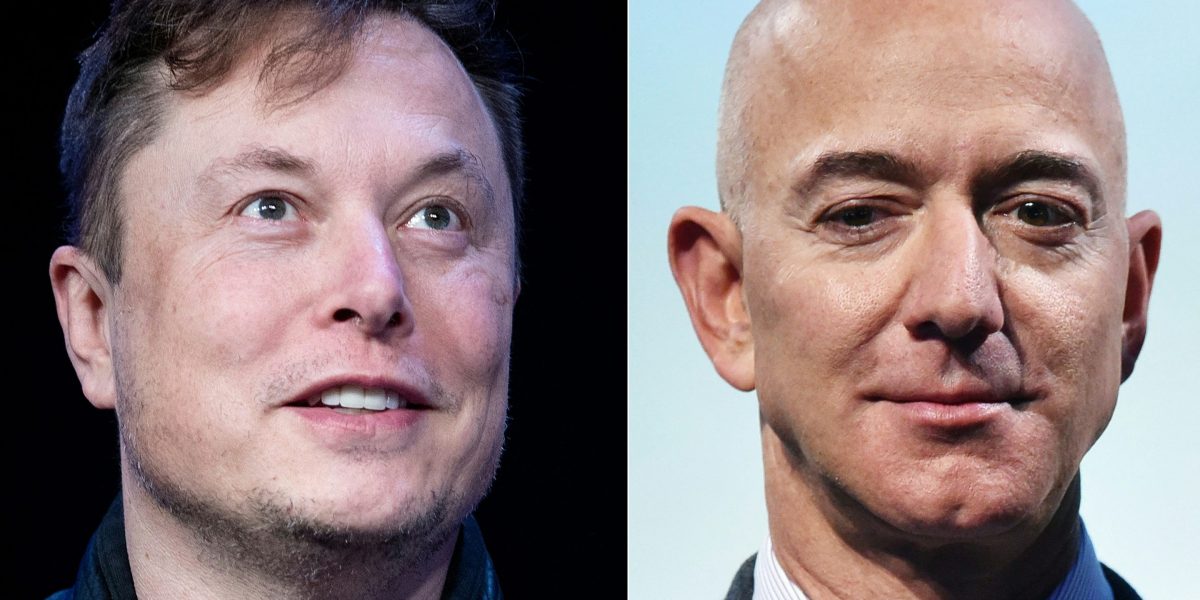
A charismatic founder with near-obsessive conviction, a business that bleeds money, and a stock price based on a wildly optimistic valuation. In 1997, Jeff Bezos took Amazon public at a price of $18 per share at a $438 million valuation. The online bookseller's stock would then crater 90% after the dot-com bubble burst, before flourishing into a $2.6 trillion conglomerate that raked in $77.7 billion last year. Enter SpaceX in 2026. Founded by Elon Musk, the company lost $4.9 billion last year, and went public at $135 a share in June, with a valuation that quickly rose to a sky-high $2 trillion. The two mega-cap companies are primarily known for businesses that have little in common, with Amazon dominating the online retail business while SpaceX has become the world's leading rocket maker. But look a little closer, and the two companies have strikingly similar silhouettes which seem likely to bump up against each other ever more frequently as they compete on the public market stage. Perhaps more than any other tech companies out there today, Amazon and SpaceX are both conglomerates with broad collections of assets and businesses that each believe work together to create a more powerful whole. Both companies offer satellite-beamed high-speed internet access. They're both in the cloud computing and AI infrastructure business with expensive data centers. Chips? Amazon's Trainium and Graviton processors hit an annual revenue run rate above $20 billion in Q1, nearly doubling the $10 billion run rate from the previous quarter. SpaceX has a chip-manufacturing initiative called Terafab with a goal of producing one terawatt of compute hardware each year. Amazon and SpaceX each also have advertising platforms, with Amazon ginning up $68.6 billion in ad revenue last year while SpaceX's X platform -- the social media service formerly known as Twitter -- lived inside the AI segment that posted a $6.4 billion operating loss. If you squint, you can see them as doppelgängers with one big difference -- or to be more accurate, nearly 700 billion differences. Amazon hit $716.9 billion in revenue in 2025 and $80 billion in operating income compared to SpaceX's $18.7 billion of revenue and a $2.6 billion operating loss. Investors are focused on the opportunity ahead, of course. Amazon trades at roughly 3.6 times last year's sales and about 28 times forward earnings. SpaceX trades at about 97 times sales, and had a $4.9 billion net loss. "You're basically buying [SpaceX] at an Amazon valuation when it has one-twentieth the revenue of Amazon," said Jim Lebenthal, a veteran investor and chief markets strategist at Cerity Partners. "SpaceX is an incredibly cool company -- it's amazing, everything they're doing. I also think it's wildly overvalued right now." Looking at the rival companies piece by piece, you can see that in nearly every competitive line of business, Amazon is more profitable and growing. But it was also the company that took a nosedive that nobody wanted to own on the way down. Whether SpaceX can fill its shoes requires an extraordinary amount to go right, said Lebenthal. Here's a look at how the two multi-trillion tech conglomerates stack up. Satellites Starlink, SpaceX's high-speed satellite-based internet service, is the company's current golden child, with $11.4 billion in revenue last year. It counts United Airlines, Carnival, Maersk, and John Deere as customers, and grew 50% year over year, with $4.4 billion in operating income at a 39% margin. Starlink is SpaceX's only profitable segment and a sum-of-the parts analysis from investment bank Stifel last week valued it at $1.25 trillion, just more than half of SpaceX's $2.45 trillion enterprise value. But there's a caveat. FactSet projects SpaceX will need to raise roughly $250 billion in debt over the next four years to fund its growth, according to Lebenthal, so a lot is riding on Starlink's shoulders. Amazon is the runt in this match-up. While Starlink has 9,600 satellites deployed and still in orbit, Amazon's Leo has just started to really get into a groove with about 330 satellites, according to Stifel. But Amazon sees big potential in space. In April, Amazon agreed to acquire Globalstar for $11.6 billion with the goal of expanding Leo's satellite network. And the company recently unveiled enterprise-grade Leo Ultra, which it says is the fastest satellite-internet antenna ever built. Amazon also inkeddeals with Delta Airlines and Jet Blue to expand wi-fi access on hundreds of aircraft in 2028. Cloud and Compute Amazon essentially invented the cloud business, and the company has the clear advantage right now. Amazon Web Services (AWS) posted $128.7 billion in revenue in 2025, with $45.6 billion in operating income at a 35% margin. AWS picked up the pace in the first quarter, growing 28% to $37.6 billion in revenue. Anthropic uses Amazon Trainium 2 chips to train Claude, and Amazon CEO Andy Jassy told investors that AWS's AI revenue run rate topped $15 billion in Q1 2026 and is "ascending rapidly." SpaceX is moving fast though. The company already has Colossus I and II data centers, and has signed lease deals with Anthropic and Google. And the company says its ultimate goal is to send the AI buildout into orbit. In 2025, SpaceX's AI segment generated $3.2 billion in total revenue against a $6.4 billion operating loss and in the first quarter of 2026 it lost $2.5 billion on $818 million in revenue. Dan Niles, founder of Niles Investment Management said SpaceX's compute operation today is more at a level with $5 billion CoreWeave or Amsterdam-based Nebius rather than at the level of AWS. "I don't view them as similar companies at all," said Niles. Justin Menne, a portfolio manager at Harbor Capital, sees it in terms of visibility. Amazon has a contracted backlog of $364 billion and competitive inference chips, he said, while SpaceX has plans to build. "I think in order to believe that the total enterprise value makes sense here, you're inherently giving a lot of credibility to the management team, the engineering team, in order to actually execute," said Menne. The Musk factor Menne said he hadn't done any modeling on how much the Musk premium adds to SpaceX's valuation but the non-technical answer is, "a lot," he said. Lebenthal admires Musk's accomplishments but called him "a source of discomfort" for some value investors. "It's because he says outlandishly optimistic things," Lebenthal said, Musk projected $1 trillion in revenue at SpaceX by 2030, while Lebenthal noted estimated revenues are about $40 billion for 2026. "You can't just say that and $960 billion of incremental revenue is going to come to the table," he said. SpaceX is an innovation stock that really appeals to investors who are dreamers, he added, like Ark Invest's Cathie Wood. On SpaceX's first day of trading, Wood's Ark invested about half a billion in SpaceX, and has purchased more as the price has ebbed since its opening day. Amazon founder Jeff Bezos has a similar larger-than-life profile and reputation for entrepreneurial genius as Musk does. But Bezos transitioned from CEO to executive chairman in 2021 (he still reportedly has some involvement in important priorities like AI, but his day-to-day attention seems focused on Blue Origin, his space exploration company, and Prometheus, a new AI startup he cofounded). Harbor Capital's Menne said there is no equivalent key-man premium at Amazon because "the current value of the company is less reliant on the next five years of executing on something that doesn't already exist." That said, Niles said there's a clear alternative for investors drawn to Musk. The other public company where he serves as CEO, Tesla, has near-term initiatives that include robotics, autonomous fleets, and energy storage which "are likely to come to fruition before a colony on Mars," said Niles. Still, the Musk premium can't be discounted. "Elon has this talent for making money for investors, even if crazy projections don't play out," said Menne. The $28.5 trillion TAM SpaceX's prospectus claims a total addressable market of $28.5 trillion -- roughly the size of the U.S. GDP. Of that, $22.7 trillion is a third-party estimate of the entire global "digital economy." Value-minded Lebenthal noted that "it's earnings you want, not TAM." Menne said the enterprise AI portion "is really hard to underwrite because companies have only just started actually charging for a lot of these services in a way that's not gross-margin negative." Niles added that there's inherent competition in that stratospheric figure. "There are some really pretty good companies in that space," he said. "Maybe you can take all that share from Microsoft and others, but I think Microsoft is a pretty good company." SpaceX is targeting a $1.6 trillion market for connectivity and $26.5 trillion for AI. But Amazon Leo is also gunning for the former. Amazon's AWS generated $128.7 billion in cloud revenue last year, and hosts Anthropic and OpenAI while presiding over a $364 billion contracted backlog. Both can throw down gauntlets over the TAM, but Amazon can point to revenue of $716 billion last year to SpaceX's $18.7 billion. The post SpaceX and Amazon are tech dopplegangers worth $4.5 trillion -- and they're headed for a collision appeared first on Fortune.

Wall Street feasts on fees from SpaceX IPO and mega-mergers
New York | Wall Street banks this week are set to report their biggest haul from investment banking fees in four and a half years, fuelled by SpaceX's blockbuster stock market listing and a resurgence in mega-mergers. The five largest US investment banks - JPMorgan Chase, Goldman Sachs, Morgan Stanley, Bank of America and Citigroup - are forecast to report a year-on-year fees increase of 27 per cent in the second quarter, according to estimates compiled by Bloomberg.

How Low Can SpaceX Stock Go?
Space Exploration Technologies (SPCX 4.51%) went public on June 12. Its stock promptly soared to a peak of $225, giving the company a whopping $2.9 trillion market capitalization, but it has since plummeted by 35% to close at $145 on Friday, July 10. SpaceX has a unique business that spans space transportation, satellite internet connectivity, and artificial intelligence (AI) infrastructure, and its revenue is forecast to grow rapidly over the next couple of years. However, its stock remains extremely expensive even after its recent decline, which could open the door to more losses for investors. How low can SpaceX stock go? SpaceX has a significant opportunity ahead Before we dive into SpaceX's hefty valuation and the math behind a potential decline in its stock, let's examine the company's business, which does have significant growth potential. It's divided into three core segments: SpaceX already accounts for over 80% of the world's mass to orbit, so it's launching more commercial payloads than any other company or organization on the planet. Its market share will only grow once its Starship rocket enters regular service, because its 100-ton payload capacity is four times that of the Falcon 9 rocket, which completes most trips today. The connectivity business is also set to receive a massive boost, as SpaceX will start launching its V3 satellites later this year, which offer a whopping 10 times the bandwidth of the current V2 satellites. Moreover, Starship will launch 60 V3 satellites into orbit per trip, whereas Falcon 9 is only capable of sending 27 at a time. Moving on to the AI segment, most of its revenue comes from Grok subscriptions and renting data center capacity to other companies. When SpaceX bought xAI, it took ownership of data centers like Colossus and Colossus II, which are fitted with hundreds of thousands of specialized AI chips from suppliers like Nvidia and Advanced Micro Devices. SpaceX eventually wants to send AI computing clusters into space, where they will run on solar power and won't need complex cooling systems. This infrastructure would send data back to Earth via Starlink satellites, giving SpaceX a huge advantage over any potential competitors entering this industry. Although Elon Musk founded SpaceX to focus on space exploration and transportation, the company values its opportunity in this segment at just $370 billion. That pales in comparison to the potential $1.6 trillion addressable market in the connectivity business, and the staggering $26.5 trillion opportunity in the AI infrastructure business. SpaceX stock is trading at a sky-high premium to the broader market SpaceX generated $18.7 billion in total revenue during 2025, which was up 33% from the prior year. This was the composition: Data source: SpaceX. While connectivity was the largest and fastest-growing segment last year, that looks set to change. SpaceX recently agreed to rent up to $1.25 billion in AI computing capacity per month to Anthropic, in addition to another $920 million per month to Alphabet, and $150 million per month to Reflection AI. These deals could amount to tens of billions of dollars in annual revenue over the next few years. In fact, Wall Street's average forecast (provided by Yahoo! Finance) suggests SpaceX could more than double its revenue to $38.8 billion in 2026 and then generate $72.4 billion in revenue in 2027. That brings me to its valuation. Based on SpaceX's trailing 12-month revenue and its $1.91 trillion market capitalization, its stock is trading at a price-to-sales (P/S) ratio of 98.9, making it 15 times as expensive as the Nasdaq-100 index, which has a P/S ratio of just 6.4. In other words, SpaceX is wildly overvalued relative to its big-tech peers. Even if we value SpaceX stock using Wall Street's 2027 revenue forecast, its forward P/S ratio is still a hefty 26.3. I'm not predicting this will happen, but the stock would have to plummet by 76% over the next 18 months just to trade in line with the current P/S ratio of the Nasdaq-100 index. In my opinion, the math suggests SpaceX stock will have a tough time generating upside for the foreseeable future, and I won't be surprised to see a decline of 50% (or more), particularly if the company fails to meet Wall Street's revenue expectations.
Europe just unveiled a reusable rocket concept that could challenge SpaceX's Starship
As SpaceX pushes ahead with Starship, researchers in Europe have proposed a different approach to building heavy rockets. A new study by the German Aerospace Center (DLR) presents a concept called RLV C5, a partially reusable launch vehicle that could give Europe its own super-heavy launch capability without following Starship's design.The study says Starship has already changed how the space industry thinks about heavy rocket launches. In 2023, the rocket successfully lifted off from Texas using all 33 of its engines. Later, during its fifth integrated flight test, the Super Heavy booster returned after launch and was caught by the giant mechanical arms of the launch tower, showing how reusable rocket technology is advancing.SpaceX is now developing Starship to carry more than 100 metric tonnes to low Earth orbit, the region of space closest to Earth where most satellites operate. The company also plans to make the entire rocket fully reusable so it can fly again after each mission.The DLR researchers said that instead of simply accepting SpaceX's published figures, they independently analysed videos from Starship's first four integrated flight tests. They extracted flight data and used it to build computer models to estimate the rocket's real performance.After analysing Starship, the researchers presented the RLV C5 as a possible European alternative. Rather than building a fully reusable rocket like Starship, the concept uses a partially reusable design.The RLV C5 uses a reusable winged booster from DLR's SpaceLiner project with an expendable upper stage that carries the payload into orbit. According to the study, this approach could reduce the complexity and cost of developing a fully reusable launch system.Unlike Starship, which uses methane and liquid oxygen, the RLV C5 would use liquid hydrogen and liquid oxygen. The researchers say this fuel combination is more efficient.The booster would also return differently. Instead of landing vertically using rocket engines, it would glide back through Earth's atmosphere on wings before being captured in mid-air by a large subsonic aircraft. According to the researchers, this means the booster would not need to keep fuel aside for landing, allowing more fuel to be used for carrying payload into space. The study estimates that the current reusable version of Starship can carry around 59 tonnes to low Earth orbit. A future version with Raptor 3 engines and larger fuel tanks could carry around 115 tonnes while remaining reusable. If flown as an expendable rocket, it could carry up to 188 tonnes into orbit.The proposed RLV C5 would be capable of launching more than 70 tonnes into orbit. While it cannot match Starship's maximum payload, the researchers say it makes more efficient use of its mass.According to the study, Starship is more than three times heavier than the RLV C5 because it is designed to be fully reusable. Much of that extra weight comes from features needed for repeated flights, including heat shield tiles, landing fuel and stronger structures.The researchers estimate that around 40 per cent of Starship's mass reaching orbit is useful payload. In comparison, the RLV C5 could send around 74 per cent of its mass-to-orbit as payload because of its simpler partially reusable design.
Musk Collects R40 Billion A Month In AI Rent From Google And Anthropic
Anthropic pays SpaceX $1.25 billion a month for compute. Google pays $920 million. Combined, the two AI leases are worth more than SpaceX entire 2025 revenue. Musk is the landlord of the AI race. Anthropic agreed to pay SpaceX $1.25 billion (R22.9 billion) every month for three years to rent GPU capacity at the Colossus 1 datacentre in Memphis, Tennessee. The deal, signed in May, gives Anthropic access to more than 220,000 Nvidia GPUs and over 300 megawatts of compute, which is roughly the power draw of a small city. Google signed its own lease weeks later. The search giant will pay SpaceX $920 million (R16.8 billion) a month starting October, for roughly 110,000 GPUs, running through June 2029. Combined, the two contracts are worth $2.17 billion (R39.7 billion) a month, or about $26 billion (R476 billion) a year, which is more than SpaceX's entire 2025 revenue of $18.67 billion (R341.7 billion), according to the company's S-1 filing. One tenant, paying monthly rent, nearly matching the whole company's annual turnover. (Landlord of the year, frankly.) Both companies are paying for infrastructure that was built for xAI, Musk's AI venture, which SpaceX acquired in February in an all-stock deal valued at roughly $1.25 trillion (R22.9 trillion). The merged entity went public in June at $1.77 trillion (R32.4 trillion), closing its first day of trading above $2.1 trillion (R38.4 trillion) on Nasdaq under the ticker SPCX. It was the largest IPO in history. SpaceX builds the datacentres, AI companies pay rent on them, and the rent now exceeds every other revenue line the company has. Starlink, the satellite internet business that was SpaceX's main income source, generated $11.4 billion (R208.6 billion) in 2025. The two AI leases will generate more than double that, annually, from two customers alone. The deals exist because the AI industry has run into a wall that money alone cannot fix: there are not enough chips, power, or datacentres on Earth to meet demand. Anthropic needs the capacity for its Claude models. Google needs what it calls "bridge capacity" for Gemini Enterprise, its agentic AI platform, which has grown faster than even Google's own infrastructure can handle. In January, SpaceX filed an application with the US Federal Communications Commission for permission to launch and operate up to one million satellites as part of its Orbital Data Center system, internally called Starmind. The AI1 satellite design features a 70-metre wingspan and a 150-kilowatt peak compute payload, with interchangeable hardware for different processors. Musk has said he wants to begin launching them by 2028, using Starship, and has described space as "the only way to scale AI." The rationale is uninterruptible solar power and lower cooling costs, the two biggest operating expenses for Earth-based datacentres. Nvidia has already built a chip for this. The Space-1 Vera Rubin Module, announced at GTC 2026, is designed to deliver datacentre-class AI compute in space, with up to 25 times the AI compute power per GPU compared with the H100. It is expected to be available in 2027. Whether the orbital datacentres arrive on schedule is a separate question (they will not). The Earth-based revenue is already real. Anthropic's contract alone could generate more than $40 billion (R732 billion) over its three-year term. Google's deal adds another $30 billion (R549 billion) if it runs to completion. The termination clauses are loose: Google can exit with 90 days' notice after December, and Anthropic's ramp-up period has already passed. Musk, in other words, has found a way to charge rent to the companies building the future. Whoever's model wins, Claude or Gemini or his own Grok, the landlord gets paid. [Sources: Tom's Hardware, Anthropic, Teslarati & FCC]

SpaceX and Amazon are tech dopplegangers worth $4.5 trillion -- and they're headed for a collision | Fortune
A charismatic founder with near-obsessive conviction, a business that bleeds money, and a stock price based on a wildly optimistic valuation. In 1997, Jeff Bezos took Amazon public at a price of $18 per share at a $438 million valuation. The online bookseller's stock would then crater 90% after the dot-com bubble burst, before flourishing into a $2.6 trillion conglomerate that raked in $77.7 billion last year. Enter SpaceX in 2026. Founded by Elon Musk, the company lost $4.9 billion last year, and went public at $135 a share in June, with a valuation that quickly rose to a sky-high $2 trillion. The two mega-cap companies are primarily known for businesses that have little in common, with Amazon dominating the online retail business while SpaceX has become the world's leading rocket maker. But look a little closer, and the two companies have strikingly similar silhouettes which seem likely to bump up against each other ever more frequently as they compete on the public market stage. Perhaps more than any other tech companies out there today, Amazon and SpaceX are both conglomerates with broad collections of assets and businesses that each believe work together to create a more powerful whole. Both companies offer satellite-beamed high-speed internet access. They're both in the cloud computing and AI infrastructure business with expensive data centers. Chips? Amazon's Trainium and Graviton processors hit an annual revenue run rate above $20 billion in Q1, nearly doubling the $10 billion run rate from the previous quarter. SpaceX has a chip-manufacturing initiative called Terafab with a goal of producing one terawatt of compute hardware each year. Amazon and SpaceX each also have advertising platforms, with Amazon ginning up $68.6 billion in ad revenue last year while SpaceX's X platform -- the social media service formerly known as Twitter -- lived inside the AI segment that posted a $6.4 billion operating loss. If you squint, you can see them as doppelgängers with one big difference -- or to be more accurate, nearly 700 billion differences. Amazon hit $716.9 billion in revenue in 2025 and $80 billion in operating income compared to SpaceX's $18.7 billion of revenue and a $2.6 billion operating loss. Investors are focused on the opportunity ahead, of course. Amazon trades at roughly 3.6 times last year's sales and about 28 times forward earnings. SpaceX trades at about 97 times sales, and had a $4.9 billion net loss. "You're basically buying [SpaceX] at an Amazon valuation when it has one-twentieth the revenue of Amazon," said Jim Lebenthal, a veteran investor and chief markets strategist at Cerity Partners. "SpaceX is an incredibly cool company -- it's amazing, everything they're doing. I also think it's wildly overvalued right now." Looking at the rival companies piece by piece, you can see that in nearly every competitive line of business, Amazon is more profitable and growing. But it was also the company that took a nosedive that nobody wanted to own on the way down. Whether SpaceX can fill its shoes requires an extraordinary amount to go right, said Lebenthal. Here's a look at how the two multi-trillion tech conglomerates stack up. Satellites Starlink, SpaceX's high-speed satellite-based internet service, is the company's current golden child, with $11.4 billion in revenue last year. It counts United Airlines, Carnival, Maersk, and John Deere as customers, and grew 50% year over year, with $4.4 billion in operating income at a 39% margin. Starlink is SpaceX's only profitable segment and a sum-of-the parts analysis from investment bank Stifel last week valued it at $1.25 trillion, just more than half of SpaceX's $2.45 trillion enterprise value. But there's a caveat. FactSet projects SpaceX will need to raise roughly $250 billion in debt over the next four years to fund its growth, according to Lebenthal, so a lot is riding on Starlink's shoulders. Amazon is the runt in this match-up. While Starlink has 9,600 satellites deployed and still in orbit, Amazon's Leo has just started to really get into a groove with about 330 satellites, according to Stifel. But Amazon sees big potential in space. In April, Amazon agreed to acquire Globalstar for $11.6 billion with the goal of expanding Leo's satellite network. And the company recently unveiled enterprise-grade Leo Ultra, which it says is the fastest satellite-internet antenna ever built. Amazon also inked deals with Delta Airlines and Jet Blue to expand wi-fi access on hundreds of aircraft in 2028. Cloud and Compute Amazon essentially invented the cloud business, and the company has the clear advantage right now. Amazon Web Services (AWS) posted $128.7 billion in revenue in 2025, with $45.6 billion in operating income at a 35% margin. AWS picked up the pace in the first quarter, growing 28% to $37.6 billion in revenue. Anthropic uses Amazon Trainium 2 chips to train Claude, and Amazon CEO Andy Jassy told investors that AWS's AI revenue run rate topped $15 billion in Q1 2026 and is "ascending rapidly." SpaceX is moving fast though. The company already has Colossus I and II data centers, and has signed lease deals with Anthropic and Google. And the company says its ultimate goal is to send the AI buildout into orbit. In 2025, SpaceX's AI segment generated $3.2 billion in total revenue against a $6.4 billion operating loss and in the first quarter of 2026 it lost $2.5 billion on $818 million in revenue. Dan Niles, founder of Niles Investment Management said SpaceX's compute operation today is more at a level with $5 billion CoreWeave or Amsterdam-based Nebius rather than at the level of AWS. "I don't view them as similar companies at all," said Niles. Justin Menne, a portfolio manager at Harbor Capital, sees it in terms of visibility. Amazon has a contracted backlog of $364 billion and competitive inference chips, he said, while SpaceX has plans to build. "I think in order to believe that the total enterprise value makes sense here, you're inherently giving a lot of credibility to the management team, the engineering team, in order to actually execute," said Menne. The Musk factor Menne said he hadn't done any modeling on how much the Musk premium adds to SpaceX's valuation but the non-technical answer is, "a lot," he said. Lebenthal admires Musk's accomplishments but called him "a source of discomfort" for some value investors. "It's because he says outlandishly optimistic things," Lebenthal said, Musk projected $1 trillion in revenue at SpaceX by 2030, while Lebenthal noted estimated revenues are about $40 billion for 2026. "You can't just say that and $960 billion of incremental revenue is going to come to the table," he said. SpaceX is an innovation stock that really appeals to investors who are dreamers, he added, like Ark Invest's Cathie Wood. On SpaceX's first day of trading, Wood's Ark invested about half a billion in SpaceX, and has purchased more as the price has ebbed since its opening day. Amazon founder Jeff Bezos has a similar larger-than-life profile and reputation for entrepreneurial genius as Musk does. But Bezos transitioned from CEO to executive chairman in 2021 (he still reportedly has some involvement in important priorities like AI, but his day-to-day attention seems focused on Blue Origin, his space exploration company, and Prometheus, a new AI startup he cofounded). Harbor Capital's Menne said there is no equivalent key-man premium at Amazon because "the current value of the company is less reliant on the next five years of executing on something that doesn't already exist." That said, Niles said there's a clear alternative for investors drawn to Musk. The other public company where he serves as CEO, Tesla, has near-term initiatives that include robotics, autonomous fleets, and energy storage which "are likely to come to fruition before a colony on Mars," said Niles. Still, the Musk premium can't be discounted. "Elon has this talent for making money for investors, even if crazy projections don't play out," said Menne. The $28.5 trillion TAM SpaceX's prospectus claims a total addressable market of $28.5 trillion -- roughly the size of the U.S. GDP. Of that, $22.7 trillion is a third-party estimate of the entire global "digital economy." Value-minded Lebenthal noted that "it's earnings you want, not TAM." Menne said the enterprise AI portion "is really hard to underwrite because companies have only just started actually charging for a lot of these services in a way that's not gross-margin negative." Niles added that there's inherent competition in that stratospheric figure. "There are some really pretty good companies in that space," he said. "Maybe you can take all that share from Microsoft and others, but I think Microsoft is a pretty good company." SpaceX is targeting a $1.6 trillion market for connectivity and $26.5 trillion for AI. But Amazon Leo is also gunning for the former. Amazon's AWS generated $128.7 billion in cloud revenue last year, and hosts Anthropic and OpenAI while presiding over a $364 billion contracted backlog. Both can throw down gauntlets over the TAM, but Amazon can point to revenue of $716 billion last year to SpaceX's $18.7 billion.
Lookup Thursday before sunrise for a SpaceX launch
SpaceX plans to launch a batch of Starlink satellites, designated Starlink 10-42, from Space Launch Complex 40 at Cape Canaveral Space Force Station in Florida. Timing of the scheduled 5:05 a.m. launch could make the rocket visible along parts of the East Coast, weather permitting, as it climbs into orbit. For observers in central North Carolina, the rocket should begin to rise above the southern horizon about two to three minutes after launch. Around six minutes after liftoff, look low in the southeast as the rocket reaches its highest point in the sky, about 17 degrees above the horizon. For many viewers, that will appear just above the treeline. Although sunrise will still be about an hour away on the ground, sunlight will already be reaching the upper atmosphere, where the rocket and its exhaust plume will be moving. That combination can make the plume appear to take on a jellyfish look as it expands reduced pressure of the upper reaches of the pre-dawn sky. The mission will carry 29 desk-sized Starlink satellites into orbit. These launches help replenish SpaceX's broadband internet constellation as older satellites de-orbit at the end of their useful lives. Some satellites may also de-orbit sooner than expected when increased solar activity heats and expands the upper atmosphere, increasing atmospheric drag. While you are looking for the rocket, note orange Mars and cream colored Saturn flanking the waxing crescent Moon in the southeastern sky.

Just how low could the SpaceX share price go this year?
You're reading a free article with opinions that may differ from The Twelfth Magpie's Premium Investing Services. Become a member today to get instant access to our top analyst recommendations, in-depth research, investing resources, and more. Learn more, and get a free 'Best Buy Now' stock!. Space Exploration Technologies (NASDAQ:SPCX), also known as SpaceX, has had a volatile start to life as a public company. After launching at $135 a month ago, the stock soared easily above $200 in initial trading. However, the SpaceX share price closed Friday at $145.30 and is trending lower. So what could happen from here? The move lower Over the past week, the stock is down 12%. In my view, the biggest reason behind the recent weakness is simple. Early investors who bought at the IPO are banking profit. After all, SpaceX surged immediately after its market debut as investors scrambled to gain exposure to one of the most anticipated listings in years. That enthusiasm briefly pushed the company's valuation close to $3trn, a level that I (and I'm sure many others) believed overvalued the company. So, once the initial excitement faded, many early buyers decided to lock in their gains. Selling their stock naturally has caused the share price to fall. This reason also means things don't bode well for the coming months. Given that the stock price is now close to the IPO price, more people might look to sell their shares to realise profits. After all, those with a short-term view probably would be unhappy if the stock fell below $135. Yet this could create even more selling pressure in the coming weeks, even pushing the stock under $135. Troubles ahead Unfortunately for shareholders, there are several reasons the selling could continue through the end of the year. One factor is that the stock still trades on a premium valuation despite the recent fall. It assumes SpaceX will successfully execute on ambitious projects and that take-up for Starlink is high. Any delays to these projects or weaker-than-expected financial updates could see the stock tumble. Another point I think some are forgetting is that as the months pass, larger institutional investors will have their lock-up periods expire. What I mean by this is big investors often can't sell stock after an IPO for a few months to prevent high volatility. But when this ends, it could spell trouble. A balanced view That said, writing off SpaceX would be a mistake. I think very few companies possess such a dominant competitive position as SpaceX has right now. Its reusable rocket technology continues to give it a significant cost advantage, while Starlink has already developed into a substantial recurring revenue business with considerable room for international expansion. If management continues to push ahead, investors may become more comfortable paying a premium valuation for a company that is redefining both the space industry and satellite communications. Ultimately, I think short-term pressure could see SpaceX stock finish the year below $135, potentially going as low as $100. Volatility is likely to remain the defining feature of SpaceX shares over the coming months. For long-term investors, any sharp fall could create a good buying opportunity, and this is the main reason I'm keeping the stock on my watchlist. Should you invest £5,000 in Space Exploration Technologies Corp. - Class A right now? When investing expert Mark Rogers and his team have a stock tip, it can pay to listen. After all, the flagship Twelfth Magpie Share Advisor newsletter he has run for nearly a decade has provided thousands of paying members with top stock recommendations from the UK and US markets. And right now, Mark thinks there are 6 standout stocks that investors should consider buying. Want to see if Space Exploration Technologies Corp. - Class A made the list? Jon Smith does not hold any positions in the companies mentioned.

History Says It's Time to Buy SpaceX Stock Before It's Too Late
After an incredible post-IPO performance, Space Exploration Technologies (NASDAQ: SPCX) stock has gradually returned to earth. SpaceX officially priced its June 12 IPO at $135 per share and opened at $150 per share. Shares reached their all-time high of $225.64 three days later. After a steep correction, the stock is now hovering around $145. Missed Nvidia in 2009? This Rare Signal Is Flashing Again. In 2009, a "Double Down" signal flashed for a little-known chipmaker called Nvidia. For the first time in years, that same "Total Conviction" signal is flashing for a company 1/100th the size of Nvidia. Continue " The space stock is now priced just 7% above its original IPO price, and under the price at which it began trading. Newly published historical data, however, suggest there is more upside to come. History says SpaceX stock is a buy at $145 per share Jay Ritter of the Warrington College of Business at the University of Florida has been tracking the performance of IPO stocks for years. On July 7, Ritter released a new report with fully updated statistics. Diving into the data paints an optimistic picture for SpaceX stock today. From 1980 to 2024, Ritter documented 9,253 IPOs. Over that time, the average IPO stock returned 19.1% over a three-year period. The data is already looking good for SpaceX stock. While history doesn't suggest huge returns for the stock over the next three years, the returns are nonetheless expected to be positive. Breaking down the data even further improves SpaceX's prospects. When including only IPO stocks with trailing annual sales of at least $500 million -- a refinement that narrows the universe down to just 1,500 stocks -- the average three-year return improves to 31.8%. When including only IPO stocks with trailing sales of at least $1 billion, the prospects improve even further. These stocks -- which total 866 in all -- average 32.4% returns over their first three years of trading. To be clear, there's no telling exactly where SpaceX stock will head from here. Even if shares have plenty of upside at today's prices relative to historical IPO performances, there is a wide range of outcomes for any one stock. And there are plenty of reasons to believe SpaceX stock is overvalued, even following the correction. Before the June 12 IPO, analysts at the research firm Morningstar valued SpaceX at $63, representing a 53% discount to its IPO price. "Only the most optimistic Moonshot scenario, which requires a rapidly reusable Starship and commercially competitive orbital data centers, approaches the IPO price. The IPO price implies the Moonshot scenario is highly likely, but we think the outlook is very uncertain."