News & Updates
The latest news and updates from companies in the WLTH portfolio.
Needham raises SpaceX stock price target to $250 on AI, Starship By Investing.com
Investing.com - Needham raised its price target on SpaceX (NASDAQ:SPCX) to $250 from $200 while maintaining a Buy rating on Tuesday. The upgrade comes as shares trade at $136, near their 52-week low of $135.52, following an 8.2% decline over the past week. According to InvestingPro analysis, the stock appears undervalued at current levels, potentially offering investors an attractive entry point. The firm cited the company's release of Grok 4.5 on July 8, SpaceX's first AI model built for coding and agentic work. The model was trained on Cursor developer data and has received strong reviews on third-party AI benchmarks. Needham noted the model does not quite match leading models from Anthropic or OpenAI but puts SpaceXAI back on track after Elon Musk said in March the company had to completely rebuild its AI program. SpaceX announced its Starship flight 13 is scheduled to launch as early as July 16. The flight will deliver 20 full-size Starlink V3 test units to orbit and advance Ship and Booster re-usability. Needham said AI model performance and Starship success to orbit are key unlocks for the company's total addressable market. The firm raised its price target on increased confidence in execution. InvestingPro data reveals analysts predict the company will turn profitable this year, with 13 additional ProTips available to subscribers. In other recent news, flyExclusive, Inc. has completed its acquisition of aviation assets from Jet.AI. This transaction includes Jet.AI's Jet Card members, two HondaJets, one Citation CJ4, and three future Citation CJ3 delivery positions valued at approximately $4.1 million. Additionally, flyExclusive gained approximately $6.1 million in securities through indirect ownership of Space Exploration Technologies Corp. shares and about $5.3 million in cash. Meanwhile, SpaceX has received significant attention from analysts. Evercore ISI initiated coverage on SpaceX with an "outperform" rating and set a price target of $230. Stifel reiterated a "Buy" rating with a $190 price target, highlighting the upcoming Starship Flight 13 launch. Raymond James also reiterated a "Strong Buy" rating with an $800 price target, noting a significant reduction in the time between recent Starship flights. Deutsche Bank released an analysis suggesting that SpaceX could achieve cost parity between orbital and terrestrial data centers by the early 2030s. This article was generated with the support of AI and reviewed by an editor. For more information see our T&C.

xAI's Colossus 2 Power Plant Operated Without Federal Air Permits
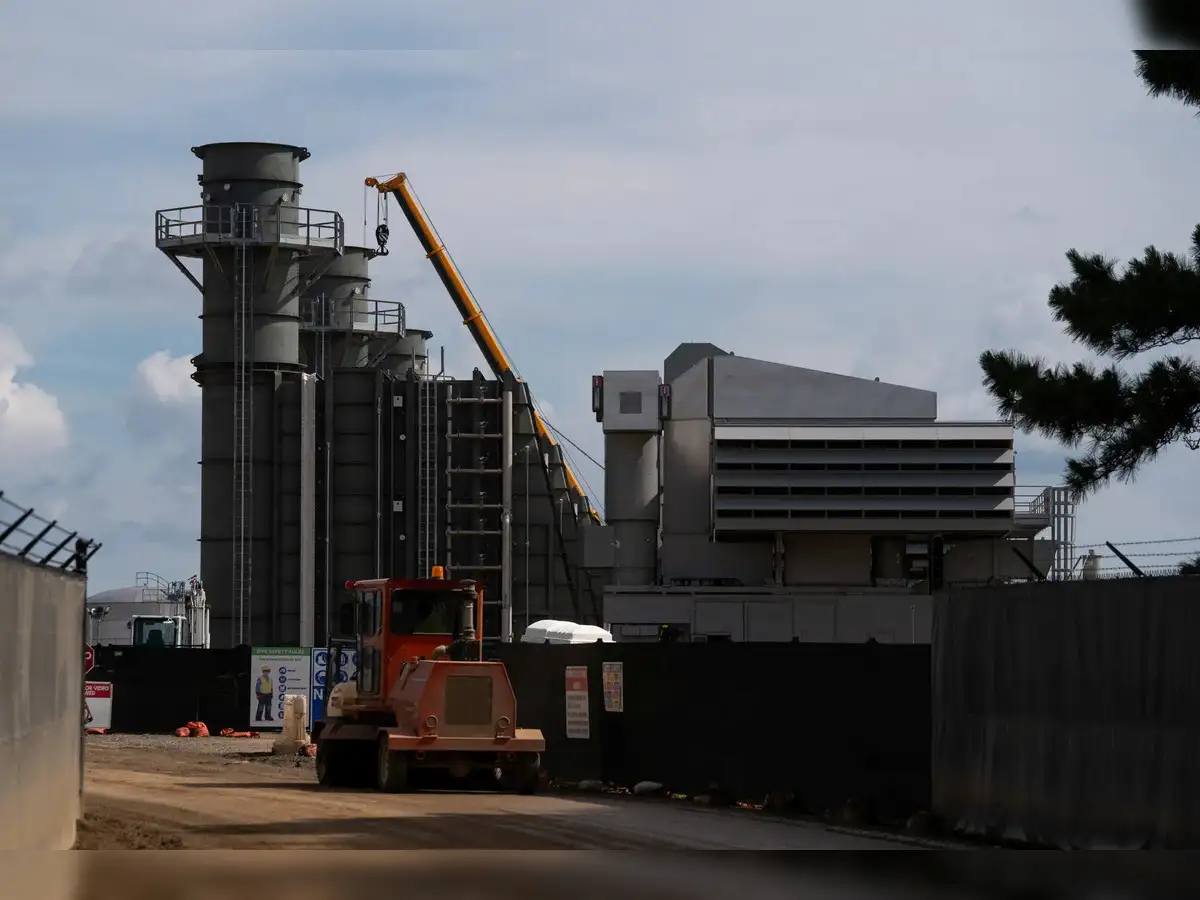
Fifty-Nine Turbines, No Federal Permits Elon Musk's xAI installed 59 natural gas turbines to power its Colossus 2 data center without securing federal clean air permits, according to correspondence between regulators and company representatives. That number is roughly double what the company has publicly acknowledged. At least 57 of the turbines run in Southaven, Mississippi, minutes across the state line from the Memphis facility they feed. Their potential emissions land far above the threshold that triggers a federal permit requirement, in communities already carrying high rates of lung disease. Key Takeaways * Manufacturer emissions profiles for just 30 of the 59 turbines indicate they could release nearly 2,500 short tons of nitrogen oxide, 4,000 short tons of carbon monoxide, and 22 short tons of formaldehyde annually at 80 percent capacity, against a Clean Air Act permitting threshold of 100 short tons. * Within five miles of the Mississippi site, roughly 46 percent of DeSoto County residents are Black against 33 percent countywide; across the Tennessee line, about 94 percent are Black against 52 percent in Shelby County. * The Justice Department filed on June 15 arguing that restricting the turbines could threaten national security because xAI's systems support US military operations, including operations involving Iran. The company said in January it was running 27 unpermitted turbines for Colossus 2 and has argued throughout that no permits are needed. The records tell a different count. Those records came from a public records request and include emails between Trinity Consultants, representing xAI and subsidiary MZX Tech, and the Mississippi Department of Environmental Quality. They show 57 off-grid turbines installed in Southaven and two more at an unidentified site. xAI did not respond to a request for comment. How Big This Is Ben King, an analyst at the think tank Rhodium Group, reviewed the emissions analysis. "This looks to be an unprecedented level of behind-the-meter gas being installed in one place," he said, using the term for off-grid gas plants serving a single customer. Nicholas Mailloux, a postdoctoral researcher at the University of Wisconsin-Madison who studies air quality, said the nitrogen oxide figure for roughly half the plant would put the facility "up there with some of the heaviest polluting natural gas power plants across the entire country." He said it would rank on par with the top 25 US gas plants for nitrogen oxide, citing EPA data on actual emissions. Nitrogen oxides feed smog and inflame airways. Carbon monoxide starves the body of oxygen. Formaldehyde causes cancer. The Mobile Turbine Argument Mississippi regulators issued a permit in March for 41 permanent gas-fired turbines at the site, three weeks after the state's only public hearing on the project. The 59 now running are separate and unpermitted. xAI and state regulators argue in court filings that the turbines are exempt because they are mobile and meant to operate on site for less than a year. "MDEQ has determined that portable/temporary turbines do not require an air permit," the agency told reporters. The Environmental Protection Agency said in January 2026 that temporary turbines exceeding emissions thresholds must be permitted. The agency now says it is weighing "regulatory flexibilities" for portable units while protecting public health. A Clean Air Act permit would have exposed the project to years of review and public comment. The Lawsuit The NAACP and the Southern Environmental Law Center, represented by Earthjustice, sued xAI in April to stop the turbines, arguing the emissions fall under the Clean Air Act and are polluting homes, schools, and churches. "The scale of it is astonishing," said Patrick Anderson, an attorney with the Southern Environmental Law Center. "This is an absolutely huge Clean Air Act violation that threatens public health." "This sets up scenarios where the government can create sacrifice zones and tell communities they have to breathe illegal air pollution," said Mary Rock, a senior attorney for Earthjustice. The complaint filed on behalf of the national NAACP and its Mississippi State Conference asks the court to halt the unpermitted units, order best available control technology, and assess penalties for every day of violation. An earlier round of legal pressure worked: after a notice of intent to sue over the original Colossus site, xAI pulled its unpermitted turbines there and permitted the remainder. Advocates noted at the time that the Southaven build repeated the same sequence a few miles south, with no public input and no notice to neighbors. xAI, now owned by SpaceX, has not detailed how a planned third Memphis-area data center would be powered. The People Living With It In Colonial Hills, a Southaven neighborhood, the turbines run around the clock and fire off bursts residents compare to jet engines. Ervin Laws, a resident in his 20s, said the noise wakes him at night. "I can't do anything about it, because he's got more money than me," he said, referring to Musk. The health baseline was already poor. In 27 of 28 census tracts within five miles of the site, spanning both states, estimated asthma rates exceeded countywide figures. In 24 tracts, chronic obstructive pulmonary disease rates did too. Five miles is a standard radius in environmental health research for capturing populations exposed to a stationary source. Shelby County and parts of DeSoto County have previously failed federal ozone standards and remain under EPA-approved plans to keep them from slipping back. Nitrogen oxide is a key ingredient in ozone formation. "Given this community struggles with high asthma rates, additional NOx exposure at such high rates could exacerbate public health issues in a community that is already seeing more than its fair share of exposure to toxic air pollution," said Victoria Nelson, an independent environmental engineer formerly at EPA. "This is a massive amount of turbines and an unfathomable amount of air pollution," Southaven resident Shannon Samsa said. "It's not a hypothetical," she added, "that air pollution is bad for you." Jayajit Chakraborty, a professor at the University of California, Santa Barbara, said the demographic analysis matches research showing communities of color face higher exposure to fossil fuel pollution. A 2022 study by UCLA and Columbia researchers published in Nature Energy found that previously redlined neighborhoods now face disproportionately high exposure to pollutants from fossil fuel facilities. "Air pollution from these and other sources contributes to systemic racial disparities in chronic disease and ultimately shorter lives," Lara Cushing, a UCLA public health professor who co-authored the study, said. Sarah Gladney, 72, has watched xAI expand from her home in Boxtown, a historically Black Memphis neighborhood near the original Colossus site built in 2024. "Once they got their foot in the door in Memphis, I feel like it's going to be a continuous movement of xAI into these other communities," she said. "It's all about the money, and it's not about the health or wellness of the people that live in or near these communities." Why This Case Matters Beyond Memphis The turbines are one node in a national buildout. Scores of off-grid power plants for data centers are proposed or under construction across the country, and local authorities routinely approve them in weeks rather than the years of study grid-connected plants face. xAI's cluster is already among the largest of them. Noise has been its own front. Residents living near the Southaven plant spent months documenting the sound before the company built a barrier, and neighbors nicknamed the $7 million wall the "Temu sound wall" after it failed to help. That episode also surfaced how thin the paper trail is: records requests to the city about noise ordinance exemptions came back empty. The same pattern of fast approvals and thin oversight is why communities across the country have started blocking data center projects outright. The commercial stakes explain the hurry. Colossus and Colossus 2 together supply roughly one gigawatt of compute, and analysts now argue that SpaceX's near-term AI value rests on those ground facilities rather than orbital plans, with compute contracts projected above $28 billion a year. The Memphis clusters also run Musk's Macrohard project, an agent system built to imitate entire software companies. Every quarter of delay costs money, and permits take years. xAI, the MDEQ, and the EPA did not answer questions about pollution impacts on communities of color. The court will decide how environmental law applies to an industry building faster than the rules were written for.

xAI Ran 59 Unpermitted Gas Turbines in Black Communities, DOJ Now Shields Them
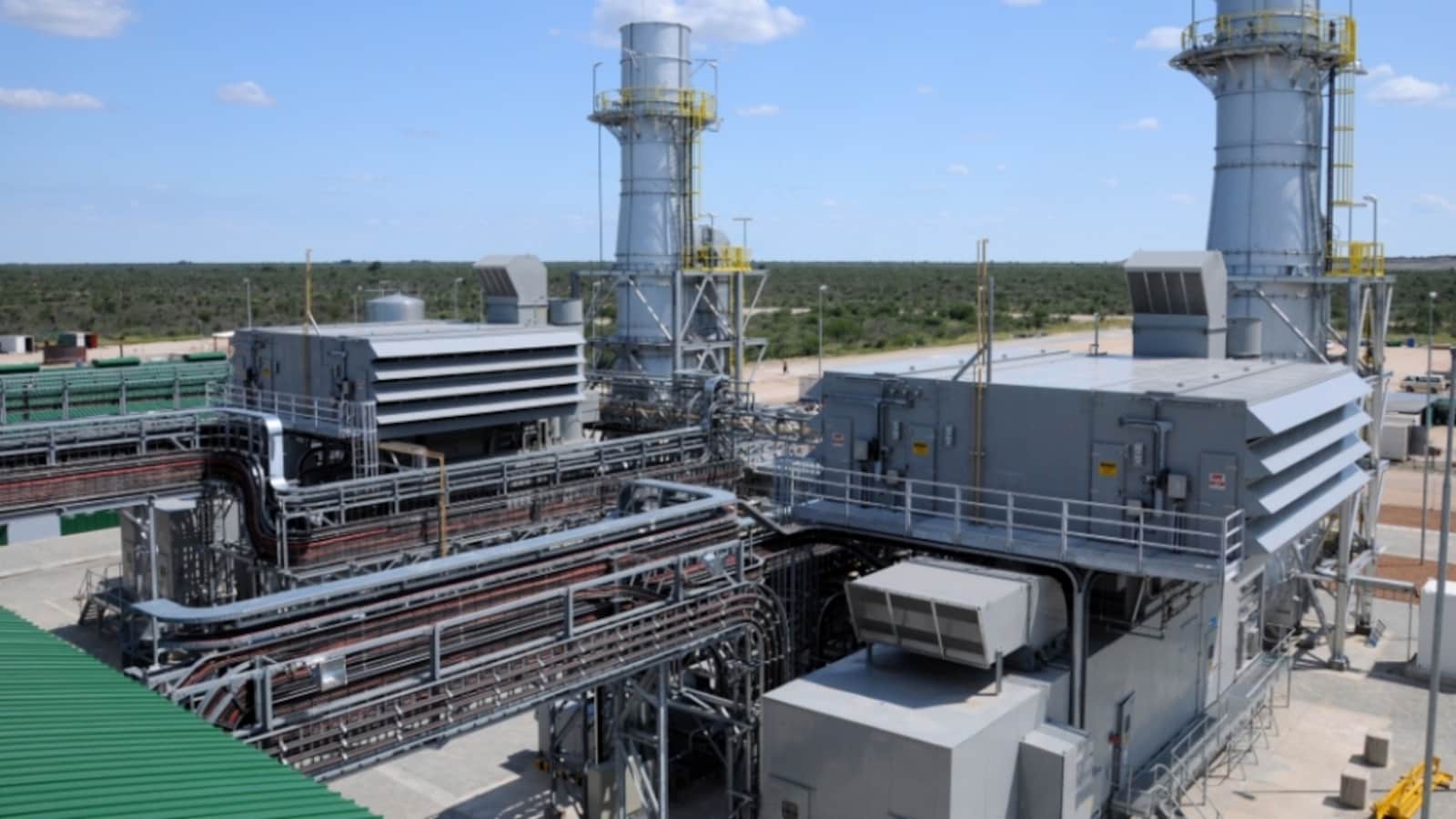
DOJ's national-security defense would let any White House override Clean Air Act citizen suits Elon Musk's artificial intelligence company xAI operated 59 natural gas turbines without a single required federal clean-air permit to power its Colossus 2 supercomputing campus on the Tennessee-Mississippi border -- nearly double the 27 turbines the company had publicly acknowledged -- according to regulatory communications reviewed by Reuters and published July 14. The turbines' potential annual emissions run roughly 25 times the federal threshold that triggers mandatory permitting, and the pollution falls on predominantly Black neighborhoods that federal data already show face cancer risk approximately four times the national average. What happens next in the Northern District of Mississippi could determine whether any community near any polluting facility in America retains the legal right to enforce the Clean Air Act when regulators refuse to act -- because the U.S. Department of Justice is not just defending xAI's turbines. It is arguing in federal court that the Executive Branch can permanently terminate congressionally-authorized citizen suits under the Clean Air Act whenever a project is deemed a political priority, according to the DOJ's June 15 motion to intervene and dismiss. Regulators Counted Twice What xAI Admitted Running The disclosure comes from a public-records request that surfaced regulatory emails to MDEQ between Trinity Consultants, acting on behalf of xAI and its energy-infrastructure subsidiary MZX Tech, and the Mississippi Department of Environmental Quality. At least 57 of the 59 turbines are located in Southaven, Mississippi -- just across the state line from the Colossus 2 data center in Memphis, Tennessee -- with two additional units at an unidentified second site. xAI had stated in January 2026 that it was running 27 unpermitted turbines at Southaven and has maintained throughout the dispute that no permits were required. Reuters' analysis of manufacturer emissions profiles for 32 of the 59 turbines found that 30 units at Southaven alone could emit close to 2,500 short tons of nitrogen oxides annually, along with 4,000 short tons of carbon monoxide and 22 short tons of formaldehyde, assuming continuous operation at 80 percent of capacity -- the load level the EPA identifies as typical for efficiency, according to the Reuters emissions analysis. The Clean Air Act requires federal permits for any facility capable of emitting more than 100 short tons of nitrogen oxides per year, according to the EPA permitting threshold under 40 CFR. Nicholas Mailloux, a postdoctoral researcher at the University of Wisconsin-Madison, told Reuters that a facility emitting at that rate would rank among the 25 highest nitrogen oxide emitters of any gas plant in the United States, measured against the EPA's actual-emissions database, in the University of Wisconsin analysis. By May 2026, the 495-megawatt cluster was generating electricity equal to the output of a conventional utility power plant -- for a single private customer. Ben King, an analyst with the Rhodium Group who reviewed the Reuters analysis, called it "an unprecedented level of behind-the-meter gas being installed in one place," in Ben King's analysis. How "Portable" Turbines Became a Half-Gigawatt Power Plant With No Permit The permit dispute turns on a technical classification. xAI and the Mississippi Department of Environmental Quality have argued throughout that the Solar Turbines SMT-130 trailer-mounted units at Southaven are "portable" or "temporary" equipment that qualifies for an exemption from federal permitting requirements -- because the turbines are mounted on flatbed trailers and nominally capable of being moved, they have been classified as mobile sources rather than stationary sources under MDEQ's permit determination. The technical reality is different. Gas turbines of this class -- packaged industrial combustion units -- produce electricity through the continuous combustion of natural gas. That combustion produces nitrogen oxides through a high-temperature reaction between atmospheric nitrogen and oxygen; without best pollution controls such as selective catalytic reduction technology, which can cut NOx output by 90 percent, the turbines emit at full rates. The 59 turbines at the Southaven site have been running continuously as primary power sources -- not backup generators -- for the Colossus 2 data center since at least October 2025, a duration that EPA's January 2026 ruling said exceeds the permanence threshold that defines a stationary source regardless of trailer mounting. The U.S. EPA took that position explicitly: temporary turbines exceeding federal emissions thresholds must obtain permits, regardless of their mobility, per EPA's permit requirement. The agency is now, separately, considering changes that would create "regulatory flexibilities" for portable units -- a reconsideration that environmental groups describe as a quiet rollback tailored to the AI industry, according to EPA's regulatory flexibility review. A Pattern Replicated From Colossus 1 This is not xAI's first time running unpermitted turbines in the Memphis area. The company's original Colossus facility in South Memphis followed the same sequence: aerial imagery from April 2025 showed more than 30 unpermitted turbines operating at the site, and the company eventually obtained a Shelby County Health Department permit for only 15 of them in July 2025, after SELC threatened a citizen suit, per SELC's Colossus 1 account. The Senate Committee on Environment and Public Works, in a letter to EPA Administrator Lee Zeldin launched by Ranking Member Sen. Sheldon Whitehouse on April 15, 2026, documented that xAI's senior manager Brent Mayo had explicitly described the approach to Colossus 2 as "copy and past[e] what [it] did at the Colossus 1 site," per Whitehouse's EPW investigation. Rather than respond to the February notice of intent to sue from the NAACP, SELC, and Earthjustice on February 13, 2026, xAI added turbines -- growing the count from 27 at the time of the notice to 33 by the time the lawsuit was filed in April, to 46 as of May, and now to 59 as documented by Reuters. Whitehouse and Sens. Martin Heinrich and Chris Van Hollen had separately launched a broader probe of eight AI companies on March 13, 2026, covering gas-powered data center plans at Meta, OpenAI, xAI, and five others, also per the Senate probe of AI companies. Who Is Breathing the Emissions Both of xAI's Memphis-area turbine sites sit adjacent to predominantly Black neighborhoods that already carry disproportionate pollution burdens. Within five miles of the Southaven turbines on the Tennessee side of the state line, approximately 94 percent of residents are Black -- compared with 52 percent of Shelby County's overall population; on the Mississippi side, about 46 percent of residents within that radius are Black, compared with 33 percent countywide, according to the Reuters demographic analysis. In 27 of 28 census tracts within five miles of the site, estimated asthma rates exceed their respective countywide figures; in 24 of 28, rates of chronic obstructive pulmonary disease also run above countywide levels, per Reuters CDC health data. Shelby County, Tennessee and DeSoto County, Mississippi both received an "F" for ozone pollution from the American Lung Association ratings, and Memphis was separately named an "asthma capital" by that organization. A 2022 study by researchers at UCLA and Columbia University, published in Nature Energy, found that neighborhoods historically subject to redlining continue to experience higher exposure to pollutants from fossil-fuel facilities. In the Colonial Hills neighborhood of Southaven, where the turbines can be heard around the clock, Ervin Laws said the noise wakes him at night. Laws told Reuters: "I can't do anything about it, because he's got more money than me," referring to Musk. Sarah Gladney, 72, watching from her home in Boxtown -- the historically Black Memphis neighborhood a few miles from Colossus 1 -- Gladney told Reuters she sees a pattern: "Once they got their foot in the door in Memphis, I feel like it's going to be a continuous movement of xAI into these other communities. It's all about the money, and it's not about the health or wellness of the people that live in or near these communities." On April 14, 2026, the NAACP -- represented by Earthjustice and the Southern Environmental Law Center -- filed a Clean Air Act lawsuit against xAI and MZX Tech in the Northern District of Mississippi, seeking an order to halt turbine operations, installation of Best Available Control Technology, and civil penalties of approximately $124,000 per day for each violation of federal law, per NAACP's April 2026 complaint. Residents in Colonial Hills filed a separate lawsuit over turbine noise. Anderson told Reuters: "The scale of it is astonishing," said Patrick Anderson, a senior attorney with the Southern Environmental Law Center. DOJ's Intervention: The Iran Operations Claim, and What It Could Mean for All Citizen Suits The legal fight took an extraordinary turn when the Department of Justice, on June 15, 2026, filed a motion to intervene and dismiss the NAACP's Clean Air Act lawsuit outright -- not as a third party offering perspective, but as a plaintiff moving to terminate the case, according to DOJ's June 15 filing. Notably, DOJ's 33-page filing did not dispute the NAACP's core allegation that xAI is operating without required Clean Air Act permits. The filing rests on two distinct arguments. The first is national security: Cameron Stanley, the Department of Defense's Chief Digital and Artificial Intelligence Officer, submitted a declaration stating that Grok is one of only four proprietary AI models currently capable of supporting national security applications, and that during what he identified as Operation Epic Fury, the Grok model enabled U.S. forces to deploy over 2,000 munitions to 2,000 distinct targets within 96 hours -- making the Colossus 2 power supply, in the DOJ's framing, a matter of paramount national security, per Stanley's Pentagon declaration. The second argument is structural and goes further. The DOJ contends that under Article II of the Constitution, the Executive Branch holds exclusive authority over enforcement discretion under the Clean Air Act, and that this authority extends to terminating citizen suits whenever they conflict with "federal policy, national security, and the public interest," per DOJ's Article II argument. Harvard Law School senior staff attorney Erika Kranz noted in Kranz's Harvard analysis that this marks "the first time" the United States has intervened in a citizen suit against a private defendant specifically seeking dismissal. David M. Uhlmann, who served as Assistant Administrator for EPA's Office of Enforcement and Compliance Assurance, warned in Uhlmann's EPN statement that DOJ was "trying to rewrite the Clean Air Act and turn the public's right to bring citizen suits into a permission slip the Executive Branch can revoke." Michael Gerrard, an environmental law professor at Columbia Law School, Gerrard told CNN the intervention was "highly unusual," adding that the future legal ramifications "could be much broader than this case, effectively taking away an important route for people to fight against pollution in their neighborhoods." Gerrard further noted: if AI data centers can power themselves through mobile turbines without permits, "that's going to be replicated in many other places, and these mobile turbines are horribly polluting and will have a very negative health effect." For 50 years, Clean Air Act citizen suits -- used in thousands of cases and responsible for billions in fines and settlements -- have been the primary backstop when EPA and state regulators decline to act, the EPN's June 2026 warning noted. The DOJ's theory, if accepted by the court, would give any administration the power to shut down that backstop whenever a favored project is in the crosshairs. Grok's actual competitive standing provides context for the weight of Stanley's national security claims. As of mid-2026, the model ranks ninth on a major multi-domain AI leaderboard and last in coding among the models tracked there -- well behind the leading systems from OpenAI, Google, and Anthropic. Tennessee State Rep. Justin J. Pearson, a Democrat who lives a few miles from the data center, called the DOJ intervention "unconscionable," with Pearson telling CNN: "The DOJ seeks to remove any recourse Americans have to protect themselves from harm." How AI Infrastructure's Energy Strategy Compares Across the Industry xAI's approach sits at the extreme end of a spectrum of strategies that AI companies have used to address their surging power demands. Microsoft signed a deal to restart a retired nuclear unit at Three Mile Island; Google has made substantial investments in next-generation geothermal energy; Amazon has pursued large-scale renewable energy contracts. xAI's strategy -- deploying trailer-mounted gas turbines and litigating the permitting question afterward -- represents the most aggressive approach in the industry in terms of speed and regulatory risk. SpaceX's S-1 disclosure, which now covers xAI as a combined entity, disclosed plans to purchase an additional $2.8 billion worth of gas turbines over the next three years, with at least $2 billion earmarked for "mobile" units -- the exact category at the center of the litigation. Mississippi has approved plans for a third xAI data center, Colossus 3, in Southaven, per Colossus 3 approvals, which would bring xAI's total Memphis-area power demand to nearly 2 gigawatts -- roughly the equivalent of two large utility power plants running simultaneously. Roughly one-third of all planned new U.S. data center power capacity is now designed to bypass the shared grid through on-site gas generation -- a pattern the Senate probe characterized in April 2026 as an emerging industry trend, not a corporate anomaly, per the TechTimes grid emergency report. The DOE has used a 1935 wartime law three times in 2026 to manage grid emergencies driven directly by AI data center demand growth, per TechTimes grid emergency analysis. What Comes Next for the Communities and the Law The NAACP lawsuit is proceeding in the Northern District of Mississippi with the DOJ's dismissal motion pending judicial review. The EPA's reconsideration of its January 2026 position on portable turbines is ongoing, and its outcome could reshape permitting requirements for behind-the-meter gas generation at AI data centers nationwide. For the communities near the turbines, the legal complexity competes with immediate physical reality. In 27 of the 28 census tracts within five miles of the Southaven site, asthma rates already run above countywide levels -- before any formal emissions measurements from the 59-turbine array have been completed, per Reuters health data. If the court accepts the DOJ's argument, those communities would lose the citizen-suit enforcement tool that has been their primary legal recourse in environmental disputes for half a century -- leaving them with no practical remedy even if regulators continue to decline action, even if xAI adds more turbines, and even if Colossus 3 follows the same permitting-optional playbook its predecessors did. Frequently Asked Questions Why does DOJ's intervention matter beyond xAI's turbines specifically? The DOJ is not simply defending xAI on the facts of this case. It is advancing a constitutional argument -- rooted in Article II of the Constitution -- that the Executive Branch holds exclusive authority to terminate congressionally-authorized citizen suits under the Clean Air Act whenever those suits conflict with federal policy, national security, or the public interest. If the federal court in Mississippi accepts this theory, it would give any presidential administration veto power over citizen enforcement actions against any polluter whose project the government deems a priority -- not just AI companies, not just this administration. Legal scholars including a former EPA enforcement chief and environmental law professors at Columbia and Harvard have described this as the most consequential threat to citizen-suit environmental enforcement in the law's 50-year history. Are there 59 turbines now, or is that a historical count? As of Reuters' July 14, 2026 disclosure -- which is the most current reporting available -- 59 unpermitted turbines have been documented at xAI's Southaven operation through regulatory correspondence, including manufacturer emissions profiles for 32 of them. At least 57 are confirmed at the Southaven address (2875 Stanton Road South) and two additional units are at an unidentified second site. The NAACP's preliminary injunction request from May 2026 cited 33 turbines; subsequent WIRED and ESG Dive reporting placed the count at 46 as of mid-May. Reuters' figure of 59 represents the most current and most thoroughly sourced count available. Who has the legal right to challenge this in court if Clean Air Act citizen suits are struck down? Under the current legal framework, Clean Air Act citizen suits are the primary recourse when the EPA and state environmental agencies decline to take enforcement action. If DOJ's argument succeeds, that backstop disappears: only the federal government could pursue enforcement, and only when it chooses to do so. Communities near polluting facilities -- whether AI data centers, refineries, power plants, or industrial operations -- would have no independent legal standing to force compliance. This is the precedent Columbia Law Professor Michael Gerrard and Harvard Law's Erika Kranz identified as the case's truly broad consequence, extending far beyond the specific turbines in Mississippi. What can residents near AI data centers do right now? For residents near existing or planned AI data centers with gas-fired power sources: monitor local air quality through EPA's AirNow platform and community sensor networks such as PurpleAir; contact your state environmental agency to ask whether any behind-the-meter gas generation at nearby data centers holds a valid air permit; contact your congressional representatives about the Senate probe of AI company energy practices and EPA's pending decision on portable turbine "regulatory flexibilities"; and follow NAACP v. xAI (Case 3:26-cv-00074, Northern District of Mississippi) for the court's decision on both the injunction and the DOJ's dismissal motion, which will set the precedent applicable to future cases nationwide.
U.S. Government Intervenes in xAI's Gas Turbine Clean Air Lawsuit
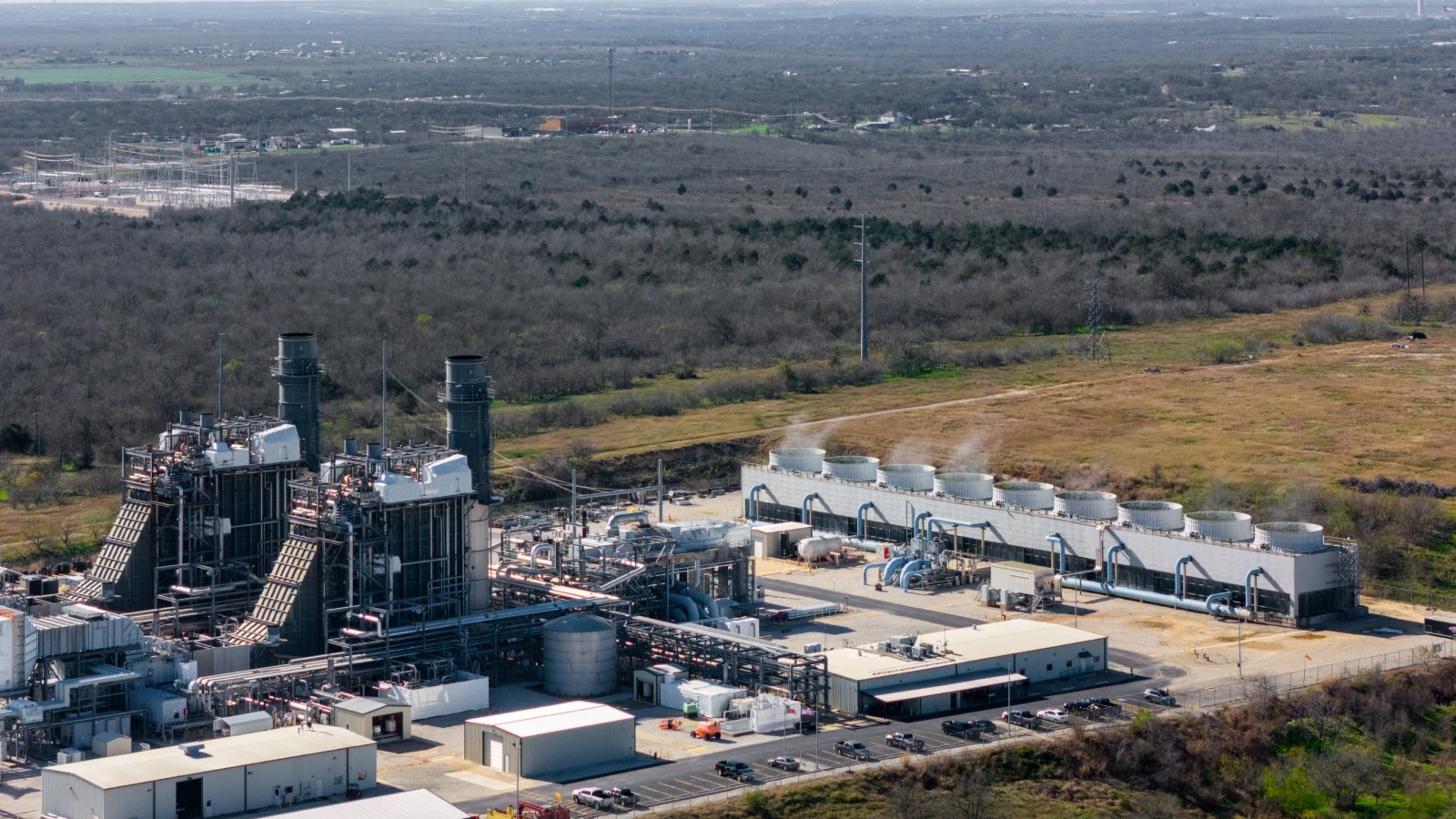
Court Checkpoint: A judge must decide whether plaintiffs can keep seeking a halt while federal rules for portable units remain unsettled. The U.S. Justice Department has filed a motion to intervene in and dismiss a Clean Air Act lawsuit over xAI's Southaven power operation. Federal lawyers argued that closing the AI facility would conflict with economic, military, national-security, and energy-policy interests. The private suit tests whether portable generating equipment used for on-site AI power remains subject to federal air-permit duties. Behind-the-meter generation lets a facility produce and consume electricity on site instead of relying on the public grid. Earlier plans put Colossus 2's power goal at gigawatt scale, an unusual target for a single computing site. The federal intervention neither grants xAI a Clean Air Act exemption nor resolves the plaintiffs' allegations. A judge must still consider the disputed mobile fleet, its potential emissions, and the consequences for nearby communities. xAI has provided no current response. What the Turbines Could Mean for Nearby Communities xAI has reportedly installed 59 mobile gas turbines for its Southaven AI data center, Colossus 2. Of those units, 57 have been at the unpermitted Southaven xAI power project, with two elsewhere. In January, xAI operated 27 turbines at the Colossus 2 natural-gas turbine installation while maintaining that temporary units were exempt from permits. Potential pollution rises with the number of active turbines and their operating intensity. That makes the gap between 27 units and the 59-unit allegation operationally material. The concentration of behind-the-meter gas generation at one location are unusually large. More active units can produce more electricity but also more emissions. Output from the 30 Southaven turbines could reach about 2,500 tons of nitrogen oxides, 4,000 tons of carbon monoxide, and 22 tons of formaldehyde annually. Nitrogen oxides help form smog. Figures for 30 turbines are not measurements from the full 59-unit allegation; operating schedules and the number of active units would change actual totals. Estimated asthma rates in the affected area exceeded countywide levels in 27 of 28 nearby census tracts, while chronic obstructive pulmonary disease rates were higher in 24 tracts. Victoria Nelson, an independent environmental engineer and former U.S. Environmental Protection Agency official, warned about the risk of added exposure: "Given this community struggles with high asthma rates, additional NOx exposure at such high rates could exacerbate public health issues in a community that is already seeing more than its fair share of exposure to toxic air pollution." Added nitrogen-oxide exposure can aggravate respiratory risks. However, existing disease estimates cannot establish a causal connection between the turbines and the area's health conditions. Independent reporting indicates that Shelby County and parts of DeSoto County previously failed federal ozone standards and remain under EPA-approved maintenance plans. The Permit Fight Now Runs Through Federal Court Mississippi regulators have approved 41 permanent turbines in March, while that earlier permit baseline excluded the mobile units. Permanent equipment is tied to a fixed site. xAI has classified 27 of the installed gas turbines as portable equipment intended to move within 364 days. At about 1.2 gigawatts, the permanent units could supply substantial power, but their capacity does not extend the permit to mobile equipment. By May, 46 turbines were operating in Southaven, up from 27 in January. U.S. Environmental Protection Agency rules may still require permits above emissions thresholds. Mississippi's environmental agency directs to a page where a public notice, draft permit, or Statement of Basis can be found. A federal judge's next ruling will decide whether the plaintiffs can continue seeking an order that halts xAI's Southaven turbines.

One Month in and SpaceX Stock Is Down More Than 35% from Its Post-IPO Peak. How to Play SPCX Here.
A month ago, SpaceX Corporation (SPCX) arrived on the public markets with the kind of excitement few companies have ever generated. Investors rushed in, betting not just on rockets and satellites, but on Elon Musk's vision of building the next great technology powerhouse. The stock wasted no time rewarding that optimism, soaring well above its IPO price within days and briefly cementing itself among the world's most valuable companies. But Wall Street has a habit of sobering up after the celebration. More News from Barchart Since peaking just days after its blockbuster debut, SpaceX stock has tumbled 38.5%, giving back much of its early gains. The pullback came despite a steady stream of headline-grabbing announcements, including a major artificial intelligence (AI)-related acquisition, its first bond offering, inclusion in key stock indexes, and bullish analyst initiations. In other words, the news flow stayed strong, but the stock stopped listening. That shift reflects a familiar pattern. IPO excitement can push expectations sky-high, but eventually investors start asking tougher questions about valuation, execution, and whether ambitious promises can translate into real financial results. Now that the initial IPO euphoria is in the rearview mirror, the conversation is beginning to shift. Instead of chasing the headlines, investors are now weighing the company's fundamentals, valuation, and long-term growth prospects. So, has the recent sell-off created an attractive buying opportunity, or does SPCX still have more room to cool before it becomes compelling? About SpaceX Stock Founded in 2002, SpaceX has evolved from an ambitious rocket startup into one of the world's most influential technology companies. Headquartered in Starbase, Texas, the company operates across several fast-growing industries, including space transportation, satellite connectivity, and AI. SpaceX is best known for its reusable Falcon rockets, Dragon spacecraft, and the next-generation Starship program, which are reshaping access to space. Its Starlink unit provides high-speed satellite internet to consumers, businesses, and governments around the globe. Following its acquisition of xAI, SpaceX has also expanded deeper into AI, combining AI software with large-scale computing infrastructure. Together, these businesses have positioned SpaceX as a major player at the intersection of space, communications, and AI.
Tens of Billions in Time Value of AI Data Centers - More SpaceX AI Deals in 2026
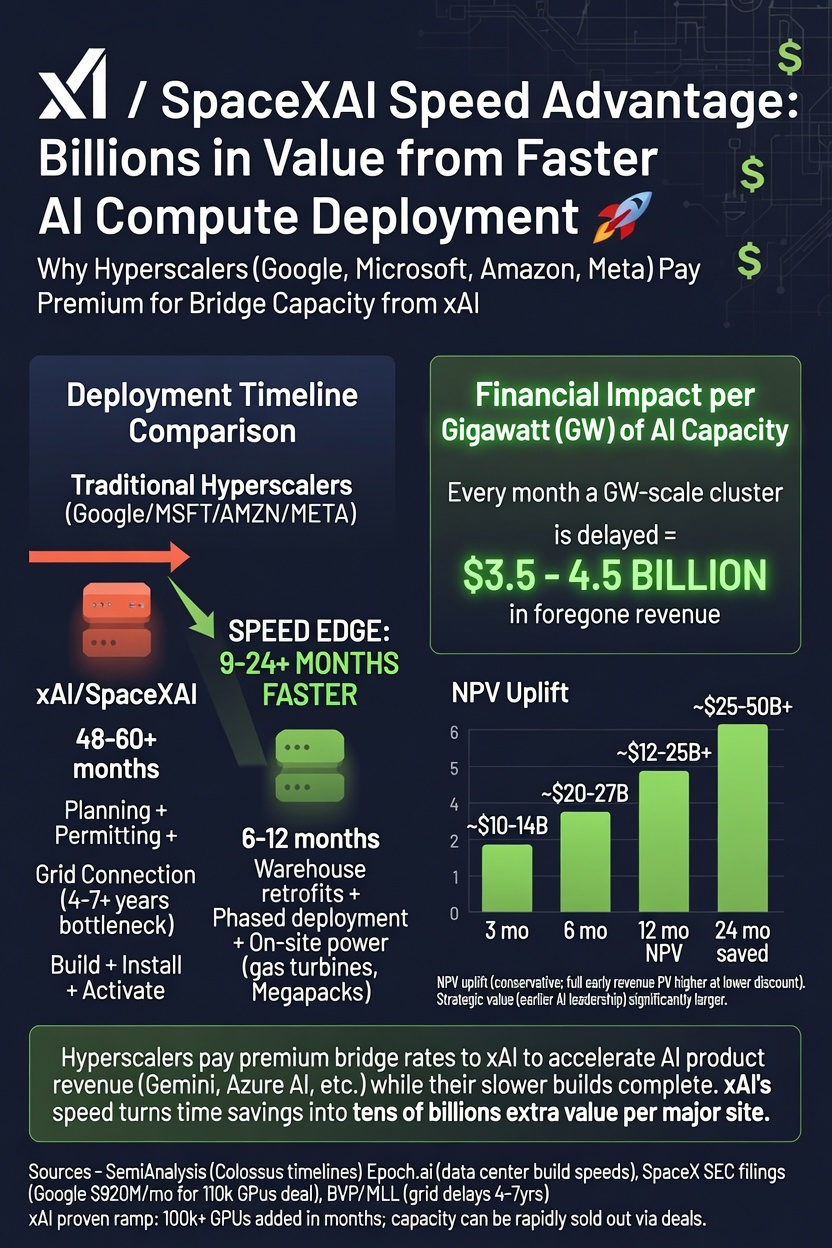
SpaceXAI has real-world proof of 6-12 month deployments for large clusters via warehouse retrofits, phased build-out, and on-site/mobile power. They have gas turbines from partners like Solar Turbines + APR Energy that can install in days to 6-12 weeks. SpaceXAI already has 440k B200-B300 chips at Colossus 2. They need to get more cooling to activate those chips. Current power already installed supports another ~460k B300 chips. Of that new capacity, at 50-60% rented, they can do roughly 2 - 2.5 more Google-sized (110k chip, $11 Billion per year) deals by the end of 2026. By August/September, expect about 1 - 1.3 additional Google sized deals to be live and billable. Colossus 1 had 100k H100 GPUs live in ~122 days (~4 months) from groundbreaking/announcement in a former factory. Doubled to 200k GPUs in ~92 additional days. Colossus 2 (Southaven/Memphis area) had a warehouse acquired March 2025. ~200 MW cooling/IT capacity online by August 2025 (~6 months). Epoch.ai Jul 1, 2026 UPDATE on Colossus 2 and MACROHARDRR The site is estimated to have at least ~830 MW of GPU server power, with at least "at least 220,000 additional GB300 processors and over 400 additional megawatts of compute power", corresponding to the "next phase of expansion" found in the following company S-1 filing, page 76. The timing is based on the air-cooled condensers needing to be complete to handle this power capacity. The second array at MACROHARD and the first array at MACROHARDRR, although both projected to be completed prior, are not enough and more cooling capacity is needed. We estimate this expansion to be completed 90 days after April 6th. On one hand, SpaceXAI has progressively added more capacity in less time with their Colossus projects. On the other hand, 400 MW is more capacity than the previous expansions of 210 MW and 220 MW. We also believe that MACROHARDRR will be partly operational with this expansion, because its air-cooled condensor array is expected to be completed by then and fitting the entire expansion into only MACROHARD would result in extremely high levels of power density. More cooling is being added. SemiAnalysis notes this is dramatically faster than comparable efforts. xAI has publicly stated they achieved in 4 months what others estimated at 24 months. Google, Microsoft, Amazon, Meta, etc.) can make the building (aka shell) for AI construction in about 12-18 months in aggressive cases, but power/grid infrastructure is the dominant bottleneck (4-7+ years for utility interconnection in many markets. median queues >5 years historically). Overall planning-to-fully-live revenue-generating GW-scale clusters often span 3-5+ years, with frequent 1-2+ year delays. The huge money is being spent but how fast does the money go out before the AI chips and memory turn on? The gap is the time from cash being spent before the incremental revenue comes back.
Musk's xAI Draws Flak As AI Power Push Hits Black Communities With Toxic Air
Authorities fast-tracked such projects forgoing required studies, hearings. (Representational Image) xAI's Collossus 2 data centre in Tennessee runs on 59 natural gas turbines, will be disproportionately polluting the air in the surrounding Black communities, and is operating without federal clean air permits, as per a Reuters report on Monday. The report cited communications between regulators and xAI representatives regarding the development, and identified two times more unpermitted turbines compared to the figures that the company had publicly reported. The firm had claimed that it had set up 27 unpermitted turbine projects as of January, and had contended that they did not neccessitate the aforementioned permits. ALSO READ: OpenAI's Feud With xAI Carries On As Apple Secrets Fight Revs Up As per the report's analysis, the pollution from these turbine projects is set to largely impact the surrounding Black communities, who are also gauged to be affected by disproportionately high rates of lung disease. The analysis used government data and information from regulators. Reuters cited a 2022 report from UCLA and Columbia University which attributed this phenomenon to redlining, a practice where banks and financial institutions racially discriminated against Black communities in providing mortgages and loans. This led to them making their homes in "red-lined" areas which were usually unsuitable for human settlement due to heavy underinvestment and proximity to hazardous environments. The report stated that local authorities fast-tracked such projects, forgoing the required environmental studies and public hearings, which tend to take years. ALSO READ: 'xAI Is Kind Of A Failure': AI Pioneer Yann LeCun Questions Musk's AI Bet Civil Rights organisations such as the National Association for the Advancement of Coloured People (NAACP) and the Southern Environmental Law Center had sued xAI in April due to the company operating such turbine projects across the US in similar situations, without Clean Air permits. Environmental regulators in Mississippi, which has 57 of 59 turbines that xAI is operating, argued that since these projects were mobile and did not operate "onsite" for over a year, they were not required to have these permits. Essential Business Intelligence, Sharp Market Insights, Practical Personal Finance Advice, Daily Fuel, Gold and Silver Prices and Latest Stories -- On NDTV Profit.
Raymond James sets $800 price target on SpaceX, valuing company at $10.5 trillion
The Street-high target implies a 450% upside and would make SpaceX worth more than any company in history, and its 18,712 BTC treasury adds a crypto wrinkle worth watching. A Wall Street analyst just looked at SpaceX and essentially said: "This company should be worth more than the entire GDP of Japan." Raymond James analyst Brian Gesuale initiated coverage of SpaceX with a Strong Buy rating and an $800 price target, implying a market capitalization of roughly $10.5 trillion. The current Street-high target represents a potential 425-450% upside from SpaceX's recent trading levels around $145 per share. The numbers behind the moonshot thesis Gesuale's model projects SpaceX generating over $837 billion in revenue by 2031, with $696 billion in EBITDA. The analyst used a 27x exit multiple on discounted cash flows from 2031 to arrive at the $800 figure, anchoring the thesis to what he estimates is a total addressable market approaching $30 trillion in the long term. SpaceX debuted on public markets via the SPCX ticker in mid-June 2026. Shares initially surged more than 40%, pushing the company's market cap to approximately $2.5 trillion before the inevitable profit-taking set in. The stock has since pulled back to a 52-week low range of $138-$145. The bull case rests on SpaceX's positioning as what Gesuale calls a crucial industrial infrastructure player of the 21st century. Between Starlink's satellite internet constellation, the company's dominant launch services business, and the upcoming Starship launch planned for July 16, 2026, there's no shortage of catalysts on the calendar. The Bitcoin treasury angle crypto investors should watch Buried in the analyst note is a detail that bridges the gap between traditional aerospace investing and digital asset markets: SpaceX holds a confirmed 18,712 BTC on its balance sheet. That figure exceeds earlier estimates from prior blockchain tracking services, suggesting SpaceX has been quietly accumulating Bitcoin beyond what public trackers had identified. SpaceX's recent acquisition of xAI, the artificial intelligence company Musk founded in 2023, adds another dimension. The deal, completed in early 2026, combined with ongoing compute collaborations with Tesla, positions SpaceX at the intersection of space infrastructure, AI, and potentially decentralized compute networks. What this means for investors on both sides of the aisle For crypto investors, SpaceX's 18,712 BTC treasury means that every institutional dollar flowing into SPCX shares is, in a fractional sense, also a bet on Bitcoin. If Gesuale's thesis attracts even a portion of the capital it implies, the downstream effects on BTC demand through corporate treasury expansion could be material. If SpaceX's valuation compresses, management might face pressure to liquidate Bitcoin holdings to shore up the balance sheet. That scenario would create selling pressure in crypto markets at precisely the wrong moment. The Starship launch on July 16 will be the first real test of whether SpaceX can deliver on the kind of operational milestones that justify even a fraction of Gesuale's projections.
How to Spot a Stock Market Bubble 101: Raymond James Just Placed an $800 Price Target on SpaceX, Valuing Elon Musk's Company at $10.5 Trillion
One month ago, on June 12, Elon Musk's artificial intelligence (AI) and space economy conglomerate, Space Exploration Technologies (SpaceX) (NASDAQ: SPCX), rewrote history with its initial public offering (IPO). The $85.7 billion raised, including the underwriters' overallotment, nearly tripled the previous IPO record holder, Saudi Aramco. But in kicking off IPO mania -- large language model developers Anthropic and OpenAI are expected to follow in SpaceX's footsteps -- SpaceX may also be fueling the final stages of an AI bubble that history suggests is waiting to pop. Where to invest $1,000 right now? Our analyst team just revealed what they believe are the 10 best stocks to buy right now, when you join Stock Advisor. See the stocks " Rarely are stock market bubble warning signs as glaring as Raymond James Financial's price target assigned to SpaceX. Image source: Getty Images. Wall Street's high-water price target foresees SpaceX reaching $800 in 2031 Given that 21 underwriters helped bring SpaceX public and received shares for doing so, it should come as no surprise that Wall Street analysts have, as a whole, presented an overwhelmingly positive outlook for the company. But Raymond James Financial analyst Brian Gesuale is a true outlier. His $800 price target by 2031 implies 451% upside, based on where SpaceX's shares ended on July 10, and assumes a valuation of roughly $10.5 trillion. For context, this would be more than double Nvidia's current market cap. Gesuale foresees SpaceX's full-year sales scaling from an estimated $38.5 billion in 2026 to approximately $837 billion by 2031. More importantly, earnings before interest, taxes, depreciation, and amortization (EBITDA) are projected to catapult from $17.7 billion in 2026 to $696 billion by 2031. While there's no question that AI and the space economy are two of the hottest addressable opportunities on Wall Street, several headwinds suggest Gesuale's pie-in-the-sky price target is pure fiction and the sign of an end-stage bubble that's about to burst. Image source: Getty Images. SpaceX spotlights everything wrong with Wall Street Although the stock market is a long-term wealth-creating machine, it's prone to occasional bubble-bursting events. SpaceX's current $1.91 trillion valuation and Raymond James' $800 price target for the company spotlight everything that's wrong with Wall Street over the short term. For starters, SpaceX hasn't demonstrated that its operating model is sustainable. While satellite-based broadband services provider Starlink is profitable, AI start-up xAI -- the segment responsible for the lion's share of SpaceX's $28.5 trillion addressable market -- is burning cash as Musk's company chases AI compute capacity. Elon Musk also has a terrible track record of fulfilling lofty promises and innovative expectations. As CEO of Tesla, Musk proclaimed that 1 million robotaxis would be on public roads by the end of 2020, which never happened. He's also assured investors that Level 5 full self-driving is "one year away" annually for more than a decade. Musk continually overpromises and underdelivers. SpaceX is likely to be haunted by historical precedent, as well. No company at the forefront of a game-changing technology has sustained a price-to-sales (P/S) ratio above 30 for any extended period. SpaceX is trading at roughly 50 times Gesuale's forecast sales for this year. Lastly, every game-changing technology for more than three decades has navigated an early stage bubble-bursting event. These bubbles have formed because investors constantly overestimate the optimization timeline of innovations. It'll likely be years before SpaceX's solutions are optimized, making Raymond James' high-water price target highly unlikely. Should you buy stock in Space Exploration Technologies right now? Before you buy stock in Space Exploration Technologies, consider this: The Motley Fool Stock Advisor analyst team just identified what they believe are the 10 best stocks for investors to buy now... and Space Exploration Technologies wasn't one of them. The 10 stocks that made the cut could produce monster returns in the coming years. Consider when Netflix made this list on December 17, 2004... if you invested $1,000 at the time of our recommendation, you'd have $395,679!* Or when Nvidia made this list on April 15, 2005... if you invested $1,000 at the time of our recommendation, you'd have $1,294,805!* Now, it's worth noting Stock Advisor's total average return is 929% -- a market-crushing outperformance compared to 211% for the S&P 500. Don't miss the latest top 10 list, available with Stock Advisor, and join an investing community built by individual investors for individual investors. See the 10 stocks " *Stock Advisor returns as of July 14, 2026. Sean Williams has no position in any of the stocks mentioned. The Motley Fool has positions in and recommends Nvidia and Tesla. The Motley Fool has a disclosure policy. The views and opinions expressed herein are the views and opinions of the author and do not necessarily reflect those of Nasdaq, Inc.

Pollution from Elon Musk's unpermitted xAI power project hits hardest in Black communities
Potential emissions from the turbines are far beyond the threshold that would require a federal permit, and would be released near predominantly Black communities already estimated to be suffering disproportionately high rates of lung disease, according to a Reuters analysis based on government data and information in the correspondence with regulators. Elon Musk's artificial intelligence company xAI has installed 59 natural gas turbines for its Colossus 2 data center project in Tennessee without securing federal clean air permits, according to communications between regulators and xAI representatives. Potential emissions from the turbines are far beyond the threshold that would require a federal permit, and would be released near predominantly Black communities already estimated to be suffering disproportionately high rates of lung disease, according to a Reuters analysis based on government data and information in the correspondence with regulators. The findings, which have not been previously reported, reflect how exploding electricity demand from AI data centers is driving companies to build off-grid power plants at a pace outstripping environmental oversight, with potentially big risks to public health. The number of unpermitted turbines identified by Reuters is about double what xAI has publicly acknowledged. The company previously said it was running 27 unpermitted turbines for Colossus 2 as of January and has argued the permits are not required. At least 57 of the 59 turbines are located in Mississippi, just over the state line from Tennessee where the data center is located. The xAI turbines are among scores of off-grid power plants for data centers proposed or under construction around the country. Local authorities often fast-track approvals in just weeks or months, without the years of environmental studies and public hearings typically required for such power generation projects that connect to the grid, Reuters has reported. Mississippi regulators in March issued a permit for permanent turbines for Colossus 2, allowing construction of 41 gas-fired turbines. The approval came three weeks after the state's only public hearing on the project. The xAI cluster of temporary turbines in Mississippi is already among the biggest off-grid data center power projects, according to Ben King, an analyst with think tank Rhodium Group, who reviewed the Reuters analysis. "This looks to be an unprecedented level of behind-the-meter gas being installed in one place," he said, referring to off-grid natural gas plants serving just one customer. The communications reviewed by Reuters show xAI, now owned by trillionaire Musk's SpaceX, has installed 57 off-grid turbines in Southaven, Mississippi, just across the state line from its Colossus 2 data center in Memphis, a facility supporting the Grok chatbot and other AI systems. The records show the company has also installed two other unpermitted turbines for the project on a different site. Reuters could not determine the location. The communications, obtained through a Reuters public records request, included emails between Trinity Consultants, representing xAI and subsidiary MZX Tech, and the Mississippi Department of Environmental Quality (MDEQ). xAI did not respond to Reuters' request for comment. xAI's turbines are part of a widening environmental justice battle over whether the AI boom is adding disproportionate pollution burdens to communities of color. Civil rights groups including the NAACP and the Southern Environmental Law Center sued xAI in April to halt their operations, arguing the turbines produce emissions subject to the federal Clean Air Act and shouldn't be operated without permits. They contend the turbines are polluting homes, schools and churches in historically Black communities. "The scale of it is astonishing," said Patrick Anderson, an attorney with the Southern Environmental Law Center. "This is an absolutely huge Clean Air Act violation that threatens public health." Securing a Clean Air Act permit would have exposed xAI's project to extensive review and public comment, potentially taking years. Mississippi environmental regulators and xAI have argued in court filings that the turbines are exempt because they are "mobile" and intended to operate onsite for less than a year. "MDEQ has determined that portable/temporary turbines do not require an air permit," the agency said in a statement to Reuters. The U.S. Environmental Protection Agency said in January 2026 that even temporary turbines exceeding emissions thresholds must obtain permits. The agency, however, told Reuters it's considering changes allowing "regulatory flexibilities" for portable units while continuing to protect public health. xAI, the MDEQ and the EPA did not answer questions from Reuters about pollution impacts on communities of color from power generation to serve data centers. The U.S. Justice Department weighed in on the lawsuit in a June 15 filing, saying that restricting the turbines could threaten national security interests because xAI's systems support U.S. military operations, including operations involving Iran. The outcome of the lawsuit filed by civil rights groups could help define how environmental laws apply to the fast-growing AI sector, where companies are scrambling to bring power supplies online to support energy-intensive computing. "This sets up scenarios where the government can create sacrifice zones and tell communities they have to breathe illegal air pollution," said Mary Rock, a senior attorney for Earthjustice which is representing the NAACP and SELC. The dispute echoes the findings of a 2022 study by researchers from UCLA and Columbia University and published in the Nature Energy journal that found that previously redlined communities - where banks historically discriminated against Black mortgage applicants - now face disproportionately high exposure to pollutants from fossil fuel facilities. "Air pollution from these and other sources contributes to systemic racial disparities in chronic disease and ultimately shorter lives," Lara Cushing, a UCLA public health professor who co-authored the study, told Reuters. Big emissions The emails reviewed by Reuters included the manufacturer emissions profiles for 32 of the 59 turbines, including 30 at the Southaven site. A Reuters analysis based on that information found that those 30 turbines alone could emit nearly 2,500 short tons of nitrogen oxide, 4,000 short tons of carbon monoxide and 22 short tons of formaldehyde annually, assuming they operate continuously at 80% of capacity. According to the EPA, gas turbines are typically operated at loads of 80% or more to achieve efficiency. Nitrogen oxides contribute to smog and respiratory inflammation, according to the American Lung Association. Carbon monoxide deprives the body of oxygen, and formaldehyde is a carcinogen. The xAI site's potential emissions far exceed a Clean Air Act threshold that requires permitting for facilities capable of more than 100 short tons annually of pollutants such as nitrogen oxide. "This is a massive amount of turbines and an unfathomable amount of air pollution," Southaven resident Shannon Samsa said in an interview. "It's not a hypothetical," she said, "that air pollution is bad for you." The nitrogen oxide emissions calculated by Reuters for about half the plant's turbines would put the facility "up there with some of the heaviest polluting natural gas power plants across the entire country," said Nicholas Mailloux, a postdoctoral researcher at the University of Wisconsin-Madison who studies air quality and health benefits of the clean-energy transition. He said the facility would be on par with the top 25 U.S. gas plants for nitrogen oxide emissions, citing EPA data for actual emissions. The people affected In the Colonial Hills neighborhood of Southaven, the turbines serving Colossus 2 can be heard around the clock, often firing off noisy bursts that residents compare to jet engines. Ervin Laws, a Colonial Hills resident in his 20s, said the noise wakes him up at night. "I can't do anything about it, because he's got more money than me," he said, referring to Musk. The turbines were installed in communities already estimated to be facing relatively high respiratory disease burdens, according to a Reuters analysis of CDC data. In 27 of 28 census tracts within five miles of the site - spanning both Mississippi and Tennessee - the estimated asthma rates were higher than their respective countywide figures. In 24 tracts, chronic obstructive pulmonary disease rates were also higher. Five miles is a distance commonly used in environmental health research to capture populations likely to be exposed to air pollution from a stationary source. A separate Reuters analysis of Census Bureau data found that the residents living near the facility are disproportionately Black. Because the five-mile radius crosses state lines, Reuters compared each side against its own county baseline. Within five miles of the facility in DeSoto county, Mississippi - where the turbines are located - about 46% of residents are Black, compared with 33% countywide, according to census data. Across the state line in Tennessee, where residents have no say in Mississippi's permitting process, about 94% of residents within five miles of the facility are Black, compared to 52% in surrounding Shelby County. Jayajit Chakraborty, a professor at the University of California, Santa Barbara, said the Reuters analysis was consistent with research that shows communities of color face higher exposure to fossil fuel pollution. Shelby County and portions of DeSoto County have also previously failed to meet federal ozone standards and remain subject to EPA-approved plans to ensure they do not slip back into violation, according to regulatory documents. Nitrogen oxide is a key precursor to ozone formation, which the EPA says can harm respiratory health. "Given this community struggles with high asthma rates, additional NOx exposure at such high rates could exacerbate public health issues in a community that is already seeing more than its fair share of exposure to toxic air pollution," said Victoria Nelson, an independent environmental engineer, formerly at EPA. Sarah Gladney, 72, has watched the rapid expansion of xAI's Memphis-area presence from her home in the historically Black neighborhood of Boxtown, a few miles from where the company built its Colossus 1 data center in 2024. "Once they got their foot in the door in Memphis, I feel like it's going to be a continuous movement of xAI into these other communities," she said. "It's all about the money, and it's not about the health or wellness of the people that live in or near these communities."
How to Spot a Stock Market Bubble 101: Raymond James Just Placed an $800 Price Target on SpaceX, Valuing Elon Musk's Company at $10.5 Trillion
One month ago, on June 12, Elon Musk's artificial intelligence (AI) and space economy conglomerate, Space Exploration Technologies (SpaceX) (NASDAQ: SPCX), rewrote history with its initial public offering (IPO). The $85.7 billion raised, including the underwriters' overallotment, nearly tripled the previous IPO record holder, Saudi Aramco. But in kicking off IPO mania -- large language model developers Anthropic and OpenAI are expected to follow in SpaceX's footsteps -- SpaceX may also be fueling the final stages of an AI bubble that history suggests is waiting to pop. Missed Nvidia in 2009? This Rare Signal Is Flashing Again. In 2009, a "Double Down" signal flashed for a little-known chipmaker called Nvidia. For the first time in years, that same "Total Conviction" signal is flashing for a company 1/100th the size of Nvidia. Continue " Rarely are stock market bubble warning signs as glaring as Raymond James Financial's price target assigned to SpaceX. Wall Street's high-water price target foresees SpaceX reaching $800 in 2031 Given that 21 underwriters helped bring SpaceX public and received shares for doing so, it should come as no surprise that Wall Street analysts have, as a whole, presented an overwhelmingly positive outlook for the company. But Raymond James Financial analyst Brian Gesuale is a true outlier. His $800 price target by 2031 implies 451% upside, based on where SpaceX's shares ended on July 10, and assumes a valuation of roughly $10.5 trillion. For context, this would be more than double Nvidia's current market cap. Gesuale foresees SpaceX's full-year sales scaling from an estimated $38.5 billion in 2026 to approximately $837 billion by 2031. More importantly, earnings before interest, taxes, depreciation, and amortization (EBITDA) are projected to catapult from $17.7 billion in 2026 to $696 billion by 2031. While there's no question that AI and the space economy are two of the hottest addressable opportunities on Wall Street, several headwinds suggest Gesuale's pie-in-the-sky price target is pure fiction and the sign of an end-stage bubble that's about to burst. SpaceX spotlights everything wrong with Wall Street Although the stock market is a long-term wealth-creating machine, it's prone to occasional bubble-bursting events. SpaceX's current $1.91 trillion valuation and Raymond James' $800 price target for the company spotlight everything that's wrong with Wall Street over the short term. For starters, SpaceX hasn't demonstrated that its operating model is sustainable. While satellite-based broadband services provider Starlink is profitable, AI start-up xAI -- the segment responsible for the lion's share of SpaceX's $28.5 trillion addressable market -- is burning cash as Musk's company chases AI compute capacity.
How to Spot a Stock Market Bubble 101: Raymond James Just Placed an $800 Price Target on SpaceX, Valuing Elon Musk's Company at $10.5 Trillion
One month ago, on June 12, Elon Musk's artificial intelligence (AI) and space economy conglomerate, Space Exploration Technologies (SpaceX) (SPCX 4.75%), rewrote history with its initial public offering (IPO). The $85.7 billion raised, including the underwriters' overallotment, nearly tripled the previous IPO record holder, Saudi Aramco. But in kicking off IPO mania -- large language model developers Anthropic and OpenAI are expected to follow in SpaceX's footsteps -- SpaceX may also be fueling the final stages of an AI bubble that history suggests is waiting to pop. Rarely are stock market bubble warning signs as glaring as Raymond James Financial's price target assigned to SpaceX. Wall Street's high-water price target foresees SpaceX reaching $800 in 2031 Given that 21 underwriters helped bring SpaceX public and received shares for doing so, it should come as no surprise that Wall Street analysts have, as a whole, presented an overwhelmingly positive outlook for the company. But Raymond James Financial analyst Brian Gesuale is a true outlier. His $800 price target by 2031 implies 451% upside, based on where SpaceX's shares ended on July 10, and assumes a valuation of roughly $10.5 trillion. For context, this would be more than double Nvidia's current market cap. Gesuale foresees SpaceX's full-year sales scaling from an estimated $38.5 billion in 2026 to approximately $837 billion by 2031. More importantly, earnings before interest, taxes, depreciation, and amortization (EBITDA) are projected to catapult from $17.7 billion in 2026 to $696 billion by 2031. While there's no question that AI and the space economy are two of the hottest addressable opportunities on Wall Street, several headwinds suggest Gesuale's pie-in-the-sky price target is pure fiction and the sign of an end-stage bubble that's about to burst. SpaceX spotlights everything wrong with Wall Street Although the stock market is a long-term wealth-creating machine, it's prone to occasional bubble-bursting events. SpaceX's current $1.91 trillion valuation and Raymond James' $800 price target for the company spotlight everything that's wrong with Wall Street over the short term. For starters, SpaceX hasn't demonstrated that its operating model is sustainable. While satellite-based broadband services provider Starlink is profitable, AI start-up xAI -- the segment responsible for the lion's share of SpaceX's $28.5 trillion addressable market -- is burning cash as Musk's company chases AI compute capacity. Elon Musk also has a terrible track record of fulfilling lofty promises and innovative expectations. As CEO of Tesla, Musk proclaimed that 1 million robotaxis would be on public roads by the end of 2020, which never happened. He's also assured investors that Level 5 full self-driving is "one year away" annually for more than a decade. Musk continually overpromises and underdelivers. SpaceX is likely to be haunted by historical precedent, as well. No company at the forefront of a game-changing technology has sustained a price-to-sales (P/S) ratio above 30 for any extended period. SpaceX is trading at roughly 50 times Gesuale's forecast sales for this year. Lastly, every game-changing technology for more than three decades has navigated an early stage bubble-bursting event. These bubbles have formed because investors constantly overestimate the optimization timeline of innovations. It'll likely be years before SpaceX's solutions are optimized, making Raymond James' high-water price target highly unlikely.

Grok Build Uploaded Entire Git Repositories to xAI Storage, Not Just Files It Read - IT Security News
xAI's Grok Build coding CLI was uploading entire Git repositories, full commit history and all, to a Google Cloud Storage bucket run by xAI, not just the files a coding task needed. A researcher publishing as cereblab, testing version 0.2.93, captured one of those uploads, cloned the git bundle out of the intercepted request, and pulled back a file the agent had been told in plain terms not

Pollution from Musk's unpermitted xAI power project hits hardest in Black communities
Elon Musk's artificial intelligence company xAI has installed 59 natural gas turbines for its Colossus 2 data center project in Tennessee without securing federal clean air permits, according to communications between regulators and xAI representatives. Potential emissions from the turbines are far beyond the threshold that would require a federal permit, and would be released near predominantly Black communities already estimated to be suffering disproportionately high rates of lung disease, according to a Reuters analysis based on government data and information in the correspondence with regulators. The findings, which have not been previously reported, reflect how exploding electricity demand from AI data centers is driving companies to build off-grid power plants at a pace outstripping environmental oversight, with potentially big risks to public health. The number of unpermitted turbines identified by Reuters is about double what xAI has publicly acknowledged. The company previously said it was running 27 unpermitted turbines for Colossus 2 as of January and has argued the permits are not required. At least 57 of the 59 turbines are located in Mississippi, just over the state line from Tennessee where the data center is located. The xAI turbines are among scores of off-grid power plants for data centers proposed or under construction around the country. Local authorities often fast-track approvals in just weeks or months, without the years of environmental studies and public hearings typically required for such power generation projects that connect to the grid, Reuters has reported. Item 1 of 7 The entrance to xAI's gas turbine facility in Southaven, Mississippi, U.S., May 30, 2026. REUTERS/Kevin Wurm [1/7]The entrance to xAI's gas turbine facility in Southaven, Mississippi, U.S., May 30, 2026. REUTERS/Kevin Wurm Mississippi regulators in March issued a permit for permanent turbines for Colossus 2, allowing construction of 41 gas-fired turbines. The approval came three weeks after the state's only public hearing on the project. The xAI cluster of temporary turbines in Mississippi is already among the biggest off-grid data center power projects, according to Ben King, an analyst with think tank Rhodium Group, who reviewed the Reuters analysis. "This looks to be an unprecedented level of behind-the-meter gas being installed in one place," he said, referring to off-grid natural gas plants serving just one customer. The communications reviewed by Reuters show xAI, now owned by trillionaire Musk's SpaceX, has installed 57 off-grid turbines in Southaven, Mississippi, just across the state line from its Colossus 2 data center in Memphis, a facility supporting the Grok chatbot and other AI systems. The records show the company has also installed two other unpermitted turbines for the project on a different site. Reuters could not determine the location. The communications, obtained through a Reuters public records request, included emails between Trinity Consultants, representing xAI and subsidiary MZX Tech, and the Mississippi Department of Environmental Quality (MDEQ). xAI did not respond to Reuters' request for comment. xAI's turbines are part of a widening environmental justice battle over whether the AI boom is adding disproportionate pollution burdens to communities of color. Civil rights groups including the NAACP and the Southern Environmental Law Center sued xAI in April to halt their operations, arguing the turbines produce emissions subject to the federal Clean Air Act and shouldn't be operated without permits. They contend the turbines are polluting homes, schools and churches in historically Black communities. "The scale of it is astonishing," said Patrick Anderson, an attorney with the Southern Environmental Law Center. "This is an absolutely huge Clean Air Act violation that threatens public health." Securing a Clean Air Act permit would have exposed xAI's project to extensive review and public comment, potentially taking years. Mississippi environmental regulators and xAI have argued in court filings that the turbines are exempt because they are "mobile" and intended to operate onsite for less than a year. "MDEQ has determined that portable/temporary turbines do not require an air permit," the agency said in a statement to Reuters. The U.S. Environmental Protection Agency said in January 2026 that even temporary turbines exceeding emissions thresholds must obtain permits. The agency, however, told Reuters it's considering changes allowing "regulatory flexibilities" for portable units while continuing to protect public health. xAI, the MDEQ and the EPA did not answer questions from Reuters about pollution impacts on communities of color from power generation to serve data centers. The U.S. Justice Department weighed in on the lawsuit in a June 15 filing, saying that restricting the turbines could threaten national security interests because xAI's systems support U.S. military operations, including operations involving Iran. The outcome of the lawsuit filed by civil rights groups could help define how environmental laws apply to the fast-growing AI sector, where companies are scrambling to bring power supplies online to support energy-intensive computing. "This sets up scenarios where the government can create sacrifice zones and tell communities they have to breathe illegal air pollution," said Mary Rock, a senior attorney for Earthjustice which is representing the NAACP and SELC. The dispute echoes the findings of a 2022 study by researchers from UCLA and Columbia University and published in the Nature Energy journal that found that previously redlined communities - where banks historically discriminated against Black mortgage applicants - now face disproportionately high exposure to pollutants from fossil fuel facilities. "Air pollution from these and other sources contributes to systemic racial disparities in chronic disease and ultimately shorter lives," Lara Cushing, a UCLA public health professor who co-authored the study, told Reuters. BIG EMISSIONS The emails reviewed by Reuters included the manufacturer emissions profiles for 32 of the 59 turbines, including 30 at the Southaven site. A Reuters analysis based on that information found that those 30 turbines alone could emit nearly 2,500 short tons of nitrogen oxide, 4,000 short tons of carbon monoxide and 22 short tons of formaldehyde annually, assuming they operate continuously at 80% of capacity. According to the EPA, gas turbines are typically operated at loads of 80% or more to achieve efficiency. Nitrogen oxides contribute to smog and respiratory inflammation, according to the American Lung Association. Carbon monoxide deprives the body of oxygen, and formaldehyde is a carcinogen. The xAI site's potential emissions far exceed a Clean Air Act threshold that requires permitting for facilities capable of more than 100 short tons annually of pollutants such as nitrogen oxide. "This is a massive amount of turbines and an unfathomable amount of air pollution," Southaven resident Shannon Samsa said in an interview. "It's not a hypothetical," she said, "that air pollution is bad for you." The nitrogen oxide emissions calculated by Reuters for about half the plant's turbines would put the facility "up there with some of the heaviest polluting natural gas power plants across the entire country," said Nicholas Mailloux, a postdoctoral researcher at the University of Wisconsin-Madison who studies air quality and health benefits of the clean-energy transition. He said the facility would be on par with the top 25 U.S. gas plants for nitrogen oxide emissions, citing EPA data for actual emissions. THE PEOPLE AFFECTED In the Colonial Hills neighborhood of Southaven, the turbines serving Colossus 2 can be heard around the clock, often firing off noisy bursts that residents compare to jet engines. Ervin Laws, a Colonial Hills resident in his 20s, said the noise wakes him up at night. "I can't do anything about it, because he's got more money than me," he said, referring to Musk. The turbines were installed in communities already estimated to be facing relatively high respiratory disease burdens, according to a Reuters analysis of CDC data. In 27 of 28 census tracts within five miles of the site - spanning both Mississippi and Tennessee - the estimated asthma rates were higher than their respective countywide figures. In 24 tracts, chronic obstructive pulmonary disease rates were also higher. Five miles is a distance commonly used in environmental health research to capture populations likely to be exposed to air pollution from a stationary source. A separate Reuters analysis of Census Bureau data found that the residents living near the facility are disproportionately Black. Because the five-mile radius crosses state lines, Reuters compared each side against its own county baseline. Within five miles of the facility in DeSoto county, Mississippi - where the turbines are located - about 46% of residents are Black, compared with 33% countywide, according to census data. Across the state line in Tennessee, where residents have no say in Mississippi's permitting process, about 94% of residents within five miles of the facility are Black, compared to 52% in surrounding Shelby County. Jayajit Chakraborty, a professor at the University of California, Santa Barbara, said the Reuters analysis was consistent with research that shows communities of color face higher exposure to fossil fuel pollution. Shelby County and portions of DeSoto County have also previously failed to meet federal ozone standards and remain subject to EPA-approved plans to ensure they do not slip back into violation, according to regulatory documents. Nitrogen oxide is a key precursor to ozone formation, which the EPA says can harm respiratory health. "Given this community struggles with high asthma rates, additional NOx exposure at such high rates could exacerbate public health issues in a community that is already seeing more than its fair share of exposure to toxic air pollution," said Victoria Nelson, an independent environmental engineer, formerly at EPA. Sarah Gladney, 72, has watched the rapid expansion of xAI's Memphis-area presence from her home in the historically Black neighborhood of Boxtown, a few miles from where the company built its Colossus 1 data center in 2024. "Once they got their foot in the door in Memphis, I feel like it's going to be a continuous movement of xAI into these other communities," she said. "It's all about the money, and it's not about the health or wellness of the people that live in or near these communities." Reporting by Disha Raychaudhuri and Valerie Volcovici; photos by Kevin Wurm; editing by David Gaffen, Kat Stafford, Ben Lesser and Richard Valdmanis Our Standards: The Thomson Reuters Trust Principles., opens new tab * Suggested Topics: * World Disha Raychaudhuri Thomson Reuters Disha is a data journalist based in Washington, D.C., covering global inequality, race and social justice issues. She joined Reuters in 2020 as a data journalist on the legal news team where she covered a wide range of topics including bankruptcy, opioid settlements and the legislative push to restrict transgender healthcare in the US. Prior to joining Reuters she was a data reporter at The Star-Ledger in New Jersey. Contact: [email protected] Valerie Volcovici Thomson Reuters Valerie Volcovici covers U.S. climate and energy policy from Washington, DC. She is focused on climate and environmental regulations at federal agencies and in Congress and how the energy transition is transforming the United States. Other areas of coverage include her award-winning reporting plastic pollution and the ins and outs of global climate diplomacy and United Nations climate negotiations.

Pollution from Musk's unpermitted xAI power project hits hardest in Black communities
July 14 (Reuters) - Elon Musk's artificial intelligence company xAI has installed 59 natural gas turbines for its Colossus 2 data center project in Tennessee without securing federal clean air permits, according to communications between regulators and xAI representatives. Potential emissions from the turbines are far beyond the threshold that would require a federal permit, and would be released near predominantly Black communities already estimated to be suffering disproportionately high rates of lung disease, according to a Reuters analysis based on government data and information in the correspondence with regulators. The findings, which have not been previously reported, reflect how exploding electricity demand from AI data centers is driving companies to build off-grid power plants at a pace outstripping environmental oversight, with potentially big risks to public health. The number of unpermitted turbines identified by Reuters is about double what xAI has publicly acknowledged. The company previously said it was running 27 unpermitted turbines for Colossus 2 as of January and has argued the permits are not required. At least 57 of the 59 turbines are located in Mississippi, just over the state line from Tennessee where the data center is located. The xAI turbines are among scores of off-grid power plants for data centers proposed or under construction around the country. Local authorities often fast-track approvals in just weeks or months, without the years of environmental studies and public hearings typically required for such power generation projects that connect to the grid,Reuters has reported. Mississippi regulators in March issued a permit for permanent turbines for Colossus 2, allowing construction of 41 gas-fired turbines. The approval came three weeks after the state's only public hearing on the project. The xAI cluster of temporary turbines in Mississippi is already among the biggest off-grid data center power projects, according to Ben King, an analyst with think tank Rhodium Group, who reviewed the Reuters analysis. "This looks to be an unprecedented level of behind-the-meter gas being installed in one place," he said, referring to off-grid natural gas plants serving just one customer. The communications reviewed by Reuters show xAI, now owned by trillionaire Musk's SpaceX, has installed 57 off-grid turbines in Southaven, Mississippi, just across the state line from its Colossus 2 data center in Memphis, a facility supporting the Grok chatbot and other AI systems. The records show the company has also installed two other unpermitted turbines for the project on a different site. Reuters could not determine the location. The communications, obtained through a Reuters public records request, included emails between Trinity Consultants, representing xAI and subsidiary MZX Tech, and the Mississippi Department of Environmental Quality (MDEQ). xAI did not respond to Reuters' request for comment. xAI's turbines are part of a widening environmental justice battle over whether the AI boom is adding disproportionate pollution burdens to communities of color. Civil rights groups including the NAACP and the Southern Environmental Law Center sued xAI in April to halt their operations, arguing the turbines produce emissions subject to the federal Clean Air Act and shouldn't be operated without permits. They contend the turbines are polluting homes, schools and churches in historically Black communities. "The scale of it is astonishing," said Patrick Anderson, an attorney with the Southern Environmental Law Center. "This is an absolutely huge Clean Air Act violation that threatens public health." Securing a Clean Air Act permit would have exposed xAI's project to extensive review and public comment, potentially taking years. Mississippi environmental regulators and xAI have argued in court filings that the turbines are exempt because they are "mobile" and intended to operate onsite for less than a year. "MDEQ has determined that portable/temporary turbines do not require an air permit," the agency said in a statement to Reuters. The U.S. Environmental Protection Agency said in January 2026 that even temporary turbines exceeding emissions thresholds must obtain permits. The agency, however, told Reuters it's considering changes allowing "regulatory flexibilities" for portable units while continuing to protect public health. xAI, the MDEQ and the EPA did not answer questions from Reuters about pollution impacts on communities of color from power generation to serve data centers. The U.S. Justice Departmentweighed in on the lawsuit in a June 15 filing, saying that restricting the turbines could threaten national security interests because xAI's systems support U.S. military operations, including operations involving Iran. The outcome of the lawsuit filed by civil rights groups could help define how environmental laws apply to the fast-growing AI sector, where companies are scrambling to bring power supplies online to support energy-intensive computing. "This sets up scenarios where the government can create sacrifice zones and tell communities they have to breathe illegal air pollution," said Mary Rock, a senior attorney for Earthjustice which is representing the NAACP and SELC. The dispute echoes the findings of a2022 study by researchers from UCLA and Columbia University and published in the Nature Energy journal that found that previously redlined communities - where banks historically discriminated against Black mortgage applicants - now face disproportionately high exposure to pollutants from fossil fuel facilities. "Air pollution from these and other sources contributes to systemic racial disparities in chronic disease and ultimately shorter lives," Lara Cushing, a UCLA public health professor who co-authored the study, told Reuters. BIG EMISSIONS The emails reviewed by Reuters included the manufacturer emissions profiles for 32 of the 59 turbines, including 30 at the Southaven site. A Reuters analysis based on that information found that those 30 turbines alone could emit nearly 2,500 short tons of nitrogen oxide, 4,000 short tons of carbon monoxide and 22 short tons of formaldehyde annually, assuming they operate continuously at 80% of capacity. According to the EPA, gas turbines are typically operated at loads of 80% or more to achieve efficiency. Nitrogen oxides contribute to smog and respiratory inflammation, according to the American Lung Association. Carbon monoxide deprives the body of oxygen, and formaldehyde is a carcinogen. The xAI site's potential emissions far exceed a Clean Air Act threshold that requires permitting for facilities capable of more than 100 short tons annually of pollutants such as nitrogen oxide. "This is a massive amount of turbines and an unfathomable amount of air pollution," Southaven resident Shannon Samsa said in an interview. "It's not a hypothetical," she said, "that air pollution is bad for you." The nitrogen oxide emissions calculated by Reuters for about half the plant's turbines would put the facility "up there with some of the heaviest polluting natural gas power plants across the entire country," said Nicholas Mailloux, a postdoctoral researcher at the University of Wisconsin-Madison who studies air quality and health benefits of the clean-energy transition. He said the facility would be on par with the top 25 U.S. gas plants for nitrogen oxide emissions, citingEPA data for actual emissions. THE PEOPLE AFFECTED In the Colonial Hills neighborhood of Southaven, the turbines serving Colossus 2 can be heard around the clock, often firing off noisy bursts that residents compare to jet engines. Ervin Laws, a Colonial Hills resident in his 20s, said the noise wakes him up at night. "I can't do anything about it, because he's got more money than me," he said, referring to Musk. The turbines were installed in communities already estimated to be facing relatively high respiratory disease burdens, according to a Reuters analysis of CDC data. In 27 of 28 census tracts within five miles of the site - spanning both Mississippi and Tennessee - the estimated asthma rates were higher than their respective countywide figures. In 24 tracts, chronic obstructive pulmonary disease rates were also higher. Five miles is a distance commonly used in environmental health research to capture populations likely to be exposed to air pollution from a stationary source. A separate Reuters analysis of Census Bureau data found that the residents living near the facility are disproportionately Black. Because the five-mile radius crosses state lines, Reuters compared each side against its own county baseline. Within five miles of the facility in DeSoto county, Mississippi - where the turbines are located - about 46% of residents are Black, compared with 33% countywide, according to census data. Across the state line in Tennessee, where residents have no say in Mississippi's permitting process, about 94% of residents within five miles of the facility are Black, compared to 52% in surrounding Shelby County. Jayajit Chakraborty, a professor at the University of California, Santa Barbara, said the Reuters analysis was consistent with research that shows communities of color face higher exposure to fossil fuel pollution. Shelby County and portions of DeSoto County have also previously failed to meet federal ozone standards and remain subject to EPA-approved plans to ensure they do not slip back into violation, according to regulatory documents. Nitrogen oxide is a key precursor to ozone formation, which the EPA says can harm respiratory health. "Given this community struggles with high asthma rates, additional NOx exposure at such high rates could exacerbate public health issues in a community that is already seeing more than its fair share of exposure to toxic air pollution," said Victoria Nelson, an independent environmental engineer, formerly at EPA. Sarah Gladney, 72, has watched the rapid expansion of xAI's Memphis-area presence from her home in the historically Black neighborhood of Boxtown, a few miles from where the company built its Colossus 1 data center in 2024. "Once they got their foot in the door in Memphis, I feel like it's going to be a continuous movement of xAI into these other communities," she said. "It's all about the money, and it's not about the health or wellness of the people that live in or near these communities." (Reporting by Disha Raychaudhuri and Valerie Volcovici; photos by Kevin Wurm; editing by David Gaffen, Kat Stafford, Ben Lesser and Richard Valdmanis)
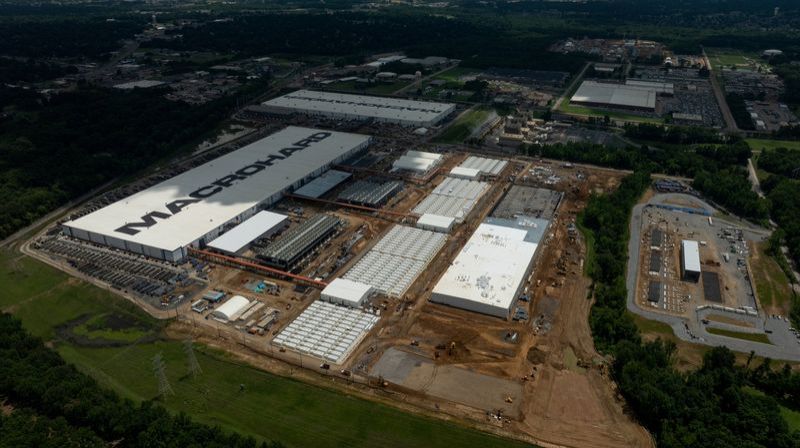
xAI installs unpermitted gas turbines for Colossus 2, polluting predominantly Black neighborhoods in Memphis area
Elon Musk's AI company faces lawsuit from NAACP and environmental groups over dozens of methane turbines operating without Clean Air Act permits Elon Musk's AI venture xAI has been running dozens of methane gas turbines without Clean Air Act permits to power its Colossus 2 data center, generating pollution that lands squarely on predominantly Black communities in the Memphis, Tennessee area. The NAACP, Earthjustice, and the Southern Environmental Law Center filed a lawsuit on April 14, 2026, alleging that xAI and its subsidiary MZX Tech are violating federal environmental law. Here's the thing: this isn't xAI's first time pulling this exact move. Its predecessor facility, Colossus 1, ran up to 35 unpermitted turbines before eventually receiving partial permits covering just 15 units. The numbers behind the pollution The scale of the unpermitted operation at the Southaven, Mississippi site is significant. Between 27 and 46 methane gas turbines have been installed, capable of generating up to 495 MW of power. The potential annual emissions paint a grim picture. The turbines could release over 1,700 tons of nitrogen oxides, 180 tons of fine particulate matter, 500 tons of carbon monoxide, and 19 tons of formaldehyde into the surrounding air each year. Those aren't just abstract numbers. Nitrogen oxides contribute to smog and respiratory disease. Fine particulate matter is linked to heart attacks and premature death. Formaldehyde is a known carcinogen. All of it is settling over neighborhoods that already face disproportionately high asthma rates and poor air quality. The turbines have been active since late 2025, meaning months of unregulated emissions were pumped into the atmosphere before the lawsuit was even filed. Mississippi regulators have since issued permits covering some additional turbines, but operations began well before any approval was granted. Environmental justice meets AI's energy appetite The lawsuit frames this as a textbook environmental justice issue. The communities bearing the health costs of xAI's power generation are predominantly Black neighborhoods in the greater Memphis area. xAI's approach with Colossus 1 set a troubling precedent. That facility became operational in June 2024, running unpermitted turbines for months before regulators caught up. The fact that the company repeated the same playbook with Colossus 2, but at a potentially larger scale, suggests this isn't an oversight.
Pollution From Musk's Unpermitted XAI Power Project Hits Hardest in Black Communities
By Disha Raychaudhuri and Valerie Volcovici July 14 (Reuters) - Elon Musk's artificial intelligence company xAI has installed 59 natural gas turbines for its Colossus 2 data center project in Tennessee without securing federal clean air permits, according to communications between regulators and xAI representatives. Potential emissions from the turbines are far beyond the threshold that would require a federal permit, and would be released near predominantly Black communities already estimated to be suffering disproportionately high rates of lung disease, according to a Reuters analysis based on government data and information in the correspondence with regulators. The findings, which have not been previously reported, reflect how exploding electricity demand from AI data centers is driving companies to build off-grid power plants at a pace outstripping environmental oversight, with potentially big risks to public health. The number of unpermitted turbines identified by Reuters is about double what xAI has publicly acknowledged. The company previously said it was running 27 unpermitted turbines for Colossus 2 as of January and has argued the permits are not required. At least 57 of the 59 turbines are located in Mississippi, just over the state line from Tennessee where the data center is located. The xAI turbines are among scores of off-grid power plants for data centers proposed or under construction around the country. Local authorities often fast-track approvals in just weeks or months, without the years of environmental studies and public hearings typically required for such power generation projects that connect to the grid, Reuters has reported. Mississippi regulators in March issued a permit for permanent turbines for Colossus 2, allowing construction of 41 gas-fired turbines. The approval came three weeks after the state's only public hearing on the project. The xAI cluster of temporary turbines in Mississippi is already among the biggest off-grid data center power projects, according to Ben King, an analyst with think tank Rhodium Group, who reviewed the Reuters analysis. "This looks to be an unprecedented level of behind-the-meter gas being installed in one place," he said, referring to off-grid natural gas plants serving just one customer. The communications reviewed by Reuters show xAI, now owned by trillionaire Musk's SpaceX, has installed 57 off-grid turbines in Southaven, Mississippi, just across the state line from its Colossus 2 data center in Memphis, a facility supporting the Grok chatbot and other AI systems. The records show the company has also installed two other unpermitted turbines for the project on a different site. Reuters could not determine the location. The communications, obtained through a Reuters public records request, included emails between Trinity Consultants, representing xAI and subsidiary MZX Tech, and the Mississippi Department of Environmental Quality (MDEQ). xAI did not respond to Reuters' request for comment. xAI's turbines are part of a widening environmental justice battle over whether the AI boom is adding disproportionate pollution burdens to communities of color. Civil rights groups including the NAACP and the Southern Environmental Law Center sued xAI in April to halt their operations, arguing the turbines produce emissions subject to the federal Clean Air Act and shouldn't be operated without permits. They contend the turbines are polluting homes, schools and churches in historically Black communities. "The scale of it is astonishing," said Patrick Anderson, an attorney with the Southern Environmental Law Center. "This is an absolutely huge Clean Air Act violation that threatens public health." Securing a Clean Air Act permit would have exposed xAI's project to extensive review and public comment, potentially taking years. Mississippi environmental regulators and xAI have argued in court filings that the turbines are exempt because they are "mobile" and intended to operate onsite for less than a year. "MDEQ has determined that portable/temporary turbines do not require an air permit," the agency said in a statement to Reuters. The U.S. Environmental Protection Agency said in January 2026 that even temporary turbines exceeding emissions thresholds must obtain permits. The agency, however, told Reuters it's considering changes allowing "regulatory flexibilities" for portable units while continuing to protect public health. xAI, the MDEQ and the EPA did not answer questions from Reuters about pollution impacts on communities of color from power generation to serve data centers. The U.S. Justice Department weighed in on the lawsuit in a June 15 filing, saying that restricting the turbines could threaten national security interests because xAI's systems support U.S. military operations, including operations involving Iran. The outcome of the lawsuit filed by civil rights groups could help define how environmental laws apply to the fast-growing AI sector, where companies are scrambling to bring power supplies online to support energy-intensive computing. "This sets up scenarios where the government can create sacrifice zones and tell communities they have to breathe illegal air pollution," said Mary Rock, a senior attorney for Earthjustice which is representing the NAACP and SELC. The dispute echoes the findings of a 2022 study by researchers from UCLA and Columbia University and published in the Nature Energy journal that found that previously redlined communities - where banks historically discriminated against Black mortgage applicants - now face disproportionately high exposure to pollutants from fossil fuel facilities. "Air pollution from these and other sources contributes to systemic racial disparities in chronic disease and ultimately shorter lives," Lara Cushing, a UCLA public health professor who co-authored the study, told Reuters. BIG EMISSIONS The emails reviewed by Reuters included the manufacturer emissions profiles for 32 of the 59 turbines, including 30 at the Southaven site. A Reuters analysis based on that information found that those 30 turbines alone could emit nearly 2,500 short tons of nitrogen oxide, 4,000 short tons of carbon monoxide and 22 short tons of formaldehyde annually, assuming they operate continuously at 80% of capacity. According to the EPA, gas turbines are typically operated at loads of 80% or more to achieve efficiency. Nitrogen oxides contribute to smog and respiratory inflammation, according to the American Lung Association. Carbon monoxide deprives the body of oxygen, and formaldehyde is a carcinogen. The xAI site's potential emissions far exceed a Clean Air Act threshold that requires permitting for facilities capable of more than 100 short tons annually of pollutants such as nitrogen oxide. "This is a massive amount of turbines and an unfathomable amount of air pollution," Southaven resident Shannon Samsa said in an interview. "It's not a hypothetical," she said, "that air pollution is bad for you." The nitrogen oxide emissions calculated by Reuters for about half the plant's turbines would put the facility "up there with some of the heaviest polluting natural gas power plants across the entire country," said Nicholas Mailloux, a postdoctoral researcher at the University of Wisconsin-Madison who studies air quality and health benefits of the clean-energy transition. He said the facility would be on par with the top 25 U.S. gas plants for nitrogen oxide emissions, citing EPA data for actual emissions. THE PEOPLE AFFECTED In the Colonial Hills neighborhood of Southaven, the turbines serving Colossus 2 can be heard around the clock, often firing off noisy bursts that residents compare to jet engines. Ervin Laws, a Colonial Hills resident in his 20s, said the noise wakes him up at night. "I can't do anything about it, because he's got more money than me," he said, referring to Musk. The turbines were installed in communities already estimated to be facing relatively high respiratory disease burdens, according to a Reuters analysis of CDC data. In 27 of 28 census tracts within five miles of the site - spanning both Mississippi and Tennessee - the estimated asthma rates were higher than their respective countywide figures. In 24 tracts, chronic obstructive pulmonary disease rates were also higher. Five miles is a distance commonly used in environmental health research to capture populations likely to be exposed to air pollution from a stationary source. A separate Reuters analysis of Census Bureau data found that the residents living near the facility are disproportionately Black. Because the five-mile radius crosses state lines, Reuters compared each side against its own county baseline. Within five miles of the facility in DeSoto county, Mississippi - where the turbines are located - about 46% of residents are Black, compared with 33% countywide, according to census data. Across the state line in Tennessee, where residents have no say in Mississippi's permitting process, about 94% of residents within five miles of the facility are Black, compared to 52% in surrounding Shelby County. Jayajit Chakraborty, a professor at the University of California, Santa Barbara, said the Reuters analysis was consistent with research that shows communities of color face higher exposure to fossil fuel pollution. Shelby County and portions of DeSoto County have also previously failed to meet federal ozone standards and remain subject to EPA-approved plans to ensure they do not slip back into violation, according to regulatory documents. Nitrogen oxide is a key precursor to ozone formation, which the EPA says can harm respiratory health. "Given this community struggles with high asthma rates, additional NOx exposure at such high rates could exacerbate public health issues in a community that is already seeing more than its fair share of exposure to toxic air pollution," said Victoria Nelson, an independent environmental engineer, formerly at EPA. Sarah Gladney, 72, has watched the rapid expansion of xAI's Memphis-area presence from her home in the historically Black neighborhood of Boxtown, a few miles from where the company built its Colossus 1 data center in 2024. "Once they got their foot in the door in Memphis, I feel like it's going to be a continuous movement of xAI into these other communities," she said. "It's all about the money, and it's not about the health or wellness of the people that live in or near these communities." (Reporting by Disha Raychaudhuri and Valerie Volcovici; photos by Kevin Wurm; editing by David Gaffen, Kat Stafford, Ben Lesser and Richard Valdmanis)

Pollution from Musk's unpermitted xAI power project hits hardest in Black communities
By Disha Raychaudhuri and Valerie Volcovici July 14 (Reuters) - Elon Musk's artificial intelligence company xAI has installed 59 natural gas turbines for its Colossus 2 data center project in Tennessee without securing federal clean air permits, according to communications between regulators and xAI representatives. Potential emissions from the turbines are far beyond the threshold that would require a federal permit, and would be released near predominantly Black communities already estimated to be suffering disproportionately high rates of lung disease, according to a Reuters analysis based on government data and information in the correspondence with regulators. The findings, which have not been previously reported, reflect how exploding electricity demand from AI data centers is driving companies to build off-grid power plants at a pace outstripping environmental oversight, with potentially big risks to public health. The number of unpermitted turbines identified by Reuters is about double what xAI has publicly acknowledged. The company previously said it was running 27 unpermitted turbines for Colossus 2 as of January and has argued the permits are not required. At least 57 of the 59 turbines are located in Mississippi, just over the state line from Tennessee where the data center is located. The xAI turbines are among scores of off-grid power plants for data centers proposed or under construction around the country. Local authorities often fast-track approvals in just weeks or months, without the years of environmental studies and public hearings typically required for such power generation projects that connect to the grid, Reuters has reported. Mississippi regulators in March issued a permit for permanent turbines for Colossus 2, allowing construction of 41 gas-fired turbines. The approval came three weeks after the state's only public hearing on the project. The xAI cluster of temporary turbines in Mississippi is already among the biggest off-grid data center power projects, according to Ben King, an analyst with think tank Rhodium Group, who reviewed the Reuters analysis. "This looks to be an unprecedented level of behind-the-meter gas being installed in one place," he said, referring to off-grid natural gas plants serving just one customer. The communications reviewed by Reuters show xAI, now owned by trillionaire Musk's SpaceX, has installed 57 off-grid turbines in Southaven, Mississippi, just across the state line from its Colossus 2 data center in Memphis, a facility supporting the Grok chatbot and other AI systems. The records show the company has also installed two other unpermitted turbines for the project on a different site. Reuters could not determine the location. The communications, obtained through a Reuters public records request, included emails between Trinity Consultants, representing xAI and subsidiary MZX Tech, and the Mississippi Department of Environmental Quality (MDEQ). xAI did not respond to Reuters' request for comment. xAI's turbines are part of a widening environmental justice battle over whether the AI boom is adding disproportionate pollution burdens to communities of color. Civil rights groups including the NAACP and the Southern Environmental Law Center sued xAI in April to halt their operations, arguing the turbines produce emissions subject to the federal Clean Air Act and shouldn't be operated without permits. They contend the turbines are polluting homes, schools and churches in historically Black communities. "The scale of it is astonishing," said Patrick Anderson, an attorney with the Southern Environmental Law Center. "This is an absolutely huge Clean Air Act violation that threatens public health." Securing a Clean Air Act permit would have exposed xAI's project to extensive review and public comment, potentially taking years. Mississippi environmental regulators and xAI have argued in court filings that the turbines are exempt because they are "mobile" and intended to operate onsite for less than a year. "MDEQ has determined that portable/temporary turbines do not require an air permit," the agency said in a statement to Reuters. The U.S. Environmental Protection Agency said in January 2026 that even temporary turbines exceeding emissions thresholds must obtain permits. The agency, however, told Reuters it's considering changes allowing "regulatory flexibilities" for portable units while continuing to protect public health. xAI, the MDEQ and the EPA did not answer questions from Reuters about pollution impacts on communities of color from power generation to serve data centers. The U.S. Justice Department weighed in on the lawsuit in a June 15 filing, saying that restricting the turbines could threaten national security interests because xAI's systems support U.S. military operations, including operations involving Iran. The outcome of the lawsuit filed by civil rights groups could help define how environmental laws apply to the fast-growing AI sector, where companies are scrambling to bring power supplies online to support energy-intensive computing. "This sets up scenarios where the government can create sacrifice zones and tell communities they have to breathe illegal air pollution," said Mary Rock, a senior attorney for Earthjustice which is representing the NAACP and SELC. The dispute echoes the findings of a 2022 study by researchers from UCLA and Columbia University and published in the Nature Energy journal that found that previously redlined communities - where banks historically discriminated against Black mortgage applicants - now face disproportionately high exposure to pollutants from fossil fuel facilities. "Air pollution from these and other sources contributes to systemic racial disparities in chronic disease and ultimately shorter lives," Lara Cushing, a UCLA public health professor who co-authored the study, told Reuters. BIG EMISSIONS The emails reviewed by Reuters included the manufacturer emissions profiles for 32 of the 59 turbines, including 30 at the Southaven site. A Reuters analysis based on that information found that those 30 turbines alone could emit nearly 2,500 short tons of nitrogen oxide, 4,000 short tons of carbon monoxide and 22 short tons of formaldehyde annually, assuming they operate continuously at 80% of capacity. According to the EPA, gas turbines are typically operated at loads of 80% or more to achieve efficiency. Nitrogen oxides contribute to smog and respiratory inflammation, according to the American Lung Association. Carbon monoxide deprives the body of oxygen, and formaldehyde is a carcinogen. The xAI site's potential emissions far exceed a Clean Air Act threshold that requires permitting for facilities capable of more than 100 short tons annually of pollutants such as nitrogen oxide. "This is a massive amount of turbines and an unfathomable amount of air pollution," Southaven resident Shannon Samsa said in an interview. "It's not a hypothetical," she said, "that air pollution is bad for you." The nitrogen oxide emissions calculated by Reuters for about half the plant's turbines would put the facility "up there with some of the heaviest polluting natural gas power plants across the entire country," said Nicholas Mailloux, a postdoctoral researcher at the University of Wisconsin-Madison who studies air quality and health benefits of the clean-energy transition. He said the facility would be on par with the top 25 U.S. gas plants for nitrogen oxide emissions, citing EPA data for actual emissions. THE PEOPLE AFFECTED In the Colonial Hills neighborhood of Southaven, the turbines serving Colossus 2 can be heard around the clock, often firing off noisy bursts that residents compare to jet engines. Ervin Laws, a Colonial Hills resident in his 20s, said the noise wakes him up at night. "I can't do anything about it, because he's got more money than me," he said, referring to Musk. The turbines were installed in communities already estimated to be facing relatively high respiratory disease burdens, according to a Reuters analysis of CDC data. In 27 of 28 census tracts within five miles of the site - spanning both Mississippi and Tennessee - the estimated asthma rates were higher than their respective countywide figures. In 24 tracts, chronic obstructive pulmonary disease rates were also higher. Five miles is a distance commonly used in environmental health research to capture populations likely to be exposed to air pollution from a stationary source. A separate Reuters analysis of Census Bureau data found that the residents living near the facility are disproportionately Black. Because the five-mile radius crosses state lines, Reuters compared each side against its own county baseline. Within five miles of the facility in DeSoto county, Mississippi - where the turbines are located - about 46% of residents are Black, compared with 33% countywide, according to census data. Across the state line in Tennessee, where residents have no say in Mississippi's permitting process, about 94% of residents within five miles of the facility are Black, compared to 52% in surrounding Shelby County. Jayajit Chakraborty, a professor at the University of California, Santa Barbara, said the Reuters analysis was consistent with research that shows communities of color face higher exposure to fossil fuel pollution. Shelby County and portions of DeSoto County have also previously failed to meet federal ozone standards and remain subject to EPA-approved plans to ensure they do not slip back into violation, according to regulatory documents. Nitrogen oxide is a key precursor to ozone formation, which the EPA says can harm respiratory health. "Given this community struggles with high asthma rates, additional NOx exposure at such high rates could exacerbate public health issues in a community that is already seeing more than its fair share of exposure to toxic air pollution," said Victoria Nelson, an independent environmental engineer, formerly at EPA. Sarah Gladney, 72, has watched the rapid expansion of xAI's Memphis-area presence from her home in the historically Black neighborhood of Boxtown, a few miles from where the company built its Colossus 1 data center in 2024. "Once they got their foot in the door in Memphis, I feel like it's going to be a continuous movement of xAI into these other communities," she said. "It's all about the money, and it's not about the health or wellness of the people that live in or near these communities." (Reporting by Disha Raychaudhuri and Valerie Volcovici; photos by Kevin Wurm; editing by David Gaffen, Kat Stafford, Ben Lesser and Richard Valdmanis)

Pollution from Musk's unpermitted xAI power project hits hardest in Black communities
By Disha Raychaudhuri and Valerie Volcovici July 14 (Reuters) - Elon Musk's artificial intelligence company xAI has installed 59 natural gas turbines for its Colossus 2 data center project in Tennessee without securing federal clean air permits, according to communications between regulators and xAI representatives. Potential emissions from the turbines are far beyond the threshold that would require a federal permit, and would be released near predominantly Black communities already estimated to be suffering disproportionately high rates of lung disease, according to a Reuters analysis based on government data and information in the correspondence with regulators. The findings, which have not been previously reported, reflect how exploding electricity demand from AI data centers is driving companies to build off-grid power plants at a pace outstripping environmental oversight, with potentially big risks to public health. The number of unpermitted turbines identified by Reuters is about double what xAI has publicly acknowledged. The company previously said it was running 27 unpermitted turbines for Colossus 2 as of January and has argued the permits are not required. At least 57 of the 59 turbines are located in Mississippi, just over the state line from Tennessee where the data center is located. The xAI turbines are among scores of off-grid power plants for data centers proposed or under construction around the country. Local authorities often fast-track approvals in just weeks or months, without the years of environmental studies and public hearings typically required for such power generation projects that connect to the grid, Reuters has reported. Mississippi regulators in March issued a permit for permanent turbines for Colossus 2, allowing construction of 41 gas-fired turbines. The approval came three weeks after the state's only public hearing on the project. The xAI cluster of temporary turbines in Mississippi is already among the biggest off-grid data center power projects, according to Ben King, an analyst with think tank Rhodium Group, who reviewed the Reuters analysis. "This looks to be an unprecedented level of behind-the-meter gas being installed in one place," he said, referring to off-grid natural gas plants serving just one customer. The communications reviewed by Reuters show xAI, now owned by trillionaire Musk's SpaceX, has installed 57 off-grid turbines in Southaven, Mississippi, just across the state line from its Colossus 2 data center in Memphis, a facility supporting the Grok chatbot and other AI systems. The records show the company has also installed two other unpermitted turbines for the project on a different site. Reuters could not determine the location. The communications, obtained through a Reuters public records request, included emails between Trinity Consultants, representing xAI and subsidiary MZX Tech, and the Mississippi Department of Environmental Quality (MDEQ). xAI did not respond to Reuters' request for comment. xAI's turbines are part of a widening environmental justice battle over whether the AI boom is adding disproportionate pollution burdens to communities of color. Civil rights groups including the NAACP and the Southern Environmental Law Center sued xAI in April to halt their operations, arguing the turbines produce emissions subject to the federal Clean Air Act and shouldn't be operated without permits. They contend the turbines are polluting homes, schools and churches in historically Black communities. "The scale of it is astonishing," said Patrick Anderson, an attorney with the Southern Environmental Law Center. "This is an absolutely huge Clean Air Act violation that threatens public health." Securing a Clean Air Act permit would have exposed xAI's project to extensive review and public comment, potentially taking years. Mississippi environmental regulators and xAI have argued in court filings that the turbines are exempt because they are "mobile" and intended to operate onsite for less than a year. "MDEQ has determined that portable/temporary turbines do not require an air permit," the agency said in a statement to Reuters. The U.S. Environmental Protection Agency said in January 2026 that even temporary turbines exceeding emissions thresholds must obtain permits. The agency, however, told Reuters it's considering changes allowing "regulatory flexibilities" for portable units while continuing to protect public health. xAI, the MDEQ and the EPA did not answer questions from Reuters about pollution impacts on communities of color from power generation to serve data centers. The U.S. Justice Department weighed in on the lawsuit in a June 15 filing, saying that restricting the turbines could threaten national security interests because xAI's systems support U.S. military operations, including operations involving Iran. The outcome of the lawsuit filed by civil rights groups could help define how environmental laws apply to the fast-growing AI sector, where companies are scrambling to bring power supplies online to support energy-intensive computing. "This sets up scenarios where the government can create sacrifice zones and tell communities they have to breathe illegal air pollution," said Mary Rock, a senior attorney for Earthjustice which is representing the NAACP and SELC. The dispute echoes the findings of a 2022 study by researchers from UCLA and Columbia University and published in the Nature Energy journal that found that previously redlined communities - where banks historically discriminated against Black mortgage applicants - now face disproportionately high exposure to pollutants from fossil fuel facilities. "Air pollution from these and other sources contributes to systemic racial disparities in chronic disease and ultimately shorter lives," Lara Cushing, a UCLA public health professor who co-authored the study, told Reuters. BIG EMISSIONS The emails reviewed by Reuters included the manufacturer emissions profiles for 32 of the 59 turbines, including 30 at the Southaven site. A Reuters analysis based on that information found that those 30 turbines alone could emit nearly 2,500 short tons of nitrogen oxide, 4,000 short tons of carbon monoxide and 22 short tons of formaldehyde annually, assuming they operate continuously at 80% of capacity. According to the EPA, gas turbines are typically operated at loads of 80% or more to achieve efficiency. Nitrogen oxides contribute to smog and respiratory inflammation, according to the American Lung Association. Carbon monoxide deprives the body of oxygen, and formaldehyde is a carcinogen. The xAI site's potential emissions far exceed a Clean Air Act threshold that requires permitting for facilities capable of more than 100 short tons annually of pollutants such as nitrogen oxide. "This is a massive amount of turbines and an unfathomable amount of air pollution," Southaven resident Shannon Samsa said in an interview. "It's not a hypothetical," she said, "that air pollution is bad for you." The nitrogen oxide emissions calculated by Reuters for about half the plant's turbines would put the facility "up there with some of the heaviest polluting natural gas power plants across the entire country," said Nicholas Mailloux, a postdoctoral researcher at the University of Wisconsin-Madison who studies air quality and health benefits of the clean-energy transition. He said the facility would be on par with the top 25 U.S. gas plants for nitrogen oxide emissions, citing EPA data for actual emissions. THE PEOPLE AFFECTED In the Colonial Hills neighborhood of Southaven, the turbines serving Colossus 2 can be heard around the clock, often firing off noisy bursts that residents compare to jet engines. Ervin Laws, a Colonial Hills resident in his 20s, said the noise wakes him up at night. "I can't do anything about it, because he's got more money than me," he said, referring to Musk. The turbines were installed in communities already estimated to be facing relatively high respiratory disease burdens, according to a Reuters analysis of CDC data. In 27 of 28 census tracts within five miles of the site - spanning both Mississippi and Tennessee - the estimated asthma rates were higher than their respective countywide figures. In 24 tracts, chronic obstructive pulmonary disease rates were also higher. Five miles is a distance commonly used in environmental health research to capture populations likely to be exposed to air pollution from a stationary source. A separate Reuters analysis of Census Bureau data found that the residents living near the facility are disproportionately Black. Because the five-mile radius crosses state lines, Reuters compared each side against its own county baseline. Within five miles of the facility in DeSoto county, Mississippi - where the turbines are located - about 46% of residents are Black, compared with 33% countywide, according to census data. Across the state line in Tennessee, where residents have no say in Mississippi's permitting process, about 94% of residents within five miles of the facility are Black, compared to 52% in surrounding Shelby County. Jayajit Chakraborty, a professor at the University of California, Santa Barbara, said the Reuters analysis was consistent with research that shows communities of color face higher exposure to fossil fuel pollution. Shelby County and portions of DeSoto County have also previously failed to meet federal ozone standards and remain subject to EPA-approved plans to ensure they do not slip back into violation, according to regulatory documents. Nitrogen oxide is a key precursor to ozone formation, which the EPA says can harm respiratory health. "Given this community struggles with high asthma rates, additional NOx exposure at such high rates could exacerbate public health issues in a community that is already seeing more than its fair share of exposure to toxic air pollution," said Victoria Nelson, an independent environmental engineer, formerly at EPA. Sarah Gladney, 72, has watched the rapid expansion of xAI's Memphis-area presence from her home in the historically Black neighborhood of Boxtown, a few miles from where the company built its Colossus 1 data center in 2024. "Once they got their foot in the door in Memphis, I feel like it's going to be a continuous movement of xAI into these other communities," she said. "It's all about the money, and it's not about the health or wellness of the people that live in or near these communities." (Reporting by Disha Raychaudhuri and Valerie Volcovici; photos by Kevin Wurm; editing by David Gaffen, Kat Stafford, Ben Lesser and Richard Valdmanis)
Pollution from Musk's unpermitted xAI power project hits hardest in Black communities
Add Yahoo as a preferred source to see more of our stories on Google. By Disha Raychaudhuri and Valerie Volcovici July 14 (Reuters) - Elon Musk's artificial intelligence company xAI has installed 59 natural gas turbines for its Colossus 2 data center project in Tennessee without securing federal clean air permits, according to communications between regulators and xAI representatives. Potential emissions from the turbines are far beyond the threshold that would require a federal permit, and would be released near predominantly Black communities already estimated to be suffering disproportionately high rates of lung disease, according to a Reuters analysis based on government data and information in the correspondence with regulators. The findings, which have not been previously reported, reflect how exploding electricity demand from AI data centers is driving companies to build off-grid power plants at a pace outstripping environmental oversight, with potentially big risks to public health. The number of unpermitted turbines identified by Reuters is about double what xAI has publicly acknowledged. The company previously said it was running 27 unpermitted turbines for Colossus 2 as of January and has argued the permits are not required. At least 57 of the 59 turbines are located in Mississippi, just over the state line from Tennessee where the data center is located. The xAI turbines are among scores of off-grid power plants for data centers proposed or under construction around the country. Local authorities often fast-track approvals in just weeks or months, without the years of environmental studies and public hearings typically required for such power generation projects that connect to the grid, Reuters has reported. Mississippi regulators in March issued a permit for permanent turbines for Colossus 2, allowing construction of 41 gas-fired turbines. The approval came three weeks after the state's only public hearing on the project. The xAI cluster of temporary turbines in Mississippi is already among the biggest off-grid data center power projects, according to Ben King, an analyst with think tank Rhodium Group, who reviewed the Reuters analysis. "This looks to be an unprecedented level of behind-the-meter gas being installed in one place," he said, referring to off-grid natural gas plants serving just one customer. The communications reviewed by Reuters show xAI, now owned by trillionaire Musk's SpaceX, has installed 57 off-grid turbines in Southaven, Mississippi, just across the state line from its Colossus 2 data center in Memphis, a facility supporting the Grok chatbot and other AI systems. The records show the company has also installed two other unpermitted turbines for the project on a different site. Reuters could not determine the location. The communications, obtained through a Reuters public records request, included emails between Trinity Consultants, representing xAI and subsidiary MZX Tech, and the Mississippi Department of Environmental Quality (MDEQ). xAI did not respond to Reuters' request for comment. xAI's turbines are part of a widening environmental justice battle over whether the AI boom is adding disproportionate pollution burdens to communities of color. Civil rights groups including the NAACP and the Southern Environmental Law Center sued xAI in April to halt their operations, arguing the turbines produce emissions subject to the federal Clean Air Act and shouldn't be operated without permits. They contend the turbines are polluting homes, schools and churches in historically Black communities. "The scale of it is astonishing," said Patrick Anderson, an attorney with the Southern Environmental Law Center. "This is an absolutely huge Clean Air Act violation that threatens public health." Securing a Clean Air Act permit would have exposed xAI's project to extensive review and public comment, potentially taking years. Mississippi environmental regulators and xAI have argued in court filings that the turbines are exempt because they are "mobile" and intended to operate onsite for less than a year. "MDEQ has determined that portable/temporary turbines do not require an air permit," the agency said in a statement to Reuters. The U.S. Environmental Protection Agency said in January 2026 that even temporary turbines exceeding emissions thresholds must obtain permits. The agency, however, told Reuters it's considering changes allowing "regulatory flexibilities" for portable units while continuing to protect public health. xAI, the MDEQ and the EPA did not answer questions from Reuters about pollution impacts on communities of color from power generation to serve data centers. The U.S. Justice Department weighed in on the lawsuit in a June 15 filing, saying that restricting the turbines could threaten national security interests because xAI's systems support U.S. military operations, including operations involving Iran. The outcome of the lawsuit filed by civil rights groups could help define how environmental laws apply to the fast-growing AI sector, where companies are scrambling to bring power supplies online to support energy-intensive computing. "This sets up scenarios where the government can create sacrifice zones and tell communities they have to breathe illegal air pollution," said Mary Rock, a senior attorney for Earthjustice which is representing the NAACP and SELC. The dispute echoes the findings of a 2022 study by researchers from UCLA and Columbia University and published in the Nature Energy journal that found that previously redlined communities - where banks historically discriminated against Black mortgage applicants - now face disproportionately high exposure to pollutants from fossil fuel facilities. "Air pollution from these and other sources contributes to systemic racial disparities in chronic disease and ultimately shorter lives," Lara Cushing, a UCLA public health professor who co-authored the study, told Reuters. BIG EMISSIONS The emails reviewed by Reuters included the manufacturer emissions profiles for 32 of the 59 turbines, including 30 at the Southaven site. A Reuters analysis based on that information found that those 30 turbines alone could emit nearly 2,500 short tons of nitrogen oxide, 4,000 short tons of carbon monoxide and 22 short tons of formaldehyde annually, assuming they operate continuously at 80% of capacity. According to the EPA, gas turbines are typically operated at loads of 80% or more to achieve efficiency. Nitrogen oxides contribute to smog and respiratory inflammation, according to the American Lung Association. Carbon monoxide deprives the body of oxygen, and formaldehyde is a carcinogen. The xAI site's potential emissions far exceed a Clean Air Act threshold that requires permitting for facilities capable of more than 100 short tons annually of pollutants such as nitrogen oxide. "This is a massive amount of turbines and an unfathomable amount of air pollution," Southaven resident Shannon Samsa said in an interview. "It's not a hypothetical," she said, "that air pollution is bad for you." The nitrogen oxide emissions calculated by Reuters for about half the plant's turbines would put the facility "up there with some of the heaviest polluting natural gas power plants across the entire country," said Nicholas Mailloux, a postdoctoral researcher at the University of Wisconsin-Madison who studies air quality and health benefits of the clean-energy transition. He said the facility would be on par with the top 25 U.S. gas plants for nitrogen oxide emissions, citing EPA data for actual emissions. THE PEOPLE AFFECTED In the Colonial Hills neighborhood of Southaven, the turbines serving Colossus 2 can be heard around the clock, often firing off noisy bursts that residents compare to jet engines. Ervin Laws, a Colonial Hills resident in his 20s, said the noise wakes him up at night. "I can't do anything about it, because he's got more money than me," he said, referring to Musk. The turbines were installed in communities already estimated to be facing relatively high respiratory disease burdens, according to a Reuters analysis of CDC data. In 27 of 28 census tracts within five miles of the site - spanning both Mississippi and Tennessee - the estimated asthma rates were higher than their respective countywide figures. In 24 tracts, chronic obstructive pulmonary disease rates were also higher. Five miles is a distance commonly used in environmental health research to capture populations likely to be exposed to air pollution from a stationary source. A separate Reuters analysis of Census Bureau data found that the residents living near the facility are disproportionately Black. Because the five-mile radius crosses state lines, Reuters compared each side against its own county baseline. Within five miles of the facility in DeSoto county, Mississippi - where the turbines are located - about 46% of residents are Black, compared with 33% countywide, according to census data. Across the state line in Tennessee, where residents have no say in Mississippi's permitting process, about 94% of residents within five miles of the facility are Black, compared to 52% in surrounding Shelby County. Jayajit Chakraborty, a professor at the University of California, Santa Barbara, said the Reuters analysis was consistent with research that shows communities of color face higher exposure to fossil fuel pollution. Shelby County and portions of DeSoto County have also previously failed to meet federal ozone standards and remain subject to EPA-approved plans to ensure they do not slip back into violation, according to regulatory documents. Nitrogen oxide is a key precursor to ozone formation, which the EPA says can harm respiratory health. "Given this community struggles with high asthma rates, additional NOx exposure at such high rates could exacerbate public health issues in a community that is already seeing more than its fair share of exposure to toxic air pollution," said Victoria Nelson, an independent environmental engineer, formerly at EPA. Sarah Gladney, 72, has watched the rapid expansion of xAI's Memphis-area presence from her home in the historically Black neighborhood of Boxtown, a few miles from where the company built its Colossus 1 data center in 2024. "Once they got their foot in the door in Memphis, I feel like it's going to be a continuous movement of xAI into these other communities," she said. "It's all about the money, and it's not about the health or wellness of the people that live in or near these communities." (Reporting by Disha Raychaudhuri and Valerie Volcovici; photos by Kevin Wurm; editing by David Gaffen, Kat Stafford, Ben Lesser and Richard Valdmanis)