News & Updates
The latest news and updates from companies in the WLTH portfolio.
How the math works on a $1.75 trillion SpaceX valuation
But analysts and portfolio managers are also pricing in considerably more. Musk's track record of building successful, industry-disrupting companies gives analysts and portfolio managers confidence that the unproven bets - Starship, xAI, and an ambitious push into data-center satellites - will eventually pay off too. By Medha Singh, Echo Wang and Noel Randewich Elon Musk's SpaceX is seeking a $1.75 trillion valuation in its forthcoming initial public offering. How far into the stratosphere is that? Going by common Wall Street metrics, the answer is, way out there. SpaceX would immediately become the sixth most-valuable publicly listed U.S. firm, worth more than the likes of Meta Platforms, which has been publicly listed for more than a decade, and Berkshire Hathaway, a company older than SpaceX founder Elon Musk. And yet, there is no sign that investors will think twice about hitting the buy button once it goes public in an IPO that could raise $75 billion or more, which would be a record. The frenzy has grown so intense that some are pouring money into opaque secondary markets, accepting complex arrangements and murky ownership just for a shot at owning the shares. "It has almost no comparable listed peer to benchmark a valuation off of and would likely come at a significant premium to anything else that is listed in the space tech sector, given its size and market leadership," said Samuel Kerr, global head of equity capital markets at Mergermarket. SpaceX's valuation is grounded in its profitable, fast-growing Starlink satellite network, which has over 10 million subscribers, and a launch business that analysts and investors say has transformed access to orbit. The Falcon 9, which in December 2015 became the first large rocket to make a controlled recovery after delivering a payload into orbit, completed 165 launches in 2025, a new annual record. But analysts and portfolio managers are also pricing in considerably more. Musk's track record of building successful, industry-disrupting companies gives analysts and portfolio managers confidence that the unproven bets - Starship, xAI, and an ambitious push into data-center satellites - will eventually pay off too. "This is a set of proven juggernaut, mega-cap businesses," said Daniel Hanson, portfolio manager at Neuberger's Quality Equity Fund, an existing SpaceX investor with close to 10% of its $2.6 billion in assets allocated to the company. "The launch business and the Starlink business are proven, here and now. xAI is about optionality," he said, referring to businesses that could add value over time as they benefit from long-term shifts toward AI, data and global connectivity. Here's a quick look at the pros and cons ahead of the IPO. LEADING THE SPACE RACE SpaceX has a commanding lead in deploying the low-Earth orbit satellites that deliver internet and communications for its Starlink service from space. Starlink is profitable and accounts for roughly 50% to 80% of SpaceX's revenue. Many of the parent company's other ambitions are yet to be realized. These include the delayed Starship rocket program for Moon and Mars missions and plans to launch up to one million data-center satellites linked to its money-losing AI unit. To justify the valuation, "investors will need to keep strict tabs on the timing of Starship coming to market and on the ramp-up of Starlink service direct to cellphones," PitchBook analyst Franco Granda said in a note last month. Even so, SpaceX launches a rocket nearly every two days, faster than any space program or firm in history, giving it key capacity in a market where launch access has become a bottleneck for rivals like Amazon, which is building its own satellite networks. "It's a one-of-a-kind for a start," said Mark Boggett, CEO of venture capital fund Seraphim Space. MULTIPLES ARE STRETCHED SpaceX posted about $8 billion in profit and revenue of $15 billion to $16 billion in 2025, Reuters exclusively reported in January. The profit figure is based on EBITDA, or earnings before interest, taxes, depreciation and amortization, a standard measure of operating performance. Revenue growth has ranged in recent years from 51% in 2024 to 100% in 2021. Unlike listed companies covered by analysts, no consensus projections exist for SpaceX's growth. Reuters made several assumptions in order to compare SpaceX's potential valuation with listed firms. Reuters assumed cash flow and revenue would double in 2026 from reported levels in 2025, an aggressive rate aimed at making the valuation multiples err on the low side. Using those assumptions, at a market capitalization of $1.75 trillion, SpaceX would carry a price-to-revenue multiple of 56 and a price-to-EBITDA multiple of 109 - eye-popping valuations for even the fastest-growing companies. Tesla, which Musk also leads, is valued at 12 times expected revenue and 79 times EBITDA, making it one of Wall Street's priciest stocks. Palantir is at 43 and 75 for those metrics, respectively, after its shares soared 500% in the past two years on optimism about its fast-expanding AI business. Generally speaking, the higher the multiple, the harder it is for a company's performance to meet expectations to keep its stock appreciating. "Starlink is the only reason this valuation is defensible," said Shay Boloor, chief market strategist at Futurum Equities. Its subscriber base "is just growing at crazy levels." THE FOG OF PRIVATE COMPANY VALUATIONS In its merger with Musk's artificial intelligence startup xAI in February, SpaceX was valued at $1 trillion and the Grok chatbot developer at $250 billion. That transaction gives analysts at least one recent anchor for the combined entity's value, and some investors argue it is too conservative. It is currently valued at $1.54 trillion on secondary trading venue Nasdaq Private Market. "SpaceX is consistently one of the most actively traded names on our platform because there's nothing else like it in the private markets today," said Greg Martin, co-founder at Rainmaker Securities, a trading platform for private pre-IPO shares. "Demand has also almost always outpaced supply, and that's been true even during periods where broader secondary market activity has been more muted."
Anthropic rolls out Project Glasswing after holding back Mythos amid safety concerns
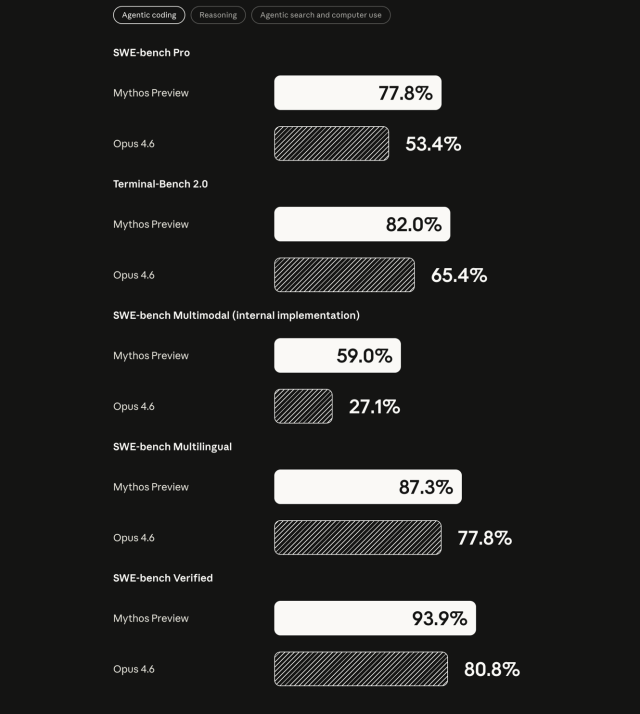
"In particular, it has demonstrated powerful cybersecurity skills, which can be used for both defensive purposes (finding and fixing vulnerabilities in software code) and offensive purposes (designing sophisticated ways to exploit those vulnerabilities). It is largely due to these capabilities that we have made the decision not to release Claude Mythos Preview for general availability," the company noted in its Systems Card report.
Perplexity's Shift to AI Agents Boosts Revenue 50% | PYMNTS.com
By completing this form, you agree to receive marketing communications from PYMNTS and to the sharing of your information with our sponsor, if applicable, in accordance with our Privacy Policy and Terms and Conditions. The company's revenues have jumped 50% in the last month, with estimated annual recurring revenue (ARR) topping $450 million in March, the Financial Times (FT) reported Wednesday (April 8), citing figures seen by the news outlet. As the report notes, the move marks a pivot from the chatbot-style search engine once viewed as a credible challenge to Google to AI agents that perform tasks on user's behalf. Perplexity has more than 100 million monthly active users from its search and agent tools, the FT said, citing company executives. This includes tens of thousands of enterprise clients, with the company making money via consumer and enterprise subscriptions, which can cost anywhere from $20 to $200 a month. The FT points out that Perplexity's growth is still dwarfed by that of other top AI startups. For example, coding company Cursor has seen its ARR reach $2 billion, up from less than $100 million in 2024. Anthropic reported an ARR of $19 billion at the end of February, while OpenAI said it generated $20 billion last year. Writing about the rise of agentic AI last month, PYMNTS noted research showing that many consumers now use AI tools to assist with everyday duties like planning trips, researching purchases, organizing personal finances and learning about new subjects. "Instead of serving as occasional utilities, AI systems are becoming general-purpose assistants embedded across multiple aspects of daily decision-making," that report said. "This shift matters because habitual use changes the starting point of digital activity." In other Perplexity news, the company this week introduced a new tax agent for Computer, its agentic AI designed to complete complex tasks with limited human supervision. "The distinction between Computer and general-purpose AI chatbots is structural," PYMNTS wrote. "Tools like ChatGPT or Gemini respond to tax questions based on training data that has a fixed cutoff date and no direct connection to current IRS materials." That report pointed to a test of four major AI chatbots conducted by TaxSlayer which found the tools miscalculated the refund or amount owed by an average of more than $2,000 in eight fictional tax scenarios, even when given the necessary forms. Perplexity says it has addressed this by packaging tax knowledge as loadable modules built on its Agent Skills protocol. These modules are continuously updated and grounded in materials and regulations from the IRS, allowing the system to apply current rules.
Air India And Air India Express Suspend Dubai And Middle East Flights Abruptly, Passengers Face Uncertainty And Travel Chaos, Check New Schedule Here
Air India Halts Middle East Flights, Runs Relief Operations for Stranded UAE Passengers The Air India Group, which includes Air India and Air India Express, has established a temporary operational halt, which affects its scheduled flights through multiple essential Middle Eastern airports. The West Asian region's changing geopolitical situation, together with its new airspace regulations, has caused the airlines to stop their scheduled flights to Bahrain Dammam Doha Kuwait and Riyadh. The term "suspension" indicates a complete pause in operations, but actual conditions for United Arab Emirates travelers show a different situation. The airlines have implemented non-scheduled relief flights to reduce passenger disruptions, which have replaced their normal flight operations. The group operated more than 30 special rotations on March 8 and 9 to connect major Indian cities with UAE destinations which included Dubai Abu Dhabi and Sharjah, while giving priority to passengers who already had valid reservations. Air India Flight Operations and Strategic Rerouting The current operational framework for Air India operates according to two separate strategies that use safety measures together with regional stability requirements to determine flight operations. The airline maintains its services to Muscat in Oman and Jeddah in Saudi Arabia because the airspace above these regions remains open for operation. Air India Express maintained its regular round-trips to Muscat, which began at Delhi and Mumbai and Kochi, according to the schedule on March 8, 2026. The airline has implemented "bridge flights" to operate flights at Dubai, which currently has its scheduled slots frozen. The non-scheduled operations AI4201 and IX2117 function as transportation resources for citizens who need to return home. The carrier uses this flexible method to manage its operations because it can take advantage of available slots and obtain necessary permissions from UAE civil aviation authorities without having to follow regular scheduling procedures. Air India Operations - 08 April 2026 Air India Passenger Rebooking and Refund Policies Air India Group has implemented a complete relief policy this week to solve operational problems that affect thousands of passengers. The airline has granted passengers whose Middle Eastern flights were cancelled a special "one-time waiver," which allows them to book future flights without incurring extra costs. The March 8 schedule shows its most important feature through "cross-emirate" travel options, which let travelers from Dubai to Jaipur use special flights from Ras Al Khaimah to Delhi without paying additional fees. The airline will issue complete refunds to passengers who decide to forgo their scheduled flights. The company is improving support services by creating digital pathways that include their AI-powered WhatsApp assistant "Tia" that provides live flight updates while managing re-ticketing requests to decrease traditional call center workload.

AWS and Anthropic Advancing AI-powered Cybersecurity With Claude Mythos
As cyber threats evolve at an unprecedented pace, Amazon Web Services (AWS) and Anthropic have teamed up to introduce the next generation of artificial intelligence for cybersecurity. Announced as part of Anthropic's new Project Glasswing, a specialized AI model named Claude Mythos Preview is entering a gated release to help secure the world's most critical software. AWS already leverages machine learning heavily to protect its massive infrastructure. The company's internal AI-powered log analysis recently reduced security review time from an average of 6 hours to just 7 minutes. By analyzing over 400 trillion network flows daily, AWS successfully blocked more than 300 million malicious S3 encryption attempts in 2025 alone. Now, they are extending these advanced capabilities to enterprise customers. Claude Mythos Enters Preview Claude Mythos Preview represents a fundamental leap in AI reasoning tailored specifically for cybersecurity and complex software coding. Designed to find and patch vulnerabilities at scale, this model efficiently surfaces critical security findings with minimal manual guidance from engineers. Because AI models capable of building working exploits carry inherent risks, AWS and Anthropic are taking a deliberately cautious approach to distribution. Claude Mythos Preview is currently available via a gated research preview through Amazon Bedrock. Access is restricted to an allow-list of organizations, focusing heavily on internet-critical companies and major open-source maintainers whose software impacts hundreds of millions of users. Organizations testing the model on Amazon Bedrock benefit from strict, enterprise-grade security controls. Teams can safely explore the AI's capabilities without exposing production assets to unnecessary risk using several core protections. * Customer-managed data encryption ensures privacy. * Strict Virtual Private Cloud (VPC) isolation keeps workloads secure. * Automated Reasoning safeguards provide 99% accuracy against factual hallucinations. Autonomous Penetration Testing Alongside the announcement of the Claude Mythos, AWS has officially made its new AWS Security Agent generally available. This tool transforms enterprise penetration testing from a periodic, manual bottleneck into a persistent, on-demand capability. Operating 24/7, the Security Agent uses specialized AI to independently discover and validate vulnerabilities across AWS, Azure, GCP, and on-premises environments. Unlike traditional security scanners that generate unverified alerts, the AWS Security Agent actively attempts to exploit vulnerabilities using targeted attack chains. When it successfully confirms a legitimate risk, it delivers comprehensive, actionable documentation directly to security teams. * Standardized CVSS risk scores define the threat level. * Application-specific severity ratings contextualize the danger. * Detailed reproduction steps show exactly how the exploit works. * Practical remediation suggestions offer immediate fixes. As nation-state actors and ransomware syndicates increasingly adopt AI to scale their operations, defensive strategies must evolve. By combining Anthropic's advanced threat detection capabilities with autonomous cloud security agents, AWS aims to equip organizations to build robust defenses before new threats even emerge.

Anthropic AI finds 'thousands' of gaping holes in tech security
A new AI model from OpenAI rival Anthropic is so good at finding previously undiscovered software vulnerabilities that it could become a devastating cyberweapon in the wrong hands, Anthropic says. Announcing the new AI, called Claude Mythos Preview, on Tuesday, Anthropic said it was not making it public but instead allowing major US companies such as Apple, Amazon, Microsoft and NVIDIA to use it to plug security holes in their software. The AI model was able to find a 27-year-old vulnerability in the OpenBSD operating system, which is considered particularly secure, Anthropic said. Overall, Mythos has already discovered "thousands" of serious vulnerabilities, including in every widely used operating system and web browser. In the video software FFmpeg, the model tracked down a loophole that had been unpatched for 16 years. Mythos Preview was also able, within a few hours, to develop programmes to exploit these vulnerabilities, which experts said would have taken them several weeks. In a test, an early version of the software was given the task of breaking out of a shielded computer environment and reporting this to the tester. According to Anthropic, the software bypassed the security precautions, gained broader internet access for itself and sent the employee an email that surprised him while he was sitting in the park with a sandwich. The company did not specifically train the model to do all this, it said. With rapid progress in artificial intelligence, such capabilities could soon be available to online attackers, Anthropic warned. In a cooperation called "Project Glasswing", companies are therefore being given access to Mythos to find security holes in their software. Anthropic does not plan to make Mythos generally accessible. Other cooperation partners include the Linux Foundation, the IT security firms Crowdstrike and Palo Alto Networks and the network specialist Cisco. Anthropic is best known for the AI software Claude, which competes with OpenAI's ChatGPT. Most recently, the company made headlines over a dispute with the Pentagon: Anthropic denied the use of its AI in autonomous weapons or for mass surveillance in the US. The Defense Department then declared Anthropic a supply chain risk, largely blocking the company's path to doing business with the US government. Anthropic is taking legal action against this.

Globalization hasn't stopped. The chaos over Hormuz proves it
Zachary Karabell is an author and investor and writes "The Edgy Optimist" on Substack. In recent years, a common refrain has held that the period of globalization that followed the Cold War is ending. But if the situation in Iran and the Persian Gulf demonstrates anything, it's that the world remains more economically integrated than ever. The global markets for goods and vital commodities such as oil, gas and fertilizer remain entrenched, even to the point that an economic colossus such as the United States or China is not immune to price and supply shocks. The first supposed end of globalization was the financial crisis of 2008. Then, in 2016, it was the Brexit referendum, which the Economic Policy Institute suggested could be "the end of globalization as we know it." This was quickly followed by the first election of Donald Trump and his "America First" approach to foreign affairs, which came as progressives were also cooling to the idea of a globalized economy that they believed enriched companies and elites while impoverishing the working class. The covid-19 crisis of 2020-2021 was supposed to hasten globalization's demise while leading countries and companies to build more "resilient" supply chains. And finally, the second season of the Trump Show seems hell-bent on deconstructing the entire post-World War II neoliberal order, including the United Nations and NATO. It is true that these and other supply shocks led to investments in more diverse sources of energy. After its vulnerability to imports of oil was exposed in the 1970s, the U.S. worked to reduce its dependence on foreign oil. By the late 2010s, U.S. investment in shale oil extraction, liquefied natural gas and ethanol production made the U.S. a net exporter of energy. Russia's 2022 invasion of Ukraine and the subsequent European Union decision to restrict its imports of Russian oil and gas lowered dependency on any one supplier. But the U.S. isn't energy independent. The soaring price of gas due to the closure of the Strait of Hormuz is a sharp reminder of that. It is also a reminder that the world's energy, commodities and supply chains remain significantly interconnected, even as the armchair narrative has been that the whole experiment of globalization failed. Whether or not it failed, whether its detractors on the left and the right like it, the interdependence of every country is a stark reality of the world. American energy independence would require a decade of work and trillions of dollars spent on building pipelines, increasing refining capacity and retooling its power plants. Even amid the latest supply disruption, doing so makes little economic sense. The world has a wealth of oil and gas supply, and there are complexities and costs tied to which type of oil (light crude, such as Brent or West Texas Intermediate, versus heavy sour oil from Venezuela) can be refined into what products (gasoline, jet fuel, diesel). This is why the U.S. exports and imports millions of barrels of oil every day. The same principle applies to chemicals and fertilizers made with natural gas. Much of the world's fertilizer is made in the Gulf states, particularly Qatar, because those countries produce so much natural gas and have invested in factories. About a third of global seaborne trade of fertilizers passes through the Strait of Hormuz. And it's not just where the products are made, but where it makes the most economic sense to ship them from. The United Arab Emirates, for example, is a leader in bulk container shipping because it is an efficient cargo hub. The illusion that globalization is over simply because people and governments say it is should be shattered by the closing of the Strait of Hormuz. A system is not replaced just because pundits say it's bad, politicians declare they plan to end it or people express a desire for something different. Energy and supply chains that took decades to create and trillions of dollars to build will endure because they are the least expensive way to provide consumers what they want and countries what they need. The only way to change that is to spend money and time to create alternatives. For now, the world remains interdependent, with globalized supply chains and all the attendant strengths and vulnerabilities.

Anthropic AI finds 'thousands' of gaping holes in tech security
A new AI model from OpenAI rival Anthropic is so good at finding previously undiscovered software vulnerabilities that it could become a devastating cyberweapon in the wrong hands, Anthropic says. Announcing the new AI, called Claude Mythos Preview, on Tuesday, Anthropic said it was not making it public but instead allowing major US companies such as Apple, Amazon, Microsoft and NVIDIA to use it to plug security holes in their software. The AI model was able to find a 27-year-old vulnerability in the OpenBSD operating system, which is considered particularly secure, Anthropic said. Overall, Mythos has already discovered "thousands" of serious vulnerabilities, including in every widely used operating system and web browser. In the video software FFmpeg, the model tracked down a loophole that had been unpatched for 16 years. Mythos Preview was also able, within a few hours, to develop programmes to exploit these vulnerabilities, which experts said would have taken them several weeks. In a test, an early version of the software was given the task of breaking out of a shielded computer environment and reporting this to the tester. According to Anthropic, the software bypassed the security precautions, gained broader internet access for itself and sent the employee an email that surprised him while he was sitting in the park with a sandwich. The company did not specifically train the model to do all this, it said. With rapid progress in artificial intelligence, such capabilities could soon be available to online attackers, Anthropic warned. In a cooperation called "Project Glasswing", companies are therefore being given access to Mythos to find security holes in their software. Anthropic does not plan to make Mythos generally accessible. Other cooperation partners include the Linux Foundation, the IT security firms Crowdstrike and Palo Alto Networks and the network specialist Cisco. Anthropic is best known for the AI software Claude, which competes with OpenAI's ChatGPT. Most recently, the company made headlines over a dispute with the Pentagon: Anthropic denied the use of its AI in autonomous weapons or for mass surveillance in the US. The Defense Department then declared Anthropic a supply chain risk, largely blocking the company's path to doing business with the US government. Anthropic is taking legal action against this.

Polymarket Switches to Native USDC in Platform Overhaul
Better liquidity and trading efficiency: Using one stablecoin consolidates liquidity, improving pricing and execution for users. Polymarket said it will replace bridged stablecoin USDC.e with native USD Coin across its platform as part of an update to its trading infrastructure, according to a post from the project's developers on X. The change accompanies an update to the platform's exchange contracts described in the developer announcement. The decision aligns with a broader shift across crypto platforms toward reducing reliance on bridged assets for cleaner liquidity structures and more transparent asset backing in crypto markets. According to the firm, it will deploy a redesigned exchange contract, a redesigned exchange contract using native USDC as the platform's primary settlement asset. USDC.e, a bridged version of USD Coin used on networks where native USDC is not issued directly, has been a functional but imperfect solution for liquidity across networks. By replacing it with native USD Coin, Polymarket is aligning its infrastructure with a more direct and verifiable reserve system. The change is not merely cosmetic. The company is deploying a redesigned order-matching system and simplifying how trades are structured, aiming to improve speed and accessibility for both users and developers. Bridged assets like USDC.e rely on interoperability protocols that introduce additional layers of counterparty and smart contract risk. Native USDC, issued directly by Circle and backed by dollar-denominated reserves, maintains a one-to-one backing with US dollar reserves held in regulated financial institutions. This simplifies redemption pathways and reduces reliance on third-party bridge mechanisms. Polymarket said migration tools would be introduced to help users transition existing balances during the rollout The move comes at a time when crypto platforms have increasingly moved toward native stablecoin settlement to reduce bridge-related risk and risk mitigation in crypto markets. By replacing USDC.e with a native token backed directly by USDC reserves, Polymarket simplifies settlement infrastructure and reduces exposure to bridge-related counterparty risk. The upgrade also introduces features that appeal to professional traders and liquidity providers who prioritise asset clarity and regulatory alignment. It also reduces fragmentation in liquidity pools, a common issue when multiple token versions coexist on the same platform. The shift reflects a broader trend across decentralised finance platforms toward consolidating liquidity around fewer stablecoin settlement assets.. Eliminating this exposure may enhance user confidence, especially as prediction markets handle event-driven volatility where settlement certainty is critical. At a broader level, the shift reflects a maturing DeFi ecosystem where platforms are moving away from workaround solutions toward standardised financial primitives. This aligns with a wider industry trend of consolidating around fewer, more robust stablecoin options. Native USDC will serve as the platform's primary dollar-denominated settlement asset following the migration, ensuring parity with dollar-dominated value. This divergence suggests a market preference for directly issued assets with transparent reserve backing. Liquidity fragmentation is another measurable factor. On platforms where both native and bridged versions of the same asset coexist, trading activity is often split between pools, reducing overall depth. Consolidating liquidity into a single asset can improve execution quality by tightening spreads and increasing order book efficiency. Additionally, institutional flows into stablecoins have increasingly favoured issuers with clear regulatory frameworks. Deployment is expected within a multi-week rollout window, with phased migration for users. Circle's disclosures and reserve attestations have made USDC a preferred option for entities seeking compliance-ready exposure to digital dollars. Polymarket's behaviour suggests migration to native stablecoin settlement may improve execution quality by consolidating liquidity into a single asset when available. The platform's decision formalises this behaviour into a system-wide standard, potentially improving execution quality across its markets. Polymarket's transition away from USDC.e signals a broader recalibration within decentralised finance. As platforms evolve, the emphasis is shifting from rapid expansion to structural integrity and institutional compatibility.

Alphabet's early SpaceX gamble now worth billions, Sunday Pichai says invest every last dollar in AI startup
Alphabet CEO Sundar Pichai says AI boom opening doors to new bets as SpaceX stake nears $100 billion Born in Madurai, Pichai completed his B.Tech in metallurgical engineering from IIT Kharagpur, graduating in 1993. Reports stated that his professors described him as shy, quiet and exceptionally intelligent during his time at the institute. Alphabet's massive early bet on SpaceX is now looking like one of its biggest wins, and Chief Executive Officer Sundar Pichai says the artificial intelligence boom is opening the door to many more such investments. Speaking in a conversation with Stripe co-founder John Collison, Pichai pointed to opportunities emerging from the AI shift, saying Alphabet is looking at deploying capital where returns can be strong. "You know SpaceX, Anthropic and so on so, I think now with the AI shift, there are more opportunities on which we can deploy capital in a good way and so we are doing that," he said. SpaceX bet could touch $100 billion Alphabet's 2015 investment in SpaceX is now potentially worth around $100 billion. The company had invested $900 million at a valuation of about $12 billion. That stake has surged in value following SpaceX's merger with xAI earlier this year in a deal valued at $1.25 trillion. If Alphabet has retained its holdings, the value could rise further, especially with SpaceX filing confidentially for an initial public offering and reportedly targeting a $1.75 trillion valuation. AI drives bigger, direct investments Alphabet has traditionally invested in startups through its venture arms GV and CapitalG. But the scale of AI funding is changing that approach. With AI companies now requiring billions in funding, Alphabet is increasingly investing directly from its balance sheet, alongside peers such as Nvidia, Microsoft and Amazon. Anthropic investment grows One of Alphabet's key AI bets is Anthropic, a rival at the model level but also a partner through its use of Google's cloud and tensor processing units. Alphabet first invested $300 million in 2023 for about a 10% stake, followed by an additional $2 billion. Its total investment now exceeds $3 billion, with its stake estimated at around 14%. Anthropic's valuation has climbed sharply, reaching $380 billion in its latest funding round in February. Focus on capital efficiency Pichai emphasised that Alphabet is prioritising returns while scaling investments. "To the extent you're bullish on ROIC, you want to invest every last dollar you can there," he said, referring to return on invested capital. He added that the company aims to be "good stewards of capital." Stripe and Waymo examples Pichai cited Alphabet's investment in Stripe as another example of effective capital allocation. The fintech firm was valued at $159 billion in February, more than 17 times its valuation when GV joined a funding round in 2016. He also spoke about Waymo, noting that Alphabet would have invested more earlier if it had the current financial maturity. Waymo raised $2.25 billion in 2020 and later secured a $16 billion round this year, valuing it at $126 billion.

Anthropic's new AI is too powerful for the world
The Rundown: Anthropic introduced Project Glasswing, a cybersecurity coalition with AWS, Apple, Google, Microsoft, Nvidia, and 7 other partners built around Claude Mythos Preview, a new unreleased frontier AI with extremely powerful capabilities. The details: Why it matters: If you ever wonder what type of models the top labs have under wraps, Mythos is a nice preview of the answer. Anthropic thinks it's so powerful it won't even release it publicly, instead giving time for the company (and its group of partners) to work on cybersecurity and safety rollouts for future Mythos-level general models.

69% of All Traders on Polymarket Are Unprofitable | BitcoinChaser
New on-chain data from Predict Parity shows 69% of Polymarket traders operate at a loss. Data released by PredictParity on April 6 shows that 69% of traders historically on Polymarket are unprofitable. The site, an analytics platform dedicated to tracking prediction markets, found that 53% of traders have lost between $1 and $100 trading on Polymarket. Conversely, 31% of traders are profitable, with 23% earning between $0 and $100 historically. This data is drawn from a pool of over 2.4 million traders across all time, revealing the everyday reality of what trading on a prediction market like Polymarket actually looks like. Unprofiltable traders More than 1.29 million traders, representing over half of the entire all-time user base, saw lifetime losses of $100 or less. While the narrative around Polymarket and prediction markets often focuses on stories of high-stakes gambling, these micro-losses actually form the backbone of the platform's community. As the stakes climb, the numbers thin out. A small fraction of the user base faced significant financial hits: roughly 11,500 people lost more than $10,000, and an elite "underclass" of just 80 individuals recorded losses exceeding $1 million. Profitable traders On the other side of the ledger, the 31% of traders who finished in the green tell a similar story of modest returns for the masses. Nearly 561,500 people, or roughly 23% of all users, walked away with a profit of $100 or less. This suggests that for most, "winning" on Polymarket is enough to cover a nice dinner but not a career change. Fewer than 11,000 traders managed to cross the $10,000 profit mark. The true whales of the platform are a rare breed. Only 104 traders, a mere 0.0043% of the total population, achieved the milestone of $1 million or more in lifetime winnings. Interestingly, while there are slightly more million-dollar winners than losers, the low-stakes $1 to $100 range remains the most common experience, where losers outnumber winners by more than two to one. The data Predict Parity is a specialized on-chain analytics platform that focuses specifically on prediction markets. Because Polymarket is built on the Polygon blockchain, every single trade, win, and loss is recorded publicly on a decentralized ledger. Parity scrapes these millions of blockchain transactions and transforms the raw numbers into readable analytics, revealing big-picture trends like the profit and loss distribution chart. Further data available on Parity includes tracking for specific wallets, live market spreads and liquidity, and historical forecasting accuracy to see how reliably these markets predict real-world events over time. Prediction markets are accurate at scale Prediction markets grew rapidly in mainstream awareness because of how accurate they proved to be. Polymarket and Kalshi predicted the 2024 U.S. election of Donald Trump more accurately than official pollsters did. And since then, they have proven again and again to get it right. This is because humans as a collective have an innate ability to average out to the most accurate answer. A great example of this is the classic "wisdom of the crowd" experiment involving a jar full of jelly beans. When you ask individuals to guess how many beans are in the jar, their personal estimates are usually wildly incorrect. But when you take hundreds of those independent guesses and average them together, the final number is almost always strikingly close to the exact count. So the strength of the predictions on Polymarket is not in individual traders but as a collective. The more traders there are, the more accurate the predictions tend to be. These platforms are so reliable that major financial data services like Bloomberg have integrated Polymarket odds directly into the Bloomberg Terminal. Meanwhile, traditional outlets like The Wall Street Journal and CNBC regularly cite their data, using them as crowdsourced pollsters in the modern media landscape. Where the money goes: Bot trading Many of the top accounts on Polymarket are not human; they are high frequency trading (HFT) bots acting as market makers. These algorithms aim for small, marginal gains by taking both sides of a market, placing bets on "Yes" and "No" simultaneously to capture the spread. By collecting just fractions of a cent per trade and repeating the process thousands of times, the most sophisticated of these algorithms generate massive profits over time. Data released by Predict Parity highlights exactly how pervasive this is. They identified 5,785 bot accounts responsible for a staggering 39.9% of Polymarket's total trading volume. Collectively, these bots have generated over $104 million in cumulative profit. Interestingly, running a bot does not guarantee success. The data shows that roughly 62% of these automated accounts actually operate at a loss. However, a small handful of elite algorithms at the very top pull in enough millions to overwhelmingly skew the total bot profit into the green. Ultimately, while everyday traders are experiencing widespread micro losses, this data reveals that a massive portion of that lost money is going directly into the pockets of a few highly optimized algorithms playing the spread.

Anthropic unveils Project Glasswing to boost cybersecurity with AI: Details
Anthropic has announced Project Glasswing, a new cybersecurity initiative bringing together Amazon Web Services, Apple, Broadcom, Cisco, CrowdStrike, Google, JPMorganChase, the Linux Foundation, Microsoft, NVIDIA and Palo Alto Networks to secure critical software systems using advanced AI. The company said the effort is driven by capabilities observed in its unreleased frontier model, Claude Mythos Preview, which can identify software vulnerabilities and help security teams fix them before they are misused by attackers. What will Claude Mythos do According to Anthropic, Claude Mythos Preview is capable of scanning code and systems to detect previously unknown security flaws, including critical vulnerabilities that may have gone unnoticed for years. The model can also simulate how these flaws could be exploited, allowing companies to better understand the risks and patch them more effectively. Anthropic said the model has already identified thousands of high-severity vulnerabilities across major operating systems, web browsers and widely used software. These findings are being responsibly disclosed so that developers can fix them before any real-world misuse. Regarding its availability, the company said, "We do not plan to make Claude Mythos Preview generally available, but our eventual goal is to enable our users to safely deploy Mythos-class models at scale -- for cybersecurity purposes, but also for the myriad other benefits that such highly capable models will bring. To do so, we need to make progress in developing cybersecurity (and other) safeguards that detect and block the model's most dangerous outputs. We plan to launch new safeguards with an upcoming Claude Opus model, allowing us to improve and refine them with a model that does not pose the same level of risk as Mythos Preview." ALSO READ: OPPO is set to launch F33 series in India on April 15: What to expect Also Read Gemini AI can now suggest captions for your Google Map review pictures OPPO is set to launch F33 series in India on April 15: What to expect Google updates Gemini with mental health support features and safety tools Amazon to end Kindle Store support for old e-book readers: What's changing Adobe's AI-based Student Spaces in Acrobat can generate summaries, guides What this means for users For everyday users, the announcement points to a future where cybersecurity could improve significantly, even as threats grow. Anthropic noted that many digital services people rely on -- from banking to healthcare -- run on software that may contain hidden flaws. With AI tools like Mythos Preview, companies can detect and fix these issues faster, potentially reducing the risk of data breaches, service disruptions and cyberattacks. The initiative also extends to open-source software, which powers many consumer apps and platforms. Industry collaboration and next steps Project Glasswing includes participation from the listed companies along with over 40 additional organisations working on critical infrastructure. Anthropic said it is committing up to $100 million in usage credits for the initiative, along with funding support for open-source security efforts. The company emphasised that collaboration will be key as AI-driven threats evolve. It plans to share learnings from the project, including vulnerabilities fixed and best practices, to help improve cybersecurity standards across the industry. ALSO READ: MSI Prestige 13 AI+ and Raider 18 Max launched in India: Price, specs Anthropic added that while advanced AI models introduce new risks, they can also play a crucial role in strengthening digital security when used responsibly. More From This Section Google Chrome update brings vertical tabs, upgraded reading mode: Details iPhone 17 Pro Max on Nasa's Artemis II mission: How it made it to space Apple's first foldable iPhone remains on track for September debut AI investment hits $800 billion, India emerges as key applications hub Tech Wrap April 7: AI Edge Eloquent app, Netflix Playground, Google Photos
Chaos malware expands from routers to Linux cloud servers - IT Security News
Chaos, Go-based malware first documented by Lumen's Black Lotus Labs, has historically targeted routers and edge devices. A new variant observed in March 2026 shows the malware operating against misconfigured Linux cloud servers, a category of infrastructure the botnet had not previously prioritized. Darktrace's malware research team documented the compromise through its CloudyPots program, a global honeypot network the company runs to capture attacker behavior across a range of services and cloud platforms. One honeypot ... More →

Anthropic's Claude Mythos Finds Thousands of Zero-Day Flaws Across Major Systems - IT Security News
The technical storage or access is necessary for the legitimate purpose of storing preferences that are not requested by the subscriber or user. The technical storage or access that is used exclusively for statistical purposes. The technical storage or access that is used exclusively for anonymous statistical purposes. Without a subpoena, voluntary compliance on the part of your Internet Service Provider, or additional records from a third party, information stored or retrieved for this purpose alone cannot usually be used to identify you.
The SpaceX IPO Is Elon Musk's Most Audacious Product Launch Yet
On Monday night, a crew of four astronauts on NASA's Orion spacecraft traveled around the moon for the first time in 50 years. The Artemis II mission is the latest stage of NASA's attempt to return humans to the moon -- and a made-for-TV demonstration of the space agency's engineering prowess. Awkwardly for Elon Musk, his rocket company played no part in the milestone, which may be why he was initially pretty quiet about NASA's success amid his usual social media output of political provocations and AI-generated pictures of scantily clad women. Behind the scenes, though, Musk is engaged in a feat of financial engineering that is as improbable as any trip to the far side of the moon, if not more so. As the NASA crew hurtles home, Musk is racing toward an initial public offering for SpaceX that could value it at around $2 trillion (or perhaps even more). That's roughly five times what the company was worth last year -- an increase in valuation that reflects less the success of its core business and more the extreme frothiness of the artificial intelligence market and Musk's attempt to quickly pivot his decades-old rocket company into a vehicle for investor speculation. Musk, who'd long insisted he would never take SpaceX public -- at least not until it had established a Mars colony -- appears to be trying to beat AI rivals Anthropic and OpenAI to the public markets as early as this summer. To appreciate how dramatic this shift has been, consider that just nine months ago SpaceX investors were buying shares at a valuation of about $400 billion. That figure sounded a bit rich, and made SpaceX the most valuable privately held US company. It's done fine since then, though it hasn't changed much. Starlink, its satellite internet service provider, seems to be growing -- and SpaceX's revenue is "approaching $20 billion," according to Bloomberg Intelligence, up from about $16 billion last year. Although the company's in-development Starship rocket had two successful test flights in the second half of last year, it has yet to reach low Earth orbit. And the questions that hung over the business last summer remain unsettled. Starlink is a smallish internet provider at the moment, with about 10 million subscribers, and it's not clear it will ever be able to deliver enough bandwidth to profitably support the hundreds of millions of subscribers Musk would need to justify a multitrillion-dollar valuation. (Currently, T-Mobile US Inc. has about 14 times as many subscribers and a valuation that's a fraction of SpaceX's.) The service faces stiff competition in countries with established providers. In the developing world some customers have complained that its prices are too high. The other significant source of revenue for SpaceX comes from the US government, a relationship that carries significant political risks. Musk's relationship with President Donald Trump has been, well, a bit choppy. His ties to the Democratic Party, which seems likely to retake at least one chamber of Congress in November, have been broken since he was famously snubbed at a White House event in 2022. What has changed, of course, since last year is Musk's attempt to capitalize on seemingly limitless reserves of AI-related hype. In December, Bloomberg News reported that SpaceX's valuation had doubled to $800 billion based, in part, on a plan to build AI data centers in space. Two months later, there was yet another valuation upgrade, to $1.25 trillion. This time the justification was the merger of SpaceX with Musk's artificial intelligence company, xAI. Get the Morning & Evening Briefing Americas newsletters. Get the Morning & Evening Briefing Americas newsletters. Get the Morning & Evening Briefing Americas newsletters. Start every morning with what you need to know followed by context and analysis on news of the day each evening. Plus, Bloomberg Weekend. Start every morning with what you need to know followed by context and analysis on news of the day each evening. Plus, Bloomberg Weekend. Start every morning with what you need to know followed by context and analysis on news of the day each evening. Plus, Bloomberg Weekend. Plus Signed UpPlus Sign UpPlus Sign Up By continuing, I agree to the Privacy Policy and Terms of Service. None of this makes much sense, outside of the reality distortion field that Musk has long cultivated. Owning xAI, which includes Musk's social media service X and chatbot Grok, hardly helps SpaceX's rocket ambitions, or even its data center plans. If anything it could suck resources away from Starlink and Starship, because xAI is burning through billions of dollars a year. The clearest example of potential synergy to date: According to the New York Times, Musk has required prospective bankers and lawyers to sign up for Grok accounts if they want a piece of the IPO. The plan appears to be for xAI to help with the data center part of the newly public business -- though the specifics of how that would work remain extremely vague. "This marks not just the next chapter, but the next book in SpaceX and xAI's mission," Musk wrote in his deal announcement. Musk has used this line before, previously deploying the book/chapter dichotomy to justify Tesla Inc.'s pivot from traditional car sales to a focus on AI and robotaxis. "We're not just opening a new chapter for Tesla," Musk said in 2024. "We're starting a new book." So far, though, the new book feels more like a pamphlet. The company's robotaxi service remains exceedingly limited -- the vast majority have safety drivers and only nine cars are truly driverless, according to the crowdsourced Robotaxi Tracker. Waymo, by contrast, has thousands of vehicles operating autonomously. The shift in focus seems to have hurt Tesla's car sales, and the company's stock price has fallen nearly 30% since December. None of this is to say that Musk's pitch for the SpaceX IPO will fall flat. Musk has a unique ability to persuade public-market investors to focus on a futuristic sales pitch while tuning out any reasons for skepticism. In the past, however, Musk was in a category by himself. This time he won't be the only one selling a utopian vision of the AI future. OpenAI and Anthropic are racing to go public as well, likely at valuations that are in the same ballpark as SpaceX's, and both of those companies have much bigger AI businesses. In January, Bloomberg News reported that xAI had pulled in about $100 million in revenue the previous quarter. In March, OpenAI claimed revenue of $2 billion a month, or roughly 60 times more. The gap between reality distortion field and reality has never been wider.

Latest Anthropic AI model finds cracks in software defenses
SAN FRANCISCO - Anthropic said its yet-to-be-released artificial intelligence model called Claude Mythos has proven keenly adept at exposing software weaknesses. Mythos has laid bare thousands of vulnerabilities in commonly used applications for which no patch or fix exists, prompting the San Francisco-based AI startup to form an alliance with cybersecurity specialists to bolster defenses against hacking. "We have a new model that we're explicitly not releasing to the public," Mike Krieger of Anthropic Labs said at a HumanX AI conference in San Francisco. Instead, Anthropic is letting cybersecurity specialists and engineers in the open-source community work with Mythos to use the model as a defensive weapon "sort of arming them ahead of time," Krieger explained. Leaps in AI model capabilities have come with concerns about hackers using such tools for figuring out passwords or cracking encryption meant to keep data safe. The oldest of the vulnerabilities uncovered by Mythos dates back 27 years, and none were ostensibly noticed by their makers before being pinpointed by the AI model, according to Anthropic. Mythos is the latest generation of Anthropic's Claude family of AI, and a recent leak of some of its code prompted the startup to release a blog post warning it posed unprecedented cybersecurity risks. "AI models have reached a level of coding capability where they can surpass all but the most skilled humans at finding and exploiting software vulnerabilities," Anthropic said in a blog post. "The fallout -- for economies, public safety, and national security -- could be severe." Software vulnerabilities exposed by Mythos were often subtle and difficult to detect without AI, according to Anthropic. As an example, it said Mythos found a previously unnoticed flaw in video software that had been tested more than 5 million times by its creators. As a precaution, Anthropic has shared a version of Mythos with cybersecurity companies CrowdStrike and Palo Alto Networks, as well as with Amazon, Apple and Microsoft in a project it dubbed "Glasswing." Networking giants Cisco and Broadcom are taking part in the project, along with the Linux Foundation that promotes the free, open-source Linux computer operating system. "This work is too important and too urgent to do alone," Cisco chief security and trust officer Anthony Grieco said in a joint release about Glasswing. "AI capabilities have crossed a threshold that fundamentally changes the urgency required to protect critical infrastructure from cyber threats, and there is no going back." Approximately 40 organizations involved in the design, maintenance or operation of computer systems are said to have joined Glasswing. Project partners are to share their Mythos findings, according to Anthropic, which is providing about $100 million worth of computing resources for the mission. Early work with AI models has shown they can help find and fix software and hardware vulnerabilities at a pace and scale not previously possible, according to Grieco. "The window between a vulnerability being discovered and being exploited by an adversary has collapsed -- what once took months now happens in minutes with AI," said Crowdstrik chief technology officer Elia Zaitsev. "Claude Mythos Preview demonstrates what is now possible for defenders at scale, and adversaries will inevitably look to exploit the same capabilities." Anthropic said it has had discussions with the US government regarding Mythos despite a decree by the White House in February to terminate all contracts with the startup. That directive was put on hold by a federal court judge while a legal challenge by Anthropic works its way through the courts.
Anthropic's New Model, The Mythos Wolf, Glasswing and Alignment
With Stratechery Plus you get access to the subscriber-only Stratechery Update and Stratechery Interviews, and the Sharp Tech, Sharp China, Dithering, Greatest of All Talk, and Asianometry podcasts. Stratechery Updates are also available via SMS, RSS, or on this site. Please see the Stratechery Update Schedule for more details about delivery times and planned days-off. Please note that all subscriptions auto-renew monthly/annually (but can be cancelled at any time). If you are interested in ordering and managing multiple subscriptions for your team or company, please fill in the form here.
'Hey Plex' will be replaced by 'Hey Perplexity' on your Galaxy S26
Samsung baked the Perplexity AI assistant into the Galaxy S26 series. You could bring up the assistant with the "Hey Plex" hot word, but we found that the Galaxy S26's first update took this capability away. It appears that the change has been made by Perplexity itself as it's changing the hot word from "Hey Plex" to "Hey Perplexity." The first Galaxy S26 update had removed the "Hey Plex detection" option from the Perplexity app. This meant that users could only bring up two assistants with voice commands instead of three, the other two being Bixby and Gemini. As AndroidAuthority highlights, Perplexity CEO Aravind Srinivas had previously posted on X that the company was shifting to a new hot word which would be "Hey Perplexity." They've now dug into the new version 2.81.2 of the Perplexity app for Android and found screenshots that back up this transition. The app doesn't use these screens publicly right now but since they've been built into it, it's only a matter of time before they're made live. They make it very clear that "Hey Perplexity" will be the new wake word going forward. It's unclear why the company would want to change its previous hot word. One theory is that it might want to avoid any confusion with the Plex media streaming service, so it may want to use the full "Perplexity" brand in the hot word. The company hasn't said when this switch would be live in the app but seeing as how the groundwork has already been laid, it may be sooner rather than later.

Anthropic's Project Glasswing: 12 Launch Partners, $100M in Credits, and a New Cybersecurity Test
anthropic has turned a software-security announcement into a wider test of how frontier AI should be used in the most sensitive parts of the digital economy. Project Glasswing is framed as an initiative to secure critical software for the AI era, and it arrives with a rare mix of scale, urgency, and caution: a new model, named launch partners, and a direct claim that no single organization can handle the problem alone. The move matters because the software at stake supports systems billions of people rely on every day. Why Project Glasswing matters now Project Glasswing is built around Claude Mythos Preview, described as Anthropic's most capable model yet for coding and agentic tasks. In practical terms, the company is positioning the model as a defensive tool for organizations responsible for critical software infrastructure. The launch partner list includes Amazon Web Services, Apple, Broadcom, Cisco, CrowdStrike, Google, JPMorganChase, the Linux Foundation, Microsoft, NVIDIA, and Palo Alto Networks. Anthropic says it has also extended access to more than 40 additional organizations that build or maintain critical software infrastructure. The timing is significant because the initiative is not presented as a future plan; it is already underway. Anthropic says launch partners are using Claude Mythos Preview in their defensive security work, while the company shares what it learns so the broader industry can benefit. That structure suggests an attempt to move from isolated experimentation to a coordinated security model centered on early access, shared findings, and rapid iteration. In an environment where software defenders often move slower than attackers, that gap can be decisive. Inside the Anthropic security strategy At the core of anthropic's pitch is a simple but consequential claim: a model that can deeply understand and modify complex software can also help find and fix vulnerabilities. Anthropic says Claude Mythos Preview has already identified thousands of zero-day vulnerabilities across critical infrastructure and is available as a gated research preview. That is a strong statement, but the company also ties it to a broader framing of security work as a collective effort involving frontier AI developers, software companies, security researchers, open-source maintainers, and governments. The financial backing is also notable. Anthropic says it is committing up to $100 million in usage credits and $4 million in donations to open-source security organizations. It also says Claude Mythos Preview will be available to Project Glasswing participants at $25 per million input tokens and $125 per million output tokens through the Claude API, Amazon Bedrock, Google Cloud's Vertex AI, and Microsoft Foundry. Those details point to a deliberate attempt to lower friction for large-scale defensive testing while keeping the model access controlled. That balance is where the deeper significance lies. anthropic is not simply releasing a product; it is trying to define a security ecosystem around a frontier model. The company's emphasis on a gated research preview, launch partners, and published evaluation material reflects an effort to make the model's use legible to defenders without treating cybersecurity as an open-ended experiment. The company says its Frontier Red Team has published a detailed writeup on how the model discovers, reproduces, and patches real-world vulnerabilities, alongside the evaluation methodology, capability results, and safety testing in the system card. Expert perspectives on the model's role The available record in this announcement is company-authored, but the framing still reveals the scale of the policy challenge. Anthropic says no single organization can manage critical software defense alone, and that frontier AI developers, software companies, security researchers, open-source maintainers, and governments all have essential roles to play. That statement matters because it moves the discussion beyond product launch language and into the architecture of digital resilience. From an editorial standpoint, the significance is not just that anthropic is offering access; it is that the company is openly linking frontier capability to infrastructure defense. The company's own assessment is that defensive strength comes from a model's broader ability to understand and change complex code. If that holds, then the value of Project Glasswing will depend on whether defenders can use the model quickly enough, safely enough, and at enough scale to matter in live systems. Regional and global impact The launch partner list alone indicates a global footprint. The companies and institutions named span cloud computing, enterprise software, cybersecurity, open-source governance, semiconductors, and financial services. That breadth suggests Project Glasswing is not aimed at a narrow niche; it is designed for the connective tissue of modern infrastructure. Because the initiative focuses on critical software, its effects could reach sectors where even small weaknesses cascade across industries and borders. There is also a wider policy implication. anthropic is effectively arguing that advanced AI should be embedded into defensive workflows rather than treated as a separate layer of technology. If that approach proves workable, it could influence how governments and major institutions think about procurement, security review, and responsible deployment. If it falls short, it will strengthen the case for tighter limits on how frontier models enter sensitive systems. For now, Project Glasswing is a live test of whether accelerated capability can be paired with measured control. The open question is whether this kind of model-centered defense can keep pace with the complexity of the software it is meant to protect -- or whether Project Glasswing becomes evidence that the next cybersecurity advantage will belong to those who can operationalize anthropic fastest.